EXPERIMENTAL DESIGN
     Dr.(Mrs.) A.V.Raman
     Dean
     Omayal Achi College of Nursing
     Avadi, Chennai
INTRODUCTION TO RESEARCH DESIGNS
      Quantitative research design

 • Research design of a study spells out the
   basic strategies that researchers adopt to
   develop evidence that is accurate and
   interpretable
 • The research design incorporates some of
   the most important methodological
   decisions that the researchers make
   particularly in quantitative studies
ASPECTS OF QUANTITATIVE
            RESEARCH
•   Intervention
•   Comparisons
•   Control of extraneous variables
•   Timing of data collection
•   Research sites and settings
•   Communication with the subjects
INTERVENTION
In some studies nurse researchers want to test the
   effect of specific intervention on dependent
   variable (for e.g.. the effect of specific
   intervention on labor and neonatal outcome)
COMPARISON
The most common types of comparisons are
1. Comparisons between two or more groups (The
   hypothesis that the drug tamoxefin reduced the
   rate of breast cancer in high risk women could be
   tested by comparing women who received
   tamoxefin and those who did not)
2.In certain instances it is desirable to make
   comparisons for the same study participants
(e.g. studying patients heart rate before and after
   intervention,
  Comparing low back pain for patients lying in
   two different positions)
CONTROLS FOR EXTRANEOUS VARIABLES
The complexity of relationships among human
   characteristics often makes it difficult to answer
   research questions unless efforts are made to
   isolate key research variables and control other
   factors extraneous to the research questions
TIMING FOR DATA COLLECTION
In most studies data are collected from
  subjects at a single point of time (for e.g. the
  subjects might be asked on a single
  occasion to describe the health promotion
  behavior)

    In some designs we contact the subjects
  in multiple time (e.g. to observe the growth
  pattern 3 monthly) Hence the researcher
  must decide on the number of data
  collection points needed to address the
  research question properly
RESEARCH SITES AND SETTINGS
 sites are the overall location for
 research
 Settings are the more specific place
 where data collection will occur
  sites and settings to be selected so as to
 maximize the validity and reliability of
 th data in designing a study. The setting
 should be natural and avoid anxiety
 promoting or foreign to the subjects
 experiences
COMMUNICATION WITH THE SUBJECTS
   Decide how much information to be
     given to the participants
 Full disclosure of the study?
 Consent Oral or written?
 Think about the reading and
  comprehension level of the subjects
    Who will provide the information?
    What additional questions from the
     subjects are expected?
     Debriefing sessions?
EXPERIMENTAL DESIGN


Science answers questions with experiments
EXPERIMENTAL DESIGN
 An  experiment is a scientific
 investigation      in      which
 observations are made and data
 are collected according to a set
 of well defined criteria. In an
 experiment,    researchers   are
 active   agents    not   passive
 observers.
The procedures developed
by physical scientists were
    profitably adopted by
  biologists during the 19 th

 century, resulting in many
achievements in physiology
       and medicine.
DEFINITION
  Experimental method is an
empirical research method used
  to examine a hypothesized
 causal relationship between
 independent and dependent
           variables.
DEFINE THE PROBLEM

Begin by asking a question about
your topic
  What is a good question for an
           experiment?
  One that is testable with the
       materials at hand
Now we need a hypothesis to
   guide our investigation.


 What is a hypothesis?


Your best thinking about how the change
you make might affect another factor.
  Tentative or trial solution to the
question. An if ………… then …………
statement.
CHARACTERISTICS OF
  EXPERIMENTAL DESIGN

A true experimental
design is characterized
by Manipulation,
Control , and
randomization
MANIPULATION
    Refers to the process by
which      the      researcher
manages the independent
variable in order to study the
effect on the dependent
variable.
EXAMPLE
. Gentle massage is effective as a pain relief
   measure for elderly nursing home residents
  The Independent variable is gentle massage
   which could be manipulated by giving some
   patients the massage intervention and
   withholding it for others
  Then it is possible to compare the pain level
   (dependent variable) in the two group to
   see if differences in receipt of the
   intervention resulted in degree of pain
   levels
CONTROL

The experiment must be organized
 so that the extraneous factors are
 prevented from operating and
 confusing the outcome which is
 to be appraised.
Control is acquired by
manipulating by randomizing,
by careful preparation of the
experimental protocols, and
by the use of a comparison
group or groups.
EXAMPLE
• If a researcher wanted to supplement diet of
  the low birth baby with a particular nutrient
  for 2 weeks, the weight gain at the end of 2
  weeks would tell us nothing about the
  treatment effectiveness
  Suppose an average 1 kg. weight gain is
  noted does this gain support the conclusion
  that nutrition supplement (IV) caused the
  weight gain (DV)
The answer will be NO? because babies
 normally gain weight as they mature
Without a control group- a group that does not
 receive the nutritional supplements it is
 impossible to separate the effects of
 maturation from those treatment

Therefore the term CONTROL GROUP
 refers to a group of subjects whose
 performance on a dependent variable is used
 to evaluate the performance of the
 experimental group on the same dependent
 variable
RANDOMISATION
The term random essentially means that every
 subject has an equal chance of being assigned
 to any group. Randomization is the process
 that first ensures every unit in the target
 population has an equal chance of being
 chosen for the study sample, and then
 ensures that each unit in the study sample
 has on equal chance of being assigned to
 either the experimental or the control group.
EXAMPLE

The effectiveness of a contraceptive health
 education programme for multiparous
 women. Two groups of subjects were
 included .One group was given
 intervention and other was not. The
 women in the sample are likely to differ
 in age, education, and attitude This
 would affect the woman's diligence in
 practicing contraception
Although randomization is a preferred
  scientific method for equalizing the
  groups, there is no guarantee that the
  group will in fact be equal Therefore we
  need a procedure to consciously control
  of those characteristics of subjects that
  are likely to affect the outcome is called
  MATCHING (e.g. if matching were used in
  contraceptive education, then the
  researcher might ensure that if there was
  a married 38 year old woman with six
  children in exp. Group, then there will also
  be 38 year old woman with six children in
  control group
The antecedent event in a
  proposed causal
 sequence is called the
 “independent variable”.
The measured effect in
 the causal sequence is
 called the
 “dependent variable”.
Eight classes of extraneous variables
  may especially interfere with research
  on human subjects, history,
  maturation, testing, instrumentation,
  statistical regression selection,
  mortality and interaction among these.
• History, the specific events occurring
  between the first and second
  measurement in addition to the
  experimental variables
2. Maturation, process within the respondents
  operating as a function of the passage of time
  per se (not specific to the particular events),
  including growing older, growing hungrier,
  growing more tired and the like
3. Testing, the effects of taking a test upon the
  scores of a second testing
4. Instrumentation, in which changes in the
  calibration of a measuring instrument or
  changes in the observers or scores used may
  produce changes in the obtained
  measurements
5. Statistical regression, operating where
  groups have been selected on the basis of
  their extreme scores
6. Biaser resulting in differential selection of
   respondents for the comparison groups ?

7. Experimental mortality, or differential loss
  of respondents for the comparison groups
8. Selection-maturation interaction etc.,
  which in certain of the multiple group
  quasi-experimental designs, might be
  mistaken for the effects of the
  experimental variable.
PRINCIPLE GUIDELINES OF
        EXPERIMENTS

The MAX-MIN-CON. By Kerlinger 1986.
The abbreviation stands for the following.
MAX-Maximize experimental variable
MIN- Minimize error variance.
CON-Control extraneous variance.
MAJOR STEPS IN
  EXPERIMENTAL DESIGN
1. Delineate the population or universe to
   be studied (i.e. the set of subjects or
   objects that share a common observable
   characteristic)
2. Select a sample from the population by
   random sampling
3. By random assignment, sub-divide the
   sample into two sub-samples
4.. Specify one sub-sample, the
   experimental group and other the control
   group
5. Before introducing the independent
   variable, observe and record all
   important characteristics of the two
   groups
3. Introduce the independent variable into
   the experimental group but withholds it
   from the control group
7. After introducing the independent
   variable, observe the dependent variable
   in both experimental and control group
8. Compare the changes that occur in
   the experimental group with those
   that may have occurred in the
   control group
2. Record the difference
10.Compare these values with
   statistically computed values that
   judge the significance of the
   difference, and indicate whether or
   not the observed differences could
   have occurred by chance.
TYPES OF EXPERIMENTAL
          DESIGN
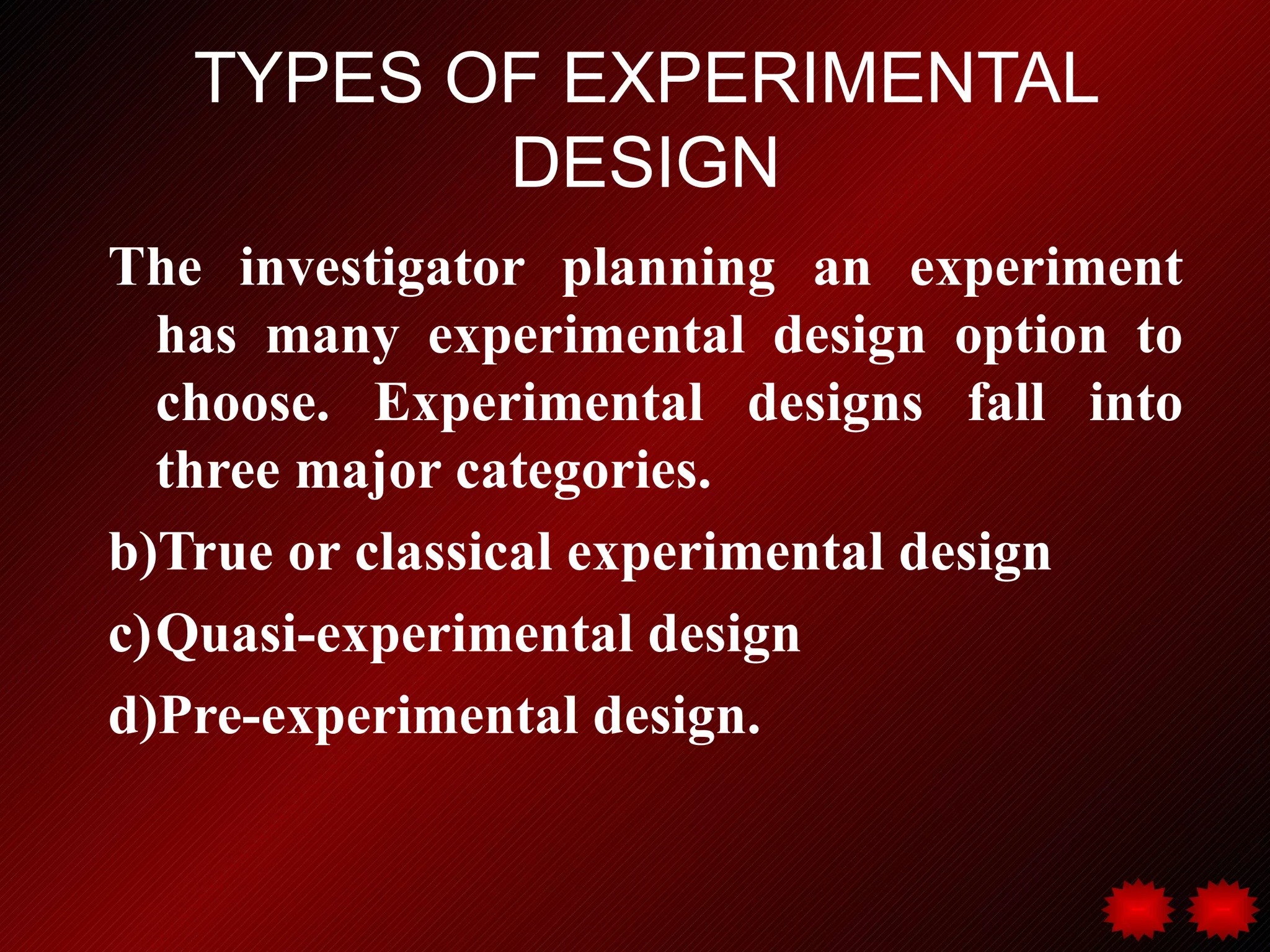
The investigator planning an experiment
  has many experimental design option to
  choose. Experimental designs fall into
  three major categories.
b)True or classical experimental design
c)Quasi-experimental design
d)Pre-experimental design.
TRUE OR CLASSICAL EXPERIMENTAL
               DESIGN
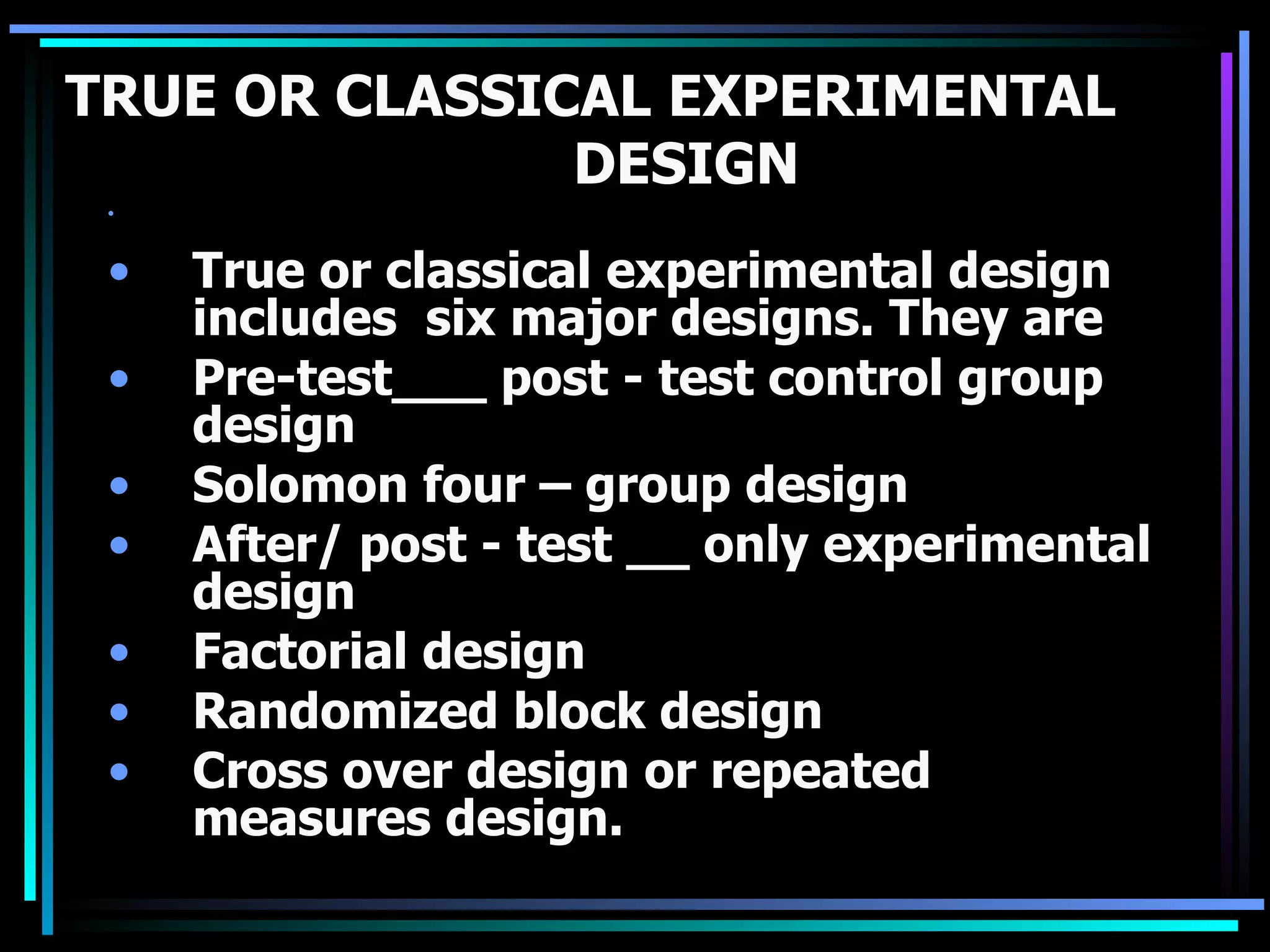
 •   TRUE OR CLASSICAL EXPERIMENTAL   DESIGN


 •   True or classical experimental design
     includes six major designs. They are
 •   Pre-test___ post - test control group
     design
 •   Solomon four – group design
 •   After/ post - test __ only experimental
     design
 •   Factorial design
 •   Randomized block design
 •   Cross over design or repeated
     measures design.
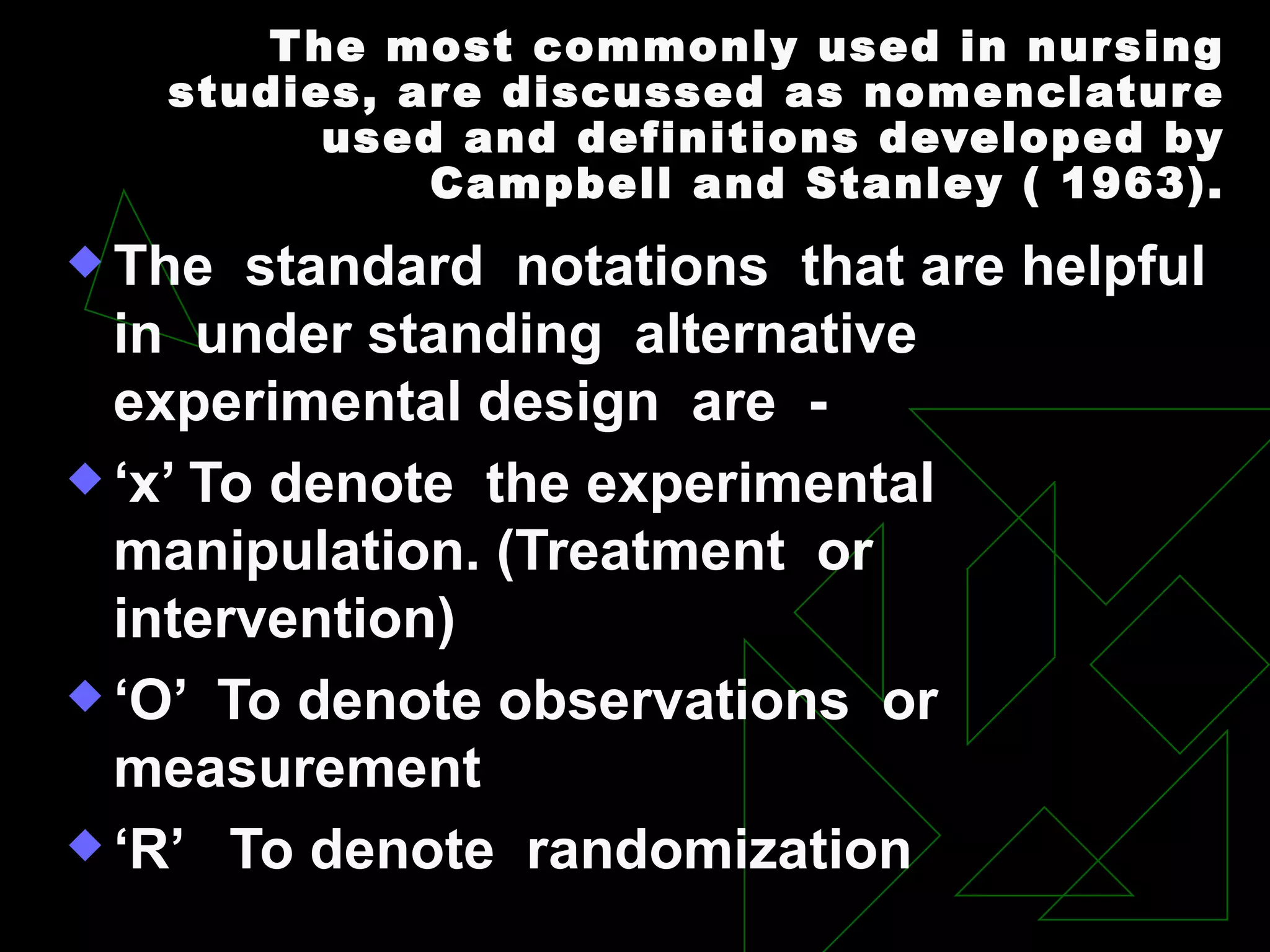
T he most commonly used in nur sing
   studies, ar e discussed as nomenclatur e
          used and definitions developed by
              Campbell and Stanley ( 1963).
 The   standard notations that are helpful
  in under standing alternative
  experimental design are -
 ‘x’ To denote the experimental
  manipulation. (Treatment or
  intervention)
 ‘O’ To denote observations or
  measurement
 ‘R’ To denote randomization
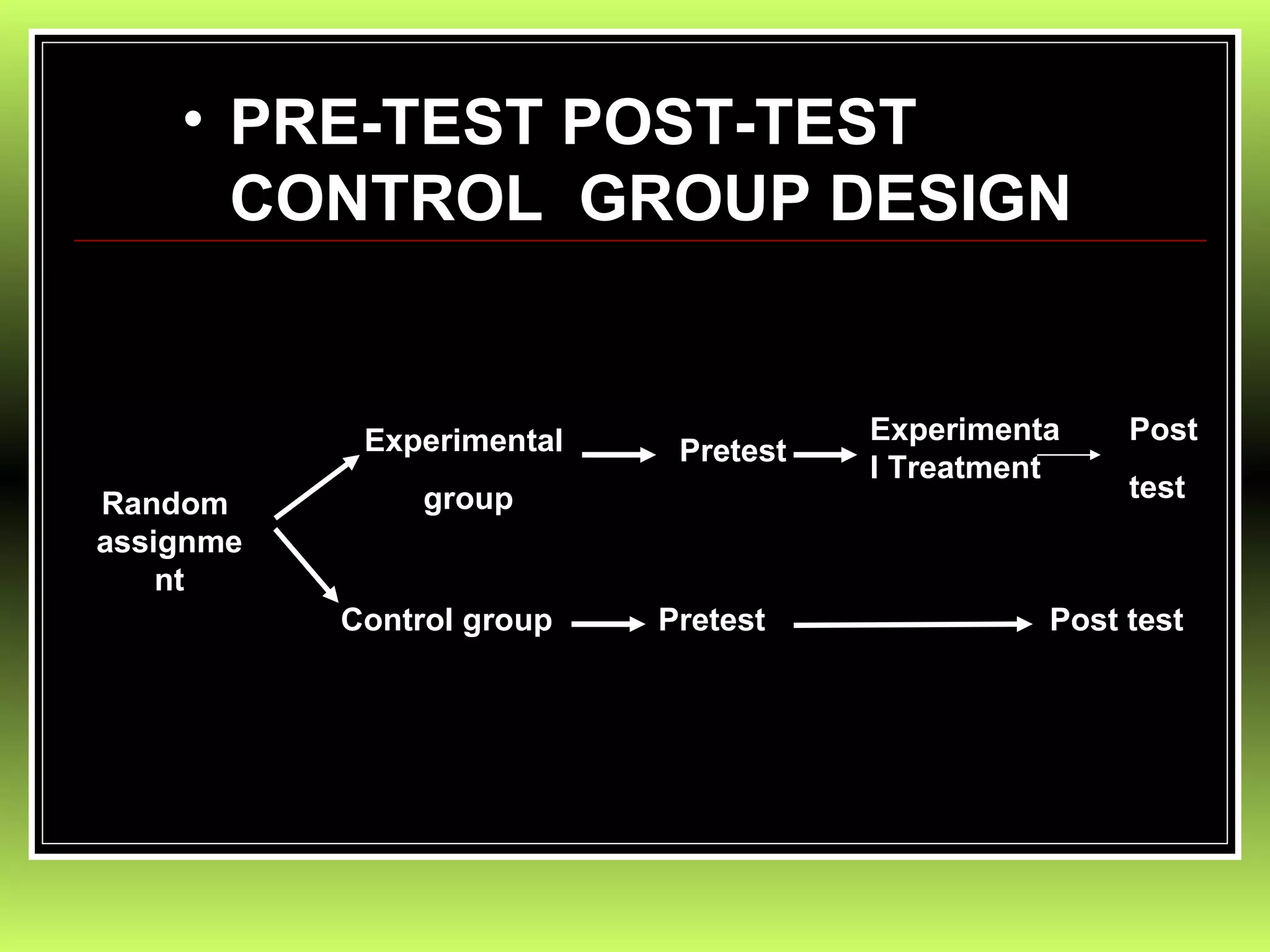
• PRE-TEST POST-TEST
      CONTROL GROUP DESIGN


            Experimental              Experimenta    Post
                            Pretest
                                      l Treatment
                group                                test
Random
assignme
    nt
           Control group   Pretest              Post test
EXAMPLE

Effectiveness of antenatal
 nutrition education on
 pregnancy and labor outcome
 among primi para mothers
 attending out patient department
 of selected hospitals Madurai
 2007-2009
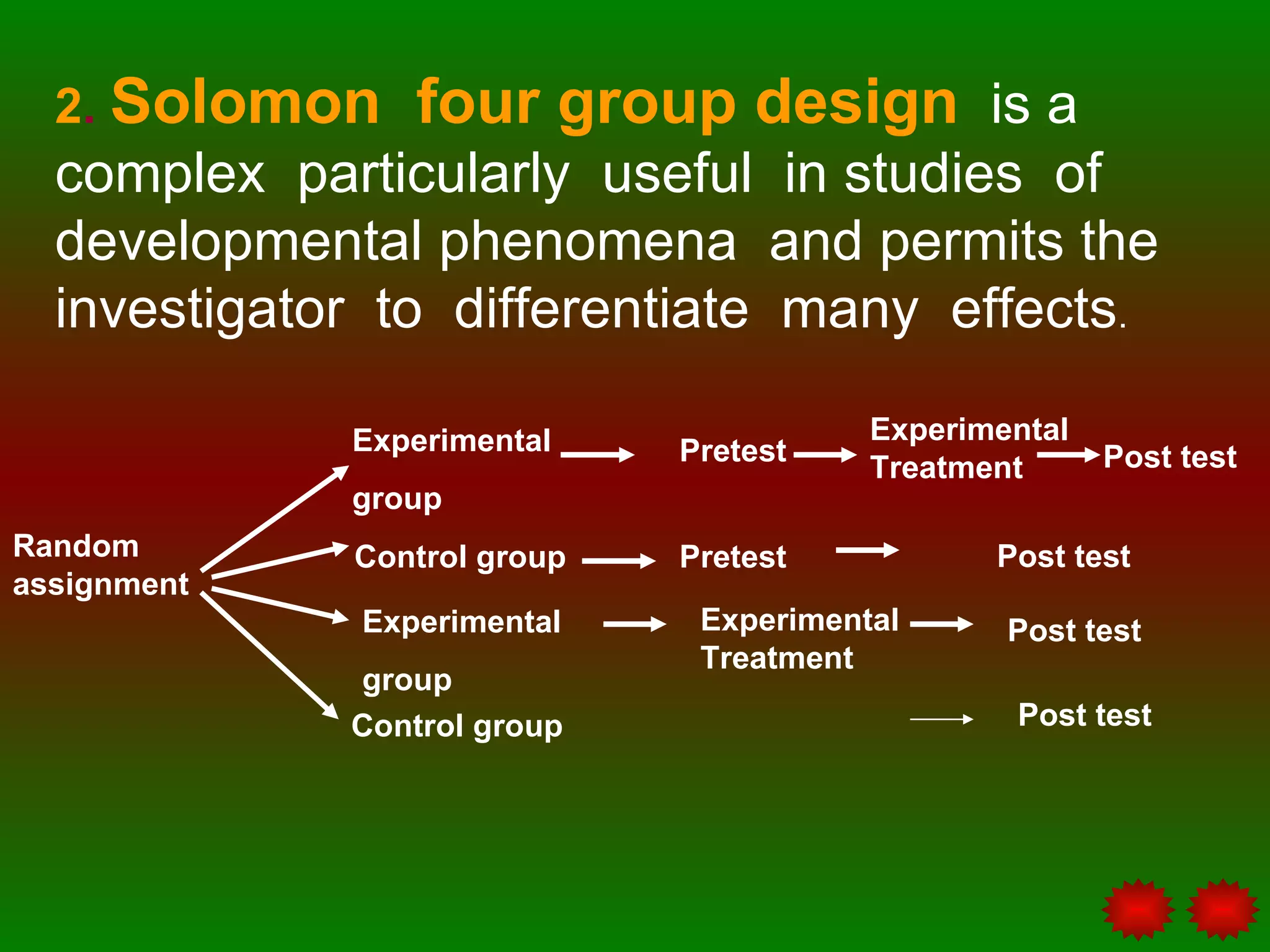
2. Solomon     four group design is a
  complex particularly useful in studies of
  developmental phenomena and permits the
  investigator to differentiate many effects.

             Experimental               Experimental
                             Pretest                   Post test
                                        Treatment
             group
Random       Control group   Pretest           Post test
assignment
             Experimental     Experimental      Post test
                              Treatment
             group
             Control group                      Post test
EXAMPLE

Effectiveness of workshop on
 management of HIV to improve
 the nurses attitude toward
 patients with AIDS admitted in
 selected hospitals , Madurai
 2006-2008
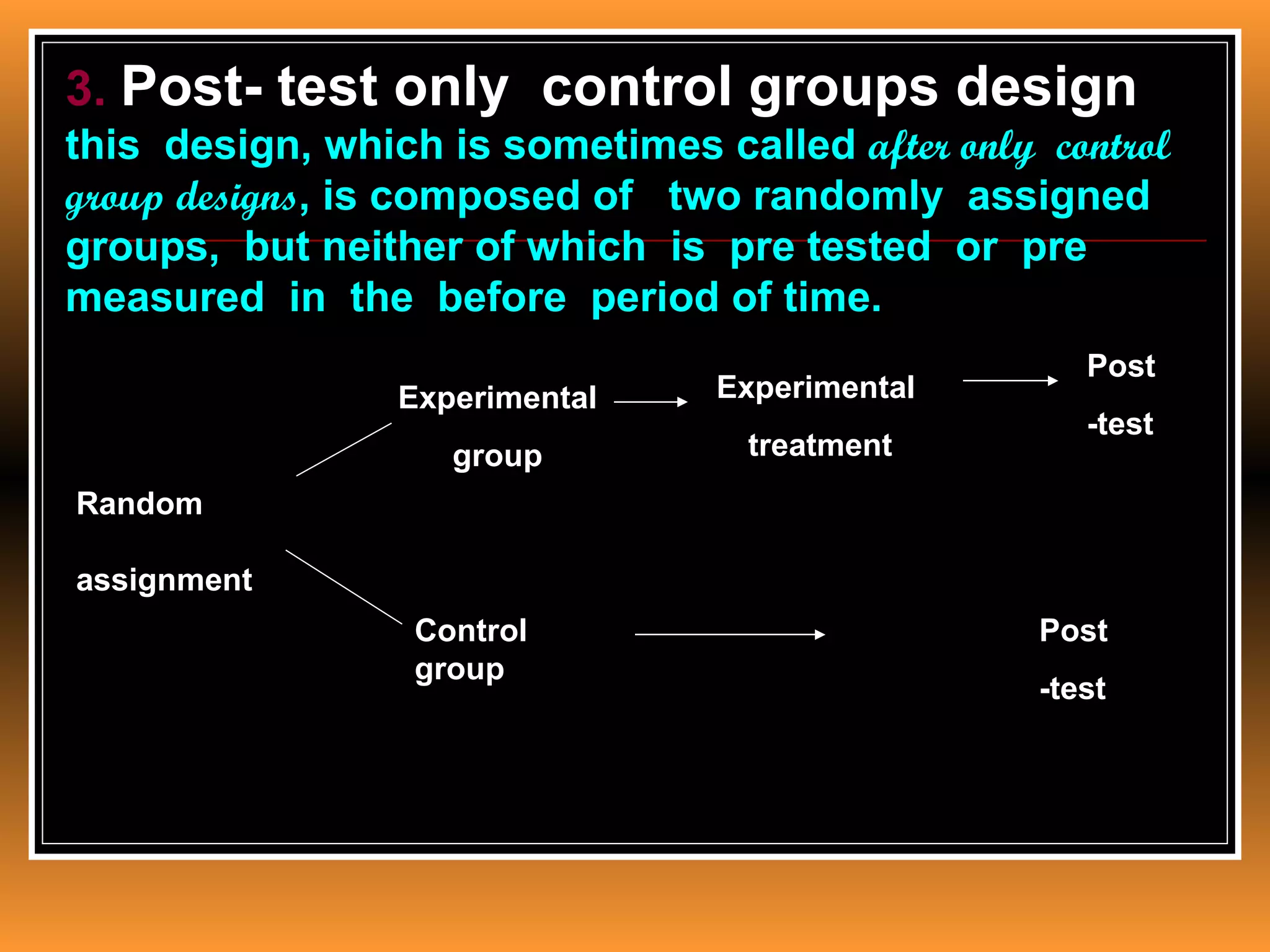
3. Post- test only control groups design
this design, which is sometimes called after only control
group designs, is composed of two randomly assigned
groups, but neither of which is pre tested or pre
measured in the before period of time.
                                                     Post
                 Experimental    Experimental
                                                     -test
                    group          treatment
Random

assignment
                  Control                         Post
                  group
                                                  -test
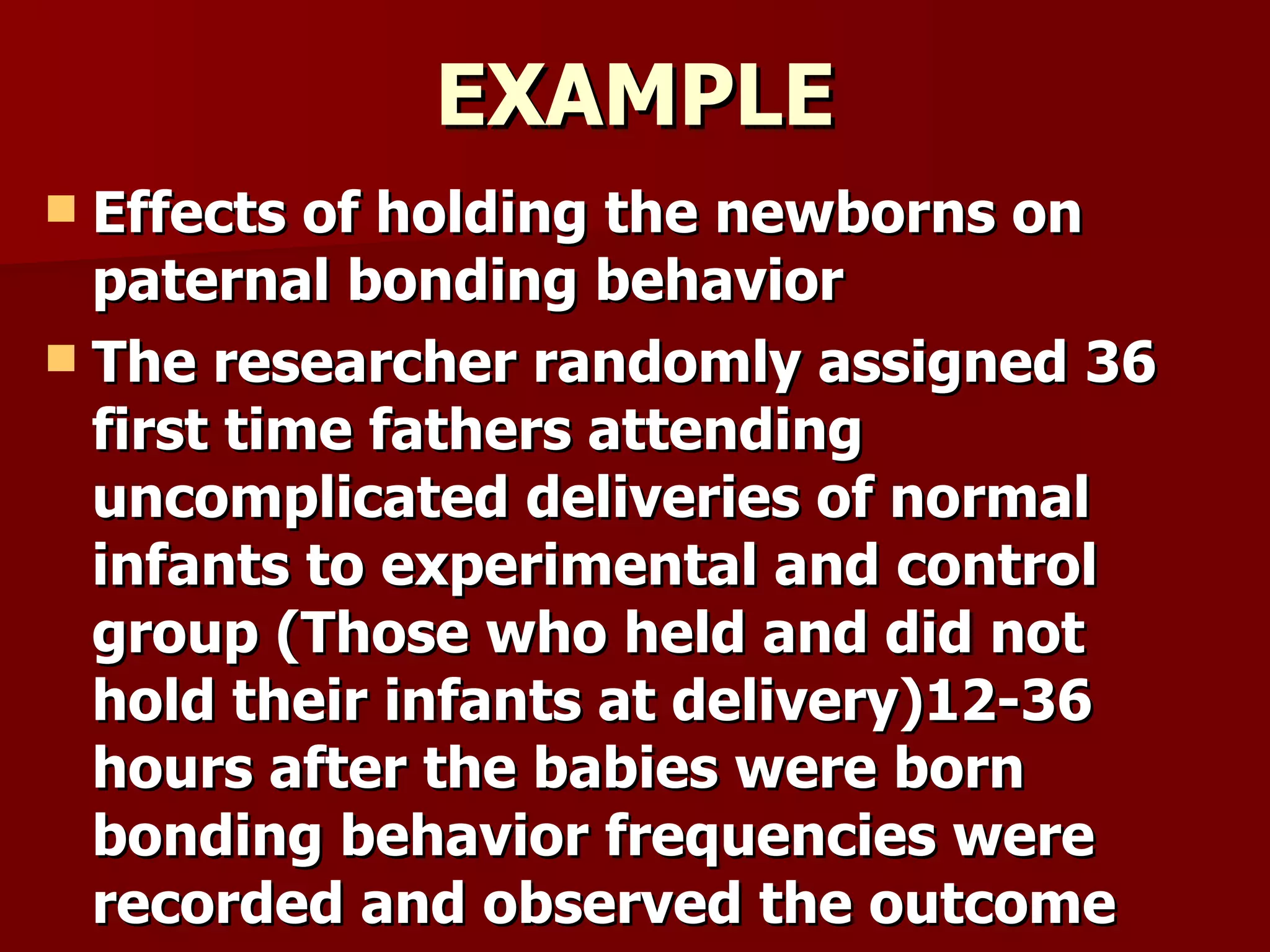
EXAMPLE
 Effects of holding the newborns on
  paternal bonding behavior
 The researcher randomly assigned 36
  first time fathers attending
  uncomplicated deliveries of normal
  infants to experimental and control
  group (Those who held and did not
  hold their infants at delivery)12-36
  hours after the babies were born
  bonding behavior frequencies were
  recorded and observed the outcome
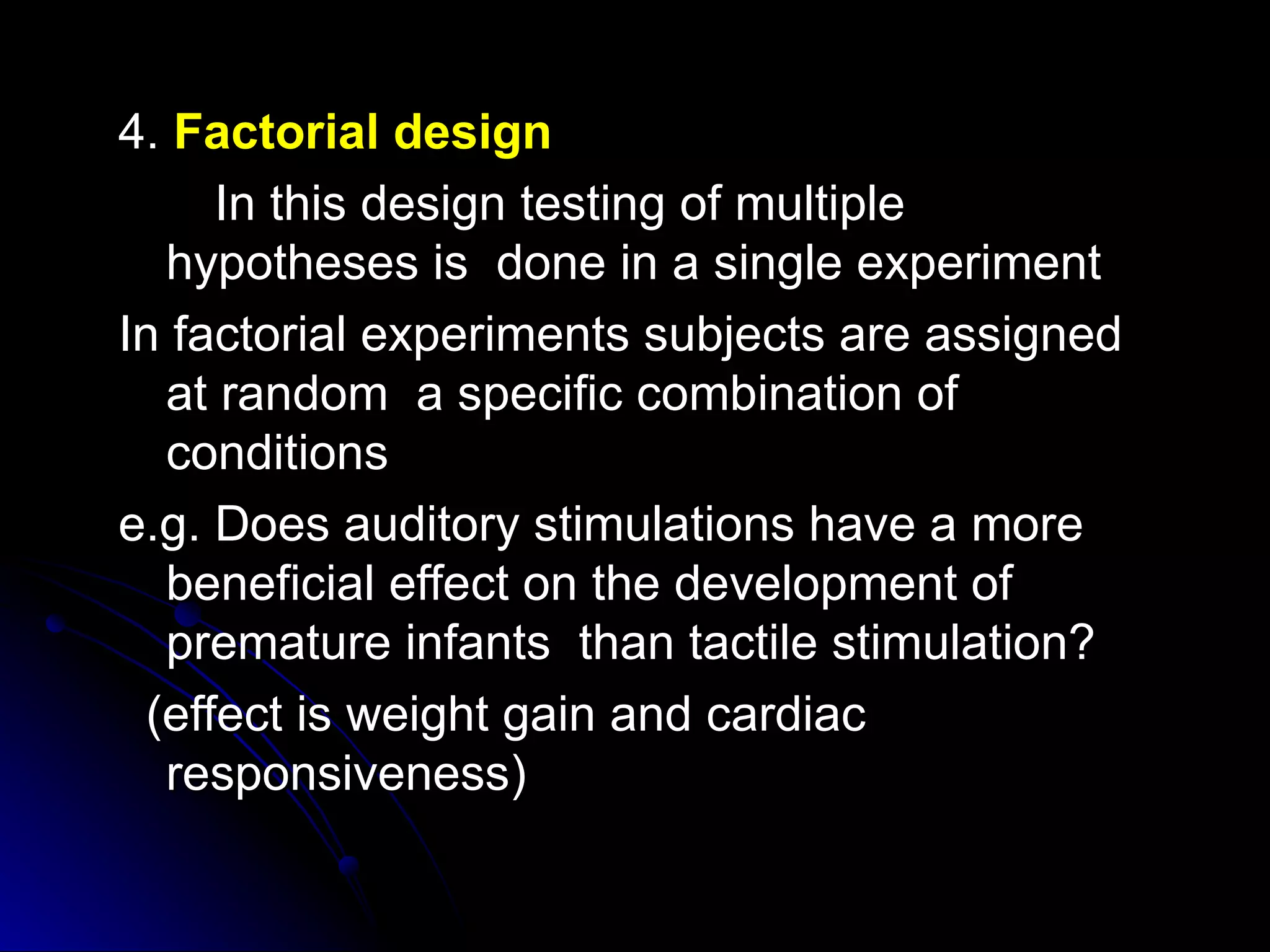
4. Factorial design
      In this design testing of multiple
   hypotheses is done in a single experiment
In factorial experiments subjects are assigned
   at random a specific combination of
   conditions
e.g. Does auditory stimulations have a more
   beneficial effect on the development of
   premature infants than tactile stimulation?
  (effect is weight gain and cardiac
   responsiveness)
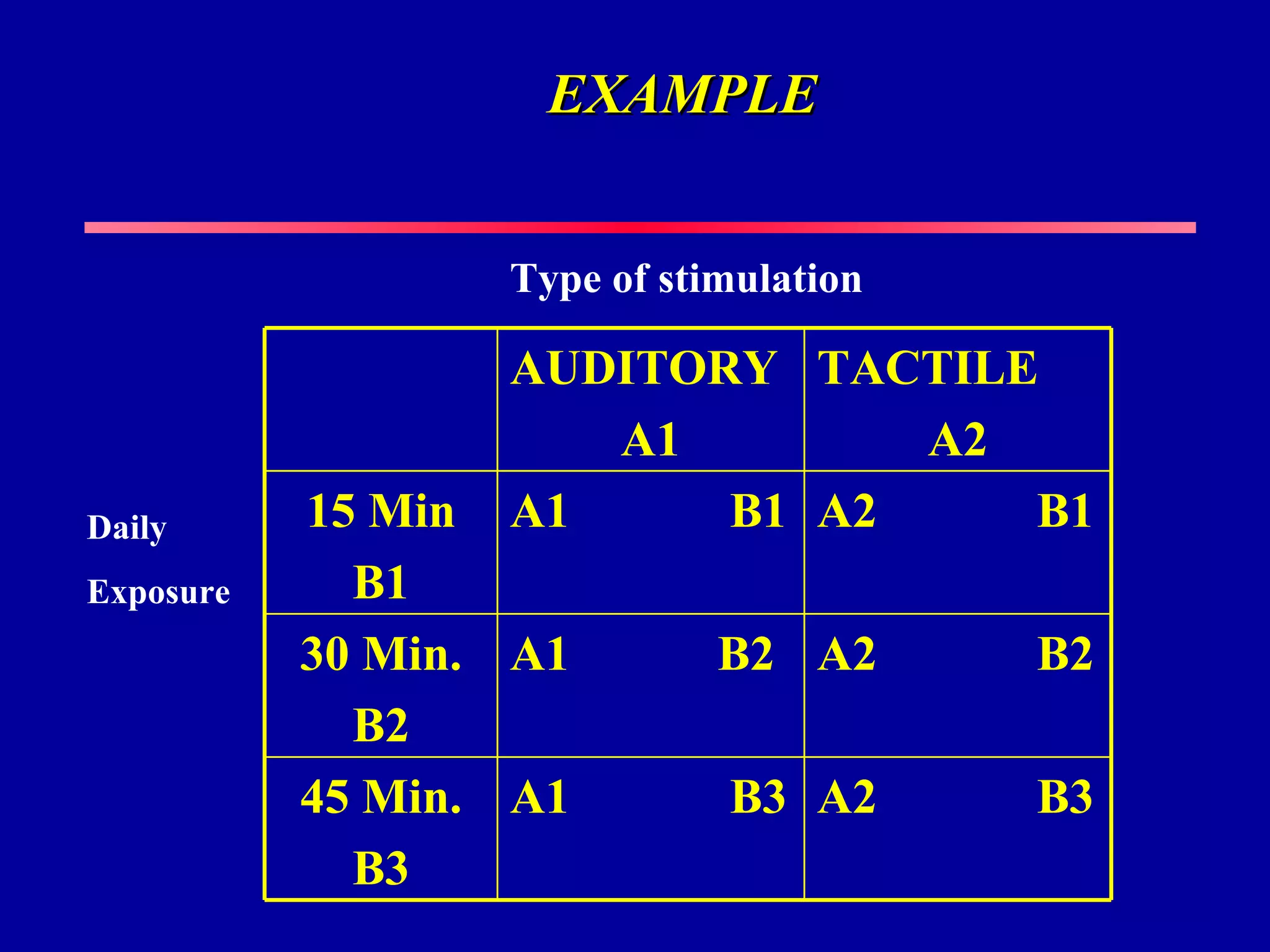
EXAMPLE


                  Type of stimulation

                  AUDITORY TACTILE
                     A1        A2
Daily      15 Min A1     B1 A2    B1
Exposure     B1
           30 Min. A1        B2 A2      B2
             B2
           45 Min. A1        B3 A2      B3
             B3
1. Randomized Block Design
    There are two factors (independent
  variables) but one factor is not
  experimentally manipulated.
      e.g. Compare the effects of tactile
  versus auditory stimulation for female
  vs male infants.
  It can be structured as 2x2 experiment,
  with type of stimulation as one factor
  and gender as the other factor
•   Cross over design (or Repeated
    measures design)
    It involves the exposure of the same
    subjects to more than one experimental
    treatment
    e.g. Effectiveness of two alternative
    back rest position ( flat, horizontal vs.
    30o elevation) on intracranial and
    cerebral perfusion pressures in brain
    injured adults
PRE-EXPERIMENTAL DESIGNS
•   The one –shot case study or
    single case study
→ The study design has a total
 absence of control, it is
 considered to be little value as
 an experiment.
2.One-GroupPretest-posttest
 design
 Only one group is observed before
 and after the independent variable
 is introduced. Loss of the control
 group decreases the usefulness
 of the study but may be necessary
  in cases where it is not possible
 or feasible to have control groups
EXAMPLE

Effectiveness of selected
 nursing intervention on
 knowledge and level of
 satisfaction among clients
 with stroke
ADVANTAGES OF EXPERIMENTAL
           DESIGN
1.True experiments are the most powerful
  method for testing hypothesis of cause and
  effect relationship between variable because of
  the rigours, precision and control properties of
  experimental design.
2. This ‘if then’ type of relationship is important
  to nursing and medical researchers because of
  its    implications     for    predication   and
  explanation.
3.Though the control imposed
 by manipulation comparison
 and randomization,
 alternative explanation to a
 cause interpretation can be
 ruled out or discredited.
DISADVANTAGES OF EXPERIMENTAL
           DESIGN
1.   Some variables are not feasible or ethical
     to manipulate e.g., assessing pregnant
     women to take a new drug found to be
     dangerous to fetal development would not
     be ethically possible.
2.     Randomization and otherwise equal
     treatment of control and experimental
     group can occur in a laboratory, but these
     conditions do not resemble what goes
     under    real   world     conditions,   and
     experimental findings can therefore be
     based on rather artificial circumstance
3. Experimental design attempt to
 reduce variable to measurable
 terms. Many of the phenomena
 that are important to science in
 nursing         are      complex,
 multidimensional and holistic, and
 defy the reductionism that has
 worked reasonably in the physical
 or natural sciences.
QUASI EXPERIMENTAL
      DESIGN
DEFINITION
It is a research design in
which the researcher initiates
an experimental treatment but
some characteristics of a true
experiment is lacking.
PURPOSES
 To provide alternative means of
  examining causality in situations
  not conducive to experimental
  group.
 To  facilitate the search for
  knowledge and examination of
  causality in situations in which
  complete control is not possible.
RANDOM ASSIGNMENT

It is a procedure used to
assign subjects to
treatment or control
groups randomly.
COMPARISON GROUPS
    Comparison groups are not selected using
 random sampling and do not receive the
 experimental treatment.
Types of comparisons groups:
  Groups that receive no treatment.
  Groups that receive placebo treatment
  Groups that receive usual treatment.
  Groups that receive second experimental
   treatment.
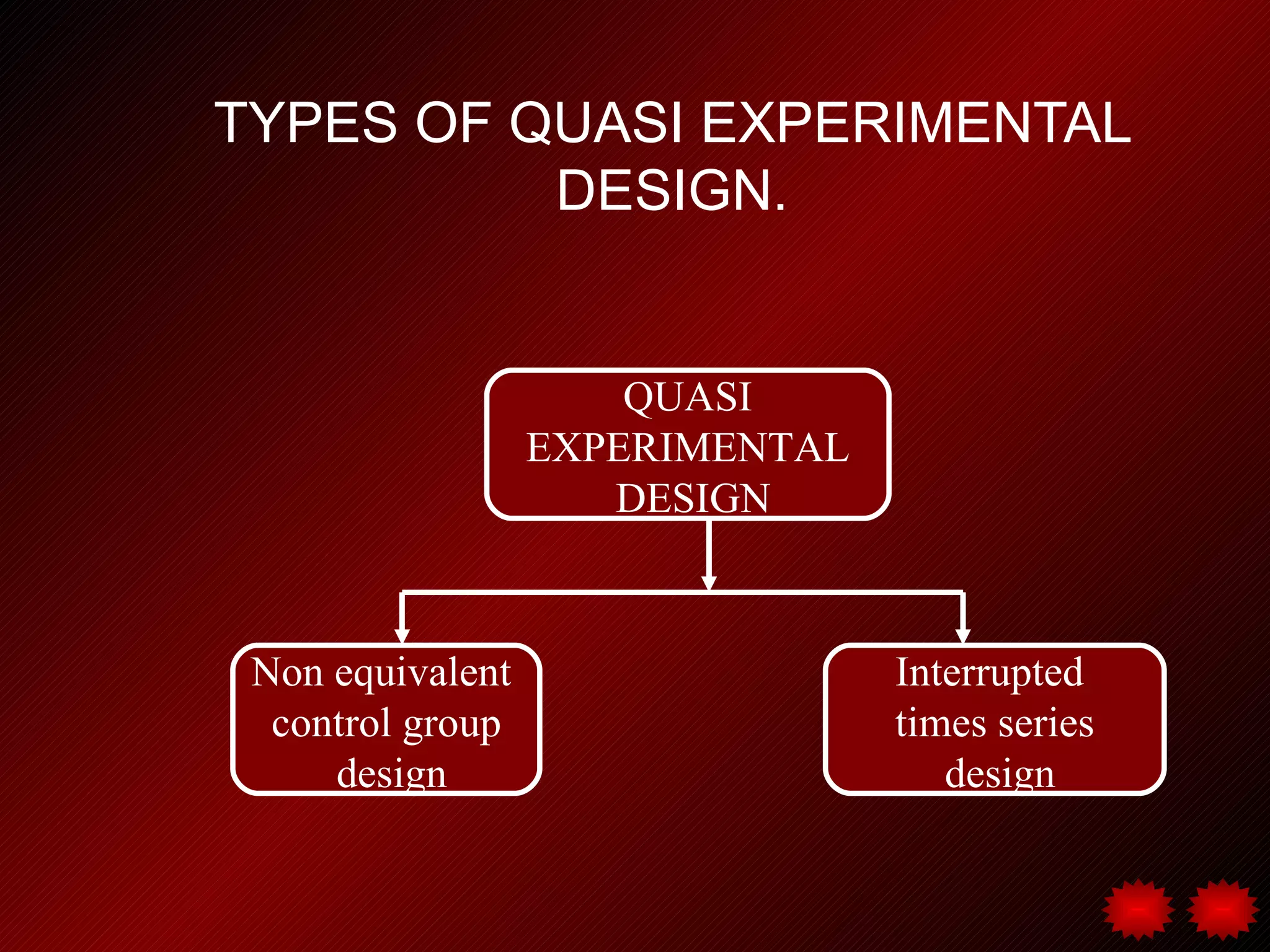
TYPES OF QUASI EXPERIMENTAL
          DESIGN.


                      QUASI
                  EXPERIMENTAL
                     DESIGN


 Non equivalent                  Interrupted
  control group                  times series
     design                         design
NON EQUIVALENT
 COMPARISON
GROUP DESIGNS
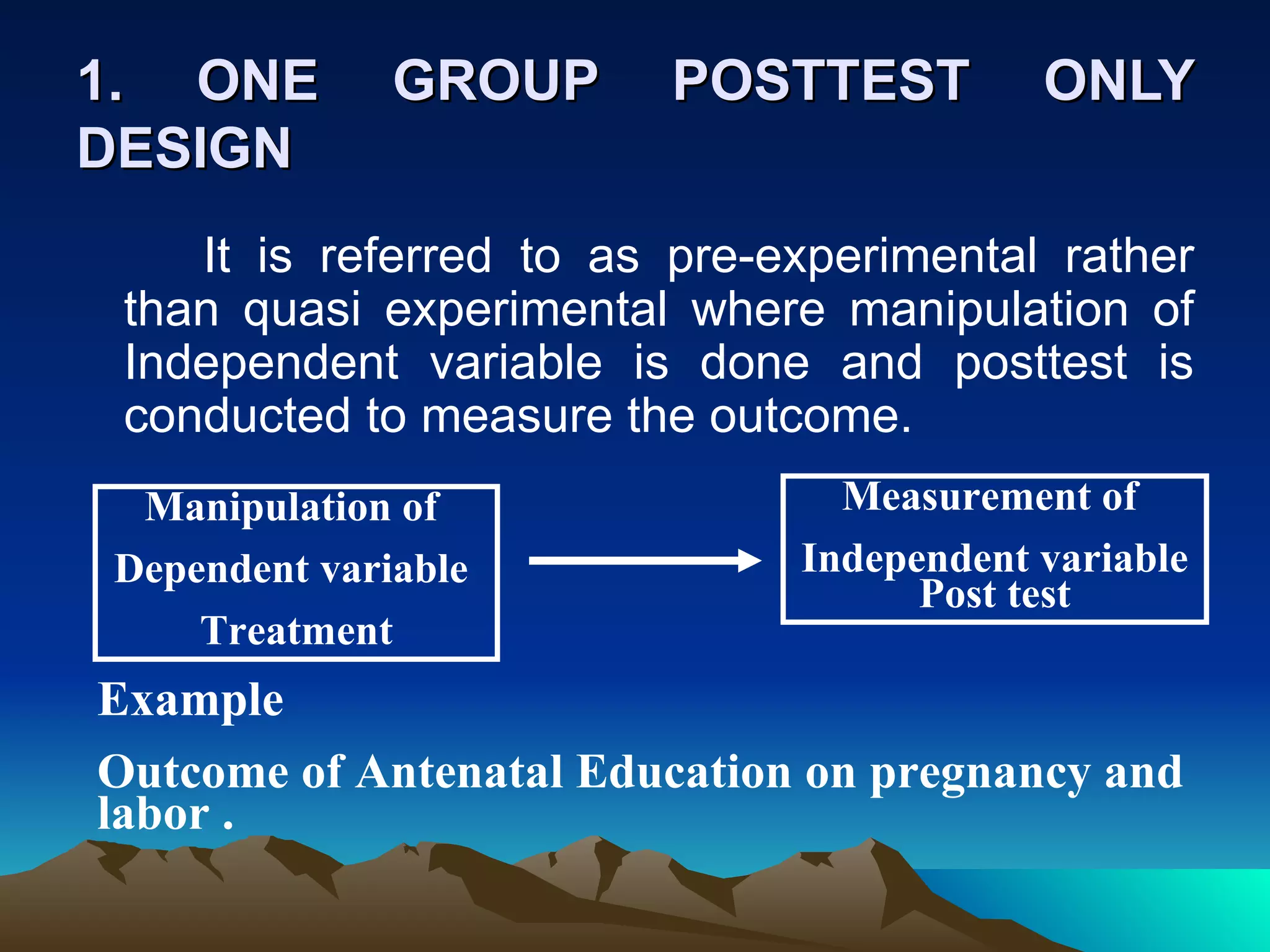
1. ONE        GROUP      POSTTEST         ONLY
DESIGN
    It is referred to as pre-experimental rather
 than quasi experimental where manipulation of
 Independent variable is done and posttest is
 conducted to measure the outcome.
 Manipulation of                Measurement of
Dependent variable            Independent variable
                                    Post test
    Treatment
Example
Outcome of Antenatal Education on pregnancy and
labor .
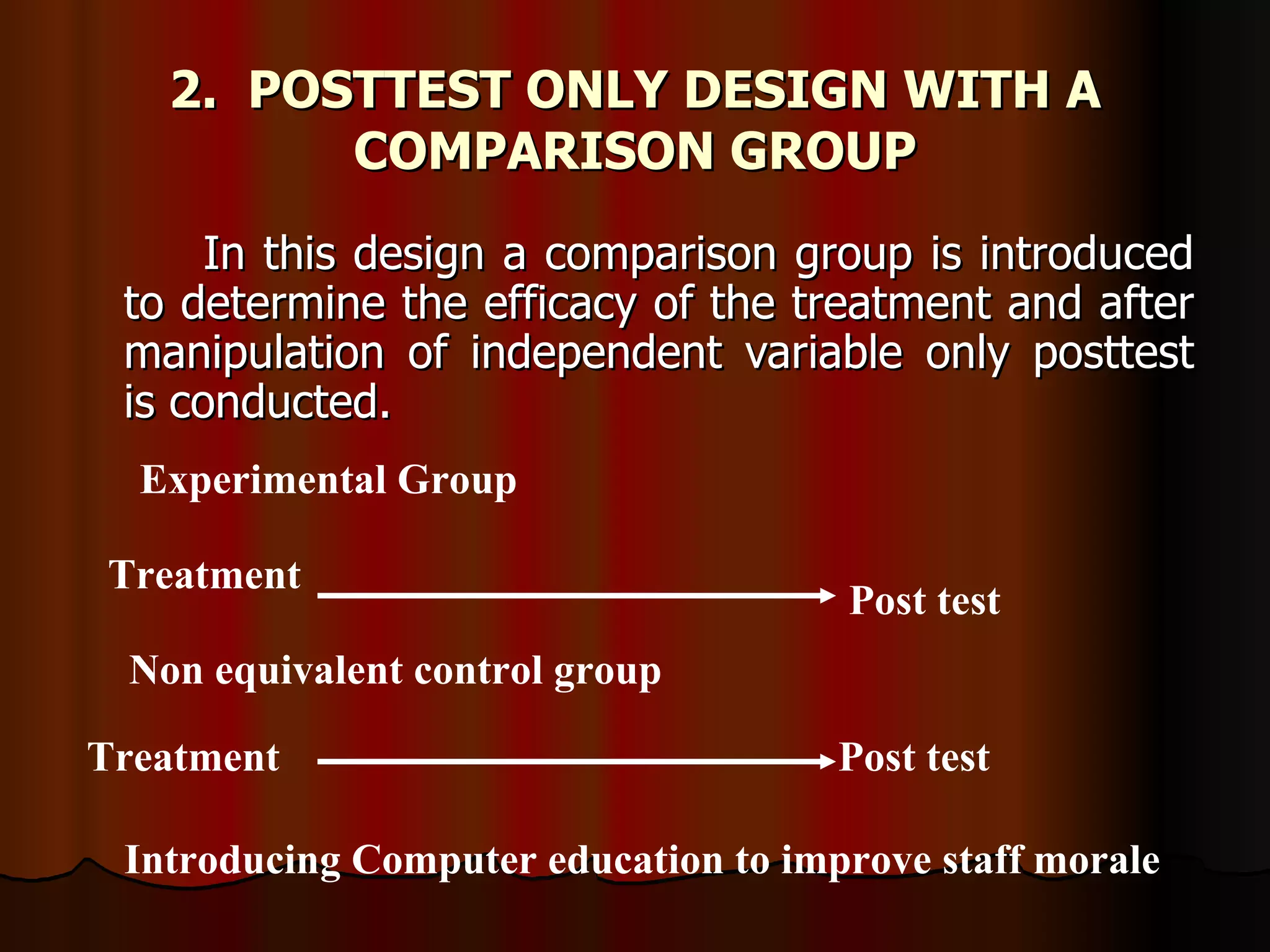
2. POSTTEST ONLY DESIGN WITH A
         COMPARISON GROUP
      In this design a comparison group is introduced
 to determine the efficacy of the treatment and after
 manipulation of independent variable only posttest
 is conducted.
  Experimental Group

Treatment
                                      Post test
 Non equivalent control group

Treatment                             Post test

 Introducing Computer education to improve staff morale
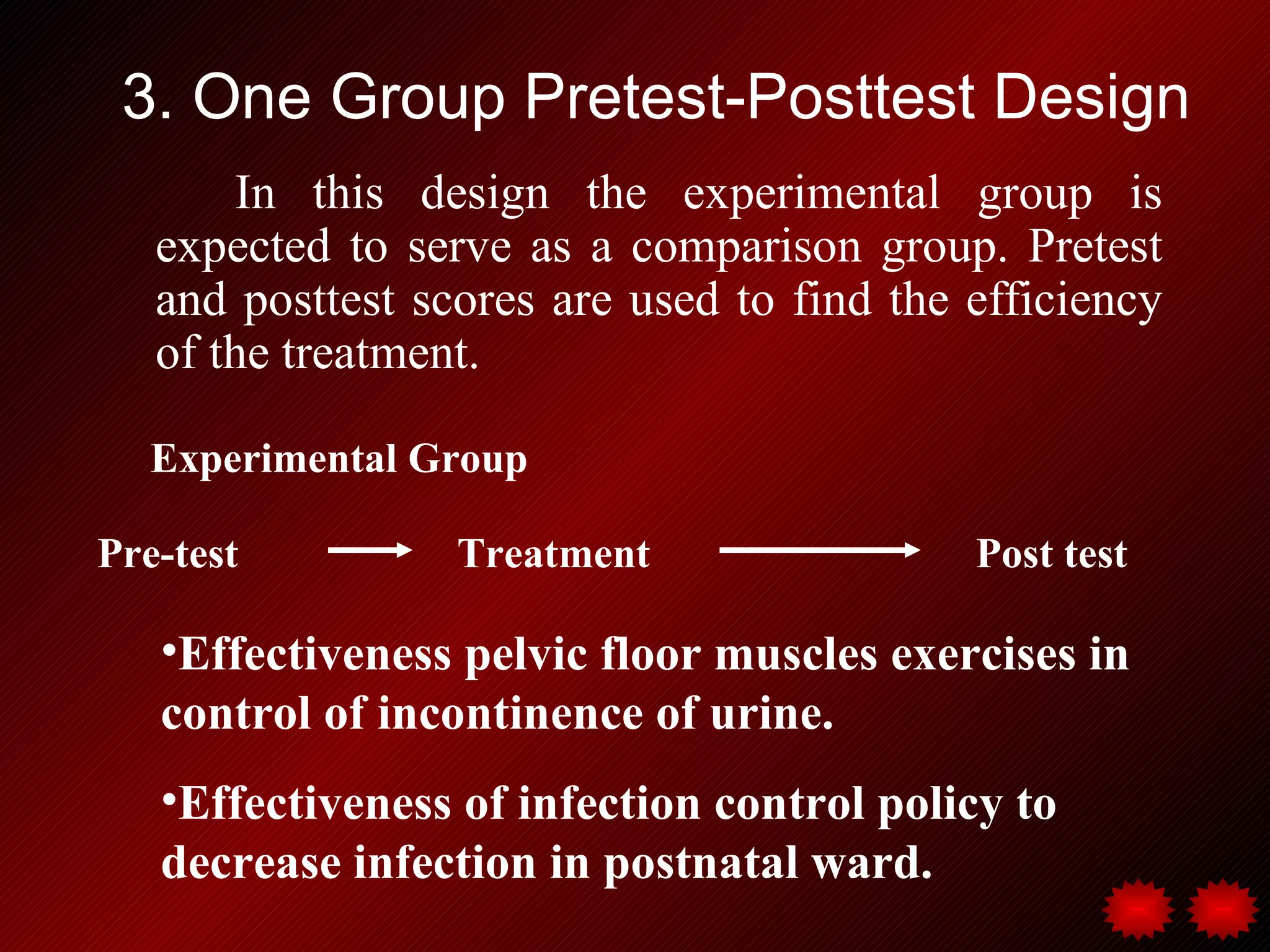
3. One Group Pretest-Posttest Design
       In this design the experimental group is
   expected to serve as a comparison group. Pretest
   and posttest scores are used to find the efficiency
   of the treatment.

   Experimental Group

Pre-test          Treatment                 Post test

   •Effectiveness pelvic floor muscles exercises in
   control of incontinence of urine.
   •Effectiveness of infection control policy to
   decrease infection in postnatal ward.
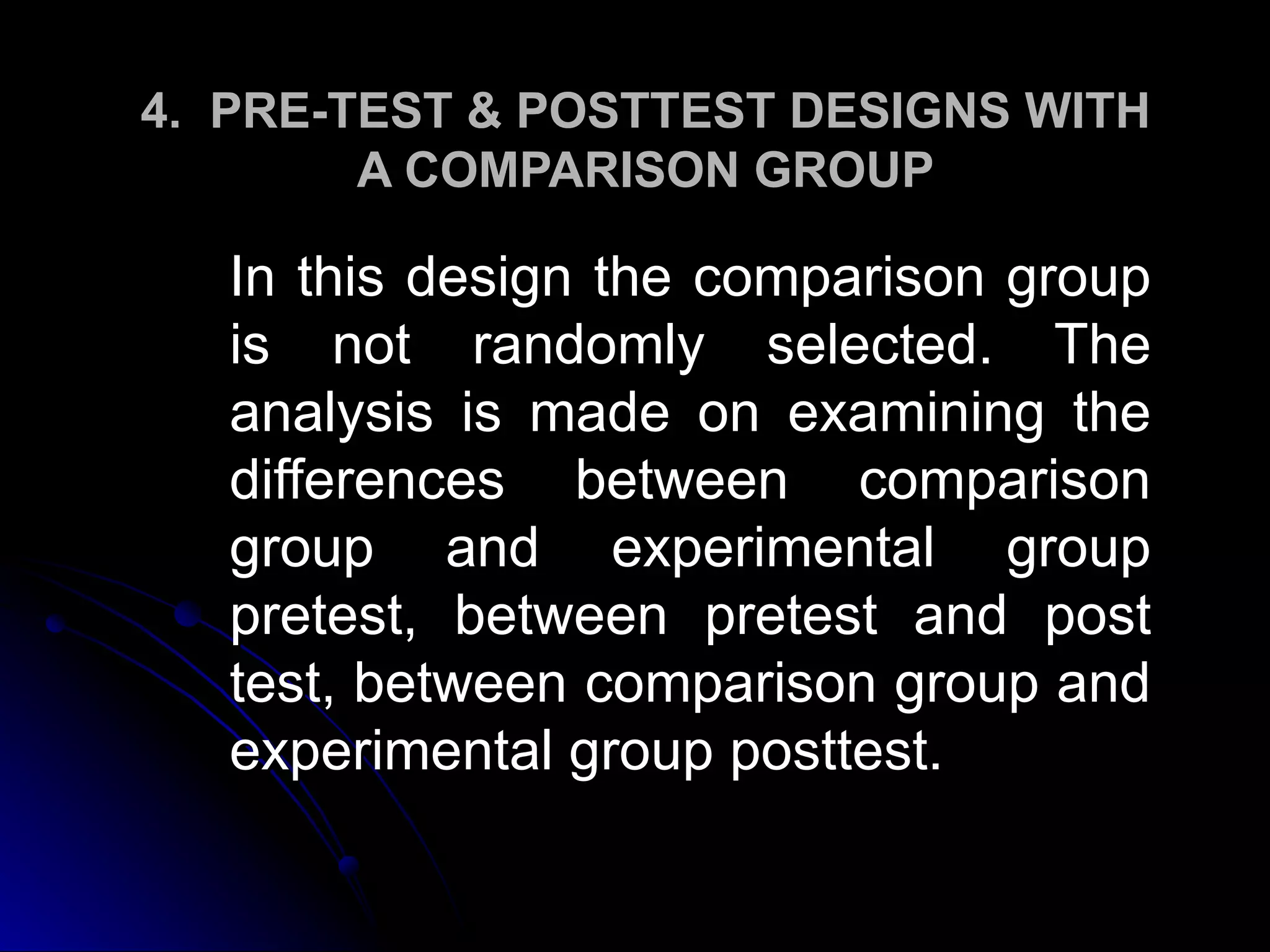
4. PRE-TEST & POSTTEST DESIGNS WITH
        A COMPARISON GROUP

   In this design the comparison group
   is not randomly selected. The
   analysis is made on examining the
   differences between comparison
   group and experimental group
   pretest, between pretest and post
   test, between comparison group and
   experimental group posttest.
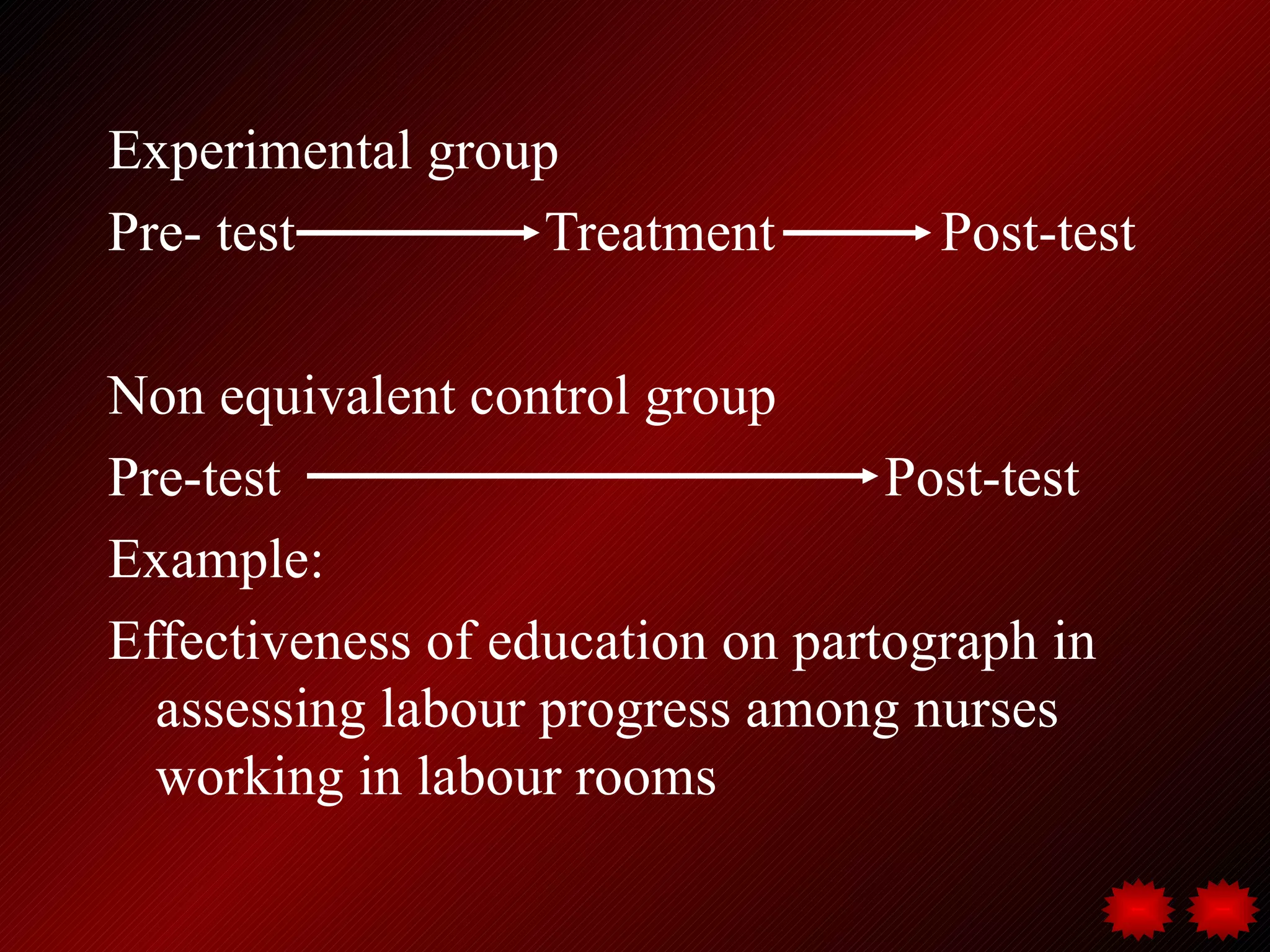
Experimental group
Pre- test        Treatment          Post-test

Non equivalent control group
Pre-test                          Post-test
Example:
Effectiveness of education on partograph in
  assessing labour progress among nurses
  working in labour rooms
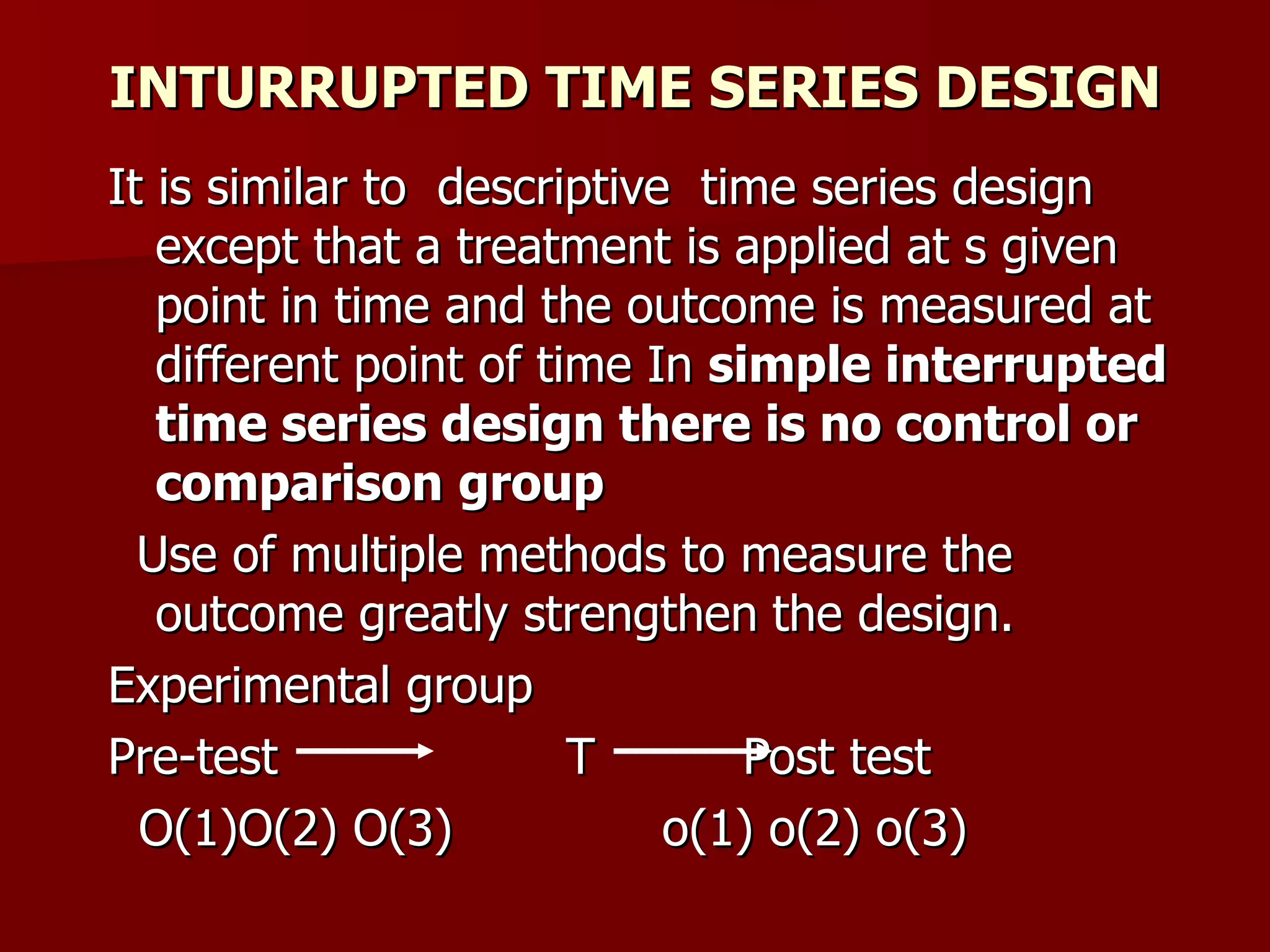
INTURRUPTED TIME SERIES DESIGN
It is similar to descriptive time series design
   except that a treatment is applied at s given
   point in time and the outcome is measured at
   different point of time In simple interrupted
   time series design there is no control or
   comparison group
  Use of multiple methods to measure the
   outcome greatly strengthen the design.
Experimental group
Pre-test                T       Post test
  O(1)O(2) O(3)             o(1) o(2) o(3)
EXAMPLE
Effectiveness of selected nutritional
  interventions on growth and
  development pattern of children
  attending under fives clinic at
  Omayal Achi community health centre
  at Tiruvalluvar district 2006- 2008
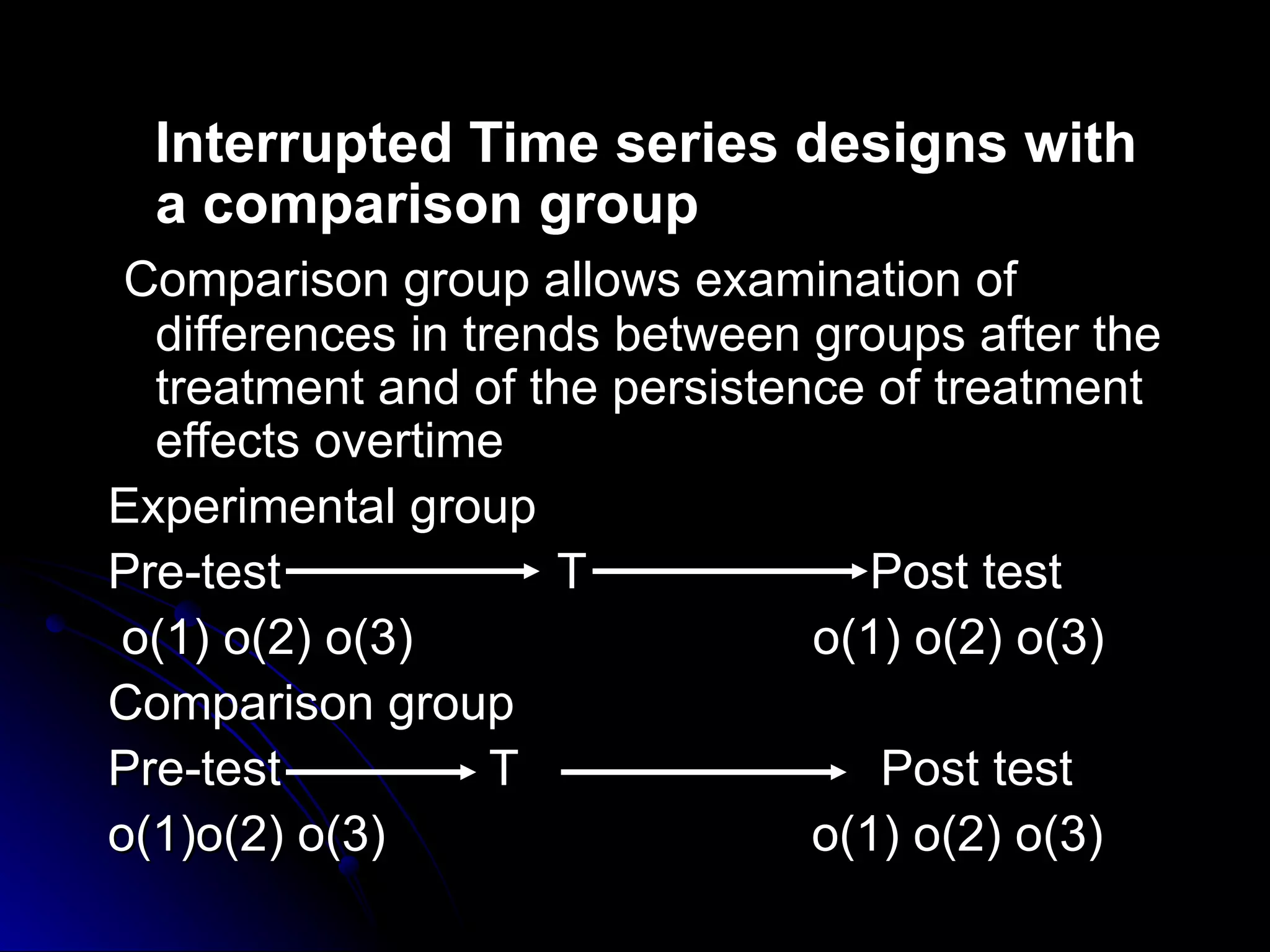
Interrupted Time series designs with
  a comparison group
 Comparison group allows examination of
  differences in trends between groups after the
  treatment and of the persistence of treatment
  effects overtime
Experimental group
Pre-test             T             Post test
 o(1) o(2) o(3)                 o(1) o(2) o(3)
Comparison group
Pre-test           T               Post test
o(1)o(2) o(3)                   o(1) o(2) o(3)
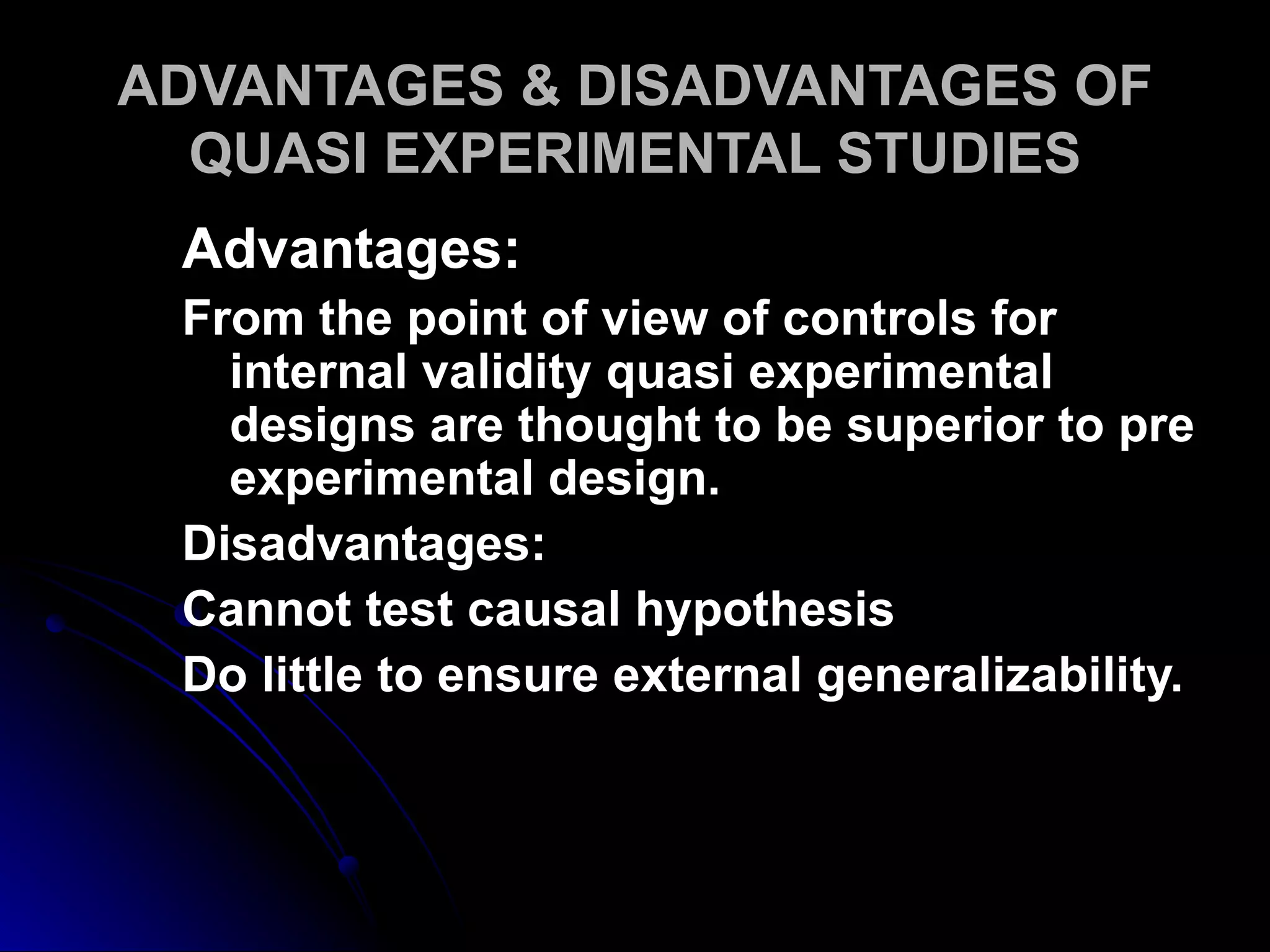
ADVANTAGES & DISADVANTAGES OF
  QUASI EXPERIMENTAL STUDIES
 Advantages:
 From the point of view of controls for
   internal validity quasi experimental
   designs are thought to be superior to pre
   experimental design.
 Disadvantages:
 Cannot test causal hypothesis
 Do little to ensure external generalizability.
Research Design

Research Design

  • 1.
    EXPERIMENTAL DESIGN Dr.(Mrs.) A.V.Raman Dean Omayal Achi College of Nursing Avadi, Chennai
  • 2.
    INTRODUCTION TO RESEARCHDESIGNS Quantitative research design • Research design of a study spells out the basic strategies that researchers adopt to develop evidence that is accurate and interpretable • The research design incorporates some of the most important methodological decisions that the researchers make particularly in quantitative studies
  • 3.
    ASPECTS OF QUANTITATIVE RESEARCH • Intervention • Comparisons • Control of extraneous variables • Timing of data collection • Research sites and settings • Communication with the subjects
  • 4.
    INTERVENTION In some studiesnurse researchers want to test the effect of specific intervention on dependent variable (for e.g.. the effect of specific intervention on labor and neonatal outcome) COMPARISON The most common types of comparisons are 1. Comparisons between two or more groups (The hypothesis that the drug tamoxefin reduced the rate of breast cancer in high risk women could be tested by comparing women who received tamoxefin and those who did not)
  • 5.
    2.In certain instancesit is desirable to make comparisons for the same study participants (e.g. studying patients heart rate before and after intervention, Comparing low back pain for patients lying in two different positions) CONTROLS FOR EXTRANEOUS VARIABLES The complexity of relationships among human characteristics often makes it difficult to answer research questions unless efforts are made to isolate key research variables and control other factors extraneous to the research questions
  • 6.
    TIMING FOR DATACOLLECTION In most studies data are collected from subjects at a single point of time (for e.g. the subjects might be asked on a single occasion to describe the health promotion behavior) In some designs we contact the subjects in multiple time (e.g. to observe the growth pattern 3 monthly) Hence the researcher must decide on the number of data collection points needed to address the research question properly
  • 7.
    RESEARCH SITES ANDSETTINGS sites are the overall location for research Settings are the more specific place where data collection will occur sites and settings to be selected so as to maximize the validity and reliability of th data in designing a study. The setting should be natural and avoid anxiety promoting or foreign to the subjects experiences
  • 8.
    COMMUNICATION WITH THESUBJECTS  Decide how much information to be given to the participants  Full disclosure of the study?  Consent Oral or written?  Think about the reading and comprehension level of the subjects  Who will provide the information?  What additional questions from the subjects are expected?  Debriefing sessions?
  • 9.
    EXPERIMENTAL DESIGN Science answersquestions with experiments
  • 10.
    EXPERIMENTAL DESIGN  An experiment is a scientific investigation in which observations are made and data are collected according to a set of well defined criteria. In an experiment, researchers are active agents not passive observers.
  • 11.
    The procedures developed byphysical scientists were profitably adopted by biologists during the 19 th century, resulting in many achievements in physiology and medicine.
  • 12.
    DEFINITION Experimentalmethod is an empirical research method used to examine a hypothesized causal relationship between independent and dependent variables.
  • 13.
    DEFINE THE PROBLEM Beginby asking a question about your topic What is a good question for an experiment? One that is testable with the materials at hand
  • 14.
    Now we needa hypothesis to guide our investigation. What is a hypothesis? Your best thinking about how the change you make might affect another factor. Tentative or trial solution to the question. An if ………… then ………… statement.
  • 15.
    CHARACTERISTICS OF EXPERIMENTAL DESIGN A true experimental design is characterized by Manipulation, Control , and randomization
  • 16.
    MANIPULATION Refers to the process by which the researcher manages the independent variable in order to study the effect on the dependent variable.
  • 17.
    EXAMPLE . Gentle massageis effective as a pain relief measure for elderly nursing home residents The Independent variable is gentle massage which could be manipulated by giving some patients the massage intervention and withholding it for others Then it is possible to compare the pain level (dependent variable) in the two group to see if differences in receipt of the intervention resulted in degree of pain levels
  • 18.
    CONTROL The experiment mustbe organized so that the extraneous factors are prevented from operating and confusing the outcome which is to be appraised.
  • 19.
    Control is acquiredby manipulating by randomizing, by careful preparation of the experimental protocols, and by the use of a comparison group or groups.
  • 20.
    EXAMPLE • If aresearcher wanted to supplement diet of the low birth baby with a particular nutrient for 2 weeks, the weight gain at the end of 2 weeks would tell us nothing about the treatment effectiveness Suppose an average 1 kg. weight gain is noted does this gain support the conclusion that nutrition supplement (IV) caused the weight gain (DV)
  • 21.
    The answer willbe NO? because babies normally gain weight as they mature Without a control group- a group that does not receive the nutritional supplements it is impossible to separate the effects of maturation from those treatment Therefore the term CONTROL GROUP refers to a group of subjects whose performance on a dependent variable is used to evaluate the performance of the experimental group on the same dependent variable
  • 22.
    RANDOMISATION The term randomessentially means that every subject has an equal chance of being assigned to any group. Randomization is the process that first ensures every unit in the target population has an equal chance of being chosen for the study sample, and then ensures that each unit in the study sample has on equal chance of being assigned to either the experimental or the control group.
  • 23.
    EXAMPLE The effectiveness ofa contraceptive health education programme for multiparous women. Two groups of subjects were included .One group was given intervention and other was not. The women in the sample are likely to differ in age, education, and attitude This would affect the woman's diligence in practicing contraception
  • 24.
    Although randomization isa preferred scientific method for equalizing the groups, there is no guarantee that the group will in fact be equal Therefore we need a procedure to consciously control of those characteristics of subjects that are likely to affect the outcome is called MATCHING (e.g. if matching were used in contraceptive education, then the researcher might ensure that if there was a married 38 year old woman with six children in exp. Group, then there will also be 38 year old woman with six children in control group
  • 25.
    The antecedent eventin a proposed causal sequence is called the “independent variable”.
  • 26.
    The measured effectin the causal sequence is called the “dependent variable”.
  • 27.
    Eight classes ofextraneous variables may especially interfere with research on human subjects, history, maturation, testing, instrumentation, statistical regression selection, mortality and interaction among these. • History, the specific events occurring between the first and second measurement in addition to the experimental variables
  • 28.
    2. Maturation, processwithin the respondents operating as a function of the passage of time per se (not specific to the particular events), including growing older, growing hungrier, growing more tired and the like 3. Testing, the effects of taking a test upon the scores of a second testing 4. Instrumentation, in which changes in the calibration of a measuring instrument or changes in the observers or scores used may produce changes in the obtained measurements
  • 29.
    5. Statistical regression,operating where groups have been selected on the basis of their extreme scores 6. Biaser resulting in differential selection of respondents for the comparison groups ? 7. Experimental mortality, or differential loss of respondents for the comparison groups 8. Selection-maturation interaction etc., which in certain of the multiple group quasi-experimental designs, might be mistaken for the effects of the experimental variable.
  • 30.
    PRINCIPLE GUIDELINES OF EXPERIMENTS The MAX-MIN-CON. By Kerlinger 1986. The abbreviation stands for the following. MAX-Maximize experimental variable MIN- Minimize error variance. CON-Control extraneous variance.
  • 31.
    MAJOR STEPS IN EXPERIMENTAL DESIGN 1. Delineate the population or universe to be studied (i.e. the set of subjects or objects that share a common observable characteristic) 2. Select a sample from the population by random sampling 3. By random assignment, sub-divide the sample into two sub-samples
  • 32.
    4.. Specify onesub-sample, the experimental group and other the control group 5. Before introducing the independent variable, observe and record all important characteristics of the two groups 3. Introduce the independent variable into the experimental group but withholds it from the control group 7. After introducing the independent variable, observe the dependent variable in both experimental and control group
  • 33.
    8. Compare thechanges that occur in the experimental group with those that may have occurred in the control group 2. Record the difference 10.Compare these values with statistically computed values that judge the significance of the difference, and indicate whether or not the observed differences could have occurred by chance.
  • 34.
    TYPES OF EXPERIMENTAL DESIGN The investigator planning an experiment has many experimental design option to choose. Experimental designs fall into three major categories. b)True or classical experimental design c)Quasi-experimental design d)Pre-experimental design.
  • 35.
    TRUE OR CLASSICALEXPERIMENTAL DESIGN • TRUE OR CLASSICAL EXPERIMENTAL DESIGN • True or classical experimental design includes six major designs. They are • Pre-test___ post - test control group design • Solomon four – group design • After/ post - test __ only experimental design • Factorial design • Randomized block design • Cross over design or repeated measures design.
  • 36.
    T he mostcommonly used in nur sing studies, ar e discussed as nomenclatur e used and definitions developed by Campbell and Stanley ( 1963).  The standard notations that are helpful in under standing alternative experimental design are -  ‘x’ To denote the experimental manipulation. (Treatment or intervention)  ‘O’ To denote observations or measurement  ‘R’ To denote randomization
  • 37.
    • PRE-TEST POST-TEST CONTROL GROUP DESIGN Experimental Experimenta Post Pretest l Treatment group test Random assignme nt Control group Pretest Post test
  • 38.
    EXAMPLE Effectiveness of antenatal nutrition education on pregnancy and labor outcome among primi para mothers attending out patient department of selected hospitals Madurai 2007-2009
  • 39.
    2. Solomon four group design is a complex particularly useful in studies of developmental phenomena and permits the investigator to differentiate many effects. Experimental Experimental Pretest Post test Treatment group Random Control group Pretest Post test assignment Experimental Experimental Post test Treatment group Control group Post test
  • 40.
    EXAMPLE Effectiveness of workshopon management of HIV to improve the nurses attitude toward patients with AIDS admitted in selected hospitals , Madurai 2006-2008
  • 41.
    3. Post- testonly control groups design this design, which is sometimes called after only control group designs, is composed of two randomly assigned groups, but neither of which is pre tested or pre measured in the before period of time. Post Experimental Experimental -test group treatment Random assignment Control Post group -test
  • 42.
    EXAMPLE  Effects ofholding the newborns on paternal bonding behavior  The researcher randomly assigned 36 first time fathers attending uncomplicated deliveries of normal infants to experimental and control group (Those who held and did not hold their infants at delivery)12-36 hours after the babies were born bonding behavior frequencies were recorded and observed the outcome
  • 43.
    4. Factorial design In this design testing of multiple hypotheses is done in a single experiment In factorial experiments subjects are assigned at random a specific combination of conditions e.g. Does auditory stimulations have a more beneficial effect on the development of premature infants than tactile stimulation? (effect is weight gain and cardiac responsiveness)
  • 44.
    EXAMPLE Type of stimulation AUDITORY TACTILE A1 A2 Daily 15 Min A1 B1 A2 B1 Exposure B1 30 Min. A1 B2 A2 B2 B2 45 Min. A1 B3 A2 B3 B3
  • 45.
    1. Randomized BlockDesign There are two factors (independent variables) but one factor is not experimentally manipulated. e.g. Compare the effects of tactile versus auditory stimulation for female vs male infants. It can be structured as 2x2 experiment, with type of stimulation as one factor and gender as the other factor
  • 46.
    Cross over design (or Repeated measures design) It involves the exposure of the same subjects to more than one experimental treatment e.g. Effectiveness of two alternative back rest position ( flat, horizontal vs. 30o elevation) on intracranial and cerebral perfusion pressures in brain injured adults
  • 47.
    PRE-EXPERIMENTAL DESIGNS • The one –shot case study or single case study → The study design has a total absence of control, it is considered to be little value as an experiment.
  • 48.
    2.One-GroupPretest-posttest design Onlyone group is observed before and after the independent variable is introduced. Loss of the control group decreases the usefulness of the study but may be necessary in cases where it is not possible or feasible to have control groups
  • 49.
    EXAMPLE Effectiveness of selected nursing intervention on knowledge and level of satisfaction among clients with stroke
  • 50.
    ADVANTAGES OF EXPERIMENTAL DESIGN 1.True experiments are the most powerful method for testing hypothesis of cause and effect relationship between variable because of the rigours, precision and control properties of experimental design. 2. This ‘if then’ type of relationship is important to nursing and medical researchers because of its implications for predication and explanation.
  • 51.
    3.Though the controlimposed by manipulation comparison and randomization, alternative explanation to a cause interpretation can be ruled out or discredited.
  • 52.
    DISADVANTAGES OF EXPERIMENTAL DESIGN 1. Some variables are not feasible or ethical to manipulate e.g., assessing pregnant women to take a new drug found to be dangerous to fetal development would not be ethically possible. 2. Randomization and otherwise equal treatment of control and experimental group can occur in a laboratory, but these conditions do not resemble what goes under real world conditions, and experimental findings can therefore be based on rather artificial circumstance
  • 53.
    3. Experimental designattempt to reduce variable to measurable terms. Many of the phenomena that are important to science in nursing are complex, multidimensional and holistic, and defy the reductionism that has worked reasonably in the physical or natural sciences.
  • 54.
  • 55.
    DEFINITION It is aresearch design in which the researcher initiates an experimental treatment but some characteristics of a true experiment is lacking.
  • 56.
    PURPOSES  To providealternative means of examining causality in situations not conducive to experimental group.  To facilitate the search for knowledge and examination of causality in situations in which complete control is not possible.
  • 57.
    RANDOM ASSIGNMENT It isa procedure used to assign subjects to treatment or control groups randomly.
  • 58.
    COMPARISON GROUPS Comparison groups are not selected using random sampling and do not receive the experimental treatment. Types of comparisons groups: Groups that receive no treatment. Groups that receive placebo treatment Groups that receive usual treatment. Groups that receive second experimental treatment.
  • 59.
    TYPES OF QUASIEXPERIMENTAL DESIGN. QUASI EXPERIMENTAL DESIGN Non equivalent Interrupted control group times series design design
  • 60.
  • 61.
    1. ONE GROUP POSTTEST ONLY DESIGN It is referred to as pre-experimental rather than quasi experimental where manipulation of Independent variable is done and posttest is conducted to measure the outcome. Manipulation of Measurement of Dependent variable Independent variable Post test Treatment Example Outcome of Antenatal Education on pregnancy and labor .
  • 62.
    2. POSTTEST ONLYDESIGN WITH A COMPARISON GROUP In this design a comparison group is introduced to determine the efficacy of the treatment and after manipulation of independent variable only posttest is conducted. Experimental Group Treatment Post test Non equivalent control group Treatment Post test Introducing Computer education to improve staff morale
  • 63.
    3. One GroupPretest-Posttest Design In this design the experimental group is expected to serve as a comparison group. Pretest and posttest scores are used to find the efficiency of the treatment. Experimental Group Pre-test Treatment Post test •Effectiveness pelvic floor muscles exercises in control of incontinence of urine. •Effectiveness of infection control policy to decrease infection in postnatal ward.
  • 64.
    4. PRE-TEST &POSTTEST DESIGNS WITH A COMPARISON GROUP In this design the comparison group is not randomly selected. The analysis is made on examining the differences between comparison group and experimental group pretest, between pretest and post test, between comparison group and experimental group posttest.
  • 65.
    Experimental group Pre- test Treatment Post-test Non equivalent control group Pre-test Post-test Example: Effectiveness of education on partograph in assessing labour progress among nurses working in labour rooms
  • 66.
    INTURRUPTED TIME SERIESDESIGN It is similar to descriptive time series design except that a treatment is applied at s given point in time and the outcome is measured at different point of time In simple interrupted time series design there is no control or comparison group Use of multiple methods to measure the outcome greatly strengthen the design. Experimental group Pre-test T Post test O(1)O(2) O(3) o(1) o(2) o(3)
  • 67.
    EXAMPLE Effectiveness of selectednutritional interventions on growth and development pattern of children attending under fives clinic at Omayal Achi community health centre at Tiruvalluvar district 2006- 2008
  • 68.
    Interrupted Time seriesdesigns with a comparison group Comparison group allows examination of differences in trends between groups after the treatment and of the persistence of treatment effects overtime Experimental group Pre-test T Post test o(1) o(2) o(3) o(1) o(2) o(3) Comparison group Pre-test T Post test o(1)o(2) o(3) o(1) o(2) o(3)
  • 69.
    ADVANTAGES & DISADVANTAGESOF QUASI EXPERIMENTAL STUDIES Advantages: From the point of view of controls for internal validity quasi experimental designs are thought to be superior to pre experimental design. Disadvantages: Cannot test causal hypothesis Do little to ensure external generalizability.