FREQUENCY
DISTRIBUTIONS
Behavioral Statistics
Summer 2017
Dr. Germano
What is a frequency distribution?
An organized tabulation of the number of individuals
located in each category on a scale of measurement
• A method for simplifying and organizing
data
• Presents an organized picture of the
entire set of scores
• Are scores generally high or low?
• Are the scores clustered together or spread
out?
• Shows where each individual is located
relative to others in a distribution
• Where does one score fall relative to all
others?
Frequency Distribution Tables
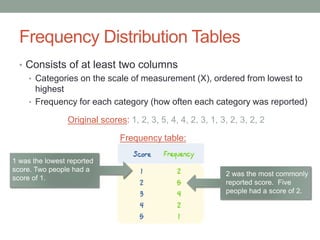
• Consists of at least two columns
• Categories on the scale of measurement (X), ordered from lowest to
highest
• Frequency for each category (how often each category was reported)
Original scores: 1, 2, 3, 5, 4, 4, 2, 3, 1, 3, 2, 3, 2, 2
Frequency table:
1 was the lowest reported
score. Two people had a
score of 1.
2 was the most commonly
reported score. Five
people had a score of 2.
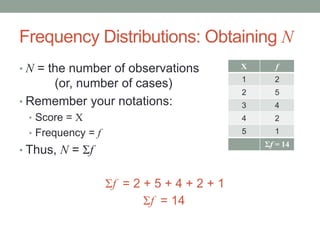
Frequency Distributions: Obtaining N
• N = the number of observations
(or, number of cases)
• Remember your notations:
• Score = X
• Frequency = f
• Thus, N = Σf
X f
1 2
2 5
3 4
4 2
5 1
Σf = 14
Σf = 2 + 5 + 4 + 2 + 1
Σf = 14
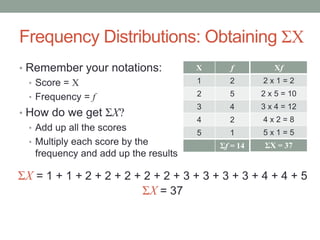
Frequency Distributions: Obtaining ΣX
• Remember your notations:
• Score = X
• Frequency = f
• How do we get ΣX?
• Add up all the scores
• Multiply each score by the
frequency and add up the results
X f
1 2
2 5
3 4
4 2
5 1
Σf = 14
Xf
2 x 1 = 2
2 x 5 = 10
3 x 4 = 12
4 x 2 = 8
5 x 1 = 5
ΣX = 37
ΣX = 1 + 1 + 2 + 2 + 2 + 2 + 2 + 3 + 3 + 3 + 3 + 4 + 4 + 5
ΣX = 37
Obtaining (ΣX)2 and ΣX2
X f
1 2
2 5
3 4
4 2
5 1
Σf = 14
ΣX2 = 12+ 12+ 22+ 22+ 22+ 22+ 22+ 32+ 32+ 32+ 32+ 42+ 42+ 52
ΣX2 = 1 + 1 + 4 + 4 + 4 + 4 + 4 + 9 + 9 + 9 + 9 + 16 + 16 + 25
ΣX2 = 115
• Remember the order of operations:
1. Parentheses
2. Exponents
3. Multiplication/Division
4. Adding/Subtracting
(ΣX)2 = (37)2
(ΣX)2 =1369
Proportions (p) and Percentages (%)
• p measures the fraction of the total group
associated with each score
• p = f/N
X f
1 2
2 5
3 4
4 2
5 1
Σf = 14
p = f/N
2/14 = 0.143
5/14 = 0.357
4/14 = 0.286
2/14 = 0.143
1/14 = 0.071
% = p(100)
14.3%
35.7%
28.6%
14.3%
7.1%
Σp = 1.00 Σ% = 100%
*Math check: sum proportions = 1.00;
sum percentages = 100%
Types of Frequency Distribution Tables
Regular Frequency Distribution
• Lists all of the individual
categories (X values)
Grouped Frequency Distribution
• When listing all of the
individual categories is
not
possible/helpful/reasonabl
e
• e.g., Test scores 0-100
X f
1 2
2 5
3 4
4 2
5 1
Σf = 14
Grouped Frequency Tables
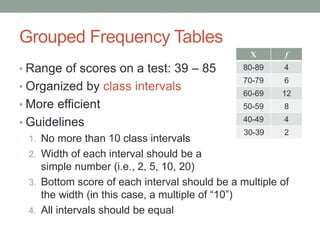
• Range of scores on a test: 39 – 85
• Organized by class intervals
• More efficient
• Guidelines
1. No more than 10 class intervals
2. Width of each interval should be a
simple number (i.e., 2, 5, 10, 20)
3. Bottom score of each interval should be a multiple of
the width (in this case, a multiple of “10”)
4. All intervals should be equal
X f
80-89 4
70-79 6
60-69 12
50-59 8
40-49 4
30-39 2
Grouped Frequency Tables
• What information is lost?
• The individual scores – and thus, our
ability to solve for Σ(Xf)
X f
80-89 4
70-79 6
60-69 12
50-59 8
40-49 4
30-39 2
Constructing a Grouped Frequency Table
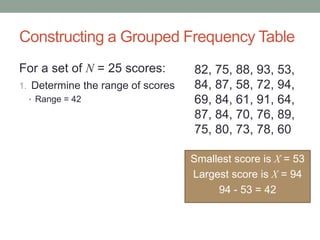
For a set of N = 25 scores: 82, 75, 88, 93, 53,
84, 87, 58, 72, 94,
69, 84, 61, 91, 64,
87, 84, 70, 76, 89,
75, 80, 73, 78, 60
Constructing a Grouped Frequency Table
For a set of N = 25 scores: 82, 75, 88, 93, 53,
84, 87, 58, 72, 94,
69, 84, 61, 91, 64,
87, 84, 70, 76, 89,
75, 80, 73, 78, 60
1. Determine the range of scores
• Range = 42
Smallest score is X = 53
Largest score is X = 94
94 - 53 = 42
Constructing a Grouped Frequency Table
For a set of N = 25 scores: 82, 75, 88, 93, 53,
84, 87, 58, 72, 94,
69, 84, 61, 91, 64,
87, 84, 70, 76, 89,
75, 80, 73, 78, 60
1. Determine the range of scores
• Range = 42
2. Group scores into intervals
• At least 9 intervals needed
Smallest score is X = 53
Largest score is X = 94
94 - 53 = 42
Width # of Intervals Needed to
Cover a Range of 42 Points
2 21 (too many)
5 9 (OK)
10 5 (too few)
Constructing a Grouped Frequency Table
For a set of N = 25 scores: 82, 75, 88, 93, 53,
84, 87, 58, 72, 94,
69, 84, 61, 91, 64,
87, 84, 70, 76, 89,
75, 80, 73, 78, 60
1. Determine the range of scores
• Range = 42
2. Group scores into intervals
• At least 9 intervals needed
3. Identify the intervals
• Bottom interval should be
50-54
• Next is 55-59
• Then 60-64
• Etc.
Smallest score is X = 53
Largest score is X = 94
94 - 53 = 42
Lowest score is X = 53
Lowest interval should contain this value
Interval should have a multiple of 5 as its
bottom score
Interval should contain 5 values (because
it has an interval of 5)
Constructing a Grouped Frequency Table
For a set of N = 25 scores:
1. Determine the range of scores
• Range = 42
2. Group scores into intervals
• At least 9 intervals needed
3. Identify the intervals
• Bottom interval should be
50-54
• Next is 55-59
• Then 60-64
• Etc.
X
90-94
85-89
80-84
75-79
70-74
65-69
60-64
55-59
50-54
f
3
4
5
4
3
1
3
1
1
p = f/N
0.12
0.16
0.20
0.16
0.12
0.04
0.12
0.04
0.04
Σp
1.00
Σ%
100%
%
12%
16%
20%
16%
12%
4%
12%
4%
4%
Real Limits
Recall from Chapter 1:
Real Limits and Frequency Distributions
X
90-94
85-89
80-84
75-79
70-74
65-69
60-64
55-59
50-54
f
3
4
5
4
3
1
3
1
1
• For X = 60 – 64, there are 3 scores
• Does not mean 3 scores are identical
• Means 3 scores fall within the interval
• For each interval, there are limits
• Lower real limit
• Upper real limit 3 different scores
within this interval
50 55 60 65 70 75 80 85 90 95
59.5 – 64.5
Apparent Limits
Real Limits
Frequency Distribution Graphs
• X-axis (abscissa)
• Horizontal line
• Values increase from left to right
• Y-axis (ordinate)
• Vertical line
• Values increase from bottom to
top
• In a frequency distribution graph:
• Score categories (X values) are listed on the X axis
• Frequencies are listed on the Y axis
Graphs for Interval or Ratio Data
Histogram
• Adjacent bars touch
• Height of bar indicates
frequency
• Width corresponds to the score
(or limits of the range of scores)
Polygon
• Vertical position of dot indicates a
score’s frequency
• Continuous line is draw between
series of dots
• X = 0 typically one category
above/below highest/lowest score
A Modified Histogram
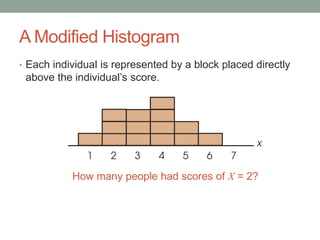
• Each individual is represented by a block placed directly
above the individual’s score.
How many people had scores of X = 2?
Histogram and Polygon on One Graph
What If Your Data Is Not Interval/Ratio?
• Bar Graph
• For nominal or ordinal data
• Like a histogram in structure, but the bars do not touch
• Emphasizes distinct categories
Leave NYC
immediately!
A Warning…
Don’t Misrepresent Your Data!
Leave NYC
immediately!
Oh, wait…
A Warning…
Graphs for Population Distributions
Relative Frequencies
• We may not know exactly how
many fish are in Lake Erie, but
we do know that there are
double the number of Bluegill
than there are Bass
Smooth Curves
• When the population consists of
numerical scores from an interval
or ratio scale
• Indicates that we are showing the
relative changes that occur from
one score to the next
Describing a Frequency Distribution
• Three characteristics completely describe any distribution
• Central tendency (Chapter 3)
• Where is the center of the distribution?
• Variability (Chapter 4)
• Are the scores spread out, or clustered together?
• Shape
• Are the scores normally distributed among the population?
The Shape of a Frequency Distribution
Skewed Distributions
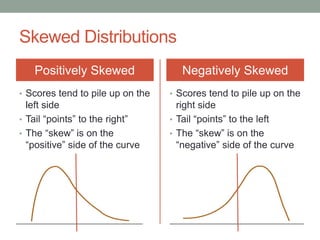
Positively Skewed
• Scores tend to pile up on the
left side
• Tail “points” to the right”
• The “skew” is on the
“positive” side of the curve
Negatively Skewed
• Scores tend to pile up on the
right side
• Tail “points” to the left
• The “skew” is on the
“negative” side of the curve
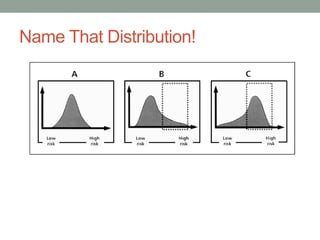
Name That Distribution!
Symmetric (no skew) Positive Skew Negative Skew
Percentiles & Percentile Ranks
• Percentile rank
• The percentage of individuals in the distribution with scores at or
below the particular value
• Percentile
• When a score is identified by its percentile rank
For example:
o Your exam score is X = 43
o 60% of the class had scores of 43 or lower
o Your score has a percentile rank of 60% and is called the 60th
percentile.
Percentiles & Percentile Ranks
X f Xf p % cf c%
1 2 2 0.143 14.3% 2 (2/14)100% = 14.3%
2 5 10 0.357 35.7% (2+5) = 7 (7/14)100% = 50%
3 4 12 0.286 28.6% (7+4) = 11 (11/14)100% = 78.6%
4 2 8 0.143 14.3% (11+2) = 13 (13/14)100% = 92.9%
5 1 5 0.071 7.1% (13+1) = 14 (14/14)100% = 100%
N = 14 (x lowx high) (cf/N)(100%)
• To find percentiles and percentile ranks, we must first
calculate cumulative frequency (cf) and cumulative
percentage (c%) for each score (or interval)
Let’s Practice
1. Find the 70th percentile (remember real limits!)
2. Find the percentile rank for X = 9.4
X f cf c%
0 – 4 2 2 10%
5 – 9 4 6 20%
10 – 14 8 14 70%
15 – 19 5 19 95%
20 - 24 1 20 100%

Frequency Distributions

  • 1.
  • 2.
    What is afrequency distribution? An organized tabulation of the number of individuals located in each category on a scale of measurement • A method for simplifying and organizing data • Presents an organized picture of the entire set of scores • Are scores generally high or low? • Are the scores clustered together or spread out? • Shows where each individual is located relative to others in a distribution • Where does one score fall relative to all others?
  • 3.
    Frequency Distribution Tables •Consists of at least two columns • Categories on the scale of measurement (X), ordered from lowest to highest • Frequency for each category (how often each category was reported) Original scores: 1, 2, 3, 5, 4, 4, 2, 3, 1, 3, 2, 3, 2, 2 Frequency table: 1 was the lowest reported score. Two people had a score of 1. 2 was the most commonly reported score. Five people had a score of 2.
  • 4.
    Frequency Distributions: ObtainingN • N = the number of observations (or, number of cases) • Remember your notations: • Score = X • Frequency = f • Thus, N = Σf X f 1 2 2 5 3 4 4 2 5 1 Σf = 14 Σf = 2 + 5 + 4 + 2 + 1 Σf = 14
  • 5.
    Frequency Distributions: ObtainingΣX • Remember your notations: • Score = X • Frequency = f • How do we get ΣX? • Add up all the scores • Multiply each score by the frequency and add up the results X f 1 2 2 5 3 4 4 2 5 1 Σf = 14 Xf 2 x 1 = 2 2 x 5 = 10 3 x 4 = 12 4 x 2 = 8 5 x 1 = 5 ΣX = 37 ΣX = 1 + 1 + 2 + 2 + 2 + 2 + 2 + 3 + 3 + 3 + 3 + 4 + 4 + 5 ΣX = 37
  • 6.
    Obtaining (ΣX)2 andΣX2 X f 1 2 2 5 3 4 4 2 5 1 Σf = 14 ΣX2 = 12+ 12+ 22+ 22+ 22+ 22+ 22+ 32+ 32+ 32+ 32+ 42+ 42+ 52 ΣX2 = 1 + 1 + 4 + 4 + 4 + 4 + 4 + 9 + 9 + 9 + 9 + 16 + 16 + 25 ΣX2 = 115 • Remember the order of operations: 1. Parentheses 2. Exponents 3. Multiplication/Division 4. Adding/Subtracting (ΣX)2 = (37)2 (ΣX)2 =1369
  • 7.
    Proportions (p) andPercentages (%) • p measures the fraction of the total group associated with each score • p = f/N X f 1 2 2 5 3 4 4 2 5 1 Σf = 14 p = f/N 2/14 = 0.143 5/14 = 0.357 4/14 = 0.286 2/14 = 0.143 1/14 = 0.071 % = p(100) 14.3% 35.7% 28.6% 14.3% 7.1% Σp = 1.00 Σ% = 100% *Math check: sum proportions = 1.00; sum percentages = 100%
  • 8.
    Types of FrequencyDistribution Tables Regular Frequency Distribution • Lists all of the individual categories (X values) Grouped Frequency Distribution • When listing all of the individual categories is not possible/helpful/reasonabl e • e.g., Test scores 0-100 X f 1 2 2 5 3 4 4 2 5 1 Σf = 14
  • 9.
    Grouped Frequency Tables •Range of scores on a test: 39 – 85 • Organized by class intervals • More efficient • Guidelines 1. No more than 10 class intervals 2. Width of each interval should be a simple number (i.e., 2, 5, 10, 20) 3. Bottom score of each interval should be a multiple of the width (in this case, a multiple of “10”) 4. All intervals should be equal X f 80-89 4 70-79 6 60-69 12 50-59 8 40-49 4 30-39 2
  • 10.
    Grouped Frequency Tables •What information is lost? • The individual scores – and thus, our ability to solve for Σ(Xf) X f 80-89 4 70-79 6 60-69 12 50-59 8 40-49 4 30-39 2
  • 11.
    Constructing a GroupedFrequency Table For a set of N = 25 scores: 82, 75, 88, 93, 53, 84, 87, 58, 72, 94, 69, 84, 61, 91, 64, 87, 84, 70, 76, 89, 75, 80, 73, 78, 60
  • 12.
    Constructing a GroupedFrequency Table For a set of N = 25 scores: 82, 75, 88, 93, 53, 84, 87, 58, 72, 94, 69, 84, 61, 91, 64, 87, 84, 70, 76, 89, 75, 80, 73, 78, 60 1. Determine the range of scores • Range = 42 Smallest score is X = 53 Largest score is X = 94 94 - 53 = 42
  • 13.
    Constructing a GroupedFrequency Table For a set of N = 25 scores: 82, 75, 88, 93, 53, 84, 87, 58, 72, 94, 69, 84, 61, 91, 64, 87, 84, 70, 76, 89, 75, 80, 73, 78, 60 1. Determine the range of scores • Range = 42 2. Group scores into intervals • At least 9 intervals needed Smallest score is X = 53 Largest score is X = 94 94 - 53 = 42 Width # of Intervals Needed to Cover a Range of 42 Points 2 21 (too many) 5 9 (OK) 10 5 (too few)
  • 14.
    Constructing a GroupedFrequency Table For a set of N = 25 scores: 82, 75, 88, 93, 53, 84, 87, 58, 72, 94, 69, 84, 61, 91, 64, 87, 84, 70, 76, 89, 75, 80, 73, 78, 60 1. Determine the range of scores • Range = 42 2. Group scores into intervals • At least 9 intervals needed 3. Identify the intervals • Bottom interval should be 50-54 • Next is 55-59 • Then 60-64 • Etc. Smallest score is X = 53 Largest score is X = 94 94 - 53 = 42 Lowest score is X = 53 Lowest interval should contain this value Interval should have a multiple of 5 as its bottom score Interval should contain 5 values (because it has an interval of 5)
  • 15.
    Constructing a GroupedFrequency Table For a set of N = 25 scores: 1. Determine the range of scores • Range = 42 2. Group scores into intervals • At least 9 intervals needed 3. Identify the intervals • Bottom interval should be 50-54 • Next is 55-59 • Then 60-64 • Etc. X 90-94 85-89 80-84 75-79 70-74 65-69 60-64 55-59 50-54 f 3 4 5 4 3 1 3 1 1 p = f/N 0.12 0.16 0.20 0.16 0.12 0.04 0.12 0.04 0.04 Σp 1.00 Σ% 100% % 12% 16% 20% 16% 12% 4% 12% 4% 4%
  • 16.
  • 17.
    Real Limits andFrequency Distributions X 90-94 85-89 80-84 75-79 70-74 65-69 60-64 55-59 50-54 f 3 4 5 4 3 1 3 1 1 • For X = 60 – 64, there are 3 scores • Does not mean 3 scores are identical • Means 3 scores fall within the interval • For each interval, there are limits • Lower real limit • Upper real limit 3 different scores within this interval 50 55 60 65 70 75 80 85 90 95 59.5 – 64.5 Apparent Limits Real Limits
  • 18.
    Frequency Distribution Graphs •X-axis (abscissa) • Horizontal line • Values increase from left to right • Y-axis (ordinate) • Vertical line • Values increase from bottom to top • In a frequency distribution graph: • Score categories (X values) are listed on the X axis • Frequencies are listed on the Y axis
  • 19.
    Graphs for Intervalor Ratio Data Histogram • Adjacent bars touch • Height of bar indicates frequency • Width corresponds to the score (or limits of the range of scores) Polygon • Vertical position of dot indicates a score’s frequency • Continuous line is draw between series of dots • X = 0 typically one category above/below highest/lowest score
  • 20.
    A Modified Histogram •Each individual is represented by a block placed directly above the individual’s score. How many people had scores of X = 2?
  • 21.
  • 22.
    What If YourData Is Not Interval/Ratio? • Bar Graph • For nominal or ordinal data • Like a histogram in structure, but the bars do not touch • Emphasizes distinct categories
  • 23.
  • 24.
    Don’t Misrepresent YourData! Leave NYC immediately! Oh, wait… A Warning…
  • 25.
    Graphs for PopulationDistributions Relative Frequencies • We may not know exactly how many fish are in Lake Erie, but we do know that there are double the number of Bluegill than there are Bass Smooth Curves • When the population consists of numerical scores from an interval or ratio scale • Indicates that we are showing the relative changes that occur from one score to the next
  • 26.
    Describing a FrequencyDistribution • Three characteristics completely describe any distribution • Central tendency (Chapter 3) • Where is the center of the distribution? • Variability (Chapter 4) • Are the scores spread out, or clustered together? • Shape • Are the scores normally distributed among the population?
  • 27.
    The Shape ofa Frequency Distribution
  • 28.
    Skewed Distributions Positively Skewed •Scores tend to pile up on the left side • Tail “points” to the right” • The “skew” is on the “positive” side of the curve Negatively Skewed • Scores tend to pile up on the right side • Tail “points” to the left • The “skew” is on the “negative” side of the curve
  • 29.
  • 30.
    Name That Distribution! Symmetric(no skew) Positive Skew Negative Skew
  • 31.
    Percentiles & PercentileRanks • Percentile rank • The percentage of individuals in the distribution with scores at or below the particular value • Percentile • When a score is identified by its percentile rank For example: o Your exam score is X = 43 o 60% of the class had scores of 43 or lower o Your score has a percentile rank of 60% and is called the 60th percentile.
  • 32.
    Percentiles & PercentileRanks X f Xf p % cf c% 1 2 2 0.143 14.3% 2 (2/14)100% = 14.3% 2 5 10 0.357 35.7% (2+5) = 7 (7/14)100% = 50% 3 4 12 0.286 28.6% (7+4) = 11 (11/14)100% = 78.6% 4 2 8 0.143 14.3% (11+2) = 13 (13/14)100% = 92.9% 5 1 5 0.071 7.1% (13+1) = 14 (14/14)100% = 100% N = 14 (x lowx high) (cf/N)(100%) • To find percentiles and percentile ranks, we must first calculate cumulative frequency (cf) and cumulative percentage (c%) for each score (or interval)
  • 33.
    Let’s Practice 1. Findthe 70th percentile (remember real limits!) 2. Find the percentile rank for X = 9.4 X f cf c% 0 – 4 2 2 10% 5 – 9 4 6 20% 10 – 14 8 14 70% 15 – 19 5 19 95% 20 - 24 1 20 100%