Data Collection
Data Sources
• Primary
  Data structures of variables that have been
  specifically collected and assembled for current
  research problem or opportunity situation.
• Secondary
  Historical data structures of variables that have
  been previously collected and assembled for
  some research problem or opportunity situation
  other than the current situation.
Secondary Data
Disadvantages
• Authenticity and accuracy of data are difficult to know
• May be obsolete and not up-dated
• May not be properly arranged, compiled and presented
• Units may be different and ambiguous
Advantages
• Cost-effective, sometimes even available free of any expenditure
• Time saving
• Needs much less effort
• Familiarity with this data indicates the fallacies, deficiencies and gaps, as a result of
   which the researcher becomes aware and alert while collecting primary data
• Dealing with this data may lead to a better comprehension of and provide useful
   insights into the research problem
• Used as a basis for comparison with primary data
• Occasionally more accurate than primary data
• Information may be available only from this data and there may be no recourse to
   primary data
Criteria & Caution
Criteria for Evaluating Secondary Data
•   Do the data help answer the questions?
•   Do data apply to population, geographical area and time period of interest?
•   Can the units and classifications presented apply?
•   Is it possible to go to the origin of the data?
•   Is the cost of data acquisition worth it?
•   Accuracy? Can the accuracy be tested?
•   Is it from a trusted source? Authentic?
•   Is using the data worth the risk?
Caution prior to using secondary data
•   data should answer the research questions
•   data should pertain to the appropriate population, geographical area, category of socio-economic
    class and time period
•   the units and classifications with which the data is presented should apply
•   if required the researcher should have access to the origin of the data
•   the cost of data acquisition should be worth it
•   the accuracy of the data should be made sure
•   it should be possible to test the accuracy of the data
•   data should be from a trusted source and be authentic
•   if acquiring the data requires some time, the waiting should be worthwhile and the time gap
    should not change the research scenario
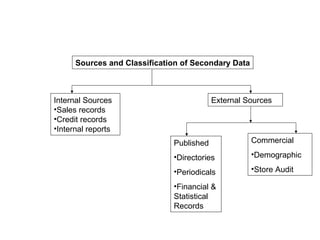
Sources and Classification of Secondary Data


Internal Sources                          External Sources
•Sales records
•Credit records
•Internal reports
                              Published              Commercial

                              •Directories           •Demographic

                              •Periodicals           •Store Audit

                              •Financial &
                              Statistical
                              Records
Primary data for Qualitative
             Research
Direct – non-disguised
• Interview method
• Focus group discussions
• Delphi technique

Indirect - disguised
• Projective technique
Interview

•   formalised process
•   well-trained interviewer asks a subject
•   set of structured, semi-structured and open ended questions
•   in a face-to-face setting.

Steps to be taken prior to conducting an interview
• Determine the topic, objective and purpose of the research.
• Decide and identify the interviewees
• Seek appointments with the interviewees, preferably according to
   their convenience.
• Prepare a list of factual as well as open-ended questions before the
   interview
• The questions should be written on a piece of paper and additional
   papers should be carried so as to make notes as and when
   required.
Kinds of Questions
• Factual questions - age, gender,
  education, ethnicity, family structure,
  country of birth, migration, etc.
• Open-ended questions help to bring out
  the interviewee’s memories, feelings,
  attitudes, perceptions, etc. about a certain
  topic. Example- ‘What are your
  anticipations and expectations from the
  forthcoming budget?’
Steps to be taken while conducting an interview
• The interviewees should be explained clearly about the purpose of
   the questions and how the research will benefit from their answers.
• Notes must be taken from the answers, sometimes summarising the
   answers received and sometimes quoting them verbatim.
• Many interviewers make audio recording of the interview, making
   sure to get permission from your interviewee first.
• As much as possible should be gathered from the interview – the
   interviewee should be permitted to talk and give his own opinion.
• The final and vital step is to thank the interviewees and let them
   know your gratitude for the information they have contributed
   towards the research.
In an interview of the probing kind
• The interviewee’s initial response to a specific question is taken
• This response is used as the guide line and frame work for the next
    question(s)
• More detailed responses are derived from these question(s)

Essential qualities of the interviewer
• Interviewer should be fully aware of the what and why of research being
   conducted
• The venue and time of the interview should be selected so that they suit the
   interviewee
• Approach should be informal with a slight firmness
• All possible effort should be made to make a good rapport
• Communicating, listening and understanding skills must be very good
• The interviewee should feel that the interview is a pleasant experience
   rather than a harrowing and compelling one
Characteristics of questions in an interview
• Questions that give one-word, yes-or-no answers should
  be avoided. They should rather be replaced with open-
  ended questions Example “What games do you play?”
  will get you more information than “Do you play cricket?”
• The questions should be asked in clear pronunciation
  and smooth accent.
• Language of the questions should never be offensive.
• Words should be chosen with care.
• If the interviewee fails to understand the meaning of a
  question, it must be explained in simpler language or
  translated into a language with which he is familiar and
  comfortable with.
Kinds of Questions
Open-ended questions
Give us a window into what the respondent is thinking and feeling.
Examples
• Tell me about your home.
• What do you think would happen if -------?
Closed-ended questions
• Allow us to get definite answers and move toward closing the
   interview.
• Start with verbs, such as "Are...?" "Will...?" "Is...?" "Have...?"
   "Did...?" and even contractions such as "Aren't...?" "Didn't...?" and
   "Won't...?"
• This is often called a convergent question.
• It brings conversation gradually to a convergence (begin narrowing
   the conversation) on a single point or decision.
• A closed-ended question is answered with a "yes" or a "no."
Probing questions
• To know how the respondent has reached particular conclusions,
• To consider and weigh diverse evidence,
• To examine the validity of their own deductions and inductions,
• To consider opposing points of view.
Examples
• Why do you think Indian brands succeed in the world market?
• Can you elaborate?
• What evidence can you present to support your answer?
Double-barreled questions combine two or more issues in a single question.
    AVOID
• Does the question include the word "and"?
• Answers to double-barreled questions are ambiguous because two or more ideas are
   confounded.
Examples
• Why do you think Indian brands succeed and flourish in the world market?
• Do you like and enjoy shopping in Supermarkets and Malls?
Focus Group Discussions
•   - formalised process
    – of bringing a small select group of people together
    – for an interactive and spontaneous discussion
    – on one particular topic or concept
Objectives
• Provide data for defining and redefining research problems
• Identify specific hidden information requirements
• Reveals hidden
    – needs, wants, preferences
    – attitudes, feelings, behaviours
    – perceptions, opinions
• Generate new ideas
• Discover new constructs and measurement methods
• Understand sudden changes
Advantages
•  May give insights into not just what participants think, but also why they think it.
•  Can reveal consensus and diversity of the different needs, experiences, preferences, and
   assumptions of the participants.
•  Allows interaction among participants – enabling each to take clues from others and thus
   augmenting and opposing each other's ideas and comments to provide an in-depth view not
   attainable from individual questioning.
•  Unexpected comments and opinions and can be explored easily.
•  New perspectives and avenues open up.
•  A warm and healthy rapport between the moderator and the participants can encourage the latter
   to express their feelings fully, candidly and honestly.

Disadvantages
•   Group sizes are typically small and may not be representative of the target population.
•   If the potential participants live in geographically distant regions, getting them to congregate at
    the same place at the same time may be difficult.
•   The information collected may have an inclination to be biased by subjective interpretation than is
    the case with quantitative methods.
•   More outspoken and ‘confident’ participants can dominate the discussion.
•   Viewpoints of less assertive and rather quiet people often are difficult to assess.
Steps in conducting an FGD

• Planning
• Conducting
• Analysing and reporting results
Planning

•   Have a thorough idea of the possible uses to which the findings of the
    FGD will be put.
•   Identify and select participants with the appropriate profile -
    participants who represent the target population. Homogenous groups help
    to create a sense of comfort and compatibility among participants.
•   The group size of an FGD should range between 5 and 12. This size group
    gives everyone a chance to participate, while providing enough diversity of
    opinion for a well-rounded perspective. A smaller group should be made
    when the need is to obtain more depth and detail of information and / or the
    participants have a lot to contribute to the purpose of the research.
•   The number of sessions is usually restricted to one, but can be
    increased if the need rises
•   Duration of sessions depend on the intricacy of the research and
    involvement of the participants. But as a rule of the thumb sessions
    should last between 1 to 3 hours.
•   The meeting time and venue of the FGD should left to the discretion of
    the participants.
Conducting
•   The moderator should be the one who knows how to and is competent
    enough to work with a group of people. He should be able to encourage full
    participation and interaction among the participants.
•   A person acting as an observer or recorder should record all comments
    made and opinions aired by the group (using an audio tape or video
    recorder is advised) and note any significant gestures or behaviour.
•   The identity of the moderator is never revealed to the participants
    throughout the course of the FGD, lest they become conditioned.
•   The session should begin with an introduction of the participants to each
    other.
•   The purpose and the main objective of the FDG should be briefly explained
    to the participants.
•   The main session of the FGD should be carefully conducted and should be
    moulded towards the direction which will serve the purpose of the FGD.
•   Concluding the session should be with a vote of thanks by the moderator
    addressed to all other members of the FGD, with special mention of the
    participants.
Analysing and reporting results
•    After completion of the FGD, the task of the researcher is to sit with
     the moderator and observer and carefully and meticulously scan the
     proceedings of the FGD – notes, conversation, audio and video
     recordings. They should pay special emphasis on
1.   Words
2.   Comments
3.   Frequency of comments
4.   Intensity of comments
5.   Special mentions
•    Interpreting each of the above in a correct way with reference to the
     topic of the FGD and more so to the research is very essential for
     the fulfillment of the research.
The moderator

• Although every member of an FGD play important roles in the
  successfully conducting it, the part the moderator plays is the most
  vital.
• The moderator's job is to encourage discussion and lead the FGD in
  the proper direction.
• His job is also to maintain focus, so that the discussion does not go
  too astray from the essentials.
• But, too much moderator control and intervention might lead to a
  situation, where the participants' find difficult or reserved to express
  their own perspectives.
• Whereas, too little moderator control means that less about the topic
  may be discussed.
• Thus, moderator must play his role optimally, judiciously and
  informally but sternly.
• Moderators need specialised training to become so.
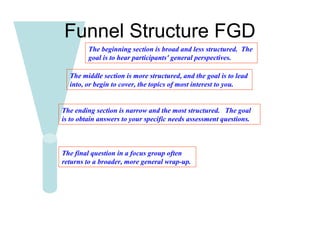
Funnel Structure FGD
         The beginning section is broad and less structured. The
         goal is to hear participants' general perspectives.

  The middle section is more structured, and the goal is to lead
  into, or begin to cover, the topics of most interest to you.


The ending section is narrow and the most structured. The goal
is to obtain answers to your specific needs assessment questions.


The final question in a focus group often
returns to a broader, more general wrap-up.
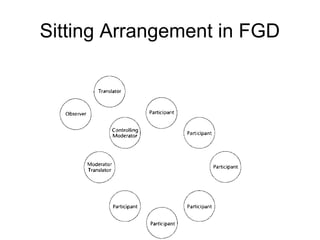
Sitting Arrangement in FGD
Projective techniques
This is a specialised method of data collection,
where one to one unstructured interview is
conducted with the target individual at a place
where they are in their natural environment, e.g.
their home or recreation club.
 – This technique enables understanding the target's
   behaviour within the context of his own world.
 – When a researcher uses projective techniques, he
   asks an informant to react to some kind of visual or
   verbal stimulus.
• Example: An informant may be provided with a rough outline of the
  body and be asked to draw her or his perception of the conception
  or onset of an illness.
• Another way of a projective technique is the presentation of a
  hypothetical question or an incomplete sentence or story to the
  respondent. The researcher may ask the respondent to complete in
  writing sentences or give an outline of the story etc.
• Example 1– ‘If I were to discover that my neighbour had TB, I
  would feel ------------------------------------.’
• Example 2 – ‘The following picture series refers to the population
  explosion in certain rural parts of India.

•   Word association test
•   Sentence completion test
•   Thematic apperception test (TAT)
•   Third-person techniques
Word Association Test
•   A list of words or phrases can be presented in random order to respondents, who are requested to state or write
    the word or phrase that pops into their mind;
•   Respondents are asked for what word or phrase comes to mind immediately upon hearing certain brand names;
•   Similarly, respondents can be asked about slogans and what they suggest;
•   Respondents are asked to describe an inanimate object or product by giving it "human characteristics" or
    associating descriptive adjectives with it.
•   For example, a group of tourism professionals working on establishing a strategic marketing plan for their
    community were asked to come up with personality traits or "human characteristics" for the villages as well as the
    cities within their area:
•   Villages
     –       Serene
     –       Conservative
     –       Quaint
     –       Friendly
     –       Accessible
     –       Reliable
•   Cities
     –       Brash
     –       Rushed
     –       Liberal
     –       Modern
     –       Cold
•    Most of the tourism industry representatives came from the cities and had strongly argued that the urban areas
    had historically been neglected in promotional campaigns. As a result of this and other exercises, they came to
    the realization that the rural areas were a strong feature of the overall attractiveness of the destination and
    needed to be featured as key elements in any marketing campaign.
Sentence Completion Test

•  In the sentence completion method, respondents are given incomplete
   sentences and asked to complete the thought. These sentences are usually
   in the third person and tend to be somewhat ambiguous. For example, the
   following sentences would provide striking differences in how they were
   completed depending on the personality of the respondent:
"A beach vacation is……………………"
"Taking a holiday in the mountains is…."
"Golfing is for…"
"The average person considers skiing….."
"People who visit museums are…………"
• Generally speaking, sentence completion tests are easier to interpret since
   the answers provided will be more detailed than in a word association test.
   However, their intent is also more obvious to the respondent, and could
   possible result in less honest replies.
• A variant of this method is the story completion test. A story in words or
   pictures is given to the respondent who is then asked to complete it in
   his/her own words.
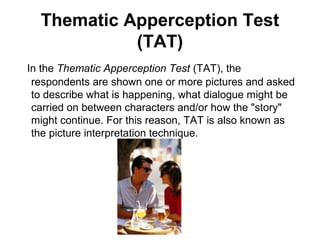
Thematic Apperception Test
            (TAT)
In the Thematic Apperception Test (TAT), the
 respondents are shown one or more pictures and asked
 to describe what is happening, what dialogue might be
 carried on between characters and/or how the "story"
 might continue. For this reason, TAT is also known as
 the picture interpretation technique.
Third Person Technique
By providing respondents with the
opportunity to talk about someone
else, such as a neighbor, a relative or a
friend, they can talk freely about
attitudes that they would not
necessarily admit to holding
themselves.
Quantitative Research Procedure
Questionnaire
• set of questions and scales
• following a particular logic
• designed to generate enough raw data
• accomplishing the research objectives
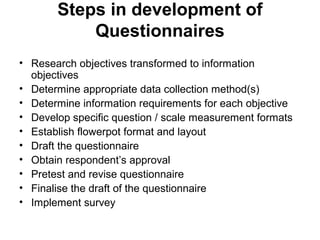
Steps in development of
           Questionnaires
• Research objectives transformed to information
  objectives
• Determine appropriate data collection method(s)
• Determine information requirements for each objective
• Develop specific question / scale measurement formats
• Establish flowerpot format and layout
• Draft the questionnaire
• Obtain respondent’s approval
• Pretest and revise questionnaire
• Finalise the draft of the questionnaire
• Implement survey
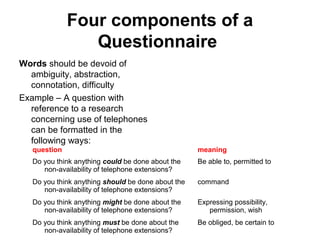
Four components of a
                 Questionnaire
Words should be devoid of
  ambiguity, abstraction,
  connotation, difficulty
Example – A question with
  reference to a research
  concerning use of telephones
  can be formatted in the
  following ways:
   question                                         meaning
   Do you think anything could be done about the    Be able to, permitted to
      non-availability of telephone extensions?
   Do you think anything should be done about the   command
      non-availability of telephone extensions?
   Do you think anything might be done about the    Expressing possibility,
      non-availability of telephone extensions?        permission, wish
   Do you think anything must be done about the     Be obliged, be certain to
      non-availability of telephone extensions?
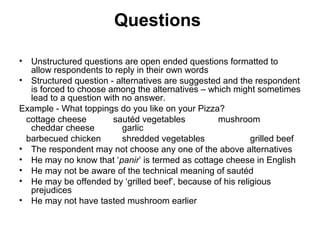
Questions

• Unstructured questions are open ended questions formatted to
  allow respondents to reply in their own words
• Structured question - alternatives are suggested and the respondent
  is forced to choose among the alternatives – which might sometimes
  lead to a question with no answer.
Example - What toppings do you like on your Pizza?
 cottage cheese        sautéd vegetables         mushroom
  cheddar cheese          garlic
 barbecued chicken        shredded vegetables              grilled beef
• The respondent may not choose any one of the above alternatives
• He may no know that ‘panir’ is termed as cottage cheese in English
• He may not be aware of the technical meaning of sautéd
• He may be offended by ‘grilled beef’, because of his religious
  prejudices
• He may not have tasted mushroom earlier
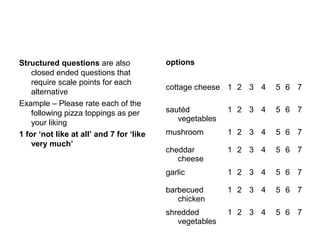
Structured questions are also             options
    closed ended questions that
    require scale points for each
                                          cottage cheese 1 2 3 4    5 6 7
    alternative
Example – Please rate each of the
    following pizza toppings as per       sautéd          1 2 3 4   5 6 7
                                             vegetables
    your liking
1 for ‘not like at all’ and 7 for ‘like   mushroom        1 2 3 4   5 6 7
    very much’
                                          cheddar         1 2 3 4   5 6 7
                                             cheese
                                          garlic          1 2 3 4   5 6 7

                                          barbecued       1 2 3 4   5 6 7
                                             chicken
                                          shredded        1 2 3 4   5 6 7
                                             vegetables
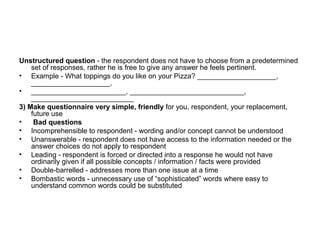
Unstructured question - the respondent does not have to choose from a predetermined
    set of responses, rather he is free to give any answer he feels pertinent.
• Example - What toppings do you like on your Pizza? ____________________,
    ____________________,
• ________________________, _____________________________,
    __________________________
3) Make questionnaire very simple, friendly for you, respondent, your replacement,
    future use
•    Bad questions
• Incomprehensible to respondent - wording and/or concept cannot be understood
• Unanswerable - respondent does not have access to the information needed or the
    answer choices do not apply to respondent
• Leading - respondent is forced or directed into a response he would not have
    ordinarily given if all possible concepts / information / facts were provided
• Double-barrelled - addresses more than one issue at a time
• Bombastic words - unnecessary use of “sophisticated” words where easy to
    understand common words could be substituted
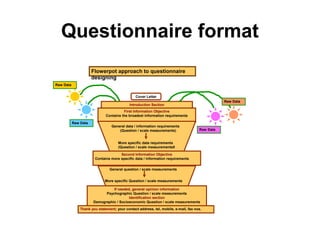
Questionnaire format
                      Flowerpot approach to questionnaire
                      designing
Raw Data


                                               Cover Letter
                                                                                                Raw Data
                                            Introduction Section
                                        First Information Objective
                              Contains the broadest information requirements

           Raw Data
                                 General data / information requirements
                                     (Question / scale measurements)                 Raw Data


                                     More specific data requirements
                                     (Question / scale measurements0

                                     Second Information Objective
                       Contains more specific data / information requirements


                                General question / scale measurements


                             More specific Question / scale measurements

                                If needed, general opinion information
                            Psychographic Question / scale measurements
                                         Identification section
                      Demographic / Socioeconomic Question / scale measurements
               Thank you statement; your contact address, tel, mobile, e-mail, fax nos.
Any doubts?

  Thank you

Data collection

  • 1.
  • 2.
    Data Sources • Primary Data structures of variables that have been specifically collected and assembled for current research problem or opportunity situation. • Secondary Historical data structures of variables that have been previously collected and assembled for some research problem or opportunity situation other than the current situation.
  • 3.
    Secondary Data Disadvantages • Authenticityand accuracy of data are difficult to know • May be obsolete and not up-dated • May not be properly arranged, compiled and presented • Units may be different and ambiguous Advantages • Cost-effective, sometimes even available free of any expenditure • Time saving • Needs much less effort • Familiarity with this data indicates the fallacies, deficiencies and gaps, as a result of which the researcher becomes aware and alert while collecting primary data • Dealing with this data may lead to a better comprehension of and provide useful insights into the research problem • Used as a basis for comparison with primary data • Occasionally more accurate than primary data • Information may be available only from this data and there may be no recourse to primary data
  • 4.
    Criteria & Caution Criteriafor Evaluating Secondary Data • Do the data help answer the questions? • Do data apply to population, geographical area and time period of interest? • Can the units and classifications presented apply? • Is it possible to go to the origin of the data? • Is the cost of data acquisition worth it? • Accuracy? Can the accuracy be tested? • Is it from a trusted source? Authentic? • Is using the data worth the risk? Caution prior to using secondary data • data should answer the research questions • data should pertain to the appropriate population, geographical area, category of socio-economic class and time period • the units and classifications with which the data is presented should apply • if required the researcher should have access to the origin of the data • the cost of data acquisition should be worth it • the accuracy of the data should be made sure • it should be possible to test the accuracy of the data • data should be from a trusted source and be authentic • if acquiring the data requires some time, the waiting should be worthwhile and the time gap should not change the research scenario
  • 5.
    Sources and Classificationof Secondary Data Internal Sources External Sources •Sales records •Credit records •Internal reports Published Commercial •Directories •Demographic •Periodicals •Store Audit •Financial & Statistical Records
  • 6.
    Primary data forQualitative Research Direct – non-disguised • Interview method • Focus group discussions • Delphi technique Indirect - disguised • Projective technique
  • 7.
    Interview • formalised process • well-trained interviewer asks a subject • set of structured, semi-structured and open ended questions • in a face-to-face setting. Steps to be taken prior to conducting an interview • Determine the topic, objective and purpose of the research. • Decide and identify the interviewees • Seek appointments with the interviewees, preferably according to their convenience. • Prepare a list of factual as well as open-ended questions before the interview • The questions should be written on a piece of paper and additional papers should be carried so as to make notes as and when required.
  • 8.
    Kinds of Questions •Factual questions - age, gender, education, ethnicity, family structure, country of birth, migration, etc. • Open-ended questions help to bring out the interviewee’s memories, feelings, attitudes, perceptions, etc. about a certain topic. Example- ‘What are your anticipations and expectations from the forthcoming budget?’
  • 9.
    Steps to betaken while conducting an interview • The interviewees should be explained clearly about the purpose of the questions and how the research will benefit from their answers. • Notes must be taken from the answers, sometimes summarising the answers received and sometimes quoting them verbatim. • Many interviewers make audio recording of the interview, making sure to get permission from your interviewee first. • As much as possible should be gathered from the interview – the interviewee should be permitted to talk and give his own opinion. • The final and vital step is to thank the interviewees and let them know your gratitude for the information they have contributed towards the research.
  • 10.
    In an interviewof the probing kind • The interviewee’s initial response to a specific question is taken • This response is used as the guide line and frame work for the next question(s) • More detailed responses are derived from these question(s) Essential qualities of the interviewer • Interviewer should be fully aware of the what and why of research being conducted • The venue and time of the interview should be selected so that they suit the interviewee • Approach should be informal with a slight firmness • All possible effort should be made to make a good rapport • Communicating, listening and understanding skills must be very good • The interviewee should feel that the interview is a pleasant experience rather than a harrowing and compelling one
  • 11.
    Characteristics of questionsin an interview • Questions that give one-word, yes-or-no answers should be avoided. They should rather be replaced with open- ended questions Example “What games do you play?” will get you more information than “Do you play cricket?” • The questions should be asked in clear pronunciation and smooth accent. • Language of the questions should never be offensive. • Words should be chosen with care. • If the interviewee fails to understand the meaning of a question, it must be explained in simpler language or translated into a language with which he is familiar and comfortable with.
  • 12.
    Kinds of Questions Open-endedquestions Give us a window into what the respondent is thinking and feeling. Examples • Tell me about your home. • What do you think would happen if -------? Closed-ended questions • Allow us to get definite answers and move toward closing the interview. • Start with verbs, such as "Are...?" "Will...?" "Is...?" "Have...?" "Did...?" and even contractions such as "Aren't...?" "Didn't...?" and "Won't...?" • This is often called a convergent question. • It brings conversation gradually to a convergence (begin narrowing the conversation) on a single point or decision. • A closed-ended question is answered with a "yes" or a "no."
  • 13.
    Probing questions • Toknow how the respondent has reached particular conclusions, • To consider and weigh diverse evidence, • To examine the validity of their own deductions and inductions, • To consider opposing points of view. Examples • Why do you think Indian brands succeed in the world market? • Can you elaborate? • What evidence can you present to support your answer? Double-barreled questions combine two or more issues in a single question. AVOID • Does the question include the word "and"? • Answers to double-barreled questions are ambiguous because two or more ideas are confounded. Examples • Why do you think Indian brands succeed and flourish in the world market? • Do you like and enjoy shopping in Supermarkets and Malls?
  • 14.
    Focus Group Discussions • - formalised process – of bringing a small select group of people together – for an interactive and spontaneous discussion – on one particular topic or concept Objectives • Provide data for defining and redefining research problems • Identify specific hidden information requirements • Reveals hidden – needs, wants, preferences – attitudes, feelings, behaviours – perceptions, opinions • Generate new ideas • Discover new constructs and measurement methods • Understand sudden changes
  • 15.
    Advantages • Maygive insights into not just what participants think, but also why they think it. • Can reveal consensus and diversity of the different needs, experiences, preferences, and assumptions of the participants. • Allows interaction among participants – enabling each to take clues from others and thus augmenting and opposing each other's ideas and comments to provide an in-depth view not attainable from individual questioning. • Unexpected comments and opinions and can be explored easily. • New perspectives and avenues open up. • A warm and healthy rapport between the moderator and the participants can encourage the latter to express their feelings fully, candidly and honestly. Disadvantages • Group sizes are typically small and may not be representative of the target population. • If the potential participants live in geographically distant regions, getting them to congregate at the same place at the same time may be difficult. • The information collected may have an inclination to be biased by subjective interpretation than is the case with quantitative methods. • More outspoken and ‘confident’ participants can dominate the discussion. • Viewpoints of less assertive and rather quiet people often are difficult to assess.
  • 16.
    Steps in conductingan FGD • Planning • Conducting • Analysing and reporting results
  • 17.
    Planning • Have a thorough idea of the possible uses to which the findings of the FGD will be put. • Identify and select participants with the appropriate profile - participants who represent the target population. Homogenous groups help to create a sense of comfort and compatibility among participants. • The group size of an FGD should range between 5 and 12. This size group gives everyone a chance to participate, while providing enough diversity of opinion for a well-rounded perspective. A smaller group should be made when the need is to obtain more depth and detail of information and / or the participants have a lot to contribute to the purpose of the research. • The number of sessions is usually restricted to one, but can be increased if the need rises • Duration of sessions depend on the intricacy of the research and involvement of the participants. But as a rule of the thumb sessions should last between 1 to 3 hours. • The meeting time and venue of the FGD should left to the discretion of the participants.
  • 18.
    Conducting • The moderator should be the one who knows how to and is competent enough to work with a group of people. He should be able to encourage full participation and interaction among the participants. • A person acting as an observer or recorder should record all comments made and opinions aired by the group (using an audio tape or video recorder is advised) and note any significant gestures or behaviour. • The identity of the moderator is never revealed to the participants throughout the course of the FGD, lest they become conditioned. • The session should begin with an introduction of the participants to each other. • The purpose and the main objective of the FDG should be briefly explained to the participants. • The main session of the FGD should be carefully conducted and should be moulded towards the direction which will serve the purpose of the FGD. • Concluding the session should be with a vote of thanks by the moderator addressed to all other members of the FGD, with special mention of the participants.
  • 19.
    Analysing and reportingresults • After completion of the FGD, the task of the researcher is to sit with the moderator and observer and carefully and meticulously scan the proceedings of the FGD – notes, conversation, audio and video recordings. They should pay special emphasis on 1. Words 2. Comments 3. Frequency of comments 4. Intensity of comments 5. Special mentions • Interpreting each of the above in a correct way with reference to the topic of the FGD and more so to the research is very essential for the fulfillment of the research.
  • 20.
    The moderator • Althoughevery member of an FGD play important roles in the successfully conducting it, the part the moderator plays is the most vital. • The moderator's job is to encourage discussion and lead the FGD in the proper direction. • His job is also to maintain focus, so that the discussion does not go too astray from the essentials. • But, too much moderator control and intervention might lead to a situation, where the participants' find difficult or reserved to express their own perspectives. • Whereas, too little moderator control means that less about the topic may be discussed. • Thus, moderator must play his role optimally, judiciously and informally but sternly. • Moderators need specialised training to become so.
  • 21.
    Funnel Structure FGD The beginning section is broad and less structured. The goal is to hear participants' general perspectives. The middle section is more structured, and the goal is to lead into, or begin to cover, the topics of most interest to you. The ending section is narrow and the most structured. The goal is to obtain answers to your specific needs assessment questions. The final question in a focus group often returns to a broader, more general wrap-up.

  • 22.
  • 23.
    Projective techniques This isa specialised method of data collection, where one to one unstructured interview is conducted with the target individual at a place where they are in their natural environment, e.g. their home or recreation club. – This technique enables understanding the target's behaviour within the context of his own world. – When a researcher uses projective techniques, he asks an informant to react to some kind of visual or verbal stimulus.
  • 24.
    • Example: Aninformant may be provided with a rough outline of the body and be asked to draw her or his perception of the conception or onset of an illness. • Another way of a projective technique is the presentation of a hypothetical question or an incomplete sentence or story to the respondent. The researcher may ask the respondent to complete in writing sentences or give an outline of the story etc. • Example 1– ‘If I were to discover that my neighbour had TB, I would feel ------------------------------------.’ • Example 2 – ‘The following picture series refers to the population explosion in certain rural parts of India. • Word association test • Sentence completion test • Thematic apperception test (TAT) • Third-person techniques
  • 25.
    Word Association Test • A list of words or phrases can be presented in random order to respondents, who are requested to state or write the word or phrase that pops into their mind; • Respondents are asked for what word or phrase comes to mind immediately upon hearing certain brand names; • Similarly, respondents can be asked about slogans and what they suggest; • Respondents are asked to describe an inanimate object or product by giving it "human characteristics" or associating descriptive adjectives with it. • For example, a group of tourism professionals working on establishing a strategic marketing plan for their community were asked to come up with personality traits or "human characteristics" for the villages as well as the cities within their area: • Villages – Serene – Conservative – Quaint – Friendly – Accessible – Reliable • Cities – Brash – Rushed – Liberal – Modern – Cold • Most of the tourism industry representatives came from the cities and had strongly argued that the urban areas had historically been neglected in promotional campaigns. As a result of this and other exercises, they came to the realization that the rural areas were a strong feature of the overall attractiveness of the destination and needed to be featured as key elements in any marketing campaign.
  • 26.
    Sentence Completion Test • In the sentence completion method, respondents are given incomplete sentences and asked to complete the thought. These sentences are usually in the third person and tend to be somewhat ambiguous. For example, the following sentences would provide striking differences in how they were completed depending on the personality of the respondent: "A beach vacation is……………………" "Taking a holiday in the mountains is…." "Golfing is for…" "The average person considers skiing….." "People who visit museums are…………" • Generally speaking, sentence completion tests are easier to interpret since the answers provided will be more detailed than in a word association test. However, their intent is also more obvious to the respondent, and could possible result in less honest replies. • A variant of this method is the story completion test. A story in words or pictures is given to the respondent who is then asked to complete it in his/her own words.
  • 27.
    Thematic Apperception Test (TAT) In the Thematic Apperception Test (TAT), the respondents are shown one or more pictures and asked to describe what is happening, what dialogue might be carried on between characters and/or how the "story" might continue. For this reason, TAT is also known as the picture interpretation technique.
  • 28.
    Third Person Technique Byproviding respondents with the opportunity to talk about someone else, such as a neighbor, a relative or a friend, they can talk freely about attitudes that they would not necessarily admit to holding themselves.
  • 29.
    Quantitative Research Procedure Questionnaire •set of questions and scales • following a particular logic • designed to generate enough raw data • accomplishing the research objectives
  • 30.
    Steps in developmentof Questionnaires • Research objectives transformed to information objectives • Determine appropriate data collection method(s) • Determine information requirements for each objective • Develop specific question / scale measurement formats • Establish flowerpot format and layout • Draft the questionnaire • Obtain respondent’s approval • Pretest and revise questionnaire • Finalise the draft of the questionnaire • Implement survey
  • 31.
    Four components ofa Questionnaire Words should be devoid of ambiguity, abstraction, connotation, difficulty Example – A question with reference to a research concerning use of telephones can be formatted in the following ways: question meaning Do you think anything could be done about the Be able to, permitted to non-availability of telephone extensions? Do you think anything should be done about the command non-availability of telephone extensions? Do you think anything might be done about the Expressing possibility, non-availability of telephone extensions? permission, wish Do you think anything must be done about the Be obliged, be certain to non-availability of telephone extensions?
  • 32.
    Questions • Unstructured questionsare open ended questions formatted to allow respondents to reply in their own words • Structured question - alternatives are suggested and the respondent is forced to choose among the alternatives – which might sometimes lead to a question with no answer. Example - What toppings do you like on your Pizza? cottage cheese sautéd vegetables mushroom cheddar cheese garlic barbecued chicken shredded vegetables grilled beef • The respondent may not choose any one of the above alternatives • He may no know that ‘panir’ is termed as cottage cheese in English • He may not be aware of the technical meaning of sautéd • He may be offended by ‘grilled beef’, because of his religious prejudices • He may not have tasted mushroom earlier
  • 33.
    Structured questions arealso options closed ended questions that require scale points for each cottage cheese 1 2 3 4 5 6 7 alternative Example – Please rate each of the following pizza toppings as per sautéd 1 2 3 4 5 6 7 vegetables your liking 1 for ‘not like at all’ and 7 for ‘like mushroom 1 2 3 4 5 6 7 very much’ cheddar 1 2 3 4 5 6 7 cheese garlic 1 2 3 4 5 6 7 barbecued 1 2 3 4 5 6 7 chicken shredded 1 2 3 4 5 6 7 vegetables
  • 34.
    Unstructured question -the respondent does not have to choose from a predetermined set of responses, rather he is free to give any answer he feels pertinent. • Example - What toppings do you like on your Pizza? ____________________, ____________________, • ________________________, _____________________________, __________________________ 3) Make questionnaire very simple, friendly for you, respondent, your replacement, future use • Bad questions • Incomprehensible to respondent - wording and/or concept cannot be understood • Unanswerable - respondent does not have access to the information needed or the answer choices do not apply to respondent • Leading - respondent is forced or directed into a response he would not have ordinarily given if all possible concepts / information / facts were provided • Double-barrelled - addresses more than one issue at a time • Bombastic words - unnecessary use of “sophisticated” words where easy to understand common words could be substituted
  • 35.
    Questionnaire format Flowerpot approach to questionnaire designing Raw Data Cover Letter Raw Data Introduction Section First Information Objective Contains the broadest information requirements Raw Data General data / information requirements (Question / scale measurements) Raw Data More specific data requirements (Question / scale measurements0 Second Information Objective Contains more specific data / information requirements General question / scale measurements More specific Question / scale measurements If needed, general opinion information Psychographic Question / scale measurements Identification section Demographic / Socioeconomic Question / scale measurements Thank you statement; your contact address, tel, mobile, e-mail, fax nos.
  • 36.
    Any doubts? Thank you