__________________________________
__________________________________


           to
__________________________________
__________________________________


      m e
__________________________________


   co ess
__________________________________


 el n
__________________________________
__________________________________

w si
__________________________________


    u
__________________________________

  b         ch
__________________________________

         ar s
__________________________________


      se d
__________________________________


    re ho
__________________________________
__________________________________


        et
__________________________________
__________________________________

      m
__________________________________
__________________________________
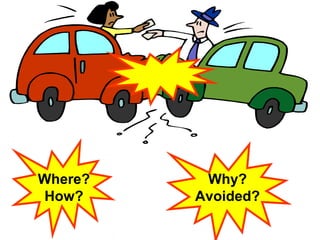
Where?    Why?
How?     Avoided?
BUSINESS RESEARCH METHODS


‘You see things and you say “Why” but I dream
things that never were and I say “Why Not?”’
                       ~ George Bernard Shaw
Causal research
Exploratory research
Pure research
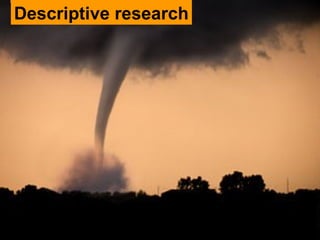
Descriptive research
Fundamental research
Contents

1.Introduction to Research
• Overview of Research Methodology
• Meaning and definition of Research
• Relevance and Significance of Research in business
• Types of Research
• Research problems
• Evolution of Research
2.Research Process
•    Introduction
•    Theoretical Framework
•    Research Hypotheses
3.Research Design
•     Introduction
•     Nature of and Classification of design
•     Developing an appropriate research design
•     Experimental Research Design
Contents

4. Randomized Design, Latin Square Design, Factorial Design
•    Basic principles, types of experimental design
•    Validity - external and internal
5. Scales and Measurements
•    Types of measurements
•    Scales and comparison between different scales
•    Characteristics – Validity
•    Different Methods of measurement
•    Developing Scales – Classification of scales
•    Rating Scales, Attitude Scales, Thurston scale
•    Likert scale, Semantic Differential scale
•    Types of Errors in measurement
•    Test of Reliability
•    Measures of Stability
•    Threats to Reliability
Contents
6.Survey Research
•   Introduction and Purpose
•   Methods of data collection - Interviews, observation,
   schedule, Questionnaire - other methods of data collection
•   Panel research, warranty cards,
•   Pantry audit and consumer panel
•   Mechanical Devices
•   Projective Techniques
•   Sociometry
7.Overview of data sources and computer research
•    Data Type
•    Primary data- Sources of Primary data
•    Secondary data - Sources of Secondary data
•    Uses of Primary and secondary data,
•    Evaluation of primary and secondary data
•    Sampling Methods
•    Computer and internet application
Contents

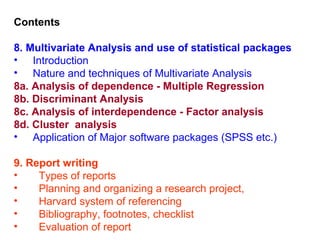
8. Multivariate Analysis and use of statistical packages
• Introduction
• Nature and techniques of Multivariate Analysis
8a. Analysis of dependence - Multiple Regression
8b. Discriminant Analysis
8c. Analysis of interdependence - Factor analysis
8d. Cluster analysis
• Application of Major software packages (SPSS etc.)

9. Report writing
•    Types of reports
•    Planning and organizing a research project,
•    Harvard system of referencing
•    Bibliography, footnotes, checklist
•    Evaluation of report
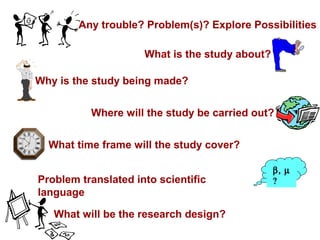
Any trouble? Problem(s)? Explore Possibilities

                     What is the study about?

Why is the study being made?


          Where will the study be carried out?


  What time frame will the study cover?

                                                β, µ
Problem translated into scientific              ?
language

   What will be the research design?
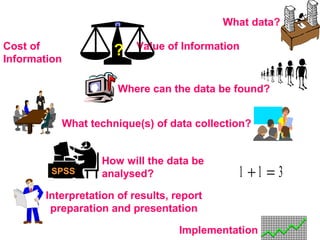
What data?

Cost of                   Value of Information
Information
                     ?

                      Where can the data be found?


          What technique(s) of data collection?


                  How will the data be
         SPSS     analysed?                  1 +1 = 3
       Interpretation of results, report
        preparation and presentation

                                   Implementation
Meaning and Definition of Research

• Research deals with the problems of life
• These problems are manifest in the social realm,
family and personal life, travel, leisure, purchases,
services rendered and demanded etc.
• NOT all problems can be solved by research
• Some problems can be solved without the aid of
formal research tools.


But our day to day life is sufficiently complex - that
thorough understanding of research methodology
facilitates and enhances reaching sound decisions.
The purpose of research is to search and develop knowledge.


In brief, research can be defined as
•   a systematic investigation of a certain situation
•   based on relevant and pertinent information and
    principles
•    procured from suitable sources – animate and / or
    inanimate
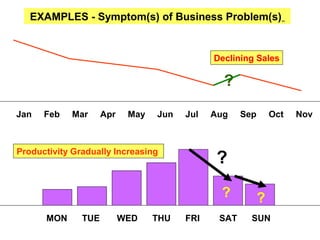
EXAMPLES - Symptom(s) of Business Problem(s)


                                              Declining Sales

                                                ?
Jan   Feb   Mar      Apr    May   Jun   Jul   Aug    Sep       Oct   Nov


Productivity Gradually Increasing
                                               ?
                                               ?           ?
      MON      TUE         WED    THU   FRI    SAT     SUN
Survey is

• observational or descriptive
• study in which
• individuals are systematically examined or critically inspected
• without detailed verification
• for the absence or presence (or degree of presence) of
characteristics of interest.

Survey is a component and form the basis for the majority
of business research that is conducted.
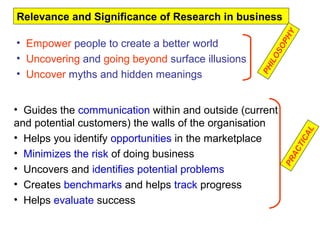
Relevance and Significance of Research in business


                                                           Y
                                                         PH
• Empower people to create a better world


                                                       SO
• Uncovering and going beyond surface illusions


                                                    ILO
                                                  PH
• Uncover myths and hidden meanings


• Guides the communication within and outside (current
and potential customers) the walls of the organisation


                                                                AL
• Helps you identify opportunities in the marketplace


                                                             TIC
• Minimizes the risk of doing business


                                                           AC
                                                         PR
• Uncovers and identifies potential problems
• Creates benchmarks and helps track progress
• Helps evaluate success
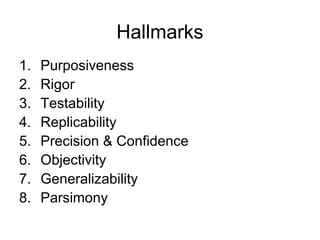
Hallmarks
1.   Purposiveness
2.   Rigor
3.   Testability
4.   Replicability
5.   Precision & Confidence
6.   Objectivity
7.   Generalizability
8.   Parsimony
Exercise
Assess the hallmarks
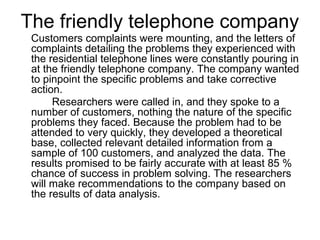
The friendly telephone company
 Customers complaints were mounting, and the letters of
 complaints detailing the problems they experienced with
 the residential telephone lines were constantly pouring in
 at the friendly telephone company. The company wanted
 to pinpoint the specific problems and take corrective
 action.
      Researchers were called in, and they spoke to a
 number of customers, nothing the nature of the specific
 problems they faced. Because the problem had to be
 attended to very quickly, they developed a theoretical
 base, collected relevant detailed information from a
 sample of 100 customers, and analyzed the data. The
 results promised to be fairly accurate with at least 85 %
 chance of success in problem solving. The researchers
 will make recommendations to the company based on
 the results of data analysis.
Induction & Deduction
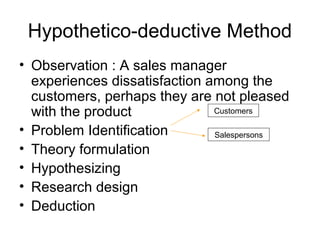
Hypothetico-deductive Method
• Observation : A sales manager
  experiences dissatisfaction among the
  customers, perhaps they are not pleased
  with the product             Customers

• Problem Identification       Salespersons
• Theory formulation
• Hypothesizing
• Research design
• Deduction
Types of Research
Exercise
• ABC Ltd. Saw trouble brewing. It was in
  distress experiencing computer problems.
  Turnover among programmers was
  unusually high and processing of a claims
  becomes a big nightmare. Clients were
  canceling their policies, claims for bypass
  surgery and such were sure way up, and
  premiums paid out relative to clients’
  medical expenses, on a percentage basis,
  was close to 85%.
Types of Research

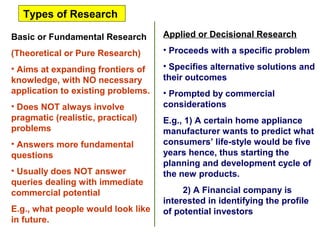
Basic or Fundamental Research       Applied or Decisional Research

(Theoretical or Pure Research)      • Proceeds with a specific problem

• Aims at expanding frontiers of    • Specifies alternative solutions and
knowledge, with NO necessary        their outcomes
application to existing problems.   • Prompted by commercial
• Does NOT always involve           considerations
pragmatic (realistic, practical)    E.g., 1) A certain home appliance
problems                            manufacturer wants to predict what
• Answers more fundamental          consumers’ life-style would be five
questions                           years hence, thus starting the
                                    planning and development cycle of
• Usually does NOT answer           the new products.
queries dealing with immediate
commercial potential                     2) A Financial company is
                                    interested in identifying the profile
E.g., what people would look like   of potential investors
in future.
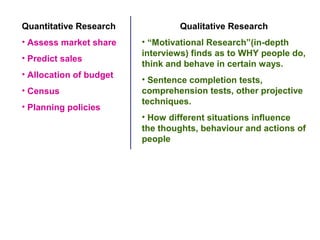
Quantitative Research            Qualitative Research
• Assess market share    • “Motivational Research”(in-depth
                         interviews) finds as to WHY people do,
• Predict sales
                         think and behave in certain ways.
• Allocation of budget
                         • Sentence completion tests,
• Census                 comprehension tests, other projective
                         techniques.
• Planning policies
                         • How different situations influence
                         the thoughts, behaviour and actions of
                         people
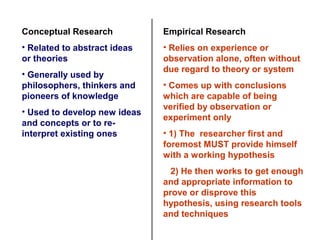
Conceptual Research           Empirical Research
• Related to abstract ideas   • Relies on experience or
or theories                   observation alone, often without
                              due regard to theory or system
• Generally used by
philosophers, thinkers and    • Comes up with conclusions
pioneers of knowledge         which are capable of being
                              verified by observation or
• Used to develop new ideas
                              experiment only
and concepts or to re-
interpret existing ones       • 1) The researcher first and
                              foremost MUST provide himself
                              with a working hypothesis
                                2) He then works to get enough
                              and appropriate information to
                              prove or disprove this
                              hypothesis, using research tools
                              and techniques
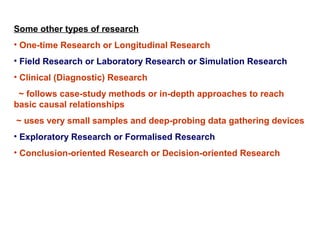
Some other types of research
• One-time Research or Longitudinal Research
• Field Research or Laboratory Research or Simulation Research
• Clinical (Diagnostic) Research
 ~ follows case-study methods or in-depth approaches to reach
basic causal relationships
~ uses very small samples and deep-probing data gathering devices
• Exploratory Research or Formalised Research
• Conclusion-oriented Research or Decision-oriented Research
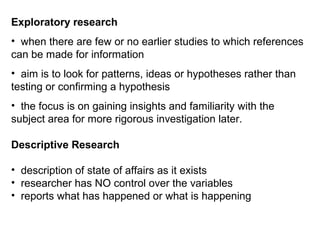
Exploratory research
• when there are few or no earlier studies to which references
can be made for information
• aim is to look for patterns, ideas or hypotheses rather than
testing or confirming a hypothesis
• the focus is on gaining insights and familiarity with the
subject area for more rigorous investigation later.

Descriptive Research

• description of state of affairs as it exists
• researcher has NO control over the variables
• reports what has happened or what is happening
Q&A’s
One hears the word research being mentioned by
 several groups such as research organizations,
 college and university professors, doctoral
 students, graduate assistants working for faculty,
 graduate and undergraduate students doing
 their term papers, research departments in the
 industry, newspaper reporters, journalists,
 lawyers, doctors, and many other professionals
 and non- professionals.
Which among the aforementioned groups are
 involved in the areas of basic or applied
 research? Why?
Dilemmas of Nisha Sabarwal
  Nisha Sabarwal, Chief production Manager, was on top of the world
  just two years ago. In her non traditional job, she was cited to e a
  real backbone of the company, and a performance was in no small
  measure responsible fr the mergers the institution was
  contemplating with other well known global cooperations.

Of late though , the products of the company had to be recalled several
   times owing to safety concerns . Quality glitches and production
   delays also plagued the company.

To project a good image to customers, Sabarwal developed a very
   reassuring website and made sweeping changes in the
   manufacturing process to enhance the guilty of he product, minimize
   defects and enhance the efficiency of the workers. A year after all
   these changes the company continues to recall defective products!!!
Any doubts?

  Thank you

Research intro

  • 1.
    __________________________________ __________________________________ to __________________________________ __________________________________ m e __________________________________ co ess __________________________________ el n __________________________________ __________________________________ w si __________________________________ u __________________________________ b ch __________________________________ ar s __________________________________ se d __________________________________ re ho __________________________________ __________________________________ et __________________________________ __________________________________ m __________________________________ __________________________________
  • 2.
    Where? Why? How? Avoided?
  • 4.
    BUSINESS RESEARCH METHODS ‘Yousee things and you say “Why” but I dream things that never were and I say “Why Not?”’ ~ George Bernard Shaw
  • 5.
  • 6.
  • 7.
  • 8.
  • 9.
  • 10.
    Contents 1.Introduction to Research •Overview of Research Methodology • Meaning and definition of Research • Relevance and Significance of Research in business • Types of Research • Research problems • Evolution of Research 2.Research Process • Introduction • Theoretical Framework • Research Hypotheses 3.Research Design • Introduction • Nature of and Classification of design • Developing an appropriate research design • Experimental Research Design
  • 11.
    Contents 4. Randomized Design,Latin Square Design, Factorial Design • Basic principles, types of experimental design • Validity - external and internal 5. Scales and Measurements • Types of measurements • Scales and comparison between different scales • Characteristics – Validity • Different Methods of measurement • Developing Scales – Classification of scales • Rating Scales, Attitude Scales, Thurston scale • Likert scale, Semantic Differential scale • Types of Errors in measurement • Test of Reliability • Measures of Stability • Threats to Reliability
  • 12.
    Contents 6.Survey Research • Introduction and Purpose • Methods of data collection - Interviews, observation, schedule, Questionnaire - other methods of data collection • Panel research, warranty cards, • Pantry audit and consumer panel • Mechanical Devices • Projective Techniques • Sociometry 7.Overview of data sources and computer research • Data Type • Primary data- Sources of Primary data • Secondary data - Sources of Secondary data • Uses of Primary and secondary data, • Evaluation of primary and secondary data • Sampling Methods • Computer and internet application
  • 13.
    Contents 8. Multivariate Analysisand use of statistical packages • Introduction • Nature and techniques of Multivariate Analysis 8a. Analysis of dependence - Multiple Regression 8b. Discriminant Analysis 8c. Analysis of interdependence - Factor analysis 8d. Cluster analysis • Application of Major software packages (SPSS etc.) 9. Report writing • Types of reports • Planning and organizing a research project, • Harvard system of referencing • Bibliography, footnotes, checklist • Evaluation of report
  • 14.
    Any trouble? Problem(s)?Explore Possibilities What is the study about? Why is the study being made? Where will the study be carried out? What time frame will the study cover? β, µ Problem translated into scientific ? language What will be the research design?
  • 15.
    What data? Cost of Value of Information Information ? Where can the data be found? What technique(s) of data collection? How will the data be SPSS analysed? 1 +1 = 3 Interpretation of results, report preparation and presentation Implementation
  • 16.
    Meaning and Definitionof Research • Research deals with the problems of life • These problems are manifest in the social realm, family and personal life, travel, leisure, purchases, services rendered and demanded etc. • NOT all problems can be solved by research • Some problems can be solved without the aid of formal research tools. But our day to day life is sufficiently complex - that thorough understanding of research methodology facilitates and enhances reaching sound decisions.
  • 17.
    The purpose ofresearch is to search and develop knowledge. In brief, research can be defined as • a systematic investigation of a certain situation • based on relevant and pertinent information and principles • procured from suitable sources – animate and / or inanimate
  • 18.
    EXAMPLES - Symptom(s)of Business Problem(s) Declining Sales ? Jan Feb Mar Apr May Jun Jul Aug Sep Oct Nov Productivity Gradually Increasing ? ? ? MON TUE WED THU FRI SAT SUN
  • 19.
    Survey is • observationalor descriptive • study in which • individuals are systematically examined or critically inspected • without detailed verification • for the absence or presence (or degree of presence) of characteristics of interest. Survey is a component and form the basis for the majority of business research that is conducted.
  • 20.
    Relevance and Significanceof Research in business Y PH • Empower people to create a better world SO • Uncovering and going beyond surface illusions ILO PH • Uncover myths and hidden meanings • Guides the communication within and outside (current and potential customers) the walls of the organisation AL • Helps you identify opportunities in the marketplace TIC • Minimizes the risk of doing business AC PR • Uncovers and identifies potential problems • Creates benchmarks and helps track progress • Helps evaluate success
  • 21.
    Hallmarks 1. Purposiveness 2. Rigor 3. Testability 4. Replicability 5. Precision & Confidence 6. Objectivity 7. Generalizability 8. Parsimony
  • 22.
  • 23.
    The friendly telephonecompany Customers complaints were mounting, and the letters of complaints detailing the problems they experienced with the residential telephone lines were constantly pouring in at the friendly telephone company. The company wanted to pinpoint the specific problems and take corrective action. Researchers were called in, and they spoke to a number of customers, nothing the nature of the specific problems they faced. Because the problem had to be attended to very quickly, they developed a theoretical base, collected relevant detailed information from a sample of 100 customers, and analyzed the data. The results promised to be fairly accurate with at least 85 % chance of success in problem solving. The researchers will make recommendations to the company based on the results of data analysis.
  • 24.
  • 25.
    Hypothetico-deductive Method • Observation: A sales manager experiences dissatisfaction among the customers, perhaps they are not pleased with the product Customers • Problem Identification Salespersons • Theory formulation • Hypothesizing • Research design • Deduction
  • 26.
  • 27.
    Exercise • ABC Ltd.Saw trouble brewing. It was in distress experiencing computer problems. Turnover among programmers was unusually high and processing of a claims becomes a big nightmare. Clients were canceling their policies, claims for bypass surgery and such were sure way up, and premiums paid out relative to clients’ medical expenses, on a percentage basis, was close to 85%.
  • 28.
    Types of Research Basicor Fundamental Research Applied or Decisional Research (Theoretical or Pure Research) • Proceeds with a specific problem • Aims at expanding frontiers of • Specifies alternative solutions and knowledge, with NO necessary their outcomes application to existing problems. • Prompted by commercial • Does NOT always involve considerations pragmatic (realistic, practical) E.g., 1) A certain home appliance problems manufacturer wants to predict what • Answers more fundamental consumers’ life-style would be five questions years hence, thus starting the planning and development cycle of • Usually does NOT answer the new products. queries dealing with immediate commercial potential 2) A Financial company is interested in identifying the profile E.g., what people would look like of potential investors in future.
  • 29.
    Quantitative Research Qualitative Research • Assess market share • “Motivational Research”(in-depth interviews) finds as to WHY people do, • Predict sales think and behave in certain ways. • Allocation of budget • Sentence completion tests, • Census comprehension tests, other projective techniques. • Planning policies • How different situations influence the thoughts, behaviour and actions of people
  • 30.
    Conceptual Research Empirical Research • Related to abstract ideas • Relies on experience or or theories observation alone, often without due regard to theory or system • Generally used by philosophers, thinkers and • Comes up with conclusions pioneers of knowledge which are capable of being verified by observation or • Used to develop new ideas experiment only and concepts or to re- interpret existing ones • 1) The researcher first and foremost MUST provide himself with a working hypothesis 2) He then works to get enough and appropriate information to prove or disprove this hypothesis, using research tools and techniques
  • 31.
    Some other typesof research • One-time Research or Longitudinal Research • Field Research or Laboratory Research or Simulation Research • Clinical (Diagnostic) Research ~ follows case-study methods or in-depth approaches to reach basic causal relationships ~ uses very small samples and deep-probing data gathering devices • Exploratory Research or Formalised Research • Conclusion-oriented Research or Decision-oriented Research
  • 32.
    Exploratory research • whenthere are few or no earlier studies to which references can be made for information • aim is to look for patterns, ideas or hypotheses rather than testing or confirming a hypothesis • the focus is on gaining insights and familiarity with the subject area for more rigorous investigation later. Descriptive Research • description of state of affairs as it exists • researcher has NO control over the variables • reports what has happened or what is happening
  • 33.
    Q&A’s One hears theword research being mentioned by several groups such as research organizations, college and university professors, doctoral students, graduate assistants working for faculty, graduate and undergraduate students doing their term papers, research departments in the industry, newspaper reporters, journalists, lawyers, doctors, and many other professionals and non- professionals. Which among the aforementioned groups are involved in the areas of basic or applied research? Why?
  • 34.
    Dilemmas of NishaSabarwal Nisha Sabarwal, Chief production Manager, was on top of the world just two years ago. In her non traditional job, she was cited to e a real backbone of the company, and a performance was in no small measure responsible fr the mergers the institution was contemplating with other well known global cooperations. Of late though , the products of the company had to be recalled several times owing to safety concerns . Quality glitches and production delays also plagued the company. To project a good image to customers, Sabarwal developed a very reassuring website and made sweeping changes in the manufacturing process to enhance the guilty of he product, minimize defects and enhance the efficiency of the workers. A year after all these changes the company continues to recall defective products!!!
  • 35.
    Any doubts? Thank you