Experimental Research
       Design

       Presented by:
      Paola Bianca, Basa
     Dalluay, Maria Frances
      Marquez, Mareshka
         Pineda, Lizelle
Outline
I. Definition
II. Type of problem
III. Data Collection Procedures
    Instruments
    Procedures
    Participants
IV. Data Analysis and Interpretation Procedures
    Data Analysis
    Interpretation
    Conclusion
V. References
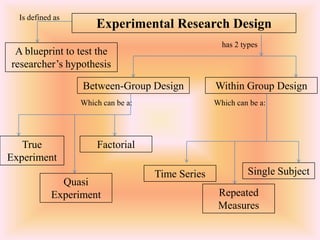
Is defined as
                      Experimental Research Design
                                                    has 2 types
 A blueprint to test the
researcher’s hypothesis

                  Between-Group Design            Within Group Design
                  Which can be a:                 Which can be a:


   True               Factorial
Experiment
                                    Time Series            Single Subject
              Quasi
            Experiment                             Repeated
                                                   Measures
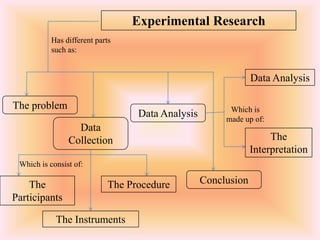
Experimental Research
           Has different parts
           such as:


                                                                Data Analysis

The problem                                              Which is
                                   Data Analysis        made up of:
                  Data
                Collection                                           The
                                                                Interpretation
 Which is consist of:

    The                      The Procedure         Conclusion
Participants

            The Instruments
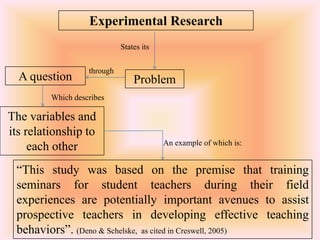
Experimental Research
                             States its


                   through
  A question                     Problem
         Which describes

The variables and
its relationship to
                                          An example of which is:
     each other
 “This study was based on the premise that training
 seminars for student teachers during their field
 experiences are potentially important avenues to assist
 prospective teachers in developing effective teaching
 behaviors”. (Deno & Schelske, as cited in Creswell, 2005)
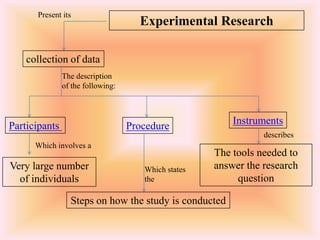
Present its
                                     Experimental Research

    collection of data
               The description
               of the following:


Participants                                             Instruments
                                   Procedure
                                                                describes
      Which involves a
                                                     The tools needed to
Very large number                     Which states   answer the research
  of individuals                      the                 question

                 Steps on how the study is conducted
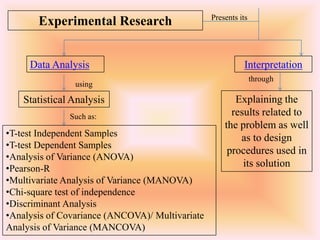
Presents its
       Experimental Research


     Data Analysis                                         Interpretation
                                                                through
                using

    Statistical Analysis                                Explaining the
               Such as:                                results related to
                                                     the problem as well
•T-test Independent Samples                              as to design
•T-test Dependent Samples
                                                      procedures used in
•Analysis of Variance (ANOVA)
•Pearson-R
                                                          its solution
•Multivariate Analysis of Variance (MANOVA)
•Chi-square test of independence
•Discriminant Analysis
•Analysis of Covariance (ANCOVA)/ Multivariate
Analysis of Variance (MANCOVA)
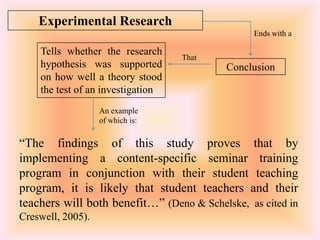
Experimental Research
                                                Ends with a

    Tells whether the research
                                   That
    hypothesis was supported               Conclusion
    on how well a theory stood
    the test of an investigation
                   An example
                   of which is:


“The findings of this study proves that by
implementing a content-specific seminar training
program in conjunction with their student teaching
program, it is likely that student teachers and their
teachers will both benefit…” (Deno & Schelske, as cited in
Creswell, 2005).
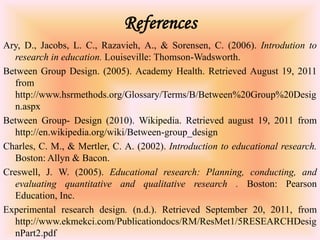
References
Ary, D., Jacobs, L. C., Razavieh, A., & Sorensen, C. (2006). Introdution to
   research in education. Louiseville: Thomson-Wadsworth.
Between Group Design. (2005). Academy Health. Retrieved August 19, 2011
   from
   http://www.hsrmethods.org/Glossary/Terms/B/Between%20Group%20Desig
   n.aspx
Between Group- Design (2010). Wikipedia. Retrieved august 19, 2011 from
   http://en.wikipedia.org/wiki/Between-group_design
Charles, C. M., & Mertler, C. A. (2002). Introduction to educational research.
   Boston: Allyn & Bacon.
Creswell, J. W. (2005). Educational research: Planning, conducting, and
   evaluating quantitative and qualitative research . Boston: Pearson
   Education, Inc.
Experimental research design. (n.d.). Retrieved September 20, 2011, from
   http://www.ekmekci.com/Publicationdocs/RM/ResMet1/5RESEARCHDesig
   nPart2.pdf
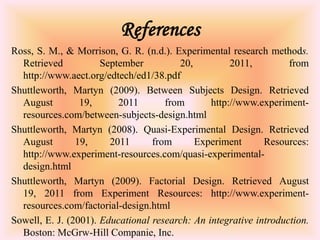
References
Ross, S. M., & Morrison, G. R. (n.d.). Experimental research methods.
  Retrieved           September         20,          2011,         from
  http://www.aect.org/edtech/ed1/38.pdf
Shuttleworth, Martyn (2009). Between Subjects Design. Retrieved
  August         19,      2011       from       http://www.experiment-
  resources.com/between-subjects-design.html
Shuttleworth, Martyn (2008). Quasi-Experimental Design. Retrieved
  August        19,     2011      from      Experiment       Resources:
  http://www.experiment-resources.com/quasi-experimental-
  design.html
Shuttleworth, Martyn (2009). Factorial Design. Retrieved August
  19, 2011 from Experiment Resources: http://www.experiment-
  resources.com/factorial-design.html
Sowell, E. J. (2001). Educational research: An integrative introduction.
  Boston: McGrw-Hill Companie, Inc.
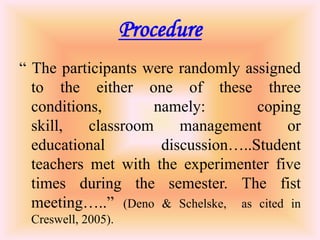
Procedure
“ The participants were randomly assigned
  to the either one of these three
  conditions,        namely:        coping
  skill,   classroom     management      or
  educational         discussion…..Student
  teachers met with the experimenter five
  times during the semester. The fist
  meeting…..” (Deno & Schelske, as cited in
 Creswell, 2005).
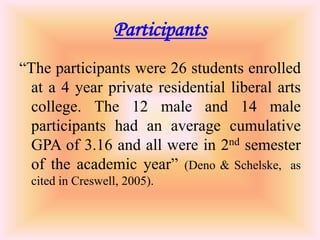
Participants
“The participants were 26 students enrolled
  at a 4 year private residential liberal arts
  college. The 12 male and 14 male
  participants had an average cumulative
  GPA of 3.16 and all were in 2nd semester
  of the academic year” (Deno & Schelske, as
 cited in Creswell, 2005).
Instruments
“ Three instruments were used to determine
  teacher effectiveness. Two instruments
  were used to measure student behavior…
  The component rating scale was used to
  measure teacher’s class management
  skills…A student evaluation scale was
  used to….” (Deno & Schelske, as cited in
 Creswell, 2005).
Data Analysis
“ To determine if differences existed between the
  groups, the dependent data were statistically
  analyzed using T-test…The first analysis
  focused on the..using the component rating
  scale…the results reveal that…the second
  examined the…using their overall performance
  on the student teaching evaluation…the third
  was directed at pupil on-task behavior…”
  (Deno & Schelske, as cited in Creswell, 2005).
Interpretation
“The results from both of the faculty
  ratings provide a basis for concluding that
  content-specific     training     seminars
  contribute MORE to the development of
  effective classroom management skills”
 (Deno & Schelske, as cited in Creswell, 2005).

Experimental research design.revised

  • 1.
    Experimental Research Design Presented by: Paola Bianca, Basa Dalluay, Maria Frances Marquez, Mareshka Pineda, Lizelle
  • 2.
    Outline I. Definition II. Typeof problem III. Data Collection Procedures  Instruments  Procedures  Participants IV. Data Analysis and Interpretation Procedures  Data Analysis  Interpretation  Conclusion V. References
  • 3.
    Is defined as Experimental Research Design has 2 types A blueprint to test the researcher’s hypothesis Between-Group Design Within Group Design Which can be a: Which can be a: True Factorial Experiment Time Series Single Subject Quasi Experiment Repeated Measures
  • 4.
    Experimental Research Has different parts such as: Data Analysis The problem Which is Data Analysis made up of: Data Collection The Interpretation Which is consist of: The The Procedure Conclusion Participants The Instruments
  • 5.
    Experimental Research States its through A question Problem Which describes The variables and its relationship to An example of which is: each other “This study was based on the premise that training seminars for student teachers during their field experiences are potentially important avenues to assist prospective teachers in developing effective teaching behaviors”. (Deno & Schelske, as cited in Creswell, 2005)
  • 6.
    Present its Experimental Research collection of data The description of the following: Participants Instruments Procedure describes Which involves a The tools needed to Very large number Which states answer the research of individuals the question Steps on how the study is conducted
  • 7.
    Presents its Experimental Research Data Analysis Interpretation through using Statistical Analysis Explaining the Such as: results related to the problem as well •T-test Independent Samples as to design •T-test Dependent Samples procedures used in •Analysis of Variance (ANOVA) •Pearson-R its solution •Multivariate Analysis of Variance (MANOVA) •Chi-square test of independence •Discriminant Analysis •Analysis of Covariance (ANCOVA)/ Multivariate Analysis of Variance (MANCOVA)
  • 8.
    Experimental Research Ends with a Tells whether the research That hypothesis was supported Conclusion on how well a theory stood the test of an investigation An example of which is: “The findings of this study proves that by implementing a content-specific seminar training program in conjunction with their student teaching program, it is likely that student teachers and their teachers will both benefit…” (Deno & Schelske, as cited in Creswell, 2005).
  • 9.
    References Ary, D., Jacobs,L. C., Razavieh, A., & Sorensen, C. (2006). Introdution to research in education. Louiseville: Thomson-Wadsworth. Between Group Design. (2005). Academy Health. Retrieved August 19, 2011 from http://www.hsrmethods.org/Glossary/Terms/B/Between%20Group%20Desig n.aspx Between Group- Design (2010). Wikipedia. Retrieved august 19, 2011 from http://en.wikipedia.org/wiki/Between-group_design Charles, C. M., & Mertler, C. A. (2002). Introduction to educational research. Boston: Allyn & Bacon. Creswell, J. W. (2005). Educational research: Planning, conducting, and evaluating quantitative and qualitative research . Boston: Pearson Education, Inc. Experimental research design. (n.d.). Retrieved September 20, 2011, from http://www.ekmekci.com/Publicationdocs/RM/ResMet1/5RESEARCHDesig nPart2.pdf
  • 10.
    References Ross, S. M.,& Morrison, G. R. (n.d.). Experimental research methods. Retrieved September 20, 2011, from http://www.aect.org/edtech/ed1/38.pdf Shuttleworth, Martyn (2009). Between Subjects Design. Retrieved August 19, 2011 from http://www.experiment- resources.com/between-subjects-design.html Shuttleworth, Martyn (2008). Quasi-Experimental Design. Retrieved August 19, 2011 from Experiment Resources: http://www.experiment-resources.com/quasi-experimental- design.html Shuttleworth, Martyn (2009). Factorial Design. Retrieved August 19, 2011 from Experiment Resources: http://www.experiment- resources.com/factorial-design.html Sowell, E. J. (2001). Educational research: An integrative introduction. Boston: McGrw-Hill Companie, Inc.
  • 11.
    Procedure “ The participantswere randomly assigned to the either one of these three conditions, namely: coping skill, classroom management or educational discussion…..Student teachers met with the experimenter five times during the semester. The fist meeting…..” (Deno & Schelske, as cited in Creswell, 2005).
  • 12.
    Participants “The participants were26 students enrolled at a 4 year private residential liberal arts college. The 12 male and 14 male participants had an average cumulative GPA of 3.16 and all were in 2nd semester of the academic year” (Deno & Schelske, as cited in Creswell, 2005).
  • 13.
    Instruments “ Three instrumentswere used to determine teacher effectiveness. Two instruments were used to measure student behavior… The component rating scale was used to measure teacher’s class management skills…A student evaluation scale was used to….” (Deno & Schelske, as cited in Creswell, 2005).
  • 14.
    Data Analysis “ Todetermine if differences existed between the groups, the dependent data were statistically analyzed using T-test…The first analysis focused on the..using the component rating scale…the results reveal that…the second examined the…using their overall performance on the student teaching evaluation…the third was directed at pupil on-task behavior…” (Deno & Schelske, as cited in Creswell, 2005).
  • 15.
    Interpretation “The results fromboth of the faculty ratings provide a basis for concluding that content-specific training seminars contribute MORE to the development of effective classroom management skills” (Deno & Schelske, as cited in Creswell, 2005).