Measurement of Variables
How are variables measured?
• Office desk
• Demographic data
• Absenteeism (decision making when who
  is to be fired?)
• Blood pressure, height, weight.
• Perception, feelings and attitude
  (subjective)
Operational Definition or
    Operationalizing the Concept
Way of measuring abstract things to
 observable characteristics and behaviour.
Concept: Thirsty
Drink plenty of fluids

To determine the thirst levels of each
 individuals by measuring the quantity of
 fluid they consume to quench their thirst
Mc Cleland’s theory
• Need of Achievement
• Need of Power
• Need of Affiliation


       Need of Achievement
            Measure?
What behavioral dimension is
 observed within people driven by
        high motivation?
1. Work round the clock or driven by work.
2. Unwillingness to relax
3. Work on their own
4. Challenging job but not too challenging
   where probability of success is low
5. Progress by getting feedback
Dimension 1: Work round the clock
• Working all the time( number of hours
  worker in a day)
• Persevere even in face of some setbacks
( nos. of setbacks experienced in task)
• Reluctance to take time off ( how
  frequently time off and for what reasons)
Dimension 2: Unwillingness to relax
• How often you think about work when you
  are away from workplace?
• What are your hobbies?
• How do you spend your time when you
  are away from the workplace?

 Continuum of who relax very well to who
              relax very little
Dimension 3: Work on their own
 No patience with ineffective people and
 are reluctant to work with others

    Impatience with ineffectiveness
Dimension 4: Challenging job but
      not too challenging
Routine or stereotyped job description and
 other calling for gradations of challenge
 built into them

    Those to opt for medium degree of
   challenge would have high achievement
    orientation then lower or higher ones
Dimension 5: Progress by getting
              feedback
• Like feedback from superiors and even
  subordinates
• Appreciate both positive and negative
 by keeping a track on how often individuals
  seek feedback from other during a certain
  period of time-say a month or more.
   Continuum of extensive feedback to no
                   feedback
1.    To what extent you push yourself to get the work done?
2.    How difficult do you find it to continue in face of failures or discouraging
      results?
3.    How often do you neglect personal matters because you are preoccupied
      by your job?
4.    How frequently you think about ur job when away?
5.    To what extent you engage in hobbies?
6.    How disappointed you feel on not reaching goals you had set for
      yourself?
7.    How much do you concentrate on job?
8.    How annoyed you get when you make mistakes?
9.    To what extent u refer to work with a friendly but incompetent to one
      who’s competent?
10.   To what extent u prefer to work yourself?
11.   To what extent you prefer a job that is difficult but challenging than easy
      to routine?
12.   To what degree you prefer extremely difficult assignment to easy one?
13.   During 3 months, how often have you sought for feedback from
      superiors?
14.   During 3 months, how often have you sought for feedback from
      coworkers?
15.   How often within 3 months you have checked with your subordinates that
      what you are doing in not getting in their way of efficient performance/
16.   To what extent would it frustrate you if people did not give you feedback
      on how you are progressing?
What is operational definition is not
• Not reasons, antecedents, consequences
  and correlates
• It describes observable characteristics

Exercise:
Operationalize concept of Learning and
 Stress
Scaling
• the process or result of
• observing an event or object
• in order to determine its extent or quantity
• by comparison with a known unit and
• then assigning numbers or any other
  symbols to characteristic or feature
• according to some prespecified formal
  rules.
There are four primary scales of
           measurement are

•   Nominal (or categorical) scale
•   Ordinal scale
•   Interval scale
•   Ratio scale
Nominal Scale

• does not express any values or relationships
  between variables
• the only mathematical or statistical operation
  that can be performed on nominal scales is a
  frequency run or count
• most of the demographic information collected is
  in the form of nominal scales
• categories are mutually exclusive and
  exhaustive
Example
• American
• Australian
• Chinese
• German
• Indian
Every respondent has to fit any one
• Example 1
• Gender – male or female
• Example 2
• Do you use Fair and Lovely soap?– yes or no
• Example 3
• Are you undergraduate, graduate or post graduate?
Exercise
• Suggest two variables that would be
  natural candidates for nominal scales and
  set up mutually exclusive or collectively
  exhaustive categories for each.
Ordinal Scale
categories have a logical or ordered relationship
to each other (rank-orders the categories in a
meaningful way)
 – permit the measurement of degrees of difference, but
   not the specific amount of difference.
 – only possible to determine whether an object or
   individual has more or less or equal amount of
   characteristic in comparison to any other – but NOT
   what amount of this characteristic
Example
• Example - Let there be 3 students A, B and C
  who respectively received 10, 12 and 20 marks
  in a test.
• The ranks would be – A – 1st           B – 2nd
      C – 3rd
•
• The quantitative (numerical) difference between
  1 and 2 is the same as that between 2 and 3.
• But the difference between the ranks, 1st and
  2nd is NOT the same as that between 2nd and
  3rd.
Exercise
Develop an ordinal scale for consumer
 preferences for different brands of beer
Interval Scale

• numbers are used to rate and assess objects so
  that numerically equal distances on the scale
  represent equal distances in the characteristic
  being measured
• distance between adjacent points on the scale is
  equal
• It helps to compute mean and standard
  deviation
• no true zero in this scale
Example
Let there be 4 students A, B, C and D who respectively
  received 4, 10, 16 and 20 marks in a test.

Is D doubly brilliant than B?
Is A’s brilliance a quarter that of C’s?
The quantitative (numerical) difference between A’s marks
   and B’s is the same as that between B’s and C’s
The quantitative (numerical) difference between C’s marks
   and D’s is thrice that between B’s and C’s.
Exercise
Develop Achievement motivation on the
 interval scale
Ratio Scale

• This scale consists not only of equidistant
  points but also has a meaningful zero
  point
• most sophisticated of scales, since it
  incorporates all the properties of nominal,
  ordinal and interval scales
Example
(1) Temperature measured in degrees Kelvin is a ratio
   scale. because absolute zero = meaningful zero point
0° K on the Kelvin scale = – 273.15 °C on the Celsius scale
(2) If we ask 2 respondents their ages,
difference between any two years would always be the
   same
‘zero’ would signify the absence of age or birth
Hence, a 100-year old person is indeed twice as old as a
   50-year old one.
Sales figures, quantities purchased and market share are
   all expressed on a ratio scale.
(4) most commonly when respondents are asked for their
   age, income, years of participation, etc.
Exercise

Mention one variable for each of the four
 scales in the context of a market survey
 and explain how or why it would fit into the
 scale.
Rating Scales
• Dichotomous scale
 Elicits a Yes or No answer (nominal)
• Category scale
 Multiple items to elicit a single response
  (nominal)
• Likert Scale Strong subjects on 5 pt scale
 SD 1       D2 N3 A4 SA5
• Semantic Differential
Bipolar attributes identified at extremes of
  the scale(interval)
Responsive__ __ __ __ __ __ __Unresponsive
• Numerical 5pt or 7pt scale
Extremely pleased 7 6 5 4 3 2 1Extremly Displeased
• Itemized rating scale : 5 or 7 pt scale.
  Balanced scale with a neutral point
( unlikely & likely)
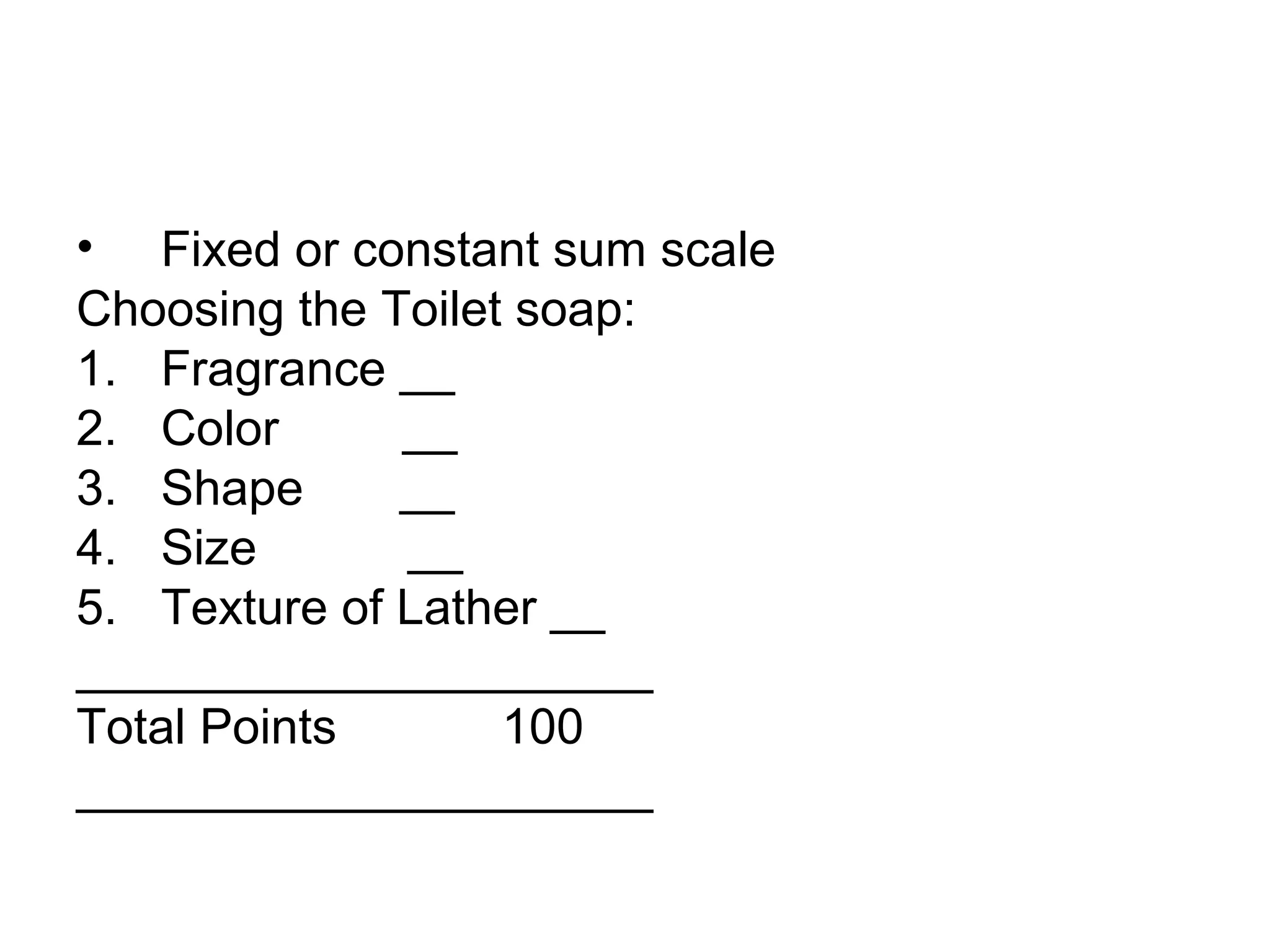
• Fixed or constant sum scale
Choosing the Toilet soap:
1. Fragrance __
2. Color      __
3. Shape      __
4. Size       __
5. Texture of Lather __
_____________________
Total Points       100
_____________________
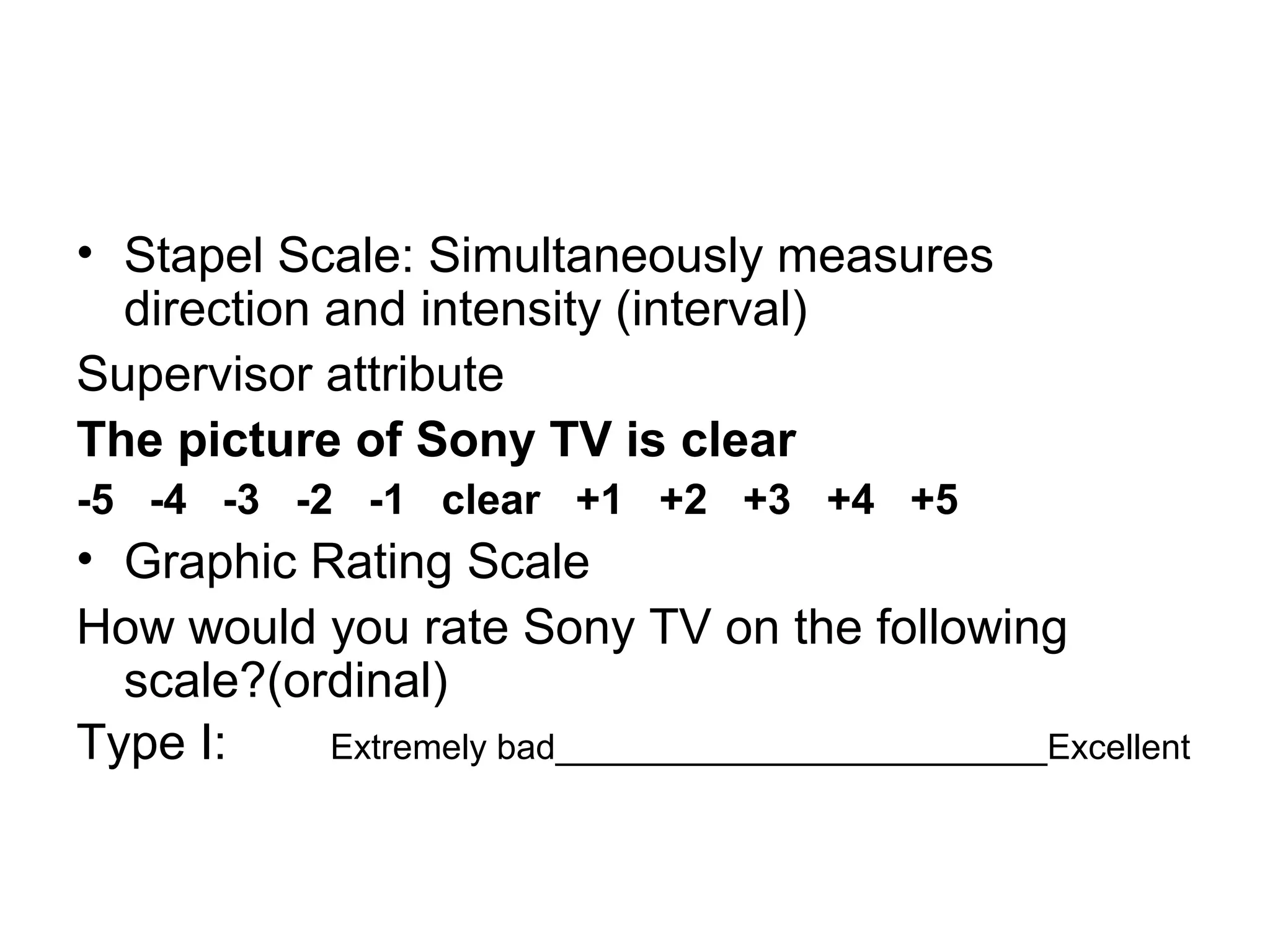
• Stapel Scale: Simultaneously measures
  direction and intensity (interval)
Supervisor attribute
The picture of Sony TV is clear
-5 -4 -3 -2 -1 clear +1 +2 +3 +4 +5
• Graphic Rating Scale
How would you rate Sony TV on the following
  scale?(ordinal)
Type I:    Extremely bad_________________________Excellent
• Consensus or Thurstone Equal Appearing
  Interval scale
• Multidimensional scaling- conjoint analysis
Ranking Scales
• Ordinal nature
• They do not give definitive clues
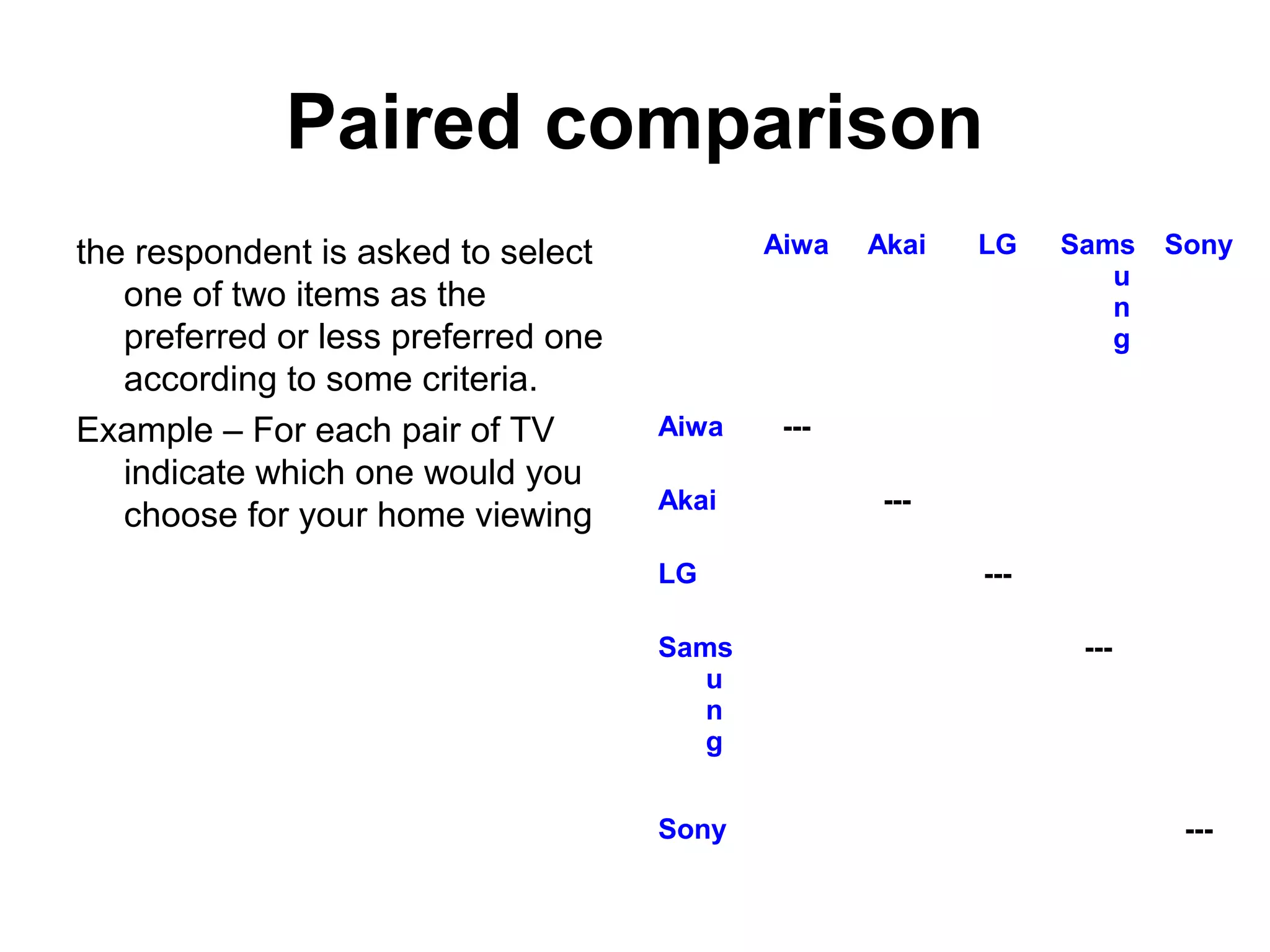
Paired comparison
the respondent is asked to select           Aiwa   Akai   LG    Sams   Sony
                                                                   u
   one of two items as the                                         n
   preferred or less preferred one                                 g
   according to some criteria.
Example – For each pair of TV        Aiwa    ---
   indicate which one would you
                                     Akai           ---
   choose for your home viewing
                                     LG                   ---

                                     Sams                        ---
                                        u
                                        n
                                        g


                                     Sony                               ---
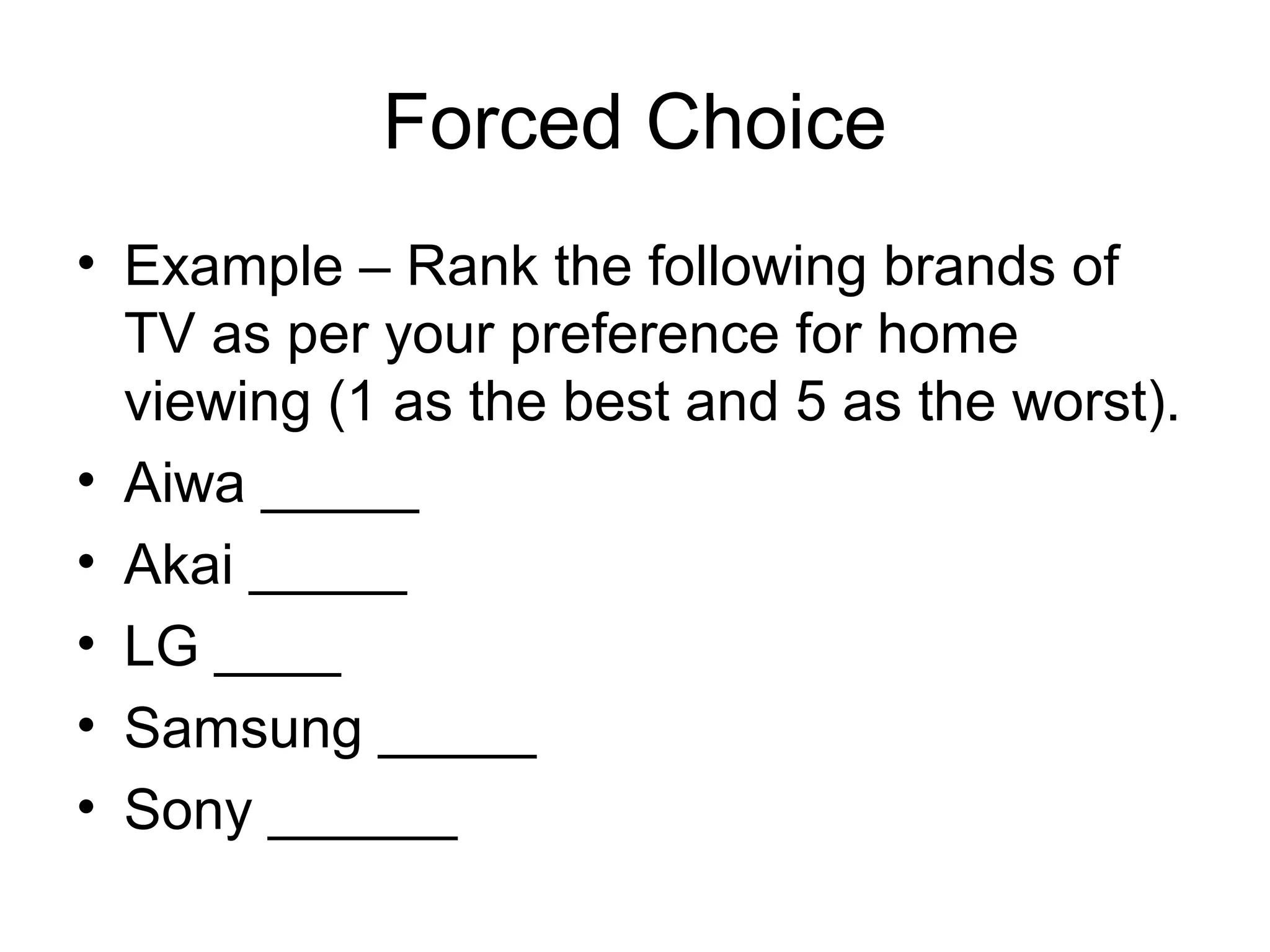
Forced Choice
• Example – Rank the following brands of
  TV as per your preference for home
  viewing (1 as the best and 5 as the worst).
• Aiwa _____
• Akai _____
• LG ____
• Samsung _____
• Sony ______
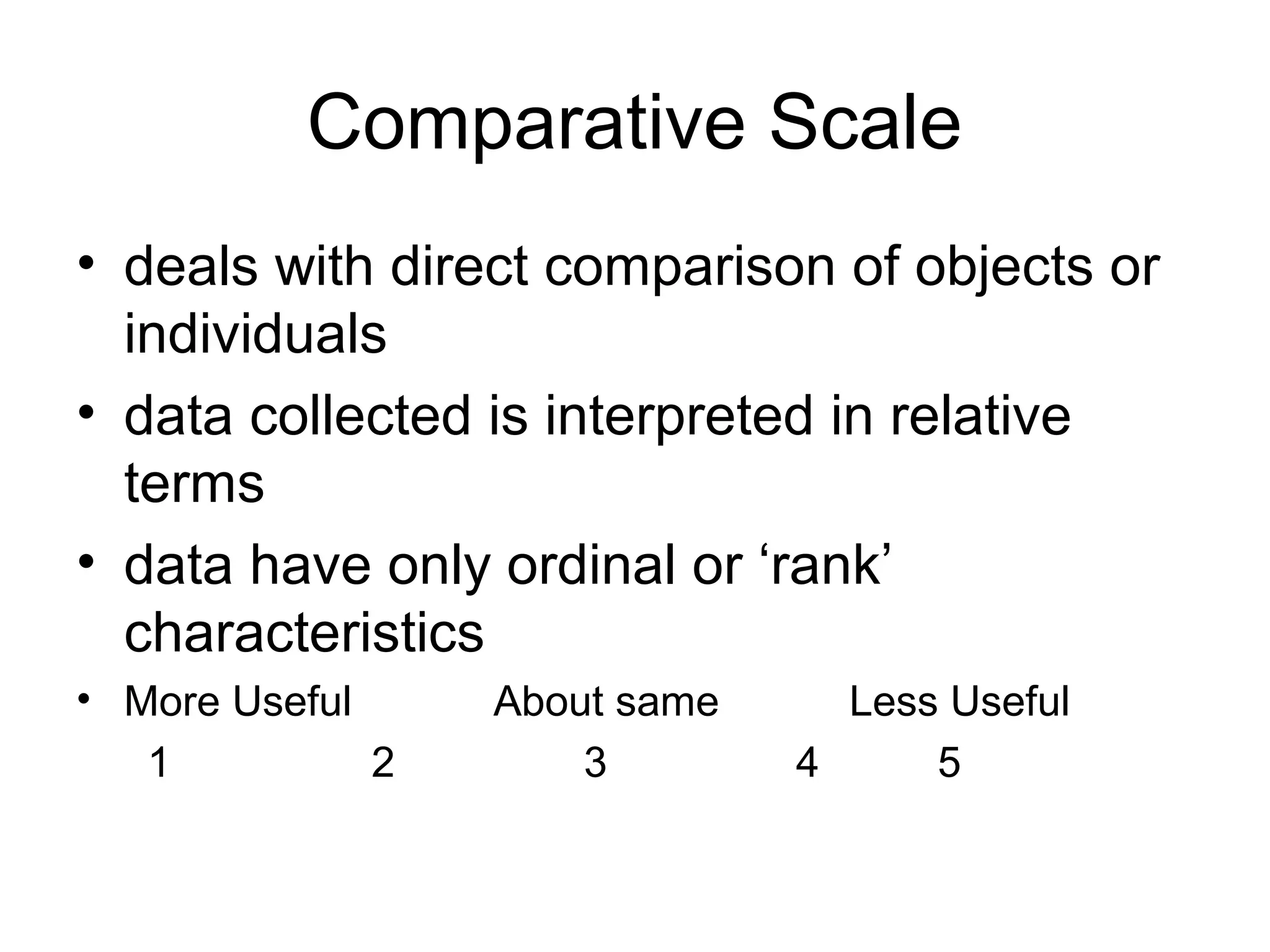
Comparative Scale
• deals with direct comparison of objects or
  individuals
• data collected is interpreted in relative
  terms
• data have only ordinal or ‘rank’
  characteristics
• More Useful     About same     Less Useful
   1          2       3        4     5
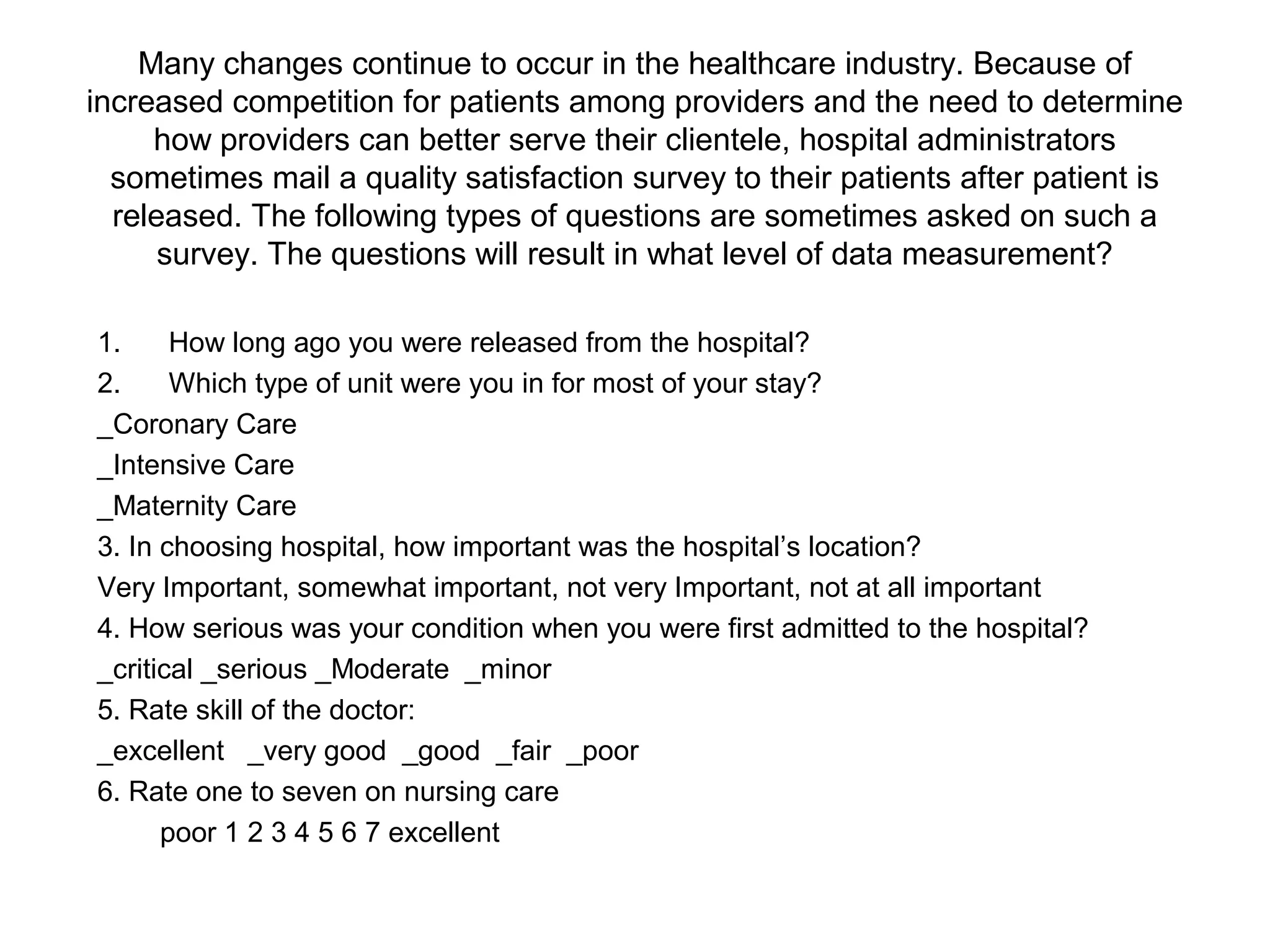
Many changes continue to occur in the healthcare industry. Because of
increased competition for patients among providers and the need to determine
     how providers can better serve their clientele, hospital administrators
  sometimes mail a quality satisfaction survey to their patients after patient is
  released. The following types of questions are sometimes asked on such a
      survey. The questions will result in what level of data measurement?

1.     How long ago you were released from the hospital?
2.     Which type of unit were you in for most of your stay?
_Coronary Care
_Intensive Care
_Maternity Care
3. In choosing hospital, how important was the hospital’s location?
Very Important, somewhat important, not very Important, not at all important
4. How serious was your condition when you were first admitted to the hospital?
_critical _serious _Moderate _minor
5. Rate skill of the doctor:
_excellent _very good _good _fair _poor
6. Rate one to seven on nursing care
      poor 1 2 3 4 5 6 7 excellent
Goodness of Measures
•   Accurately measure
•   Without redundancy
•   Differentiate relevant and irrelevant
    things

1. Reliability
2. Validity
Reliability
Measures without bias, consistent across
  time and various items in instrument
• Test-retest reliability (across time)
• Parallel-reliability( changes in wordings
  and sequence)
• Interitem Consistency Reliability
  (Cronbach’s Coefficient)
• Split-half reliability
Validity
Authenticity of experimental design
Cause-effect relationships(internal)
Generalizability(external)
• Content Validity(face validity)
• Criterion related(Concurrent:difference is
  clear)
• Construct Validity(Convergent &
  Discriminant)
Any doubts?

  Thank you

Measurement of variable& scaling (2)

  • 1.
  • 2.
    How are variablesmeasured? • Office desk • Demographic data • Absenteeism (decision making when who is to be fired?) • Blood pressure, height, weight. • Perception, feelings and attitude (subjective)
  • 3.
    Operational Definition or Operationalizing the Concept Way of measuring abstract things to observable characteristics and behaviour. Concept: Thirsty Drink plenty of fluids To determine the thirst levels of each individuals by measuring the quantity of fluid they consume to quench their thirst
  • 4.
    Mc Cleland’s theory •Need of Achievement • Need of Power • Need of Affiliation Need of Achievement Measure?
  • 5.
    What behavioral dimensionis observed within people driven by high motivation? 1. Work round the clock or driven by work. 2. Unwillingness to relax 3. Work on their own 4. Challenging job but not too challenging where probability of success is low 5. Progress by getting feedback
  • 6.
    Dimension 1: Workround the clock • Working all the time( number of hours worker in a day) • Persevere even in face of some setbacks ( nos. of setbacks experienced in task) • Reluctance to take time off ( how frequently time off and for what reasons)
  • 7.
    Dimension 2: Unwillingnessto relax • How often you think about work when you are away from workplace? • What are your hobbies? • How do you spend your time when you are away from the workplace? Continuum of who relax very well to who relax very little
  • 8.
    Dimension 3: Workon their own No patience with ineffective people and are reluctant to work with others Impatience with ineffectiveness
  • 9.
    Dimension 4: Challengingjob but not too challenging Routine or stereotyped job description and other calling for gradations of challenge built into them Those to opt for medium degree of challenge would have high achievement orientation then lower or higher ones
  • 10.
    Dimension 5: Progressby getting feedback • Like feedback from superiors and even subordinates • Appreciate both positive and negative by keeping a track on how often individuals seek feedback from other during a certain period of time-say a month or more. Continuum of extensive feedback to no feedback
  • 11.
    1. To what extent you push yourself to get the work done? 2. How difficult do you find it to continue in face of failures or discouraging results? 3. How often do you neglect personal matters because you are preoccupied by your job? 4. How frequently you think about ur job when away? 5. To what extent you engage in hobbies? 6. How disappointed you feel on not reaching goals you had set for yourself? 7. How much do you concentrate on job? 8. How annoyed you get when you make mistakes? 9. To what extent u refer to work with a friendly but incompetent to one who’s competent? 10. To what extent u prefer to work yourself? 11. To what extent you prefer a job that is difficult but challenging than easy to routine? 12. To what degree you prefer extremely difficult assignment to easy one? 13. During 3 months, how often have you sought for feedback from superiors? 14. During 3 months, how often have you sought for feedback from coworkers? 15. How often within 3 months you have checked with your subordinates that what you are doing in not getting in their way of efficient performance/ 16. To what extent would it frustrate you if people did not give you feedback on how you are progressing?
  • 12.
    What is operationaldefinition is not • Not reasons, antecedents, consequences and correlates • It describes observable characteristics Exercise: Operationalize concept of Learning and Stress
  • 13.
    Scaling • the processor result of • observing an event or object • in order to determine its extent or quantity • by comparison with a known unit and • then assigning numbers or any other symbols to characteristic or feature • according to some prespecified formal rules.
  • 14.
    There are fourprimary scales of measurement are • Nominal (or categorical) scale • Ordinal scale • Interval scale • Ratio scale
  • 15.
    Nominal Scale • doesnot express any values or relationships between variables • the only mathematical or statistical operation that can be performed on nominal scales is a frequency run or count • most of the demographic information collected is in the form of nominal scales • categories are mutually exclusive and exhaustive
  • 16.
    Example • American • Australian •Chinese • German • Indian Every respondent has to fit any one • Example 1 • Gender – male or female • Example 2 • Do you use Fair and Lovely soap?– yes or no • Example 3 • Are you undergraduate, graduate or post graduate?
  • 17.
    Exercise • Suggest twovariables that would be natural candidates for nominal scales and set up mutually exclusive or collectively exhaustive categories for each.
  • 18.
    Ordinal Scale categories havea logical or ordered relationship to each other (rank-orders the categories in a meaningful way) – permit the measurement of degrees of difference, but not the specific amount of difference. – only possible to determine whether an object or individual has more or less or equal amount of characteristic in comparison to any other – but NOT what amount of this characteristic
  • 19.
    Example • Example -Let there be 3 students A, B and C who respectively received 10, 12 and 20 marks in a test. • The ranks would be – A – 1st B – 2nd C – 3rd • • The quantitative (numerical) difference between 1 and 2 is the same as that between 2 and 3. • But the difference between the ranks, 1st and 2nd is NOT the same as that between 2nd and 3rd.
  • 20.
    Exercise Develop an ordinalscale for consumer preferences for different brands of beer
  • 21.
    Interval Scale • numbersare used to rate and assess objects so that numerically equal distances on the scale represent equal distances in the characteristic being measured • distance between adjacent points on the scale is equal • It helps to compute mean and standard deviation • no true zero in this scale
  • 22.
    Example Let there be4 students A, B, C and D who respectively received 4, 10, 16 and 20 marks in a test. Is D doubly brilliant than B? Is A’s brilliance a quarter that of C’s? The quantitative (numerical) difference between A’s marks and B’s is the same as that between B’s and C’s The quantitative (numerical) difference between C’s marks and D’s is thrice that between B’s and C’s.
  • 23.
  • 24.
    Ratio Scale • Thisscale consists not only of equidistant points but also has a meaningful zero point • most sophisticated of scales, since it incorporates all the properties of nominal, ordinal and interval scales
  • 25.
    Example (1) Temperature measuredin degrees Kelvin is a ratio scale. because absolute zero = meaningful zero point 0° K on the Kelvin scale = – 273.15 °C on the Celsius scale (2) If we ask 2 respondents their ages, difference between any two years would always be the same ‘zero’ would signify the absence of age or birth Hence, a 100-year old person is indeed twice as old as a 50-year old one. Sales figures, quantities purchased and market share are all expressed on a ratio scale. (4) most commonly when respondents are asked for their age, income, years of participation, etc.
  • 26.
    Exercise Mention one variablefor each of the four scales in the context of a market survey and explain how or why it would fit into the scale.
  • 27.
    Rating Scales • Dichotomousscale Elicits a Yes or No answer (nominal) • Category scale Multiple items to elicit a single response (nominal) • Likert Scale Strong subjects on 5 pt scale SD 1 D2 N3 A4 SA5
  • 28.
    • Semantic Differential Bipolarattributes identified at extremes of the scale(interval) Responsive__ __ __ __ __ __ __Unresponsive • Numerical 5pt or 7pt scale Extremely pleased 7 6 5 4 3 2 1Extremly Displeased • Itemized rating scale : 5 or 7 pt scale. Balanced scale with a neutral point ( unlikely & likely)
  • 29.
    • Fixed orconstant sum scale Choosing the Toilet soap: 1. Fragrance __ 2. Color __ 3. Shape __ 4. Size __ 5. Texture of Lather __ _____________________ Total Points 100 _____________________
  • 30.
    • Stapel Scale:Simultaneously measures direction and intensity (interval) Supervisor attribute The picture of Sony TV is clear -5 -4 -3 -2 -1 clear +1 +2 +3 +4 +5 • Graphic Rating Scale How would you rate Sony TV on the following scale?(ordinal) Type I: Extremely bad_________________________Excellent
  • 31.
    • Consensus orThurstone Equal Appearing Interval scale • Multidimensional scaling- conjoint analysis
  • 32.
    Ranking Scales • Ordinalnature • They do not give definitive clues
  • 33.
    Paired comparison the respondentis asked to select Aiwa Akai LG Sams Sony u one of two items as the n preferred or less preferred one g according to some criteria. Example – For each pair of TV Aiwa --- indicate which one would you Akai --- choose for your home viewing LG --- Sams --- u n g Sony ---
  • 34.
    Forced Choice • Example– Rank the following brands of TV as per your preference for home viewing (1 as the best and 5 as the worst). • Aiwa _____ • Akai _____ • LG ____ • Samsung _____ • Sony ______
  • 35.
    Comparative Scale • dealswith direct comparison of objects or individuals • data collected is interpreted in relative terms • data have only ordinal or ‘rank’ characteristics • More Useful About same Less Useful 1 2 3 4 5
  • 36.
    Many changes continueto occur in the healthcare industry. Because of increased competition for patients among providers and the need to determine how providers can better serve their clientele, hospital administrators sometimes mail a quality satisfaction survey to their patients after patient is released. The following types of questions are sometimes asked on such a survey. The questions will result in what level of data measurement? 1. How long ago you were released from the hospital? 2. Which type of unit were you in for most of your stay? _Coronary Care _Intensive Care _Maternity Care 3. In choosing hospital, how important was the hospital’s location? Very Important, somewhat important, not very Important, not at all important 4. How serious was your condition when you were first admitted to the hospital? _critical _serious _Moderate _minor 5. Rate skill of the doctor: _excellent _very good _good _fair _poor 6. Rate one to seven on nursing care poor 1 2 3 4 5 6 7 excellent
  • 37.
    Goodness of Measures • Accurately measure • Without redundancy • Differentiate relevant and irrelevant things 1. Reliability 2. Validity
  • 38.
    Reliability Measures without bias,consistent across time and various items in instrument • Test-retest reliability (across time) • Parallel-reliability( changes in wordings and sequence) • Interitem Consistency Reliability (Cronbach’s Coefficient) • Split-half reliability
  • 39.
    Validity Authenticity of experimentaldesign Cause-effect relationships(internal) Generalizability(external) • Content Validity(face validity) • Criterion related(Concurrent:difference is clear) • Construct Validity(Convergent & Discriminant)
  • 40.
    Any doubts? Thank you