Hello, I’m
Baymax your
Research
Companion.
Photo credits: https://www.pinterest.com/pin/361625045056217933/
BY MYLA D. GERMAN
MALABON NATIONAL HIGH SCHOOL
RESEARCH
DESIGNS
What is Research Design?
-Like a blueprint for the research.
-A research design is a plan that
guides the decision as to:
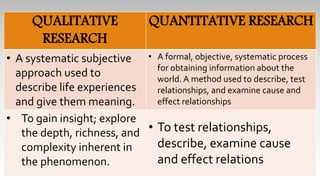
QUALITATIVE
RESEARCH
QUANTITATIVE RESEARCH
• A systematic subjective
approach used to
describe life experiences
and give them meaning.
• A formal, objective, systematic process
for obtaining information about the
world. A method used to describe, test
relationships, and examine cause and
effect relationships
• To gain insight; explore
the depth, richness, and
complexity inherent in
the phenomenon.
• To test relationships,
describe, examine cause
and effect relations
Qualitative Research
Designs
Describes and examines
events of the past to
understand the present and
anticipate potential future
effects.
Describe a culture's
characteristics.
is a type of qualitative
research that seeks action to
improve practice and study
the effects of the action
that was taken.
Describe in-depth the
experience of one
person, family, group,
community, or
institution.
Quantitative Research
Designs
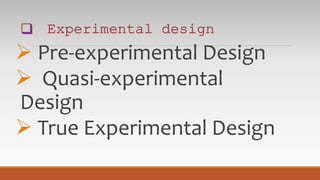
 Pre-experimental Design
 Quasi-experimental
Design
 True Experimental Design
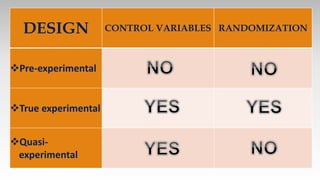
DESIGN CONTROL VARIABLES RANDOMIZATION
Pre-experimental
True experimental
Quasi-
experimental
Pre -
Experimental
Design
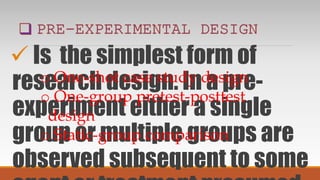
 Is the simplest form of
research design. In a pre-
experiment either a single
group or multiple groups are
observed subsequent to some
o One-shot case study design
o One-group pretest-posttest
design
o Static-group comparison
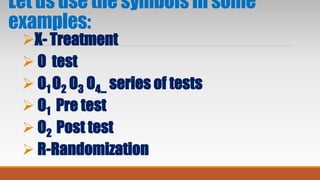
Let us use the symbols in some
examples:
X- Treatment
 O test
 O1 O2 O3 O4... series of tests
 O1 Pre test
 O2 Post test
 R-Randomization
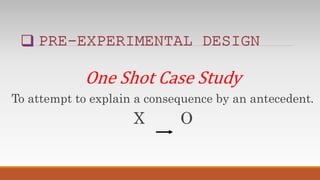
One Shot Case Study
To attempt to explain a consequence by an antecedent.
X O
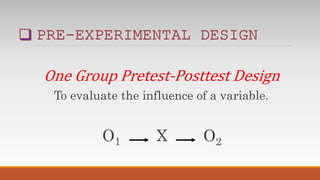
One Group Pretest-Posttest Design
To evaluate the influence of a variable.
O1 X O2
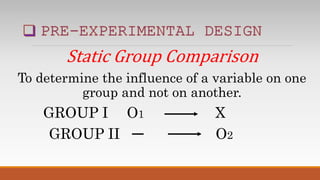
Static Group Comparison
To determine the influence of a variable on one
group and not on another.
GROUP I O1 X
GROUP II O2
Quasi Experimental
Design
“QUASI”- LATIN WORD MEANS
ALMOST BUT NOT REALLY
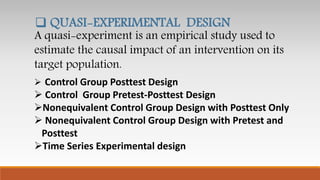
A quasi-experiment is an empirical study used to
estimate the causal impact of an intervention on its
target population.
 QUASI-EXPERIMENTAL DESIGN
 Control Group Posttest Design
 Control Group Pretest-Posttest Design
Nonequivalent Control Group Design with Posttest Only
 Nonequivalent Control Group Design with Pretest and
Posttest
Time Series Experimental design
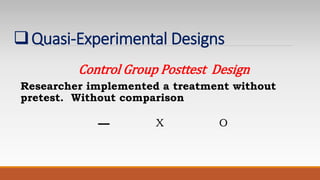
Quasi-Experimental Designs
Control Group Posttest Design
Researcher implemented a treatment without
pretest. Without comparison
X O
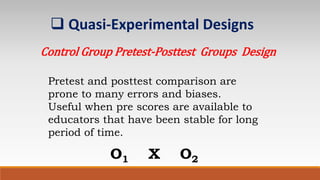
Control Group Pretest-Posttest Groups Design
 Quasi-Experimental Designs
O1 X O2
Pretest and posttest comparison are
prone to many errors and biases.
Useful when pre scores are available to
educators that have been stable for long
period of time.
Quasi-Experimental Designs
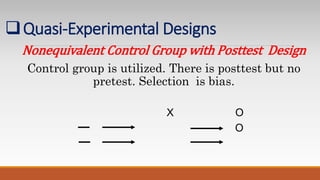
Nonequivalent Control Group with Posttest Design
Control group is utilized. There is posttest but no
pretest. Selection is bias.
X O
O
Nonequivalent Control Group Pretest-
Posttest Design
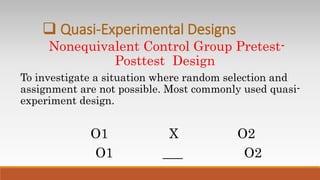
To investigate a situation where random selection and
assignment are not possible. Most commonly used quasi-
experiment design.
O1 X O2
O1 ___ O2
 Quasi-Experimental Designs
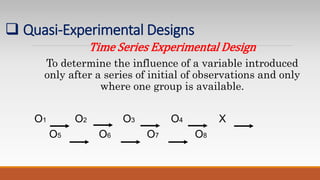
Time Series Experimental Design
To determine the influence of a variable introduced
only after a series of initial of observations and only
where one group is available.
O1 O2 O3 O4 X
O5 O6 O7 O8
 Quasi-Experimental Designs
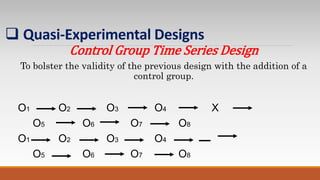
Control Group Time Series Design
To bolster the validity of the previous design with the addition of a
control group.
O1 O2 O3 O4 X
O5 O6 O7 O8
O1 O2 O3 O4
O5 O6 O7 O8
True Experimental
Design
True Experimental Design
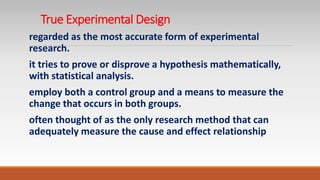
regarded as the most accurate form of experimental
research.
it tries to prove or disprove a hypothesis mathematically,
with statistical analysis.
employ both a control group and a means to measure the
change that occurs in both groups.
often thought of as the only research method that can
adequately measure the cause and effect relationship
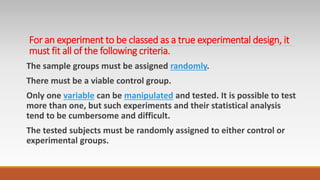
For an experiment to be classed as a true experimental design, it
must fit all of the following criteria.
The sample groups must be assigned randomly.
There must be a viable control group.
Only one variable can be manipulated and tested. It is possible to test
more than one, but such experiments and their statistical analysis
tend to be cumbersome and difficult.
The tested subjects must be randomly assigned to either control or
experimental groups.
True Experimental Design
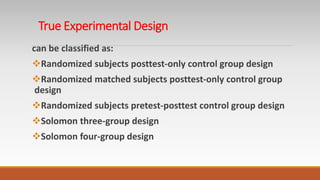
can be classified as:
Randomized subjects posttest-only control group design
Randomized matched subjects posttest-only control group
design
Randomized subjects pretest-posttest control group design
Solomon three-group design
Solomon four-group design
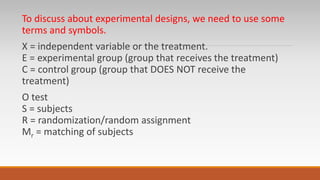
To discuss about experimental designs, we need to use some
terms and symbols.
X = independent variable or the treatment.
E = experimental group (group that receives the treatment)
C = control group (group that DOES NOT receive the
treatment)
O test
S = subjects
R = randomization/random assignment
Mr = matching of subjects
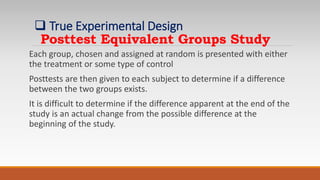
Posttest Equivalent Groups Study
Each group, chosen and assigned at random is presented with either
the treatment or some type of control
Posttests are then given to each subject to determine if a difference
between the two groups exists.
It is difficult to determine if the difference apparent at the end of the
study is an actual change from the possible difference at the
beginning of the study.
 True Experimental Design
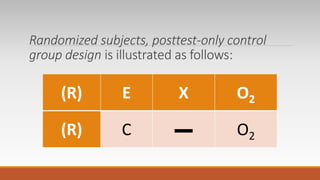
Randomized subjects, posttest-only control
group design is illustrated as follows:
(R) E X O2
(R) C ▬ O2
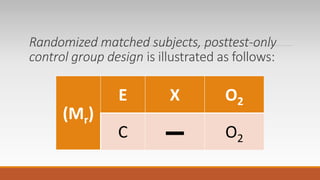
Randomized matched subjects, posttest-only
control group design is illustrated as follows:
(Mr)
E X O2
C ▬ O2
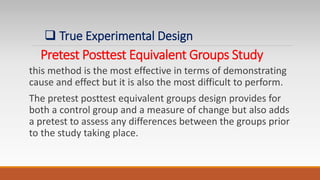
Pretest Posttest Equivalent Groups Study
this method is the most effective in terms of demonstrating
cause and effect but it is also the most difficult to perform.
The pretest posttest equivalent groups design provides for
both a control group and a measure of change but also adds
a pretest to assess any differences between the groups prior
to the study taking place.
 True Experimental Design
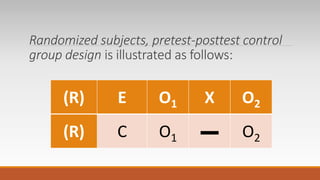
Randomized subjects, pretest-posttest control
group design is illustrated as follows:
(R) E O1 X O2
(R) C O1 ▬ O2
 True Experimental Design
Solomon Group Design
The Solomon group design is a way of avoiding some of
the difficulties associated with the pretest-posttest
design.
This design contains extra control groups, which serve to
reduce the influence of confounding variables and allow
the researcher to test whether the pretest itself has an
effect on the subjects.
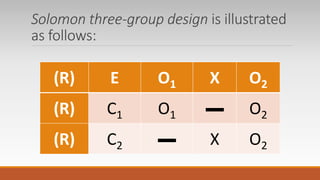
Solomon three-group design is illustrated
as follows:
(R) E O1 X O2
(R) C1 O1 ▬ O2
(R) C2 ▬ X O2
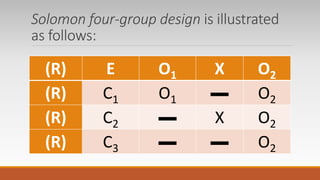
Solomon four-group design is illustrated
as follows:
(R) E O1 X O2
(R) C1 O1 ▬ O2
(R) C2 ▬ X O2
(R) C3 ▬ ▬ O2
Advanges and Disadvantages
of
True Experimental Design
Advantages
The results of a true experimental design can be
statistically analyzed and so there can be little argument
about the results.
It is also much easier for other researchers to replicate the
experiment and validate the results.
For physical sciences working with mainly numerical data,
it is much easier to manipulate one variable, so true
experimental design usually gives a yes or no answer.
Disadvantages
can be almost too perfect, with the conditions being
under complete control and not being representative of
real world conditions.
For psychologists and behavioral biologists, for example,
there can never be any guarantee that a human or living
organism will exhibit ‘normal’ behavior under
experimental conditions.
Disadvantages
can be too accurate and it is very difficult to obtain a complete
rejection or acceptance of a hypothesis because the standards of
proof required are so difficult to reach.
difficult and expensive to set up. They can also be very impractical.
for some fields, like physics, there are not as many variables so the
design is easy, for social sciences and biological sciences, where
variations are not so clearly defined it is much more difficult to
exclude other factors that may be affecting the manipulated
variable.
Thank You for listening,
God Bless.mdcGerman
Photo credits: https://www.pinterest.com/pin/361625045056217933/
Referencesohttp://allpsych.com/researchmethods/trueexperimentaldesign.html
ohttp://quantres.wordpress.com/2009/11/19/quantitative-research-designs/
ohttps://explorable.com/true-experimental-design
ohttp://pareonline.net/getvn.asp?v=5&n=14
ohttp://web.csulb.edu/~msaintg/ppa696/696preex
o http://www.umsl.edu/~lindquists/qualdsgn.html
PRE EXPERIMENTAL Designs
ohttp://www.umsl.edu/~lindquists/quald
ohttp://health.prenhall.com/nieswiadomy/pdf/NIESWIADOMY10.pdfsgn.html

Research Design Slide Show

  • 1.
    Hello, I’m Baymax your Research Companion. Photocredits: https://www.pinterest.com/pin/361625045056217933/ BY MYLA D. GERMAN MALABON NATIONAL HIGH SCHOOL
  • 2.
  • 3.
    What is ResearchDesign? -Like a blueprint for the research. -A research design is a plan that guides the decision as to:
  • 4.
    QUALITATIVE RESEARCH QUANTITATIVE RESEARCH • Asystematic subjective approach used to describe life experiences and give them meaning. • A formal, objective, systematic process for obtaining information about the world. A method used to describe, test relationships, and examine cause and effect relationships • To gain insight; explore the depth, richness, and complexity inherent in the phenomenon. • To test relationships, describe, examine cause and effect relations
  • 5.
  • 6.
    Describes and examines eventsof the past to understand the present and anticipate potential future effects.
  • 7.
  • 8.
    is a typeof qualitative research that seeks action to improve practice and study the effects of the action that was taken.
  • 9.
    Describe in-depth the experienceof one person, family, group, community, or institution.
  • 10.
  • 11.
     Pre-experimental Design Quasi-experimental Design  True Experimental Design
  • 12.
    DESIGN CONTROL VARIABLESRANDOMIZATION Pre-experimental True experimental Quasi- experimental
  • 13.
  • 14.
     Is thesimplest form of research design. In a pre- experiment either a single group or multiple groups are observed subsequent to some o One-shot case study design o One-group pretest-posttest design o Static-group comparison
  • 15.
    Let us usethe symbols in some examples: X- Treatment  O test  O1 O2 O3 O4... series of tests  O1 Pre test  O2 Post test  R-Randomization
  • 16.
    One Shot CaseStudy To attempt to explain a consequence by an antecedent. X O
  • 17.
    One Group Pretest-PosttestDesign To evaluate the influence of a variable. O1 X O2
  • 18.
    Static Group Comparison Todetermine the influence of a variable on one group and not on another. GROUP I O1 X GROUP II O2
  • 19.
    Quasi Experimental Design “QUASI”- LATINWORD MEANS ALMOST BUT NOT REALLY
  • 20.
    A quasi-experiment isan empirical study used to estimate the causal impact of an intervention on its target population.  QUASI-EXPERIMENTAL DESIGN  Control Group Posttest Design  Control Group Pretest-Posttest Design Nonequivalent Control Group Design with Posttest Only  Nonequivalent Control Group Design with Pretest and Posttest Time Series Experimental design
  • 21.
    Quasi-Experimental Designs Control GroupPosttest Design Researcher implemented a treatment without pretest. Without comparison X O
  • 22.
    Control Group Pretest-PosttestGroups Design  Quasi-Experimental Designs O1 X O2 Pretest and posttest comparison are prone to many errors and biases. Useful when pre scores are available to educators that have been stable for long period of time.
  • 23.
    Quasi-Experimental Designs Nonequivalent ControlGroup with Posttest Design Control group is utilized. There is posttest but no pretest. Selection is bias. X O O
  • 24.
    Nonequivalent Control GroupPretest- Posttest Design To investigate a situation where random selection and assignment are not possible. Most commonly used quasi- experiment design. O1 X O2 O1 ___ O2  Quasi-Experimental Designs
  • 25.
     Quasi-Experimental Designs TimeSeries Experimental Design To determine the influence of a variable introduced only after a series of initial of observations and only where one group is available. O1 O2 O3 O4 X O5 O6 O7 O8
  • 26.
     Quasi-Experimental Designs ControlGroup Time Series Design To bolster the validity of the previous design with the addition of a control group. O1 O2 O3 O4 X O5 O6 O7 O8 O1 O2 O3 O4 O5 O6 O7 O8
  • 27.
  • 28.
    True Experimental Design regardedas the most accurate form of experimental research. it tries to prove or disprove a hypothesis mathematically, with statistical analysis. employ both a control group and a means to measure the change that occurs in both groups. often thought of as the only research method that can adequately measure the cause and effect relationship
  • 29.
    For an experimentto be classed as a true experimental design, it must fit all of the following criteria. The sample groups must be assigned randomly. There must be a viable control group. Only one variable can be manipulated and tested. It is possible to test more than one, but such experiments and their statistical analysis tend to be cumbersome and difficult. The tested subjects must be randomly assigned to either control or experimental groups.
  • 30.
    True Experimental Design canbe classified as: Randomized subjects posttest-only control group design Randomized matched subjects posttest-only control group design Randomized subjects pretest-posttest control group design Solomon three-group design Solomon four-group design
  • 31.
    To discuss aboutexperimental designs, we need to use some terms and symbols. X = independent variable or the treatment. E = experimental group (group that receives the treatment) C = control group (group that DOES NOT receive the treatment) O test S = subjects R = randomization/random assignment Mr = matching of subjects
  • 32.
    Posttest Equivalent GroupsStudy Each group, chosen and assigned at random is presented with either the treatment or some type of control Posttests are then given to each subject to determine if a difference between the two groups exists. It is difficult to determine if the difference apparent at the end of the study is an actual change from the possible difference at the beginning of the study.  True Experimental Design
  • 33.
    Randomized subjects, posttest-onlycontrol group design is illustrated as follows: (R) E X O2 (R) C ▬ O2
  • 34.
    Randomized matched subjects,posttest-only control group design is illustrated as follows: (Mr) E X O2 C ▬ O2
  • 35.
    Pretest Posttest EquivalentGroups Study this method is the most effective in terms of demonstrating cause and effect but it is also the most difficult to perform. The pretest posttest equivalent groups design provides for both a control group and a measure of change but also adds a pretest to assess any differences between the groups prior to the study taking place.  True Experimental Design
  • 36.
    Randomized subjects, pretest-posttestcontrol group design is illustrated as follows: (R) E O1 X O2 (R) C O1 ▬ O2
  • 37.
     True ExperimentalDesign Solomon Group Design The Solomon group design is a way of avoiding some of the difficulties associated with the pretest-posttest design. This design contains extra control groups, which serve to reduce the influence of confounding variables and allow the researcher to test whether the pretest itself has an effect on the subjects.
  • 38.
    Solomon three-group designis illustrated as follows: (R) E O1 X O2 (R) C1 O1 ▬ O2 (R) C2 ▬ X O2
  • 39.
    Solomon four-group designis illustrated as follows: (R) E O1 X O2 (R) C1 O1 ▬ O2 (R) C2 ▬ X O2 (R) C3 ▬ ▬ O2
  • 40.
  • 41.
    Advantages The results ofa true experimental design can be statistically analyzed and so there can be little argument about the results. It is also much easier for other researchers to replicate the experiment and validate the results. For physical sciences working with mainly numerical data, it is much easier to manipulate one variable, so true experimental design usually gives a yes or no answer.
  • 42.
    Disadvantages can be almosttoo perfect, with the conditions being under complete control and not being representative of real world conditions. For psychologists and behavioral biologists, for example, there can never be any guarantee that a human or living organism will exhibit ‘normal’ behavior under experimental conditions.
  • 43.
    Disadvantages can be tooaccurate and it is very difficult to obtain a complete rejection or acceptance of a hypothesis because the standards of proof required are so difficult to reach. difficult and expensive to set up. They can also be very impractical. for some fields, like physics, there are not as many variables so the design is easy, for social sciences and biological sciences, where variations are not so clearly defined it is much more difficult to exclude other factors that may be affecting the manipulated variable.
  • 44.
    Thank You forlistening, God Bless.mdcGerman Photo credits: https://www.pinterest.com/pin/361625045056217933/
  • 45.