Experimental Designs
• Laboratory experiment- researcher creates a
situation with the desired condition and then
manipulates some variables while controlling
others.
• A field experiment is a study in a realistic or
natural setting and involves manipulation of
the independent variable while carefully
controlling the others
Randomized designs
• Completely Randomized Designs (CRD)- an
experimental design that uses a random
process to assign experimental units to
treatments
• A Randomized Block Design- Grouping test
units into homogenous blocks (similar to
stratified sampling)
Validity
• Internal validity: Is the effect due to our
hypothesized cause?
• External validity: Can we generalize to other
samples?
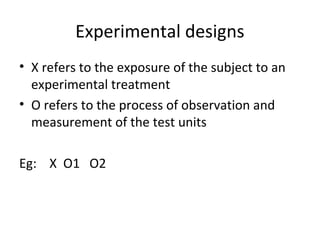
Experimental designs
• X refers to the exposure of the subject to an
experimental treatment
• O refers to the process of observation and
measurement of the test units
Eg: X O1 O2
Extraneous variables
• History- specific events external to the
experiment but occurring at the same time ,
that may affect the criterion variable
• Maturation-Changes occurring within test
units that are not due to the experimental
variable but due to the passage of time
• Testing-the experiment itself may affect the
responses
• Instrument variation- changes in the
instrument may account for the differences
• Statistical regression-the tendency of the
extreme cases to move closer to the average
during the course of the experiment
• Selection bias- the way in which the test units
are selected
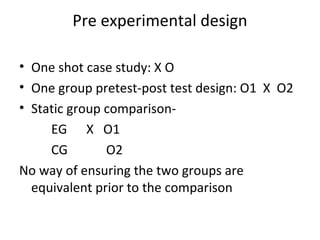
Pre experimental design
• One shot case study: X O
• One group pretest-post test design: O1 X O2
• Static group comparisonEG X O1
CG
O2
No way of ensuring the two groups are
equivalent prior to the comparison
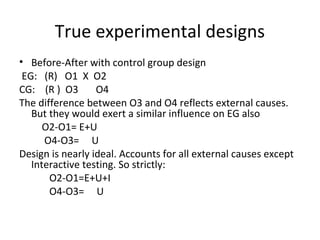
True experimental designs
• Before-After with control group design
EG: (R) O1 X O2
CG: (R ) O3
O4
The difference between O3 and O4 reflects external causes.
But they would exert a similar influence on EG also
O2-O1= E+U
O4-O3= U
Design is nearly ideal. Accounts for all external causes except
Interactive testing. So strictly:
O2-O1=E+U+I
O4-O3= U
Four group- six study design
•
•
•
•

EG 1:
CG 1:
EG 2:
CG 2:

O1 X O2 O2-O1 = E+U+I
O3
O4 O4-O3= U
X O5 O5- ½ (O1+O3)= E+U
O6 O6- ½ (O1+O3)= U
Time series experimental designs
• Several observations taken before the
treatment; then the treatment (X) is
administered, then several observations are
taken to measure if there is a change in the
pattern after as compared to before the
experiment
• O1 O2 O3 X O4 O5 O6
Factorial designs
• Allow for the testing of two or more treatments (factors) at
various levels.
• Main effect: the influence on a dependant variable by each
independent variable separately
• Interactive effect: the effect on a dependant variable by
combinations of two or more independent variables
• Interactive effects may be more than the total of the main
effects
• A researcher wants to understand the
influence of both gender and the
advertisement (2 advts are beingconsidered)
on ‘believability’. There are 2 independent
variables: gender and advt.
• Each variable has 2 levels (2 advts and 2
genders)- leads to a 2X2 factorial design
Latin square design
• Attempts to control or block out the
confounding effect of extraneous factors.
• A balanced two-way classification scheme
• In a Latin square design, both the confounding
factors must have the same number of levels
• Eg: A taste test involving 3 levels of tastes
administered to 3 different people with the
order of the administration randomized

Experimental+designs

  • 1.
  • 2.
    • Laboratory experiment-researcher creates a situation with the desired condition and then manipulates some variables while controlling others. • A field experiment is a study in a realistic or natural setting and involves manipulation of the independent variable while carefully controlling the others
  • 3.
    Randomized designs • CompletelyRandomized Designs (CRD)- an experimental design that uses a random process to assign experimental units to treatments • A Randomized Block Design- Grouping test units into homogenous blocks (similar to stratified sampling)
  • 4.
    Validity • Internal validity:Is the effect due to our hypothesized cause? • External validity: Can we generalize to other samples?
  • 5.
    Experimental designs • Xrefers to the exposure of the subject to an experimental treatment • O refers to the process of observation and measurement of the test units Eg: X O1 O2
  • 6.
    Extraneous variables • History-specific events external to the experiment but occurring at the same time , that may affect the criterion variable • Maturation-Changes occurring within test units that are not due to the experimental variable but due to the passage of time • Testing-the experiment itself may affect the responses
  • 7.
    • Instrument variation-changes in the instrument may account for the differences • Statistical regression-the tendency of the extreme cases to move closer to the average during the course of the experiment • Selection bias- the way in which the test units are selected
  • 8.
    Pre experimental design •One shot case study: X O • One group pretest-post test design: O1 X O2 • Static group comparisonEG X O1 CG O2 No way of ensuring the two groups are equivalent prior to the comparison
  • 9.
    True experimental designs •Before-After with control group design EG: (R) O1 X O2 CG: (R ) O3 O4 The difference between O3 and O4 reflects external causes. But they would exert a similar influence on EG also O2-O1= E+U O4-O3= U Design is nearly ideal. Accounts for all external causes except Interactive testing. So strictly: O2-O1=E+U+I O4-O3= U
  • 10.
    Four group- sixstudy design • • • • EG 1: CG 1: EG 2: CG 2: O1 X O2 O2-O1 = E+U+I O3 O4 O4-O3= U X O5 O5- ½ (O1+O3)= E+U O6 O6- ½ (O1+O3)= U
  • 11.
    Time series experimentaldesigns • Several observations taken before the treatment; then the treatment (X) is administered, then several observations are taken to measure if there is a change in the pattern after as compared to before the experiment • O1 O2 O3 X O4 O5 O6
  • 12.
    Factorial designs • Allowfor the testing of two or more treatments (factors) at various levels. • Main effect: the influence on a dependant variable by each independent variable separately • Interactive effect: the effect on a dependant variable by combinations of two or more independent variables • Interactive effects may be more than the total of the main effects
  • 13.
    • A researcherwants to understand the influence of both gender and the advertisement (2 advts are beingconsidered) on ‘believability’. There are 2 independent variables: gender and advt. • Each variable has 2 levels (2 advts and 2 genders)- leads to a 2X2 factorial design
  • 14.
    Latin square design •Attempts to control or block out the confounding effect of extraneous factors. • A balanced two-way classification scheme • In a Latin square design, both the confounding factors must have the same number of levels • Eg: A taste test involving 3 levels of tastes administered to 3 different people with the order of the administration randomized