Collaborative, Social, and Informal Learning:
Where do Learning Professionals Fit
ELearning Guild 2015 Online Forum
Everyday Workplace Learning:
A Quick Guide for L&D
Jane Hart
Centre for Learning & Performance Technologies
18 November 2015
@C4LPT
www.JaneHart.com
www.C4LPT.co.uk
www.ModernWorkplaceLearning.com
2
Jay Cross 1944 - 2015
“Informal learning is the unofficial, unscheduled,
impromptu way most people learn to do their jobs.
Informal learning is like riding a bicycle:
The rider chooses the destination and the route.
The cyclist can take a detour at a moment’s
Notice to admire the scenery or help a fellow
rider.”
What ONE word/phrase sums up informal learning for you? 3
What is Everyday Workplace Learning?
Everyday workplace learning is the learning
that takes place everyday, as individuals do
their jobs – individually or working with their
internal colleagues, as well as connecting with
others in (online) professional networks and
channels.
It’s about continuously acquiring small pieces
of information or skills (often unconsciously)
That over time build up into a large body of
knowledge and expertise, which means an
individual becomes proficient in their job and
knowledgeable about their industry or
profession.
4
© C4LPT, 2015
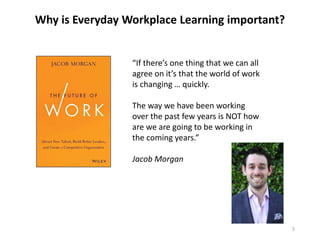
“If there’s one thing that we can all
agree on it’s that the world of work
is changing … quickly.
The way we have been working
over the past few years is NOT how
are we are going to be working in
the coming years.”
Jacob Morgan
Why is Everyday Workplace Learning important?
5
Jacob Morgan
“Knowledge is a commodity, to be the
smartest person in the room all you need
is a smartphone.
What is far more valuable than knowledge
is the ability to learn new things and apply
those learnings to new scenarios and
environments.
This is what the employee of the future
needs to focus on, ‘learning to learn’.”
```````````````
6
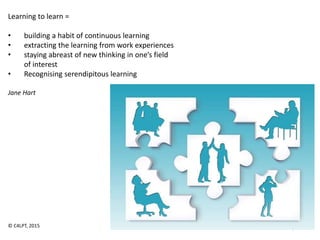
Learning to learn =
• building a habit of continuous learning
• extracting the learning from work experiences
• staying abreast of new thinking in one’s field
of interest
• Recognising serendipitous learning
Jane Hart
© C4LPT, 2015
7
Jacob Morgan
“that learning and teaching can happen
between employees without official
corporate training programs or manuals.
Have a question? Tap into the collective
intelligence of your company. Want to show
someone how to do something? Whip out
your smartphone, film it, and upload it to
your organization’s collaboration platform for
your peers to see.”
http://www.forbes.com/sites/jacobm
organ/2014/11/11/the-7-principles-
of-the-future-employee/
8
Who is responsible for Everyday Workplace Learning?
Senior managers > moving from a culture of training to a
culture of continuous learning
Line managers > continuous development of their people is a
key responsibility
Individuals > take responsibility and ownership of their
learning
L&D > promote, enable and support everyday workplace
learning by working with managers, individuals and teams
9
© C4LPT, 2015
Help the manager
Help individuals
Help the team
15 ways to
promote, enable
and support
EWL
10
1 - HELP THE MANAGER
to develop talent and help individuals
reach their potential
“A ‘stretch assignment’ is a
project or task given to
employees which is beyond
their current knowledge or
skills level in order to ‘stretch’
employees developmentally.
The stretch assignment
challenges employees by
placing them into
uncomfortable situations in
order to learn and grow.”
Josh Bersin How are you igniting your managers
to coach employees?
11
2 - HELP THE MANAGER
to value learning in all its forms
12
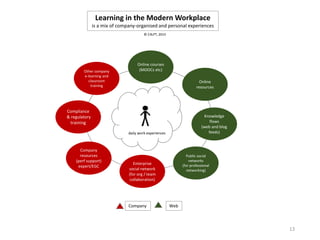
Learning in the Modern Workplace
is a mix of company-organised and personal experiences
Other company
e-learning and
classroom
training
Compliance
& regulatory
training
Company
resources
(perf support)
expert/EGC
Enterprise
social network
(for org / team
collaboration)
Public social
networks
(for professional
networking)
Knowledge
flows
(web and blog
feeds)
Online
resources
Online courses
(MOOCs etc)
Company Web
daily work experiences
© C4LPT, 2015
13
3 - HELP THE MANAGER
to build a learning worker mindset
“What did you
learn today?
14
4 - HELP INDIVIDUALS
to reflect on their work and learning
expeiriences
"We do not learn from experience …
we learn from reflecting
on experience.”
(John Dewey)
15
© C4LPT, 2015
“After every experience take 30 seconds
to write down the most important points”
“Spend 10 minutes at the end of each
day, reflecting on the day and
write down 100 words.”
HELP INDIVIDUALS
to extract the learning from the work
How do YOU reflect on
your experiences –
do you keep a work diary or blog?
16
© C4LPT, 2015
5 - HELP THE MANAGER
to enable personal planned learning
- unofficially or officially
17
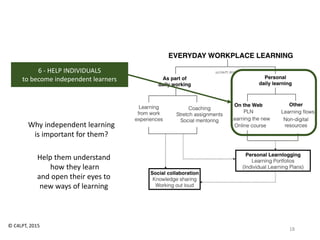
6 - HELP INDIVIDUALS
to become independent learners
Why independent learning
is important for them?
Help them understand
how they learn
and open their eyes to
new ways of learning
18
© C4LPT, 2015
A is for AUTONOMY – the ability to choose what, how, when and with
whom I learn is essential for me. I learn best when I am in control of
what I do.
B is for BLOGGING – the place where I reflect on what I have learned,
and by writing about it, it helps me articulate it. I write for me – but if
others enjoy what I write, so much the better.
C is for COLLABORATION – I like to work on my own, but I also like to
work with a group of others, particularly my Internet Time Alliance
colleagues. Collaborating with them, we learn together and build on
each others ideas and thinking.
D is for DISCOVERY – According to Wikipedia, discovery is
“the observation of new phenomena, new actions, or new events and
providing new reasoning to explain the knowledge gathered through
such observations with previously acquired knowledge from abstract
thought and everyday experiences“. This is how I see my role in the
changing world of workplace learning.
E is for EVERYDAY – I learn new things everyday – whether they are
planned or not – often serendipitously – so I make sure I keep my eyes
open for new thinking and ideas wherever it may be.
F is for FEEDLY – the place where I aggregate all my subscriptions to
blog and newsfeeds. New stuff therefore comes automatically to me so I
can view it in my own time.
G is for GOOGLE – like pretty much everyone else, I couldn’t do without
Google Search, if I quickly need to look something up.
H is for HARRY – this is my (nearly 4 year old) grandson who helps me
see the world through different eyes as he learns new ideas and
concepts.
I is for iPHONE & iPAD – I can’t do without these two mobile devices –
it means I can access whatever I need, whenever I need it, wherever I
am.
J is for JOIN THE DOTS – for me learning is about joining the dots
between (often) random pieces of information – not having them all
neatly connected and the picture coloured in by someone else.
K is for KEYNOTE – I’ve moved away from PowerPoint to Keynote, and
find it a much more appealing way to create my presentations, where I
share my ideas with others in conferences and events. I can also control
a live presentation very easily using my iPhone (and even my Apple
Watch)!
L is for LEARNING WORKER – This is a term created by Jacob
Morgan, and I think it is a good way to describe my approach to
continuously learning new stuff.
M is for MODERN WORKPLACE LEARNING – this is where my
current (work and learning) efforts are focused, on helping organisations
understand that in the workplace there is a need to provide modern
learning experiences as well as promote everyday learning.
N is for NETWORKING – My connections with people from all around the world
are essential to me. This is the way I find out what others are doing, what they
are thinking, the problems they have, and how they are overcoming them.
Learning in my networks is the most powerful way I learn today.
O is for OPEN SOURCE – when it comes to software, I value tools where the
source code is available for general public use and which results in collaborative
efforts to improve it. WordPress is a great example of this. I run a number of self-
hosted WordPress installations, and as the code is updated, my installs
are quickly (often automatically) updated, which means I benefit immediately
from all the improvements in the technology.
P is for PERFORMANCE SUPORT – often I just need to remind myself about
something, e.g. a software task that I carry out infrequently. I therefore have links
to useful places I can quickly find answers to my ad hoc problems.
Q is for QUICK – In this new world, I need to be agile, flexible and responsive –
not hang around and wait and see! Learn fast; act quickly is my motto.
R is for RESEARCH – sometimes an activity I work on requires some in-depth
research, and the Web provides me with all the resources and tools I need to
provide a well researched report.
S is for SOCIAL – learning from the resources, experiences and knowledge that
others have freely and willingly shared both in social networks as well as other
social channels like YouTube, SlideShare, Pinterest, and so on.
T is for TWITTER – this is the first thing I turn to every morning to view some of
the things that have been shared and the interactions that have taken place.
U is for UPDATING – the world is changing fast and I want to keep up with it!
V is for VALUE – we learn for ourselves, not for other people. So for me, it’s all
about the value something brings to me – whether it’s a piece of content or a
connection with someone. I haven’t got the capacity to read/view everything or
connect with everyone. I need to discriminate and select the valuable (learning)
activities for my needs.
W is for WIKIPEDIA – this is my first port of call if I need a good overall summary
of a new topic with some links to readings for deeper discovery.
X is for OS X (original Mac OS X). Yes, in the last few years I’ve become an
Apple Fangirl! Alongside, my iPhone and my iPad, my MacBook Air is my life. I
don’t go anywhere without one or more of these devices!
Y is for YAMMER – I host a few social groups on Yammer, and learn from the
people who post there everyday. One of my daily activities is to interact with
participants on my social workshops and the people in the other groups to which
I belong. It’s about giving as well as taking!
Z is for GEN Z – the generation that was born after the Millennials. This
generation is already in schools and will be in the workplace shortly. Although
many people don’t like to talk of generational differences, I think observing how
these young people are interacting with the technology and the world around
them is fascinating, and I learn a lot from it.
19
Learning in the Modern Workplace
is a mix of company-organised and personal experiences
Other company
e-learning and
classroom
training
Compliance
& regulatory
training
Company
resources
(perf support)
expert/EGC
Enterprise
social network
(for org / team
collaboration)
Public social
networks
(for professional
networking)
Knowledge
flows
(web and blog
feeds)
Online
resources
Online courses
(MOOCs etc)
daily work experiences
© C4LPT, 2015
Provide at least
3 examples of
how you have
used any of
these ways to
learn at work
20
7 - HELP INDIVIDUALS
to develop their own
Individual Learning Plans
21
© C4LPT, 2015
7 - HELP INDIVIDUALS
to develop their own
Individual Learning Plans
What part could you play in helping an individual develop their ILP?
Goals
Resources
Evidence
22
© C4LPT, 2015
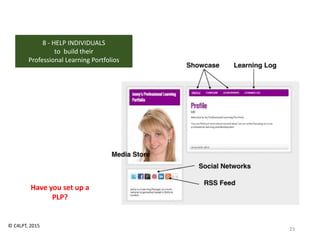
8 - HELP INDIVIDUALS
to build their
Professional Learning Portfolios
Have you set up a
PLP?
23
© C4LPT, 2015
9 - HELP INDIVIDUALS
to set up a daily learning workout
Help to make learning
a daily habit
24
© C4LPT, 2015
30 mins a day
= 2.5 hours a week
= 10 hours a month
= 100+ hours a year
Equivalent to
10 training days a year
9 - HELP INDIVIDUALS
to set up a daily learning workout
What sort of resources would work best for a daily workout?
25
© C4LPT, 2015
10 - HELP THE MANAGER
to help the team see learning
together as an integral part of work
11 - HELP THE MANAGER
To provide a safe space to share
experiences
26
© C4LPT, 2015
12 - HELP A TEAM
to share effectively
What advice would you
give a team when
helping them to share?
27
© C4LPT, 2015
13 - HELP A TEAM
to work out loud
28
© C4LPT, 2015
14 - HELP A TEAM
to build a habit of sharing
and working out loud
How could you help
a team build a habit of
sharing and working
our loud?
29
© C4LPT, 2015
15 - HELP A MANAGER
to measure success in terms of
impact on performance
30
© C4LPT, 2015
Personal Learning Advisor
Collaboration Consultant
31
© C4LPT, 2015
Part 1: Introduction
Part 2: Provide modern training
Part 3: Promote everyday learning
Online resource site
MWL Social Online Workshops
MWL Association
The MWL book is available as
a paperback or PDF at
ModernWorkplaceLearning.com/
Book
32

Everyday Workplace Learning; A Quick Guide

  • 1.
    Collaborative, Social, andInformal Learning: Where do Learning Professionals Fit ELearning Guild 2015 Online Forum Everyday Workplace Learning: A Quick Guide for L&D Jane Hart Centre for Learning & Performance Technologies 18 November 2015
  • 2.
  • 3.
    Jay Cross 1944- 2015 “Informal learning is the unofficial, unscheduled, impromptu way most people learn to do their jobs. Informal learning is like riding a bicycle: The rider chooses the destination and the route. The cyclist can take a detour at a moment’s Notice to admire the scenery or help a fellow rider.” What ONE word/phrase sums up informal learning for you? 3
  • 4.
    What is EverydayWorkplace Learning? Everyday workplace learning is the learning that takes place everyday, as individuals do their jobs – individually or working with their internal colleagues, as well as connecting with others in (online) professional networks and channels. It’s about continuously acquiring small pieces of information or skills (often unconsciously) That over time build up into a large body of knowledge and expertise, which means an individual becomes proficient in their job and knowledgeable about their industry or profession. 4 © C4LPT, 2015
  • 5.
    “If there’s onething that we can all agree on it’s that the world of work is changing … quickly. The way we have been working over the past few years is NOT how are we are going to be working in the coming years.” Jacob Morgan Why is Everyday Workplace Learning important? 5
  • 6.
    Jacob Morgan “Knowledge isa commodity, to be the smartest person in the room all you need is a smartphone. What is far more valuable than knowledge is the ability to learn new things and apply those learnings to new scenarios and environments. This is what the employee of the future needs to focus on, ‘learning to learn’.” ``````````````` 6
  • 7.
    Learning to learn= • building a habit of continuous learning • extracting the learning from work experiences • staying abreast of new thinking in one’s field of interest • Recognising serendipitous learning Jane Hart © C4LPT, 2015 7
  • 8.
    Jacob Morgan “that learningand teaching can happen between employees without official corporate training programs or manuals. Have a question? Tap into the collective intelligence of your company. Want to show someone how to do something? Whip out your smartphone, film it, and upload it to your organization’s collaboration platform for your peers to see.” http://www.forbes.com/sites/jacobm organ/2014/11/11/the-7-principles- of-the-future-employee/ 8
  • 9.
    Who is responsiblefor Everyday Workplace Learning? Senior managers > moving from a culture of training to a culture of continuous learning Line managers > continuous development of their people is a key responsibility Individuals > take responsibility and ownership of their learning L&D > promote, enable and support everyday workplace learning by working with managers, individuals and teams 9 © C4LPT, 2015
  • 10.
    Help the manager Helpindividuals Help the team 15 ways to promote, enable and support EWL 10
  • 11.
    1 - HELPTHE MANAGER to develop talent and help individuals reach their potential “A ‘stretch assignment’ is a project or task given to employees which is beyond their current knowledge or skills level in order to ‘stretch’ employees developmentally. The stretch assignment challenges employees by placing them into uncomfortable situations in order to learn and grow.” Josh Bersin How are you igniting your managers to coach employees? 11
  • 12.
    2 - HELPTHE MANAGER to value learning in all its forms 12
  • 13.
    Learning in theModern Workplace is a mix of company-organised and personal experiences Other company e-learning and classroom training Compliance & regulatory training Company resources (perf support) expert/EGC Enterprise social network (for org / team collaboration) Public social networks (for professional networking) Knowledge flows (web and blog feeds) Online resources Online courses (MOOCs etc) Company Web daily work experiences © C4LPT, 2015 13
  • 14.
    3 - HELPTHE MANAGER to build a learning worker mindset “What did you learn today? 14
  • 15.
    4 - HELPINDIVIDUALS to reflect on their work and learning expeiriences "We do not learn from experience … we learn from reflecting on experience.” (John Dewey) 15 © C4LPT, 2015
  • 16.
    “After every experiencetake 30 seconds to write down the most important points” “Spend 10 minutes at the end of each day, reflecting on the day and write down 100 words.” HELP INDIVIDUALS to extract the learning from the work How do YOU reflect on your experiences – do you keep a work diary or blog? 16 © C4LPT, 2015
  • 17.
    5 - HELPTHE MANAGER to enable personal planned learning - unofficially or officially 17
  • 18.
    6 - HELPINDIVIDUALS to become independent learners Why independent learning is important for them? Help them understand how they learn and open their eyes to new ways of learning 18 © C4LPT, 2015
  • 19.
    A is forAUTONOMY – the ability to choose what, how, when and with whom I learn is essential for me. I learn best when I am in control of what I do. B is for BLOGGING – the place where I reflect on what I have learned, and by writing about it, it helps me articulate it. I write for me – but if others enjoy what I write, so much the better. C is for COLLABORATION – I like to work on my own, but I also like to work with a group of others, particularly my Internet Time Alliance colleagues. Collaborating with them, we learn together and build on each others ideas and thinking. D is for DISCOVERY – According to Wikipedia, discovery is “the observation of new phenomena, new actions, or new events and providing new reasoning to explain the knowledge gathered through such observations with previously acquired knowledge from abstract thought and everyday experiences“. This is how I see my role in the changing world of workplace learning. E is for EVERYDAY – I learn new things everyday – whether they are planned or not – often serendipitously – so I make sure I keep my eyes open for new thinking and ideas wherever it may be. F is for FEEDLY – the place where I aggregate all my subscriptions to blog and newsfeeds. New stuff therefore comes automatically to me so I can view it in my own time. G is for GOOGLE – like pretty much everyone else, I couldn’t do without Google Search, if I quickly need to look something up. H is for HARRY – this is my (nearly 4 year old) grandson who helps me see the world through different eyes as he learns new ideas and concepts. I is for iPHONE & iPAD – I can’t do without these two mobile devices – it means I can access whatever I need, whenever I need it, wherever I am. J is for JOIN THE DOTS – for me learning is about joining the dots between (often) random pieces of information – not having them all neatly connected and the picture coloured in by someone else. K is for KEYNOTE – I’ve moved away from PowerPoint to Keynote, and find it a much more appealing way to create my presentations, where I share my ideas with others in conferences and events. I can also control a live presentation very easily using my iPhone (and even my Apple Watch)! L is for LEARNING WORKER – This is a term created by Jacob Morgan, and I think it is a good way to describe my approach to continuously learning new stuff. M is for MODERN WORKPLACE LEARNING – this is where my current (work and learning) efforts are focused, on helping organisations understand that in the workplace there is a need to provide modern learning experiences as well as promote everyday learning. N is for NETWORKING – My connections with people from all around the world are essential to me. This is the way I find out what others are doing, what they are thinking, the problems they have, and how they are overcoming them. Learning in my networks is the most powerful way I learn today. O is for OPEN SOURCE – when it comes to software, I value tools where the source code is available for general public use and which results in collaborative efforts to improve it. WordPress is a great example of this. I run a number of self- hosted WordPress installations, and as the code is updated, my installs are quickly (often automatically) updated, which means I benefit immediately from all the improvements in the technology. P is for PERFORMANCE SUPORT – often I just need to remind myself about something, e.g. a software task that I carry out infrequently. I therefore have links to useful places I can quickly find answers to my ad hoc problems. Q is for QUICK – In this new world, I need to be agile, flexible and responsive – not hang around and wait and see! Learn fast; act quickly is my motto. R is for RESEARCH – sometimes an activity I work on requires some in-depth research, and the Web provides me with all the resources and tools I need to provide a well researched report. S is for SOCIAL – learning from the resources, experiences and knowledge that others have freely and willingly shared both in social networks as well as other social channels like YouTube, SlideShare, Pinterest, and so on. T is for TWITTER – this is the first thing I turn to every morning to view some of the things that have been shared and the interactions that have taken place. U is for UPDATING – the world is changing fast and I want to keep up with it! V is for VALUE – we learn for ourselves, not for other people. So for me, it’s all about the value something brings to me – whether it’s a piece of content or a connection with someone. I haven’t got the capacity to read/view everything or connect with everyone. I need to discriminate and select the valuable (learning) activities for my needs. W is for WIKIPEDIA – this is my first port of call if I need a good overall summary of a new topic with some links to readings for deeper discovery. X is for OS X (original Mac OS X). Yes, in the last few years I’ve become an Apple Fangirl! Alongside, my iPhone and my iPad, my MacBook Air is my life. I don’t go anywhere without one or more of these devices! Y is for YAMMER – I host a few social groups on Yammer, and learn from the people who post there everyday. One of my daily activities is to interact with participants on my social workshops and the people in the other groups to which I belong. It’s about giving as well as taking! Z is for GEN Z – the generation that was born after the Millennials. This generation is already in schools and will be in the workplace shortly. Although many people don’t like to talk of generational differences, I think observing how these young people are interacting with the technology and the world around them is fascinating, and I learn a lot from it. 19
  • 20.
    Learning in theModern Workplace is a mix of company-organised and personal experiences Other company e-learning and classroom training Compliance & regulatory training Company resources (perf support) expert/EGC Enterprise social network (for org / team collaboration) Public social networks (for professional networking) Knowledge flows (web and blog feeds) Online resources Online courses (MOOCs etc) daily work experiences © C4LPT, 2015 Provide at least 3 examples of how you have used any of these ways to learn at work 20
  • 21.
    7 - HELPINDIVIDUALS to develop their own Individual Learning Plans 21 © C4LPT, 2015
  • 22.
    7 - HELPINDIVIDUALS to develop their own Individual Learning Plans What part could you play in helping an individual develop their ILP? Goals Resources Evidence 22 © C4LPT, 2015
  • 23.
    8 - HELPINDIVIDUALS to build their Professional Learning Portfolios Have you set up a PLP? 23 © C4LPT, 2015
  • 24.
    9 - HELPINDIVIDUALS to set up a daily learning workout Help to make learning a daily habit 24 © C4LPT, 2015
  • 25.
    30 mins aday = 2.5 hours a week = 10 hours a month = 100+ hours a year Equivalent to 10 training days a year 9 - HELP INDIVIDUALS to set up a daily learning workout What sort of resources would work best for a daily workout? 25 © C4LPT, 2015
  • 26.
    10 - HELPTHE MANAGER to help the team see learning together as an integral part of work 11 - HELP THE MANAGER To provide a safe space to share experiences 26 © C4LPT, 2015
  • 27.
    12 - HELPA TEAM to share effectively What advice would you give a team when helping them to share? 27 © C4LPT, 2015
  • 28.
    13 - HELPA TEAM to work out loud 28 © C4LPT, 2015
  • 29.
    14 - HELPA TEAM to build a habit of sharing and working out loud How could you help a team build a habit of sharing and working our loud? 29 © C4LPT, 2015
  • 30.
    15 - HELPA MANAGER to measure success in terms of impact on performance 30 © C4LPT, 2015
  • 31.
    Personal Learning Advisor CollaborationConsultant 31 © C4LPT, 2015
  • 32.
    Part 1: Introduction Part2: Provide modern training Part 3: Promote everyday learning Online resource site MWL Social Online Workshops MWL Association The MWL book is available as a paperback or PDF at ModernWorkplaceLearning.com/ Book 32