Supporting
Social	&	Collaborative	Learning	
in	the	Workplace
Jane	Hart
Centre	for	Learning	&	
Performance	Technologies
Masterclass
CIPD	L&D	Show
11	May	2016
C4LPT.co.uk
ModernWorkplaceLearning.com
JaneHart.com
@C4LPT(c)	C4LPT,	2016 2
independent	learning
personal
learning	network
(PLN)
professional
networking
eventsblog	and
web	feeds
conferences,
backchannels
trade	fairs
exhibiitions
(online)
communities
courses/
MOOCs
videos
podcasts
books
web	search
learning	from	personal
work	experiences
reflection
coaching
stretch	
assign-
ments
company
docs
job
aids
guidance
from
managers
trial
and
error
learning	by	working	
with	colleagues
collaborative
problem	solving
knowledge	and
experience
sharing
resource
sharing
working	out
loud
asking	and	
answering
questions
meetingsconversations
(c)	C4LPT,	2016
3
learning	from	
instruction
classroom	
training	
&	elearning
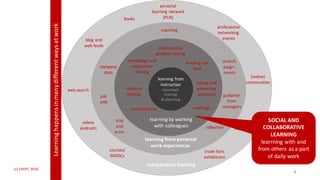
Learning	happens	in	many	different	ways	at	work
SOCIAL	AND	
COLLABORATIVE	
LEARNING
learrning with	and	
from	others	as	a	part	
of	daily	work
(c)	C4LPT,	2016 4
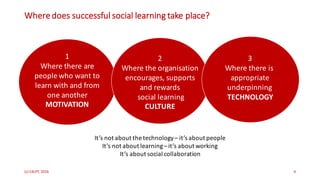
Where	does	successful	social	learning	take	place?
1
Where	there	are	
people	who	want	to	
learn	with	and	from	
one	another
MOTIVATION
2
Where	the	organisation
encourages,	supports	
and	rewards
social	learning
CULTURE
3
Where	there	is	
appropriate
underpinning	
TECHNOLOGY
It’s not	about	the	technology	– it’s	about	people
It’s	not	about	learning	– it’s	about	working
It’s	about	social	collaboration
(c)	C4LPT,	2016 5
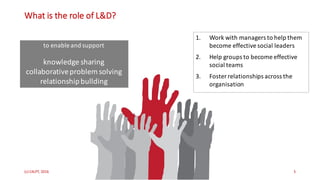
What	is	the	role	of	L&D?
to	enable	and	support
knowledge	sharing
collaborative	problem	solving
relationship	bullding
1. Work	with	managers	to	help	them	
become	effective	social	leaders
2. Help	groups	to	become	effective	
social	teams
3. Foster	relationships	across	the	
organisation
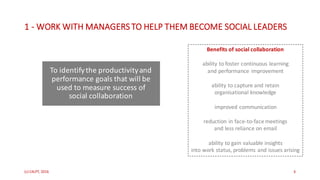
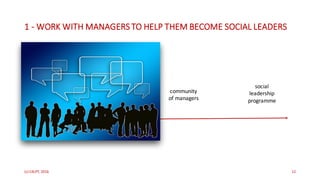
1 - WORK	WITH	MANAGERS	TO	HELP	THEM	BECOME	SOCIAL	LEADERS
To	identify	the	productivity	and	
performance	goals	that	will	be	
used	to	measure	success	of	
social	collaboration
(c)	C4LPT,	2016 6
Benefits	of	social	collaboration
ability	to	foster	continuous	learning
and	performance	improvement
ability	to	capture	and	retain
organisational knowledge
improved	communication
reduction	in	face-to-face	meetings
and	less	reliance	on	email
ability	to	gain	valuable	insights
into	work	status,	problems	and	issues	arising
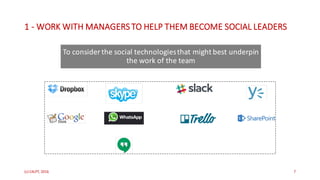
1 - WORK	WITH	MANAGERS	TO	HELP	THEM	BECOME	SOCIAL	LEADERS
To	consider	the	social	technologies	that	might	best	underpin	
the	work	of	the	team
(c)	C4LPT,	2016 7
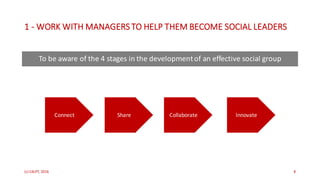
Connect Share Collaborate Innovate
1 - WORK	WITH	MANAGERS	TO	HELP	THEM	BECOME	SOCIAL	LEADERS
(c)	C4LPT,	2016 8
To	be	aware	of	the	4	stages	in	the	development	of	an	effective	social	group
1 - WORK	WITH	MANAGERS	TO	HELP	THEM	BECOME	SOCIAL	LEADERS
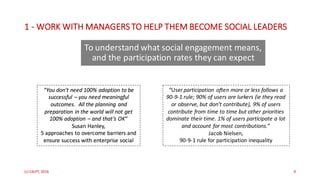
To	understand	what	social	engagement	means,	
and	the	participation	rates	they	can	expect
(c)	C4LPT,	2016 9
“You	don’t	need	100%	adoption	to	be	
successful	– you	need	meaningful	
outcomes.		All	the	planning	and	
preparation	in	the	world	will	not	get	
100%	adoption	– and	that’s	OK”
Susan	Hanley,	
5	approaches	to	overcome	barriers	and	
ensure	success	with	enterprise	social
“User participation	 often	more	or	less	follows	a	
90-9-1	rule;	90%	of	users	are	lurkers	(ie they	read	
or	observe,	but	don’t	contribute),	9%	of	users	
contribute	from	time	to	time	but	other	priorities	
dominate	their	time.	1%	of	users	participate	a	lot	
and	account	for	most	contributions.”
Jacob	Nielsen,	
90-9-1	rule	for	participation	inequality
1 - WORK	WITH	MANAGERS	TO	HELP	THEM	BECOME	SOCIAL	LEADERS
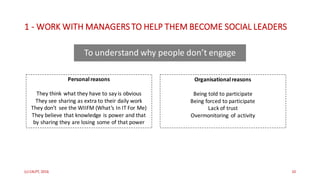
To	understand	why	people	don’t	engage
(c)	C4LPT,	2016 10
Personal	reasons
They	think	what	they	have	to	say	is	obvious
They	see	sharing	as	extra	to	their	daily	work
They	don’t	 see	the	WIIFM	(What’s	In	IT	For	Me)
They	believe	that	knowledge	is	power	and	that	
by	sharing	they	are	losing	some	of	that	power
Organisationalreasons
Being	told	to	participate
Being	forced	to	participate
Lack	of	trust
Overmonitoring of	activity
1 - WORK	WITH	MANAGERS	TO	HELP	THEM	BECOME	SOCIAL	LEADERS
(c)	C4LPT,	2016 11
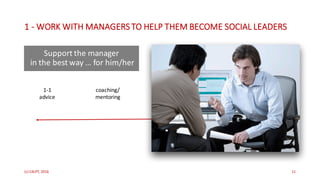
1-1
advice
coaching/
mentoring
community	
of	managers
social	
leadership
programme
Support	the	manager
in	the	best	way	…	for	him/her
1 - WORK	WITH	MANAGERS	TO	HELP	THEM	BECOME	SOCIAL	LEADERS
(c)	C4LPT,	2016 12
1-1
advice
coaching/
mentoring
community	
of	managers
social	
leadership
programme
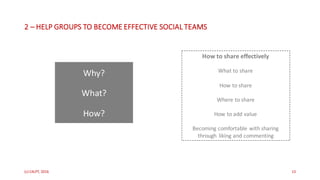
2 – HELP	GROUPS	TO	BECOME	EFFECTIVE	SOCIAL	TEAMS
Why?	
What?
How?
(c)	C4LPT,	2016 13
How	to	share	effectively
What	to	share
How	to	share
Where	to	share
How	to	add	value
Becoming	comfortable	with	sharing	
through	 liking	and	commenting
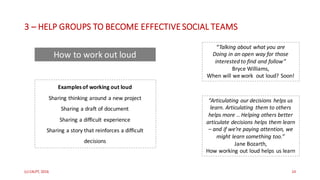
3 – HELP	GROUPS	TO	BECOME	EFFECTIVE	SOCIAL	TEAMS
(c)	C4LPT,	2016 14
“Talking	about	what	you	are
Doing	in	an	open	way	for	those
interested	to	find	and	follow”
Bryce	Williams,	
When	will	we	work		out	loud?	Soon!
“Articulating	our	decisions	helps	us	
learn.	Articulating	 them	to	others	
helps	more	..	Helping	others	better
articulate	decisions	helps	them	learn	
– and	if	we’re	paying	attention,	we	
might	learn	something	too.”
Jane	Bozarth,	
How	working	out	loud	helps	us	learn
Examples	of	working	out	loud
Sharing	thinking	around	a	new	project
Sharing	a	draft	of	document
Sharing	a	difficult	experience
Sharing	a	story	that	reinforces	a	difficult	
decisions
How	to	work	out	loud
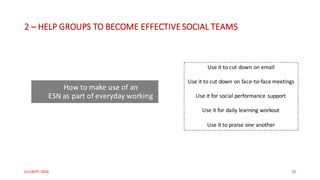
2 – HELP	GROUPS	TO	BECOME	EFFECTIVE	SOCIAL	TEAMS
How	to	make	use	of	an	
ESN	as	part	of	everyday	working
(c)	C4LPT,	2016 15
Use	it	to	cut	down	on	email
Use	it	to	cut	down	on	face-to-face	meetings
Use	it	for	social	performance	support
Use	it	for	daily	learning	workout
Use	it	to	praise	one	another
(c)	C4LPT,	2016 16
group
conversations
1-1
support
guided	social	
learning	experience/	
social challenge
2 – HELP	GROUPS	TO	BECOME	EFFECTIVE	SOCIAL	TEAMS
embed	yourself	
in	the	work	of
the	group	
Support	the	team
in	the	best	way	
for	them
(c)	C4LPT,	2016 17
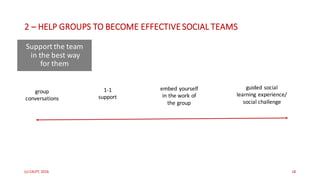
group
conversations
1-1
support
guided	social	
learning	experience/	
social challenge
2 – HELP	GROUPS	TO	BECOME	EFFECTIVE	SOCIAL	TEAMS
embed	yourself	
in	the	work	of
the	group	
Support	the	team
in	the	best	way	
for	them
(c)	C4LPT,	2016 18
group
conversations
1-1
support
guided	social	
learning	experience/	
social challenge
2 – HELP	GROUPS	TO	BECOME	EFFECTIVE	SOCIAL	TEAMS
embed	yourself	
in	the	work	of
the	group	
Support	the	team
in	the	best	way	
for	them
(c)	C4LPT,	2016 19
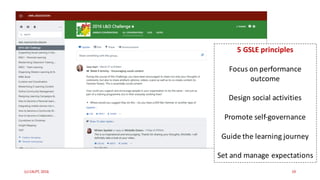
5	GSLE	principles	
Focus	on	performance	
outcome
Design	social	activities
Promote	self-governance
Guide	the	learning	journey
Set	and	manage	expectations
(c)	C4LPT,	2016 20
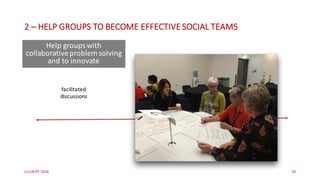
facilitated
discussions
2 – HELP	GROUPS	TO	BECOME	EFFECTIVE	SOCIAL	TEAMS
innovation	
workshops
ideation	
challenges
hackathons
Help	groups	with	
collaborative	problem	solving	
and	to	innovate
(c)	C4LPT,	2016 21
facilitated
discussions
innovation	
workshops
2 – HELP	GROUPS	TO	BECOME	EFFECTIVE	SOCIAL	TEAMS
ideation	
challenges
hackathons
Help	groups	with	
collaborative	problem	solving	
and	to	innovate
(c)	C4LPT,	2016 22
coordinate
regular	(informal)	
learning	events
(e.g.	lunch	‘n’	learns,
book	clubs)
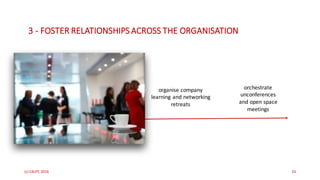
organise company	
networking	events
orchestrate
unconferences
and	open	space	
meetings
organise company
learning	and	networking	
retreats
3	- FOSTER	RELATIONSHIPS	ACROSS	THE	ORGANISATION	
Offer	a	range	of	learning	and	networking	events
to	build	social	and	collaborative	culture
(c)	C4LPT,	2016 23
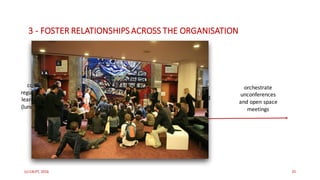
orchestrate
unconferences
and	open	space	
meetings
organise company
learning	and	networking	
retreats
3	- FOSTER	RELATIONSHIPS	ACROSS	THE	ORGANISATION	
coordinate
regular	(informal)	
learning	events
(e.g.	lunch	‘n’	learns,
book	clubs)
organise company	
networking	events
(c)	C4LPT,	2016 24
coordinate
regular	informal	
learning	events
(lunch	n	learns)
organise cpmpany
networking	events
orchestrate
unconferences
and	open	space	
meetings
organise company
learning	and	networking	
retreats
3	- FOSTER	RELATIONSHIPS	ACROSS	THE	ORGANISATION
(c)	C4LPT,	2016 25
coordinate
regular	informal	
learning	events
(lunch	n	learns)
organise cpmpany
networking	events
orchestrate
unconferences
and	open	space	
meetings
organise company
learning	and	networking	
retreats
3	- FOSTER	RELATIONSHIPS	ACROSS	THE	ORGANISATION
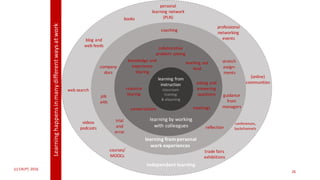
independent	learning
personal
learning	network
(PLN)
professional
networking
eventsblog	and
web	feeds
conferences,
backchannels
trade	fairs
exhibiitions
(online)
communities
courses/
MOOCs
videos
podcasts
books
web	search
learning	from	personal
work	experiences
reflection
coaching
stretch	
assign-
ments
company
docs
job
aids
guidance
from
managers
trial
and
error
learning	by	working	
with	colleagues
collaborative
problem	solving
knowledge	and
experience
sharing
resource
sharing
working	out
loud
asking	and	
answering
questions
meetingsconversations
(c)	C4LPT,	2016
26
learning	from	
instruction
classroom	
training	
&	elearning
Learning	happens	in	many	different	ways	at	work
(c)	C4LPT,	2016
27
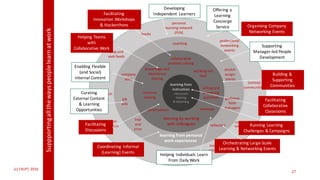
Suppportingall	the	ways	people	learn	at	work
Facilitating
Collaborative	
Classrooms
Running	Learning	
Challenges &	Campaigns
Building	&	
Supporting	
Communities
Helping	Teams	
with
Collaborative	Work
Facilitating
Discussions
Facilitating
Innovation	Workshops
&	Hackerthons
Enabling	Flexible
(and	Social)
Internal	Content
Curating
External	Content
&	Learning	
Opportunities
Helping	Individuals	Learn
From	Daily	Work
Developing
Independent	Learners
Offering	a	
Learning	
Concierge
Service Organising Company
Networking	Events
Orchestrating	Large-Scale
Learning	&	Networking	EventsCoordinating	Informal	
(Learning)	Events
Supporting
Manager-led	People	
Development
Where	do	I	start?
(c)	C4LPT,	2016 28
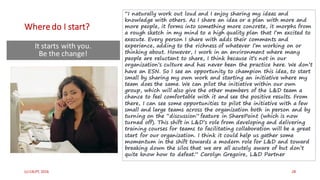
“I naturally work out loud and I enjoy sharing my ideas and
knowledge with others. As I share an idea or a plan with more and
more people, it forms into something more concrete, it morphs from
a rough sketch in my mind to a high quality plan that I’m excited to
execute. Every person I share with adds their comments and
experience, adding to the richness of whatever I’m working on or
thinking about. However, I work in an environment where many
people are reluctant to share, I think because it’s not in our
organization’s culture and has never been the practice here. We don’t
have an ESN. So I see an opportunity to champion this idea, to start
small by sharing my own work and starting an initiative where my
team does the same. We can pilot the initiative within our own
group, which will also give the other members of the L&D team a
chance to feel comfortable with it and see the positive results. From
there, I can see some opportunities to pilot the initiative with a few
small and large teams across the organization both in person and by
turning on the “discussion” feature in SharePoint (which is now
turned off). This shift in L&D’s role from developing and delivering
training courses for teams to facilitating collaboration will be a great
start for our organization. I think it could help us gather some
momentum in the shift towards a modern role for L&D and toward
breaking down the silos that we are all acutely aware of but don’t
quite know how to defeat.” Carolyn Gregoire, L&D Partner
It	starts	with	you.
Be	the	change!
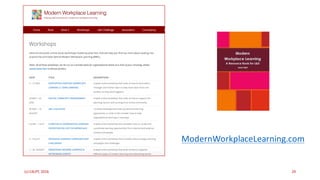
ModernWorkplaceLearning.com
(c)	C4LPT,	2016 29

Supporting Social & Collaborative Learning in the Workplace