RP Kafui KORNU
Sunyani-Central Rotary Club
September 21, 2019
Whoisaleader?
• A leader can be anyone on the team who has a particular
talent, who is creatively thinking out of the box and has
a great idea, who has experience in a certain aspect of
the business or project that can prove useful.
• A leader leads based on strengths, not titles.
• Are good leaders born, or can leadership be taught?
LeadershipEssentials
1. Be a Big Thinker.
2. Have a Mission the Matters
3. Be Ethical
4. Be a Change-Master
5. Be sensitive
6. Be a Risk taker
LeadershipEssentials
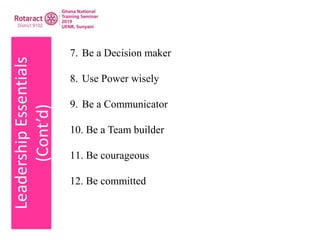
(Cont’d) 7. Be a Decision maker
8. Use Power wisely
9. Be a Communicator
10. Be a Team builder
11. Be courageous
12. Be committed
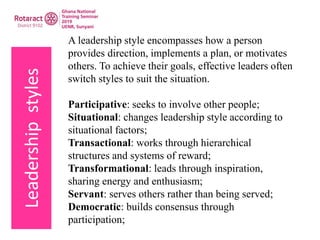
Leadershipstyles A leadership style encompasses how a person
provides direction, implements a plan, or motivates
others. To achieve their goals, effective leaders often
switch styles to suit the situation.
Participative: seeks to involve other people;
Situational: changes leadership style according to
situational factors;
Transactional: works through hierarchical
structures and systems of reward;
Transformational: leads through inspiration,
sharing energy and enthusiasm;
Servant: serves others rather than being served;
Democratic: builds consensus through
participation;
Leadershipstyles
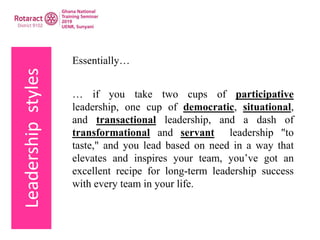
Essentially…
… if you take two cups of participative
leadership, one cup of democratic, situational,
and transactional leadership, and a dash of
transformational and servant leadership "to
taste," and you lead based on need in a way that
elevates and inspires your team, you’ve got an
excellent recipe for long-term leadership success
with every team in your life.
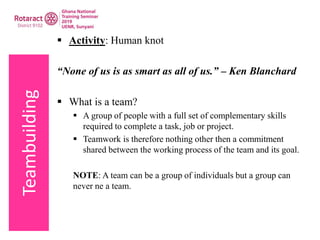
Teambuilding  Activity: Human knot
“None of us is as smart as all of us.” – Ken Blanchard
 What is a team?
 A group of people with a full set of complementary skills
required to complete a task, job or project.
 Teamwork is therefore nothing other then a commitment
shared between the working process of the team and its goal.
NOTE: A team can be a group of individuals but a group can
never ne a team.
Teambuilding(Cont’d)
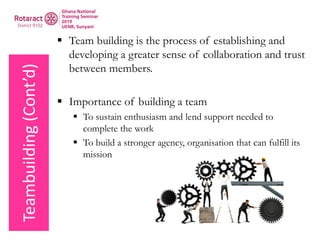
 Team building is the process of establishing and
developing a greater sense of collaboration and trust
between members.
 Importance of building a team
 To sustain enthusiasm and lend support needed to
complete the work
 To build a stronger agency, organisation that can fulfill its
mission
Howdoesateamwork
best?  A team succeeds when its members have:
 A commitment to common objectives
 Defined roles and responsibilities
 Effective decision systems, communication and work
procedures
 Good personal relationships
 Team morale depends on:
 Support
 Resources
 Communication
 Personalities
Skillsrequiredfor
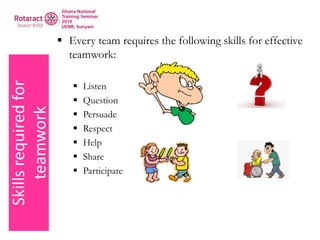
teamwork  Every team requires the following skills for effective
teamwork:
 Listen
 Question
 Persuade
 Respect
 Help
 Share
 Participate
Essentialvaluesofa
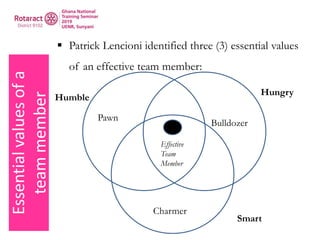
teammember  Patrick Lencioni identified three (3) essential values
of an effective team member:
Pawn
Bulldozer
Charmer
Humble
Hungry
Smart
Effective
Team
Member
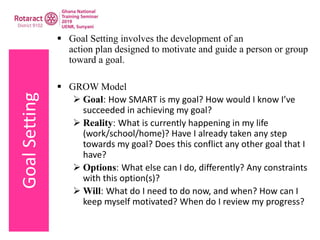
GoalSetting  Goal Setting involves the development of an
action plan designed to motivate and guide a person or group
toward a goal.
 GROW Model
 Goal: How SMART is my goal? How would I know I’ve
succeeded in achieving my goal?
 Reality: What is currently happening in my life
(work/school/home)? Have I already taken any step
towards my goal? Does this conflict any other goal that I
have?
 Options: What else can I do, differently? Any constraints
with this option(s)?
 Will: What do I need to do now, and when? How can I
keep myself motivated? When do I review my progress?
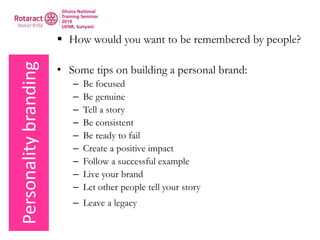
Personalitybranding  How would you want to be remembered by people?
• Some tips on building a personal brand:
– Be focused
– Be genuine
– Tell a story
– Be consistent
– Be ready to fail
– Create a positive impact
– Follow a successful example
– Live your brand
– Let other people tell your story
– Leave a legacy
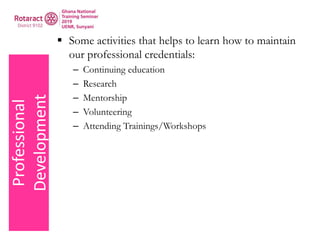
Professional
Development  Some activities that helps to learn how to maintain
our professional credentials:
– Continuing education
– Research
– Mentorship
– Volunteering
– Attending Trainings/Workshops
ThankYou
?

Leadership and Professional Development

  • 1.
    RP Kafui KORNU Sunyani-CentralRotary Club September 21, 2019
  • 2.
    Whoisaleader? • A leadercan be anyone on the team who has a particular talent, who is creatively thinking out of the box and has a great idea, who has experience in a certain aspect of the business or project that can prove useful. • A leader leads based on strengths, not titles. • Are good leaders born, or can leadership be taught?
  • 3.
    LeadershipEssentials 1. Be aBig Thinker. 2. Have a Mission the Matters 3. Be Ethical 4. Be a Change-Master 5. Be sensitive 6. Be a Risk taker
  • 4.
    LeadershipEssentials (Cont’d) 7. Bea Decision maker 8. Use Power wisely 9. Be a Communicator 10. Be a Team builder 11. Be courageous 12. Be committed
  • 5.
    Leadershipstyles A leadershipstyle encompasses how a person provides direction, implements a plan, or motivates others. To achieve their goals, effective leaders often switch styles to suit the situation. Participative: seeks to involve other people; Situational: changes leadership style according to situational factors; Transactional: works through hierarchical structures and systems of reward; Transformational: leads through inspiration, sharing energy and enthusiasm; Servant: serves others rather than being served; Democratic: builds consensus through participation;
  • 6.
    Leadershipstyles Essentially… … if youtake two cups of participative leadership, one cup of democratic, situational, and transactional leadership, and a dash of transformational and servant leadership "to taste," and you lead based on need in a way that elevates and inspires your team, you’ve got an excellent recipe for long-term leadership success with every team in your life.
  • 7.
    Teambuilding  Activity:Human knot “None of us is as smart as all of us.” – Ken Blanchard  What is a team?  A group of people with a full set of complementary skills required to complete a task, job or project.  Teamwork is therefore nothing other then a commitment shared between the working process of the team and its goal. NOTE: A team can be a group of individuals but a group can never ne a team.
  • 8.
    Teambuilding(Cont’d)  Team buildingis the process of establishing and developing a greater sense of collaboration and trust between members.  Importance of building a team  To sustain enthusiasm and lend support needed to complete the work  To build a stronger agency, organisation that can fulfill its mission
  • 9.
    Howdoesateamwork best?  Ateam succeeds when its members have:  A commitment to common objectives  Defined roles and responsibilities  Effective decision systems, communication and work procedures  Good personal relationships  Team morale depends on:  Support  Resources  Communication  Personalities
  • 10.
    Skillsrequiredfor teamwork  Everyteam requires the following skills for effective teamwork:  Listen  Question  Persuade  Respect  Help  Share  Participate
  • 11.
    Essentialvaluesofa teammember  PatrickLencioni identified three (3) essential values of an effective team member: Pawn Bulldozer Charmer Humble Hungry Smart Effective Team Member
  • 12.
    GoalSetting  GoalSetting involves the development of an action plan designed to motivate and guide a person or group toward a goal.  GROW Model  Goal: How SMART is my goal? How would I know I’ve succeeded in achieving my goal?  Reality: What is currently happening in my life (work/school/home)? Have I already taken any step towards my goal? Does this conflict any other goal that I have?  Options: What else can I do, differently? Any constraints with this option(s)?  Will: What do I need to do now, and when? How can I keep myself motivated? When do I review my progress?
  • 13.
    Personalitybranding  Howwould you want to be remembered by people? • Some tips on building a personal brand: – Be focused – Be genuine – Tell a story – Be consistent – Be ready to fail – Create a positive impact – Follow a successful example – Live your brand – Let other people tell your story – Leave a legacy
  • 14.
    Professional Development  Someactivities that helps to learn how to maintain our professional credentials: – Continuing education – Research – Mentorship – Volunteering – Attending Trainings/Workshops
  • 15.