COURTNEY ALLISONCOURTNEY ALLISON
INDIANA STATE LIBRARYINDIANA STATE LIBRARY
PROFESSIONAL DEVELOPMENT OFFICEPROFESSIONAL DEVELOPMENT OFFICE
CALLISON@LIBRARY.IN.GOVCALLISON@LIBRARY.IN.GOV / 317.910.5777/ 317.910.5777
Why it matters
Professionalism in theProfessionalism in the
WorkplaceWorkplace
WHAT WE WILL DISCUSS
TODAY
 What Professionalism is
 Appearance (why it matters)
 Workplace conversation (great reminders)
 How to work (dos and don’ts)
 Representing the Library (best practices)
And how it all relates to Professionalism!
PROFESSIONALISM???!!PROFESSIONALISM???!!
 So what is professionalism?
 And why is it important?
 What does that mean for me??
DEFINING AND
DISCUSSING
PRO·FES·SION·AL·ISMPRO·FES·SION·AL·ISM
(PR FESH NL IZ M)Əˈ Ə ˌ Ə(PR FESH NL IZ M)Əˈ Ə ˌ Ə
1.1. the conduct, aims, or qualities thatthe conduct, aims, or qualities that
characterize or mark a profession or acharacterize or mark a profession or a
professional person,professional person,
2.2. the following of a profession (asthe following of a profession (as
athletics) for gain or livelihood.athletics) for gain or livelihood.
MERRIAM WEBSTER’S
COLLEGIATE DICTIONARY,
11TH
EDITION :
Meticulous adherence to undeviatingMeticulous adherence to undeviating
courtesy, honesty,courtesy, honesty, andand responsibilityresponsibility inin
one’s dealings withone’s dealings with customerscustomers andand
associatesassociates, plus a level of excellence that, plus a level of excellence that
goes over and above the commercialgoes over and above the commercial
considerations and legal requirements.considerations and legal requirements.
WWW.BUSINESSDICTIONARY.WWW.BUSINESSDICTIONARY.
COMCOM::
A person who is an expert at his or her workA person who is an expert at his or her work
PROFESSIONALPROFESSIONAL
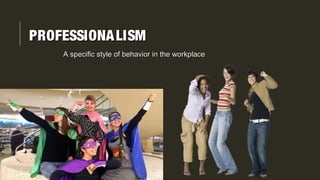
A specific style of behavior in the workplaceA specific style of behavior in the workplace
PROFESSIONALISMPROFESSIONALISM
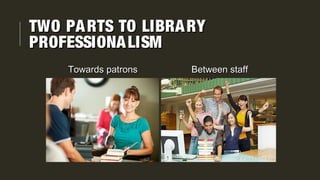
TWO PARTS TO LIBRARYTWO PARTS TO LIBRARY
PROFESSIONALISMPROFESSIONALISM
Towards patronsTowards patrons Between staffBetween staff
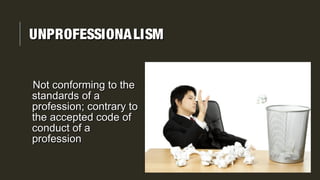
UNPROFESSIONALISMUNPROFESSIONALISM
Not conforming to theNot conforming to the
standards of astandards of a
profession; contrary toprofession; contrary to
the accepted code ofthe accepted code of
conduct of aconduct of a
professionprofession
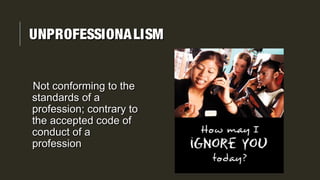
UNPROFESSIONALISMUNPROFESSIONALISM
Not conforming to theNot conforming to the
standards of astandards of a
profession; contrary toprofession; contrary to
the accepted code ofthe accepted code of
conduct of aconduct of a
professionprofession
UNPROFESSIONALUNPROFESSIONAL
 Not professional; not pertaining to orNot professional; not pertaining to or
characteristic of a professioncharacteristic of a profession
 At variance with or contrary to professionalAt variance with or contrary to professional
standards or ethics; not befitting members ofstandards or ethics; not befitting members of
a profession, as language, behavior ora profession, as language, behavior or
conductconduct
 Not belonging to a profession;Not belonging to a profession;
nonprofessionalnonprofessional
 Not done with professional competenceNot done with professional competence
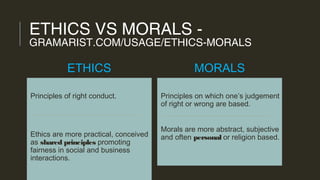
ETHICS VS MORALS -
GRAMARIST.COM/USAGE/ETHICS-MORALS
ETHICS
Principles of right conduct.
Ethics are more practical, conceived
as shared principles promoting
fairness in social and business
interactions.
MORALS
Principles on which one’s judgement
of right or wrong are based.
Morals are more abstract, subjective
and often personal or religion based.
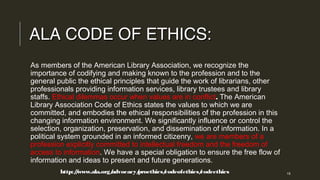
ALA CODE OF ETHICS:ALA CODE OF ETHICS:
As members of the American Library Association, we recognize the
importance of codifying and making known to the profession and to the
general public the ethical principles that guide the work of librarians, other
professionals providing information services, library trustees and library
staffs. Ethical dilemmas occur when values are in conflict. The American
Library Association Code of Ethics states the values to which we are
committed, and embodies the ethical responsibilities of the profession in this
changing information environment. We significantly influence or control the
selection, organization, preservation, and dissemination of information. In a
political system grounded in an informed citizenry, we are members of a
profession explicitly committed to intellectual freedom and the freedom of
access to information. We have a special obligation to ensure the free flow of
information and ideas to present and future generations.
http://www.ala.org/advocacy/proethics/codeofethics/codeethicshttp://www.ala.org/advocacy/proethics/codeofethics/codeethics 15
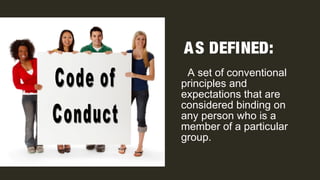
A set of conventional
principles and
expectations that are
considered binding on
any person who is a
member of a particular
group.
AS DEFINED:
PART ONE:
APPEARANCE
Why have a dress
code?
Professionalism in the
Workplace
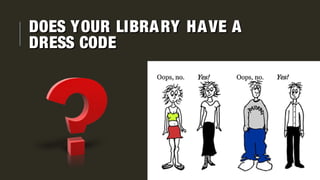
DOES YOUR LIBRARY HAVE ADOES YOUR LIBRARY HAVE A
DRESS CODEDRESS CODE
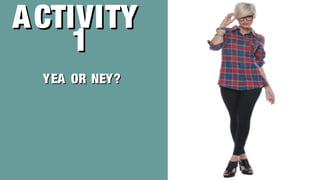
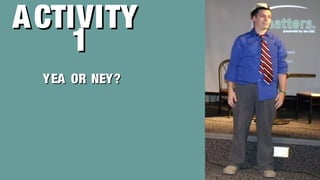
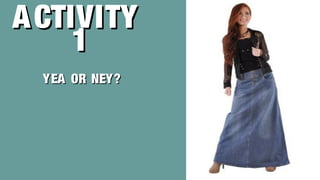
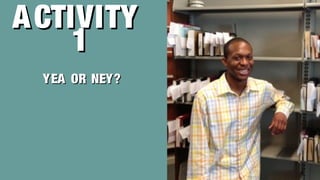
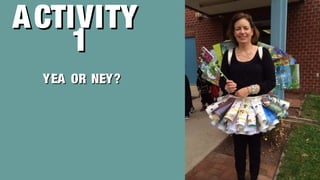
ACTIVITY 1ACTIVITY 1
YEA OR NEY?YEA OR NEY?
ACTIVITYACTIVITY
11
YEA OR NEY?YEA OR NEY?
ACTIVITYACTIVITY
11
YEA OR NEY?YEA OR NEY?
ACTIVITYACTIVITY
11
YEA OR NEY?YEA OR NEY?
ACTIVITYACTIVITY
11
YEA OR NEY?YEA OR NEY?
ACTIVITYACTIVITY
11
YEA OR NEY?YEA OR NEY?
ACTIVITYACTIVITY
11
YEA OR NEY?YEA OR NEY?
ACTIVITYACTIVITY
11
YEA OR NEY?YEA OR NEY?
ACTIVITYACTIVITY
11
YEA OR NEY?YEA OR NEY? Political
candidate’s
slogan
Political
logo
ACTIVITYACTIVITY
11
YEA OR NEY?YEA OR NEY?
ACTIVITYACTIVITY
11
YEA OR NEY?YEA OR NEY?
ACTIVITYACTIVITY
11
YEA OR NEY?YEA OR NEY?
ACTIVITYACTIVITY
11
YEA OR NEY?YEA OR NEY?
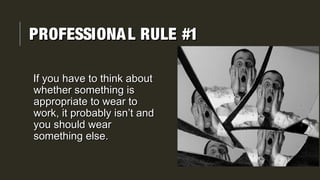
PROFESSIONALPROFESSIONAL RULE #1RULE #1
If you have to think aboutIf you have to think about
whether something iswhether something is
appropriate to wear toappropriate to wear to
work, it probably isn’t andwork, it probably isn’t and
you should wearyou should wear
something else.something else.
PART TWO:
CONVERSATIONS
Who are the people
in your
neighborhood?
Professionalism in the
Workplace
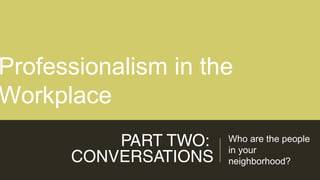
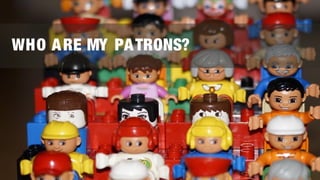
WHO ARE MY PATRONS?
DIVERSITY
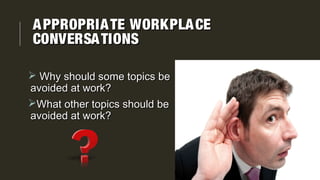
APPROPRIATE WORKPLACEAPPROPRIATE WORKPLACE
CONVERSATIONSCONVERSATIONS
 Why should some topics beWhy should some topics be
avoided at work?avoided at work?
What other topics should beWhat other topics should be
avoided at work?avoided at work?
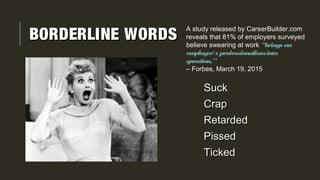
BORDERLINE WORDSBORDERLINE WORDS
SuckSuck
CrapCrap
RetardedRetarded
PissedPissed
TickedTicked
A study released by CareerBuilder.com
reveals that 81% of employers surveyed
believe swearing at work “brings an
employee's professionalisminto
question.”
– Forbes, March 19, 2015
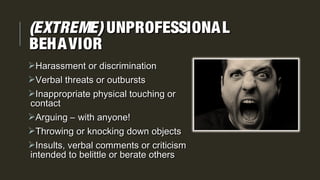
(EXTREME)(EXTREME) UNPROFESSIONALUNPROFESSIONAL
BEHAVIORBEHAVIOR
Harassment or discriminationHarassment or discrimination
Verbal threats or outburstsVerbal threats or outbursts
Inappropriate physical touching orInappropriate physical touching or
contactcontact
Arguing – with anyone!Arguing – with anyone!
Throwing or knocking down objectsThrowing or knocking down objects
Insults, verbal comments or criticismInsults, verbal comments or criticism
intended to belittle or berate othersintended to belittle or berate others
ACTIVITY 2ACTIVITY 2
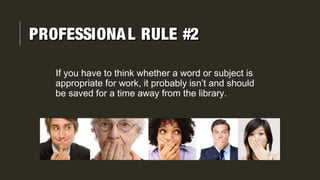
If you have to think whether a word or subject is
appropriate for work, it probably isn’t and should
be saved for a time away from the library.
PROFESSIONAL RULE #2PROFESSIONAL RULE #2
PART THREE: HOW TO
WORK
Work or not
work?
Professionalism in the
Workplace
WORK OR NOT WORK???!!WORK OR NOT WORK???!!
What are some activities that could beWhat are some activities that could be
work or not be work depending on howwork or not be work depending on how
you use them?you use them?
E-mail, texting, phone calls 
E-mail, texting, phone calls 

Facebook, Twitter, Pinterest 
Facebook, Twitter, Pinterest 

Books, Magazines 
Books, Magazines 

Talking with co-workers, patrons 
Talking with co-workers, patrons 

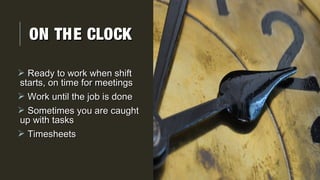
ON THE CLOCKON THE CLOCK
 Ready to work when shiftReady to work when shift
starts, on time for meetingsstarts, on time for meetings
 Work until the job is doneWork until the job is done
 Sometimes you are caughtSometimes you are caught
up with tasksup with tasks
 TimesheetsTimesheets
TALKING AT PUBLIC SERVICE DESKSTALKING AT PUBLIC SERVICE DESKS
 Keep it short, work relatedKeep it short, work related
 Everything we do or sayEverything we do or say
means something to themeans something to the
patronspatrons
 Keep personal issuesKeep personal issues
separated from the workplace!separated from the workplace!
ACTIVITY 3ACTIVITY 3
WHAT WOULD YOU DO?WHAT WOULD YOU DO?
ACTIVITY 3ACTIVITY 3
Joan works at a public service desk in the library. She lovesJoan works at a public service desk in the library. She loves
using her smartphone and she has it with her everywhere sheusing her smartphone and she has it with her everywhere she
goes. Her job at the library doesn’t require the use of a cellgoes. Her job at the library doesn’t require the use of a cell
phone to do her job. The Director sees her using her phonephone to do her job. The Director sees her using her phone
while she was on desk duty. The Director proceeds to yell atwhile she was on desk duty. The Director proceeds to yell at
Joan (in front of other staff and patrons) telling her that she isJoan (in front of other staff and patrons) telling her that she is
not allowed to have her phone with her while at the publicnot allowed to have her phone with her while at the public
desk. As soon as the Director is out of sight, Joan goes backdesk. As soon as the Director is out of sight, Joan goes back
to looking at her smartphone.to looking at her smartphone.
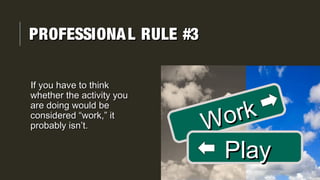
If you have to thinkf you have to think
whether the activity youwhether the activity you
are doing would beare doing would be
considered “work,” itconsidered “work,” it
probably isn’t.probably isn’t.
PROFESSIONAL RULE #3PROFESSIONAL RULE #3
WorkWork
PlayPlay
PART FOUR:
REPRESENTING THE
LIBRARY
You are the face of
the library!
Professionalism in the
Workplace
Greet everyone
with a smile
(even co-
workers)
WELCOME TO THE LIBRARY
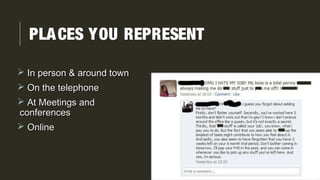
PLACES YOU REPRESENT
 In person & around townIn person & around town
 On the telephoneOn the telephone
 At Meetings andAt Meetings and
conferencesconferences
 OnlineOnline
ELECTRONICALLY (ONLINE)
 ListservsListservs
 EmailEmail
 Social NetworkingSocial Networking
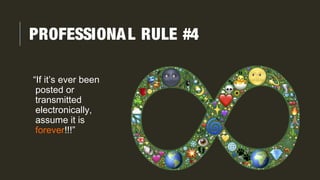
PROFESSIONAL RULE #4
“If it’s ever been
posted or
transmitted
electronically,
assume it is
forever!!!”
PROFESSIONALISM & RESPECT
 For your workplaceFor your workplace
 For your coworkersFor your coworkers
 For yourselfFor yourself
 For your patronsFor your patrons
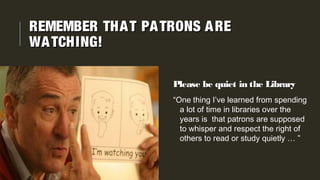
Please be quiet in the LibraryPlease be quiet in the Library
“One thing I’ve learned from spending
a lot of time in libraries over the
years is that patrons are supposed
to whisper and respect the right of
others to read or study quietly 
 ”
REMEMBER THAT PATRONS AREREMEMBER THAT PATRONS ARE
WATCHING!WATCHING!
“[An Indiana library] may be the noisiest I’ve ever
experienced — and it’s because of the library
staff! Someone should teach them to whisper.
They are equally loud whether they are checking
out books, making personal telephone calls or
gossiping about their colleagues. Does everyone
really need to know who they went to dinner with
last night? Respect your customers, keep the
noise down.”
- August 31, 2010LettertotheEditor
REMEMBER THAT PATRONS AREREMEMBER THAT PATRONS ARE
WATCHING!WATCHING!
CONTACT INFORMATIONCONTACT INFORMATION
Courtney Allison
Southeast RegionalCoordinator
ProfessionalDevelopment Office
IndianaStateLibrary
callison@library.in.gov
317.910.5777
SOURCES
http://factfinder.census.gov/
http://humanresources.about.com/od/workrelationships/a/dress_cod
e.htm
http://www.stats.indiana.edu/
http://www.politico.com/2012-election/results/president/indiana/
http://www.merriam-webster.com/dictionary/professionalism
http://www.businessdictionary.com/definition/professionalism.html
SOURCES
‱ Adubato, Steve. 2010. "Consider your message before you click 'send'
button." njbiz 23, no. 29: 11. Re g io nalBusine ss Ne ws , EBSCOho st
(accessed September 7, 2010).
‱ Bemis-Dougherty, Anita. 2010. "Professionalism and Social Networking." PT
in Mo tio n 2, no. 5: 40-47. Acade m ic Se arch Pre m ie r, EBSCOho st (accessed
September 3, 2010).
‱ Nancherla, Aparna. 2010. "On Their Best Behavior." T+ D 64, no. 4: 28.
He alth Busine ss FullTEXT, EBSCOho st (accessed September 7, 2010).
‱ Reddick, Ellen. 2009. "Are you your professional best?." Ente rprise /Salt Lake
City 39, no. 1: 9. Re g io nalBusine ss Ne ws , EBSCOho st (accessed
September 7, 2010).
‱ Samuels Gibbs, Adrienne. 2009. "Diamonds last forever; e-mail does, too!."
Ebo ny 65, no. 2/3: 34. Maste rFILE Pre m ie r, EBSCOho st (accessed
September 3, 2010).
‱ Stafford, Diane. 2009. "Tirades show cursing is everywhere these days."
Kansas City Star, The (MO ), May 26. Ne wspape r So urce , EBSCOho st
(accessed September 7, 2010).
‱ Tyler, Kathryn. "Generation Gaps." HRMag azine 53, no. 1 (January 2008):
69-72. Co rpo rate Re so urce Ne t, EBSCOho st (accessed September 7, 2010).

Professionalism in the Workplace

  • 1.
    COURTNEY ALLISONCOURTNEY ALLISON INDIANASTATE LIBRARYINDIANA STATE LIBRARY PROFESSIONAL DEVELOPMENT OFFICEPROFESSIONAL DEVELOPMENT OFFICE CALLISON@LIBRARY.IN.GOVCALLISON@LIBRARY.IN.GOV / 317.910.5777/ 317.910.5777 Why it matters Professionalism in theProfessionalism in the WorkplaceWorkplace
  • 3.
    WHAT WE WILLDISCUSS TODAY  What Professionalism is  Appearance (why it matters)  Workplace conversation (great reminders)  How to work (dos and don’ts)  Representing the Library (best practices) And how it all relates to Professionalism!
  • 4.
    PROFESSIONALISM???!!PROFESSIONALISM???!!  So whatis professionalism?  And why is it important?  What does that mean for me??
  • 5.
    DEFINING AND DISCUSSING PRO·FES·SION·AL·ISMPRO·FES·SION·AL·ISM (PR FESHNL IZ M)Əˈ Ə ˌ Ə(PR FESH NL IZ M)Əˈ Ə ˌ Ə
  • 6.
    1.1. the conduct,aims, or qualities thatthe conduct, aims, or qualities that characterize or mark a profession or acharacterize or mark a profession or a professional person,professional person, 2.2. the following of a profession (asthe following of a profession (as athletics) for gain or livelihood.athletics) for gain or livelihood. MERRIAM WEBSTER’S COLLEGIATE DICTIONARY, 11TH EDITION :
  • 7.
    Meticulous adherence toundeviatingMeticulous adherence to undeviating courtesy, honesty,courtesy, honesty, andand responsibilityresponsibility inin one’s dealings withone’s dealings with customerscustomers andand associatesassociates, plus a level of excellence that, plus a level of excellence that goes over and above the commercialgoes over and above the commercial considerations and legal requirements.considerations and legal requirements. WWW.BUSINESSDICTIONARY.WWW.BUSINESSDICTIONARY. COMCOM::
  • 8.
    A person whois an expert at his or her workA person who is an expert at his or her work PROFESSIONALPROFESSIONAL
  • 9.
    A specific styleof behavior in the workplaceA specific style of behavior in the workplace PROFESSIONALISMPROFESSIONALISM
  • 10.
    TWO PARTS TOLIBRARYTWO PARTS TO LIBRARY PROFESSIONALISMPROFESSIONALISM Towards patronsTowards patrons Between staffBetween staff
  • 11.
    UNPROFESSIONALISMUNPROFESSIONALISM Not conforming totheNot conforming to the standards of astandards of a profession; contrary toprofession; contrary to the accepted code ofthe accepted code of conduct of aconduct of a professionprofession
  • 12.
    UNPROFESSIONALISMUNPROFESSIONALISM Not conforming totheNot conforming to the standards of astandards of a profession; contrary toprofession; contrary to the accepted code ofthe accepted code of conduct of aconduct of a professionprofession
  • 13.
    UNPROFESSIONALUNPROFESSIONAL  Not professional; not pertaining to orNot professional; not pertaining to or characteristic ofa professioncharacteristic of a profession  At variance with or contrary to professionalAt variance with or contrary to professional standards or ethics; not befitting members ofstandards or ethics; not befitting members of a profession, as language, behavior ora profession, as language, behavior or conductconduct  Not belonging to a profession;Not belonging to a profession; nonprofessionalnonprofessional  Not done with professional competenceNot done with professional competence
  • 14.
    ETHICS VS MORALS- GRAMARIST.COM/USAGE/ETHICS-MORALS ETHICS Principles of right conduct. Ethics are more practical, conceived as shared principles promoting fairness in social and business interactions. MORALS Principles on which one’s judgement of right or wrong are based. Morals are more abstract, subjective and often personal or religion based.
  • 15.
    ALA CODE OFETHICS:ALA CODE OF ETHICS: As members of the American Library Association, we recognize the importance of codifying and making known to the profession and to the general public the ethical principles that guide the work of librarians, other professionals providing information services, library trustees and library staffs. Ethical dilemmas occur when values are in conflict. The American Library Association Code of Ethics states the values to which we are committed, and embodies the ethical responsibilities of the profession in this changing information environment. We significantly influence or control the selection, organization, preservation, and dissemination of information. In a political system grounded in an informed citizenry, we are members of a profession explicitly committed to intellectual freedom and the freedom of access to information. We have a special obligation to ensure the free flow of information and ideas to present and future generations. http://www.ala.org/advocacy/proethics/codeofethics/codeethicshttp://www.ala.org/advocacy/proethics/codeofethics/codeethics 15
  • 16.
    A set ofconventional principles and expectations that are considered binding on any person who is a member of a particular group. AS DEFINED:
  • 17.
    PART ONE: APPEARANCE Why havea dress code? Professionalism in the Workplace
  • 18.
    DOES YOUR LIBRARYHAVE ADOES YOUR LIBRARY HAVE A DRESS CODEDRESS CODE
  • 19.
    ACTIVITY 1ACTIVITY 1 YEAOR NEY?YEA OR NEY?
  • 20.
  • 21.
  • 22.
  • 23.
  • 24.
  • 25.
  • 26.
  • 27.
    ACTIVITYACTIVITY 11 YEA OR NEY?YEAOR NEY? Political candidate’s slogan Political logo
  • 28.
  • 29.
  • 30.
  • 31.
  • 32.
    PROFESSIONALPROFESSIONAL RULE #1RULE#1 If you have to think aboutIf you have to think about whether something iswhether something is appropriate to wear toappropriate to wear to work, it probably isn’t andwork, it probably isn’t and you should wearyou should wear something else.something else.
  • 33.
    PART TWO: CONVERSATIONS Who arethe people in your neighborhood? Professionalism in the Workplace
  • 34.
    WHO ARE MYPATRONS?
  • 35.
  • 36.
    APPROPRIATE WORKPLACEAPPROPRIATE WORKPLACE CONVERSATIONSCONVERSATIONS Why should some topics beWhy should some topics be avoided at work?avoided at work? What other topics should beWhat other topics should be avoided at work?avoided at work?
  • 37.
    BORDERLINE WORDSBORDERLINE WORDS SuckSuck CrapCrap RetardedRetarded PissedPissed TickedTicked Astudy released by CareerBuilder.com reveals that 81% of employers surveyed believe swearing at work “brings an employee's professionalisminto question.” – Forbes, March 19, 2015
  • 38.
    (EXTREME)(EXTREME) UNPROFESSIONALUNPROFESSIONAL BEHAVIORBEHAVIOR Harassment ordiscriminationHarassment or discrimination Verbal threats or outburstsVerbal threats or outbursts Inappropriate physical touching orInappropriate physical touching or contactcontact Arguing – with anyone!Arguing – with anyone! Throwing or knocking down objectsThrowing or knocking down objects Insults, verbal comments or criticismInsults, verbal comments or criticism intended to belittle or berate othersintended to belittle or berate others
  • 39.
  • 40.
    If you haveto think whether a word or subject is appropriate for work, it probably isn’t and should be saved for a time away from the library. PROFESSIONAL RULE #2PROFESSIONAL RULE #2
  • 41.
    PART THREE: HOWTO WORK Work or not work? Professionalism in the Workplace
  • 42.
    WORK OR NOTWORK???!!WORK OR NOT WORK???!! What are some activities that could beWhat are some activities that could be work or not be work depending on howwork or not be work depending on how you use them?you use them? E-mail, texting, phone calls 
E-mail, texting, phone calls 
 Facebook, Twitter, Pinterest 
Facebook, Twitter, Pinterest 
 Books, Magazines 
Books, Magazines 
 Talking with co-workers, patrons 
Talking with co-workers, patrons 

  • 43.
    ON THE CLOCKONTHE CLOCK  Ready to work when shiftReady to work when shift starts, on time for meetingsstarts, on time for meetings  Work until the job is doneWork until the job is done  Sometimes you are caughtSometimes you are caught up with tasksup with tasks  TimesheetsTimesheets
  • 44.
    TALKING AT PUBLICSERVICE DESKSTALKING AT PUBLIC SERVICE DESKS  Keep it short, work relatedKeep it short, work related  Everything we do or sayEverything we do or say means something to themeans something to the patronspatrons  Keep personal issuesKeep personal issues separated from the workplace!separated from the workplace!
  • 45.
    ACTIVITY 3ACTIVITY 3 WHATWOULD YOU DO?WHAT WOULD YOU DO?
  • 46.
    ACTIVITY 3ACTIVITY 3 Joanworks at a public service desk in the library. She lovesJoan works at a public service desk in the library. She loves using her smartphone and she has it with her everywhere sheusing her smartphone and she has it with her everywhere she goes. Her job at the library doesn’t require the use of a cellgoes. Her job at the library doesn’t require the use of a cell phone to do her job. The Director sees her using her phonephone to do her job. The Director sees her using her phone while she was on desk duty. The Director proceeds to yell atwhile she was on desk duty. The Director proceeds to yell at Joan (in front of other staff and patrons) telling her that she isJoan (in front of other staff and patrons) telling her that she is not allowed to have her phone with her while at the publicnot allowed to have her phone with her while at the public desk. As soon as the Director is out of sight, Joan goes backdesk. As soon as the Director is out of sight, Joan goes back to looking at her smartphone.to looking at her smartphone.
  • 47.
    If you haveto thinkf you have to think whether the activity youwhether the activity you are doing would beare doing would be considered “work,” itconsidered “work,” it probably isn’t.probably isn’t. PROFESSIONAL RULE #3PROFESSIONAL RULE #3 WorkWork PlayPlay
  • 48.
    PART FOUR: REPRESENTING THE LIBRARY Youare the face of the library! Professionalism in the Workplace
  • 49.
    Greet everyone with asmile (even co- workers) WELCOME TO THE LIBRARY
  • 50.
    PLACES YOU REPRESENT In person & around townIn person & around town  On the telephoneOn the telephone  At Meetings andAt Meetings and conferencesconferences  OnlineOnline
  • 51.
    ELECTRONICALLY (ONLINE)  ListservsListservs EmailEmail  Social NetworkingSocial Networking
  • 52.
    PROFESSIONAL RULE #4 “Ifit’s ever been posted or transmitted electronically, assume it is forever!!!”
  • 53.
    PROFESSIONALISM & RESPECT For your workplaceFor your workplace  For your coworkersFor your coworkers  For yourselfFor yourself  For your patronsFor your patrons
  • 54.
    Please be quietin the LibraryPlease be quiet in the Library “One thing I’ve learned from spending a lot of time in libraries over the years is that patrons are supposed to whisper and respect the right of others to read or study quietly 
 ” REMEMBER THAT PATRONS AREREMEMBER THAT PATRONS ARE WATCHING!WATCHING!
  • 55.
    “[An Indiana library]may be the noisiest I’ve ever experienced — and it’s because of the library staff! Someone should teach them to whisper. They are equally loud whether they are checking out books, making personal telephone calls or gossiping about their colleagues. Does everyone really need to know who they went to dinner with last night? Respect your customers, keep the noise down.” - August 31, 2010LettertotheEditor REMEMBER THAT PATRONS AREREMEMBER THAT PATRONS ARE WATCHING!WATCHING!
  • 56.
    CONTACT INFORMATIONCONTACT INFORMATION CourtneyAllison Southeast RegionalCoordinator ProfessionalDevelopment Office IndianaStateLibrary callison@library.in.gov 317.910.5777
  • 57.
  • 58.
    SOURCES ‱ Adubato, Steve.2010. "Consider your message before you click 'send' button." njbiz 23, no. 29: 11. Re g io nalBusine ss Ne ws , EBSCOho st (accessed September 7, 2010). ‱ Bemis-Dougherty, Anita. 2010. "Professionalism and Social Networking." PT in Mo tio n 2, no. 5: 40-47. Acade m ic Se arch Pre m ie r, EBSCOho st (accessed September 3, 2010). ‱ Nancherla, Aparna. 2010. "On Their Best Behavior." T+ D 64, no. 4: 28. He alth Busine ss FullTEXT, EBSCOho st (accessed September 7, 2010). ‱ Reddick, Ellen. 2009. "Are you your professional best?." Ente rprise /Salt Lake City 39, no. 1: 9. Re g io nalBusine ss Ne ws , EBSCOho st (accessed September 7, 2010). ‱ Samuels Gibbs, Adrienne. 2009. "Diamonds last forever; e-mail does, too!." Ebo ny 65, no. 2/3: 34. Maste rFILE Pre m ie r, EBSCOho st (accessed September 3, 2010). ‱ Stafford, Diane. 2009. "Tirades show cursing is everywhere these days." Kansas City Star, The (MO ), May 26. Ne wspape r So urce , EBSCOho st (accessed September 7, 2010). ‱ Tyler, Kathryn. "Generation Gaps." HRMag azine 53, no. 1 (January 2008): 69-72. Co rpo rate Re so urce Ne t, EBSCOho st (accessed September 7, 2010).

Editor's Notes

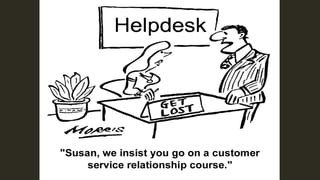
  • #3 Morris Weiss – American comic book & comic strip artist & writer
  • #4 (For each point, use clicker)
  • #5 (For each point, use clicker) Discussion - Ask for opinions about what professionalism means in general and to them personally Professionalism is important: How our institution is seen inside, outside community Helps us gain, retain patrons Help to establish support, credibility and goodwill for your library Libraries are part of the customer service industry A shelver said – “You give the books to me – I give them back to you so that you can find them again”
  • #6 Picture from - https://www.pexels.com/photo/yellow-tassel-159581/
  • #7 (Text will appear automatically) Discussion - How does this definition relate to librarians, library professional, and staff? No matter what your job is in a library, patrons will see you as a “professional” I’d like to add an ‘unofficial’ definition or opinion about professionalism: professionalism is less a matter of what professionals actually do and more a matter of who they are as human beings.
  • #8 (Text will appear automatically) Discussion - How does this definition relate to librarians, library professional, and staff? It’s important to remember that the definition places courtesy before honesty and responsibility. Libraries are a service industry and we must remember that courtesy should always come first. Frequently patrons will ask our opinions about materials in our collection. Although James Patterson may not be your cup of tea, it’s important to remember that we should be respectful of our patrons’ opinions and interests. This does not mean that you need to lie about enjoying their favorite author but it is always best to withhold your negative opinions of them. I believe that both can be applied to our profession. Patrons view us as specialists and professionals while asking for advice on how to fill out an application, the latest book to read, legal forms, etc.
  • #9 (Text will appear automatically under title) Everyone who works in the library is a library professional, regardless of your title or position. How about dress?  If you have meetings with the public on a given day, are you dressing appropriately?  Yes, casual, comfortable wear is allowed in many places.  But, what image are you trying to present on any given day? If you have a meeting or are teaching a class or giving a program – dress appropriately for the situation. Perfumes & lotions – causes people with breathing problems!
  • #10 (Text will appear automatically under title – use clicker for picture on left) Libraries can be as diverse as the communities that they serve. The dress and mannerisms of the people in this slide may be correct for a young adult librarian but inappropriate for a business librarian. On the right what department are these people from??? (when you hit click – a second image pops up on the left) – what department are they from?
  • #11 Need to be professional both to patrons and to your co-workers. Both have to work in order to have a professional work environment. If a patron is behaving in a manner which makes it difficult for you to maintain a professional demeanor you should address it immediately with your supervisor so they are aware of the issue and can advise you on how to proceed. You have to deal with co-workers in the same manner! How about manner of speaking to each other.  Tone is important.  You might talk sarcastically to a family member but is it professional to speak that way to a colleague.  Colleagues are like patrons treat each other as you would like to be treated. Common courtesy - Make eye contact and greet people, even co-workers with a smile – treat others as you would want to be treated Since we are in the library profession, every one of us is considered a professional - from Directors to front-line staff, we are all professionals and should conduct ourselves in a professional manner. This doesn’t mean being stuffy or not enjoying your time at work, it means being polite, courteous, and displaying manners to patrons, co-workers and staff alike.
  • #12 (Text will appear automatically) Not doing your work, not caring 

  • #13 If you work a public desk, don’t get engrossed in what you are doing on the computer (or phone or talking to others).  You should be interruptible.  And, please be mindful of social media.  For some people, it’s part of their job.  For others, it’s almost an addiction.  It isn’t good for the public to be seeing you surfing Facebook or Pinterest.
  • #14 (For each point, use clicker) Do you know of anyone that fits this definition? Do you?? What other examples or definitions could you use to describe someone who’s unprofessional.
  • #15 Morals are personal beliefs or opinions. When working in the library it’s important to remember that you are a government employee and must promote a community that is welcoming to everyone regardless of your personal beliefs. We must remember we don’t have to agree, but we’re not there to argue or debate them either - especially in the workplace. Story about a children’s librarian at a branch – her morals got in the way (wouldn’t give a child a book they thought was inappropriate) – that staff member was moved to the downtown library (she wasn’t in charge of a department anymore)
  • #16 Source: http://www.ala.org/advocacy/proethics/codeofethics/codeethics.
  • #17 (Text will appear automatically)
  • #19 Examples Dress Guidelines (Disclaimer: no Indiana State Library dress code mandate  1. Your appearance should not provoke, offend, embarrass, startle or distract your co-workers or patrons.  2. Your clothing should be appropriate and safe for the work you are doing.  3. Your clothing should be clean, well mended and fit properly.  4. Your clothing should not be torn, overly faded or have strong odors. 5. Your underwear should remain underneath your outerwear.  6. Your appearance should not make any overt personal, religious or political statements.  7. Unacceptable attire includes, but is not limited to: sweatpants workout attire beach attire pajamas cutoffs halters, camisoles or tank tops worn by themselves very short skirts, shorts or dresses bare midriffs sheer or revealing clothing
  • #20 (Use clicker for “Yea or Ney” to appear) Activity 1 – Disclaimer: no Indiana State Library dress code mandate Show pictures of outfits & have the group decide “Yeah or Nay” – these pictures are for discussion purposes
  • #21 Activity 1 Might be appropriate for a “formal” community & maybe not in a more “informal” community. Suits & ties might be off putting to some populations and a barrier. Or possibly the reverse as well, too casual might be a barrier. Dress to the occasion.  If you know that you are giving a presentation or meeting with someone during a particular day, you should consider dressing more professionally.  Ask your supervisor for direction.
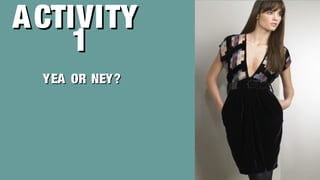
  • #22 Activity 1 Obvious – neckline too low
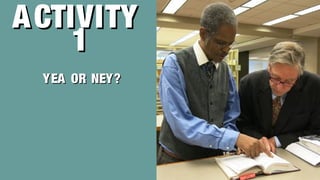
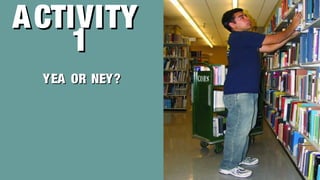
  • #23 Activity 1 – picture from http://www.lib.berkeley.edu/give/historyroom/panel6a.html Jeans are appropriate for a shelver, but maybe not someone at a service desk. Unless the whole library is informal & jeans are worn by everyone.
  • #24 Activity 1 Open toed shoes? Leggings?
  • #25 Activity 1 – picture from http://nicevillelibraryassistance.blogspot.com/2012/04/how-not-to-dress-for-interview.html Very easy – sloppy, baseball cap
  • #26 Activity 1 Would be OK for a service desk, but for a shelver dress & heels might not be best option
  • #27 Activity 1 Shirt not tucked in – might be fine for more informal libraries, more formal – maybe not. Would probably be fine for a shelver or behind the scenes person.
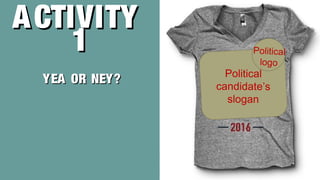
  • #28 Activity 1 Easy – definitely not! But shirts with library logo, summer reading slogan or anything pertaining to reading would be fine. A lot of times t-shirts with slogans are reserved for reading program times, specific programs or casual days.
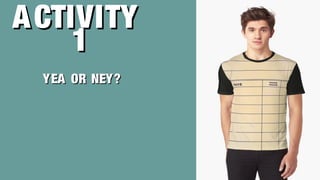
  • #29 Activity 1 Yes! Very nice library themed shirt
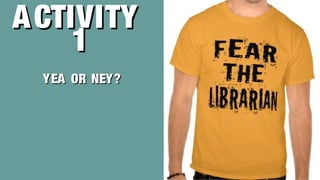
  • #30 Activity 1 Maybe not the message we want to project? Would be OK for a specific library themed program (teen program or Halloween time?)
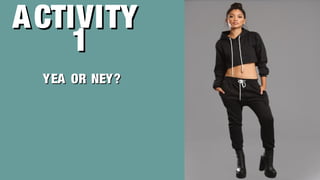
  • #31 Activity 1 Definitely – no, bare midriff & sweat pants (sweat pants with more coverage would be more appropriate for a Yoga program or other physical activity)
  • #32 Activity 1 – picture from https://www.pinterest.com/pin/123778689732288620/ Library book fairy – yes! As long as it goes with a program  Great recycling program idea! Or a storytime or Halloween costume. Community: How do you want to present the library to your community? Each library will have their own take on this but generally the same. Also what works for your position? Bottoms OK – slacks, skirts (knee length or longer) Not OK – sweatpants, athletic pants, shorts, miniskirts, overalls, spandex, jeans (except on designated days or some places wear jeans all of the time) Should not be too baggy or too tight Tops Good to Go – Turtlenecks, sweaters, dress shirts, casual shirts, polo shirts, Keep at Home – T-shirts with logos/sayings, midriff shirts, spaghetti strap shirts, halter tops, tight fitting tops Footwear OK – heels, loafers, clogs, nice sneakers, boots Not OK – flip flops, slippers Accessories Easy on the perfume No hats, headcovers (unless religious)
  • #33 (Text will appear automatically) Grandma Rule – would she approve??? Think about your community What works for your position
  • #35 You can get population numbers if needed - http://factfinder.census.gov/ (2010 Census) You can tailor this to the community you are going to with their specific socio-economic populations (might be a good discussion time – other populations?): Veterans 10% of the population of Anderson, IN are veterans What are some topics that should be avoided when talking to veterans: do not thank them for their service while in a library serving in a library capacity. You do not know how they feel about their service, if they have a lingering physical or mental ailment which they may not be reminded of. avoid buzz words such as “shell shocked”, “PTSD”, politically charged issues, etc. Go with their lead – let them be the one to initiate the conversation – and listen (don’t add your opinion) Poverty line 25.7% of population below poverty level What are some topics that should be avoided? (Don’t assume 
) do not address appearance, unless it is a behavior issue. avoid politically charged topics. do not assume that someone who appears disheveled is poor, it may just be an expression of personal style. do not assume that someone who you know is living below the poverty rate is unintelligent or lack an education. Education level 21.7% don’t have a high school diploma What can this mean for your patrons? The possession of a degree is not a determinant of intelligence. It’s very well possible that your most voracious readers never attended college, choosing to undertake self-led instructions. Some patrons may be intimidated by someone who posses a degree. You don’t need to reference your education to demonstrate your qualifications, instead let your service demonstrate your expertise. Politics http://www.politico.com/2016-election/results/map/president/indiana/ Avoid, avoid, avoid!!!! This goes for all sides – avoid, avoid, avoid LGBTQ No judging or assumptions Senior Citizens What are some topics that should be avoided? (be sensitive to their needs) do not reference any physical ailments that you may notice. They are aware that they are ageing & do not need to be reminded. do not assume that seniors need help carrying items or assistance with technology. If you notice they are struggling or may struggle, ask “would you like assistance”? Do not push the issue if they say no. do not assume your know their politics/opinions because of their age. Seniors are a diverse group of people with a wide range of interests and life experiences. Picture from - https://pixabay.com/en/grandstand-toys-males-child-330930/
  • #36 No judging culture! Part of being in a service profession is helping everyone who walks in the door. This can include people of all races, ethnicities, abilities and disabilities, religion, and sexual orientation. It can also include helping patrons of all ages, those with piercings and tattoos, different hair colors, and accents. It’s important to remember that your morals (or personal opinions) should be left at the door when starting each day, the institutions ethics are what matter.
  • #37 (For each point, use clicker) It used to be that people would avoid controversial topics in public, such as religion, politics, and money. Now it seems as if any topic is open for debate. Many topics are personal, heated, and affect how work can be done in the workplace. Many people cannot separate personal beliefs from getting the work done. We can’t always tell if someone falls into these categories just by looking at them (veterans, economic or educational level, senior citizens, political leaning - diverse community members). Try to be neutral & diplomatic!!! Other topics to be avoided at work personal issues (dates, child support, spousal problems, etc.) discussions about a particular employee - Avoid gossiping about your co-workers. This type of behavior can be contagious and contribute to an unhealthy workplace. Any conversation on desk is inviting patron to be involved – either directly or indirectly Avoid non-work related discussions while in public view When dealing with staff, remember that you must be as respectful of their opinions as with the public. It’s understandable that personal relationships can form between co-workers and if your friendship allows the open discussion of these topics that’s ok. However, be sure to avoid discussing them in public view or around co-workers who may hold different views or not want to hear them.
  • #38 (Text will come up automatically) Suck is one of those generational words. Some people my age use it all of the time, but some grandparents and even parents may find it repulsive. Any other words? I had a boss who didn’t like me to say “can’t” i.e. “I can’t tell you which legal form you need” – say instead, “I’m sorry I haven’t had legal training so I’m not able to tell you which legal form you need” – more wordy but doesn’t sound quite as negative as “I can’t”. Interesting Forbes article (in support of curse words) - https://www.forbes.com/sites/davidsturt/2015/03/19/is-the-f-bomb-appropriate-at-your-work/#7883276948a2: “To the contrary, researchers Yehuda Baruch and Stuart Jenkins found that “when used in a non-abusive manner, swearing [in the workplace] enables the development of personal relationships among coworkers.” In this study, Baruch and Jenkins studied a mail-order warehouse and watched the effect swearing had on the environment. Having both worked in various environments, we’re no strangers to both types of workplace cultures—those that curse, and those that frown upon such language. Of course, we each have our opinions—as do you—of what kind of culture we prefer. Nevertheless, more interesting to us than a list of so-called inappropriate words is the bigger picture of words—the true definition, intention, and context of any word used in the workplace. Basically, we’re more interested in the message people are sending at work. Do your words inspire greater engagement, commitment, and performance? Or do they suck the energy out of the people around you—curse words or not?”
  • #39 (Text will come up automatically) It wouldn’t be fair if we held patrons to a different standard than ourselves. We must remember that in order to maintain a level of professional behavior patrons must also interact at a similar standard. Behavior issues should be addressed immediately, less they grow into bigger problems. Civility represents the social norms and rules that must be followed in order to positively and productively relate with others. When people hear the word “civility,” words that come to mind include respect, courtesy, tolerance, consideration, and a rational approach to conflicts. http://www.alfaroenterprises.com/blog/unprofessional_behavior/.
  • #40 Activity 2 – role play (2 scenarios to choose from) Scenario A You hear a coworker and friend talk about a patron who frequents the library. It is well known around town that the person is bipolar, and she often goes off of her medication. You hear the words “crazy,” “weirdo,” and “lunatic” in the conversation. This conversation bothers you because you don’t think a staff member should talk to a patron about another patron, and you don’t know if other patrons are listening. What should you do?   Need 4 volunteers: Library Worker 1 & their Friend – talking at the Library desk. Patron – is looking through a book at the desk (& reacting to the conversation) – this person is a relative of the person they are talking about Library Worker 2 – in the background listening to the conversation and reacting   Script: Library Worker 1 – That sure was crazy! Friend – Yeah, it sure was, they must have let old Loopy Lucy out of the looney bin for the day. I can’t believe you have to deal with such weirdos here at the library. She must have been off her meds today. Library Worker 1 – I know! She’s in here all the time – but her rant today was epic! It will sure make a great Facebook post. Bet I’ll get a gazillion likes! Gotta be a full moon over the library today! Friend – I think she’s bipolar & lives at the VA. Everyone in town knows about her. I have a friend who works down in Indy at the VA headquarters, she’s even known down there! Library Worker 1 – Wonder why they thought it was a good idea to let her out today! She shouldn’t be out & about by herself. It doesn’t seem safe for her & definitely not safe for us! Patron (can’t stay silent any longer) – Uh pardon me. I was hearing you talk about “Loopy Lucy” – she’s not out by herself, she’s with me. I’m her cousin 
 can I talk to your supervisor? Discussion Library Worker 1 – what did they do wrong? Library Worker 2 – what should they do? What do you think will happen?
  • #41 (Text & pics will come up automatically) Great reminder – appropriate words or conversation topics NEVER, EVER complain about patrons where anyone can hear you. It is unprofessional, it is unwelcoming, and you never know who is listening. Yes, you might have waited until Mr. Jones left your area, but you might not realize that is his wife is standing next to you, soaking in every nasty thing you are saying! Further, we don’t want those who inadvertently hear you vent your spleen to worry that you will do the same when they leave your library.
  • #43 (For each point, use clicker) E-mail Facebook, Twitter, etc. Books, magazines, etc. Talking with co-workers, patrons
  • #44 (Text will appear automatically) Not on time when you arrive to work Don’t hand off work to coworkers & don’t close library early Ask if there are ongoing projects Professional development Timesheets: Lying on timesheet is a form of theft / keep them up to date daily / Have timesheets available to supervisors Picture from - https://www.pexels.com/photo/time-watch-hands-of-a-clock-clock-pointers-911/
  • #45 (Text will appear automatically) Need to be attentive to the patrons & not be neglectful Patrons for the most part are quietly working & when we talk, they listen 
 Be aware of your surroundings – be quite in a quiet area & if you have to let off steam (or need a reset), go to a location away from patrons Unless it is a part of your job keep facebook, pinterest, texting, emails away from public service desks – looks very unprofessional
  • #47 Activity 3 Discussion Did the Director act professionally? Did Joan act professionally? What could have been done differently?
  • #48 (Text will appear automatically) And always – consult with your supervisor to be absolutely sure (Paula made the graphic)
  • #50 (Text will appear automatically) Good patron service starts with YOU So what can you do? It is so simple. Smile in greeting to every person who enters your library. Even if you are helping someone, smile, greet them. If you aren’t with a patron, ask if you can help. We don’t have to like out patrons, to help them! If you are doing a search for someone, or if the computers are slow, TALK to your patron. Let them know what you are doing, where you are searching, while they are waiting. Be friendly and approachable. Start each transaction with fresh enthusiasm Friendly Put the patron at ease Willing to help Finding the right answer / Teaching valuable search skills / Creating a patron for life Public Service is more than getting an answer and getting the patron out of the library
  • #51 (Text will appear automatically & use clicker for pic on the right) In person - be sure you are ready to help a customer at any time while at the library Accept all requests for help when you are in a public area: on the desk, in the elevator, walking in the door. If you are in the building, you are on duty. Make every effort to find the RIGHT answer quickly for each patron. If you cannot complete the search right away, you should discuss with the patron what you have found, and what you will continue to do. Make plans to call them back right away. And if the information is for a State Agency any delay could have large repercussions. Keep their needs in mind! Around town - you can’t always help, but invite them to come into one of your locations during regular business hours On telephone Often the first contact a person has with the library Speak slowly, clearly, with a smile Always offer to call someone back, don’t ask them to call you Ask before using speakerphone Meetings & conferences - what you say and add to the conversation is a reflection on your institution; dress code still applies And on the next slide 

  • #52 (Text will appear automatically) Internal emails - Do you answer emails that come to you?  Yes, sometimes people are busy and some emails go by the wayside but email is a form of communication.  Are you courteous in your emails or do you just throw something out there any which way.  Emails have a “tone” to them too.  Be courteous, respectful and answer in a timely manner.  Sometimes, think – is an email the best way to communicate my message. Story - I knew someone who had a co-worker who always typed their emails in a large font & in all caps. I think the co-worker was on a power trip & this is how it was manifested. One day my friend challenged this person with a return email – they replied with an even bigger font & said “just because you write in a big font doesn’t mean you are right”! Listservs Everyone on the list can see post Archived Disclaimer not enough Employers sometimes look through Archives Email - E-mails can be forwarded, edited, because there is no face to face, or even voice contact, difficult to really understand what e-mail writer is trying to say. Diamonds last forever. E-mail does, too!” Routine information only Do not e-mail when angry, emotional, etc. “Reply All” issues Think before sending jokes Some topics better face to face Criticism Sensitive information Social Networking Avoid “Venting” about Patrons, Co-workers, Administration, Salaries, Policies Think about being “Friends” with patrons, coworkers Separate accounts for work & personal (Picture – Paula made it)

  • #53 (Text will appear automatically) Be careful – your words could come back to haunt you!!! Picture from - https://pixabay.com/en/infinity-emoji-creation-full-2019466/
  • #54 (Text will appear automatically) Wrapping it up – reminder from the Business Dictionary.com definition of Professionalism: “Meticulous adherence to undeviating courtesy, honesty, and responsibility in one’s dealings with customers and associates, plus a level of excellence that goes over and above the commercial considerations and legal requirements.” WORKPLACE: You have the right to your opinion - but express it in private Don’t complain about your job while on the desk Take concerns about policies and procedures to your supervisor, in private (don’t let it fester!) COWORKERS: Praise assistance, innovation Use the Golden Rule – treat others as you wish to be treated Listen to each other Recognize their expertise Keep socializing to appropriate places and times, Not at the service desk, or in front of patrons YOURSELF: Dress and speak professionally and you will be treated professionally Dress for the job you want? Dress for the library you want, too! Listen to yourself Figure out how you can grow professionally as well as personally Please and Thank You aren’t just for preschoolers Work until the job is done; be available PATRONS: Keep your complaints away from the service desk and away from your patrons Trust breeds trust Listen to your patrons Build relationships Be approachable Protect their privacy Picture – Paula took
  • #55 (Use clicker for text) Interesting situation 

  • #56 (Use clicker for text & use clicker again for the date at the bottom) OUCH! – from 2010, of course we’re not necessarily the totally quiet environment of the past (we have all kinds of activities going on)