Stress and Health Chapter 11
Chapter 11 Learning Objective Menu LO 11.1    Stress LO 11.2    Cognitive factors in stress LO 11.3    Kinds of experiences causing stress LO 11.4    Sources of stress in everyday life  LO 11.5    Suicide  LO 11.6    Types of conflict LO 11.7    Bodily reaction to stress  LO 11.8    Relationship between stress and the immune system LO 11.9    Relationship between stress and personality LO 11.10  Relationship between stress and social factors LO 11.11  Two ways to deal with stress LO 11.12  Psychological defense mechanisms LO 11.13  Meditation to relieve stress LO 11.14  Cultural influences on stress LO 11.15  How being religious helps to cope with stress LO 11.16  Ways to promote wellness in one’s life
Stress Stress  - the term used to describe the physical, emotional, cognitive, and behavioral responses to events that are appraised as threatening or challenging. Stressors  - events that cause a stress reaction. Distress  - the effect of unpleasant and undesirable stressors. Eustress  - the effect of positive events, or the optimal amount of stress that people need to promote health and well-being. LO 11.1 Stress Menu
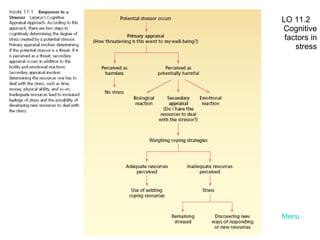
Cognitive Factors of Stress Cognitive appraisal approach  - states that how people think about a stressor determines, at least in part, how stressful that stressor will become. Primary appraisal  - the first step in assessing a stress, which involves estimating the severity of a stressor and classifying it as either a threat or a challenge. Secondary appraisal  - the second step in assessing a threat, which involves estimating the resources available to the person for coping with the stressor. LO 11.2  Cognitive factors in stress Menu
Menu LO 11.2  Cognitive factors in stress
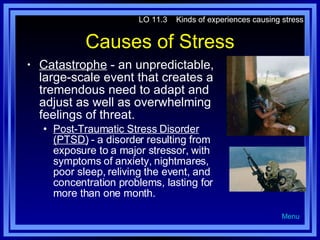
Causes of Stress Catastrophe  - an unpredictable, large-scale event that creates a tremendous need to adapt and adjust as well as overwhelming feelings of threat. Post-Traumatic Stress Disorder (PTSD)  - a disorder resulting from exposure to a major stressor, with symptoms of anxiety, nightmares, poor sleep, reliving the event, and concentration problems, lasting for more than one month. LO 11.3  Kinds of experiences causing stress Menu
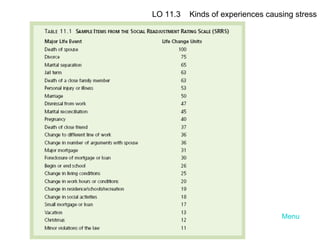
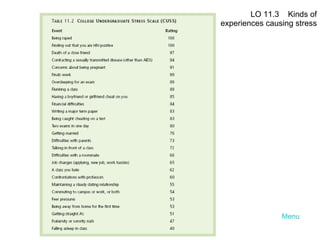
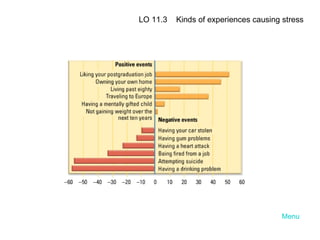
Causes of Stress Major Life Events  - cause stress by requiring adjustment. Social Readjustment Rating Scale (SRRS)  - assessment that measures the amount of stress in a person’s life over a one-year period resulting from major life events. College Undergraduate Stress Scale (CUSS)  - assessment that measures the amount of stress in a college student’s life over a one-year period resulting from major life events.  Hassles  - the daily annoyances of everyday life. LO 11.3  Kinds of experiences causing stress Menu
Menu LO 11.3  Kinds of experiences causing stress
Everyday Sources of Stress Pressure  - the psychological experience produced by urgent demands or expectations for a person’s behavior that come from an outside source. Uncontrollability  - the degree of control that the person has over a particular event or situation. The less control a person has, the greater the degree of stress. Frustration  - the psychological experience produced by the blocking of a desired goal or fulfillment of a perceived need. Conflict  - psychological experience of being pulled toward or drawn to two or more desires or goals, only one of which may be attained. LO 11.4  Sources of stress in everyday life Menu
Everyday Sources of Stress Pressure  - the psychological experience produced by urgent demands or expectations for a person’s behavior that come from an outside source. Uncontrollability  - the degree of control that the person has over a particular event or situation. The less control a person has, the greater the degree of stress. LO 11.4  Sources of stress in everyday life Menu
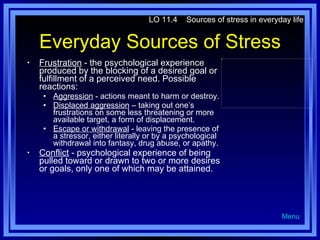
Everyday Sources of Stress Frustration  - the psychological experience produced by the blocking of a desired goal or fulfillment of a perceived need. Possible reactions: Aggression  - actions meant to harm or destroy. Displaced aggression  – taking out one’s frustrations on some less threatening or more available target, a form of displacement. Escape or withdrawal  - leaving the presence of a stressor, either literally or by a psychological withdrawal into fantasy, drug abuse, or apathy. Conflict  - psychological experience of being pulled toward or drawn to two or more desires or goals, only one of which may be attained. LO 11.4  Sources of stress in everyday life Menu
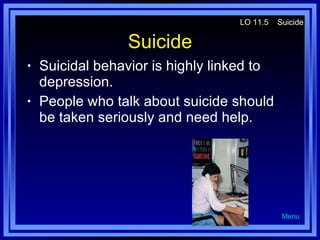
Suicide Suicidal behavior is highly linked to depression. People who talk about suicide should be taken seriously and need help. LO 11.5  Suicide Menu
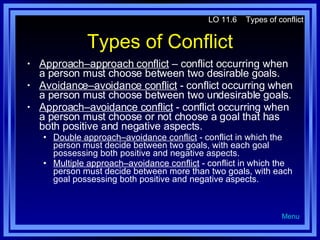
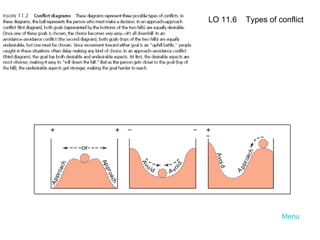
Types of Conflict Approach–approach conflict  – conflict occurring when a person must choose between two desirable goals. Avoidance–avoidance conflict  - conflict occurring when a person must choose between two undesirable goals. Approach–avoidance conflict  - conflict occurring when a person must choose or not choose a goal that has both positive and negative aspects. Double approach–avoidance conflict  - conflict in which the person must decide between two goals, with each goal possessing both positive and negative aspects. Multiple approach–avoidance conflict  - conflict in which the person must decide between more than two goals, with each goal possessing both positive and negative aspects. LO 11.6  Types of conflict Menu
Menu LO 11.6  Types of conflict
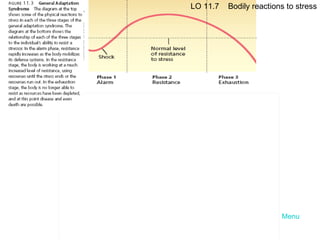
Bodily Reactions to Stress Autonomic nervous system  consists of: Sympathetic system  - responds to stressful events Parasympathetic system  - restores the body to normal functioning after the stress has ceased. General Adaptation Syndrome (GAS)  - the three stages of the body’s physiological reaction to stress, including alarm, resistance, and exhaustion.  LO 11.7  Bodily reactions to stress Menu
Menu LO 11.7  Bodily reactions to stress
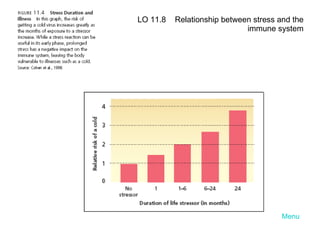
Stress and the Immune System Immune system  - the system of cells, organs, and chemicals of the body that responds to attacks from diseases, infections, and injuries. Negatively affected by stress. Psychoneuroimmunology  - the study of the effects of psychological factors such as stress, emotions, thoughts, and behavior on the immune system. Natural killer cell  - immune system cell responsible for suppressing viruses and destroying tumor cells. LO 11.8  Relationship between stress and the immune system Menu
Menu LO 11.8  Relationship between stress and the immune system
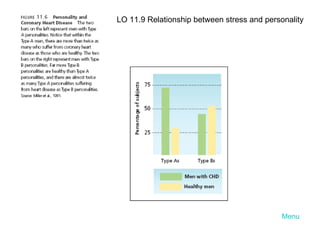
Stress and Personality Type A personality  - person who is ambitious, time conscious, extremely hardworking, and tends to have high levels of hostility and anger as well as being easily annoyed. Type B personality  - person who is relaxed and laid-back, less driven and competitive than Type A, and slow to anger. LO 11.9 Relationship between stress and personality Menu
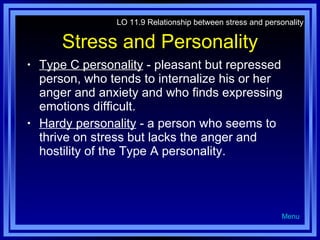
Stress and Personality Type C personality  - pleasant but repressed person, who tends to internalize his or her anger and anxiety and who finds expressing emotions difficult. Hardy personality  - a person who seems to thrive on stress but lacks the anger and hostility of the Type A personality. LO 11.9 Relationship between stress and personality Menu
Menu LO 11.9 Relationship between stress and personality
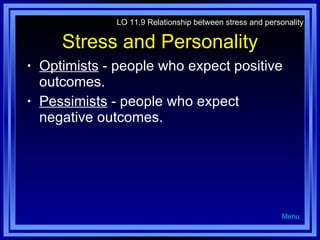
Stress and Personality Optimists  - people who expect positive outcomes. Pessimists  - people who expect negative outcomes. LO 11.9 Relationship between stress and personality Menu
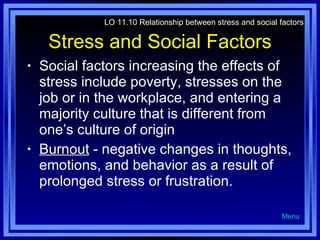
Stress and Social Factors Social factors increasing the effects of stress include poverty, stresses on the job or in the workplace, and entering a majority culture that is different from one’s culture of origin Burnout  - negative changes in thoughts, emotions, and behavior as a result of prolonged stress or frustration. LO 11.10 Relationship between stress and social factors Menu
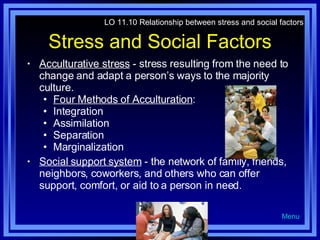
Stress and Social Factors Acculturative stress  - stress resulting from the need to change and adapt a person’s ways to the majority culture. Four Methods of Acculturation : Integration Assimilation Separation Marginalization Social support system  - the network of family, friends, neighbors, coworkers, and others who can offer support, comfort, or aid to a person in need. LO 11.10 Relationship between stress and social factors Menu
Ways to Deal with Stress Coping strategies  - actions that people can take to master, tolerate, reduce, or minimize the effects of stressors. Problem-focused coping - coping strategies that try to eliminate the source of a stress or reduce its impact through direct actions. Emotion-focused coping  - coping strategies that change the impact of a stressor by changing the emotional reaction to the stressor. LO 11.11  Two ways to deal with stress Menu
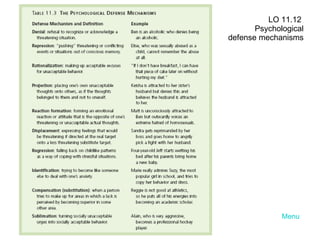
Defense Mechanisms Psychological defense mechanisms  - unconscious distortions of a person’s perception of reality that reduce stress and anxiety. Denial  -  psychological defense mechanism in which the person refuses to acknowledge or recognize a threatening situation. Repression  - psychological defense mechanism in which the person refuses to consciously remember a threatening or unacceptable event, instead pushing those events into the unconscious mind. LO 11.12  Psychological defense mechanisms Menu
Defense Mechanisms Rationalization  - psychological defense mechanism in which a person invents acceptable excuses for unacceptable behavior. Projection  - psychological defense mechanism in which unacceptable or threatening impulses or feelings are seen as originating with someone else, usually the target of the impulses or feelings. LO 11.12  Psychological defense mechanisms Menu
Defense Mechanisms Reaction formation  - psychological defense mechanism in which a person forms an opposite emotional or behavioral reaction to the way he or she really feels to keep those true feelings hidden from self and others. Displacement  - redirecting feelings from a threatening target to a less threatening one.  Regression  - psychological defense mechanism in which a person falls back on childlike patterns of responding in reaction to stressful situations. LO 11.12  Psychological defense mechanisms Menu
Defense Mechanisms Identification  - defense mechanism in which a person tries to become like someone else to deal with anxiety. Compensation (substitution)  - defense mechanism in which a person makes up for inferiorities in one area by becoming superior in another area. Sublimation  - channeling socially unacceptable impulses and urges into socially acceptable behavior. LO 11.12  Psychological defense mechanisms Menu
Menu LO 11.12  Psychological defense mechanisms
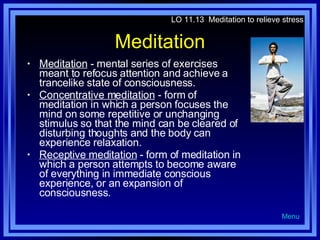
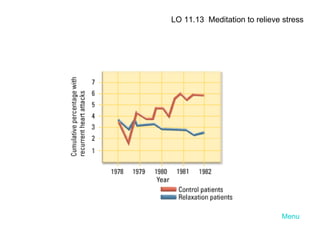
Meditation Meditation  - mental series of exercises meant to refocus attention and achieve a trancelike state of consciousness. Concentrative meditation  - form of meditation in which a person focuses the mind on some repetitive or unchanging stimulus so that the mind can be cleared of disturbing thoughts and the body can experience relaxation. Receptive meditation  - form of meditation in which a person attempts to become aware of everything in immediate conscious experience, or an expansion of consciousness. LO 11.13  Meditation to relieve stress Menu
Menu LO 11.13  Meditation to relieve stress
Cultural Influences on Stress Different cultures  perceive  stressors differently.  Coping strategies  will also vary from culture to culture. LO 11.14  Cultural influences on stress Menu
Religiosity and Stress People with religious beliefs also have been found to cope better with stressful events. LO 11.15  How being religious helps to cope with stress Menu
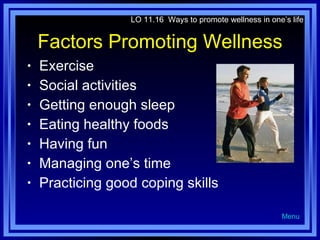
Factors Promoting Wellness Exercise Social activities Getting enough sleep Eating healthy foods Having fun Managing one’s time Practicing good coping skills LO 11.16  Ways to promote wellness in one’s life Menu

Health & Stress

  • 1.
  • 2.
    Chapter 11 LearningObjective Menu LO 11.1 Stress LO 11.2 Cognitive factors in stress LO 11.3 Kinds of experiences causing stress LO 11.4 Sources of stress in everyday life LO 11.5 Suicide LO 11.6 Types of conflict LO 11.7 Bodily reaction to stress LO 11.8 Relationship between stress and the immune system LO 11.9 Relationship between stress and personality LO 11.10 Relationship between stress and social factors LO 11.11 Two ways to deal with stress LO 11.12 Psychological defense mechanisms LO 11.13 Meditation to relieve stress LO 11.14 Cultural influences on stress LO 11.15 How being religious helps to cope with stress LO 11.16 Ways to promote wellness in one’s life
  • 3.
    Stress Stress - the term used to describe the physical, emotional, cognitive, and behavioral responses to events that are appraised as threatening or challenging. Stressors - events that cause a stress reaction. Distress - the effect of unpleasant and undesirable stressors. Eustress - the effect of positive events, or the optimal amount of stress that people need to promote health and well-being. LO 11.1 Stress Menu
  • 4.
    Cognitive Factors ofStress Cognitive appraisal approach - states that how people think about a stressor determines, at least in part, how stressful that stressor will become. Primary appraisal - the first step in assessing a stress, which involves estimating the severity of a stressor and classifying it as either a threat or a challenge. Secondary appraisal - the second step in assessing a threat, which involves estimating the resources available to the person for coping with the stressor. LO 11.2 Cognitive factors in stress Menu
  • 5.
    Menu LO 11.2 Cognitive factors in stress
  • 6.
    Causes of StressCatastrophe - an unpredictable, large-scale event that creates a tremendous need to adapt and adjust as well as overwhelming feelings of threat. Post-Traumatic Stress Disorder (PTSD) - a disorder resulting from exposure to a major stressor, with symptoms of anxiety, nightmares, poor sleep, reliving the event, and concentration problems, lasting for more than one month. LO 11.3 Kinds of experiences causing stress Menu
  • 7.
    Causes of StressMajor Life Events - cause stress by requiring adjustment. Social Readjustment Rating Scale (SRRS) - assessment that measures the amount of stress in a person’s life over a one-year period resulting from major life events. College Undergraduate Stress Scale (CUSS) - assessment that measures the amount of stress in a college student’s life over a one-year period resulting from major life events. Hassles - the daily annoyances of everyday life. LO 11.3 Kinds of experiences causing stress Menu
  • 8.
    Menu LO 11.3 Kinds of experiences causing stress
  • 9.
    Menu LO 11.3 Kinds of experiences causing stress
  • 10.
    Menu LO 11.3 Kinds of experiences causing stress
  • 11.
    Everyday Sources ofStress Pressure - the psychological experience produced by urgent demands or expectations for a person’s behavior that come from an outside source. Uncontrollability - the degree of control that the person has over a particular event or situation. The less control a person has, the greater the degree of stress. Frustration - the psychological experience produced by the blocking of a desired goal or fulfillment of a perceived need. Conflict - psychological experience of being pulled toward or drawn to two or more desires or goals, only one of which may be attained. LO 11.4 Sources of stress in everyday life Menu
  • 12.
    Everyday Sources ofStress Pressure - the psychological experience produced by urgent demands or expectations for a person’s behavior that come from an outside source. Uncontrollability - the degree of control that the person has over a particular event or situation. The less control a person has, the greater the degree of stress. LO 11.4 Sources of stress in everyday life Menu
  • 13.
    Everyday Sources ofStress Frustration - the psychological experience produced by the blocking of a desired goal or fulfillment of a perceived need. Possible reactions: Aggression - actions meant to harm or destroy. Displaced aggression – taking out one’s frustrations on some less threatening or more available target, a form of displacement. Escape or withdrawal - leaving the presence of a stressor, either literally or by a psychological withdrawal into fantasy, drug abuse, or apathy. Conflict - psychological experience of being pulled toward or drawn to two or more desires or goals, only one of which may be attained. LO 11.4 Sources of stress in everyday life Menu
  • 14.
    Suicide Suicidal behavioris highly linked to depression. People who talk about suicide should be taken seriously and need help. LO 11.5 Suicide Menu
  • 15.
    Types of ConflictApproach–approach conflict – conflict occurring when a person must choose between two desirable goals. Avoidance–avoidance conflict - conflict occurring when a person must choose between two undesirable goals. Approach–avoidance conflict - conflict occurring when a person must choose or not choose a goal that has both positive and negative aspects. Double approach–avoidance conflict - conflict in which the person must decide between two goals, with each goal possessing both positive and negative aspects. Multiple approach–avoidance conflict - conflict in which the person must decide between more than two goals, with each goal possessing both positive and negative aspects. LO 11.6 Types of conflict Menu
  • 16.
    Menu LO 11.6 Types of conflict
  • 17.
    Bodily Reactions toStress Autonomic nervous system consists of: Sympathetic system - responds to stressful events Parasympathetic system - restores the body to normal functioning after the stress has ceased. General Adaptation Syndrome (GAS) - the three stages of the body’s physiological reaction to stress, including alarm, resistance, and exhaustion. LO 11.7 Bodily reactions to stress Menu
  • 18.
    Menu LO 11.7 Bodily reactions to stress
  • 19.
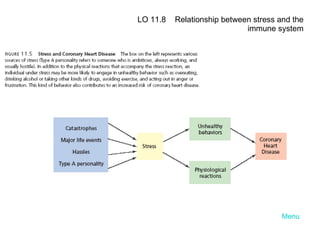
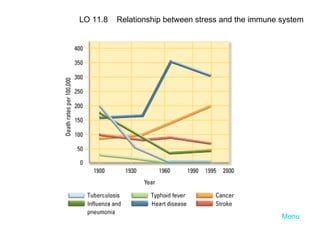
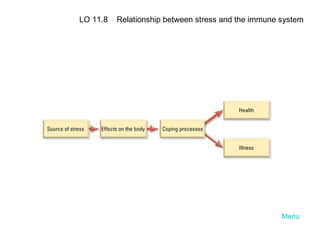
    Stress and theImmune System Immune system - the system of cells, organs, and chemicals of the body that responds to attacks from diseases, infections, and injuries. Negatively affected by stress. Psychoneuroimmunology - the study of the effects of psychological factors such as stress, emotions, thoughts, and behavior on the immune system. Natural killer cell - immune system cell responsible for suppressing viruses and destroying tumor cells. LO 11.8 Relationship between stress and the immune system Menu
  • 20.
    Menu LO 11.8 Relationship between stress and the immune system
  • 21.
    Menu LO 11.8 Relationship between stress and the immune system
  • 22.
    Menu LO 11.8 Relationship between stress and the immune system
  • 23.
    Menu LO 11.8 Relationship between stress and the immune system
  • 24.
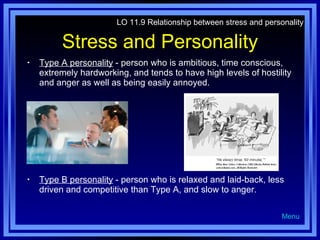
    Stress and PersonalityType A personality - person who is ambitious, time conscious, extremely hardworking, and tends to have high levels of hostility and anger as well as being easily annoyed. Type B personality - person who is relaxed and laid-back, less driven and competitive than Type A, and slow to anger. LO 11.9 Relationship between stress and personality Menu
  • 25.
    Stress and PersonalityType C personality - pleasant but repressed person, who tends to internalize his or her anger and anxiety and who finds expressing emotions difficult. Hardy personality - a person who seems to thrive on stress but lacks the anger and hostility of the Type A personality. LO 11.9 Relationship between stress and personality Menu
  • 26.
    Menu LO 11.9Relationship between stress and personality
  • 27.
    Stress and PersonalityOptimists - people who expect positive outcomes. Pessimists - people who expect negative outcomes. LO 11.9 Relationship between stress and personality Menu
  • 28.
    Stress and SocialFactors Social factors increasing the effects of stress include poverty, stresses on the job or in the workplace, and entering a majority culture that is different from one’s culture of origin Burnout - negative changes in thoughts, emotions, and behavior as a result of prolonged stress or frustration. LO 11.10 Relationship between stress and social factors Menu
  • 29.
    Stress and SocialFactors Acculturative stress - stress resulting from the need to change and adapt a person’s ways to the majority culture. Four Methods of Acculturation : Integration Assimilation Separation Marginalization Social support system - the network of family, friends, neighbors, coworkers, and others who can offer support, comfort, or aid to a person in need. LO 11.10 Relationship between stress and social factors Menu
  • 30.
    Ways to Dealwith Stress Coping strategies - actions that people can take to master, tolerate, reduce, or minimize the effects of stressors. Problem-focused coping - coping strategies that try to eliminate the source of a stress or reduce its impact through direct actions. Emotion-focused coping - coping strategies that change the impact of a stressor by changing the emotional reaction to the stressor. LO 11.11 Two ways to deal with stress Menu
  • 31.
    Defense Mechanisms Psychologicaldefense mechanisms - unconscious distortions of a person’s perception of reality that reduce stress and anxiety. Denial - psychological defense mechanism in which the person refuses to acknowledge or recognize a threatening situation. Repression - psychological defense mechanism in which the person refuses to consciously remember a threatening or unacceptable event, instead pushing those events into the unconscious mind. LO 11.12 Psychological defense mechanisms Menu
  • 32.
    Defense Mechanisms Rationalization - psychological defense mechanism in which a person invents acceptable excuses for unacceptable behavior. Projection - psychological defense mechanism in which unacceptable or threatening impulses or feelings are seen as originating with someone else, usually the target of the impulses or feelings. LO 11.12 Psychological defense mechanisms Menu
  • 33.
    Defense Mechanisms Reactionformation - psychological defense mechanism in which a person forms an opposite emotional or behavioral reaction to the way he or she really feels to keep those true feelings hidden from self and others. Displacement - redirecting feelings from a threatening target to a less threatening one. Regression - psychological defense mechanism in which a person falls back on childlike patterns of responding in reaction to stressful situations. LO 11.12 Psychological defense mechanisms Menu
  • 34.
    Defense Mechanisms Identification - defense mechanism in which a person tries to become like someone else to deal with anxiety. Compensation (substitution) - defense mechanism in which a person makes up for inferiorities in one area by becoming superior in another area. Sublimation - channeling socially unacceptable impulses and urges into socially acceptable behavior. LO 11.12 Psychological defense mechanisms Menu
  • 35.
    Menu LO 11.12 Psychological defense mechanisms
  • 36.
    Meditation Meditation - mental series of exercises meant to refocus attention and achieve a trancelike state of consciousness. Concentrative meditation - form of meditation in which a person focuses the mind on some repetitive or unchanging stimulus so that the mind can be cleared of disturbing thoughts and the body can experience relaxation. Receptive meditation - form of meditation in which a person attempts to become aware of everything in immediate conscious experience, or an expansion of consciousness. LO 11.13 Meditation to relieve stress Menu
  • 37.
    Menu LO 11.13 Meditation to relieve stress
  • 38.
    Cultural Influences onStress Different cultures perceive stressors differently. Coping strategies will also vary from culture to culture. LO 11.14 Cultural influences on stress Menu
  • 39.
    Religiosity and StressPeople with religious beliefs also have been found to cope better with stressful events. LO 11.15 How being religious helps to cope with stress Menu
  • 40.
    Factors Promoting WellnessExercise Social activities Getting enough sleep Eating healthy foods Having fun Managing one’s time Practicing good coping skills LO 11.16 Ways to promote wellness in one’s life Menu