Ethics in the Workplace
Silver Finance Inc.
February 12, 2016 Quezon City
www.mannrentoy.com
Activity No. 1
• Essential Question:
• Why do I have to be ethical in
the workplace? Is it worth it to
be ethical?
3
Workshop Objectives
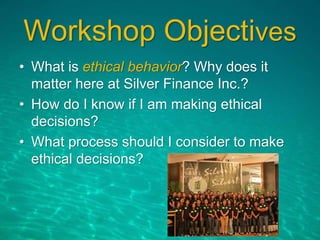
• What is ethical behavior? Why does it
matter here at Silver Finance Inc.?
• How do I know if I am making ethical
decisions?
• What process should I consider to make
ethical decisions?
Company Mission
• “To Improve the Quality of Life”
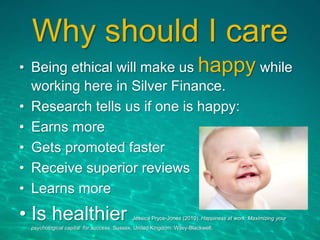
Why should I care
• Being ethical will make us happy while
working here in Silver Finance.
• Research tells us if one is happy:
• Earns more
• Gets promoted faster
• Receive superior reviews
• Learns more
• Is healthier Jessica Pryce-Jones (2010). Happiness at work: Maximizing your
psychological capital for success. Sussex, United Kingdom: Wiley-Blackwell.
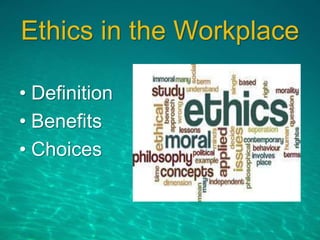
Ethics in the Workplace
• Definition
• Benefits
• Choices
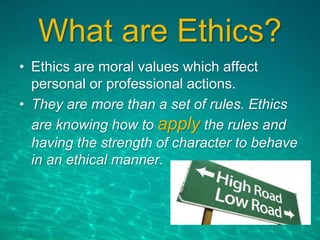
What are Ethics?
• Ethics are moral values which affect
personal or professional actions.
• They are more than a set of rules. Ethics
are knowing how to apply the rules and
having the strength of character to behave
in an ethical manner.
As practical as choosing a
restaurant
• “Study of doing what is right and wrong to
do in the conduct of life. Its primary aim is
to determine how one ought to live and
what actions one ought to do in the
conduct of one’s life.” John Deigh (2010). An introduction to ethics. New York,
New York: Cambridge University Press.
Activity No. 2
• Fact First Questioning
• Learning how to become an ethical
professional here at Silver Finance is
important. Kindly list down some benefits
of observing ethical behavior in the
workplace.
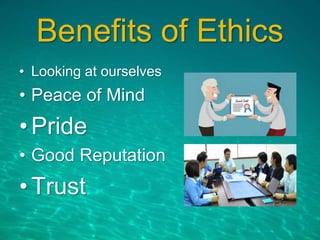
Benefits of Ethics
• Looking at ourselves
• Peace of Mind
•Pride
• Good Reputation
•Trust
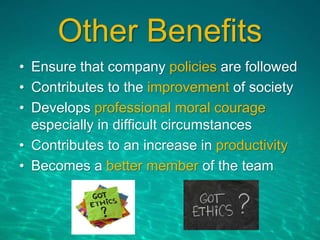
Other Benefits
• Ensure that company policies are followed
• Contributes to the improvement of society
• Develops professional moral courage
especially in difficult circumstances
• Contributes to an increase in productivity
• Becomes a better member of the team
Ethical Choices
• Ethics is not a theory but a way of life.
A Silver Finance professional will
have to ‘do’ ethics.
• In doing one’s work, one has to make
ethical choices.
Silver Finance Professional
• General Guideline:
•Be a professional and
provide excellent service.
When I am in Doubt
• Talk to people whose judgment you
respect.
• Ask ourselves: What would the most
ethical person I know would do?
• Private Victory: What would I do if I
know everyone would know?
• Golden Rule: Treat others as you
would want to be treated.
Activity No. 3
• Pull Up Your Group Chair
• As members of a group, think about
the character traits of an ethical
professional. List down the traits.
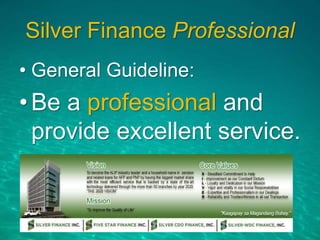
Core Values
• Steadfast commitment to help
• Loyalty and dedication in our mission
• Expertise and professionalism in our
dealings
• Reliability and trustworthiness in all
our transactions
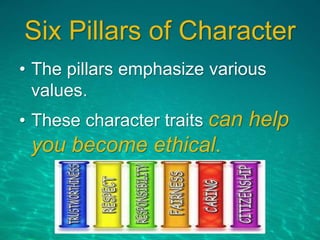
Six Pillars of Character
• The pillars emphasize various
values.
• These character traits can help
you become ethical.
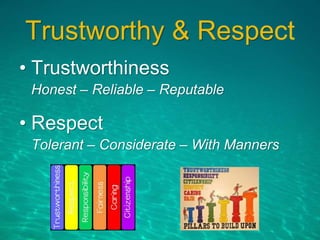
Trustworthy & Respect
• Trustworthiness
Honest – Reliable – Reputable
• Respect
Tolerant – Considerate – With Manners
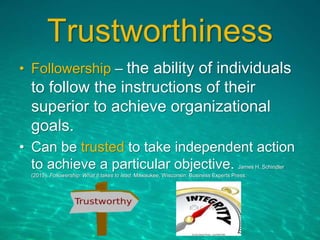
Trustworthiness
• Followership – the ability of individuals
to follow the instructions of their
superior to achieve organizational
goals.
• Can be trusted to take independent action
to achieve a particular objective. James H. Schindler
(2015). Followership: What it takes to lead. Milwaukee, Wisconsin: Business Experts Press.
15 bad behaviors that will slowly
erode your credibility
1. You don't adapt to the company
culture.
2. You make excuses.
3. You do the bare minimum.
4. You don't follow through.
5. You dress like a slob.
6. You're a pessimist.
7. You ignore coworkers.
8. You're defensive.
9. You procrastinate.
10. You write brusque emails.
11. You don't make meaningful
contributions.
12. You're always late.
13. You never stop talking.
14. You ignore emails.
15. You're rude.
Reasons for Firing
Being dishonest not trustworthy
Trust, once lost, is hard to regain
Being unreliable not trustworthy
Dependability is a professional’s
asset
Respect
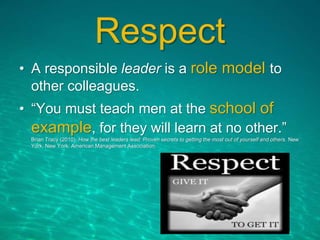
• A responsible leader is a role model to
other colleagues.
• “You must teach men at the school of
example, for they will learn at no other.”
Brian Tracy (2010). How the best leaders lead: Proven secrets to getting the most out of yourself and others. New
York, New York: American Management Association.
Other Reasons
Being troublemakers
Stirring up dissent among others
Causing arguments and problems
Being rude and using abusive
language lack manners
Inappropriate behavior is inexcusable
Reflection Points
• Can my colleagues rely on me
that I would be able to do my
tasks well? RELIABLE
• Am I honest in doing things
according to the best of my
ability? HONESTY
• Do I use the magic words
whenever I deal with my
colleagues? GOOD MANNERS
Responsible & Fair
•Responsibility
Self control – Self discipline – Accountable
•Fairness
Just – Reasonable – Impartial
Responsibility
• Calling for a vocation – we can
feel a desire to live a unique and
responsible life.
• I identify my values and strengths
• in relationships where I give and
take
• serving my company, economically
and socially. Anthony Usher (2015). Working ethically in finance:
Clarifying our vocation. New York, New York: Business Expert Press.
Reasons for Firing
Bossing others around lacks self discipline
• Giving orders is the boss’s job
Not carrying your weight lacks accountability
• Not doing your part – relying on
others to do your job for you
Fairness
• Deal with your colleagues fairly and justly,
you don’t play favorites and you don’t
belong to a clique.
• Yes – commitment to deliver
• I have to check – I’ll get back to you…
• Counteroffer – I can’t do that, I can do this
Jeff Grimshaw and Greg Baron (2010). Leadership without excuses: How to create accountability and high
performance team. New York, New York: McGraw Hill.
Other Reasons
Failing to do the task properly not
accountable
Costly errors hurt business
Being lazy not just
It’s a form of theft
Reflection Points
• Do I follow and respect
deadlines? ACCOUNTABILITY
• Do I deal with everyone
professionally? IMPARTIAL
• Do I manage my time
well? SELF-DISCIPLINE
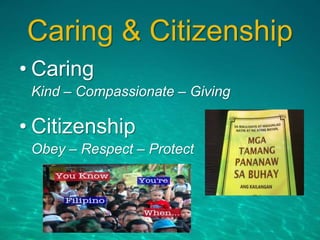
Caring & Citizenship
• Caring
Kind – Compassionate – Giving
• Citizenship
Obey – Respect – Protect
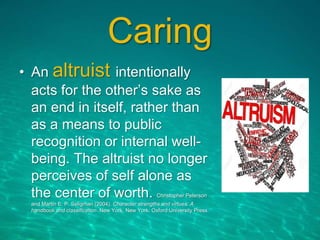
Caring
• An altruist intentionally
acts for the other’s sake as
an end in itself, rather than
as a means to public
recognition or internal well-
being. The altruist no longer
perceives of self alone as
the center of worth. Christopher Peterson
and Martin E. P. Seligman (2004). Character strengths and virtues: A
handbook and classification. New York, New York: Oxford University Press.
Reasons for Firing
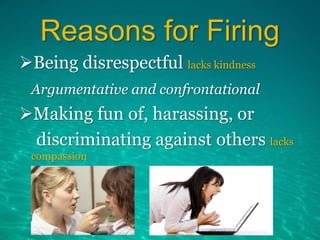
Being disrespectful lacks kindness
Argumentative and confrontational
Making fun of, harassing, or
discriminating against others lacks
compassion
Citizenship
• Critical behavior – sense of duty to
the group, loyal to friends and the
group, help others in difficulty, feel
responsible to improve the group
• Opposite behavior – selfishness,
egoistic
• Extreme behavior – forgetting
oneself, megalomaniac Armenio Rigo, Miguel Pina e
Cunha, and Stewart Clegg (2012). The virtues of leadership: Contemporary challenges for global
managers. New York, New York: Oxford University Press.
Other Reasons
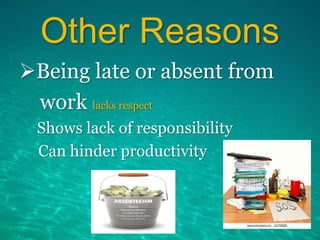
Being late or absent from
work lacks respect
Shows lack of responsibility
Can hinder productivity
Reflection Points
• Do I empathize with my
colleagues really trying to
understand them?
COMPASSIONATE
• Do I obey company rules and
regulations that seek to
promote the good? OBEDIENCE
• Do I avoid talking badly about
my colleagues? RESPECT
Activity No. 4
• We Need Good Stories/Replay of Life
• Try to recall and narrate events wherein
you have seen or heard a professional
colleague of yours here in your company
exhibit one of the character traits.
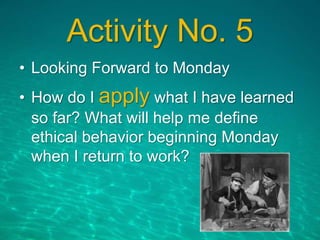
Activity No. 5
• Looking Forward to Monday
• How do I apply what I have learned
so far? What will help me define
ethical behavior beginning Monday
when I return to work?
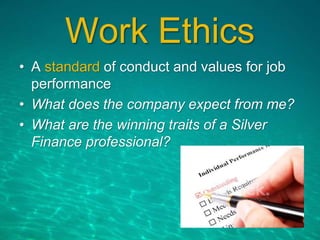
Work Ethics
• A standard of conduct and values for job
performance
• What does the company expect from me?
• What are the winning traits of a Silver
Finance professional?
Work Ethic No. 1
• Attendance
• Be on time
• Be punctual everyday
• Don’t be absent
• Be present everyday
• Plan your absences
• Don’t misuse leave time
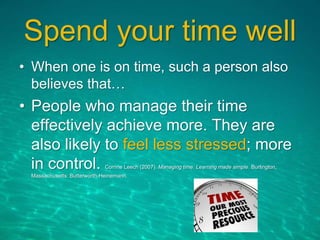
Spend your time well
• When one is on time, such a person also
believes that…
• People who manage their time
effectively achieve more. They are
also likely to feel less stressed; more
in control. Corrine Leech (2007). Managing time: Learning made simple. Burlington,
Massachusetts: Butterworth-Heinemann.
Work Ethic No. 2
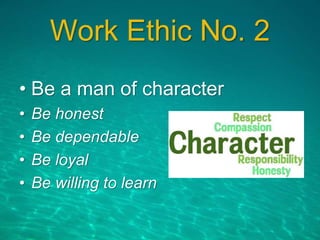
• Be a man of character
• Be honest
• Be dependable
• Be loyal
• Be willing to learn
World class company
• “If you are part of our team, the
number one thing you have is
your integrity, character, and
reputation. You have a vested
interest in the success of this
company. So, if you see that
something is not right, you will
speak up and make it right.” Robert
Spector and Patrick McCarhy (2005). The Nordstrom way to customer service excellence:
A handbook for implementing great service in your organization. Hoboken, New Jersey:
John Wiley and Sons, Inc.
Work Ethic No. 3
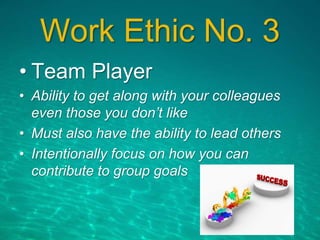
• Team Player
• Ability to get along with your colleagues
even those you don’t like
• Must also have the ability to lead others
• Intentionally focus on how you can
contribute to group goals
High performing team
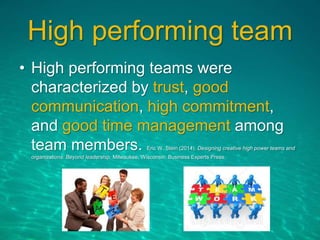
• High performing teams were
characterized by trust, good
communication, high commitment,
and good time management among
team members. Eric W. Stein (2014). Designing creative high power teams and
organizations: Beyond leadership. Milwaukee, Wisconsin: Business Experts Press.
I am interested to hear from you
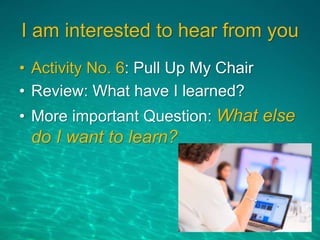
• Activity No. 6: Pull Up My Chair
• Review: What have I learned?
• More important Question: What else
do I want to learn?
Work Ethic No. 4
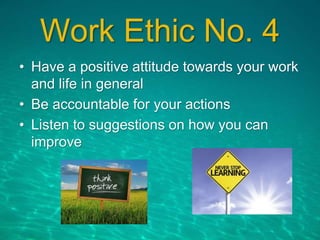
• Have a positive attitude towards your work
and life in general
• Be accountable for your actions
• Listen to suggestions on how you can
improve
Being a learner
• “One of the most important business skills,
particularly in the first few years of
entering the real workplace, is the
willingness to ask questions and learn as
much as possible. Many of the people I
started with at my company are mid-level
and senior executives because they asked
questions of everybody.” Ferguson Career Skills Library (2004).
Professional ethics and etiquette. New York, New York: Ferguson.
Work Ethic No. 5
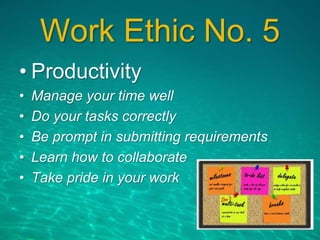
• Productivity
• Manage your time well
• Do your tasks correctly
• Be prompt in submitting requirements
• Learn how to collaborate
• Take pride in your work
Summary
• Act in manner that promotes your
colleague’s confidence in your integrity
and fairness.
• Follow the ‘Six Pillars of Character’
• Be a professional, not a worker
• Give excellent service
Activity No. 6
• Exit Slip: How do I practice
ethical behavior aligned with
the core values?
• Steadfast commitment to help
• Expertise and
professionalism in our
dealings
• Reliability and trustworthiness
in all our transactions
Ethics in the Work Place www.mannrentoy.com

Ethics in the Work Place www.mannrentoy.com

  • 1.
    Ethics in theWorkplace Silver Finance Inc. February 12, 2016 Quezon City www.mannrentoy.com
  • 2.
    Activity No. 1 •Essential Question: • Why do I have to be ethical in the workplace? Is it worth it to be ethical?
  • 3.
  • 5.
    Workshop Objectives • Whatis ethical behavior? Why does it matter here at Silver Finance Inc.? • How do I know if I am making ethical decisions? • What process should I consider to make ethical decisions?
  • 6.
    Company Mission • “ToImprove the Quality of Life”
  • 7.
    Why should Icare • Being ethical will make us happy while working here in Silver Finance. • Research tells us if one is happy: • Earns more • Gets promoted faster • Receive superior reviews • Learns more • Is healthier Jessica Pryce-Jones (2010). Happiness at work: Maximizing your psychological capital for success. Sussex, United Kingdom: Wiley-Blackwell.
  • 9.
    Ethics in theWorkplace • Definition • Benefits • Choices
  • 10.
    What are Ethics? •Ethics are moral values which affect personal or professional actions. • They are more than a set of rules. Ethics are knowing how to apply the rules and having the strength of character to behave in an ethical manner.
  • 11.
    As practical aschoosing a restaurant • “Study of doing what is right and wrong to do in the conduct of life. Its primary aim is to determine how one ought to live and what actions one ought to do in the conduct of one’s life.” John Deigh (2010). An introduction to ethics. New York, New York: Cambridge University Press.
  • 12.
    Activity No. 2 •Fact First Questioning • Learning how to become an ethical professional here at Silver Finance is important. Kindly list down some benefits of observing ethical behavior in the workplace.
  • 13.
    Benefits of Ethics •Looking at ourselves • Peace of Mind •Pride • Good Reputation •Trust
  • 14.
    Other Benefits • Ensurethat company policies are followed • Contributes to the improvement of society • Develops professional moral courage especially in difficult circumstances • Contributes to an increase in productivity • Becomes a better member of the team
  • 16.
    Ethical Choices • Ethicsis not a theory but a way of life. A Silver Finance professional will have to ‘do’ ethics. • In doing one’s work, one has to make ethical choices.
  • 17.
    Silver Finance Professional •General Guideline: •Be a professional and provide excellent service.
  • 19.
    When I amin Doubt • Talk to people whose judgment you respect. • Ask ourselves: What would the most ethical person I know would do? • Private Victory: What would I do if I know everyone would know? • Golden Rule: Treat others as you would want to be treated.
  • 20.
    Activity No. 3 •Pull Up Your Group Chair • As members of a group, think about the character traits of an ethical professional. List down the traits.
  • 21.
    Core Values • Steadfastcommitment to help • Loyalty and dedication in our mission • Expertise and professionalism in our dealings • Reliability and trustworthiness in all our transactions
  • 22.
    Six Pillars ofCharacter • The pillars emphasize various values. • These character traits can help you become ethical.
  • 23.
    Trustworthy & Respect •Trustworthiness Honest – Reliable – Reputable • Respect Tolerant – Considerate – With Manners
  • 24.
    Trustworthiness • Followership –the ability of individuals to follow the instructions of their superior to achieve organizational goals. • Can be trusted to take independent action to achieve a particular objective. James H. Schindler (2015). Followership: What it takes to lead. Milwaukee, Wisconsin: Business Experts Press.
  • 25.
    15 bad behaviorsthat will slowly erode your credibility
  • 26.
    1. You don'tadapt to the company culture.
  • 27.
    2. You makeexcuses.
  • 28.
    3. You dothe bare minimum.
  • 29.
    4. You don'tfollow through.
  • 30.
    5. You dresslike a slob.
  • 31.
    6. You're apessimist.
  • 32.
    7. You ignorecoworkers.
  • 33.
  • 34.
  • 35.
    10. You writebrusque emails.
  • 36.
    11. You don'tmake meaningful contributions.
  • 37.
  • 38.
    13. You neverstop talking.
  • 39.
  • 40.
  • 41.
    Reasons for Firing Beingdishonest not trustworthy Trust, once lost, is hard to regain Being unreliable not trustworthy Dependability is a professional’s asset
  • 42.
    Respect • A responsibleleader is a role model to other colleagues. • “You must teach men at the school of example, for they will learn at no other.” Brian Tracy (2010). How the best leaders lead: Proven secrets to getting the most out of yourself and others. New York, New York: American Management Association.
  • 44.
    Other Reasons Being troublemakers Stirringup dissent among others Causing arguments and problems Being rude and using abusive language lack manners Inappropriate behavior is inexcusable
  • 46.
    Reflection Points • Canmy colleagues rely on me that I would be able to do my tasks well? RELIABLE • Am I honest in doing things according to the best of my ability? HONESTY • Do I use the magic words whenever I deal with my colleagues? GOOD MANNERS
  • 47.
    Responsible & Fair •Responsibility Selfcontrol – Self discipline – Accountable •Fairness Just – Reasonable – Impartial
  • 48.
    Responsibility • Calling fora vocation – we can feel a desire to live a unique and responsible life. • I identify my values and strengths • in relationships where I give and take • serving my company, economically and socially. Anthony Usher (2015). Working ethically in finance: Clarifying our vocation. New York, New York: Business Expert Press.
  • 49.
    Reasons for Firing Bossingothers around lacks self discipline • Giving orders is the boss’s job Not carrying your weight lacks accountability • Not doing your part – relying on others to do your job for you
  • 51.
    Fairness • Deal withyour colleagues fairly and justly, you don’t play favorites and you don’t belong to a clique. • Yes – commitment to deliver • I have to check – I’ll get back to you… • Counteroffer – I can’t do that, I can do this Jeff Grimshaw and Greg Baron (2010). Leadership without excuses: How to create accountability and high performance team. New York, New York: McGraw Hill.
  • 52.
    Other Reasons Failing todo the task properly not accountable Costly errors hurt business Being lazy not just It’s a form of theft
  • 54.
    Reflection Points • DoI follow and respect deadlines? ACCOUNTABILITY • Do I deal with everyone professionally? IMPARTIAL • Do I manage my time well? SELF-DISCIPLINE
  • 55.
    Caring & Citizenship •Caring Kind – Compassionate – Giving • Citizenship Obey – Respect – Protect
  • 56.
    Caring • An altruistintentionally acts for the other’s sake as an end in itself, rather than as a means to public recognition or internal well- being. The altruist no longer perceives of self alone as the center of worth. Christopher Peterson and Martin E. P. Seligman (2004). Character strengths and virtues: A handbook and classification. New York, New York: Oxford University Press.
  • 57.
    Reasons for Firing Beingdisrespectful lacks kindness Argumentative and confrontational Making fun of, harassing, or discriminating against others lacks compassion
  • 59.
    Citizenship • Critical behavior– sense of duty to the group, loyal to friends and the group, help others in difficulty, feel responsible to improve the group • Opposite behavior – selfishness, egoistic • Extreme behavior – forgetting oneself, megalomaniac Armenio Rigo, Miguel Pina e Cunha, and Stewart Clegg (2012). The virtues of leadership: Contemporary challenges for global managers. New York, New York: Oxford University Press.
  • 60.
    Other Reasons Being lateor absent from work lacks respect Shows lack of responsibility Can hinder productivity
  • 61.
    Reflection Points • DoI empathize with my colleagues really trying to understand them? COMPASSIONATE • Do I obey company rules and regulations that seek to promote the good? OBEDIENCE • Do I avoid talking badly about my colleagues? RESPECT
  • 62.
    Activity No. 4 •We Need Good Stories/Replay of Life • Try to recall and narrate events wherein you have seen or heard a professional colleague of yours here in your company exhibit one of the character traits.
  • 63.
    Activity No. 5 •Looking Forward to Monday • How do I apply what I have learned so far? What will help me define ethical behavior beginning Monday when I return to work?
  • 64.
    Work Ethics • Astandard of conduct and values for job performance • What does the company expect from me? • What are the winning traits of a Silver Finance professional?
  • 65.
    Work Ethic No.1 • Attendance • Be on time • Be punctual everyday • Don’t be absent • Be present everyday • Plan your absences • Don’t misuse leave time
  • 66.
    Spend your timewell • When one is on time, such a person also believes that… • People who manage their time effectively achieve more. They are also likely to feel less stressed; more in control. Corrine Leech (2007). Managing time: Learning made simple. Burlington, Massachusetts: Butterworth-Heinemann.
  • 67.
    Work Ethic No.2 • Be a man of character • Be honest • Be dependable • Be loyal • Be willing to learn
  • 69.
    World class company •“If you are part of our team, the number one thing you have is your integrity, character, and reputation. You have a vested interest in the success of this company. So, if you see that something is not right, you will speak up and make it right.” Robert Spector and Patrick McCarhy (2005). The Nordstrom way to customer service excellence: A handbook for implementing great service in your organization. Hoboken, New Jersey: John Wiley and Sons, Inc.
  • 70.
    Work Ethic No.3 • Team Player • Ability to get along with your colleagues even those you don’t like • Must also have the ability to lead others • Intentionally focus on how you can contribute to group goals
  • 71.
    High performing team •High performing teams were characterized by trust, good communication, high commitment, and good time management among team members. Eric W. Stein (2014). Designing creative high power teams and organizations: Beyond leadership. Milwaukee, Wisconsin: Business Experts Press.
  • 72.
    I am interestedto hear from you • Activity No. 6: Pull Up My Chair • Review: What have I learned? • More important Question: What else do I want to learn?
  • 73.
    Work Ethic No.4 • Have a positive attitude towards your work and life in general • Be accountable for your actions • Listen to suggestions on how you can improve
  • 75.
    Being a learner •“One of the most important business skills, particularly in the first few years of entering the real workplace, is the willingness to ask questions and learn as much as possible. Many of the people I started with at my company are mid-level and senior executives because they asked questions of everybody.” Ferguson Career Skills Library (2004). Professional ethics and etiquette. New York, New York: Ferguson.
  • 76.
    Work Ethic No.5 • Productivity • Manage your time well • Do your tasks correctly • Be prompt in submitting requirements • Learn how to collaborate • Take pride in your work
  • 77.
    Summary • Act inmanner that promotes your colleague’s confidence in your integrity and fairness. • Follow the ‘Six Pillars of Character’ • Be a professional, not a worker • Give excellent service
  • 79.
    Activity No. 6 •Exit Slip: How do I practice ethical behavior aligned with the core values? • Steadfast commitment to help • Expertise and professionalism in our dealings • Reliability and trustworthiness in all our transactions