

why organisations need to review their approach to learning and think about
 embedding informal and social approaches as a core element in the mix


                                                    Charles Jennings
                                                    Duntroon Associates

                                                                              1
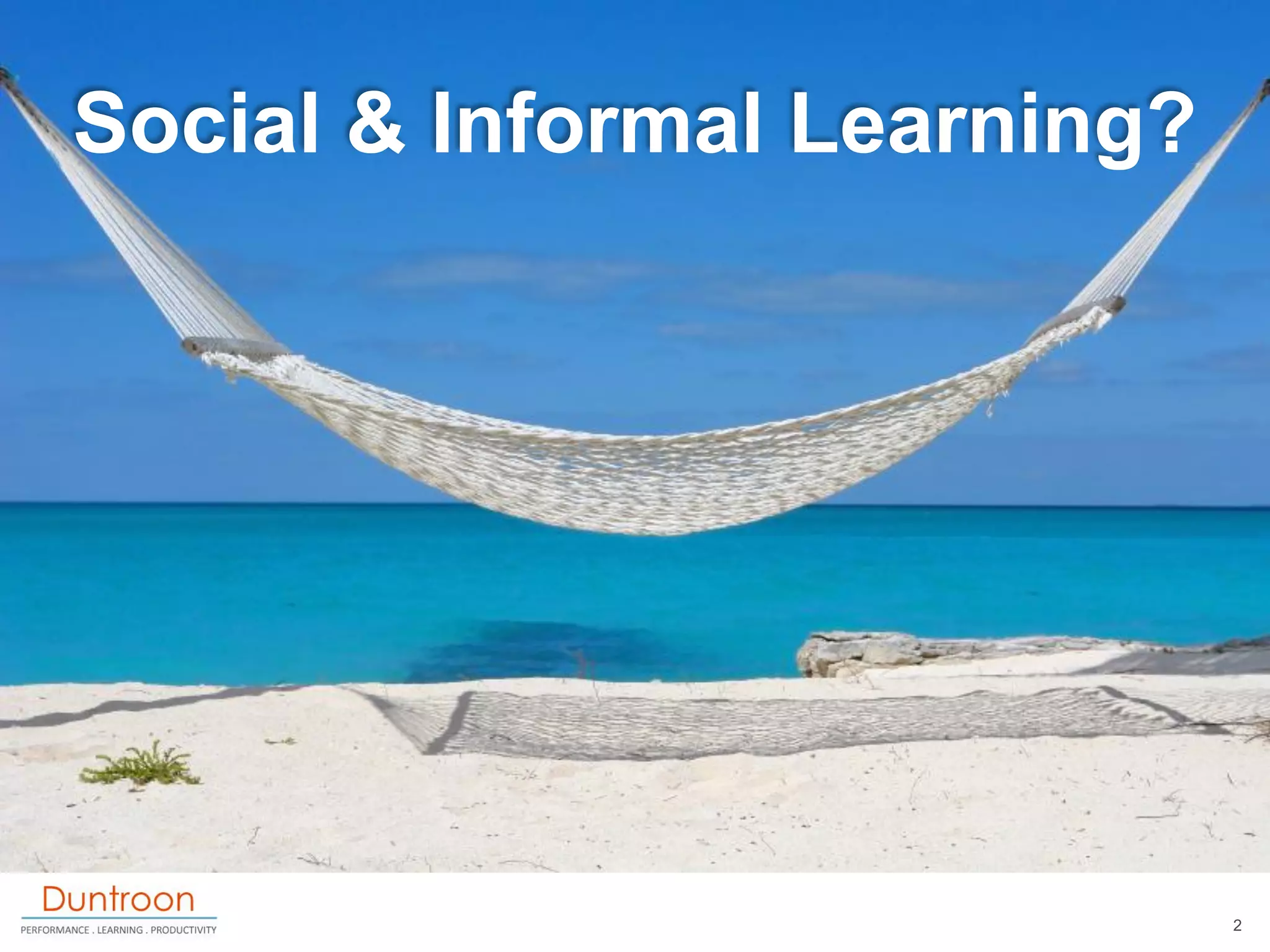
Social & Informal Learning?


                              2
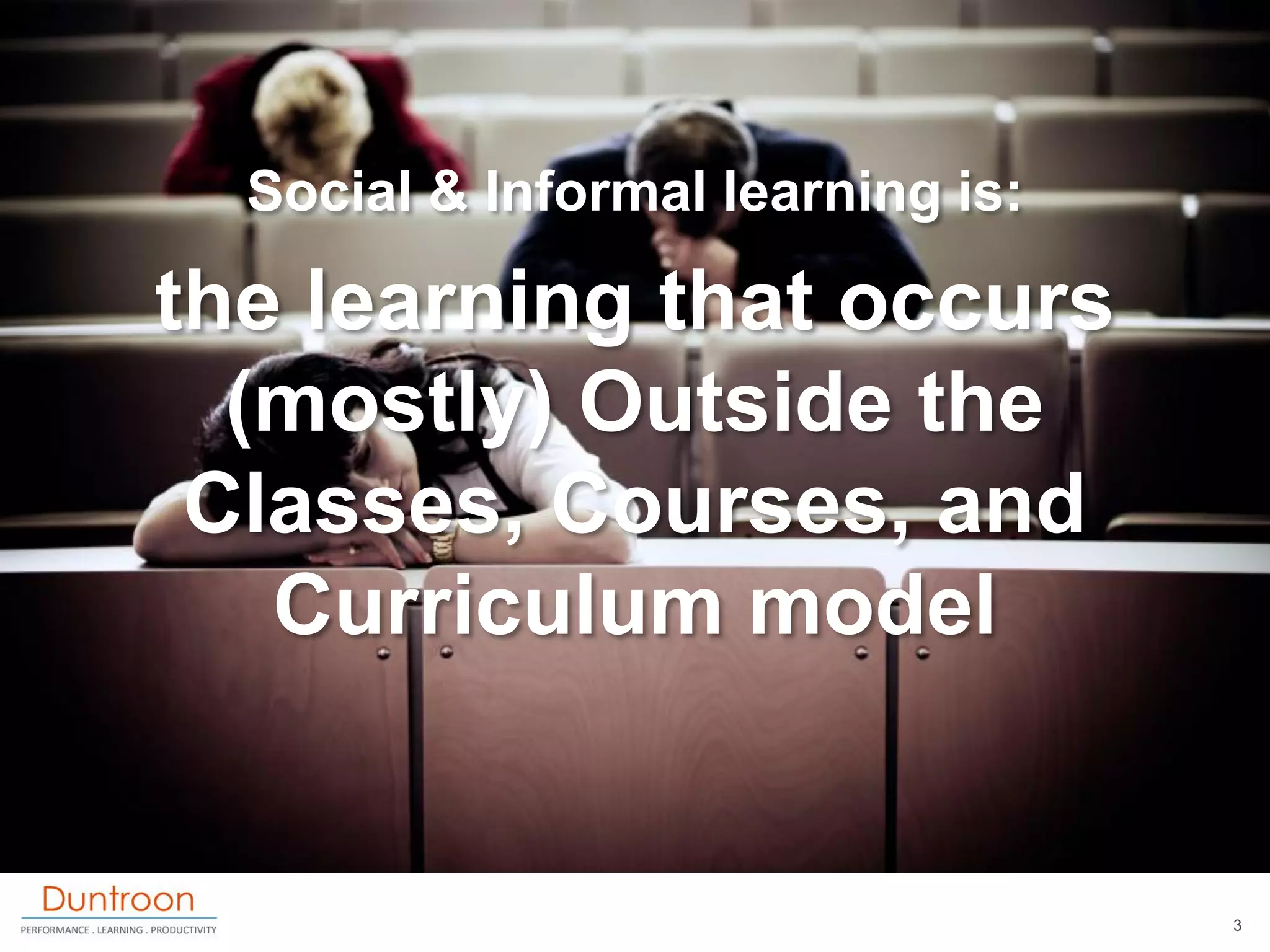
Social & Informal learning is:

the learning that occurs
  (mostly) Outside the
 Classes, Courses, and
   Curriculum model


                                   3
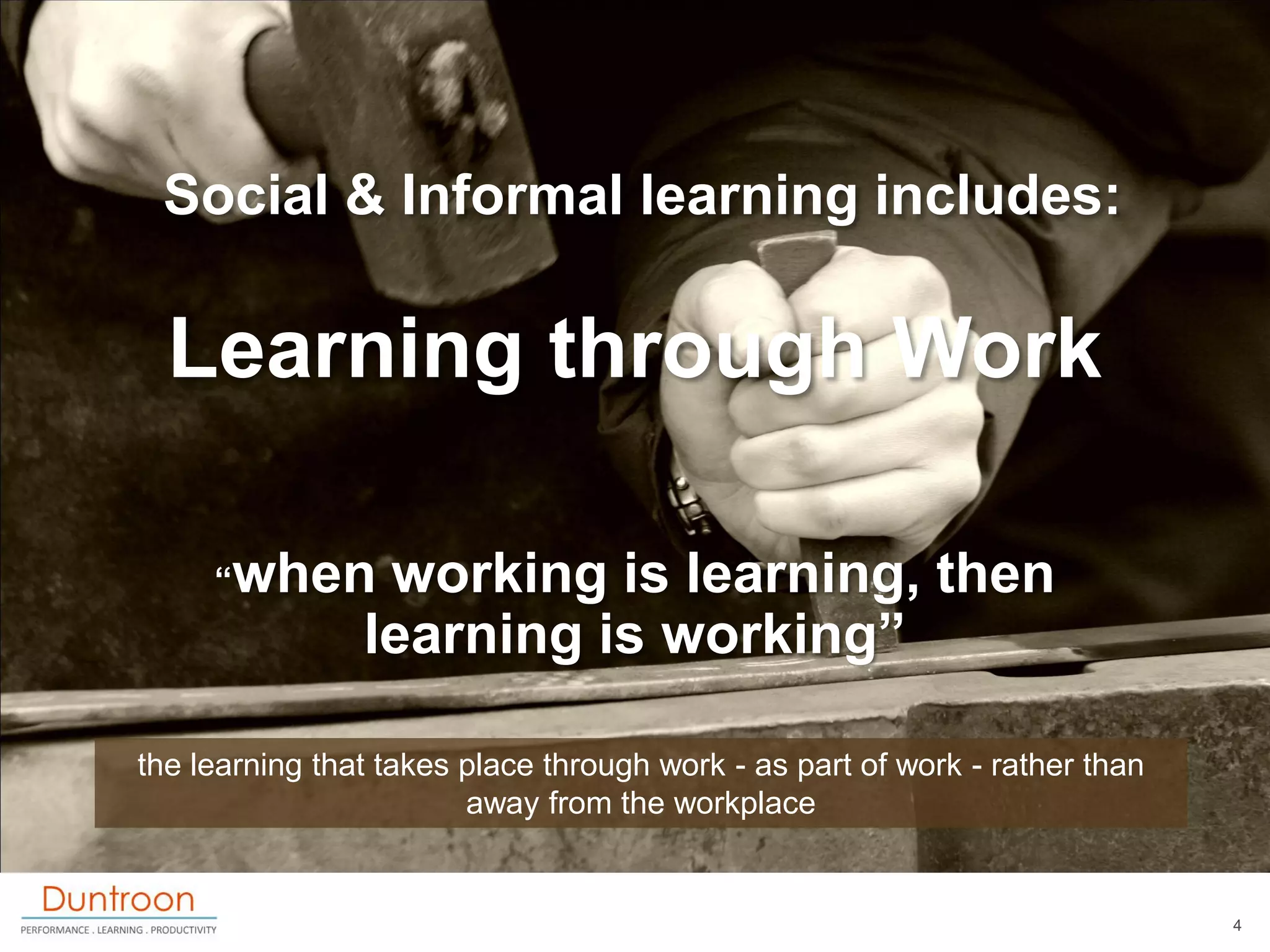
Social & Informal learning includes:

  Learning through Work

     “when       working is learning, then
                learning is working”

the learning that takes place through work - as part of work - rather than
                        away from the workplace


                                                                             4
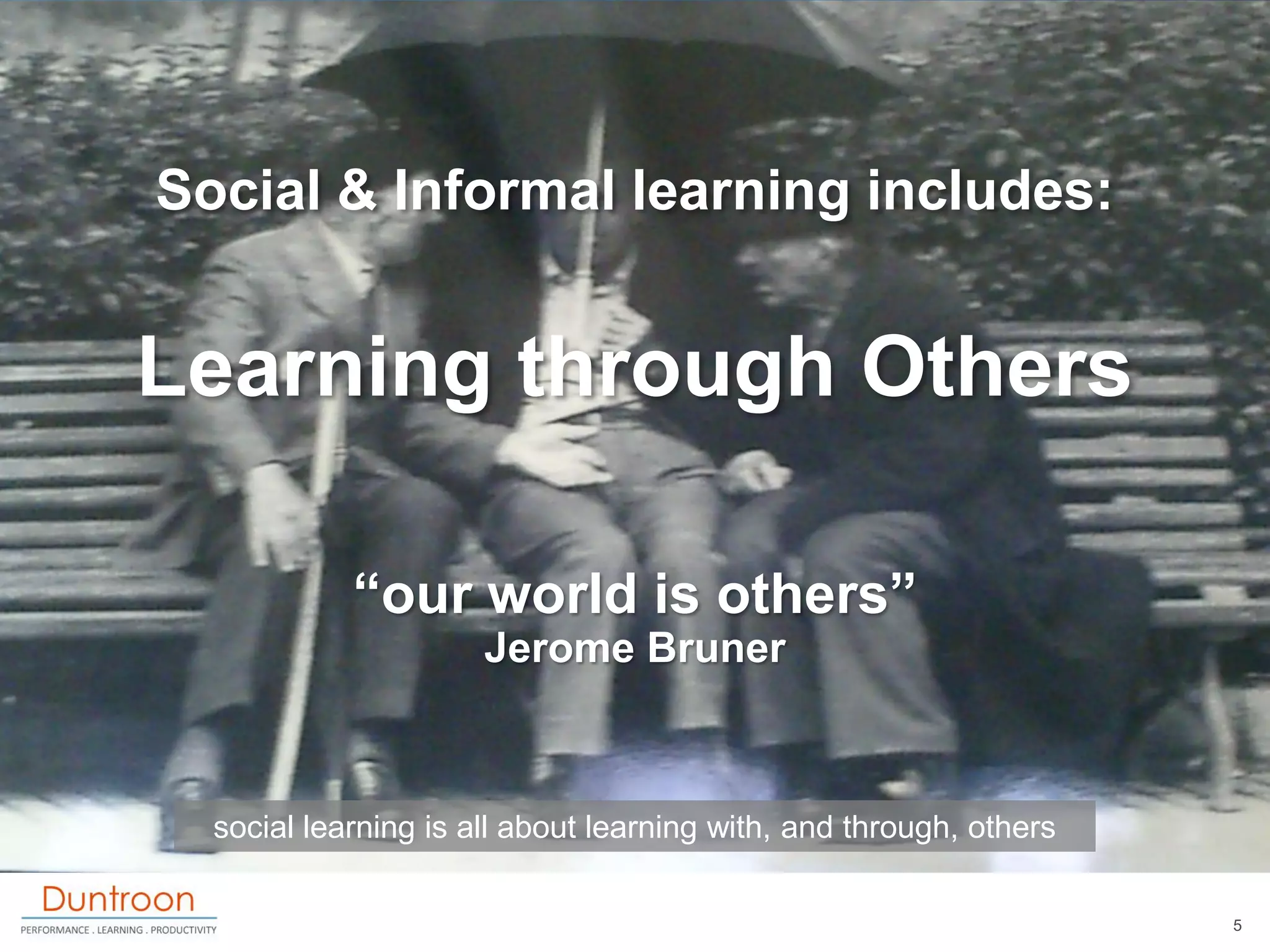
Social & Informal learning includes:


Learning through Others

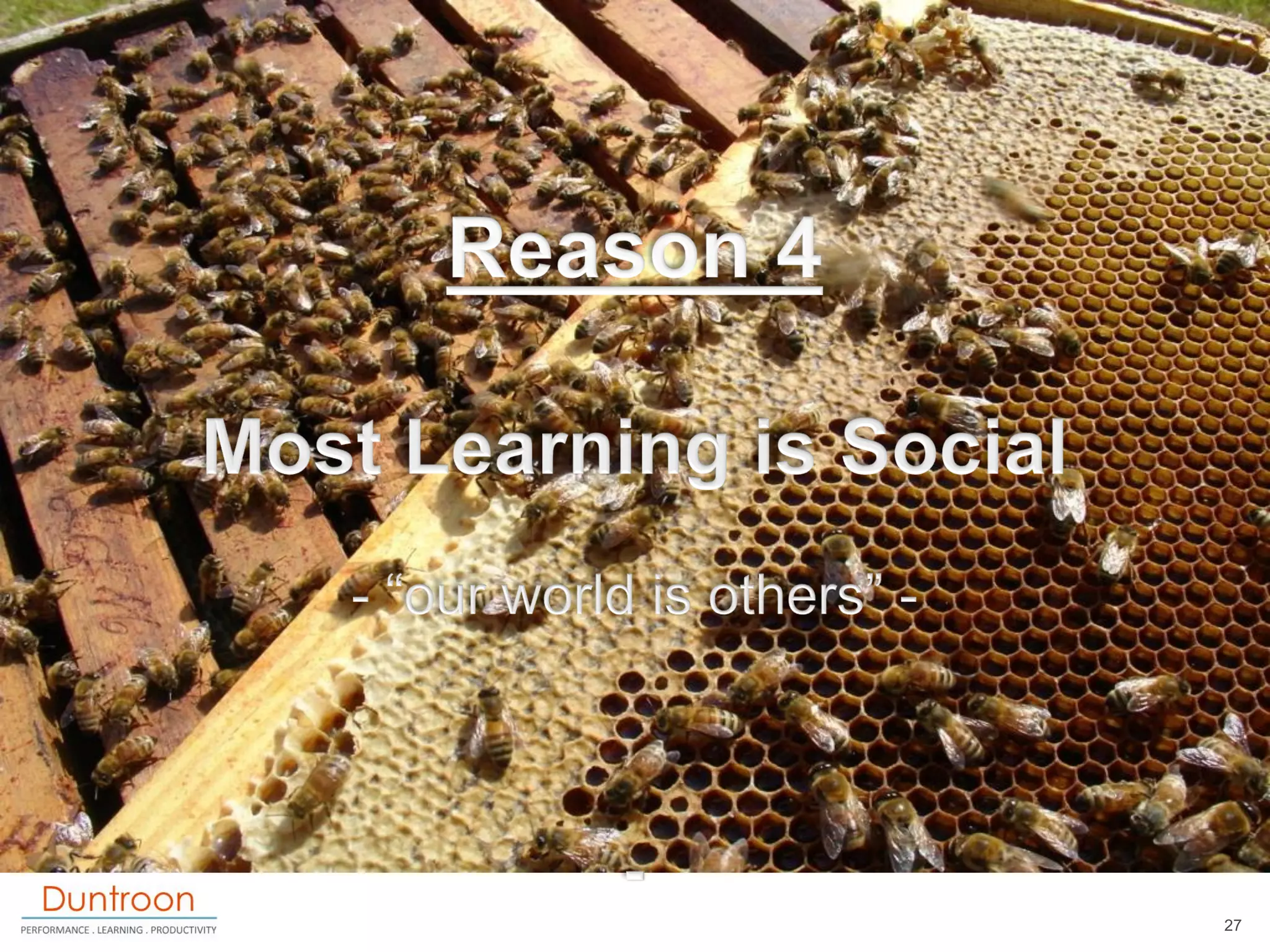
            “our world is others”
                      Jerome Bruner


  social learning is all about learning with, and through, others

                                                                    5
Amy van der Hiel


                   6
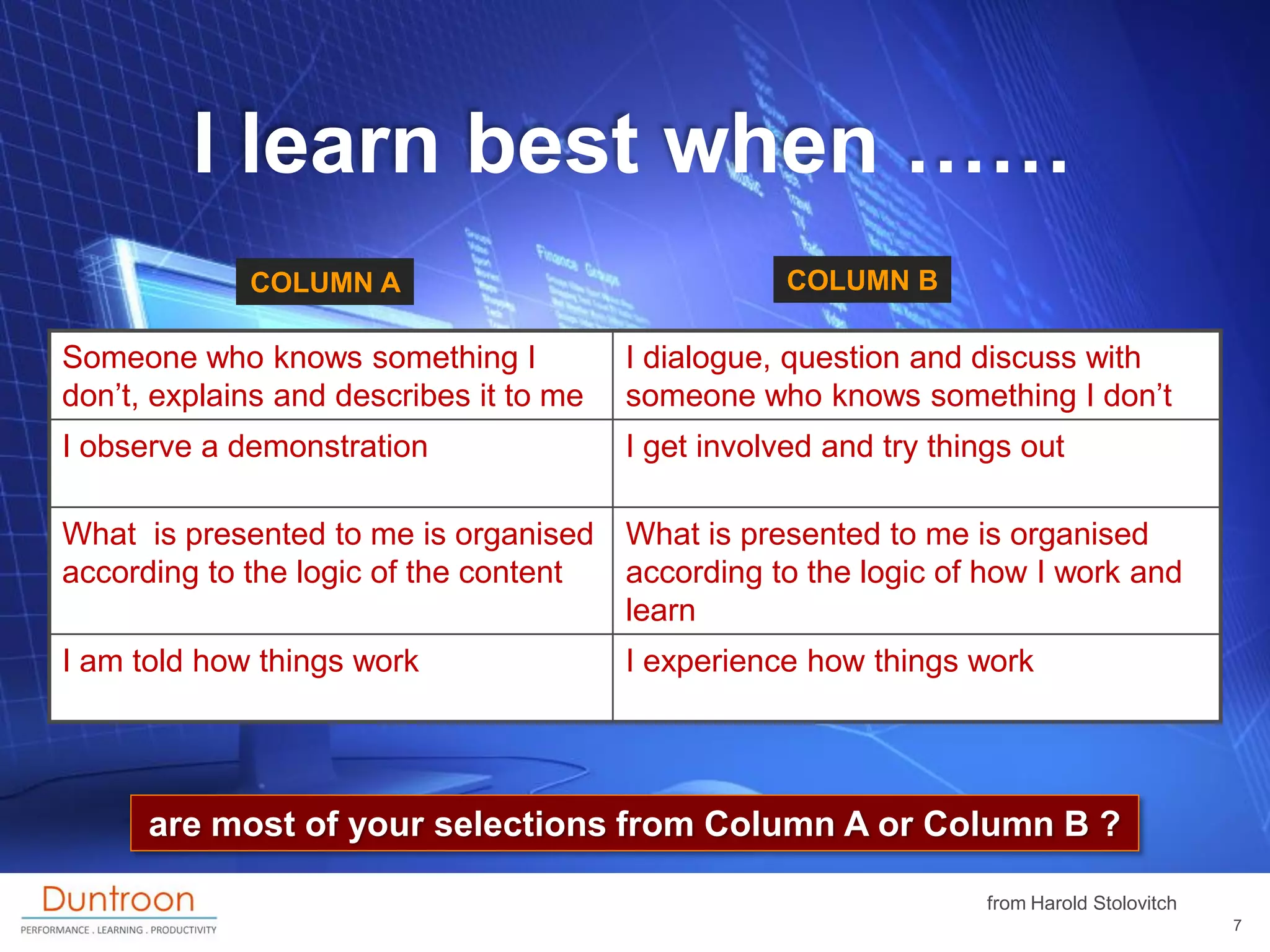
I learn best when ……
             COLUMN A                                COLUMN B

Someone who knows something I            I dialogue, question and discuss with
don‟t, explains and describes it to me   someone who knows something I don‟t
I observe a demonstration                I get involved and try things out

What is presented to me is organised What is presented to me is organised
according to the logic of the content according to the logic of how I work and
                                      learn
I am told how things work                I experience how things work


      are most of your selections from Column A or Column B ?

                                                                    from Harold Stolovitch
                                                                                             7
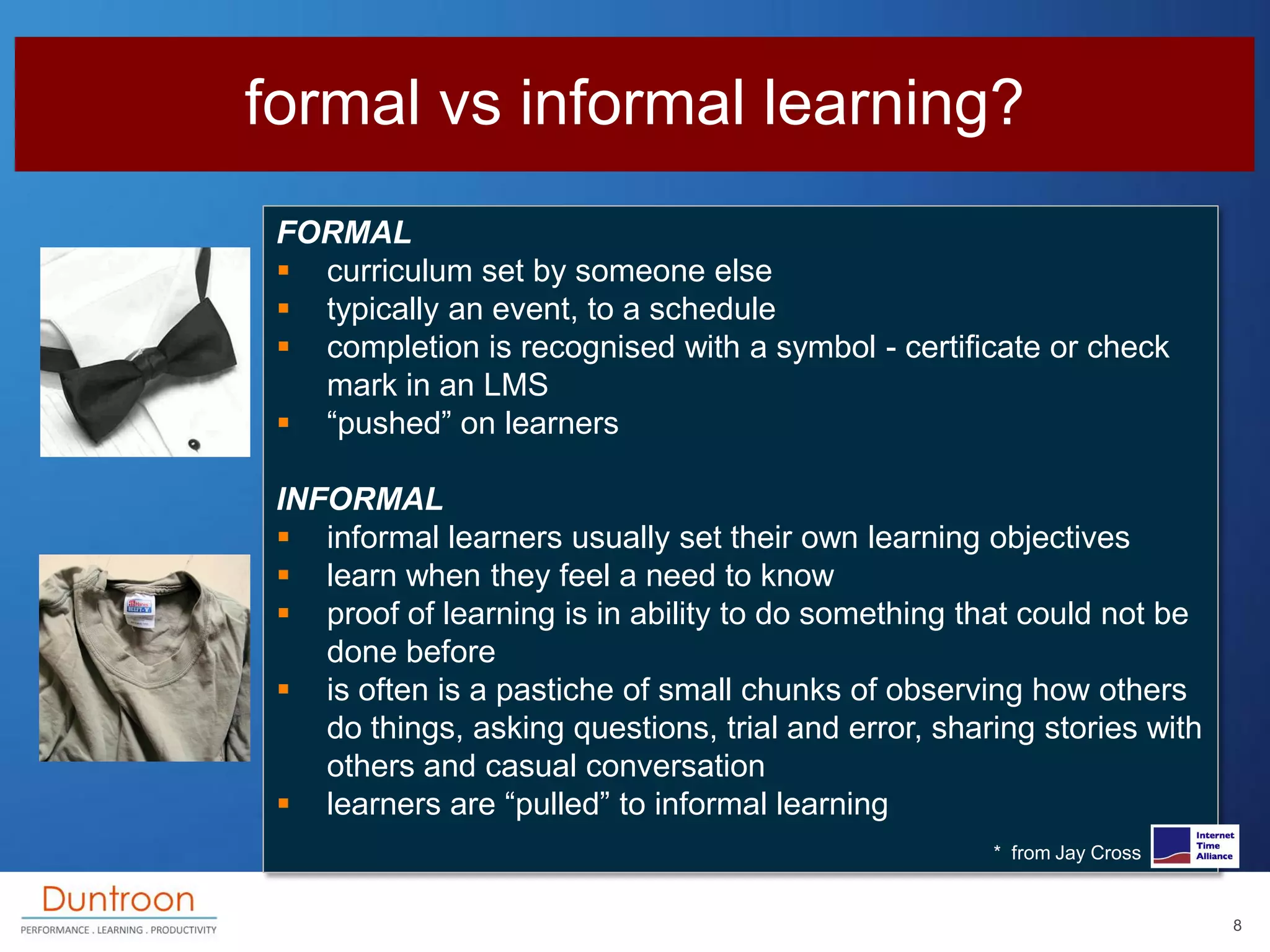
formal vs informal learning?
 FORMAL
  curriculum set by someone else
  typically an event, to a schedule
  completion is recognised with a symbol - certificate or check
   mark in an LMS
  “pushed” on learners

 INFORMAL
  informal learners usually set their own learning objectives
  learn when they feel a need to know
  proof of learning is in ability to do something that could not be
    done before
  is often is a pastiche of small chunks of observing how others
    do things, asking questions, trial and error, sharing stories with
    others and casual conversation
  learners are “pulled” to informal learning
                                                      * from Jay Cross


                                                                         8
Key Drivers
       A. We‟re Working
          In An „Always-
          on, Beta‟ World

       B. B. Learning
          Often Isn‟t What
          We Think It is


                             9
Our Always-On, Beta World


                            10
Our World is Increasingly
      Connected


        information-rich
        attention-poor


                            11
our lives are awash with information


   “In 2009 more data was generated by
   individuals than in the entire history of
           mankind through 2008”
                           Harvard Business Review
                         The Social Data Revolutions


                                                       12
Information
        volumes are increasing
          most is unstructured
half-life of the majority is decreasing


                                          13
People
               always connected
      having to deal with more complexity
making more decisions further down the hierarchy


                                                   14
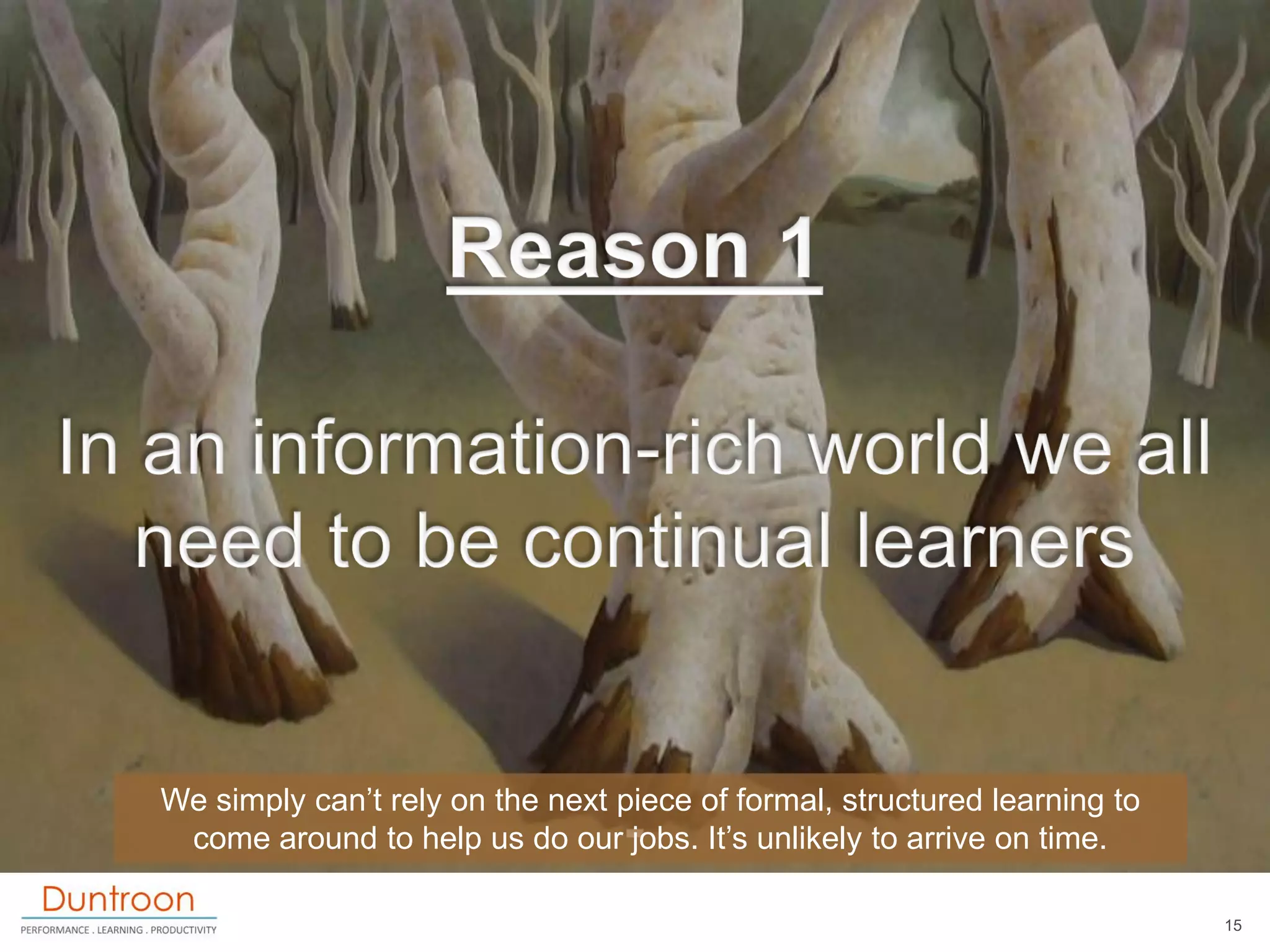
We simply can‟t rely on the next piece of formal, structured learning to
 come around to help us do our jobs. It‟s unlikely to arrive on time.

                                                                           15
some basic business truths


  in an ever-changing world, continuous
learning is the only sustainable advantage


                                  Jay Cross and Friends
                          „Working Smarter Fieldbook: informal
                                        learning in the cloud”
                                                          2010
                                 www.internettimealliance.com

                                                            16
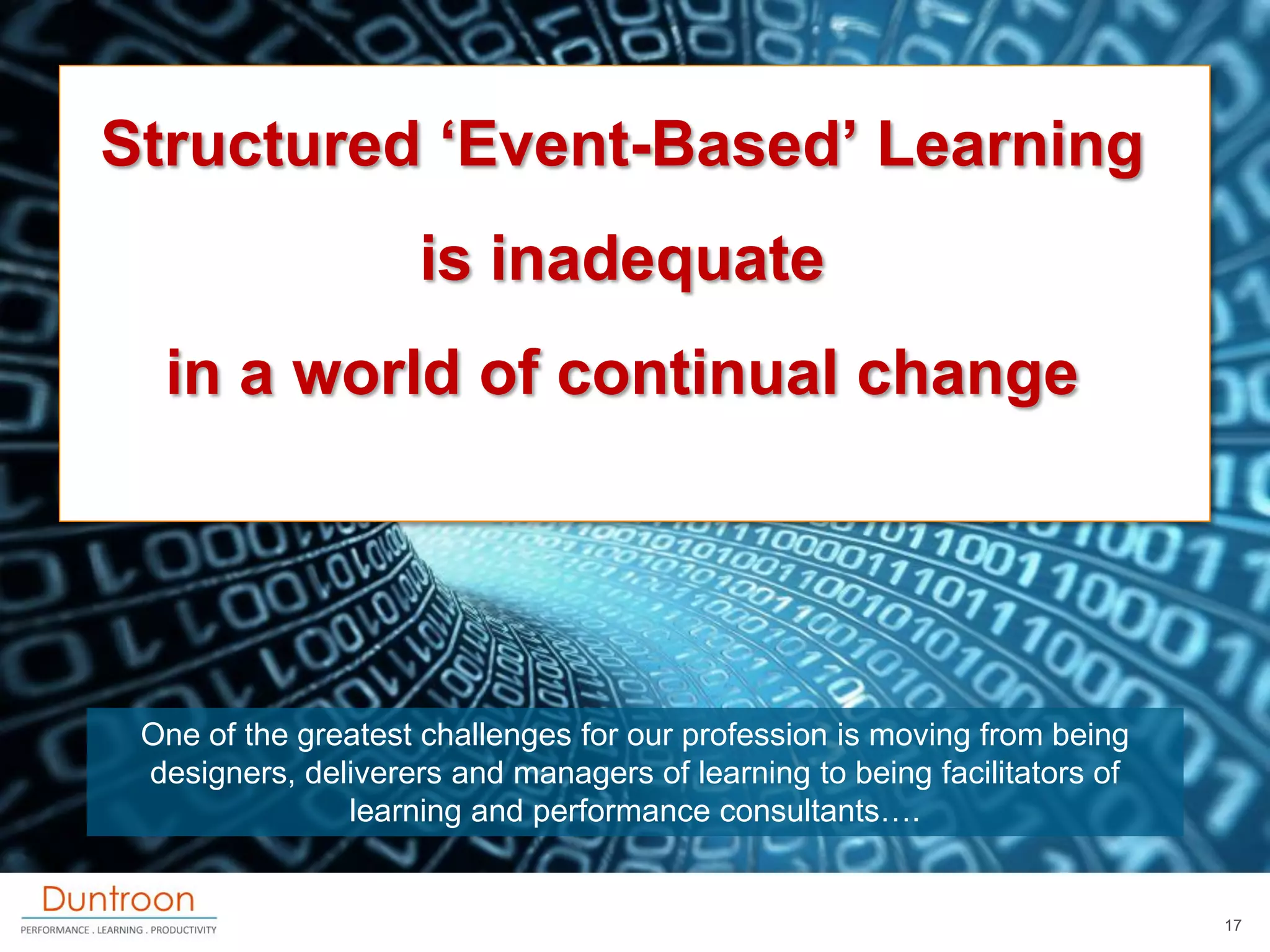
Structured „Event-Based‟ Learning
                     is inadequate
  in a world of continual change


 One of the greatest challenges for our profession is moving from being
 designers, deliverers and managers of learning to being facilitators of
               learning and performance consultants….


                                                                           17
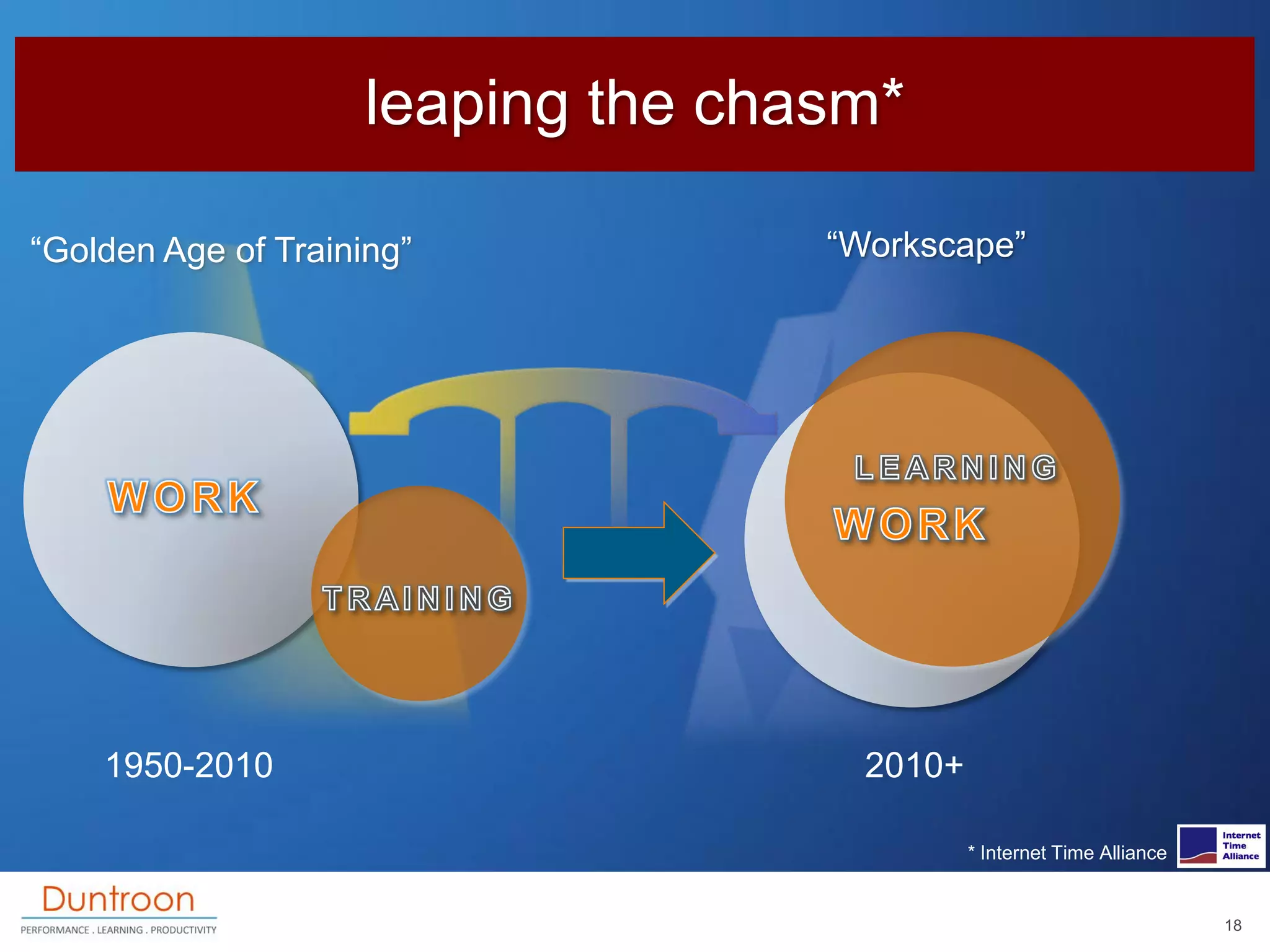
leaping the chasm*

“Golden Age of Training”            “Workscape”


    1950-2010                         2010+

                                              * Internet Time Alliance


                                                                         18
19
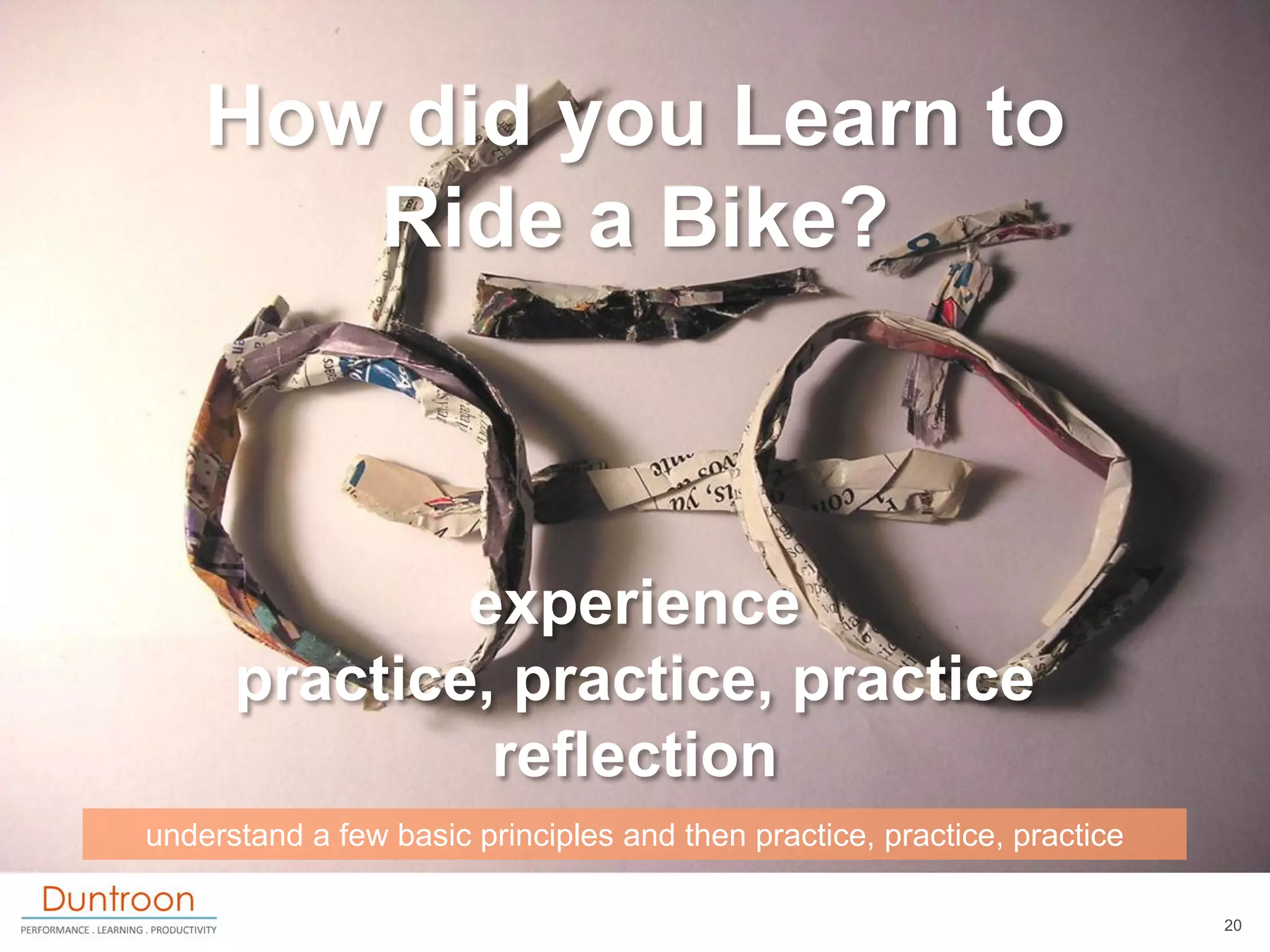
How did you Learn to
       Ride a Bike?


              experience
      practice, practice, practice
               reflection
understand a few basic principles and then practice, practice, practice

                                                                          20
21
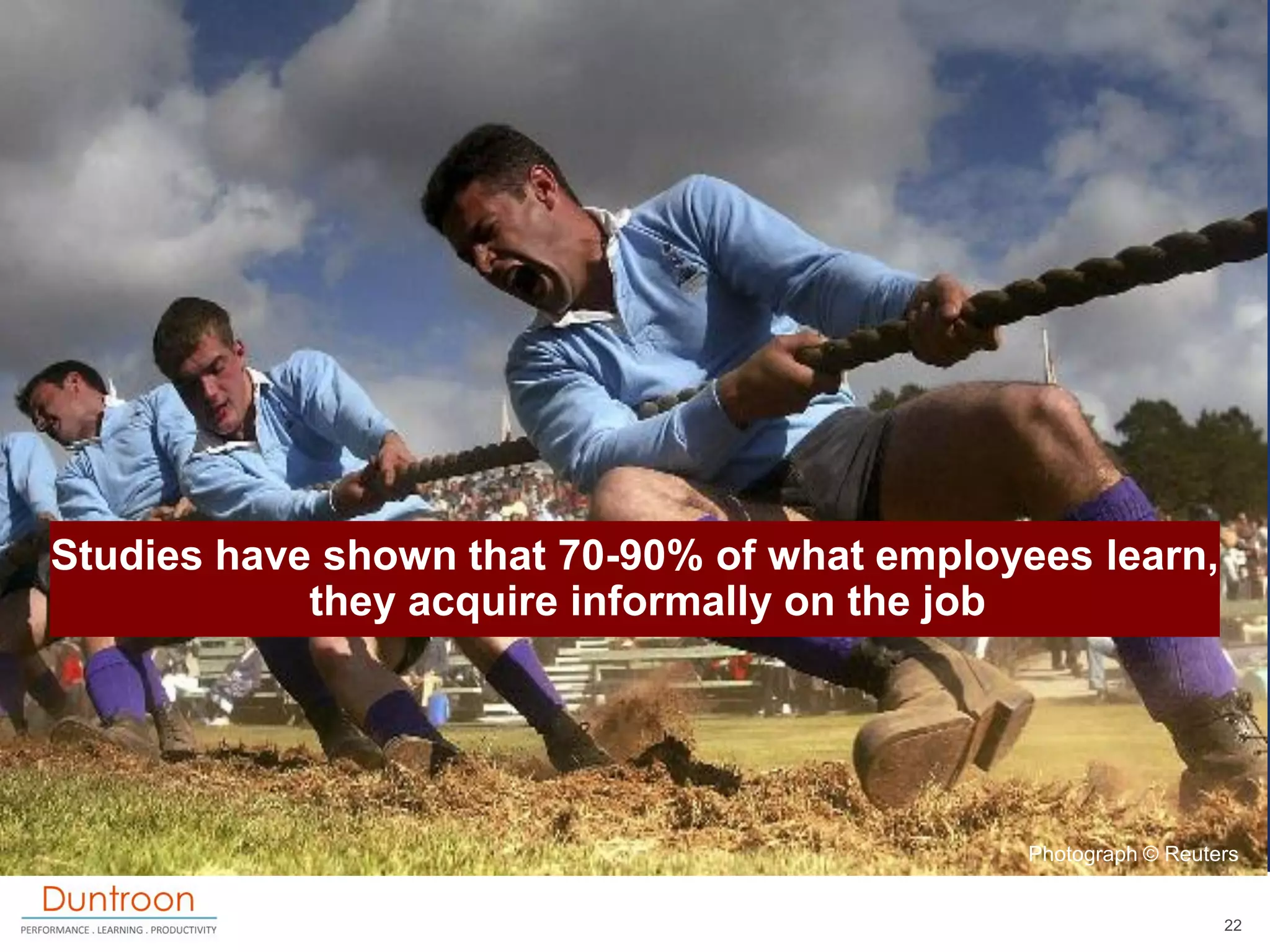
Studies have shown that 70-90% of what employees learn,
            they acquire informally on the job


                                              Photograph © Reuters


                                                                22
As long ago as 1998, the US Bureau of Labor
Statistics reported that people learn 70% of what
      they know about their jobs informally*.


                           * Loewenstein and Spletzer
                      "Formal and Informal Training: Evidence
                                 from the NLSY”


                                                                23
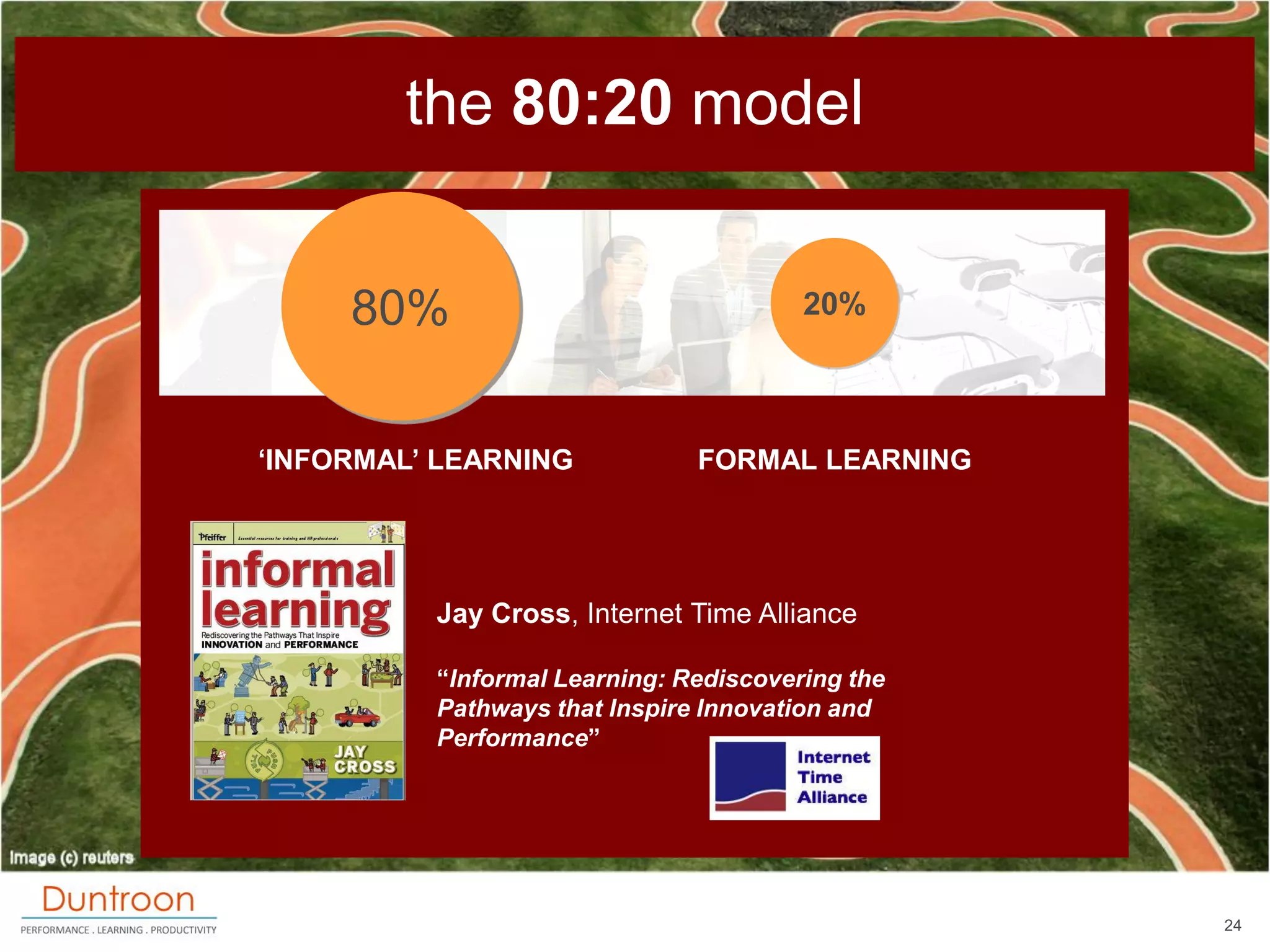
the 80:20 model


     80%                                20%


„INFORMAL‟ LEARNING            FORMAL LEARNING


          Jay Cross, Internet Time Alliance

          “Informal Learning: Rediscovering the
          Pathways that Inspire Innovation and
          Performance”


                                                  24
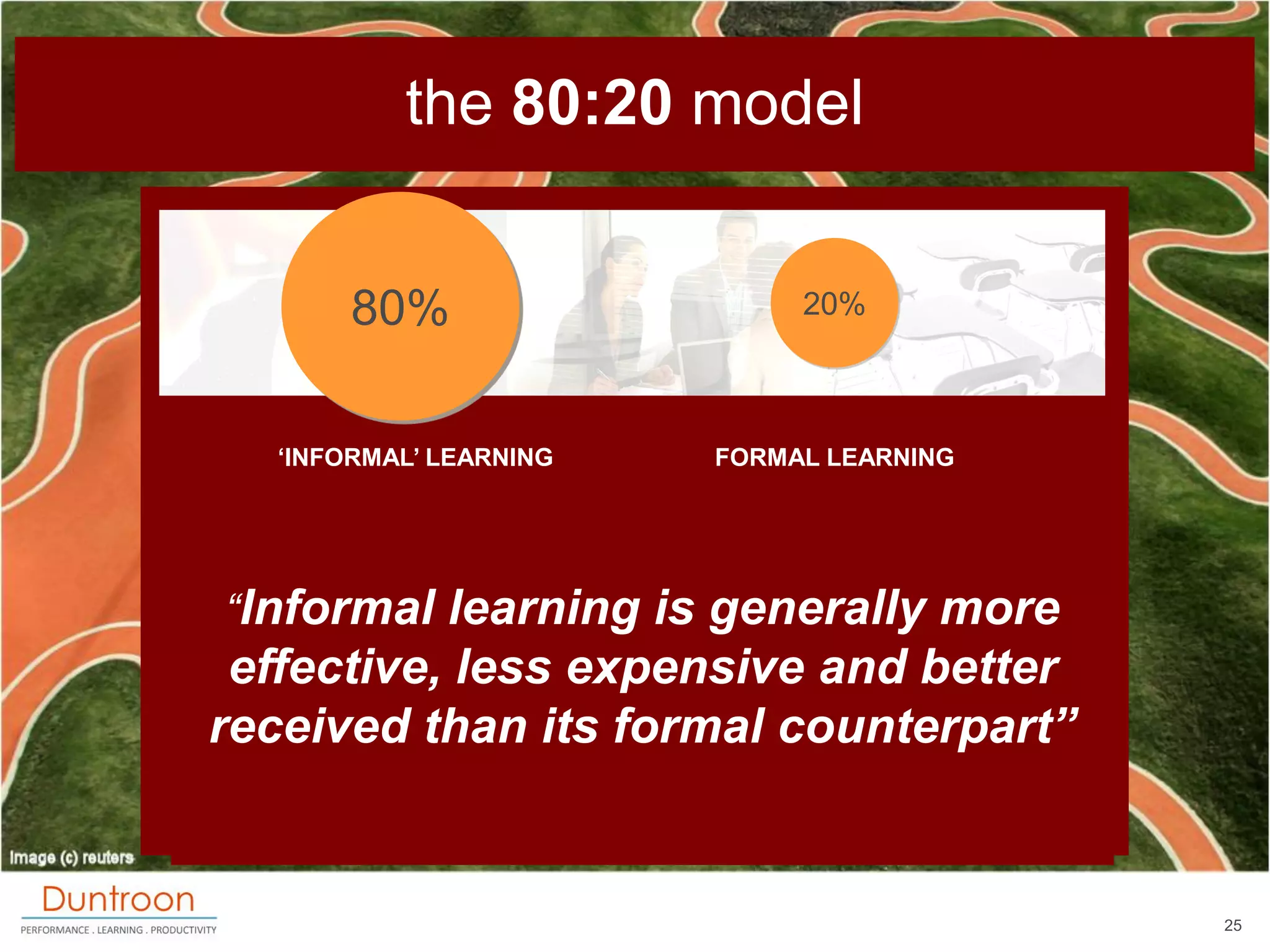
the 80:20 model


       80%                   20%


  „INFORMAL‟ LEARNING   FORMAL LEARNING


“Informal learning is generally more
 effective, less expensive and better
received than its formal counterpart”


                                          25
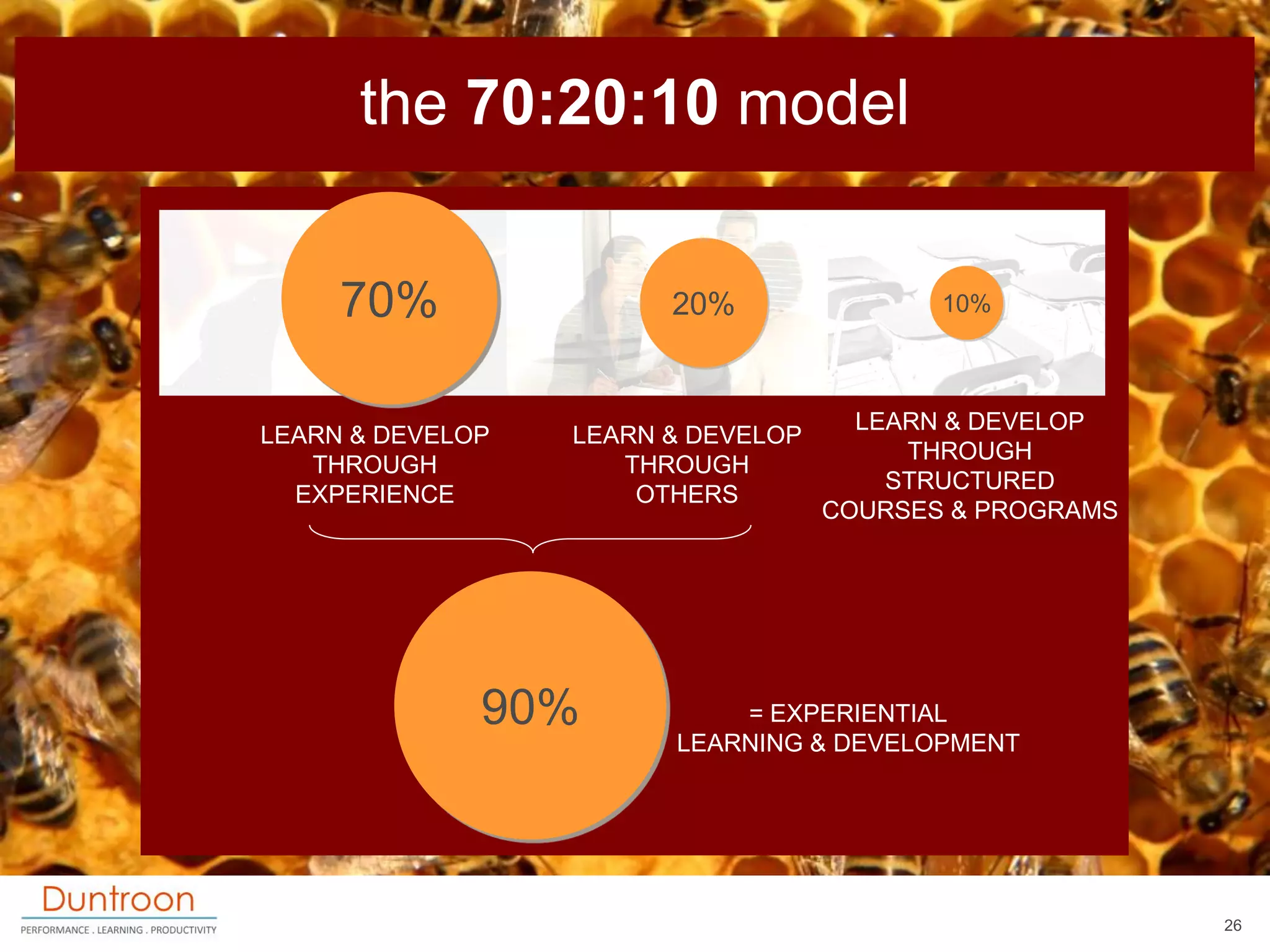
the 70:20:10 model


     70%                20%                10%


                                      LEARN & DEVELOP
LEARN & DEVELOP   LEARN & DEVELOP
                                         THROUGH
   THROUGH           THROUGH
                                        STRUCTURED
  EXPERIENCE          OTHERS
                                    COURSES & PROGRAMS


              90%           = EXPERIENTIAL
                        LEARNING & DEVELOPMENT


                                                         26
27
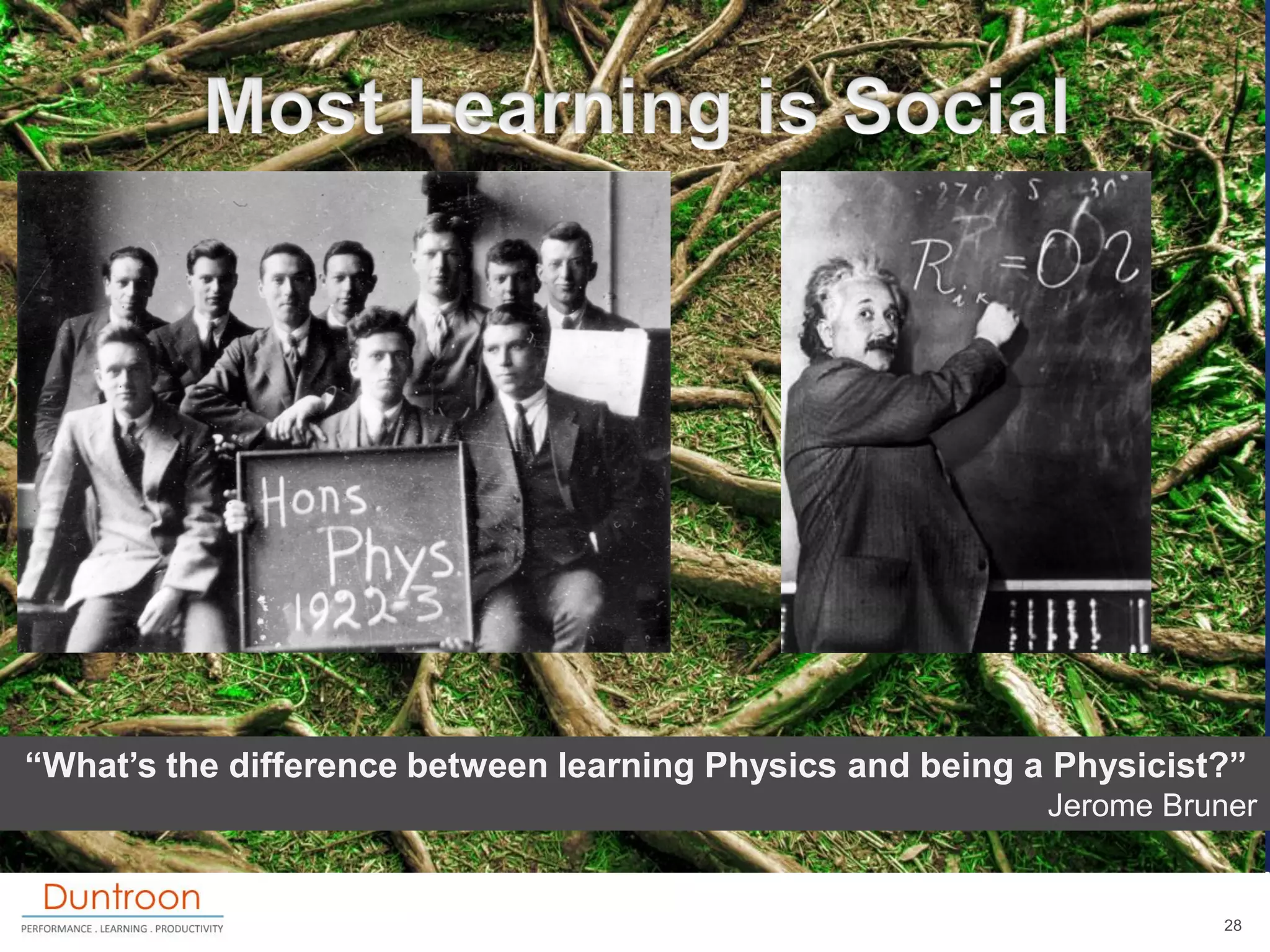
“What‟s the difference between learning Physics and being a Physicist?”
                                                           Jerome Bruner


                                                                     28
29
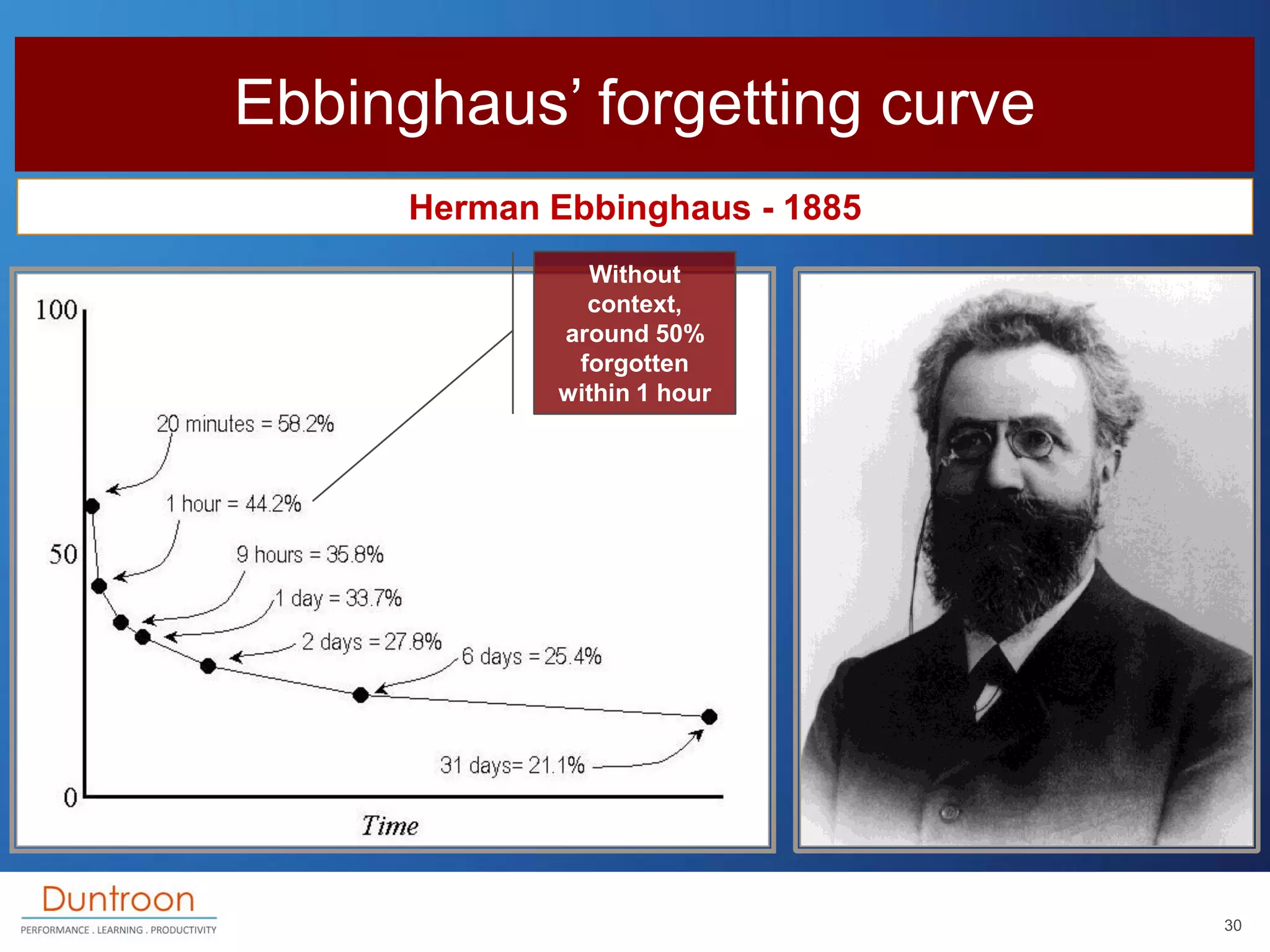
Ebbinghaus‟ forgetting curve
      Herman Ebbinghaus - 1885
                Without
               context,
             around 50%
              forgotten
             within 1 hour


                                 30
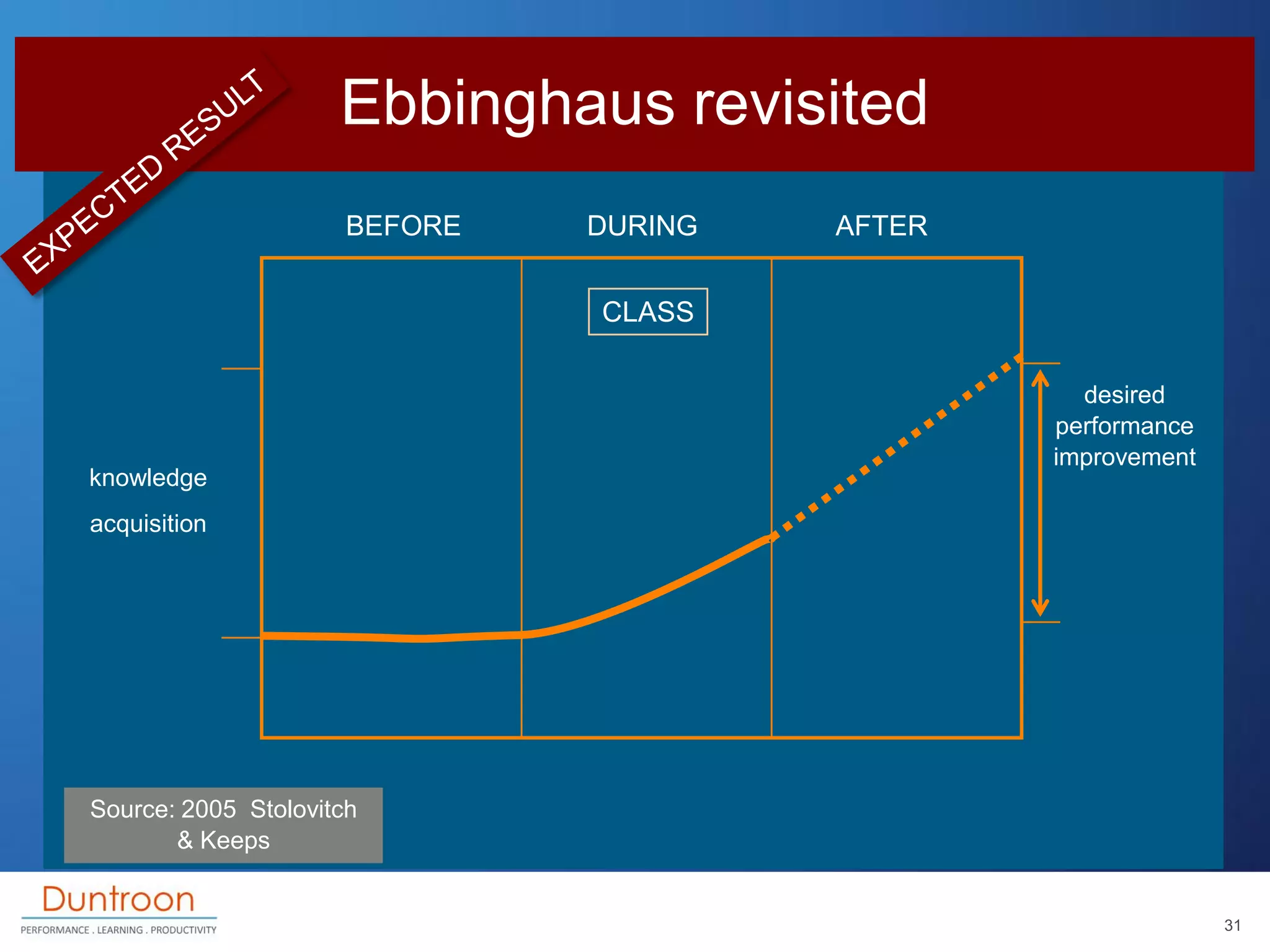
Ebbinghaus revisited
                      BEFORE   DURING   AFTER


                               CLASS

                                                  desired
                                                performance
                                                improvement
knowledge
acquisition


Source: 2005 Stolovitch
       & Keeps


                                                              31
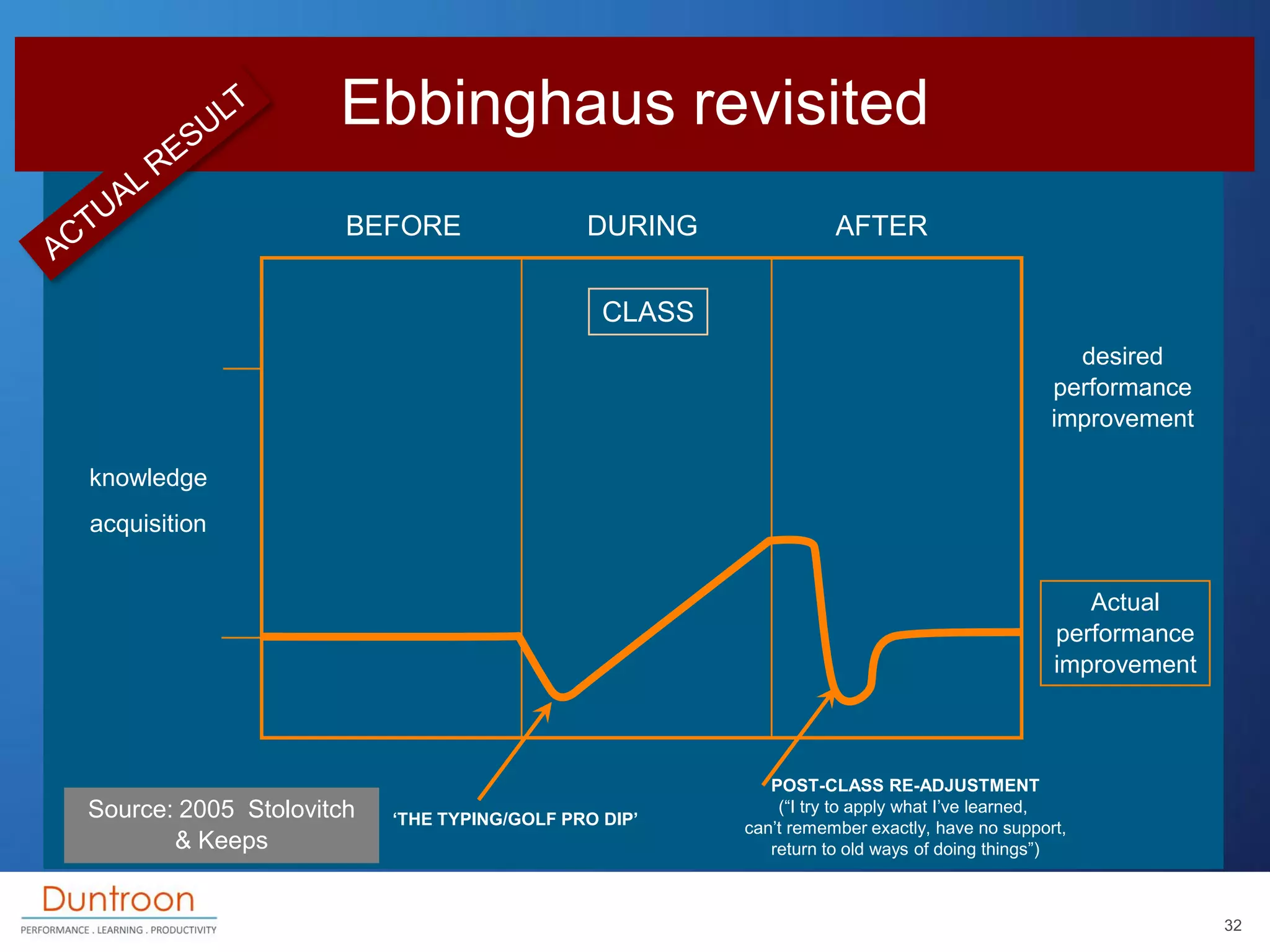
Ebbinghaus revisited
                      BEFORE                 DURING               AFTER


                                               CLASS
                                                                                               desired
                                                                                             performance
                                                                                             improvement

knowledge
acquisition


                                                                                                Actual
                                                                                             performance
                                                                                             improvement


                                                          POST-CLASS RE-ADJUSTMENT
Source: 2005 Stolovitch                                    (“I try to apply what I‟ve learned,
                          „THE TYPING/GOLF PRO DIP‟    can‟t remember exactly, have no support,
       & Keeps                                            return to old ways of doing things”)


                                                                                                           32
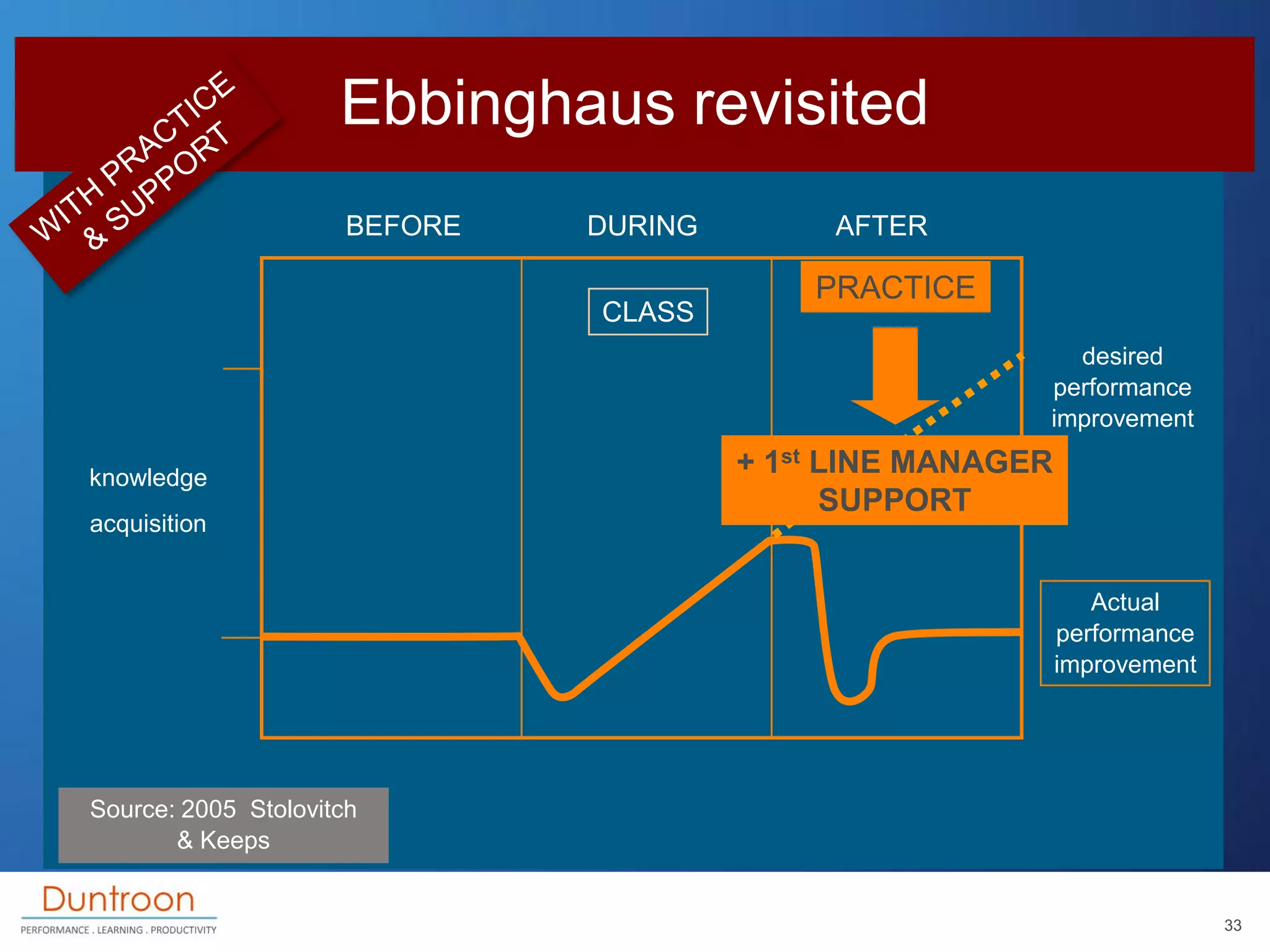
Ebbinghaus revisited
                      BEFORE   DURING        AFTER

                                            PRACTICE
                               CLASS
                                                           desired
                                                         performance
                                                         improvement

knowledge
                                        + 1st LINE MANAGER
                                              SUPPORT
acquisition


                                                                Actual
                                                             performance
                                                             improvement


Source: 2005 Stolovitch
       & Keeps


                                                                           33
34
It takes time to carry out a needs analysis, design the learning, develop
                content, then get it out to the target audience.

Once we‟ve spent all that time, resource and budget we‟re not keen to throw
             them away…. we want to sweat our assets….

                                                                              35
36
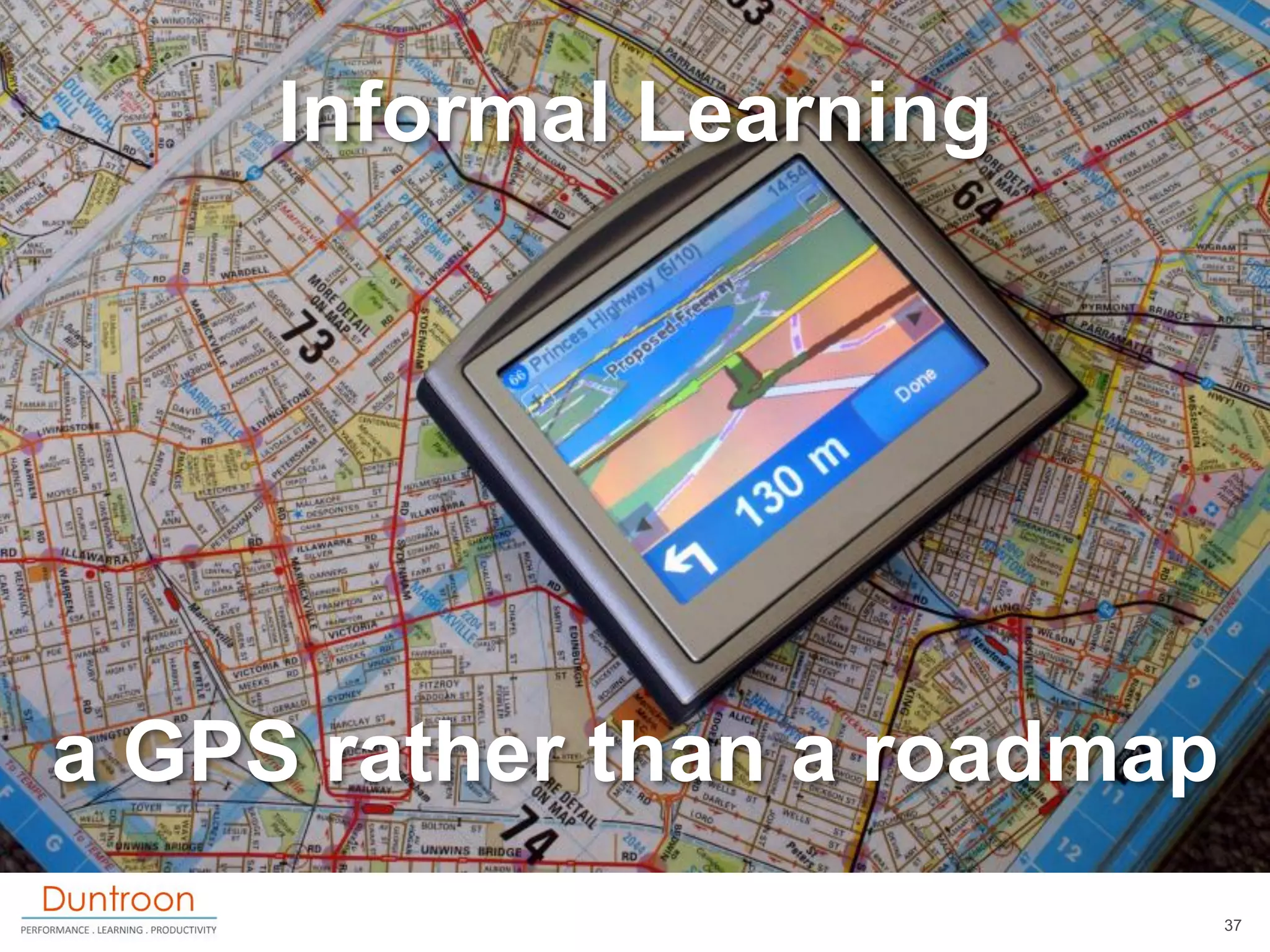
Informal Learning


a GPS rather than a roadmap
                              37
38
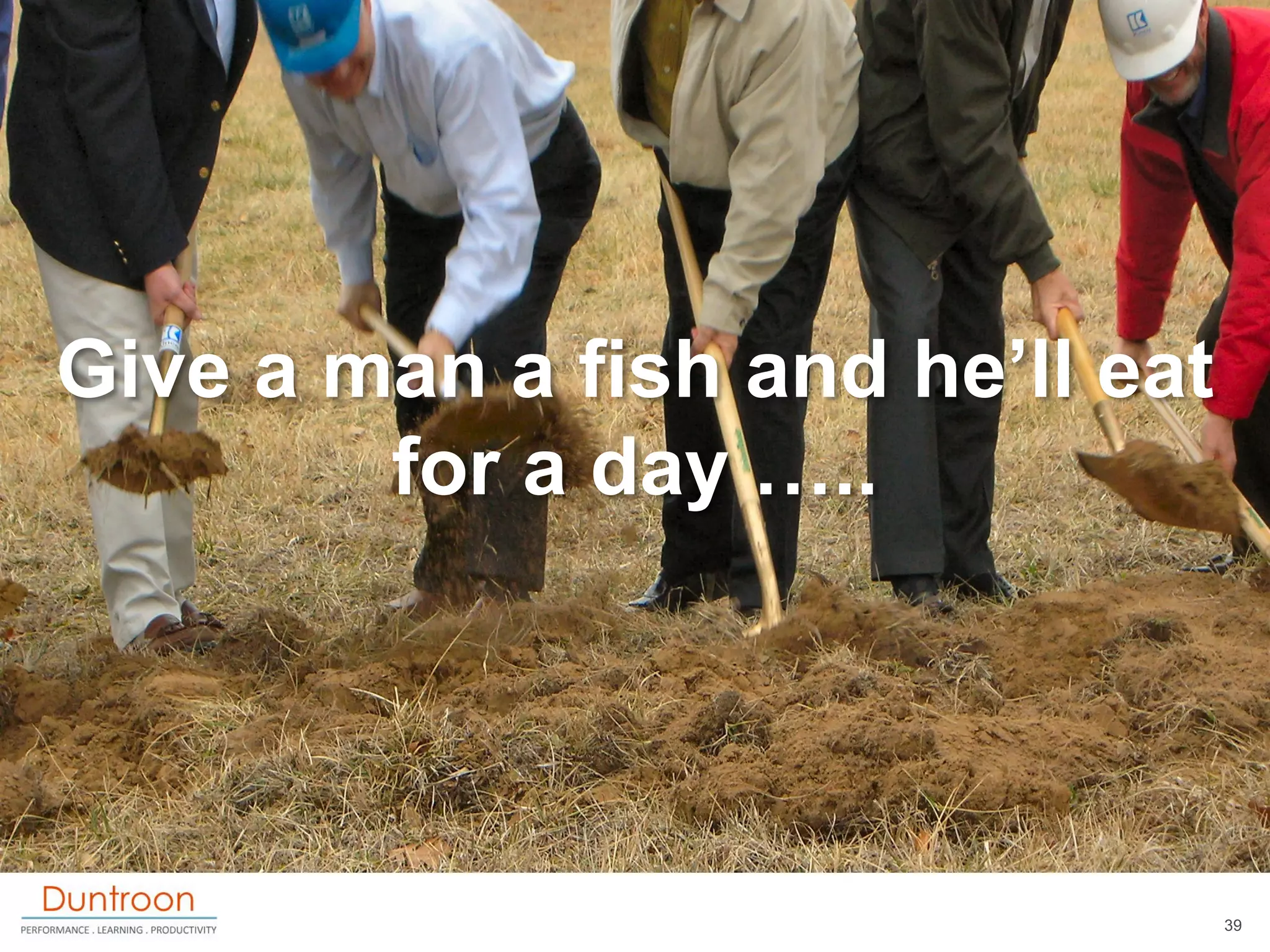
Give a man a fish and he‟ll eat
        for a day …..


                                  39
some basic business truths


 Effective and efficient learning is both a
profitable strategy and the key to business
                 longevity


                                              40
how do we „formalise‟ Informal learning?

         Wrong Question!

Don‟t try to “formalise” informal learning.

      Just focus on helping people
         do their jobs well and
            WORK SMARTER

                                              41
how do we „formalise‟ Informal learning?


open up the possibilities of supporting the
  other 80-90% of learning that has been
          ignored for far too long


                                              42
how do we „formalise‟ Informal learning?


“..embracing, encouraging and supporting
    informal learning is part of a greater
        workplace cultural change”


                                             43
what is „formalising‟ Informal learning?
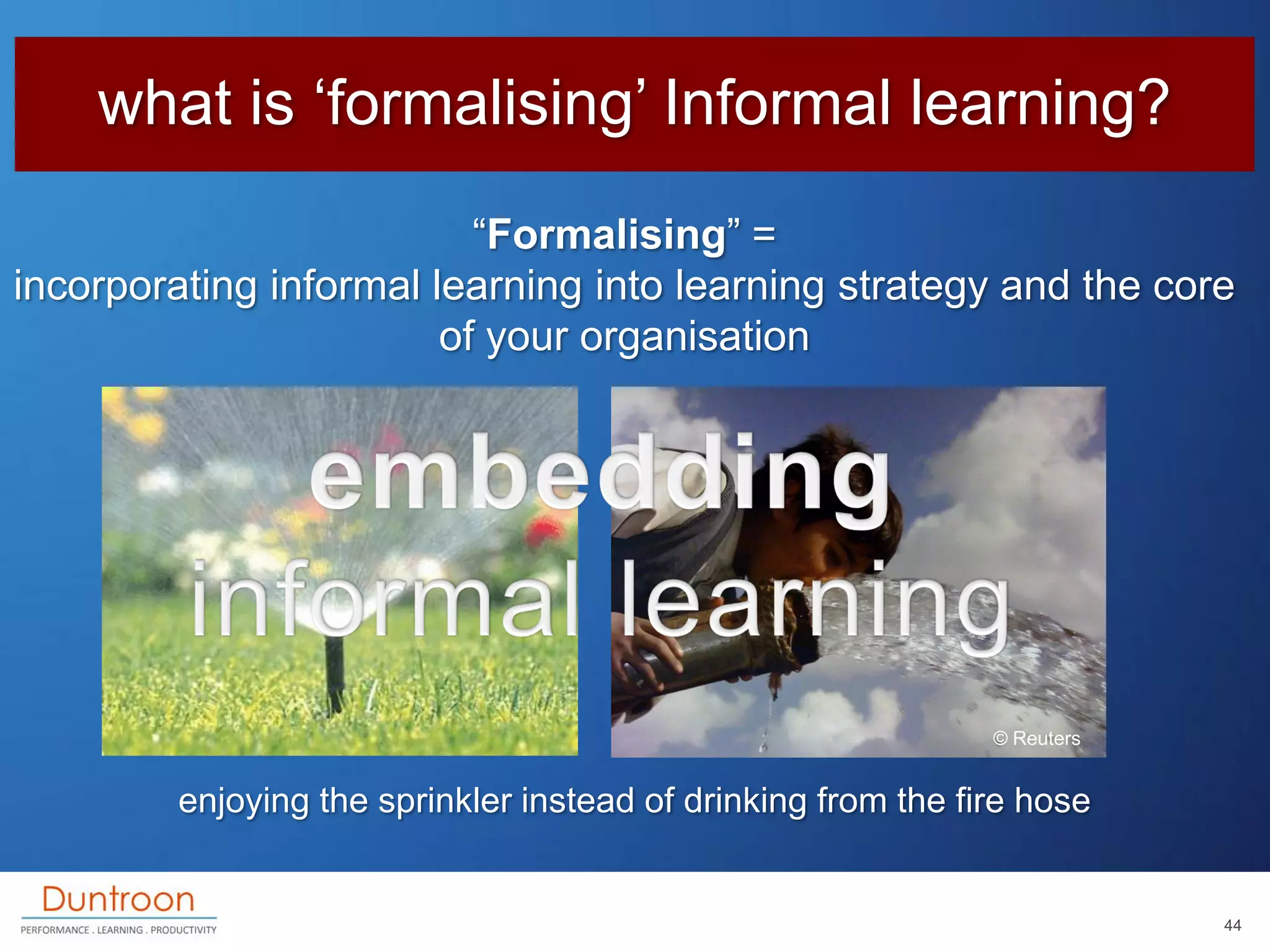
                          “Formalising” =
incorporating informal learning into learning strategy and the core
                        of your organisation


                                                               © Reuters


         enjoying the sprinkler instead of drinking from the fire hose


                                                                           44
„embedding‟ Informal learning

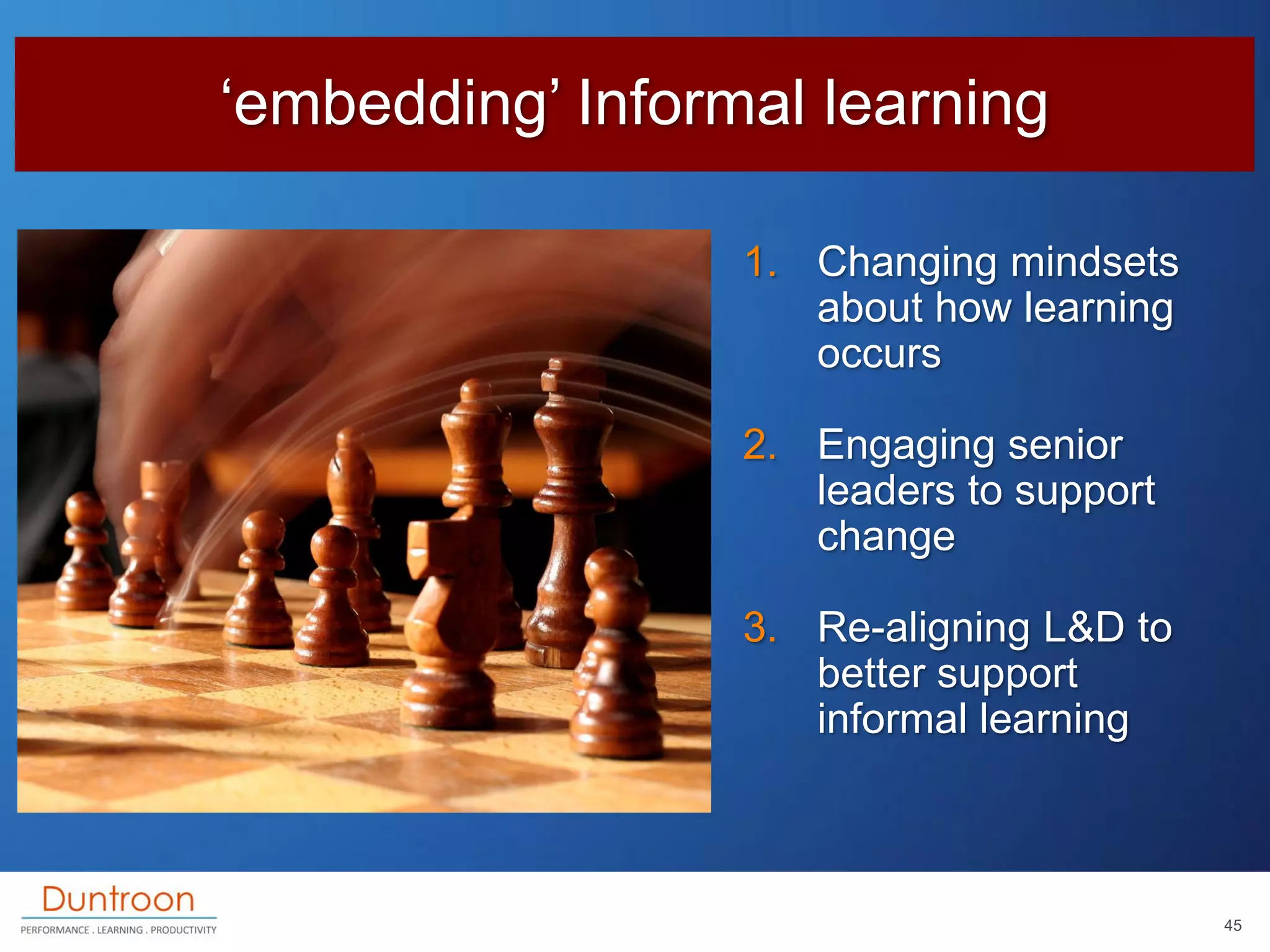
                  1. Changing mindsets
                     about how learning
                     occurs

                  2. Engaging senior
                     leaders to support
                     change

                  3. Re-aligning L&D to
                     better support
                     informal learning


                                          45
The Eight Reasons
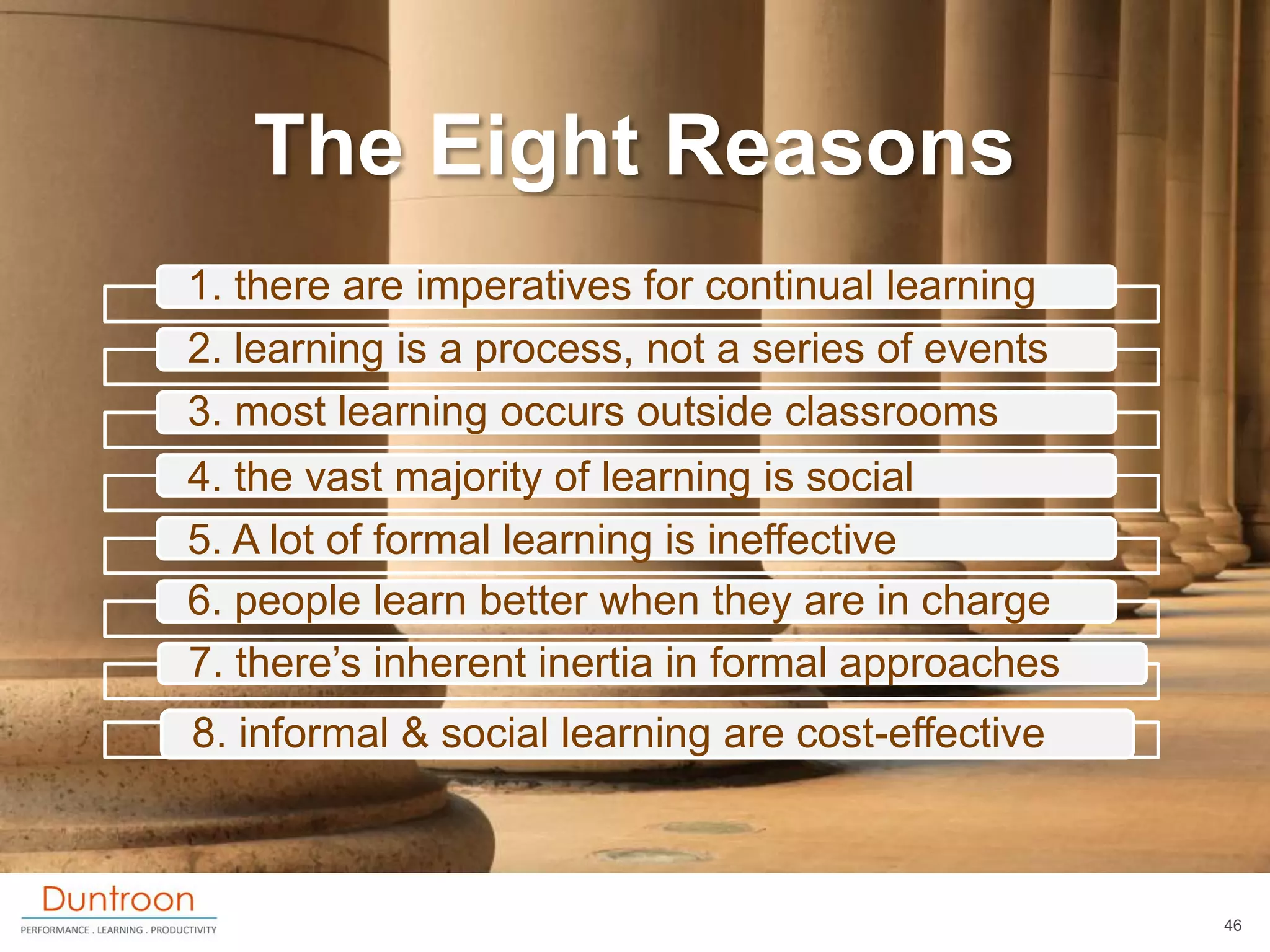
1. there are imperatives for continual learning
2. learning is a process, not a series of events
3. most learning occurs outside classrooms
4. the vast majority of learning is social
5. A lot of formal learning is ineffective
6. people learn better when they are in charge
7. there‟s inherent inertia in formal approaches
8. informal & social learning are cost-effective


                                                   46
Charles Jennings
                                         Duntroon Associates
 Deakin Prime Seminar Series:
                                         email: charles@duntroon.com
Melbourne 20-22nd  September 2010          Web: www.duntroon.com
                                           Twitter: charlesjennings
Canberra 23-24th September 2010
                                          LinkedIn: charlesjennings
 Brisbane 27-28th September 2010           Skype: charlesjennings
  Sydney 30th Sept – 1st Oct 2010           Flickr: charlesjennings

                                      Blog: charles-jennings.blogspot.com
http://www.deakinprime.com/events/       (or from www.duntroon.com)


                                            Internet Time Alliance
                                         www.internettimealliance.com
                                     Blog: http://internettime.posterous.com


                                                                               47

8 Reasons to Focus on Informal & Social Learning

  • 1.
    why organisations needto review their approach to learning and think about embedding informal and social approaches as a core element in the mix Charles Jennings Duntroon Associates 1
  • 2.
    Social & InformalLearning? 2
  • 3.
    Social & Informallearning is: the learning that occurs (mostly) Outside the Classes, Courses, and Curriculum model 3
  • 4.
    Social & Informallearning includes: Learning through Work “when working is learning, then learning is working” the learning that takes place through work - as part of work - rather than away from the workplace 4
  • 5.
    Social & Informallearning includes: Learning through Others “our world is others” Jerome Bruner social learning is all about learning with, and through, others 5
  • 6.
  • 7.
    I learn bestwhen …… COLUMN A COLUMN B Someone who knows something I I dialogue, question and discuss with don‟t, explains and describes it to me someone who knows something I don‟t I observe a demonstration I get involved and try things out What is presented to me is organised What is presented to me is organised according to the logic of the content according to the logic of how I work and learn I am told how things work I experience how things work are most of your selections from Column A or Column B ? from Harold Stolovitch 7
  • 8.
    formal vs informallearning? FORMAL  curriculum set by someone else  typically an event, to a schedule  completion is recognised with a symbol - certificate or check mark in an LMS  “pushed” on learners INFORMAL  informal learners usually set their own learning objectives  learn when they feel a need to know  proof of learning is in ability to do something that could not be done before  is often is a pastiche of small chunks of observing how others do things, asking questions, trial and error, sharing stories with others and casual conversation  learners are “pulled” to informal learning * from Jay Cross 8
  • 9.
    Key Drivers A. We‟re Working In An „Always- on, Beta‟ World B. B. Learning Often Isn‟t What We Think It is 9
  • 10.
  • 11.
    Our World isIncreasingly Connected information-rich attention-poor 11
  • 12.
    our lives areawash with information “In 2009 more data was generated by individuals than in the entire history of mankind through 2008” Harvard Business Review The Social Data Revolutions 12
  • 13.
    Information volumes are increasing most is unstructured half-life of the majority is decreasing 13
  • 14.
    People always connected having to deal with more complexity making more decisions further down the hierarchy 14
  • 15.
    We simply can‟trely on the next piece of formal, structured learning to come around to help us do our jobs. It‟s unlikely to arrive on time. 15
  • 16.
    some basic businesstruths in an ever-changing world, continuous learning is the only sustainable advantage Jay Cross and Friends „Working Smarter Fieldbook: informal learning in the cloud” 2010 www.internettimealliance.com 16
  • 17.
    Structured „Event-Based‟ Learning is inadequate in a world of continual change One of the greatest challenges for our profession is moving from being designers, deliverers and managers of learning to being facilitators of learning and performance consultants…. 17
  • 18.
    leaping the chasm* “GoldenAge of Training” “Workscape” 1950-2010 2010+ * Internet Time Alliance 18
  • 19.
  • 20.
    How did youLearn to Ride a Bike? experience practice, practice, practice reflection understand a few basic principles and then practice, practice, practice 20
  • 21.
  • 22.
    Studies have shownthat 70-90% of what employees learn, they acquire informally on the job Photograph © Reuters 22
  • 23.
    As long agoas 1998, the US Bureau of Labor Statistics reported that people learn 70% of what they know about their jobs informally*. * Loewenstein and Spletzer "Formal and Informal Training: Evidence from the NLSY” 23
  • 24.
    the 80:20 model 80% 20% „INFORMAL‟ LEARNING FORMAL LEARNING Jay Cross, Internet Time Alliance “Informal Learning: Rediscovering the Pathways that Inspire Innovation and Performance” 24
  • 25.
    the 80:20 model 80% 20% „INFORMAL‟ LEARNING FORMAL LEARNING “Informal learning is generally more effective, less expensive and better received than its formal counterpart” 25
  • 26.
    the 70:20:10 model 70% 20% 10% LEARN & DEVELOP LEARN & DEVELOP LEARN & DEVELOP THROUGH THROUGH THROUGH STRUCTURED EXPERIENCE OTHERS COURSES & PROGRAMS 90% = EXPERIENTIAL LEARNING & DEVELOPMENT 26
  • 27.
  • 28.
    “What‟s the differencebetween learning Physics and being a Physicist?” Jerome Bruner 28
  • 29.
  • 30.
    Ebbinghaus‟ forgetting curve Herman Ebbinghaus - 1885 Without context, around 50% forgotten within 1 hour 30
  • 31.
    Ebbinghaus revisited BEFORE DURING AFTER CLASS desired performance improvement knowledge acquisition Source: 2005 Stolovitch & Keeps 31
  • 32.
    Ebbinghaus revisited BEFORE DURING AFTER CLASS desired performance improvement knowledge acquisition Actual performance improvement POST-CLASS RE-ADJUSTMENT Source: 2005 Stolovitch (“I try to apply what I‟ve learned, „THE TYPING/GOLF PRO DIP‟ can‟t remember exactly, have no support, & Keeps return to old ways of doing things”) 32
  • 33.
    Ebbinghaus revisited BEFORE DURING AFTER PRACTICE CLASS desired performance improvement knowledge + 1st LINE MANAGER SUPPORT acquisition Actual performance improvement Source: 2005 Stolovitch & Keeps 33
  • 34.
  • 35.
    It takes timeto carry out a needs analysis, design the learning, develop content, then get it out to the target audience. Once we‟ve spent all that time, resource and budget we‟re not keen to throw them away…. we want to sweat our assets…. 35
  • 36.
  • 37.
    Informal Learning a GPSrather than a roadmap 37
  • 38.
  • 39.
    Give a mana fish and he‟ll eat for a day ….. 39
  • 40.
    some basic businesstruths Effective and efficient learning is both a profitable strategy and the key to business longevity 40
  • 41.
    how do we„formalise‟ Informal learning? Wrong Question! Don‟t try to “formalise” informal learning. Just focus on helping people do their jobs well and WORK SMARTER 41
  • 42.
    how do we„formalise‟ Informal learning? open up the possibilities of supporting the other 80-90% of learning that has been ignored for far too long 42
  • 43.
    how do we„formalise‟ Informal learning? “..embracing, encouraging and supporting informal learning is part of a greater workplace cultural change” 43
  • 44.
    what is „formalising‟Informal learning? “Formalising” = incorporating informal learning into learning strategy and the core of your organisation © Reuters enjoying the sprinkler instead of drinking from the fire hose 44
  • 45.
    „embedding‟ Informal learning 1. Changing mindsets about how learning occurs 2. Engaging senior leaders to support change 3. Re-aligning L&D to better support informal learning 45
  • 46.
    The Eight Reasons 1.there are imperatives for continual learning 2. learning is a process, not a series of events 3. most learning occurs outside classrooms 4. the vast majority of learning is social 5. A lot of formal learning is ineffective 6. people learn better when they are in charge 7. there‟s inherent inertia in formal approaches 8. informal & social learning are cost-effective 46
  • 47.
    Charles Jennings Duntroon Associates Deakin Prime Seminar Series: email: charles@duntroon.com Melbourne 20-22nd September 2010 Web: www.duntroon.com Twitter: charlesjennings Canberra 23-24th September 2010 LinkedIn: charlesjennings Brisbane 27-28th September 2010 Skype: charlesjennings Sydney 30th Sept – 1st Oct 2010 Flickr: charlesjennings Blog: charles-jennings.blogspot.com http://www.deakinprime.com/events/ (or from www.duntroon.com) Internet Time Alliance www.internettimealliance.com Blog: http://internettime.posterous.com 47

Editor's Notes

  • #40 We can provide class after class after class…… but if we can work as facilitators and put experts together with novices.If we can provide people with ACCESS TO KNOWLEDGE and teach them how to search effectively – rather than try to fill heads with knowledge – then we’ll stand a better chance of building high-performing teams and workforces….<CLICK>
  • #41 We, as L&D professionals, should be looking at every opportunity to make learning a profitable strategy and an important key to business longevity…<CLICK>
  • #42 K>