

AUDITING YOUR WORKPLACE
                 CULTURE

                 Joydeep Hor
                 10 July 2012

CLIENT
LOGO
HERE
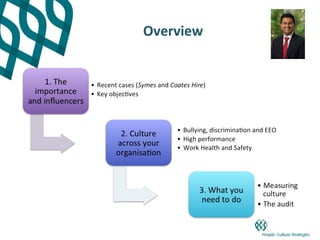
Overview
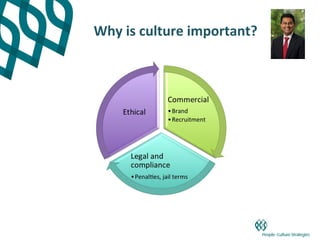
Why is culture important?
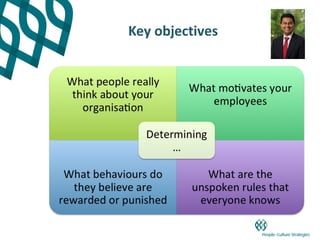
Key objectives
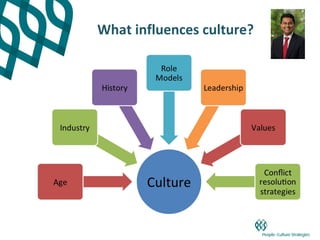
What influences culture?
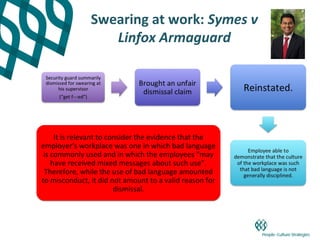
Swearing at work: Symes v
                  Linfox Armaguard


     It is relevant to consider the evidence that the
employer’s workplace was one in which bad language
 is commonly used and in which the employees “may
    have received mixed messages about such use”.
 Therefore, while the use of bad language amounted
to misconduct, it did not amount to a valid reason for
                         dismissal.
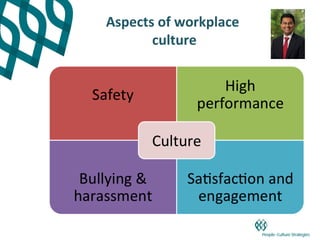
Aspects of workplace
       culture
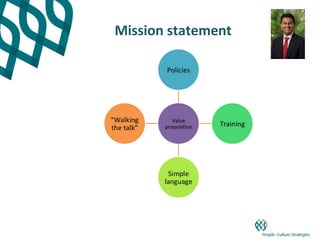
Mission statement
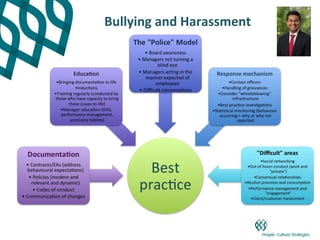
Bullying and Harassment
Review of workplace
      bullying
Drinking culture: Day v
               Sodexo

• Service attendant dismissed for failing
  an alcohol test while working for her
  employer at their client’s mine site.
• Brought an unfair dismissal claim
• Reinstated
• FWA found that the employer failed to
  implement the drugs and alcohol policy
  in a consistent manner.
Drinking Culture: Day v
                     Sodexo
• Employer had various existing drugs and alcohol policies
• Had introduced a new policy to “crack down” on the
  drinking culture at work.
• “Context and culture of the applicant’s conduct” meant
  policies not validly implemented.
• Employer continued to apply old policy – changes
  “insufficiently bedded down” or communicated to
  workforce with personnel managers, operational managers
  and employees having less than a comprehensive
  knowledge of the changes and the clear policy to be
  applied and conformed with. As a result, FWA found that
  there was no valid reason for the employee’s dismissal.
Email: Rushiti v Australia Post

• Employee sent pornographic emails externally from his work
  email account - clear breach of the employer’s policy on email
  use.
• Formerly employed as a driver only recently been given access to
  a work computer as part of return to work – argued he only
  forwarded emails sent to him by co-workers after being shown
  how to do so by another workmate.
• Employee “influenced by the conduct of other Australian Post
  employees who being in roles which required constant long term
  use of computers were much more culpable in relation to breach
  of Australia Post’s email use policy.”
• Inconsistency of treatment also
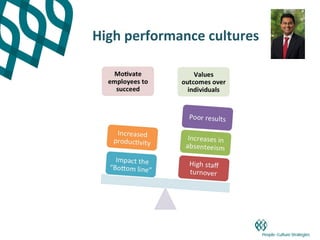
High performance cultures
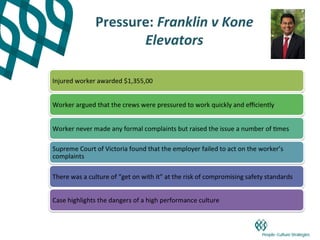
Pressure: Franklin v Kone
       Elevators
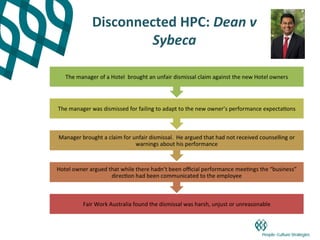
Disconnected HPC: Dean v
        Sybeca
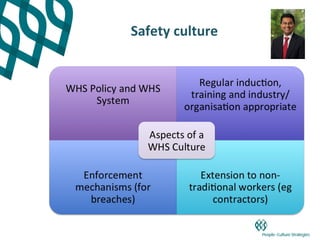
Safety culture
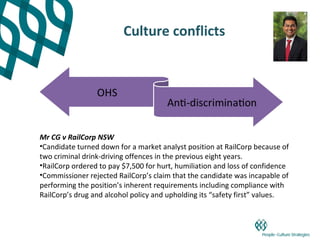
Culture conflicts


Mr CG v RailCorp NSW
•Candidate turned down for a market analyst position at RailCorp because of
two criminal drink-driving offences in the previous eight years.
•RailCorp ordered to pay $7,500 for hurt, humiliation and loss of confidence
•Commissioner rejected RailCorp’s claim that the candidate was incapable of
performing the position’s inherent requirements including compliance with
RailCorp’s drug and alcohol policy and upholding its “safety first” values.
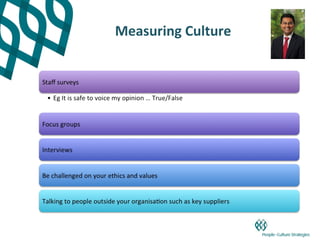
Measuring Culture
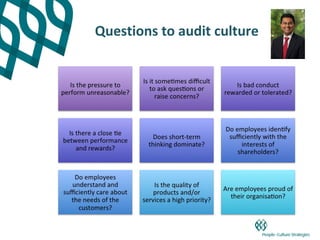
Questions to audit culture
Questions – time permitting
AUDITING YOUR WORKPLACE
                 CULTURE
           Email: joydeep.hor@peopleculture.com.au
                      Phone: 02 8094 3101
                   Connect with me on LinkedIn

CLIENT
LOGO
HERE

Auditing Your Workplace Culture

  • 1.
    AUDITING YOUR WORKPLACE CULTURE Joydeep Hor 10 July 2012 CLIENT LOGO HERE
  • 2.
  • 3.
    Why is cultureimportant?
  • 4.
  • 5.
  • 6.
    Swearing at work:Symes v Linfox Armaguard It is relevant to consider the evidence that the employer’s workplace was one in which bad language is commonly used and in which the employees “may have received mixed messages about such use”. Therefore, while the use of bad language amounted to misconduct, it did not amount to a valid reason for dismissal.
  • 7.
  • 8.
  • 9.
  • 10.
  • 11.
    Drinking culture: Dayv Sodexo • Service attendant dismissed for failing an alcohol test while working for her employer at their client’s mine site. • Brought an unfair dismissal claim • Reinstated • FWA found that the employer failed to implement the drugs and alcohol policy in a consistent manner.
  • 12.
    Drinking Culture: Dayv Sodexo • Employer had various existing drugs and alcohol policies • Had introduced a new policy to “crack down” on the drinking culture at work. • “Context and culture of the applicant’s conduct” meant policies not validly implemented. • Employer continued to apply old policy – changes “insufficiently bedded down” or communicated to workforce with personnel managers, operational managers and employees having less than a comprehensive knowledge of the changes and the clear policy to be applied and conformed with. As a result, FWA found that there was no valid reason for the employee’s dismissal.
  • 13.
    Email: Rushiti vAustralia Post • Employee sent pornographic emails externally from his work email account - clear breach of the employer’s policy on email use. • Formerly employed as a driver only recently been given access to a work computer as part of return to work – argued he only forwarded emails sent to him by co-workers after being shown how to do so by another workmate. • Employee “influenced by the conduct of other Australian Post employees who being in roles which required constant long term use of computers were much more culpable in relation to breach of Australia Post’s email use policy.” • Inconsistency of treatment also
  • 14.
  • 15.
    Pressure: Franklin vKone Elevators
  • 16.
  • 17.
  • 18.
    Culture conflicts Mr CGv RailCorp NSW •Candidate turned down for a market analyst position at RailCorp because of two criminal drink-driving offences in the previous eight years. •RailCorp ordered to pay $7,500 for hurt, humiliation and loss of confidence •Commissioner rejected RailCorp’s claim that the candidate was incapable of performing the position’s inherent requirements including compliance with RailCorp’s drug and alcohol policy and upholding its “safety first” values.
  • 19.
  • 20.
  • 21.
  • 22.
    AUDITING YOUR WORKPLACE CULTURE Email: joydeep.hor@peopleculture.com.au Phone: 02 8094 3101 Connect with me on LinkedIn CLIENT LOGO HERE

Editor's Notes

  • #4 This case can be used as an example of the risks associated with a poor culture Swearing at work : Symes v Linfox Armaguard Pty Ltd [2012] FWA 4789 In this case, a security guard who was summarily dismissed for swearing at his supervisor (“get f---ed”) brought an unfair dismissal claim and was reinstated. The claim was successful partly because the employee was able to demonstrate that the culture of the workplace was such that bad language is not generally disciplined. Fair Work Australia noted at [90] that it is relevant to consider the evidence that the respondent’s workplace is one in which bad language is commonly used and in which the employees “may have received mixed messages about such use”. Therefore, while the use of bad language amounted to misconduct, it did not amount to a valid reason for dismissal. This case is important as it demonstrates that tolerating certain types of behaviour or culture over a long period of time could diminish the employer’s capacity to discipline or dismiss employees for misconduct.
  • #9 Importance of implementing the paperwork in the context of “cracking down” on a drinking culture at work : Day v Sodexo [2011] FWA 8505. In this case, a service attendant was dismissed for failing an alcohol test while working for her employer at their client’s mine site. The employee brought an unfair dismissal claim and was reinstated after FWA found that the employer failed to implement the drugs and alcohol policy in a consistent manner. The employer had various existing drugs and alcohol policies and had introduced a new policy to “crack down” on the drinking culture at work. FWA found that while drinking alcohol at work is “usually recognised as misconduct”, an examination of the “context and culture of the applicant’s conduct” meant that the policies were not validly implemented. The employer continued to apply the old policy and the changes were “insufficiently bedded down” or communicated to the workforce with personnel managers, operational managers and employees having less than a comprehensive knowledge of the changes and the clear policy to be applied and conformed with. As a result, FWA found that there was no valid reason for the employee’s dismissal. This case demonstrates that merely having written policies in place is not sufficient to avoid the risk of unfair dismissal claim on the basis of workplace culture . Such policies need to be communicated at every level, from managers and employees, and need to be applied consistently instead of any existing policies in order for it to have any meaningful effect in the employment law sphere.
  • #14 Viewing pornography at work: Rushiti v Australian Post [2012] FWA 5012 – note that the employer has lodged appeal against the decision
  • #16 WHS risks of high performance/“get on with it” culture: Franklin v Kone Elevators Pty Ltd [2011] VSC 108 In this case, a worker who was injured as a result of being required to perform manual handling tasks for three years was awarded $1,355,000. The worker argued that the crews were pressured to work quickly and efficiently. While the employee never made any written or formal complaints about the system of work, he had raised the issue on a number of occasions with members of his crew, including his foreman, and with a safety and training manager, who failed to address the issue. Supreme Court of Victoria found that the employer failed to act on the worker’s complaints either because it did not appreciate the seriousness of his claims or because there was a “culture of ‘get on with it’ amongst the older members of the crew as well as management”. This case highlights the dangers of maintaining a high performance culture or a culture of “get on with it” at the risk of compromising safety standards. The case demonstrates that it is important to encourage open and honest communication from employees and take OHS issues seriously in order to create a safe working culture.
  • #17 High performance culture under the new management: Dean v Sybecca Pty Ltd [2010] FWA 8462 An employee who worked as the head manager at a bar brought an unfair dismissal claim against the Hotel. The hotel had a change in ownership and the employer argued that the employee was dismissed as he was unable to adapt to the new owner’s more rigorous expectations about the effort and leadership required of the Hotel Manager. FWA found that the dismissal was harsh, unjust or unreasonable and ordered the employer to pay 4 weeks’ salary and an additional amount of $1,100. The employee argued that he was never counseled or warned about any aspect of performance of his duties or his conduct. In response, the employer/owner argued that while there had not been performance meetings, they were occasions in which “the business direction was communicated to the employee and he was encouraged to support that direction”. The owner also claimed that there was common interaction with managers and staff about his expectations and that “my performance expectations were for hard working, diligent employees” and that “I would have been very clear” to the employee that “I was not happy with his performance”. FWA rejected this argument, noting that the employer did not appear to have expressly warned the Applicant at any time about his performance as a manger or else provided the Applicant with any opportunity to improve his performance. This case demonstrates that merely communicating the expectations of a workplace culture by way of informal communication, without more (such as through the implementation of a performance appraisal system or policies regarding high performance culture or bonus scheme) is unlikely to protect an employer against potential unfair dismissal or adverse action claims.
  • #19 Potential conflict between “safety first” culture and anti-discrimination law: