SOCIAL LEARNING
By: @GrowthEngineering Date: 18th November 2015
Follow us! Tweet us! Ask us
questions! We’re very friendly.
Bring you…
UNLOCKING THE FULL POWER OF INFORMAL LEARNING – ONLINE!
1
2
3
4
5
6
9
10
11
12
13
14
The Definition
How We Learn (70/20/10)
The Facts
Intellectual Capital
Continuous Learning
Innovation
Engagement
It Just Works
7
8
15
16
Problems With Formal Learning
Autonomy
Flexibility
It’s The Future
Save Money
Online Learning & 70/20/10
Gamified Social Learning
The Academy LMS
SOCIAL LEARNING SLIDESHARE 18th NOVEMBER
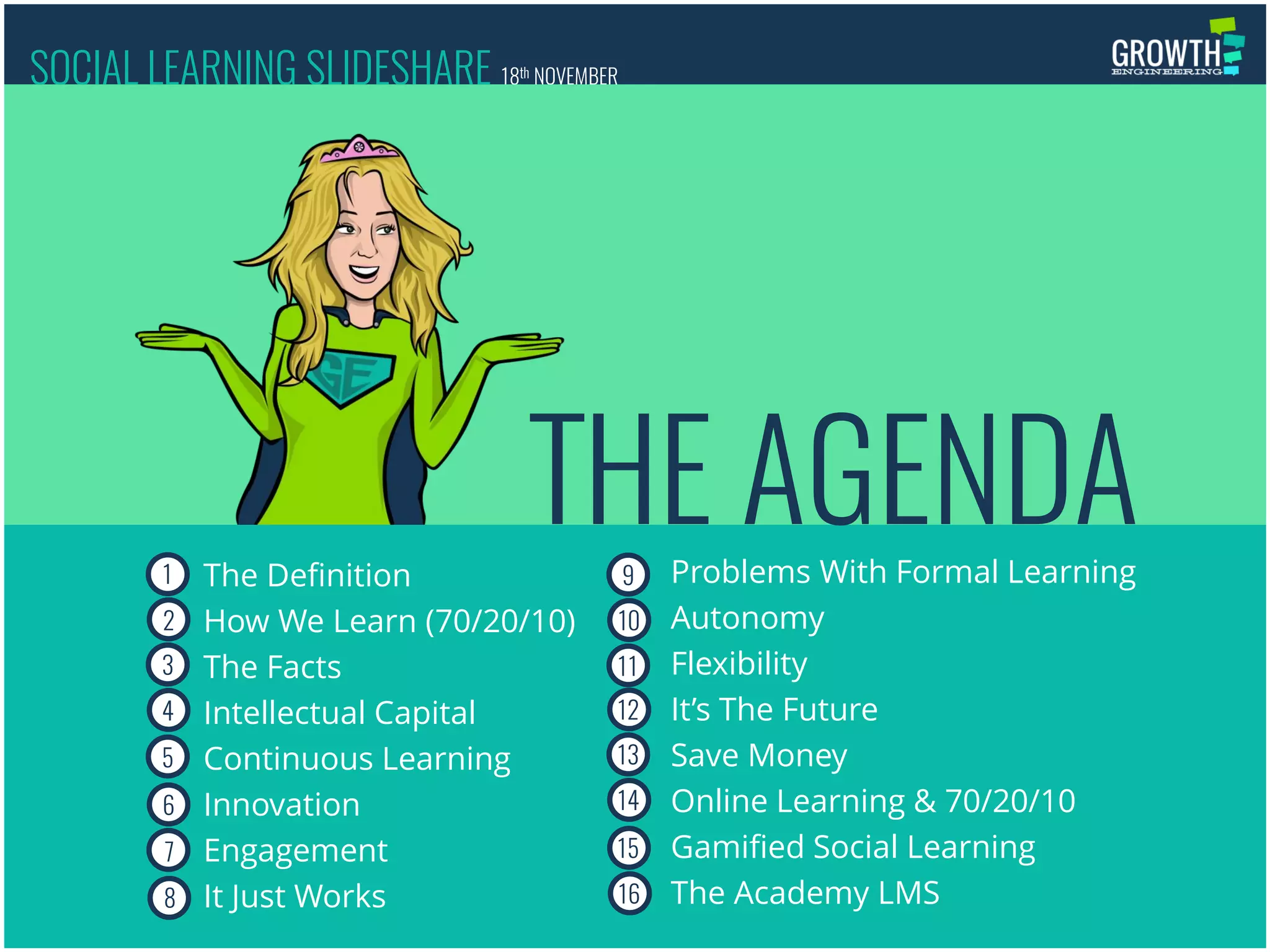
THE AGENDA
JOIN THE SOCIAL LEARNING
WOLF PACK
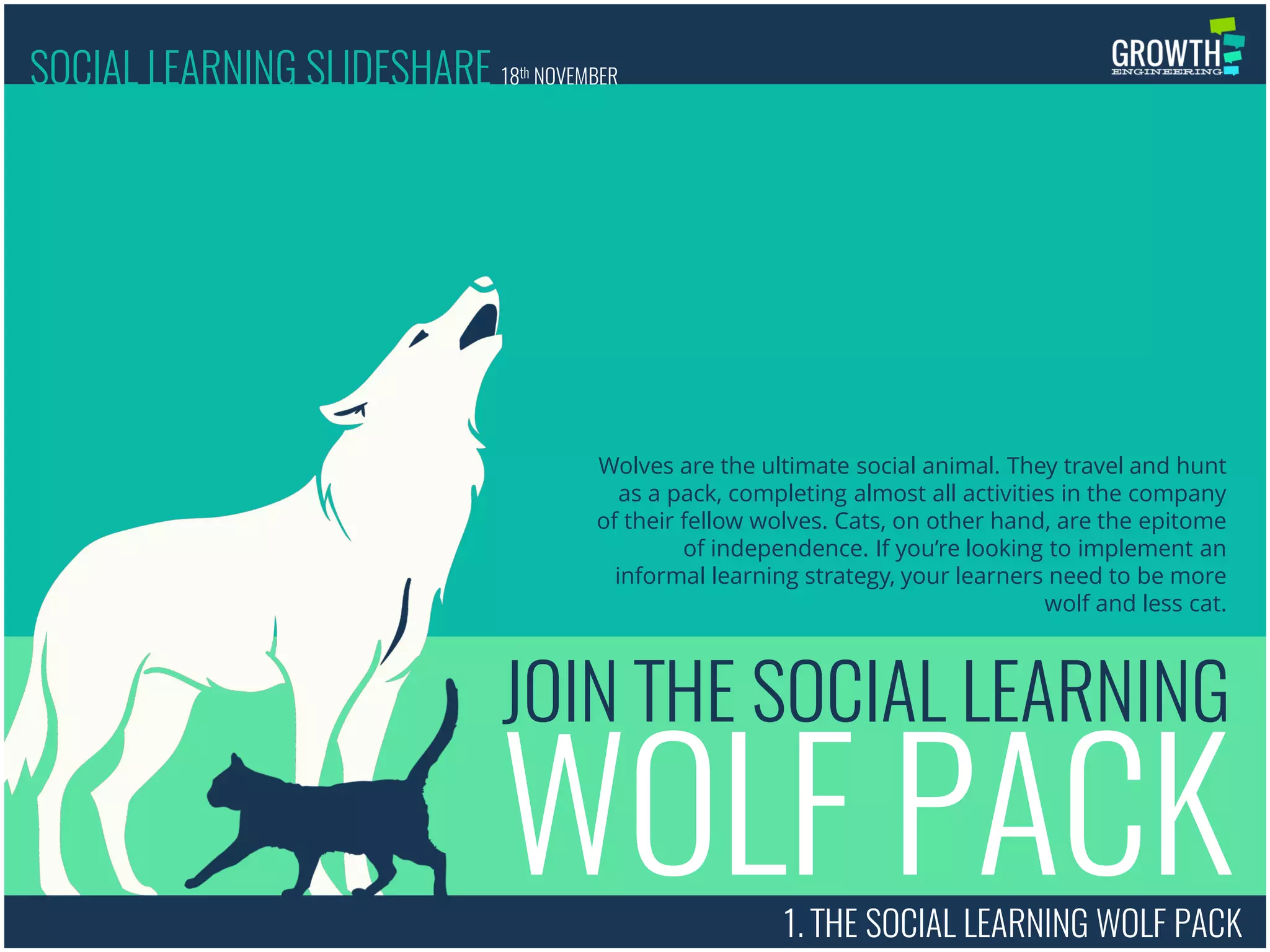
Wolves are the ultimate social animal. They travel and hunt
as a pack, completing almost all activities in the company
of their fellow wolves. Cats, on other hand, are the epitome
of independence. If you’re looking to implement an
informal learning strategy, your learners need to be more
wolf and less cat.
1. THE SOCIAL LEARNING WOLF PACK
SOCIAL LEARNING SLIDESHARE 18th NOVEMBER
THE DEFINITION
2. THE DEFINITION
Social learning or informal learning, is learning
that happens outside of the traditional sphere of
education. It’s the learning that occurs once you’ve
left the classroom or closed your textbook.
Informal learning happens when learners start
setting their own learning objectives. They drive
the experience.
SOCIAL LEARNING SLIDESHARE 18th NOVEMBER
What do we mean by ‘social learning’?
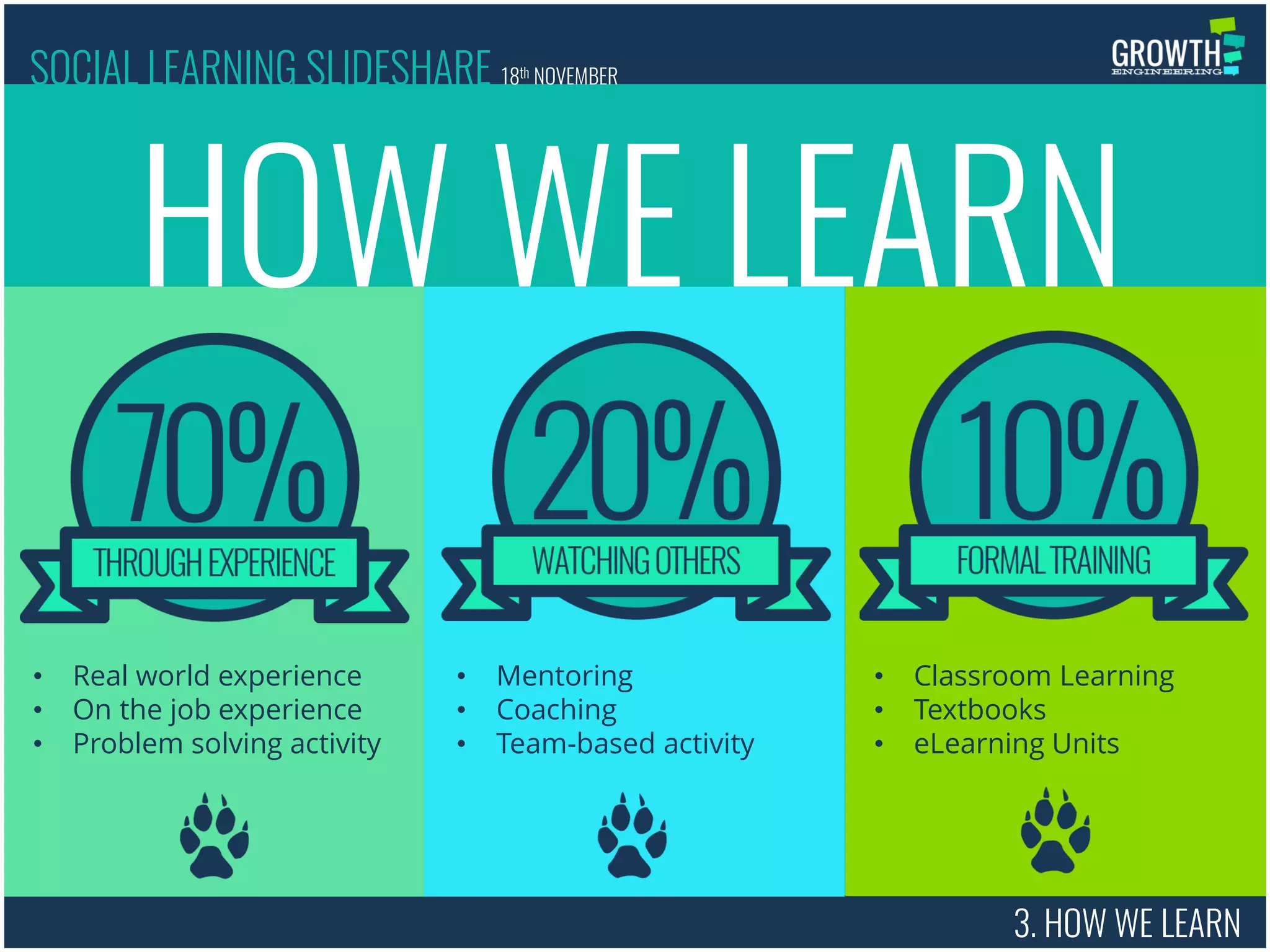
3. HOW WE LEARN
HOW WE LEARN
• Real world experience
• On the job experience
• Problem solving activity
• Mentoring
• Coaching
• Team-based activity
• Classroom Learning
• Textbooks
• eLearning Units
SOCIAL LEARNING SLIDESHARE 18th NOVEMBER
4. THE FACTS
THE FACTSThe 70/20/10 theory is grounded in reality!
SOCIAL LEARNING SLIDESHARE 18th NOVEMBER
People learn 70% of what they know about their jobs
informally.
- US BUREAU OF LABOR STATISTICS
70% of what people know about their jobs, they learn
informally from the people they work with.
- EDUCATION DEVELOPMENT CENTER, MASSACHUSETTS
“About 70% of all learning projects are planned by the
learner [themselves].”
- PROFESSOR ALLEN TOUGH, UNIVERSITY OF TORONTO
FACTBOOK
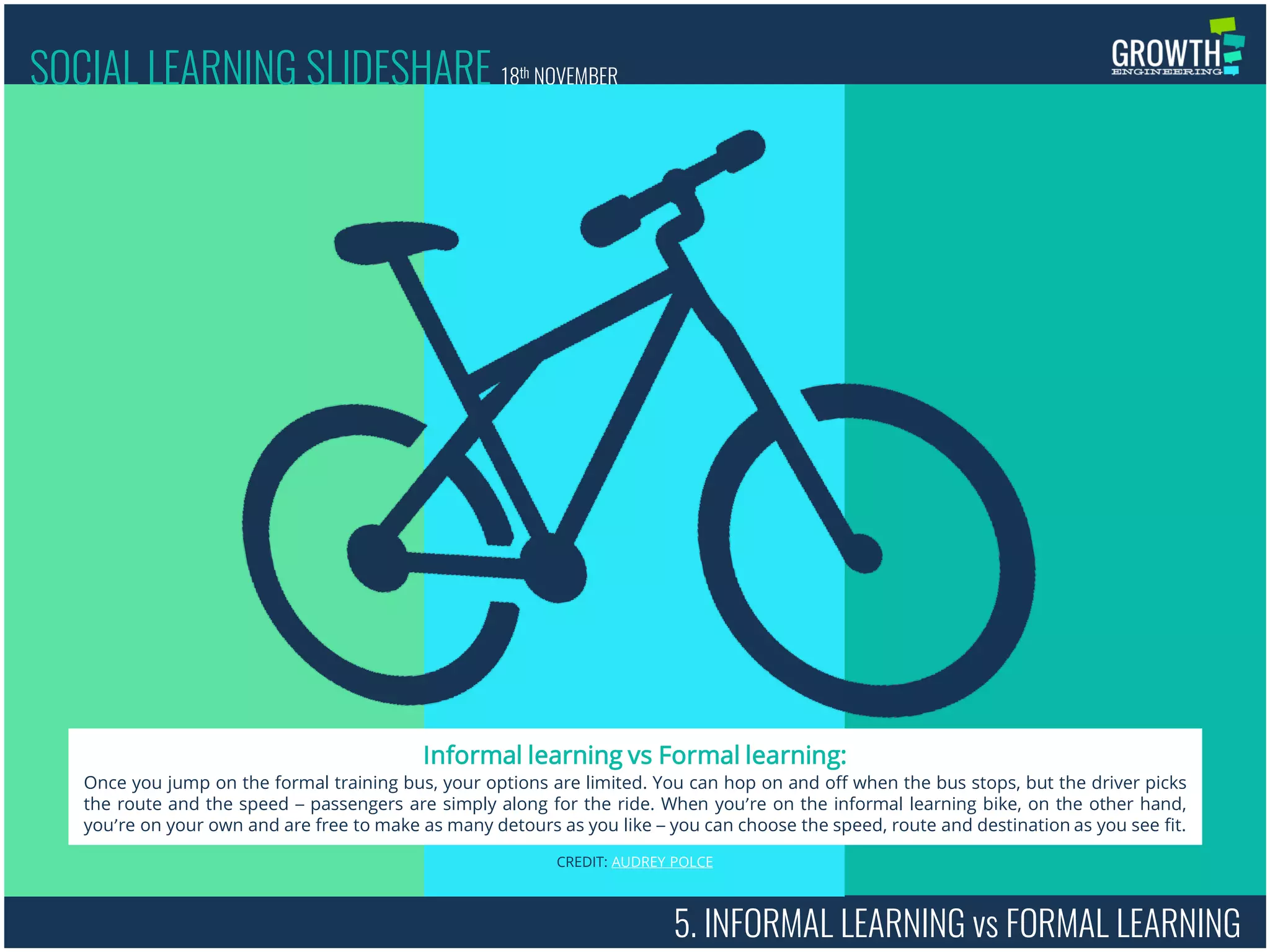
5. INFORMAL LEARNING vs FORMAL LEARNING
Informal learning vs Formal learning:
Once you jump on the formal training bus, your options are limited. You can hop on and off when the bus stops, but the driver picks
the route and the speed – passengers are simply along for the ride. When you’re on the informal learning bike, on the other hand,
you’re on your own and are free to make as many detours as you like – you can choose the speed, route and destination as you see fit.
CREDIT: AUDREY POLCE
SOCIAL LEARNING SLIDESHARE 18th NOVEMBER
THE COUNTDOWN BEGINS…
6. THE COUNTDOWN BEGINS…
11 REASONS TO EMBRACE
SOCIAL LEARNING:
SOCIAL LEARNING SLIDESHARE 18th NOVEMBER
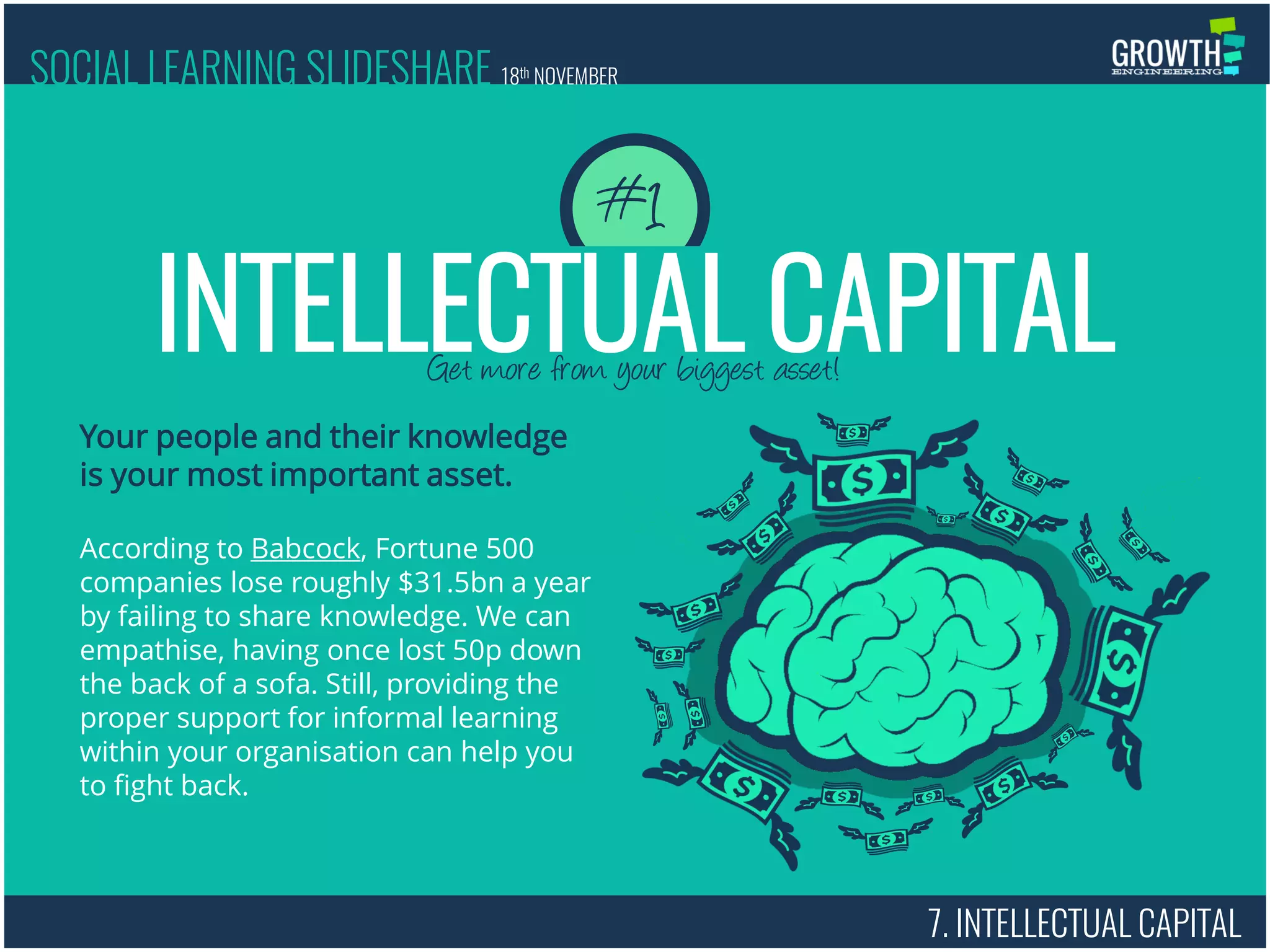
7. INTELLECTUAL CAPITAL
Get more from your biggest asset!
Your people and their knowledge
is your most important asset.
According to Babcock, Fortune 500
companies lose roughly $31.5bn a year
by failing to share knowledge. We can
empathise, having once lost 50p down
the back of a sofa. Still, providing the
proper support for informal learning
within your organisation can help you
to fight back.
INTELLECTUAL CAPITAL
#1
SOCIAL LEARNING SLIDESHARE 18th NOVEMBER
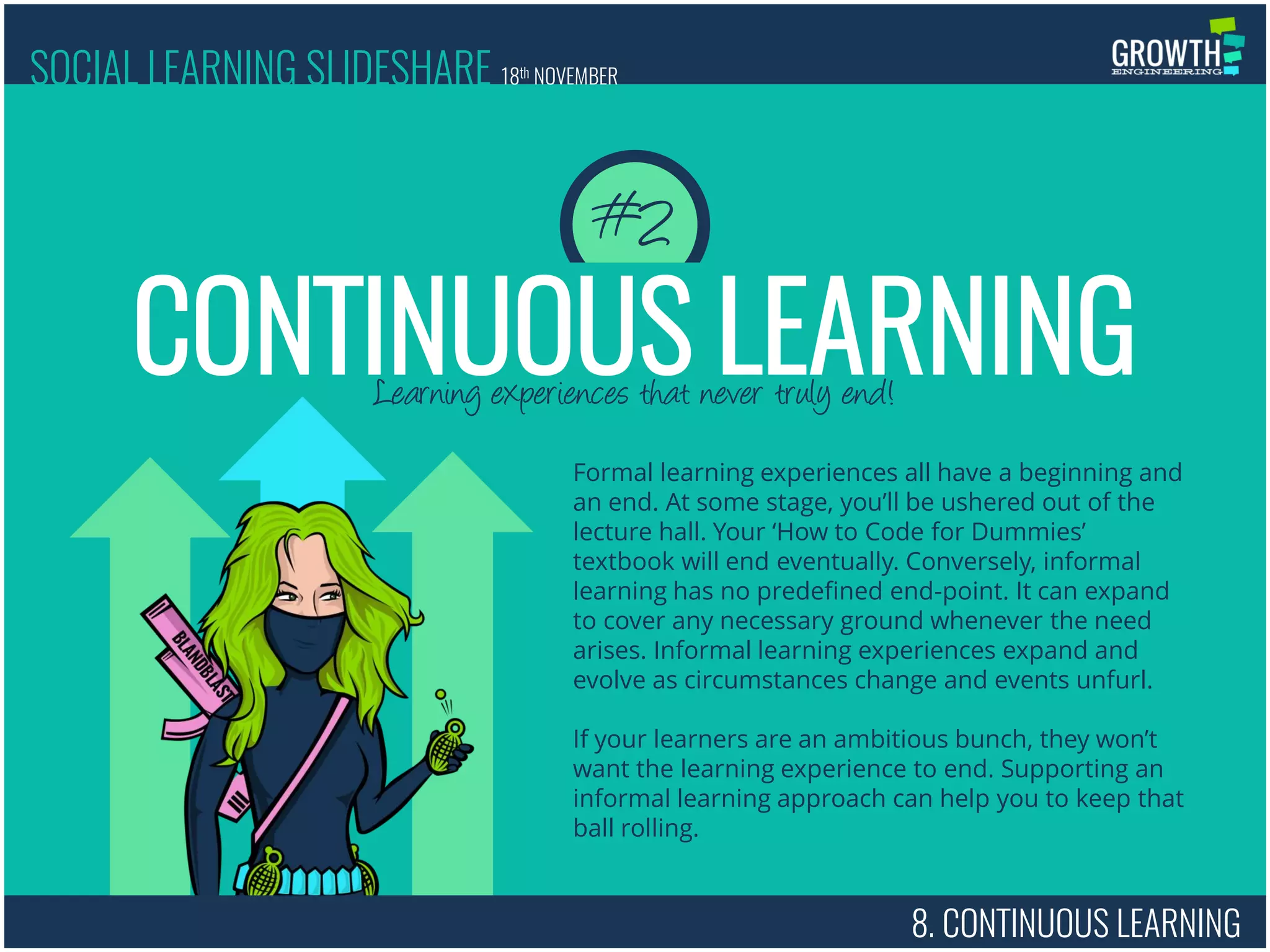
Formal learning experiences all have a beginning and
an end. At some stage, you’ll be ushered out of the
lecture hall. Your ‘How to Code for Dummies’
textbook will end eventually. Conversely, informal
learning has no predefined end-point. It can expand
to cover any necessary ground whenever the need
arises. Informal learning experiences expand and
evolve as circumstances change and events unfurl.
If your learners are an ambitious bunch, they won’t
want the learning experience to end. Supporting an
informal learning approach can help you to keep that
ball rolling.
#2
SOCIAL LEARNING SLIDESHARE 18th NOVEMBER
Learning experiences that never truly end!
CONTINUOUS LEARNING
8. CONTINUOUS LEARNING
9. PROMOTE INNOVATION
We’re better when we work together!
PROMOTE INNOVATION
#3
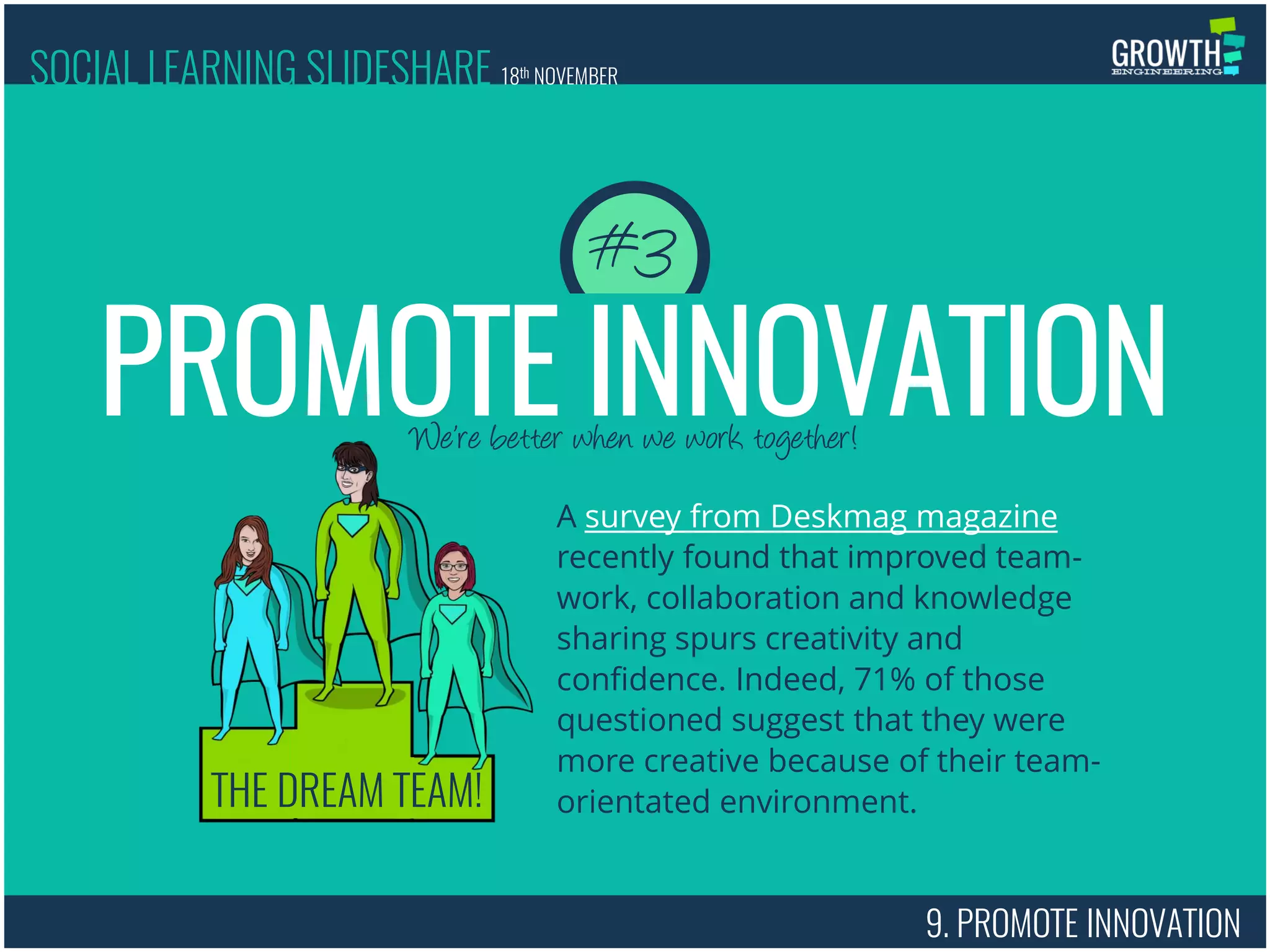
A survey from Deskmag magazine
recently found that improved team-
work, collaboration and knowledge
sharing spurs creativity and
confidence. Indeed, 71% of those
questioned suggest that they were
more creative because of their team-
orientated environment.
SOCIAL LEARNING SLIDESHARE 18th NOVEMBER
THE DREAM TEAM!
10. ENGAGE YOUR TEAM
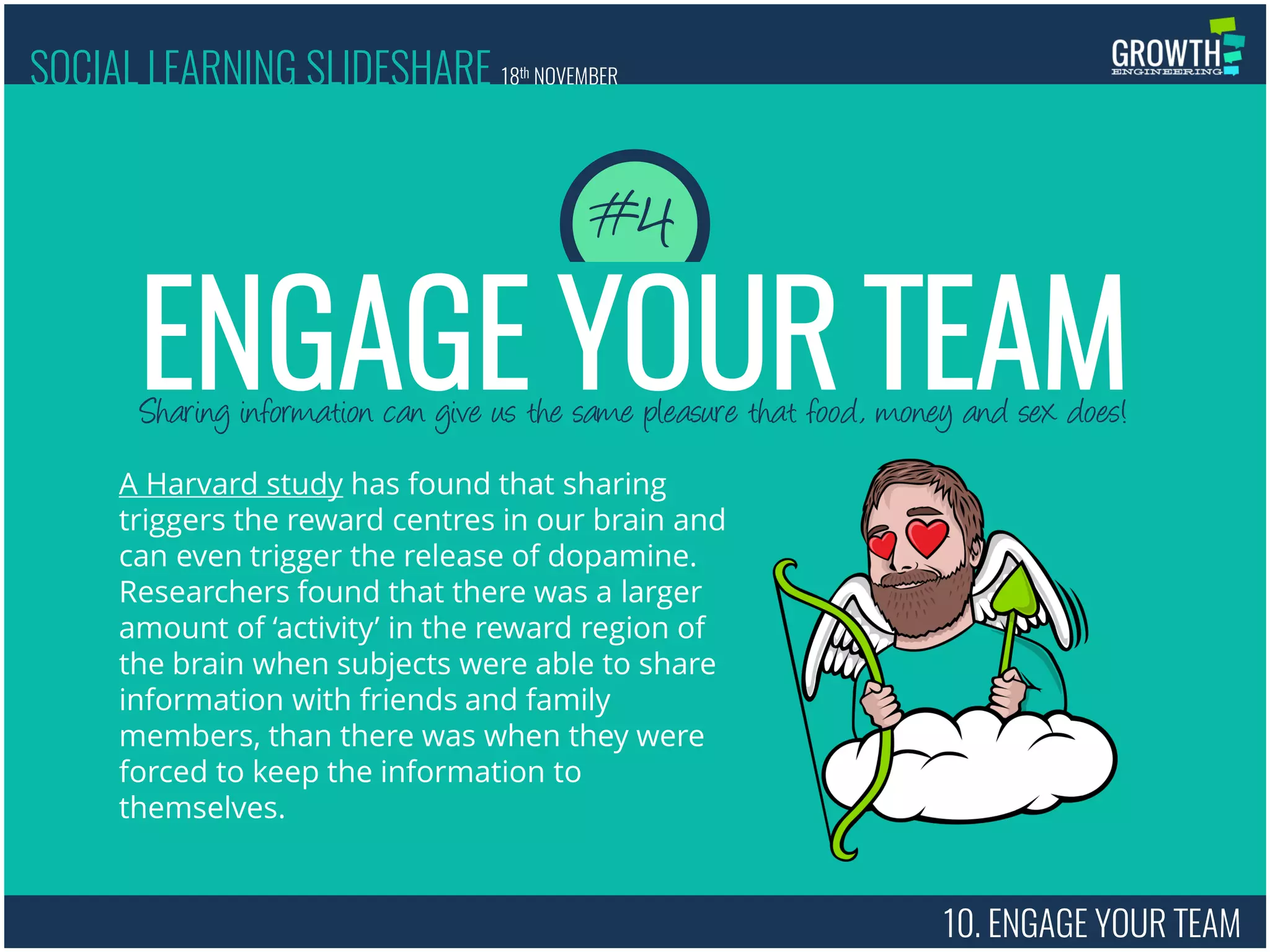
Sharing information can give us the same pleasure that food, money and sex does!
A Harvard study has found that sharing
triggers the reward centres in our brain and
can even trigger the release of dopamine.
Researchers found that there was a larger
amount of ‘activity’ in the reward region of
the brain when subjects were able to share
information with friends and family
members, than there was when they were
forced to keep the information to
themselves.
ENGAGE YOUR TEAM
#4
SOCIAL LEARNING SLIDESHARE 18th NOVEMBER
11. IT JUST WORKS
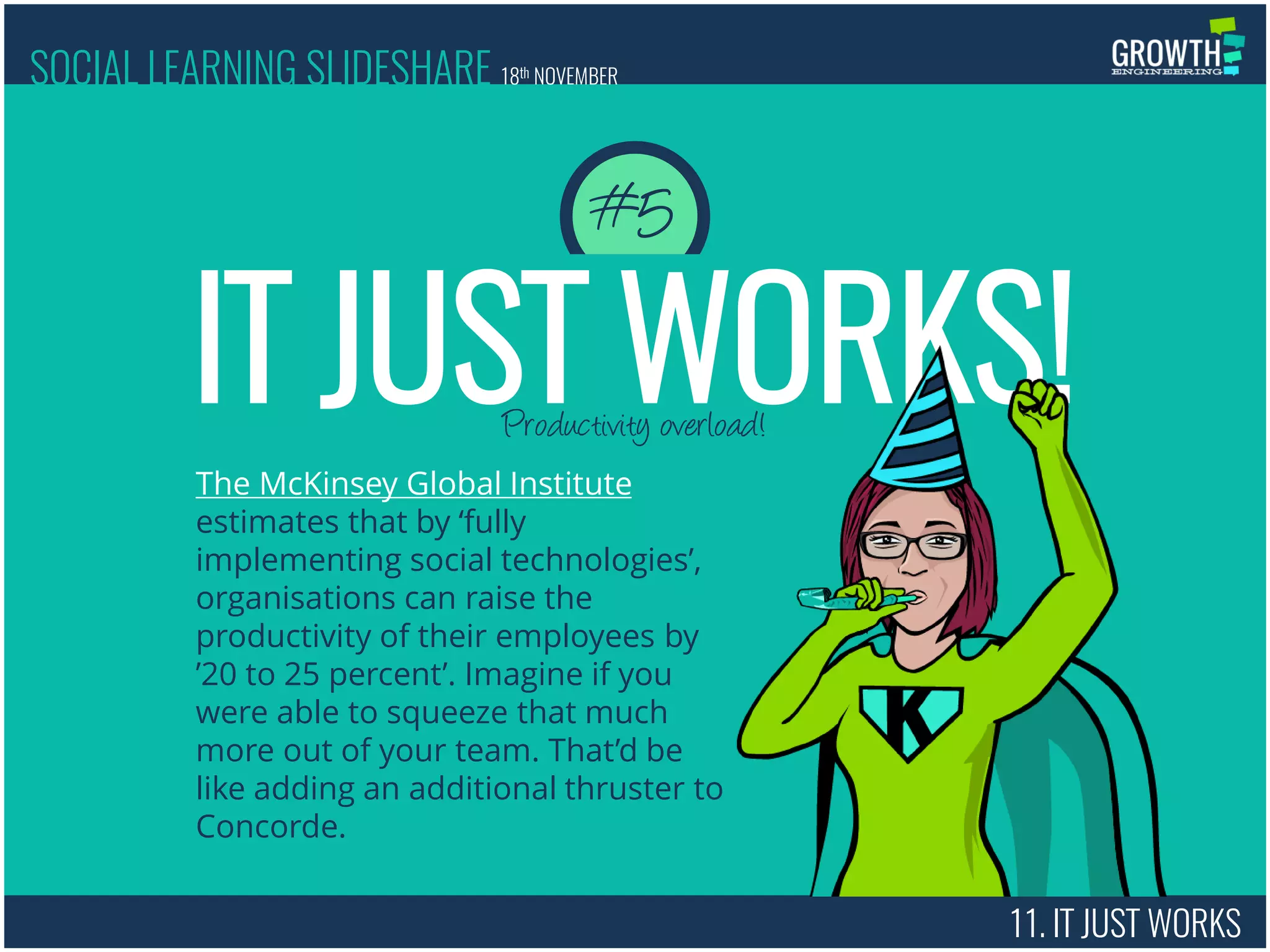
Productivity overload!
The McKinsey Global Institute
estimates that by ‘fully
implementing social technologies’,
organisations can raise the
productivity of their employees by
’20 to 25 percent’. Imagine if you
were able to squeeze that much
more out of your team. That’d be
like adding an additional thruster to
Concorde.
IT JUST WORKS!
#5
SOCIAL LEARNING SLIDESHARE 18th NOVEMBER
12. FORMAL LEARNING PROBLEMS
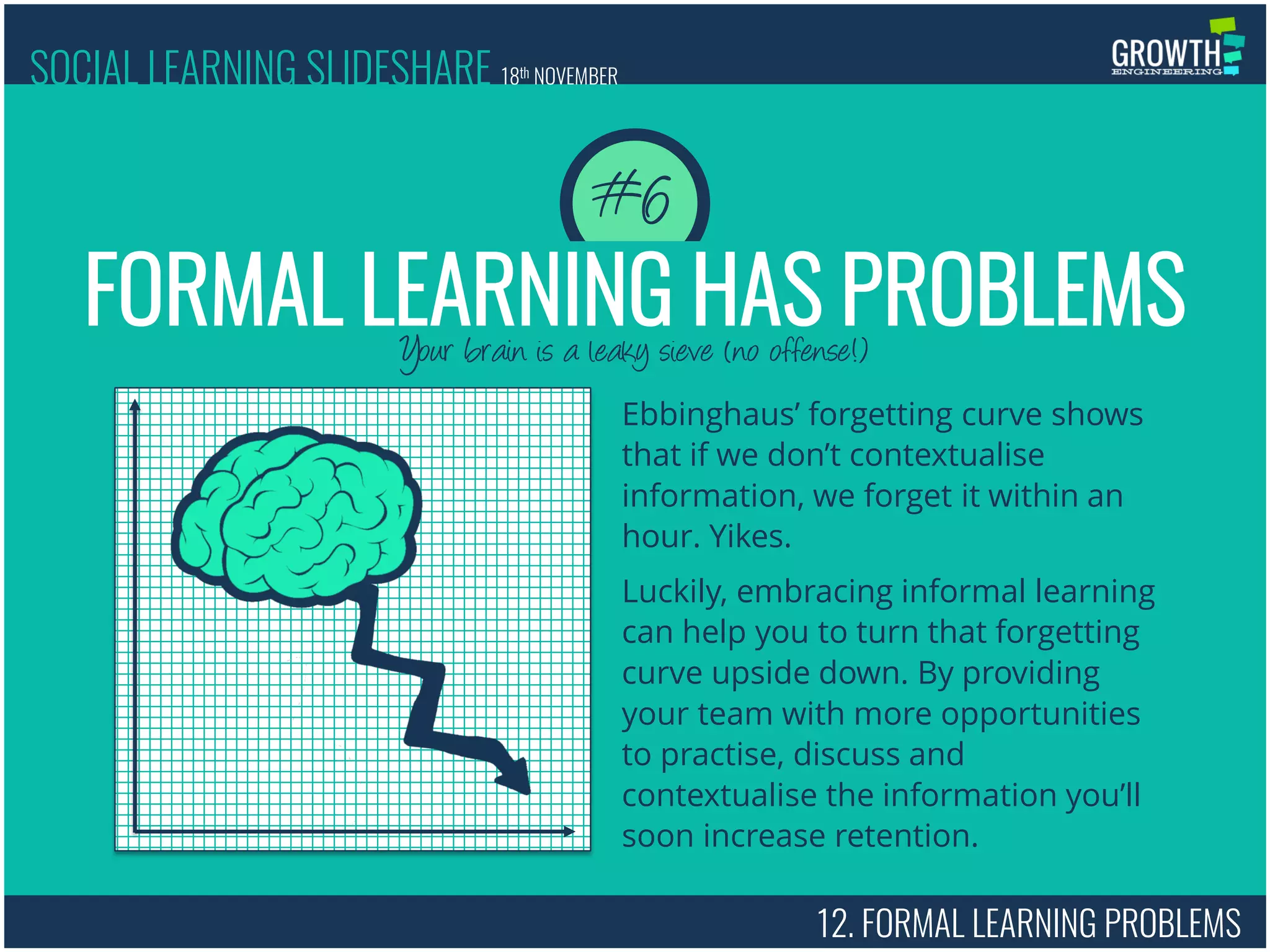
Your brain is a leaky sieve (no offense!)
FORMAL LEARNING HAS PROBLEMS
#6
Ebbinghaus’ forgetting curve shows
that if we don’t contextualise
information, we forget it within an
hour. Yikes.
Luckily, embracing informal learning
can help you to turn that forgetting
curve upside down. By providing
your team with more opportunities
to practise, discuss and
contextualise the information you’ll
soon increase retention.
SOCIAL LEARNING SLIDESHARE 18th NOVEMBER
13. AUTONOMY
Self-driven learning is more meaningful to the individual learner!
AUTONOMY & MOTIVATION
#7
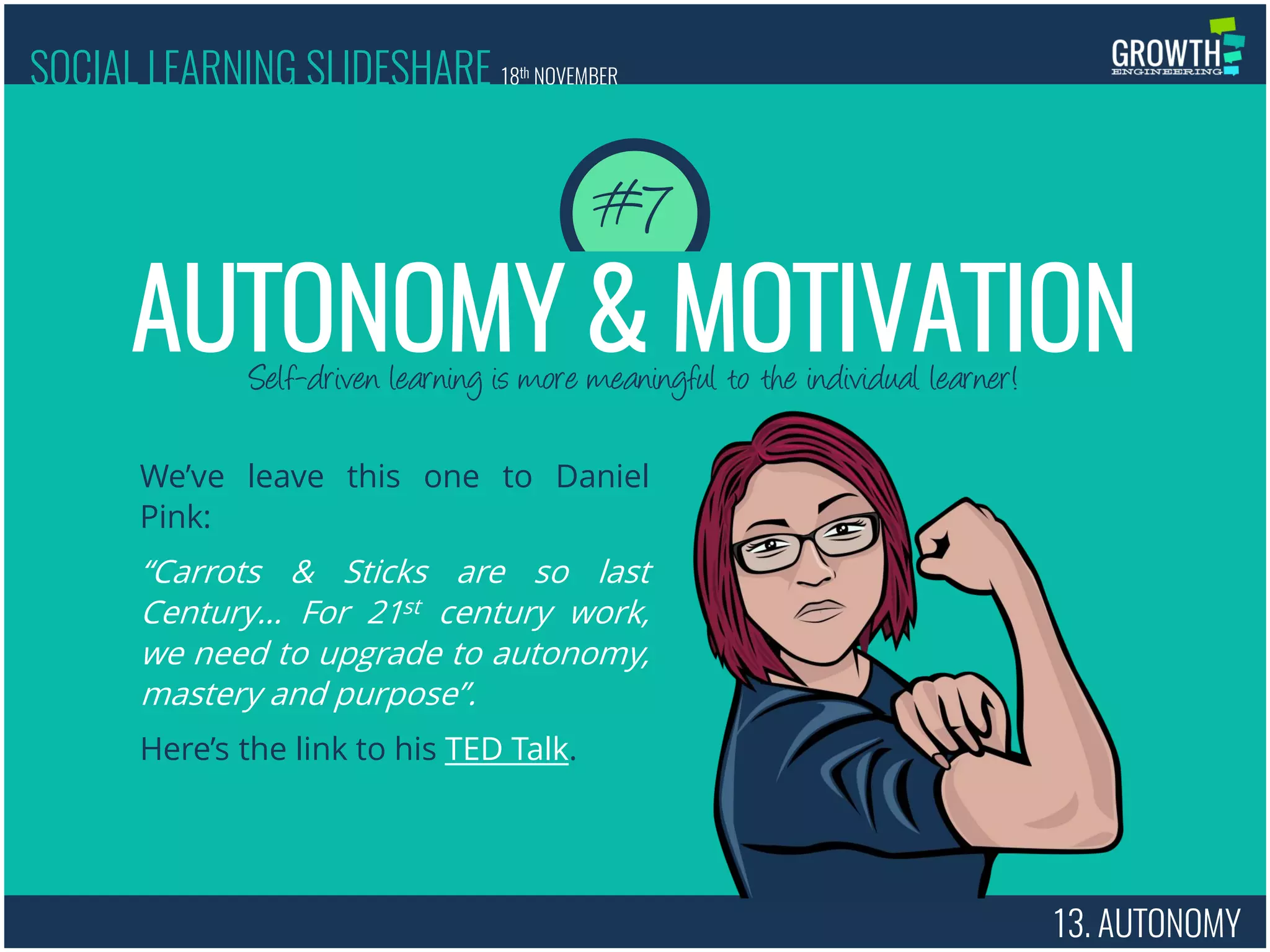
We’ve leave this one to Daniel
Pink:
“Carrots & Sticks are so last
Century… For 21st century work,
we need to upgrade to autonomy,
mastery and purpose”.
Here’s the link to his TED Talk.
SOCIAL LEARNING SLIDESHARE 18th NOVEMBER
14. FLEXIBILITY
Learn and share, anywhere!
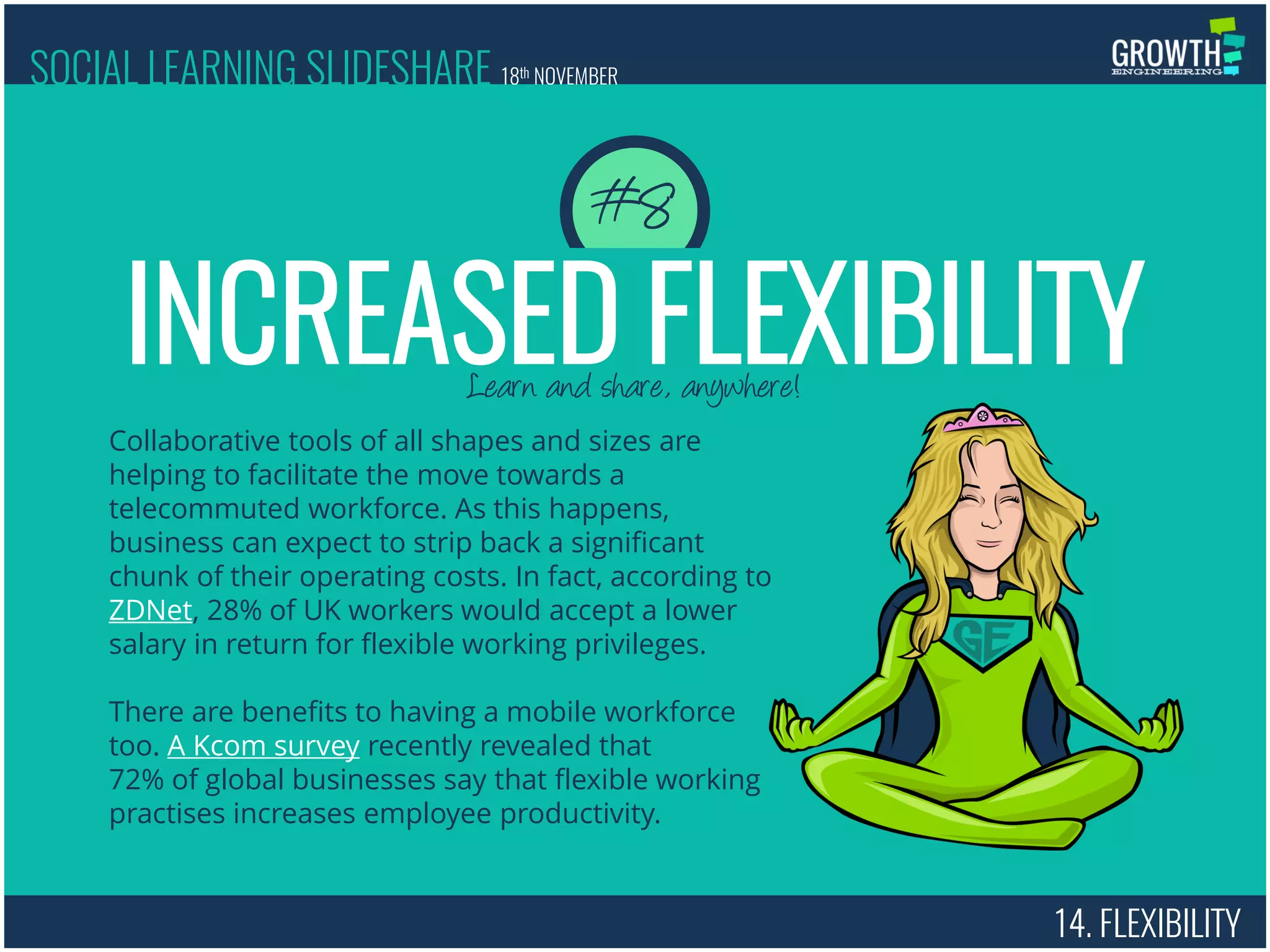
Collaborative tools of all shapes and sizes are
helping to facilitate the move towards a
telecommuted workforce. As this happens,
business can expect to strip back a significant
chunk of their operating costs. In fact, according to
ZDNet, 28% of UK workers would accept a lower
salary in return for flexible working privileges.
There are benefits to having a mobile workforce
too. A Kcom survey recently revealed that
72% of global businesses say that flexible working
practises increases employee productivity.
INCREASED FLEXIBILITY
#8
SOCIAL LEARNING SLIDESHARE 18th NOVEMBER
Social Learning: never going out of fashion!
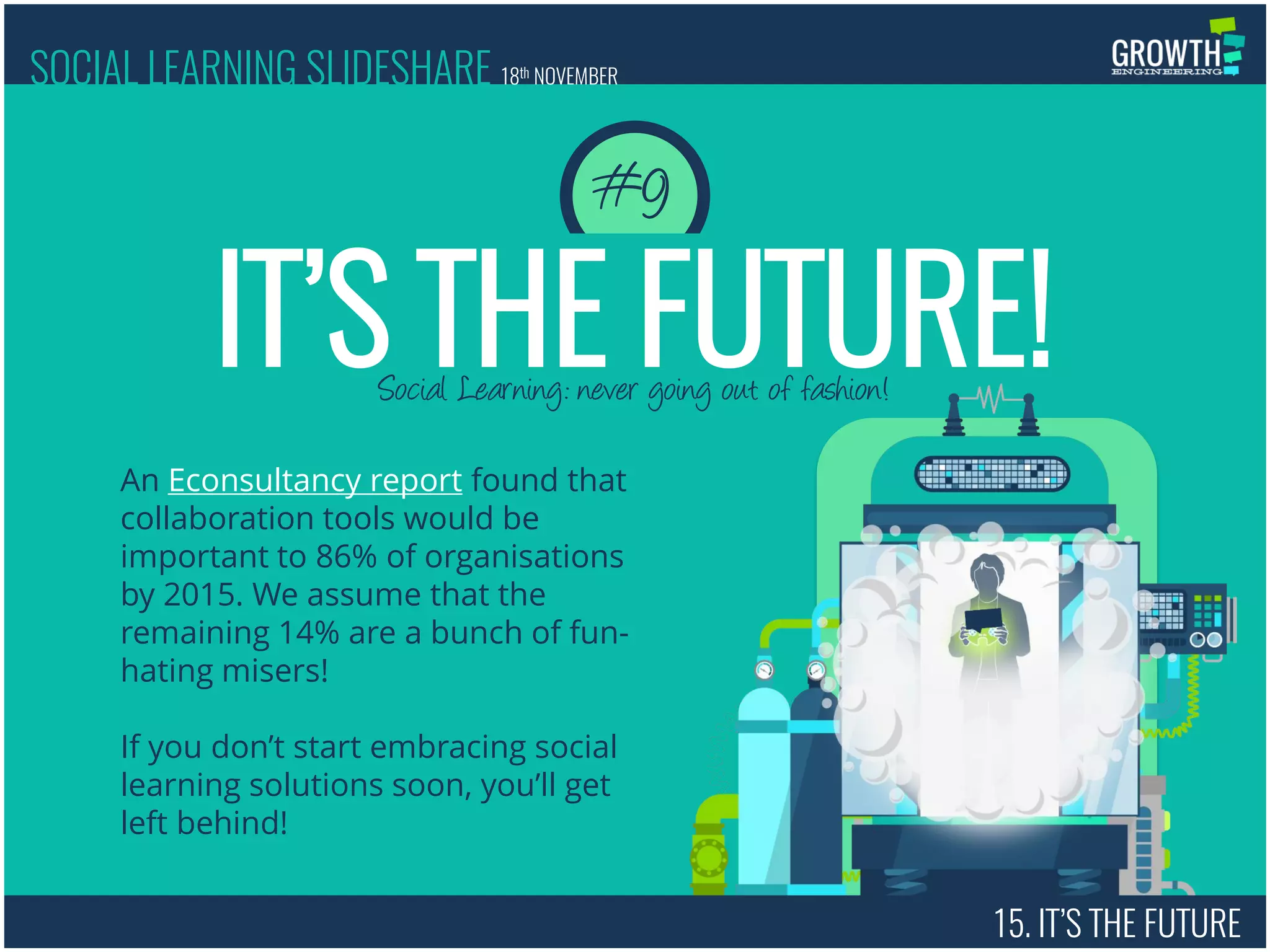
An Econsultancy report found that
collaboration tools would be
important to 86% of organisations
by 2015. We assume that the
remaining 14% are a bunch of fun-
hating misers!
If you don’t start embracing social
learning solutions soon, you’ll get
left behind!
IT’S THE FUTURE!
#9
15. IT’S THE FUTURE
SOCIAL LEARNING SLIDESHARE 18th NOVEMBER
Social butterflies flock together!
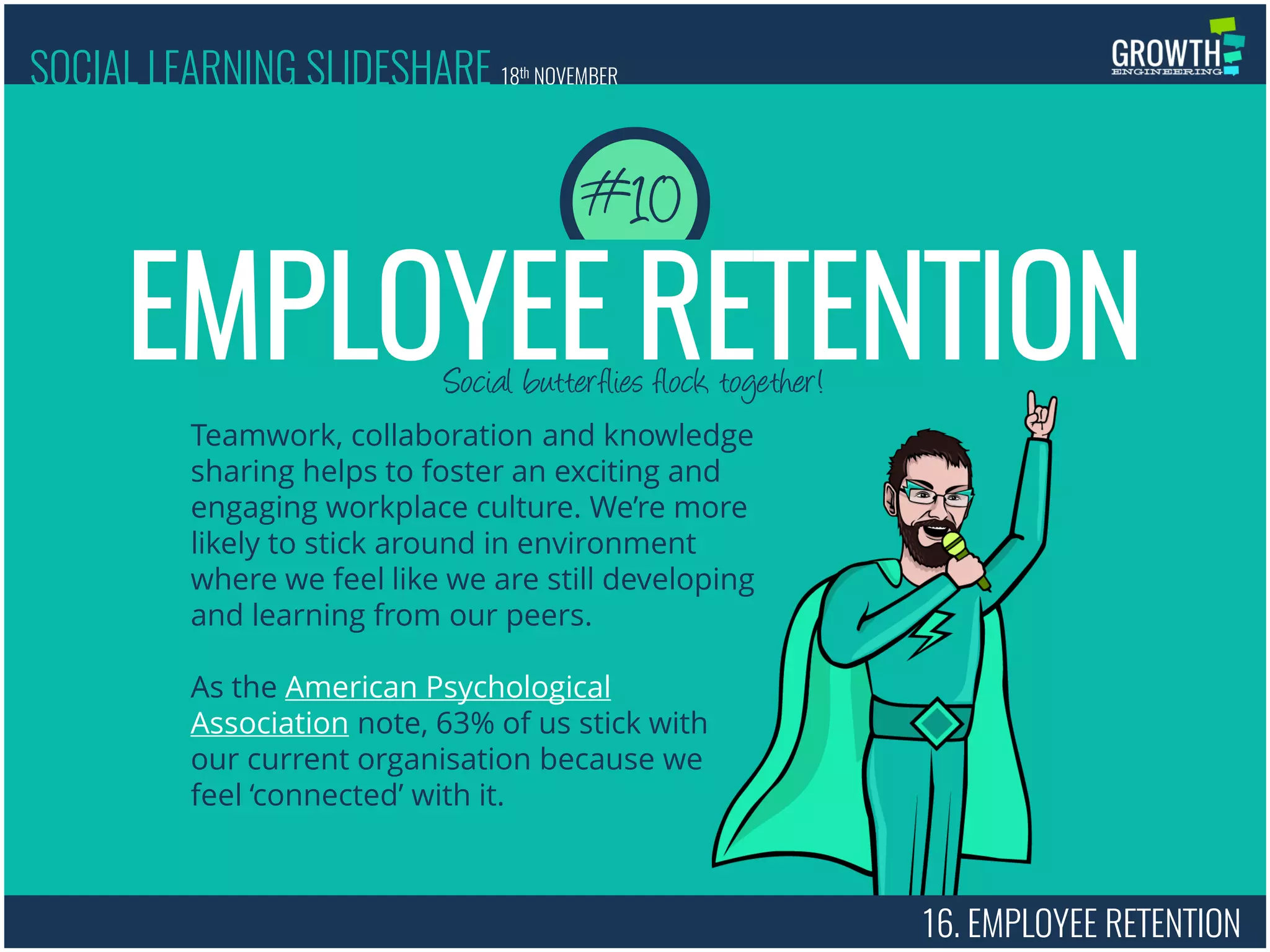
EMPLOYEE RETENTION
#10
Teamwork, collaboration and knowledge
sharing helps to foster an exciting and
engaging workplace culture. We’re more
likely to stick around in environment
where we feel like we are still developing
and learning from our peers.
As the American Psychological
Association note, 63% of us stick with
our current organisation because we
feel ‘connected’ with it.
16. EMPLOYEE RETENTION
SOCIAL LEARNING SLIDESHARE 18th NOVEMBER
17. MONEY SAVING
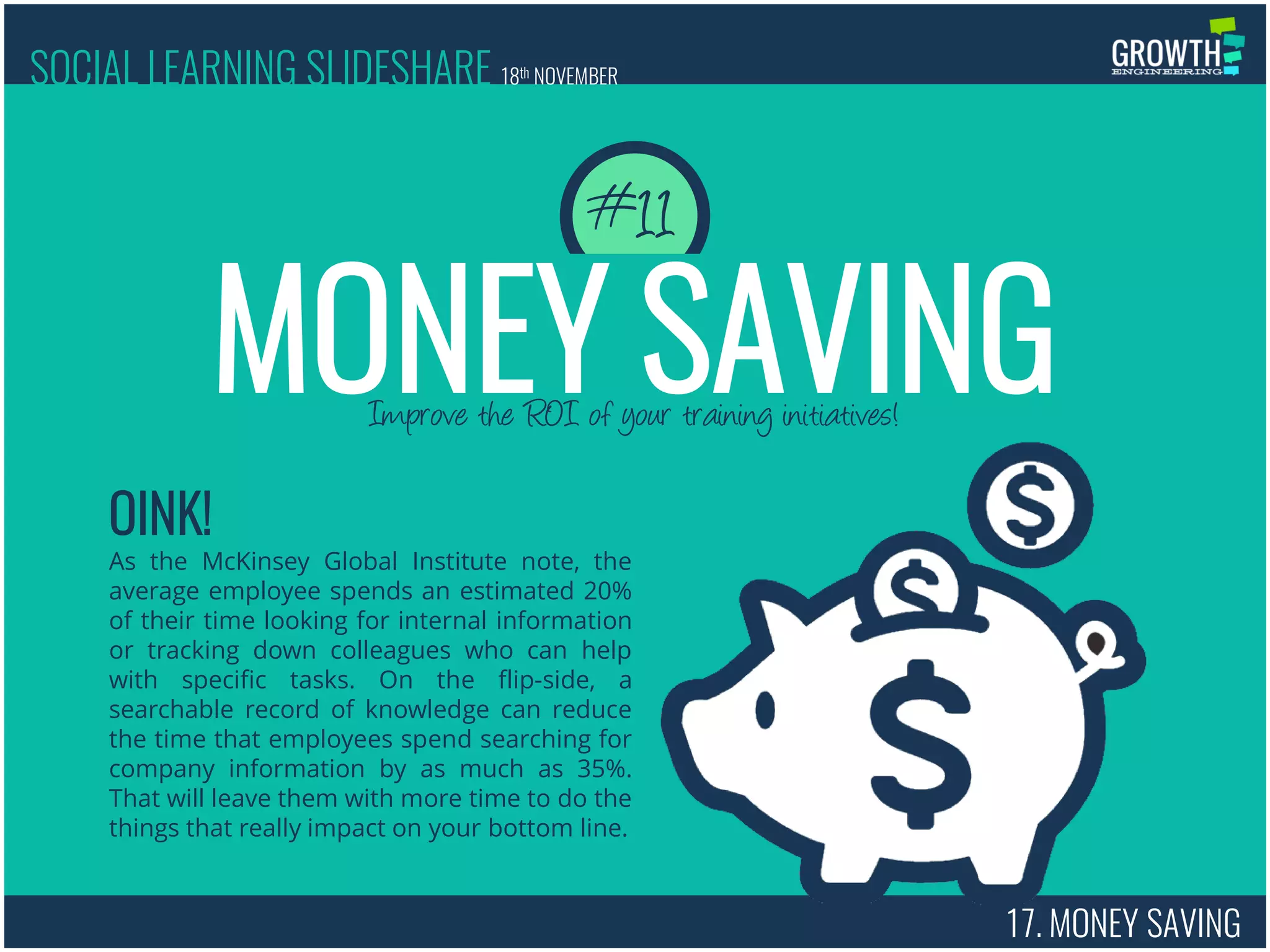
Improve the ROI of your training initiatives!
OINK!
As the McKinsey Global Institute note, the
average employee spends an estimated 20%
of their time looking for internal information
or tracking down colleagues who can help
with specific tasks. On the flip-side, a
searchable record of knowledge can reduce
the time that employees spend searching for
company information by as much as 35%.
That will leave them with more time to do the
things that really impact on your bottom line.
MONEY SAVING
#11
SOCIAL LEARNING SLIDESHARE 18th NOVEMBER
CAN ONLINE LEARNING
REALLY SUPPORT A SOCIAL
LEARNING STRATEGY?
SOCIAL LEARNING SLIDESHARE 18th NOVEMBER
18. ONLINE LEARNING & THE 70%
Can you learn from experience online?
THE 70%
ONLINE LEARNING x SOCIAL LEARNING
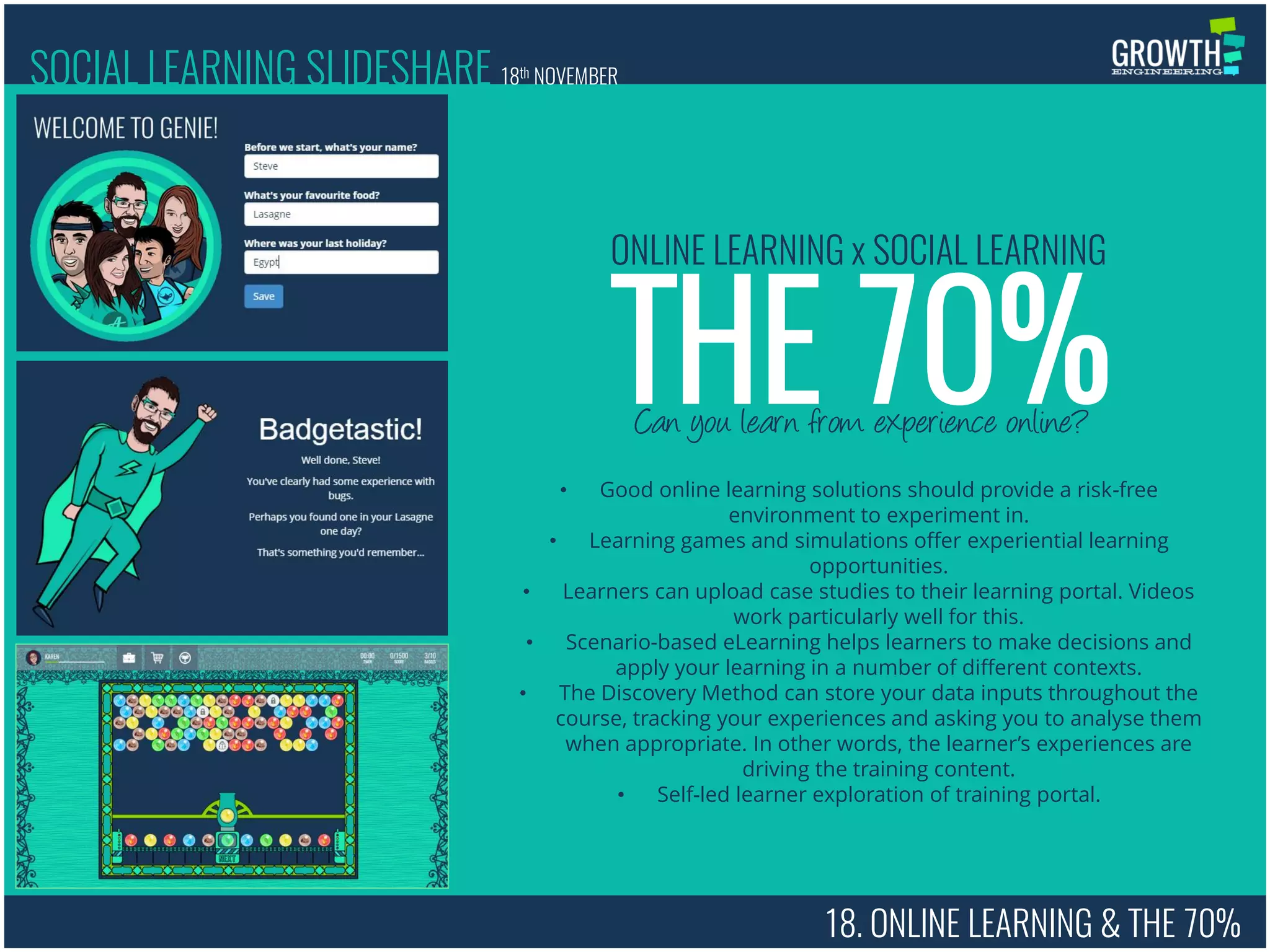
• Good online learning solutions should provide a risk-free
environment to experiment in.
• Learning games and simulations offer experiential learning
opportunities.
• Learners can upload case studies to their learning portal. Videos
work particularly well for this.
• Scenario-based eLearning helps learners to make decisions and
apply your learning in a number of different contexts.
• The Discovery Method can store your data inputs throughout the
course, tracking your experiences and asking you to analyse them
when appropriate. In other words, the learner’s experiences are
driving the training content.
• Self-led learner exploration of training portal.
SOCIAL LEARNING SLIDESHARE 18th NOVEMBER
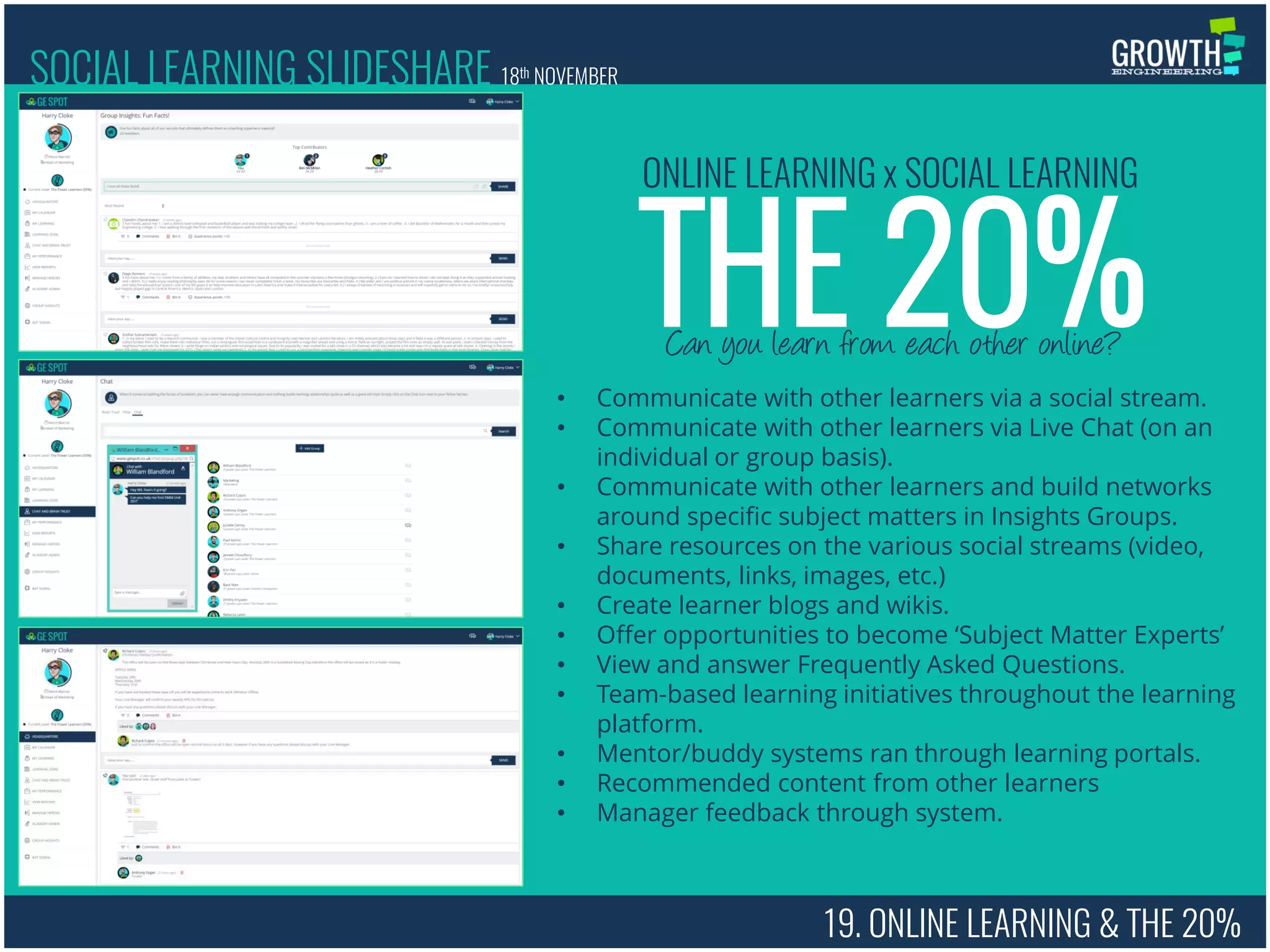
19. ONLINE LEARNING & THE 20%
Can you learn from each other online?
THE 20%
ONLINE LEARNING x SOCIAL LEARNING
• Communicate with other learners via a social stream.
• Communicate with other learners via Live Chat (on an
individual or group basis).
• Communicate with other learners and build networks
around specific subject matters in Insights Groups.
• Share resources on the various social streams (video,
documents, links, images, etc.)
• Create learner blogs and wikis.
• Offer opportunities to become ‘Subject Matter Experts’
• View and answer Frequently Asked Questions.
• Team-based learning initiatives throughout the learning
platform.
• Mentor/buddy systems ran through learning portals.
• Recommended content from other learners
• Manager feedback through system.
SOCIAL LEARNING SLIDESHARE 18th NOVEMBER
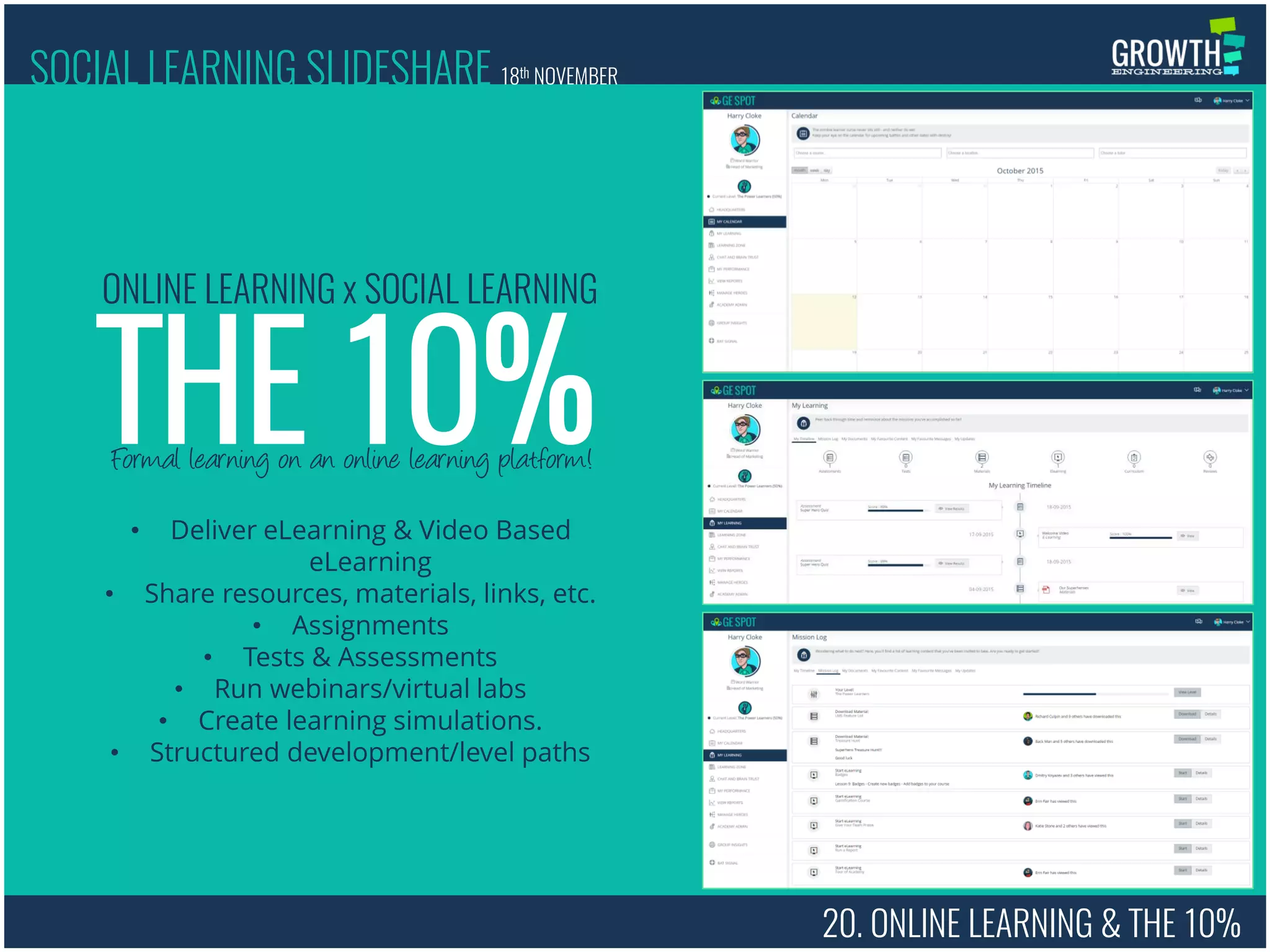
20. ONLINE LEARNING & THE 10%
Formal learning on an online learning platform!
THE 10%
ONLINE LEARNING x SOCIAL LEARNING
• Deliver eLearning & Video Based
eLearning
• Share resources, materials, links, etc.
• Assignments
• Tests & Assessments
• Run webinars/virtual labs
• Create learning simulations.
• Structured development/level paths
SOCIAL LEARNING SLIDESHARE 18th NOVEMBER
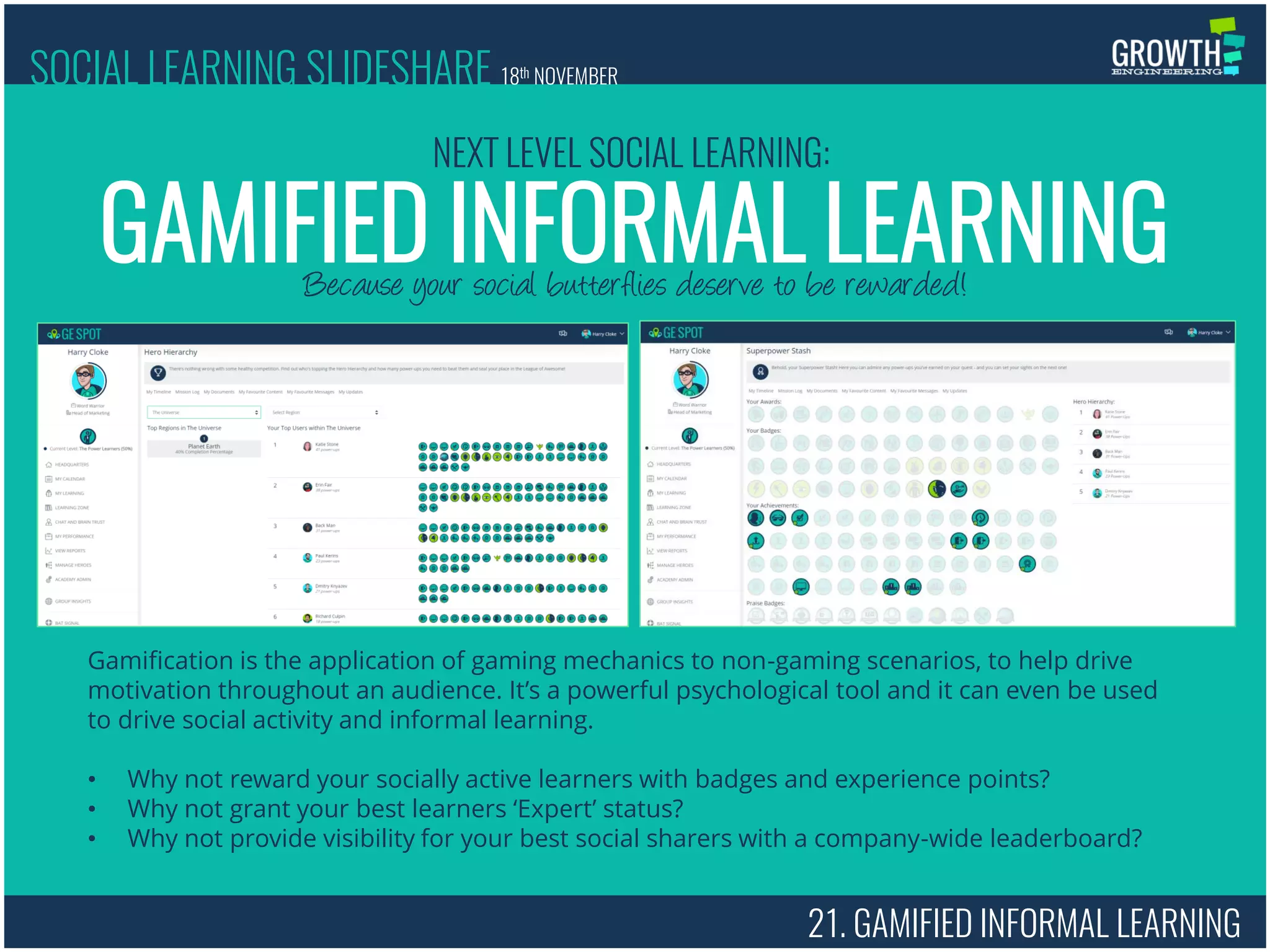
21. GAMIFIED INFORMAL LEARNING
Because your social butterflies deserve to be rewarded!
GAMIFIED INFORMAL LEARNING
NEXT LEVEL SOCIAL LEARNING:
SOCIAL LEARNING SLIDESHARE 18th NOVEMBER
Gamification is the application of gaming mechanics to non-gaming scenarios, to help drive
motivation throughout an audience. It’s a powerful psychological tool and it can even be used
to drive social activity and informal learning.
• Why not reward your socially active learners with badges and experience points?
• Why not grant your best learners ‘Expert’ status?
• Why not provide visibility for your best social sharers with a company-wide leaderboard?
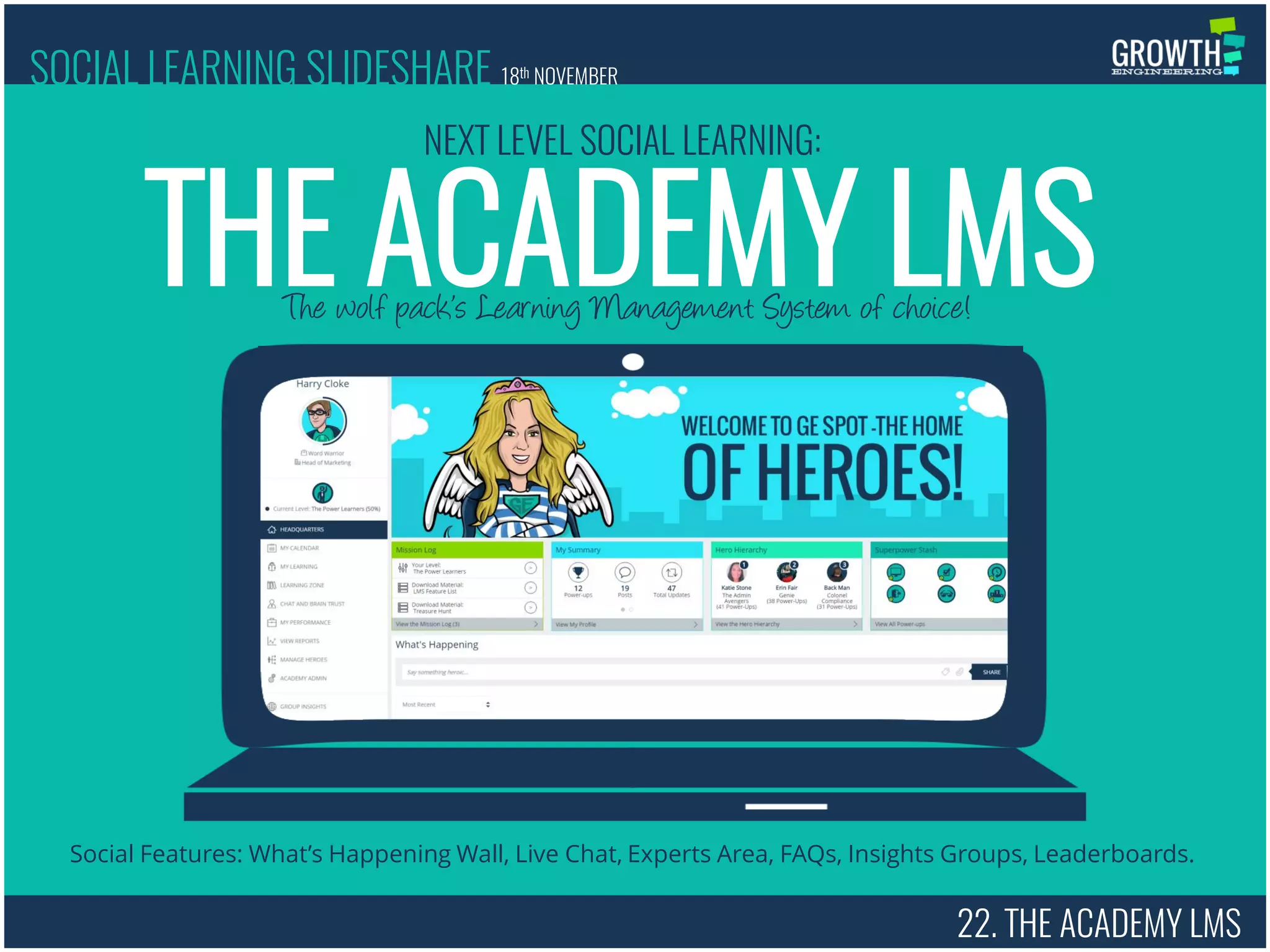
22. THE ACADEMY LMS
The wolf pack’s Learning Management System of choice!
THE ACADEMY LMS
NEXT LEVEL SOCIAL LEARNING:
Social Features: What’s Happening Wall, Live Chat, Experts Area, FAQs, Insights Groups, Leaderboards.
SOCIAL LEARNING SLIDESHARE 18th NOVEMBER
Find out how the Growth Engineering
Superheroes can make a difference:
www.growthengineering.co.uk
hello@growthengineering.co.uk
THANK YOU FOR READING

Social Learning is Super Learning!

  • 1.
    SOCIAL LEARNING By: @GrowthEngineeringDate: 18th November 2015 Follow us! Tweet us! Ask us questions! We’re very friendly. Bring you… UNLOCKING THE FULL POWER OF INFORMAL LEARNING – ONLINE!
  • 2.
    1 2 3 4 5 6 9 10 11 12 13 14 The Definition How WeLearn (70/20/10) The Facts Intellectual Capital Continuous Learning Innovation Engagement It Just Works 7 8 15 16 Problems With Formal Learning Autonomy Flexibility It’s The Future Save Money Online Learning & 70/20/10 Gamified Social Learning The Academy LMS SOCIAL LEARNING SLIDESHARE 18th NOVEMBER THE AGENDA
  • 3.
    JOIN THE SOCIALLEARNING WOLF PACK Wolves are the ultimate social animal. They travel and hunt as a pack, completing almost all activities in the company of their fellow wolves. Cats, on other hand, are the epitome of independence. If you’re looking to implement an informal learning strategy, your learners need to be more wolf and less cat. 1. THE SOCIAL LEARNING WOLF PACK SOCIAL LEARNING SLIDESHARE 18th NOVEMBER
  • 4.
    THE DEFINITION 2. THEDEFINITION Social learning or informal learning, is learning that happens outside of the traditional sphere of education. It’s the learning that occurs once you’ve left the classroom or closed your textbook. Informal learning happens when learners start setting their own learning objectives. They drive the experience. SOCIAL LEARNING SLIDESHARE 18th NOVEMBER What do we mean by ‘social learning’?
  • 5.
    3. HOW WELEARN HOW WE LEARN • Real world experience • On the job experience • Problem solving activity • Mentoring • Coaching • Team-based activity • Classroom Learning • Textbooks • eLearning Units SOCIAL LEARNING SLIDESHARE 18th NOVEMBER
  • 6.
    4. THE FACTS THEFACTSThe 70/20/10 theory is grounded in reality! SOCIAL LEARNING SLIDESHARE 18th NOVEMBER People learn 70% of what they know about their jobs informally. - US BUREAU OF LABOR STATISTICS 70% of what people know about their jobs, they learn informally from the people they work with. - EDUCATION DEVELOPMENT CENTER, MASSACHUSETTS “About 70% of all learning projects are planned by the learner [themselves].” - PROFESSOR ALLEN TOUGH, UNIVERSITY OF TORONTO FACTBOOK
  • 7.
    5. INFORMAL LEARNINGvs FORMAL LEARNING Informal learning vs Formal learning: Once you jump on the formal training bus, your options are limited. You can hop on and off when the bus stops, but the driver picks the route and the speed – passengers are simply along for the ride. When you’re on the informal learning bike, on the other hand, you’re on your own and are free to make as many detours as you like – you can choose the speed, route and destination as you see fit. CREDIT: AUDREY POLCE SOCIAL LEARNING SLIDESHARE 18th NOVEMBER
  • 8.
    THE COUNTDOWN BEGINS… 6.THE COUNTDOWN BEGINS… 11 REASONS TO EMBRACE SOCIAL LEARNING: SOCIAL LEARNING SLIDESHARE 18th NOVEMBER
  • 9.
    7. INTELLECTUAL CAPITAL Getmore from your biggest asset! Your people and their knowledge is your most important asset. According to Babcock, Fortune 500 companies lose roughly $31.5bn a year by failing to share knowledge. We can empathise, having once lost 50p down the back of a sofa. Still, providing the proper support for informal learning within your organisation can help you to fight back. INTELLECTUAL CAPITAL #1 SOCIAL LEARNING SLIDESHARE 18th NOVEMBER
  • 10.
    Formal learning experiencesall have a beginning and an end. At some stage, you’ll be ushered out of the lecture hall. Your ‘How to Code for Dummies’ textbook will end eventually. Conversely, informal learning has no predefined end-point. It can expand to cover any necessary ground whenever the need arises. Informal learning experiences expand and evolve as circumstances change and events unfurl. If your learners are an ambitious bunch, they won’t want the learning experience to end. Supporting an informal learning approach can help you to keep that ball rolling. #2 SOCIAL LEARNING SLIDESHARE 18th NOVEMBER Learning experiences that never truly end! CONTINUOUS LEARNING 8. CONTINUOUS LEARNING
  • 11.
    9. PROMOTE INNOVATION We’rebetter when we work together! PROMOTE INNOVATION #3 A survey from Deskmag magazine recently found that improved team- work, collaboration and knowledge sharing spurs creativity and confidence. Indeed, 71% of those questioned suggest that they were more creative because of their team- orientated environment. SOCIAL LEARNING SLIDESHARE 18th NOVEMBER THE DREAM TEAM!
  • 12.
    10. ENGAGE YOURTEAM Sharing information can give us the same pleasure that food, money and sex does! A Harvard study has found that sharing triggers the reward centres in our brain and can even trigger the release of dopamine. Researchers found that there was a larger amount of ‘activity’ in the reward region of the brain when subjects were able to share information with friends and family members, than there was when they were forced to keep the information to themselves. ENGAGE YOUR TEAM #4 SOCIAL LEARNING SLIDESHARE 18th NOVEMBER
  • 13.
    11. IT JUSTWORKS Productivity overload! The McKinsey Global Institute estimates that by ‘fully implementing social technologies’, organisations can raise the productivity of their employees by ’20 to 25 percent’. Imagine if you were able to squeeze that much more out of your team. That’d be like adding an additional thruster to Concorde. IT JUST WORKS! #5 SOCIAL LEARNING SLIDESHARE 18th NOVEMBER
  • 14.
    12. FORMAL LEARNINGPROBLEMS Your brain is a leaky sieve (no offense!) FORMAL LEARNING HAS PROBLEMS #6 Ebbinghaus’ forgetting curve shows that if we don’t contextualise information, we forget it within an hour. Yikes. Luckily, embracing informal learning can help you to turn that forgetting curve upside down. By providing your team with more opportunities to practise, discuss and contextualise the information you’ll soon increase retention. SOCIAL LEARNING SLIDESHARE 18th NOVEMBER
  • 15.
    13. AUTONOMY Self-driven learningis more meaningful to the individual learner! AUTONOMY & MOTIVATION #7 We’ve leave this one to Daniel Pink: “Carrots & Sticks are so last Century… For 21st century work, we need to upgrade to autonomy, mastery and purpose”. Here’s the link to his TED Talk. SOCIAL LEARNING SLIDESHARE 18th NOVEMBER
  • 16.
    14. FLEXIBILITY Learn andshare, anywhere! Collaborative tools of all shapes and sizes are helping to facilitate the move towards a telecommuted workforce. As this happens, business can expect to strip back a significant chunk of their operating costs. In fact, according to ZDNet, 28% of UK workers would accept a lower salary in return for flexible working privileges. There are benefits to having a mobile workforce too. A Kcom survey recently revealed that 72% of global businesses say that flexible working practises increases employee productivity. INCREASED FLEXIBILITY #8 SOCIAL LEARNING SLIDESHARE 18th NOVEMBER
  • 17.
    Social Learning: nevergoing out of fashion! An Econsultancy report found that collaboration tools would be important to 86% of organisations by 2015. We assume that the remaining 14% are a bunch of fun- hating misers! If you don’t start embracing social learning solutions soon, you’ll get left behind! IT’S THE FUTURE! #9 15. IT’S THE FUTURE SOCIAL LEARNING SLIDESHARE 18th NOVEMBER
  • 18.
    Social butterflies flocktogether! EMPLOYEE RETENTION #10 Teamwork, collaboration and knowledge sharing helps to foster an exciting and engaging workplace culture. We’re more likely to stick around in environment where we feel like we are still developing and learning from our peers. As the American Psychological Association note, 63% of us stick with our current organisation because we feel ‘connected’ with it. 16. EMPLOYEE RETENTION SOCIAL LEARNING SLIDESHARE 18th NOVEMBER
  • 19.
    17. MONEY SAVING Improvethe ROI of your training initiatives! OINK! As the McKinsey Global Institute note, the average employee spends an estimated 20% of their time looking for internal information or tracking down colleagues who can help with specific tasks. On the flip-side, a searchable record of knowledge can reduce the time that employees spend searching for company information by as much as 35%. That will leave them with more time to do the things that really impact on your bottom line. MONEY SAVING #11 SOCIAL LEARNING SLIDESHARE 18th NOVEMBER
  • 20.
    CAN ONLINE LEARNING REALLYSUPPORT A SOCIAL LEARNING STRATEGY? SOCIAL LEARNING SLIDESHARE 18th NOVEMBER
  • 21.
    18. ONLINE LEARNING& THE 70% Can you learn from experience online? THE 70% ONLINE LEARNING x SOCIAL LEARNING • Good online learning solutions should provide a risk-free environment to experiment in. • Learning games and simulations offer experiential learning opportunities. • Learners can upload case studies to their learning portal. Videos work particularly well for this. • Scenario-based eLearning helps learners to make decisions and apply your learning in a number of different contexts. • The Discovery Method can store your data inputs throughout the course, tracking your experiences and asking you to analyse them when appropriate. In other words, the learner’s experiences are driving the training content. • Self-led learner exploration of training portal. SOCIAL LEARNING SLIDESHARE 18th NOVEMBER
  • 22.
    19. ONLINE LEARNING& THE 20% Can you learn from each other online? THE 20% ONLINE LEARNING x SOCIAL LEARNING • Communicate with other learners via a social stream. • Communicate with other learners via Live Chat (on an individual or group basis). • Communicate with other learners and build networks around specific subject matters in Insights Groups. • Share resources on the various social streams (video, documents, links, images, etc.) • Create learner blogs and wikis. • Offer opportunities to become ‘Subject Matter Experts’ • View and answer Frequently Asked Questions. • Team-based learning initiatives throughout the learning platform. • Mentor/buddy systems ran through learning portals. • Recommended content from other learners • Manager feedback through system. SOCIAL LEARNING SLIDESHARE 18th NOVEMBER
  • 23.
    20. ONLINE LEARNING& THE 10% Formal learning on an online learning platform! THE 10% ONLINE LEARNING x SOCIAL LEARNING • Deliver eLearning & Video Based eLearning • Share resources, materials, links, etc. • Assignments • Tests & Assessments • Run webinars/virtual labs • Create learning simulations. • Structured development/level paths SOCIAL LEARNING SLIDESHARE 18th NOVEMBER
  • 24.
    21. GAMIFIED INFORMALLEARNING Because your social butterflies deserve to be rewarded! GAMIFIED INFORMAL LEARNING NEXT LEVEL SOCIAL LEARNING: SOCIAL LEARNING SLIDESHARE 18th NOVEMBER Gamification is the application of gaming mechanics to non-gaming scenarios, to help drive motivation throughout an audience. It’s a powerful psychological tool and it can even be used to drive social activity and informal learning. • Why not reward your socially active learners with badges and experience points? • Why not grant your best learners ‘Expert’ status? • Why not provide visibility for your best social sharers with a company-wide leaderboard?
  • 25.
    22. THE ACADEMYLMS The wolf pack’s Learning Management System of choice! THE ACADEMY LMS NEXT LEVEL SOCIAL LEARNING: Social Features: What’s Happening Wall, Live Chat, Experts Area, FAQs, Insights Groups, Leaderboards. SOCIAL LEARNING SLIDESHARE 18th NOVEMBER
  • 26.
    Find out howthe Growth Engineering Superheroes can make a difference: www.growthengineering.co.uk hello@growthengineering.co.uk THANK YOU FOR READING