Epginetics
Does only genes affect
our gene expression and
behaviour?
Definitions
Epigenetics: the study of phenomena and mechanisms that cause chromosome-associated heritable changes to gene
expression that are not dependent on changes in DNA sequence" Alterations in gene expression, but where the DNA
itself remains unchanged."
Epigenetic modifcatoins (marks) :are modifications that occur at chromatin level, and could regulate gene expression,
and define which genes are turned on and off. “they are made across the genome at each generation to defne cell types
and patterns of gene expression in the developing embryo”
Epigenetic inheritance : Alterations in gene expression that are passed onto the next generation, but where the DNA
itself remains unchanged. “can change the changes in phenotypic frequency, but NOT the changes in genotypic or allele
frequencies”
Epigenetic Effects : The same genome could express different phenotypes: Epigenetic differences could result in
phenotypic differences even among identical twins (clones).
Definitions
Epigenetic effects :typically not heritable changes in gene expression or cellular phenotype caused by mechanisms other than changes in
the underlying DNA sequence. Ex : DNA methylation and histone deacetylation, both of which serve to suppress gene expression
without altering the sequence of the silenced genes.
Trans generational epigenetic effects: These are regarded as effects on the phenotype (or on patterns of gene expression) that are
detected across more than one generation and that cannot be explained by Mendelian genetics (or changes to the primary DNA
sequence). Example: trans generational plasticity, maternal effects.
Trans generational epigenetic inheritance: This term refers to effects on phenotype (or on patterns of gene expression) that are passed
from one generation to the next by molecules in the germ cells and that cannot be explained by Mendelian genetics (or by changes to
the primary DNA sequence).
Paramutation: where interaction between two alleles at a single locus, results in a heritable change in expression of one allele that is
induced by the other allele. Mechanism is not fully understood, but could occur via methylation or regulatory RNAs.Paramutaton
violates Mendel’s first law, which states that each allele remains completely uninfuenced by the other.
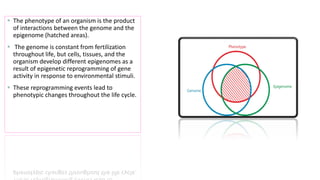
▪ The phenotype of an organism is the product
of interactions between the genome and the
epigenome (hatched areas).
▪ The genome is constant from fertilization
throughout life, but cells, tissues, and the
organism develop different epigenomes as a
result of epigenetic reprogramming of gene
activity in response to environmental stimuli.
▪ These reprogramming events lead to
phenotypic changes throughout the life cycle.
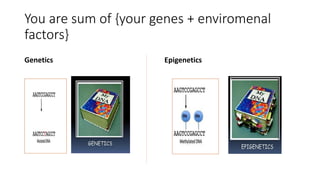
You are sum of {your genes + enviromenal
factors}
Genetics Epigenetics
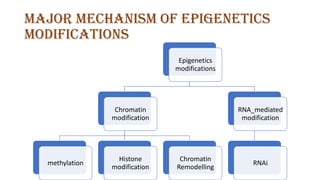
Major mechanism of epigenetics
modifications
Epigenetics
modifications
Chromatin
modification
methylation
Histone
modification
Chromatin
Remodelling
RNA_mediated
modification
RNAi
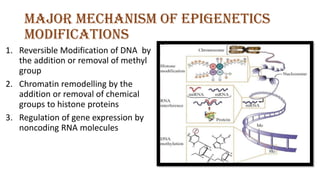
Major mechanism of epigenetics
modifications
1. Reversible Modification of DNA by
the addition or removal of methyl
group
2. Chromatin remodelling by the
addition or removal of chemical
groups to histone proteins
3. Regulation of gene expression by
noncoding RNA molecules
First :Reversible Modification of DNA by the addition
or removal of methyl group
• Mythylome: The set of methylated nucleotides
present in an organism’s genome at a given time.
• When DNA methylation take place ?
After DNA Replication and during cell differention
• What is methylation mean?
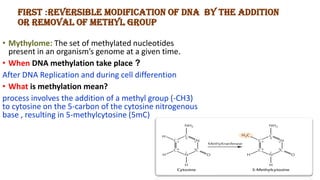
process involves the addition of a methyl group (-CH3)
to cytosine on the 5-carbon of the cytosine nitrogenous
base , resulting in 5-methylcytosine (5mC)
• What is the result of 5mC formation?
blocking the binding of transcription factors
when it binds to regulatory elements such
as promoters, therefore inactivating the
genes, and regulating gene expression.
Its mostly occur in CpG islands.
Don’t confuse
between CGs & CpG
islands
Methylation occurs by
• DNA Methyltrasnferase
• DNMT1 : maintains established patterns through rounds of DNA replication and
cell division.
• DNMT3a, DNMT13b : responsible for creating DNA methylation
patterns
Methylation occurs by:
• Demethylase
• Removal of cytosine methyl groups by enzyme-catalyzed
• Its necessary for epigenetics reprogramming of genes & can be :
1. Passive demethylation: failure to methylate new strands of DNA
during replication.
2. Active demethylation: the removal of methyl groups from
methylated cytosine independent of DNA replication.
DNA methylation importance
• Crucial part of normal organismal development and cellular
differentiation in higher organisms
• Alters gene expression pattern in cells
• Suppresses expression of viral genes and other deleterious
elements that have been incorporated into the genome of the
host over time
• Plays a crucial role in the development of nearly all types of
cancer (hypermethylation, which represses transcripton of the
promoter regions of tumor suppressor genes)
• Might be the mechanism for learning and longterm memory
storage
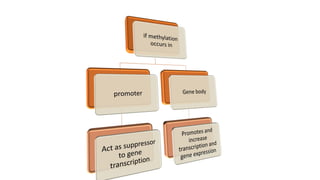
➢ Suppression of
expression occurs
Due to
interference with
binding pf
transcription
factors
➢ Methylation in
promoter or
upstream it: lead
lead to change in
gene expression
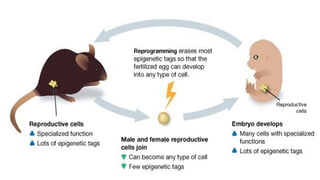
G.R: Most epigenetic modifications that are established in
most tissues during an organism’s lifetime are irrelevant with
respect to the next generation.
• This is because
1. epigenetic modifications are normally erased at each generaton For
example, DNA methylation is typically removed (or possibly oxidized)
during zygote formation and re-established through successive cell
divisions during development.
2. only epigenetic modifications of the mature gametes (and not in other
tissues) have the potential to contribute to the phenotype of the
offspring, the next generation.
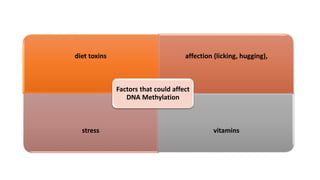
diet toxins affection (licking, hugging),
stress vitamins
Factors that could affect
DNA Methylation
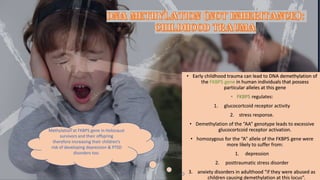
DNA Methylation (not inheritance):
Childhood trauma
• Early childhood trauma can lead to DNA demethylation of
the FKBP5 gene in human individuals that possess
particular alleles at this gene
• FKBP5 regulates:
1. glucocortcoid receptor activity
2. stress response.
• Demethylation of the “AA” genotype leads to excessive
glucocortcoid receptor activation.
• homozygous for the “A” allele of the FKBP5 gene were
more likely to suffer from:
1. depression
2. posttraumatic stress disorder
3. anxiety disorders in adulthood “if they were abused as
children causing demethylation at this locus”.
Methylation at FKBP5 gene in Holocaust
survivors and their offspring
therefore increasing their children’s
risk of developing depression & PTSD
disorders too.
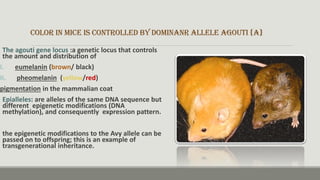
Color in mice is controlled by dominanr allele Agouti {A}
The agouti gene locus :a genetic locus that controls
the amount and distribution of
I. eumelanin (brown/ black)
II. pheomelanin (yellow/red)
pigmentation in the mammalian coat
Epialleles: are alleles of the same DNA sequence but
different epigenetic modifications (DNA
methylation), and consequently expression pattern.
the epigenetic modifications to the Avy allele can be
passed on to offspring; this is an example of
transgenerational inheritance.
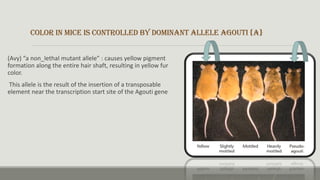
Color in mice is controlled by dominant allele Agouti {A}
(Avy) “a non_lethal mutant allele” : causes yellow pigment
formation along the entire hair shaft, resulting in yellow fur
color.
This allele is the result of the insertion of a transposable
element near the transcription start site of the Agouti gene
Histone modification
• transcription is controlled by two processes:
1. chromatin remodeling: which involves the action of ATP-powered
protein complexes that move, remove, or alter nucleosomes
2. histone modifications: which are covalent posttranslational
modifications of amino acids near the N-terminal ends of histone
proteins
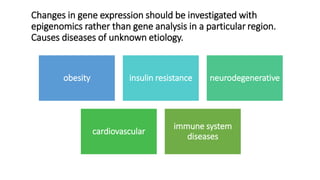
Changes in gene expression should be investigated with
epigenomics rather than gene analysis in a particular region.
Causes diseases of unknown etiology.
obesity insulin resistance neurodegenerative
cardiovascular
immune system
diseases

Epigenetics.pdf

  • 1.
    Epginetics Does only genesaffect our gene expression and behaviour?
  • 2.
    Definitions Epigenetics: the studyof phenomena and mechanisms that cause chromosome-associated heritable changes to gene expression that are not dependent on changes in DNA sequence" Alterations in gene expression, but where the DNA itself remains unchanged." Epigenetic modifcatoins (marks) :are modifications that occur at chromatin level, and could regulate gene expression, and define which genes are turned on and off. “they are made across the genome at each generation to defne cell types and patterns of gene expression in the developing embryo” Epigenetic inheritance : Alterations in gene expression that are passed onto the next generation, but where the DNA itself remains unchanged. “can change the changes in phenotypic frequency, but NOT the changes in genotypic or allele frequencies” Epigenetic Effects : The same genome could express different phenotypes: Epigenetic differences could result in phenotypic differences even among identical twins (clones).
  • 3.
    Definitions Epigenetic effects :typicallynot heritable changes in gene expression or cellular phenotype caused by mechanisms other than changes in the underlying DNA sequence. Ex : DNA methylation and histone deacetylation, both of which serve to suppress gene expression without altering the sequence of the silenced genes. Trans generational epigenetic effects: These are regarded as effects on the phenotype (or on patterns of gene expression) that are detected across more than one generation and that cannot be explained by Mendelian genetics (or changes to the primary DNA sequence). Example: trans generational plasticity, maternal effects. Trans generational epigenetic inheritance: This term refers to effects on phenotype (or on patterns of gene expression) that are passed from one generation to the next by molecules in the germ cells and that cannot be explained by Mendelian genetics (or by changes to the primary DNA sequence). Paramutation: where interaction between two alleles at a single locus, results in a heritable change in expression of one allele that is induced by the other allele. Mechanism is not fully understood, but could occur via methylation or regulatory RNAs.Paramutaton violates Mendel’s first law, which states that each allele remains completely uninfuenced by the other.
  • 4.
    ▪ The phenotypeof an organism is the product of interactions between the genome and the epigenome (hatched areas). ▪ The genome is constant from fertilization throughout life, but cells, tissues, and the organism develop different epigenomes as a result of epigenetic reprogramming of gene activity in response to environmental stimuli. ▪ These reprogramming events lead to phenotypic changes throughout the life cycle.
  • 5.
    You are sumof {your genes + enviromenal factors} Genetics Epigenetics
  • 6.
    Major mechanism ofepigenetics modifications Epigenetics modifications Chromatin modification methylation Histone modification Chromatin Remodelling RNA_mediated modification RNAi
  • 7.
    Major mechanism ofepigenetics modifications 1. Reversible Modification of DNA by the addition or removal of methyl group 2. Chromatin remodelling by the addition or removal of chemical groups to histone proteins 3. Regulation of gene expression by noncoding RNA molecules
  • 9.
    First :Reversible Modificationof DNA by the addition or removal of methyl group • Mythylome: The set of methylated nucleotides present in an organism’s genome at a given time. • When DNA methylation take place ? After DNA Replication and during cell differention • What is methylation mean? process involves the addition of a methyl group (-CH3) to cytosine on the 5-carbon of the cytosine nitrogenous base , resulting in 5-methylcytosine (5mC)
  • 10.
    • What isthe result of 5mC formation? blocking the binding of transcription factors when it binds to regulatory elements such as promoters, therefore inactivating the genes, and regulating gene expression. Its mostly occur in CpG islands. Don’t confuse between CGs & CpG islands
  • 11.
    Methylation occurs by •DNA Methyltrasnferase • DNMT1 : maintains established patterns through rounds of DNA replication and cell division. • DNMT3a, DNMT13b : responsible for creating DNA methylation patterns
  • 13.
    Methylation occurs by: •Demethylase • Removal of cytosine methyl groups by enzyme-catalyzed • Its necessary for epigenetics reprogramming of genes & can be : 1. Passive demethylation: failure to methylate new strands of DNA during replication. 2. Active demethylation: the removal of methyl groups from methylated cytosine independent of DNA replication.
  • 14.
    DNA methylation importance •Crucial part of normal organismal development and cellular differentiation in higher organisms • Alters gene expression pattern in cells • Suppresses expression of viral genes and other deleterious elements that have been incorporated into the genome of the host over time • Plays a crucial role in the development of nearly all types of cancer (hypermethylation, which represses transcripton of the promoter regions of tumor suppressor genes) • Might be the mechanism for learning and longterm memory storage ➢ Suppression of expression occurs Due to interference with binding pf transcription factors ➢ Methylation in promoter or upstream it: lead lead to change in gene expression
  • 15.
    G.R: Most epigeneticmodifications that are established in most tissues during an organism’s lifetime are irrelevant with respect to the next generation. • This is because 1. epigenetic modifications are normally erased at each generaton For example, DNA methylation is typically removed (or possibly oxidized) during zygote formation and re-established through successive cell divisions during development. 2. only epigenetic modifications of the mature gametes (and not in other tissues) have the potential to contribute to the phenotype of the offspring, the next generation.
  • 17.
    diet toxins affection(licking, hugging), stress vitamins Factors that could affect DNA Methylation
  • 18.
    DNA Methylation (notinheritance): Childhood trauma • Early childhood trauma can lead to DNA demethylation of the FKBP5 gene in human individuals that possess particular alleles at this gene • FKBP5 regulates: 1. glucocortcoid receptor activity 2. stress response. • Demethylation of the “AA” genotype leads to excessive glucocortcoid receptor activation. • homozygous for the “A” allele of the FKBP5 gene were more likely to suffer from: 1. depression 2. posttraumatic stress disorder 3. anxiety disorders in adulthood “if they were abused as children causing demethylation at this locus”. Methylation at FKBP5 gene in Holocaust survivors and their offspring therefore increasing their children’s risk of developing depression & PTSD disorders too.
  • 19.
    Color in miceis controlled by dominanr allele Agouti {A} The agouti gene locus :a genetic locus that controls the amount and distribution of I. eumelanin (brown/ black) II. pheomelanin (yellow/red) pigmentation in the mammalian coat Epialleles: are alleles of the same DNA sequence but different epigenetic modifications (DNA methylation), and consequently expression pattern. the epigenetic modifications to the Avy allele can be passed on to offspring; this is an example of transgenerational inheritance.
  • 20.
    Color in miceis controlled by dominant allele Agouti {A} (Avy) “a non_lethal mutant allele” : causes yellow pigment formation along the entire hair shaft, resulting in yellow fur color. This allele is the result of the insertion of a transposable element near the transcription start site of the Agouti gene
  • 21.
    Histone modification • transcriptionis controlled by two processes: 1. chromatin remodeling: which involves the action of ATP-powered protein complexes that move, remove, or alter nucleosomes 2. histone modifications: which are covalent posttranslational modifications of amino acids near the N-terminal ends of histone proteins
  • 22.
    Changes in geneexpression should be investigated with epigenomics rather than gene analysis in a particular region. Causes diseases of unknown etiology. obesity insulin resistance neurodegenerative cardiovascular immune system diseases