Cloning Vectors
Plasmid
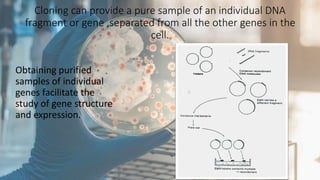
Cloning can provide a pure sample of an individual DNA
fragment or gene ,separated from all the other genes in the
cell.
Obtaining purified
samples of individual
genes facilitate the
study of gene structure
and expression.
The main properties of a vector
• Self replication (It should have an Origin of replication ( known as ORI)
• Carry genes that are identifiable by plating or biochemical tests
(Reporter genes and Selectable markers).
• Introduction ability (able to penetrate particular cells).
• Must possess restriction site or Multiple Cloning Site( MCS or
polylinker site) for insertion of DNA molecule
Why E.Coli
• Safe
• Short lifetime
• Known genome
properties of plasmid
Extra-chromosomal, double
stranded, circular DNA
molecule.
It sizes 1-200 kb.
Can carry a fragment of
DNA up to12 kb.
Found in prokaryotic and
eukaryotic cells.
Replicate as independent
units as the host cell
multiply.
Carry genes (selectable
markers) for heavy metals
tolerance, antibiotic
resistance or able to
metabolize toxic organic
compounds.
Can be easily isolated and
purified from the host cell.
Shuttle vectors
• DNA molecules that can replicate in multiple
host organisms (different type of cells or
organisms)
• plasmids contain origin of replication and
selectable marker for more than 1 host
Example: plasmids for the cloning and expression
of genes in the yeast Saccharomyces cerevisiae
contain both replication origins and selectable
markers for both E. coli and yeast
Most DNA
manipulations will be
performed using E.coli
as a host, prior to
transformation of the
final DNA construct into
yeast
RNA production plasmids
• They are molecular constructs designed to
facilitate the production of RNA in a host cell.
• the foreign DNA fragments cloned into them
can be transcribed into RNA.
• plasmids contain the promoter sites for an
RNA polymerase
• Example:
1. T3 promoter
2. T7 promoter
3. SP6 promoter
RNA made by this
method is often
used as probes for
hybridization in
Northern blotting.
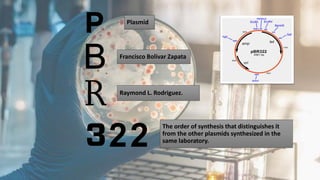
The order of synthesis that distinguishes it
from the other plasmids synthesized in the
same laboratory.
Raymond L. Rodriguez.
Francisco Bolivar Zapata
Plasmid
Plasmid
University of
California
Has 3 additional features:
1. High copy number
2. Blue-white Screening
3. multiple cloning site
or polylinker
Copy number of
pBR322
Copy number of pUC
High copy number →without
the need for chloramphenicol
amplification.
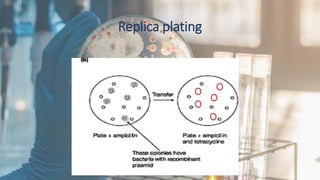
Screening by insertional inactivation of a
resistance gene
Replica plating
Replica plating
Systems have therefore been devised
for the shuttling of DNA fragments
between vectors without having to
use restriction enzymes
Gene shuffling between plasmids
using recombination
Gene shuffling between plasmids
using recombination
Gene shuffling between plasmids
using recombination
Gene shuffling between plasmids
using recombination
Shortcoming of plasmid
The efficiency at which
the plasmid is
transferred to a
bacterial cell is very
low.
The capacity of
plasmids to carry large
fragments of foreign
DNA is limited

Cloning Vectors (plasmid).pdf

  • 1.
  • 2.
    Cloning can providea pure sample of an individual DNA fragment or gene ,separated from all the other genes in the cell. Obtaining purified samples of individual genes facilitate the study of gene structure and expression.
  • 3.
    The main propertiesof a vector • Self replication (It should have an Origin of replication ( known as ORI) • Carry genes that are identifiable by plating or biochemical tests (Reporter genes and Selectable markers). • Introduction ability (able to penetrate particular cells). • Must possess restriction site or Multiple Cloning Site( MCS or polylinker site) for insertion of DNA molecule
  • 4.
    Why E.Coli • Safe •Short lifetime • Known genome
  • 5.
    properties of plasmid Extra-chromosomal,double stranded, circular DNA molecule. It sizes 1-200 kb. Can carry a fragment of DNA up to12 kb. Found in prokaryotic and eukaryotic cells. Replicate as independent units as the host cell multiply. Carry genes (selectable markers) for heavy metals tolerance, antibiotic resistance or able to metabolize toxic organic compounds. Can be easily isolated and purified from the host cell.
  • 6.
    Shuttle vectors • DNAmolecules that can replicate in multiple host organisms (different type of cells or organisms) • plasmids contain origin of replication and selectable marker for more than 1 host Example: plasmids for the cloning and expression of genes in the yeast Saccharomyces cerevisiae contain both replication origins and selectable markers for both E. coli and yeast Most DNA manipulations will be performed using E.coli as a host, prior to transformation of the final DNA construct into yeast
  • 7.
    RNA production plasmids •They are molecular constructs designed to facilitate the production of RNA in a host cell. • the foreign DNA fragments cloned into them can be transcribed into RNA. • plasmids contain the promoter sites for an RNA polymerase • Example: 1. T3 promoter 2. T7 promoter 3. SP6 promoter RNA made by this method is often used as probes for hybridization in Northern blotting.
  • 9.
    The order ofsynthesis that distinguishes it from the other plasmids synthesized in the same laboratory. Raymond L. Rodriguez. Francisco Bolivar Zapata Plasmid
  • 11.
    Plasmid University of California Has 3additional features: 1. High copy number 2. Blue-white Screening 3. multiple cloning site or polylinker
  • 12.
    Copy number of pBR322 Copynumber of pUC High copy number →without the need for chloramphenicol amplification.
  • 13.
    Screening by insertionalinactivation of a resistance gene
  • 14.
  • 15.
  • 26.
    Systems have thereforebeen devised for the shuttling of DNA fragments between vectors without having to use restriction enzymes
  • 27.
    Gene shuffling betweenplasmids using recombination
  • 28.
    Gene shuffling betweenplasmids using recombination
  • 29.
    Gene shuffling betweenplasmids using recombination
  • 30.
    Gene shuffling betweenplasmids using recombination
  • 31.
    Shortcoming of plasmid Theefficiency at which the plasmid is transferred to a bacterial cell is very low. The capacity of plasmids to carry large fragments of foreign DNA is limited