Exploring New Approaches in Therapeutics
For more info, contact us: xeraya@xeraya.com
Follow us: @xerayacapital
www.xeraya.com
Epigenetics & Gene Control
1
Epigenetics & Gene Control
Contents Overview
•  Defining Epigenetics
•  Nature vs Nurture
•  Basics of Gene Expression
•  Targeting the Chromosome
for Gene Control
•  Epigenetic Methods
•  Potential in Therapeutics
•  Case Studies
2
What is Epigenetics?
Source: https://www.livescience.com/37703-epigenetics.html
Epigenetics means ‘above’ or
‘on top of’ genetics.
It studies how our DNA interacts
with other molecules found within
our cells which can ‘activate’ or
‘deactivate’ genes.
In this case, epigenetics refers to
external modifications to DNA that
turn genes ‘on’ or ‘off.’ This affects
how cells read the genes.
Epigenetic modifications do not change the
DNA sequence itself, but instead, they alter
the physical structure of DNA, which affects
how our cells ‘read’ genes.
Credit: WhatIsEpigenetics.com
3
The human body is made up
of various components, built
from different types of
tissues, and made up of
different cell types.
All the different types of cells
(blood cells, nerve cells, skin
cells, etc.) share the same DNA.
What sets them apart are the
unique epigenetic markers on
our DNA.
Epigenetics Explained
Source: https://genetics.thetech.org/ask-a-geneticist/epigenetics-and-cell-types
4
Our genes are expressed differently (turned
‘on’ or ‘off’) by epigenetic markers, which
creates the different cell types.
Credit: The Tech Interactive
Nature vs Nurture
5
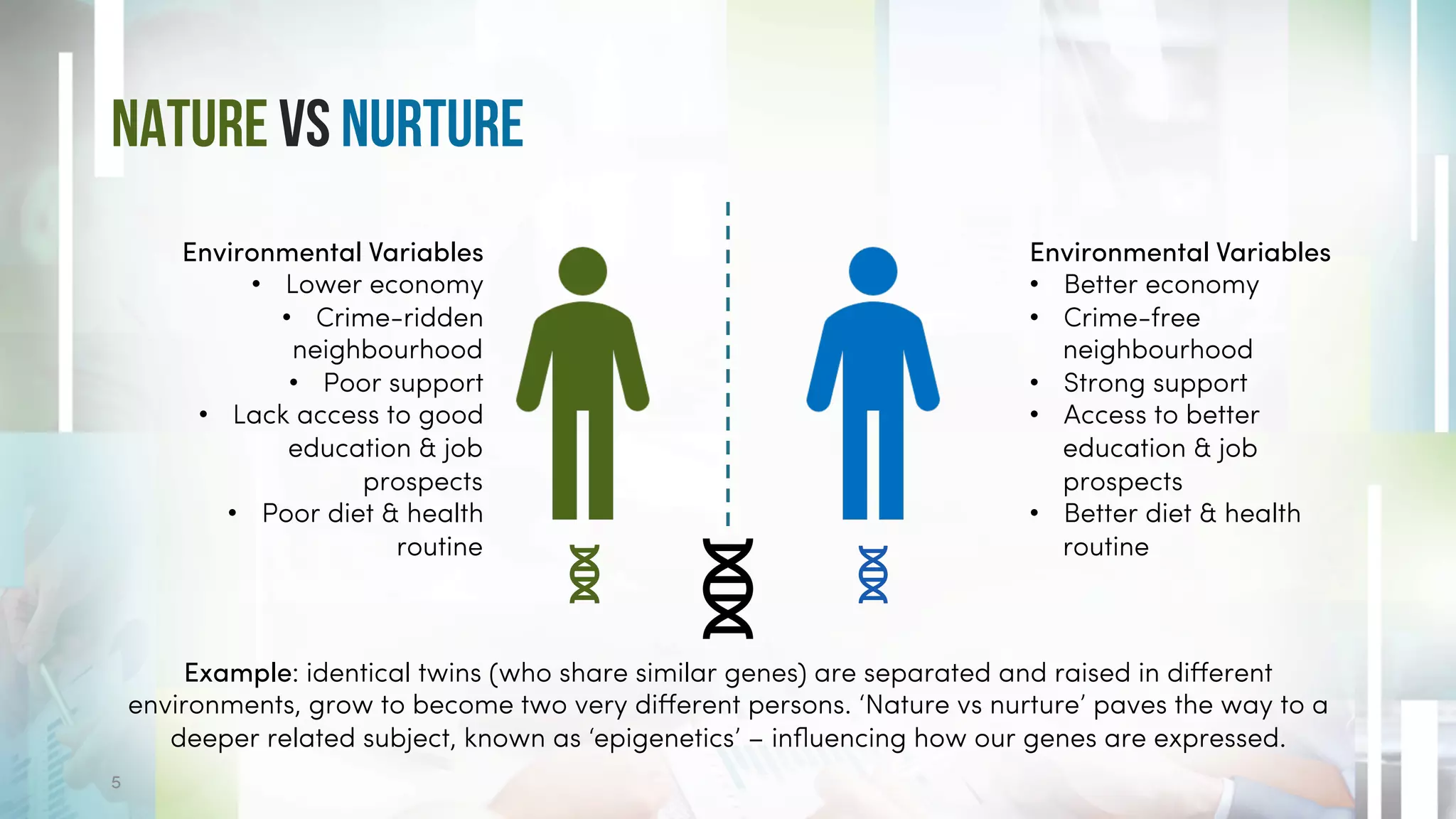
Example: identical twins (who share similar genes) are separated and raised in different
environments, grow to become two very different persons. ‘Nature vs nurture’ paves the way to a
deeper related subject, known as ‘epigenetics’ – influencing how our genes are expressed.
Environmental Variables
•  Better economy
•  Crime-free
neighbourhood
•  Strong support
•  Access to better
education & job
prospects
•  Better diet & health
routine
Environmental Variables
•  Lower economy
•  Crime-ridden
neighbourhood
•  Poor support
•  Lack access to good
education & job
prospects
•  Poor diet & health
routine
Gene Expression
From Transcription to Translation
6
Overview of Gene Expression
Source: https://www.yourgenome.org/facts/what-is-gene-expression
7
Activation
‘On/Off’ switch to
control when
proteins are
made.
Output
Volume control that
can increase or
decrease the
number of proteins
made.
Gene expression is the process
by which the instructions in our
DNA are converted into
functional products, such as a
proteins.
It is a highly regulated process that
allows our cells to respond to its
changing environment, functioning
both as ‘on/off’ switch, as well as a
volume control.
Transcription is when the DNA
in a gene is copied to
produce an RNA transcript
called a messenger RNA
(mRNA).
During transcription, several
enzymes unwind DNA to provide
access to an enzyme called RNA
polymerase which uses
available bases from the
nucleus of the cell to form the
mRNA.
Step 1: Transcription
8
Source: https://www.yourgenome.org/facts/what-is-gene-expression
Credit: Genome Research Ltd.
Step 2: Translation
Translation occurs when the
formed mRNA enters protein-
making factories in the cell,
called ribosomes.
It is read by a carrier molecule
called transfer RNA (tRNA) which
will read the mRNA 3 nucleotide
bases (a codon) at a time. Each
codon specifies a particular amino
acid, a building block of protein
assembled by a ribosomal RNA
(rRNA).
Source: https://www.yourgenome.org/facts/what-is-gene-expression
Credit: Genome Research Ltd.
9
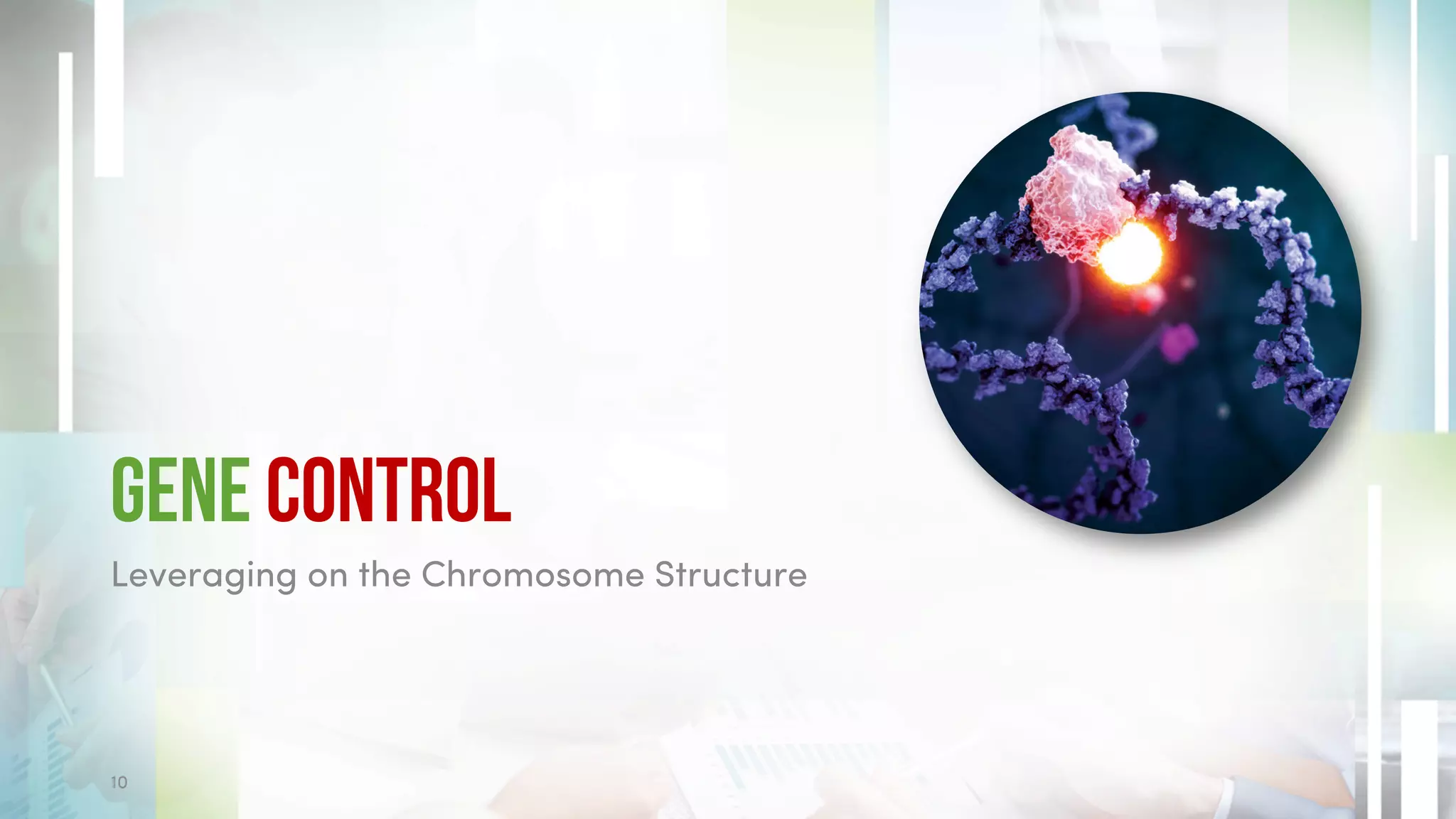
Gene Control
Leveraging on the Chromosome Structure
10
DNA ‘Packaging’
Source: https://www.genome.gov/genetics-glossary/Chromatin
11
Our DNA is compacted and
packaged (together with
histones) in the nucleus of the
cell as a substance called
‘chromatin’ (the material that
makes up our chromosomes).
For our genes to be expressed,
the chromatin needs to be
‘opened up’ so our DNA’s
instructions can be read.
Credit: National Human Genome Research Institute
Basis for Epigenetics
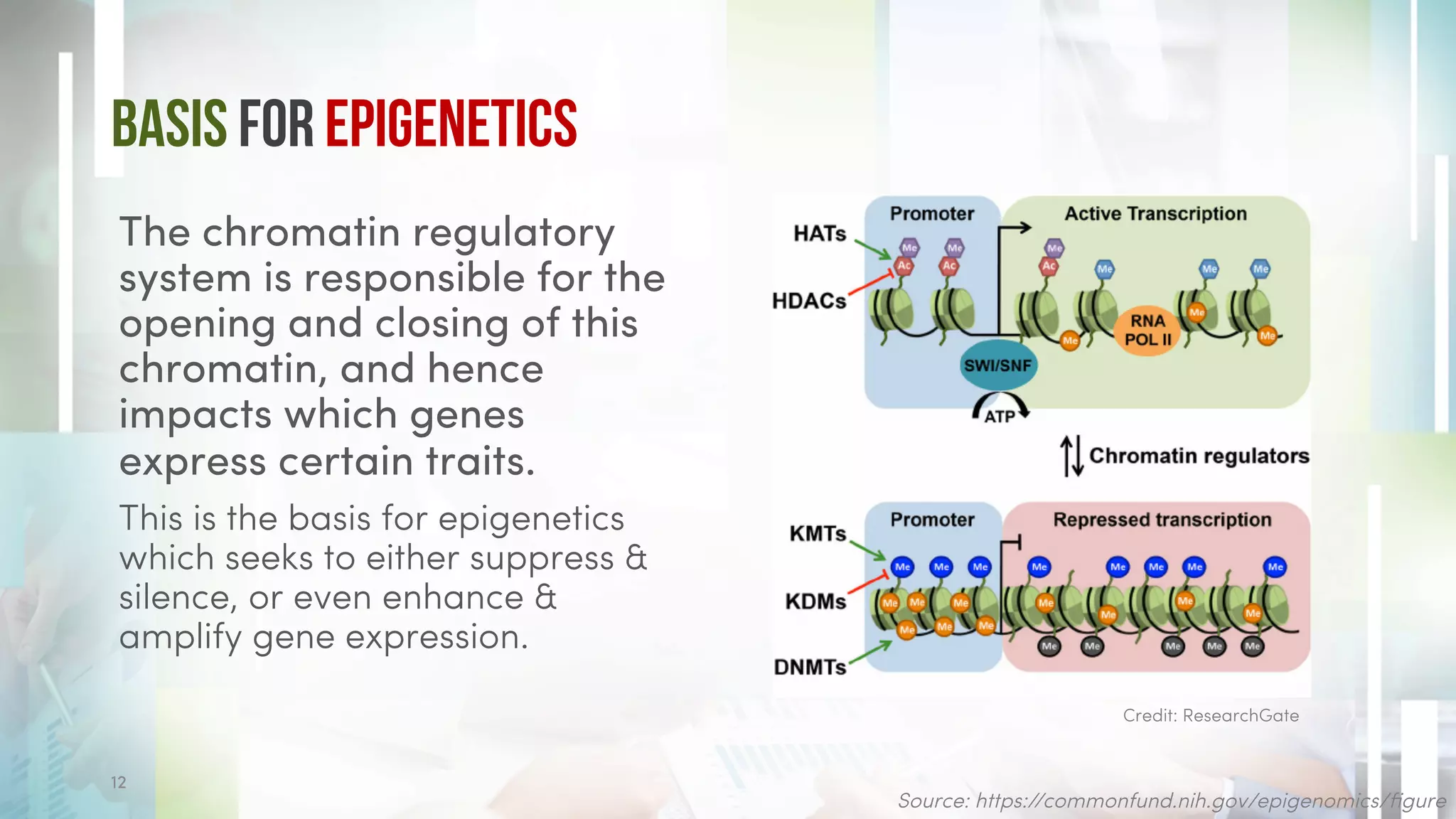
The chromatin regulatory
system is responsible for the
opening and closing of this
chromatin, and hence
impacts which genes
express certain traits.
This is the basis for epigenetics
which seeks to either suppress &
silence, or even enhance &
amplify gene expression.
Source: https://commonfund.nih.gov/epigenomics/figure
Credit: ResearchGate
12
DNA Methylation / De-Methylation
Source: https://www.livescience.com/37703-epigenetics.html
13
One example of an
epigenetic change is DNA
methylation, which is the
addition (or removal) of a
methyl group (a ‘chemical
cap’) from a DNA molecule.
Chemical caps prevent certain
genes from being expressed
entirely.
Credit: AHA Journals
Acetylation / De-Acetylation of Histones
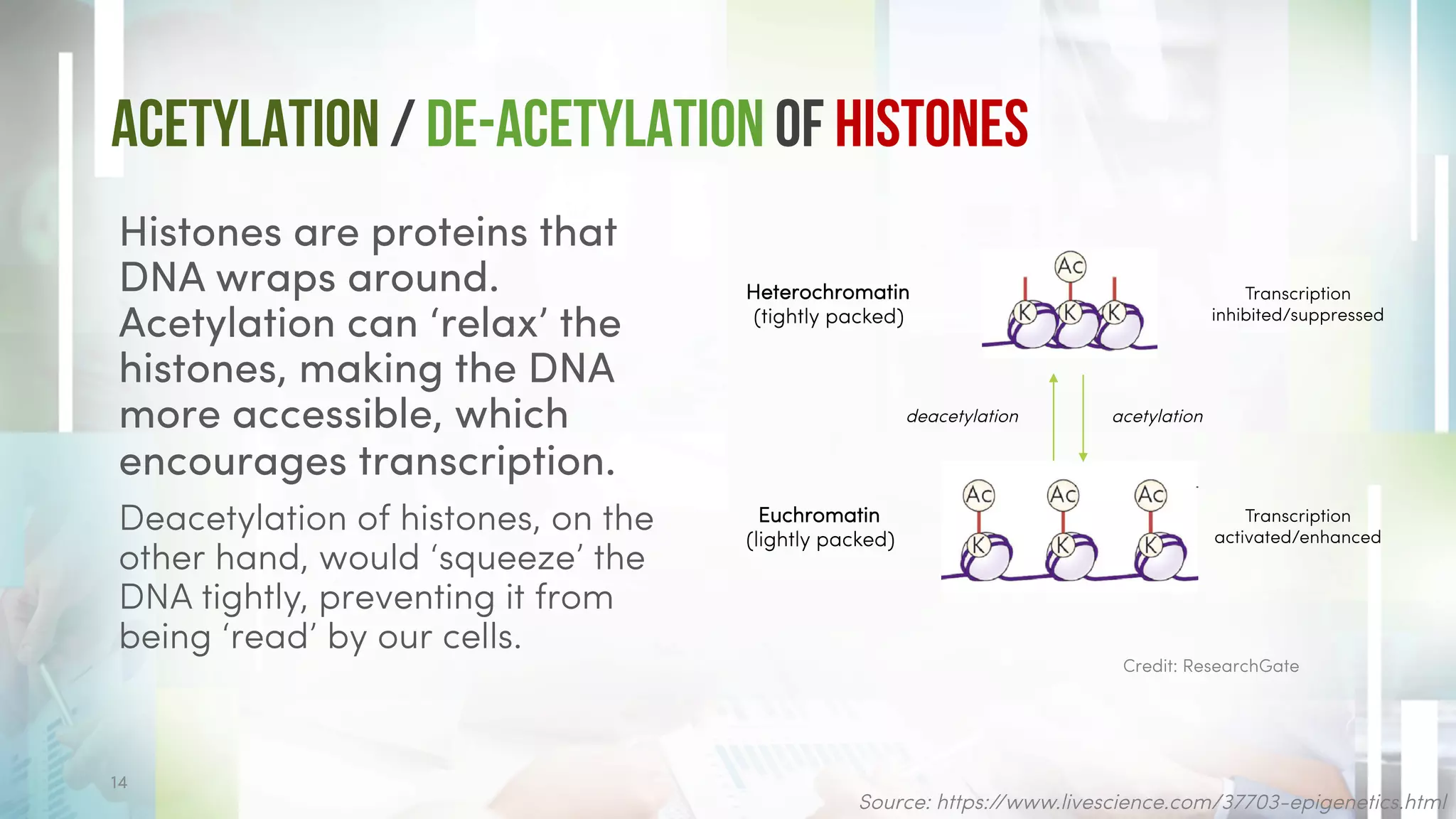
Histones are proteins that
DNA wraps around.
Acetylation can ‘relax’ the
histones, making the DNA
more accessible, which
encourages transcription.
Deacetylation of histones, on the
other hand, would ‘squeeze’ the
DNA tightly, preventing it from
being ‘read’ by our cells.
Credit: ResearchGate
14
Euchromatin
(lightly packed)
Heterochromatin
(tightly packed)
deacetylation acetylation
Transcription
inhibited/suppressed
Transcription
activated/enhanced
Source: https://www.livescience.com/37703-epigenetics.html
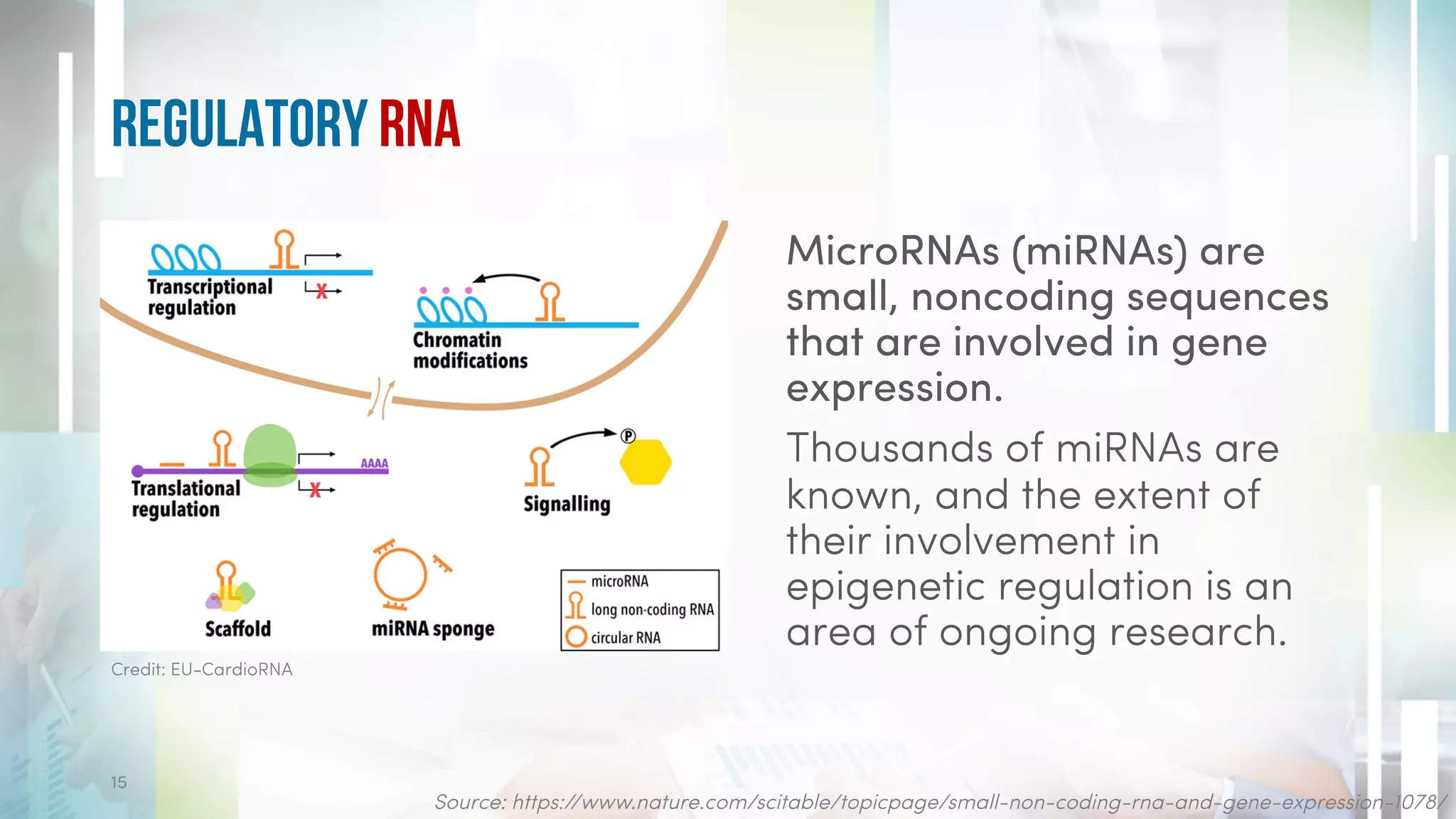
Regulatory RNA
15
MicroRNAs (miRNAs) are
small, noncoding sequences
that are involved in gene
expression.
Thousands of miRNAs are
known, and the extent of
their involvement in
epigenetic regulation is an
area of ongoing research.
Credit: EU-CardioRNA
Source: https://www.nature.com/scitable/topicpage/small-non-coding-rna-and-gene-expression-1078/
Epigenetic Therapy
Influencing Epigenetic Pathways Directly
16
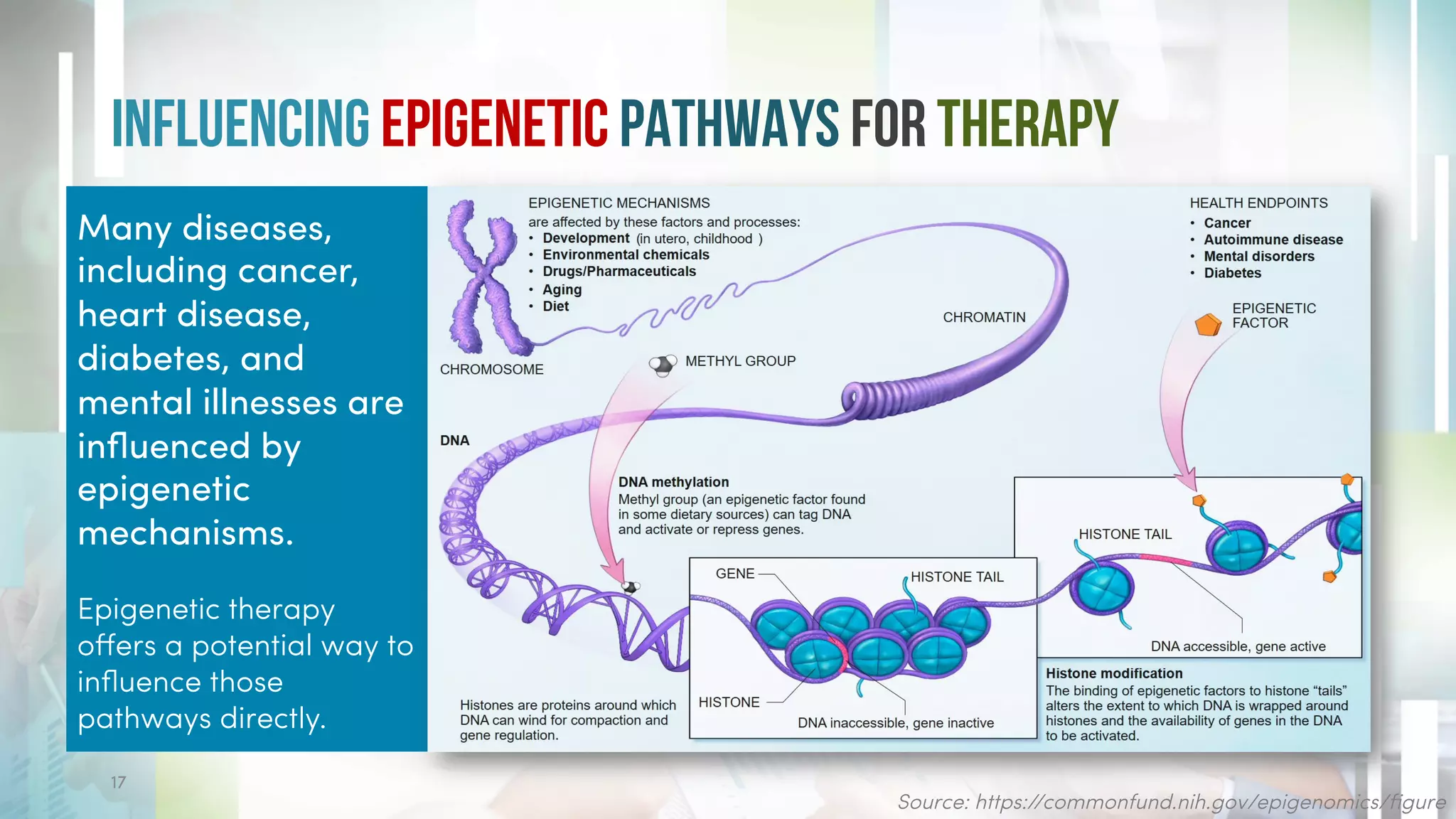
Influencing Epigenetic Pathways for Therapy
Source: https://commonfund.nih.gov/epigenomics/figure
17
Many diseases,
including cancer,
heart disease,
diabetes, and
mental illnesses are
influenced by
epigenetic
mechanisms.
Epigenetic therapy
offers a potential way to
influence those
pathways directly.
Examples of Epigenetic Therapy
18
CANCER
Mostly caused by
deactivation of antitumor
systems, and activation of
oncogenes. Epigenetic
therapy seeks to reverse the
process by influencing
patient cells to express more
antitumor activity.
DIABETES
Methylation of certain genes
cause type 2 diabetes
mellitus. Repressed genes
hinders the patient’s ability
to regulate blood sugar
transport. One approach to
epigenetic therapy is to
inhibit methylation.
CARDIAC DYSFUNCTION
Several cardiac dysfunctions
are linked to methylation
patterns of cytosine.
Regulatory RNA therapy is
being investigated. Primary
area of research is using
epigenetic methods to
increase tissue regeneration.
Gene Traffic ControlTM by Foghorn Therapeutics
The Gene Traffic ControlTM
Product Platform can
precisely target and
manipulate the chromatin
regulatory system to
develop therapies.
Currently in pre-clinical stage,
GTCTM is rapidly advancing over
10 programs across a wide range
of cancers and is beginning to
explore other diseases.
Credit: Foghorn Therapeutics
19
Source: https://foghorntx.com/platform/
Treatment of Rare Blood Cancers by Imago BioSciences
20
Imago is focused on LSD1 (short for ‘lysine-specific demethylase 1’),
that removes methyl groups from lysines on histones and other
chromatin-bound proteins regulating transcription.
The presence or absence of these ‘methyl marks’ at specific sites on
proteins helps determine the properties and fate of blood cells.
Credit: Imago Biosciences
Source: https://www.imagobio.com/research/scientific-vision/
•  Epigenetics studies how our DNA interacts with other molecules
found within our cells which can ‘activate’ or ‘deactivate’ genes.
•  Unlike gene therapy, which works to alter the DNA sequence
(having inherent side-effects), epigenetic therapy focuses on
changes in DNA expression, making it reversible and cost-
effective.
•  Key epigenetic factors include methylation/demethylation of DNA,
histone modifications (acetylation/deacetylation) and regulatory
RNAs.
•  Epigenetic approaches in therapy, seeks to either suppress and
silence, or even enhance and amplify gene expression to treat
diseases.
Conclusion
21
By xeraya capital
For more info, contact us: xeraya@xeraya.com
Follow us: @xerayacapital
www.xeraya.com
22

Epigenetics & Gene Control

  • 1.
    Exploring New Approachesin Therapeutics For more info, contact us: xeraya@xeraya.com Follow us: @xerayacapital www.xeraya.com Epigenetics & Gene Control 1
  • 2.
    Epigenetics & GeneControl Contents Overview •  Defining Epigenetics •  Nature vs Nurture •  Basics of Gene Expression •  Targeting the Chromosome for Gene Control •  Epigenetic Methods •  Potential in Therapeutics •  Case Studies 2
  • 3.
    What is Epigenetics? Source:https://www.livescience.com/37703-epigenetics.html Epigenetics means ‘above’ or ‘on top of’ genetics. It studies how our DNA interacts with other molecules found within our cells which can ‘activate’ or ‘deactivate’ genes. In this case, epigenetics refers to external modifications to DNA that turn genes ‘on’ or ‘off.’ This affects how cells read the genes. Epigenetic modifications do not change the DNA sequence itself, but instead, they alter the physical structure of DNA, which affects how our cells ‘read’ genes. Credit: WhatIsEpigenetics.com 3
  • 4.
    The human bodyis made up of various components, built from different types of tissues, and made up of different cell types. All the different types of cells (blood cells, nerve cells, skin cells, etc.) share the same DNA. What sets them apart are the unique epigenetic markers on our DNA. Epigenetics Explained Source: https://genetics.thetech.org/ask-a-geneticist/epigenetics-and-cell-types 4 Our genes are expressed differently (turned ‘on’ or ‘off’) by epigenetic markers, which creates the different cell types. Credit: The Tech Interactive
  • 5.
    Nature vs Nurture 5 Example:identical twins (who share similar genes) are separated and raised in different environments, grow to become two very different persons. ‘Nature vs nurture’ paves the way to a deeper related subject, known as ‘epigenetics’ – influencing how our genes are expressed. Environmental Variables •  Better economy •  Crime-free neighbourhood •  Strong support •  Access to better education & job prospects •  Better diet & health routine Environmental Variables •  Lower economy •  Crime-ridden neighbourhood •  Poor support •  Lack access to good education & job prospects •  Poor diet & health routine
  • 6.
  • 7.
    Overview of GeneExpression Source: https://www.yourgenome.org/facts/what-is-gene-expression 7 Activation ‘On/Off’ switch to control when proteins are made. Output Volume control that can increase or decrease the number of proteins made. Gene expression is the process by which the instructions in our DNA are converted into functional products, such as a proteins. It is a highly regulated process that allows our cells to respond to its changing environment, functioning both as ‘on/off’ switch, as well as a volume control.
  • 8.
    Transcription is whenthe DNA in a gene is copied to produce an RNA transcript called a messenger RNA (mRNA). During transcription, several enzymes unwind DNA to provide access to an enzyme called RNA polymerase which uses available bases from the nucleus of the cell to form the mRNA. Step 1: Transcription 8 Source: https://www.yourgenome.org/facts/what-is-gene-expression Credit: Genome Research Ltd.
  • 9.
    Step 2: Translation Translationoccurs when the formed mRNA enters protein- making factories in the cell, called ribosomes. It is read by a carrier molecule called transfer RNA (tRNA) which will read the mRNA 3 nucleotide bases (a codon) at a time. Each codon specifies a particular amino acid, a building block of protein assembled by a ribosomal RNA (rRNA). Source: https://www.yourgenome.org/facts/what-is-gene-expression Credit: Genome Research Ltd. 9
  • 10.
    Gene Control Leveraging onthe Chromosome Structure 10
  • 11.
    DNA ‘Packaging’ Source: https://www.genome.gov/genetics-glossary/Chromatin 11 OurDNA is compacted and packaged (together with histones) in the nucleus of the cell as a substance called ‘chromatin’ (the material that makes up our chromosomes). For our genes to be expressed, the chromatin needs to be ‘opened up’ so our DNA’s instructions can be read. Credit: National Human Genome Research Institute
  • 12.
    Basis for Epigenetics Thechromatin regulatory system is responsible for the opening and closing of this chromatin, and hence impacts which genes express certain traits. This is the basis for epigenetics which seeks to either suppress & silence, or even enhance & amplify gene expression. Source: https://commonfund.nih.gov/epigenomics/figure Credit: ResearchGate 12
  • 13.
    DNA Methylation /De-Methylation Source: https://www.livescience.com/37703-epigenetics.html 13 One example of an epigenetic change is DNA methylation, which is the addition (or removal) of a methyl group (a ‘chemical cap’) from a DNA molecule. Chemical caps prevent certain genes from being expressed entirely. Credit: AHA Journals
  • 14.
    Acetylation / De-Acetylationof Histones Histones are proteins that DNA wraps around. Acetylation can ‘relax’ the histones, making the DNA more accessible, which encourages transcription. Deacetylation of histones, on the other hand, would ‘squeeze’ the DNA tightly, preventing it from being ‘read’ by our cells. Credit: ResearchGate 14 Euchromatin (lightly packed) Heterochromatin (tightly packed) deacetylation acetylation Transcription inhibited/suppressed Transcription activated/enhanced Source: https://www.livescience.com/37703-epigenetics.html
  • 15.
    Regulatory RNA 15 MicroRNAs (miRNAs)are small, noncoding sequences that are involved in gene expression. Thousands of miRNAs are known, and the extent of their involvement in epigenetic regulation is an area of ongoing research. Credit: EU-CardioRNA Source: https://www.nature.com/scitable/topicpage/small-non-coding-rna-and-gene-expression-1078/
  • 16.
  • 17.
    Influencing Epigenetic Pathwaysfor Therapy Source: https://commonfund.nih.gov/epigenomics/figure 17 Many diseases, including cancer, heart disease, diabetes, and mental illnesses are influenced by epigenetic mechanisms. Epigenetic therapy offers a potential way to influence those pathways directly.
  • 18.
    Examples of EpigeneticTherapy 18 CANCER Mostly caused by deactivation of antitumor systems, and activation of oncogenes. Epigenetic therapy seeks to reverse the process by influencing patient cells to express more antitumor activity. DIABETES Methylation of certain genes cause type 2 diabetes mellitus. Repressed genes hinders the patient’s ability to regulate blood sugar transport. One approach to epigenetic therapy is to inhibit methylation. CARDIAC DYSFUNCTION Several cardiac dysfunctions are linked to methylation patterns of cytosine. Regulatory RNA therapy is being investigated. Primary area of research is using epigenetic methods to increase tissue regeneration.
  • 19.
    Gene Traffic ControlTMby Foghorn Therapeutics The Gene Traffic ControlTM Product Platform can precisely target and manipulate the chromatin regulatory system to develop therapies. Currently in pre-clinical stage, GTCTM is rapidly advancing over 10 programs across a wide range of cancers and is beginning to explore other diseases. Credit: Foghorn Therapeutics 19 Source: https://foghorntx.com/platform/
  • 20.
    Treatment of RareBlood Cancers by Imago BioSciences 20 Imago is focused on LSD1 (short for ‘lysine-specific demethylase 1’), that removes methyl groups from lysines on histones and other chromatin-bound proteins regulating transcription. The presence or absence of these ‘methyl marks’ at specific sites on proteins helps determine the properties and fate of blood cells. Credit: Imago Biosciences Source: https://www.imagobio.com/research/scientific-vision/
  • 21.
    •  Epigenetics studieshow our DNA interacts with other molecules found within our cells which can ‘activate’ or ‘deactivate’ genes. •  Unlike gene therapy, which works to alter the DNA sequence (having inherent side-effects), epigenetic therapy focuses on changes in DNA expression, making it reversible and cost- effective. •  Key epigenetic factors include methylation/demethylation of DNA, histone modifications (acetylation/deacetylation) and regulatory RNAs. •  Epigenetic approaches in therapy, seeks to either suppress and silence, or even enhance and amplify gene expression to treat diseases. Conclusion 21
  • 22.
    By xeraya capital Formore info, contact us: xeraya@xeraya.com Follow us: @xerayacapital www.xeraya.com 22