MISMATCH REPAIR
LOGESWARAN KA
P20BIT1013
I MSC BIOTECHNOLOGY
PERIYAR UNIVERSITY
DNA REPAIR
Set Of Processes Where A Cell Detects And Nullify Damages Occurred
In DNA.
Very Important Mechanism Since Its Failure Leads To Development Of
Severe Diseases.
Discovery  “Tomas Lindahl, Paul Modrich And Aziz Sancar”.
They Received “Nobel Prize In Chemistry” In The Year “2015”.
Their Research Focused On “Molecular Mechanisms Of DNA Repair
Processes”.
DNA DAMAGE CAUSES
DNA Damages Are Caused By “Exposure To Several Endogenous And
Exogenous Agents”.
“Errors Occurred During DNA Processing Reactions” Also Causes
Damages In The DNA.
Endogenous Agents  Reactive Oxygen, Nitrogen (Metabolites)
Exogenous Agents  UV, Dioxin (Chemical And Physical Agents)
DNA Processing Reactions  Replication, Recombination And Other
Biological Processes.
MISMATCH REPAIR
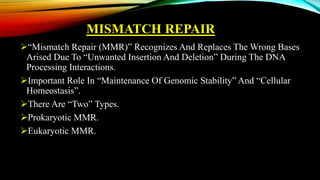
“Mismatch Repair (MMR)” Recognizes And Replaces The Wrong Bases
Arised Due To “Unwanted Insertion And Deletion” During The DNA
Processing Interactions.
Important Role In “Maintenance Of Genomic Stability” And “Cellular
Homeostasis”.
There Are “Two” Types.
Prokaryotic MMR.
Eukaryotic MMR.
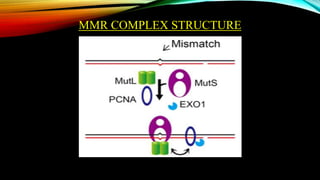
MMR COMPLEX STRUCTURE
PROKARYOTIC MMR
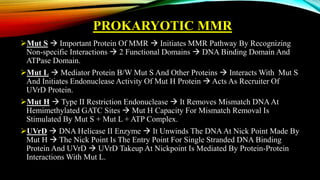
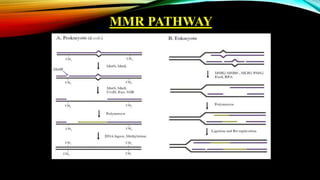
Mut S  Important Protein Of MMR  Initiates MMR Pathway By Recognizing
Non-specific Interactions  2 Functional Domains  DNA Binding Domain And
ATPase Domain.
Mut L  Mediator Protein B/W Mut S And Other Proteins  Interacts With Mut S
And Initiates Endonuclease Activity Of Mut H Protein  Acts As Recruiter Of
UVrD Protein.
Mut H  Type II Restriction Endonuclease  It Removes Mismatch DNAAt
Hemimethylated GATC Sites  Mut H Capacity For Mismatch Removal Is
Stimulated By Mut S + Mut L + ATP Complex.
UVrD  DNA Helicase II Enzyme  It Unwinds The DNAAt Nick Point Made By
Mut H  The Nick Point Is The Entry Point For Single Stranded DNA Binding
Protein And UVrD  UVrD Takeup At Nickpoint Is Mediated By Protein-Protein
Interactions With Mut L.
EUKARYOTIC MMR
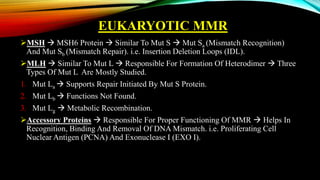
MSH  MSH6 Protein  Similar To Mut S  Mut Sa (Mismatch Recognition)
And Mut Sb (Mismatch Repair). i.e. Insertion Deletion Loops (IDL).
MLH  Similar To Mut L  Responsible For Formation Of Heterodimer  Three
Types Of Mut L Are Mostly Studied.
1. Mut La  Supports Repair Initiated By Mut S Protein.
2. Mut Lb  Functions Not Found.
3. Mut Lg  Metabolic Recombination.
Accessory Proteins  Responsible For Proper Functioning Of MMR  Helps In
Recognition, Binding And Removal Of DNA Mismatch. i.e. Proliferating Cell
Nuclear Antigen (PCNA) And Exonuclease I (EXO I).
MMR PATHWAY
BIOLOGICAL IMPORTANCE
It Promotes DNA Damage Induced Cell Cycle Arrest And Apoptosis.
It Promotes Genomic Stability.
It Increases “Antibody Diversity” By Promoting Immunoglobulin Class
Switching And Somatic Hypermutation.
It Promotes Trinucleotide Repeats (TNR) Expression [Under Research].
It Promotes Homologous Recombination.
It Promotes Interstrand Crosslink Repair Mechanisms.
REFERENCES
1) https://www.nature.com/articles/cr2007115
2) http://mcb.berkeley.edu/courses/mcb110/ALBER/13.14
.repair.pdf
3) https://www.slideshare.net/mprasadnaidu/dna-repair-
final
4) https://www.creative-diagnostics.com/mismatch-repair-
pathway.htm
THANKS FOR LEARNING

Mismatch Repair Mechanism

  • 1.
    MISMATCH REPAIR LOGESWARAN KA P20BIT1013 IMSC BIOTECHNOLOGY PERIYAR UNIVERSITY
  • 2.
    DNA REPAIR Set OfProcesses Where A Cell Detects And Nullify Damages Occurred In DNA. Very Important Mechanism Since Its Failure Leads To Development Of Severe Diseases. Discovery  “Tomas Lindahl, Paul Modrich And Aziz Sancar”. They Received “Nobel Prize In Chemistry” In The Year “2015”. Their Research Focused On “Molecular Mechanisms Of DNA Repair Processes”.
  • 3.
    DNA DAMAGE CAUSES DNADamages Are Caused By “Exposure To Several Endogenous And Exogenous Agents”. “Errors Occurred During DNA Processing Reactions” Also Causes Damages In The DNA. Endogenous Agents  Reactive Oxygen, Nitrogen (Metabolites) Exogenous Agents  UV, Dioxin (Chemical And Physical Agents) DNA Processing Reactions  Replication, Recombination And Other Biological Processes.
  • 4.
    MISMATCH REPAIR “Mismatch Repair(MMR)” Recognizes And Replaces The Wrong Bases Arised Due To “Unwanted Insertion And Deletion” During The DNA Processing Interactions. Important Role In “Maintenance Of Genomic Stability” And “Cellular Homeostasis”. There Are “Two” Types. Prokaryotic MMR. Eukaryotic MMR.
  • 5.
  • 6.
    PROKARYOTIC MMR Mut S Important Protein Of MMR  Initiates MMR Pathway By Recognizing Non-specific Interactions  2 Functional Domains  DNA Binding Domain And ATPase Domain. Mut L  Mediator Protein B/W Mut S And Other Proteins  Interacts With Mut S And Initiates Endonuclease Activity Of Mut H Protein  Acts As Recruiter Of UVrD Protein. Mut H  Type II Restriction Endonuclease  It Removes Mismatch DNAAt Hemimethylated GATC Sites  Mut H Capacity For Mismatch Removal Is Stimulated By Mut S + Mut L + ATP Complex. UVrD  DNA Helicase II Enzyme  It Unwinds The DNAAt Nick Point Made By Mut H  The Nick Point Is The Entry Point For Single Stranded DNA Binding Protein And UVrD  UVrD Takeup At Nickpoint Is Mediated By Protein-Protein Interactions With Mut L.
  • 7.
    EUKARYOTIC MMR MSH MSH6 Protein  Similar To Mut S  Mut Sa (Mismatch Recognition) And Mut Sb (Mismatch Repair). i.e. Insertion Deletion Loops (IDL). MLH  Similar To Mut L  Responsible For Formation Of Heterodimer  Three Types Of Mut L Are Mostly Studied. 1. Mut La  Supports Repair Initiated By Mut S Protein. 2. Mut Lb  Functions Not Found. 3. Mut Lg  Metabolic Recombination. Accessory Proteins  Responsible For Proper Functioning Of MMR  Helps In Recognition, Binding And Removal Of DNA Mismatch. i.e. Proliferating Cell Nuclear Antigen (PCNA) And Exonuclease I (EXO I).
  • 8.
  • 9.
    BIOLOGICAL IMPORTANCE It PromotesDNA Damage Induced Cell Cycle Arrest And Apoptosis. It Promotes Genomic Stability. It Increases “Antibody Diversity” By Promoting Immunoglobulin Class Switching And Somatic Hypermutation. It Promotes Trinucleotide Repeats (TNR) Expression [Under Research]. It Promotes Homologous Recombination. It Promotes Interstrand Crosslink Repair Mechanisms.
  • 10.
    REFERENCES 1) https://www.nature.com/articles/cr2007115 2) http://mcb.berkeley.edu/courses/mcb110/ALBER/13.14 .repair.pdf 3)https://www.slideshare.net/mprasadnaidu/dna-repair- final 4) https://www.creative-diagnostics.com/mismatch-repair- pathway.htm
  • 11.