Introduction to gene
transfer
Gene cloning in eukaryotes
Difficulties associated with gene cloning in
bacteria, especially when dealing with
genes from eukaryotic organisms
➢correction of introns of eukaryotic mRNAs
➢Unequal Transfer of Plasmids during Cell Division
• yield of two types of cells
➢post-translational modification
• inhibition of proteolysis
• glycosylation
➢Expression and Stability of Plasmids at Large Scale
some eukaryotic proteins cannot
be easily expressed in
large amounts in bacteria, and
eukaryotic expression
systems need to be employed
• development of methods for the conversion of
polyadenylated messenger RNA into double-
stranded DNA which could then be inserted into
bacterial plasmids and cloned.
Libraries from cDNA are lack
of information:
➢ Enhancers
➢ Introns
➢ Other regulatory elements
found in the genomic cDNA
library
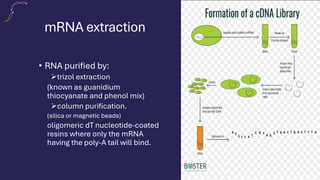
mRNA extraction
• RNA purified by:
➢trizol extraction
(known as guanidium
thiocyanate and phenol mix)
➢column purification.
(silica or magnetic beads)
oligomeric dT nucleotide-coated
resins where only the mRNA
having the poly-A tail will bind.
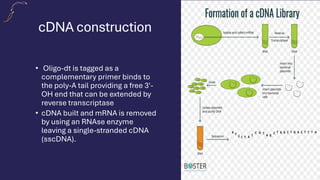
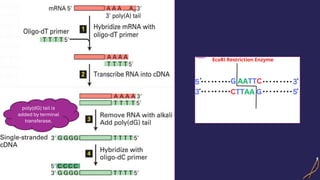
cDNA construction
• Oligo-dt is tagged as a
complementary primer binds to
the poly-A tail providing a free 3'-
OH end that can be extended by
reverse transcriptase
• cDNA built and mRNA is removed
by using an RNAse enzyme
leaving a single-stranded cDNA
(sscDNA).
poly(dG) tail is
added by terminal
transferase.
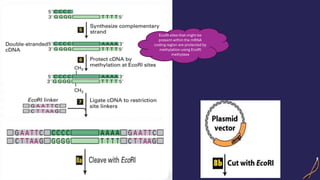
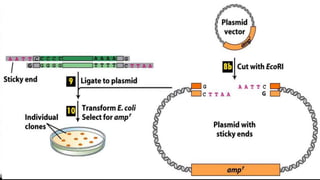
EcoRI sites that might be
present within the mRNA
coding region are protected by
methylation using EcoRI
methylase
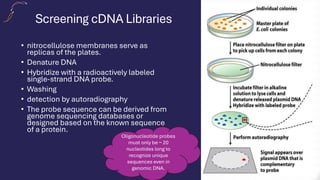
Screening cDNA Libraries
• nitrocellulose membranes serve as
replicas of the plates.
• Denature DNA
• Hybridize with a radioactively labeled
single-strand DNA probe.
• Washing
• detection by autoradiography
• The probe sequence can be derived from
genome sequencing databases or
designed based on the known sequence
of a protein.
Oligonucleotide probes
must only be ~ 20
nucleotides long to
recognize unique
sequences even in
genomic DNA.
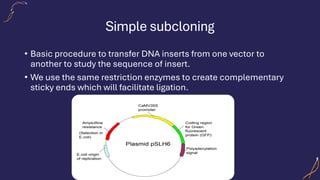
Simple subcloning
• Basic procedure to transfer DNA inserts from one vector to
another to study the sequence of insert.
• We use the same restriction enzymes to create complementary
sticky ends which will facilitate ligation.
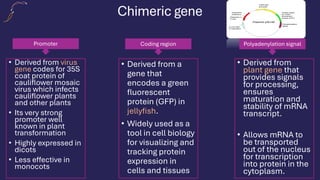
Chimeric gene
• Derived from virus
gene codes for 35S
coat protein of
cauliflower mosaic
virus which infects
cauliflower plants
and other plants
• Its very strong
promoter well
known in plant
transformation
• Highly expressed in
dicots
• Less effective in
monocots
• Derived from a
gene that
encodes a green
fluorescent
protein (GFP) in
jellyfish.
• Widely used as a
tool in cell biology
for visualizing and
tracking protein
expression in
cells and tissues
• Derived from
plant gene that
provides signals
for processing,
ensures
maturation and
stability of mRNA
transcript.
• Allows mRNA to
be transported
out of the nucleus
for transcription
into protein in the
cytoplasm.
Polyadenylation signal
Coding region
Promoter
Shuttle vector
• constructed by using the bacterial origin of replication in a yeast
plasmid which can be manipulated and cloned in bacteria.
• they are transferred into yeast cells for the possible expression of
eukaryotic genes.
• Example: B-lactamase gene (a prokaryotic gene that is expressed
in yeast).
Properties of Shuttle vector
• The vector must:
• replicate in many organisms (e.g. bacteria, yeast, and plants) to facilitate the
isolation and characterization of genes
• effectively deliver genetic information for stable maintenance in alternate
derived recipients
• be easily recognized by selectable markers
• be stable
• non-pathogenic
• non-stress-inducing
• be small in size to accommodate DNA inserts
• Cloned genes should be easily detected
• Useful quantities of the vector must be easily obtained;
• The introduced genetic information should be stably maintained as a
new heritable determinant.
Some definitions
• Transgenesis: genetic engineering technique
where foreign genes are inserted into the
genome of an organism
• Transgenic: an organism that undergoes
transgenesis (GMOs)
• Transmission genetics: the study of the
mechanisms involved in the passage of a gene
from one generation to the next
The yeast Saccharomyces cerevisiae
has become the most sophisticated
eukaryotic model for recombinant
DNA technology.
Why Saccharomyces cerevisiae?
• easy to grow and manipulate (like E.coli)
• Fast growth rate
• Itself nonpathogenic
• biochemistry and cell biology are similar between yeast and “higher”
eukaryotes (many gene homologs between yeast and humans, eg. Cell
cycle "cancer" genes)
• Excellent genetic tools are available in yeast
• Carry out PTM such as the removal of a signal sequence from a
precursor polypeptide after the secretion of cells
• Most of its genes contain introns which are spliced during purification of
mature mRNA)introns found in yeast contain sequences for correct
splicing as they are totally absent in higher eukaryotes
Yeast transformation
Electroporation
chemical
competence
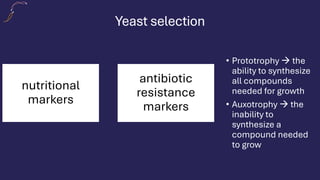
Yeast selection
nutritional
markers
antibiotic
resistance
markers
• Prototrophy → the
ability to synthesize
all compounds
needed for growth
• Auxotrophy → the
inability to
synthesize a
compound needed
to grow
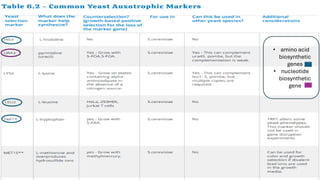
• amino acid
biosynthetic
genes
• nucleotide
biosynthetic
gene
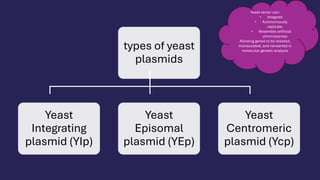
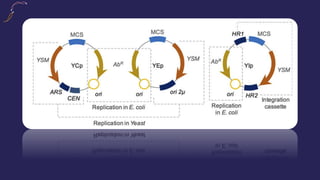
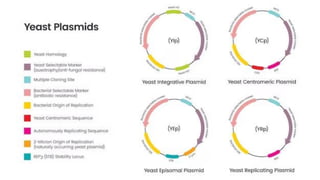
types of yeast
plasmids
Yeast
Integrating
plasmid (YIp)
Yeast
Episomal
plasmid (YEp)
Yeast
Centromeric
plasmid (Ycp)
Yeast vector can:
• Integrate
• Autonomously
replicate
• Resemble artificial
chromosomes
Allowing genes to be isolated,
manipulated, and reinserted in
molecular genetic analysis
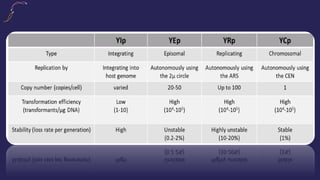
Yeast Integrating plasmid (YIp)
• Propagate and engineer using E. coli as a host
• No yeast origin of replication (must integrated directly into host
chromosome)
• Genome engineering through homologous recombination.
• No yeast replicon, can transform but cannot replicate.
• Requires integration into chromosome for propagation, but very
stable
• Useful for manipulating genes on the chromosome
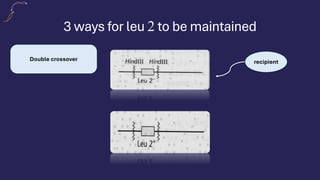
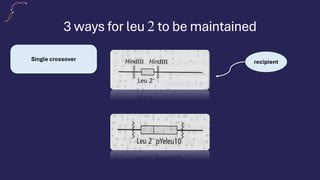
Example: YIp plasmid: leu2 complementation
• Wild-type yeast → grows on minimal medium lacking leucine
because it has the leucine biosynthetic genes
• Leu2 yeast → a mutation in the leu2 gene, that knocks out leucine
biosynthesis, therefore, no growth without leucine
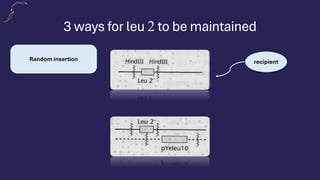
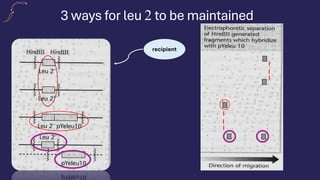
• pYeLeu10 → a plasmid (with no yeast replicon) that contains the
yeast Leu2 gene can it complement the Leu2 mutant yeast
→ a hybrid composed of E.Coli plasmid ColE1 and a
segment of yeast DNA from chromosome III
3 ways for leu 2 to be maintained
Double crossover recipient
3 ways for leu 2 to be maintained
Single crossover recipient
3 ways for leu 2 to be maintained
Random insertion recipient
3 ways for leu 2 to be maintained
recipient
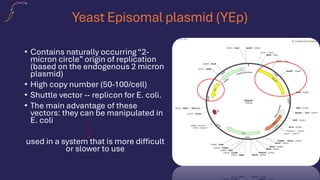
• Contains naturally occurring“2-
micron circle” origin of replication
(based on the endogenous 2 micron
plasmid)
• High copy number (50-100/cell)
• Shuttle vector -- replicon for E. coli.
• The main advantage of these
vectors: they can be manipulated in
E. coli
used in a system that is more difficult
or slower to use
Yeast Episomal plasmid (YEp)
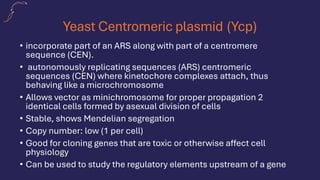
Yeast Centromeric plasmid (Ycp)
• incorporate part of an ARS along with part of a centromere
sequence (CEN).
• autonomously replicating sequences (ARS) centromeric
sequences (CEN) where kinetochore complexes attach, thus
behaving like a microchromosome
• Allows vector as minichromosome for proper propagation 2
identical cells formed by asexual division of cells
• Stable, shows Mendelian segregation
• Copy number: low (1 per cell)
• Good for cloning genes that are toxic or otherwise affect cell
physiology
• Can be used to study the regulatory elements upstream of a gene
References
• Hinnen, A., Hicks, J. B., & Fink, G. R. (1978). Transformation of yeast. Proceedings of the National
Academy of Sciences of the United States of America, 75(4), 1929–1933.
https://doi.org/10.1073/pnas.75.4.1929
• Sengupta, A., Blomqvist, K., Pickett, A. J., Zhang, Y., Chew, J. S., & Dobson, M. J. (2001).
Functional domains of yeast plasmid-encoded Rep proteins. Journal of
bacteriology, 183(7), 2306–2315. https://doi.org/10.1128/JB.183.7.2306-2315.2001
• Ikeda, K., Uchida, N., Nishimura, T., White, J., Martin, R. M., Nakauchi, H., Sebastiano, V.,
Weinberg, K. I., & Porteus, M. H. (2018). Efficient scarless genome editing in human pluripotent
stem cells. Nature methods, 15(12), 1045–1047. https://doi.org/10.1038/s41592-018-0212-y
• https://doi.org/10.1111/1751-7915.13318
• Voth, W. P., Richards, J. D., Shaw, J. M., & Stillman, D. J. (2001). Yeast vectors for
integration at the HO locus. Nucleic acids research, 29(12), E59–e59.
https://doi.org/10.1093/nar/29.12.e59

gene cloning in eukaryotes (gene transfer).pdf

  • 1.
  • 2.
    Difficulties associated withgene cloning in bacteria, especially when dealing with genes from eukaryotic organisms ➢correction of introns of eukaryotic mRNAs ➢Unequal Transfer of Plasmids during Cell Division • yield of two types of cells ➢post-translational modification • inhibition of proteolysis • glycosylation ➢Expression and Stability of Plasmids at Large Scale
  • 3.
    some eukaryotic proteinscannot be easily expressed in large amounts in bacteria, and eukaryotic expression systems need to be employed
  • 4.
    • development ofmethods for the conversion of polyadenylated messenger RNA into double- stranded DNA which could then be inserted into bacterial plasmids and cloned. Libraries from cDNA are lack of information: ➢ Enhancers ➢ Introns ➢ Other regulatory elements found in the genomic cDNA library
  • 5.
    mRNA extraction • RNApurified by: ➢trizol extraction (known as guanidium thiocyanate and phenol mix) ➢column purification. (silica or magnetic beads) oligomeric dT nucleotide-coated resins where only the mRNA having the poly-A tail will bind.
  • 6.
    cDNA construction • Oligo-dtis tagged as a complementary primer binds to the poly-A tail providing a free 3'- OH end that can be extended by reverse transcriptase • cDNA built and mRNA is removed by using an RNAse enzyme leaving a single-stranded cDNA (sscDNA).
  • 7.
    poly(dG) tail is addedby terminal transferase.
  • 8.
    EcoRI sites thatmight be present within the mRNA coding region are protected by methylation using EcoRI methylase
  • 10.
    Screening cDNA Libraries •nitrocellulose membranes serve as replicas of the plates. • Denature DNA • Hybridize with a radioactively labeled single-strand DNA probe. • Washing • detection by autoradiography • The probe sequence can be derived from genome sequencing databases or designed based on the known sequence of a protein. Oligonucleotide probes must only be ~ 20 nucleotides long to recognize unique sequences even in genomic DNA.
  • 11.
    Simple subcloning • Basicprocedure to transfer DNA inserts from one vector to another to study the sequence of insert. • We use the same restriction enzymes to create complementary sticky ends which will facilitate ligation.
  • 12.
    Chimeric gene • Derivedfrom virus gene codes for 35S coat protein of cauliflower mosaic virus which infects cauliflower plants and other plants • Its very strong promoter well known in plant transformation • Highly expressed in dicots • Less effective in monocots • Derived from a gene that encodes a green fluorescent protein (GFP) in jellyfish. • Widely used as a tool in cell biology for visualizing and tracking protein expression in cells and tissues • Derived from plant gene that provides signals for processing, ensures maturation and stability of mRNA transcript. • Allows mRNA to be transported out of the nucleus for transcription into protein in the cytoplasm. Polyadenylation signal Coding region Promoter
  • 13.
    Shuttle vector • constructedby using the bacterial origin of replication in a yeast plasmid which can be manipulated and cloned in bacteria. • they are transferred into yeast cells for the possible expression of eukaryotic genes. • Example: B-lactamase gene (a prokaryotic gene that is expressed in yeast).
  • 14.
    Properties of Shuttlevector • The vector must: • replicate in many organisms (e.g. bacteria, yeast, and plants) to facilitate the isolation and characterization of genes • effectively deliver genetic information for stable maintenance in alternate derived recipients • be easily recognized by selectable markers • be stable • non-pathogenic • non-stress-inducing • be small in size to accommodate DNA inserts • Cloned genes should be easily detected • Useful quantities of the vector must be easily obtained; • The introduced genetic information should be stably maintained as a new heritable determinant.
  • 15.
    Some definitions • Transgenesis:genetic engineering technique where foreign genes are inserted into the genome of an organism • Transgenic: an organism that undergoes transgenesis (GMOs) • Transmission genetics: the study of the mechanisms involved in the passage of a gene from one generation to the next
  • 16.
    The yeast Saccharomycescerevisiae has become the most sophisticated eukaryotic model for recombinant DNA technology.
  • 17.
    Why Saccharomyces cerevisiae? •easy to grow and manipulate (like E.coli) • Fast growth rate • Itself nonpathogenic • biochemistry and cell biology are similar between yeast and “higher” eukaryotes (many gene homologs between yeast and humans, eg. Cell cycle "cancer" genes) • Excellent genetic tools are available in yeast • Carry out PTM such as the removal of a signal sequence from a precursor polypeptide after the secretion of cells • Most of its genes contain introns which are spliced during purification of mature mRNA)introns found in yeast contain sequences for correct splicing as they are totally absent in higher eukaryotes
  • 18.
  • 19.
    Yeast selection nutritional markers antibiotic resistance markers • Prototrophy→ the ability to synthesize all compounds needed for growth • Auxotrophy → the inability to synthesize a compound needed to grow
  • 20.
    • amino acid biosynthetic genes •nucleotide biosynthetic gene
  • 21.
    types of yeast plasmids Yeast Integrating plasmid(YIp) Yeast Episomal plasmid (YEp) Yeast Centromeric plasmid (Ycp) Yeast vector can: • Integrate • Autonomously replicate • Resemble artificial chromosomes Allowing genes to be isolated, manipulated, and reinserted in molecular genetic analysis
  • 22.
    Yeast Integrating plasmid(YIp) • Propagate and engineer using E. coli as a host • No yeast origin of replication (must integrated directly into host chromosome) • Genome engineering through homologous recombination. • No yeast replicon, can transform but cannot replicate. • Requires integration into chromosome for propagation, but very stable • Useful for manipulating genes on the chromosome
  • 23.
    Example: YIp plasmid:leu2 complementation • Wild-type yeast → grows on minimal medium lacking leucine because it has the leucine biosynthetic genes • Leu2 yeast → a mutation in the leu2 gene, that knocks out leucine biosynthesis, therefore, no growth without leucine • pYeLeu10 → a plasmid (with no yeast replicon) that contains the yeast Leu2 gene can it complement the Leu2 mutant yeast → a hybrid composed of E.Coli plasmid ColE1 and a segment of yeast DNA from chromosome III
  • 24.
    3 ways forleu 2 to be maintained Double crossover recipient
  • 25.
    3 ways forleu 2 to be maintained Single crossover recipient
  • 26.
    3 ways forleu 2 to be maintained Random insertion recipient
  • 27.
    3 ways forleu 2 to be maintained recipient
  • 28.
    • Contains naturallyoccurring“2- micron circle” origin of replication (based on the endogenous 2 micron plasmid) • High copy number (50-100/cell) • Shuttle vector -- replicon for E. coli. • The main advantage of these vectors: they can be manipulated in E. coli used in a system that is more difficult or slower to use Yeast Episomal plasmid (YEp)
  • 29.
    Yeast Centromeric plasmid(Ycp) • incorporate part of an ARS along with part of a centromere sequence (CEN). • autonomously replicating sequences (ARS) centromeric sequences (CEN) where kinetochore complexes attach, thus behaving like a microchromosome • Allows vector as minichromosome for proper propagation 2 identical cells formed by asexual division of cells • Stable, shows Mendelian segregation • Copy number: low (1 per cell) • Good for cloning genes that are toxic or otherwise affect cell physiology • Can be used to study the regulatory elements upstream of a gene
  • 33.
    References • Hinnen, A.,Hicks, J. B., & Fink, G. R. (1978). Transformation of yeast. Proceedings of the National Academy of Sciences of the United States of America, 75(4), 1929–1933. https://doi.org/10.1073/pnas.75.4.1929 • Sengupta, A., Blomqvist, K., Pickett, A. J., Zhang, Y., Chew, J. S., & Dobson, M. J. (2001). Functional domains of yeast plasmid-encoded Rep proteins. Journal of bacteriology, 183(7), 2306–2315. https://doi.org/10.1128/JB.183.7.2306-2315.2001 • Ikeda, K., Uchida, N., Nishimura, T., White, J., Martin, R. M., Nakauchi, H., Sebastiano, V., Weinberg, K. I., & Porteus, M. H. (2018). Efficient scarless genome editing in human pluripotent stem cells. Nature methods, 15(12), 1045–1047. https://doi.org/10.1038/s41592-018-0212-y • https://doi.org/10.1111/1751-7915.13318 • Voth, W. P., Richards, J. D., Shaw, J. M., & Stillman, D. J. (2001). Yeast vectors for integration at the HO locus. Nucleic acids research, 29(12), E59–e59. https://doi.org/10.1093/nar/29.12.e59