Epigenetics & Epigenomics
Dr. Shiny C Thomas, Department of Biosciences, ADBU
The Norrbotten epigenetics story
• http://io9.gizmodo.com/how-an-1836-
famine-altered-the-genes-of-children-born-d-
1200001177
Epigenetics
• Epigenetics studies stably heritable traits that
cannot be explained by changes in DNA
sequence.
• Functionally relevant changes to the genome that
do not involve a change in the nucleotide
sequence.
Epigenetics- Mechanisms
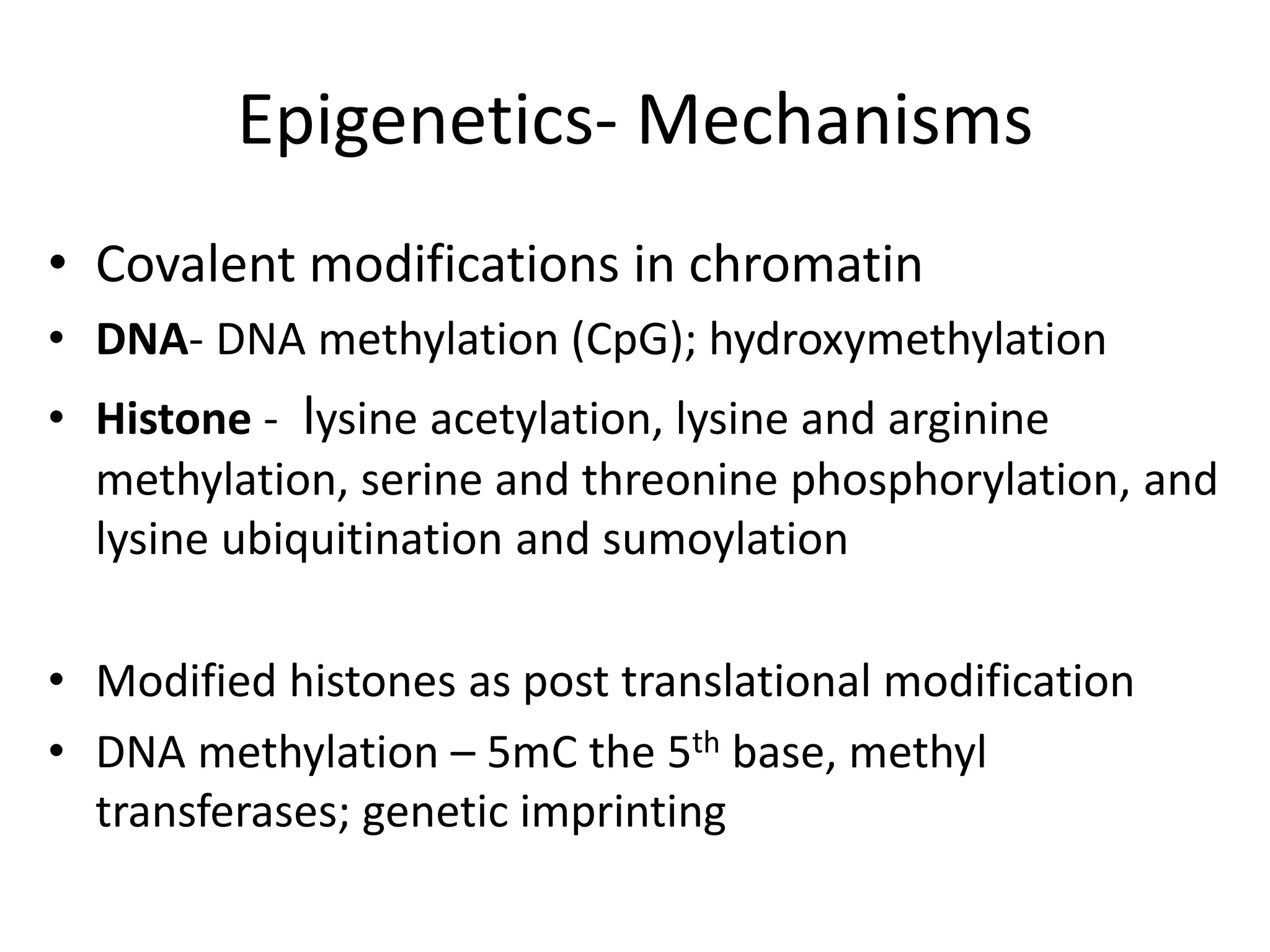
• Covalent modifications in chromatin
• DNA- DNA methylation (CpG); hydroxymethylation
• Histone - lysine acetylation, lysine and arginine
methylation, serine and threonine phosphorylation, and
lysine ubiquitination and sumoylation
• Modified histones as post translational modification
• DNA methylation – 5mC the 5th base, methyl
transferases; genetic imprinting
Epigenetics- Mechanisms
• Histone modifications – N terminii (histone tails) are
most susceptible to modifications
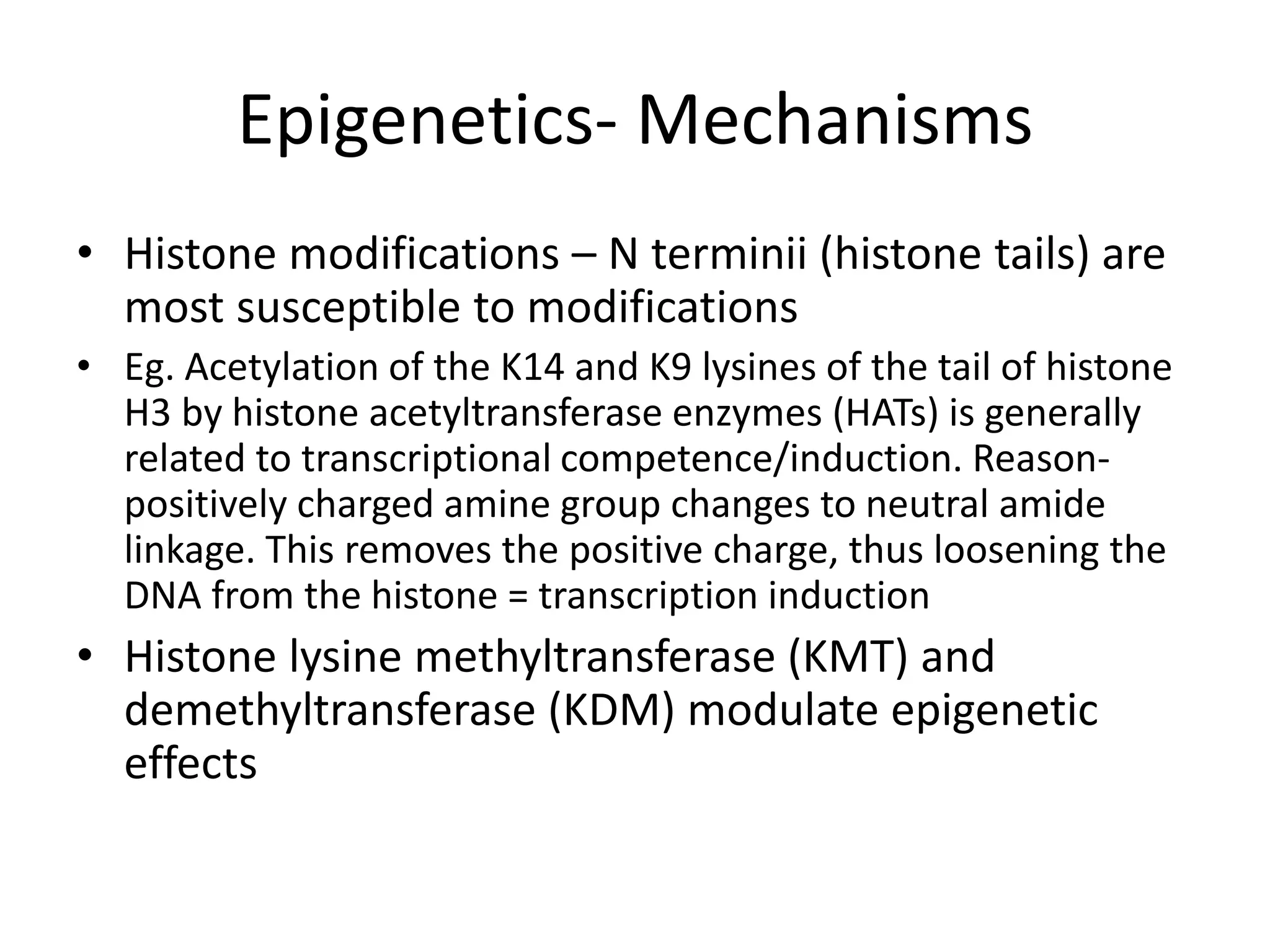
• Eg. Acetylation of the K14 and K9 lysines of the tail of histone
H3 by histone acetyltransferase enzymes (HATs) is generally
related to transcriptional competence/induction. Reason-
positively charged amine group changes to neutral amide
linkage. This removes the positive charge, thus loosening the
DNA from the histone = transcription induction
• Histone lysine methyltransferase (KMT) and
demethyltransferase (KDM) modulate epigenetic
effects
Epigenetics- Mechanisms
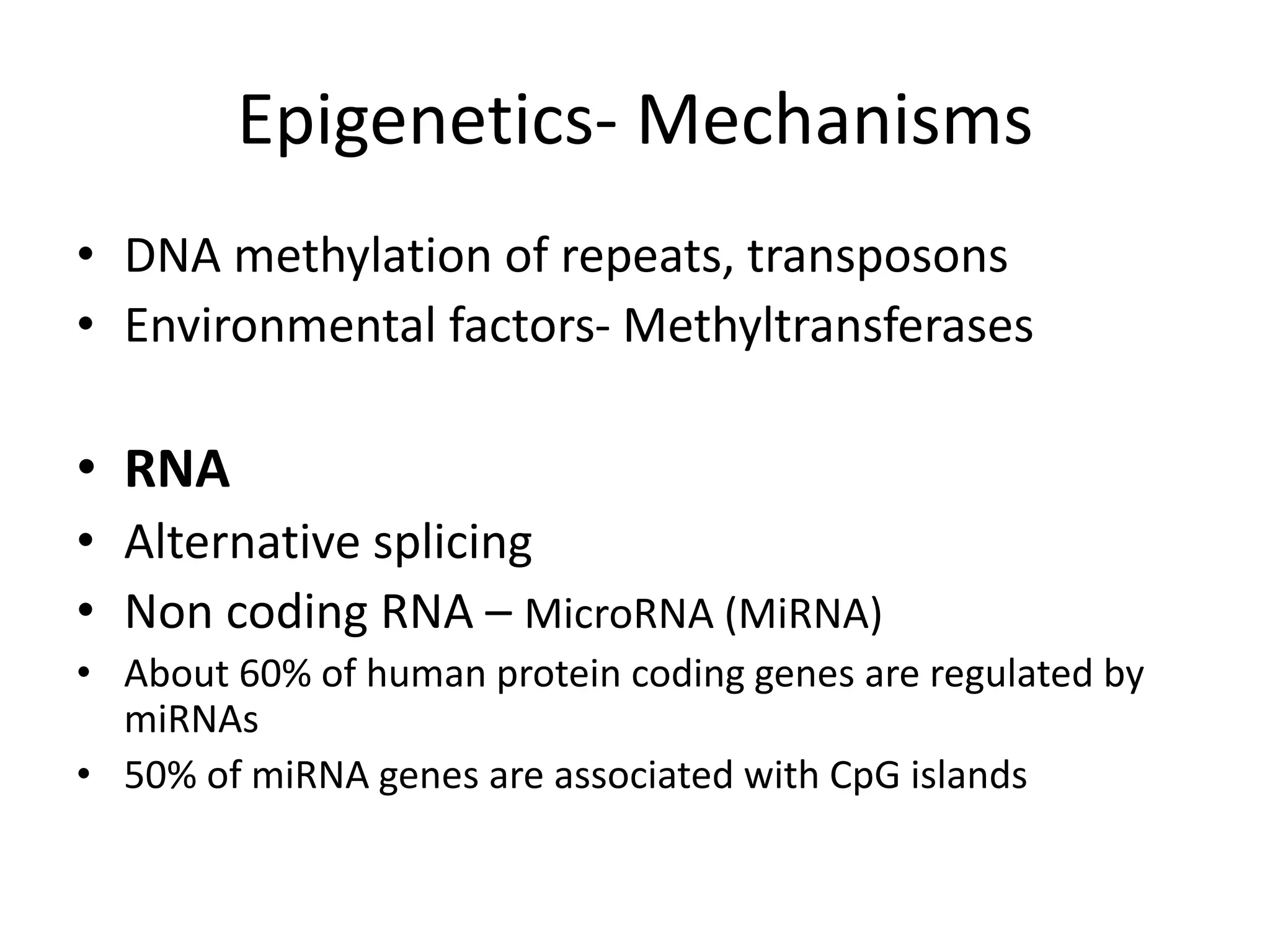
• DNA methylation of repeats, transposons
• Environmental factors- Methyltransferases
• RNA
• Alternative splicing
• Non coding RNA – MicroRNA (MiRNA)
• About 60% of human protein coding genes are regulated by
miRNAs
• 50% of miRNA genes are associated with CpG islands
Functions
• Development
• Transgenerational inheritence
Epigenome
• Epigenomics is the study of the complete set
of epigenetic modifications on the genetic
material of a cell, known as the epigenome.
• Most characterised: DNA methylation and
Histone modiciations
Methods
• Histone modification assays:
• ChIP-Chip; ChIP Seq (array hybridization, NGS)
• DNA methylation assays:
• Restriction endonuclease based
• Compare by use of methylation sensitive
enzyme vs insensitive enzyme
• Restriction Landmark Genome Scanning (RLGS),
array hybridisation, NGS (latest)
Human epigenome project
http://www.epigenome.org/index.php?page=p
roject
Regulatory and Epigenetic
landscapes of mammalian genes
• Mechanisms of gene regulation that can be stably
inherited through mitosis and (sometimes)
meiosis, but can be established and released
without changing the DNA .
• The study of heritable changes in gene activity
that are not caused by changes in the DNA
sequence.
• It includes all forms of gene regulation
WHAT IS EPIGENETICS
• All our cells contain the same genes, different
cells and tissues differ in which genes they
express.
• These differences are created and maintained by
gene regulation, not by changes in the DNA
sequence.
• Some gene regulation has evolved to respond
easily to changing conditions within the lifetime
of a single cell.
Functions of Epigenetic Regulation
1. DNA methylation
2. Covalent Histone modifications
3. Chromatin remodelling or non covalent
modifications
4. Non coding RNA
Epigenetic Mechanisms
• It plays an important role in regulating gene
expression.
• Methylation of DNA is direct chemical
modification of a cytosine nucleotides within a
continuous stretch of DNA, specifically at the 5-
position of the pyrimidine ring.
• Not all cytosines can be methylated; cytosines
must be immediately followed by a guanine in
order to be methylated.
DNA Methylation
• Histones are highly basic proteins whose function is to
organize DNA within the nucleus.
• Histone modifications can lead to either activation or
repression depending upon which residues are modified and
the type of modifications present. For example, lysine
methylation leads to transcriptional activation.
• These modifications serve as epigenetic tags or marks.
• Histone proteins have tails that can have a number of post-
translational modifications including acetylation,
methylation, phosphorylation, ubiquitylation, sumoylation,
ADP-ribosylation, glycosylation etc.
Covalent Histone Modification
• It is the post translational modification of the
amino acids that make up histone proteins
• As the histones increase the compaction of the
DNA , it depresses the genetic activity and vice–
a-versa.
• TYPES OF CHROMATIN REMODELLING
1.Sliding over 2. Histone eviction
3. Replacement with variant histones
Chromatin Remodelling / Non
Covalent Modification
• It includes short interfering RNAs (siRNAs), microRNAs
(miRNAs), and long non coding RNAs (lncRNAs) .
• It play important roles in gene expression regulation at
post-transcriptional level by mRNA degradation, during
splicing.
miRNAs
• A micro RNA is a small non-coding RNA molecule.
• It is about 22 nucleotides long.
• It functions in RNA silencing and post-transcriptional
regulation of gene expression.
Non coding RNA
siRNA
• Short interfering RNA or silencing RNA.
• double-stranded RNA molecules, 20-25 base pairs
long.
• Role in the RNA interference (RNAi) pathway.
lncRNAs
• Long non-coding RNAs (long ncRNAs, lncRNA)
• longer than 200 nucleotides.
• LincRNA play an important role in developmental
processes such as X-chromosome inactivation and
genomic imprinting.
• RNA interference
RNA interference (RNAi) is a mechanism whereby the expression
of genes is disrupted through the action of double-stranded RNA
molecules.
• X inactivation (Lyonization)
Females silence one of their two X-chromosomes through a
process referred to as X-chromosome inactivation, to compensate
gene dosage disparities.
• Genomic imprinting
Phenomenon by which certain genes are expressed in a parent of-
origin- specific manner. If the allele inherited from the father is
imprinted, it is thereby silenced, only the allele from the mother is
expressed and vice versa.
Specific Epigenetic Regulation
• The maintenance of the epigenetic state is important
throughout life for the production of differentiated cells from
adult stem cells and proper gene expression in specific cell
types.
• The epigenomic state is dynamic and tightly regulated, and
misregulation of epigenetic patterns are observed in many
human diseases and multiple types of cancers.
• Changes in the epigenome are also correlated with the aging
process.
• Some diseases have epigenetic causes like Prader-Willi
syndrome, Angelman syndrome are all the result of
uniparental disomy (UPD), a condition in which a person
inherits both homologous chromosomes from the same
parent. UPD can be the result of gene deletion, translocation,
or a defect in imprinting.
EPIGENETICS IN DEVELOPMENT &
DISEASE
• They are the means to maintain and manipulate the large
amount of data produced by sequencing epigenomes.
• Epigenetic marks are associated with specific diseases, tools
can be developed to diagnose patients and measure the
severity of disease.
• In therapeutic epigenetics several drugs, such as DNA
methyltransferase inhibitors and histone deacetylase
inhibitors, are already used in cancer treatment.
• Likewise, better understanding of the various epigenetic
diseases and syndromes may lead to effective drugs designed
to overcome epigenetic defects.
CONCLUSION

Epigenetics & Epigenomics .pdf

  • 1.
    Epigenetics & Epigenomics Dr.Shiny C Thomas, Department of Biosciences, ADBU
  • 2.
    The Norrbotten epigeneticsstory • http://io9.gizmodo.com/how-an-1836- famine-altered-the-genes-of-children-born-d- 1200001177
  • 3.
    Epigenetics • Epigenetics studiesstably heritable traits that cannot be explained by changes in DNA sequence. • Functionally relevant changes to the genome that do not involve a change in the nucleotide sequence.
  • 4.
    Epigenetics- Mechanisms • Covalentmodifications in chromatin • DNA- DNA methylation (CpG); hydroxymethylation • Histone - lysine acetylation, lysine and arginine methylation, serine and threonine phosphorylation, and lysine ubiquitination and sumoylation • Modified histones as post translational modification • DNA methylation – 5mC the 5th base, methyl transferases; genetic imprinting
  • 5.
    Epigenetics- Mechanisms • Histonemodifications – N terminii (histone tails) are most susceptible to modifications • Eg. Acetylation of the K14 and K9 lysines of the tail of histone H3 by histone acetyltransferase enzymes (HATs) is generally related to transcriptional competence/induction. Reason- positively charged amine group changes to neutral amide linkage. This removes the positive charge, thus loosening the DNA from the histone = transcription induction • Histone lysine methyltransferase (KMT) and demethyltransferase (KDM) modulate epigenetic effects
  • 6.
    Epigenetics- Mechanisms • DNAmethylation of repeats, transposons • Environmental factors- Methyltransferases • RNA • Alternative splicing • Non coding RNA – MicroRNA (MiRNA) • About 60% of human protein coding genes are regulated by miRNAs • 50% of miRNA genes are associated with CpG islands
  • 7.
  • 8.
    Epigenome • Epigenomics isthe study of the complete set of epigenetic modifications on the genetic material of a cell, known as the epigenome. • Most characterised: DNA methylation and Histone modiciations
  • 9.
    Methods • Histone modificationassays: • ChIP-Chip; ChIP Seq (array hybridization, NGS) • DNA methylation assays: • Restriction endonuclease based • Compare by use of methylation sensitive enzyme vs insensitive enzyme • Restriction Landmark Genome Scanning (RLGS), array hybridisation, NGS (latest)
  • 10.
  • 11.
  • 12.
    • Mechanisms ofgene regulation that can be stably inherited through mitosis and (sometimes) meiosis, but can be established and released without changing the DNA . • The study of heritable changes in gene activity that are not caused by changes in the DNA sequence. • It includes all forms of gene regulation WHAT IS EPIGENETICS
  • 13.
    • All ourcells contain the same genes, different cells and tissues differ in which genes they express. • These differences are created and maintained by gene regulation, not by changes in the DNA sequence. • Some gene regulation has evolved to respond easily to changing conditions within the lifetime of a single cell. Functions of Epigenetic Regulation
  • 14.
    1. DNA methylation 2.Covalent Histone modifications 3. Chromatin remodelling or non covalent modifications 4. Non coding RNA Epigenetic Mechanisms
  • 15.
    • It playsan important role in regulating gene expression. • Methylation of DNA is direct chemical modification of a cytosine nucleotides within a continuous stretch of DNA, specifically at the 5- position of the pyrimidine ring. • Not all cytosines can be methylated; cytosines must be immediately followed by a guanine in order to be methylated. DNA Methylation
  • 16.
    • Histones arehighly basic proteins whose function is to organize DNA within the nucleus. • Histone modifications can lead to either activation or repression depending upon which residues are modified and the type of modifications present. For example, lysine methylation leads to transcriptional activation. • These modifications serve as epigenetic tags or marks. • Histone proteins have tails that can have a number of post- translational modifications including acetylation, methylation, phosphorylation, ubiquitylation, sumoylation, ADP-ribosylation, glycosylation etc. Covalent Histone Modification
  • 17.
    • It isthe post translational modification of the amino acids that make up histone proteins • As the histones increase the compaction of the DNA , it depresses the genetic activity and vice– a-versa. • TYPES OF CHROMATIN REMODELLING 1.Sliding over 2. Histone eviction 3. Replacement with variant histones Chromatin Remodelling / Non Covalent Modification
  • 19.
    • It includesshort interfering RNAs (siRNAs), microRNAs (miRNAs), and long non coding RNAs (lncRNAs) . • It play important roles in gene expression regulation at post-transcriptional level by mRNA degradation, during splicing. miRNAs • A micro RNA is a small non-coding RNA molecule. • It is about 22 nucleotides long. • It functions in RNA silencing and post-transcriptional regulation of gene expression. Non coding RNA
  • 20.
    siRNA • Short interferingRNA or silencing RNA. • double-stranded RNA molecules, 20-25 base pairs long. • Role in the RNA interference (RNAi) pathway. lncRNAs • Long non-coding RNAs (long ncRNAs, lncRNA) • longer than 200 nucleotides. • LincRNA play an important role in developmental processes such as X-chromosome inactivation and genomic imprinting.
  • 21.
    • RNA interference RNAinterference (RNAi) is a mechanism whereby the expression of genes is disrupted through the action of double-stranded RNA molecules. • X inactivation (Lyonization) Females silence one of their two X-chromosomes through a process referred to as X-chromosome inactivation, to compensate gene dosage disparities. • Genomic imprinting Phenomenon by which certain genes are expressed in a parent of- origin- specific manner. If the allele inherited from the father is imprinted, it is thereby silenced, only the allele from the mother is expressed and vice versa. Specific Epigenetic Regulation
  • 22.
    • The maintenanceof the epigenetic state is important throughout life for the production of differentiated cells from adult stem cells and proper gene expression in specific cell types. • The epigenomic state is dynamic and tightly regulated, and misregulation of epigenetic patterns are observed in many human diseases and multiple types of cancers. • Changes in the epigenome are also correlated with the aging process. • Some diseases have epigenetic causes like Prader-Willi syndrome, Angelman syndrome are all the result of uniparental disomy (UPD), a condition in which a person inherits both homologous chromosomes from the same parent. UPD can be the result of gene deletion, translocation, or a defect in imprinting. EPIGENETICS IN DEVELOPMENT & DISEASE
  • 23.
    • They arethe means to maintain and manipulate the large amount of data produced by sequencing epigenomes. • Epigenetic marks are associated with specific diseases, tools can be developed to diagnose patients and measure the severity of disease. • In therapeutic epigenetics several drugs, such as DNA methyltransferase inhibitors and histone deacetylase inhibitors, are already used in cancer treatment. • Likewise, better understanding of the various epigenetic diseases and syndromes may lead to effective drugs designed to overcome epigenetic defects. CONCLUSION