Gene transfer in plants
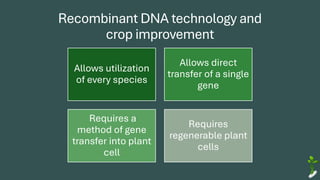
Recombinant DNA technology and
crop improvement
Allows utilization
of every species
Allows direct
transfer of a single
gene
Requires a
method of gene
transfer into plant
cell
Requires
regenerable plant
cells
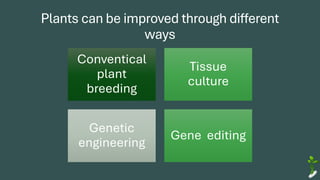
Plants can be improved through different
ways
Conventical
plant
breeding
Tissue
culture
Genetic
engineering
Gene editing
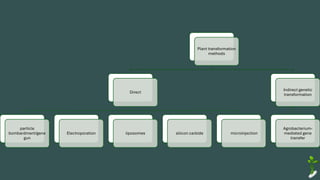
Plant transformation
methods
Direct
particle
bombardment/gene
gun
Electroporation liposomes silicon carbide microinjection
Indirect genetic
transformation
Agrobacterium-
mediated gene
transfer
Agrobacterium is the only cellular organism on Earth that is naturally capable of
transferring genetic material between the kingdoms of life, from prokaryotes to
eukaryotes
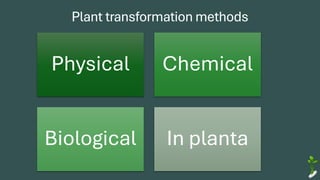
Plant transformation methods
Physical Chemical
Biological In planta
Plant transformation methods
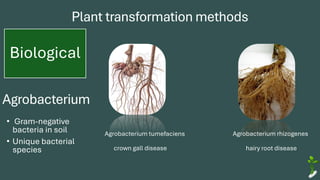
Biological
Agrobacterium
Agrobacterium tumefaciens Agrobacterium rhizogenes
• Gram-negative
bacteria in soil
• Unique bacterial
species crown gall disease hairy root disease
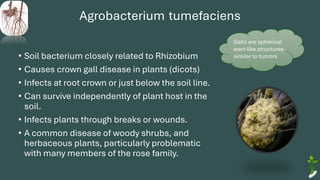
Agrobacterium tumefaciens
• Soil bacterium closely related to Rhizobium
• Causes crown gall disease in plants (dicots)
• Infects at root crown or just below the soil line.
• Can survive independently of plant host in the
soil.
• Infects plants through breaks or wounds.
• A common disease of woody shrubs, and
herbaceous plants, particularly problematic
with many members of the rose family.
Galls are spherical
wart-like structures
similar to tumors
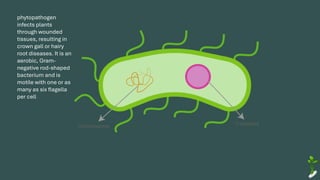
phytopathogen
infects plants
through wounded
tissues, resulting in
crown gall or hairy
root diseases. It is an
aerobic, Gram-
negative rod-shaped
bacterium and is
motile with one or as
many as six flagella
per cell
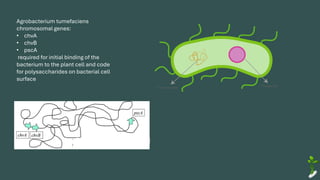
Agrobacterium tumefaciens
chromosomal genes:
• chvA
• chvB
• pscA
required for initial binding of the
bacterium to the plant cell and code
for polysaccharides on bacterial cell
surface
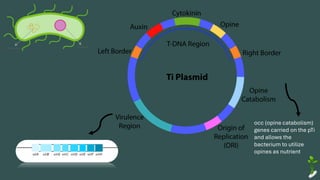
occ (opine catabolism)
genes carried on the pTi
and allows the
bacterium to utilize
opines as nutrient
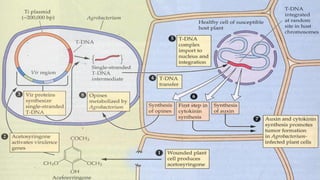
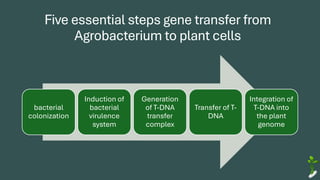
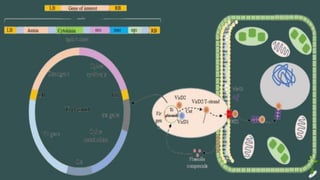
Five essential steps gene transfer from
Agrobacterium to plant cells
bacterial
colonization
Induction of
bacterial
virulence
system
Generation
of T-DNA
transfer
complex
Transfer of T-
DNA
Integration of
T-DNA into
the plant
genome
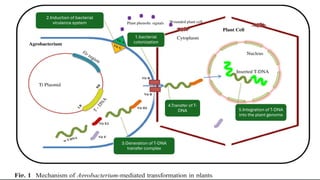
1.bacterial
colonization
2.Induction of bacterial
virulence system
3.Generation of T-DNA
transfer complex
4.Transfer of T-
DNA 5.Integration of T-DNA
into the plant genome
Agrobacterium tumefaciens
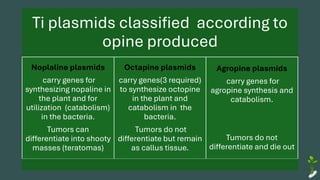
Ti plasmids classified according to
opine produced
Noplaline plasmids
carry genes for
synthesizing nopaline in
the plant and for
utilization (catabolism)
in the bacteria.
Tumors can
differentiate into shooty
masses (teratomas)
Octapine plasmids
carry genes(3 required)
to synthesize octopine
in the plant and
catabolism in the
bacteria.
Tumors do not
differentiate but remain
as callus tissue.
Agropine plasmids
carry genes for
agropine synthesis and
catabolism.
Tumors do not
differentiate and die out
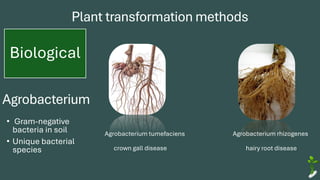
Plant transformation methods
Biological
Agrobacterium
Agrobacterium tumefaciens Agrobacterium rhizogenes
• Gram-negative
bacteria in soil
• Unique bacterial
species crown gall disease hairy root disease
Agrobacterium rhizogenes
• capable of entering a plant through a wound and causing a
proliferation of secondary roots
• Hairy roots are unique in their genetic and biosynthetic
stability. Their fast growth, low doubling time, ease of
maintenance, and ability to synthesize a range of chemical
compounds offer an additional advantage as a continuous
source for the production of valuable secondary
metabolites
• Hairy roots display stable phenotypes over multiple
generations (advantageous for studying gene function and
evaluating the effects of gene expression on plant traits)
Ri plasmids classified according to
opine produced
Agropine-type Ri-plasmid has 2
separate T-DNA regions:
TL-DNA (15-20Kb)
Nonintegrated plasmids DNA (15Kb)
TR-DNA (15-20Kb)
mannopine type Ri-plasmids
Has only one T-DNA (shares DNA
sequence homology with TL of the
agropine-type plasmids)
The complete nucleotide sequence of
the TL-region revealed the presence of
18 (ORFs), 4 of which, ORFs 10, 11,12
and 15, respectively, correspond to
the rolA,rolB, rolC, and rolD loci.
References
• [1]M. Naseem et al., “The effects of ginkgo biloba leaf extract on metabolic disturbances associated to alloxan-
induced diabetic rats,” J. Anim. Plant Sci., vol. 26, no. 3, pp. 627–635, 2016, doi: 10.1128/MMBR.67.1.16.
• [2]P. B. Moses, Gene Transfer Methods Applicable to Agricultural Organisms. 1987.
• [3]S. Mehrotra and V. Goyal, “Agrobacterium-Mediated Gene Transfer in Plants and Biosafety Considerations,” Appl.
Biochem. Biotechnol., vol. 168, no. 7, pp. 1953–1975, 2012, doi: 10.1007/s12010-012-9910-6.
• [4]G. Keshavareddy, A. R. V. Kumar, and V. S. Ramu, “Methods of Plant Transformation- A Review,” Int. J. Curr.
Microbiol. Appl. Sci., vol. 7, no. 07, pp. 2656–2668, 2018, doi: 10.20546/ijcmas.2018.707.312.
• [5]S. Rahangdale, J. Nehru, K. Vishwavidyalaya, Y. Singh, J. Nehru, and K. Vishwavidyalaya, “Advances in Biological
Sciences and Biotechnology,” Adv. Biol. Sci. Biotechnol., no. January, 2020, doi: 10.22271/int.book.11.
• [6]W. Su, M. Xu, Y. Radani, and L. Yang, “Technological Development and Application of Plant Genetic
Transformation,” Int. J. Mol. Sci., vol. 24, no. 13, 2023, doi: 10.3390/ijms241310646.
• [7]P. J. Larkin, Genetic engineering of plants — agricultural research opportunities and policy concerns, vol. 16, no. 2.
1986. doi: 10.1016/0167-8809(86)90104-0.
• [8]J. R. Zupan and P. Zambryski, “Transfer of T-DNA from,” no. 1 995.
• [9]R. Imai et al., “In planta particle bombardment (IPB): A new method for plant transformation and genome editing,”
Plant Biotechnol., vol. 37, no. 2, pp. 171–176, 2020, doi: 10.5511/PLANTBIOTECHNOLOGY.20.0206A.
• [10]Y. Zhang, Q. Zhang, and Q. J. Chen, “Agrobacterium-mediated delivery of CRISPR/Cas reagents for genome editing
in plants enters an era of ternary vector systems,” Sci. China Life Sci., vol. 63, no. 10, pp. 1491–1498, 2020, doi:
10.1007/s11427-020-1685-9.

Gene transfer in plants agrobacterium.pdf

  • 1.
  • 2.
    Recombinant DNA technologyand crop improvement Allows utilization of every species Allows direct transfer of a single gene Requires a method of gene transfer into plant cell Requires regenerable plant cells
  • 3.
    Plants can beimproved through different ways Conventical plant breeding Tissue culture Genetic engineering Gene editing
  • 4.
    Plant transformation methods Direct particle bombardment/gene gun Electroporation liposomessilicon carbide microinjection Indirect genetic transformation Agrobacterium- mediated gene transfer
  • 5.
    Agrobacterium is theonly cellular organism on Earth that is naturally capable of transferring genetic material between the kingdoms of life, from prokaryotes to eukaryotes
  • 6.
    Plant transformation methods PhysicalChemical Biological In planta
  • 7.
    Plant transformation methods Biological Agrobacterium Agrobacteriumtumefaciens Agrobacterium rhizogenes • Gram-negative bacteria in soil • Unique bacterial species crown gall disease hairy root disease
  • 8.
    Agrobacterium tumefaciens • Soilbacterium closely related to Rhizobium • Causes crown gall disease in plants (dicots) • Infects at root crown or just below the soil line. • Can survive independently of plant host in the soil. • Infects plants through breaks or wounds. • A common disease of woody shrubs, and herbaceous plants, particularly problematic with many members of the rose family. Galls are spherical wart-like structures similar to tumors
  • 9.
    phytopathogen infects plants through wounded tissues,resulting in crown gall or hairy root diseases. It is an aerobic, Gram- negative rod-shaped bacterium and is motile with one or as many as six flagella per cell
  • 10.
    Agrobacterium tumefaciens chromosomal genes: •chvA • chvB • pscA required for initial binding of the bacterium to the plant cell and code for polysaccharides on bacterial cell surface
  • 11.
    occ (opine catabolism) genescarried on the pTi and allows the bacterium to utilize opines as nutrient
  • 13.
    Five essential stepsgene transfer from Agrobacterium to plant cells bacterial colonization Induction of bacterial virulence system Generation of T-DNA transfer complex Transfer of T- DNA Integration of T-DNA into the plant genome
  • 14.
    1.bacterial colonization 2.Induction of bacterial virulencesystem 3.Generation of T-DNA transfer complex 4.Transfer of T- DNA 5.Integration of T-DNA into the plant genome
  • 16.
  • 17.
    Ti plasmids classifiedaccording to opine produced Noplaline plasmids carry genes for synthesizing nopaline in the plant and for utilization (catabolism) in the bacteria. Tumors can differentiate into shooty masses (teratomas) Octapine plasmids carry genes(3 required) to synthesize octopine in the plant and catabolism in the bacteria. Tumors do not differentiate but remain as callus tissue. Agropine plasmids carry genes for agropine synthesis and catabolism. Tumors do not differentiate and die out
  • 18.
    Plant transformation methods Biological Agrobacterium Agrobacteriumtumefaciens Agrobacterium rhizogenes • Gram-negative bacteria in soil • Unique bacterial species crown gall disease hairy root disease
  • 19.
    Agrobacterium rhizogenes • capableof entering a plant through a wound and causing a proliferation of secondary roots • Hairy roots are unique in their genetic and biosynthetic stability. Their fast growth, low doubling time, ease of maintenance, and ability to synthesize a range of chemical compounds offer an additional advantage as a continuous source for the production of valuable secondary metabolites • Hairy roots display stable phenotypes over multiple generations (advantageous for studying gene function and evaluating the effects of gene expression on plant traits)
  • 20.
    Ri plasmids classifiedaccording to opine produced Agropine-type Ri-plasmid has 2 separate T-DNA regions: TL-DNA (15-20Kb) Nonintegrated plasmids DNA (15Kb) TR-DNA (15-20Kb) mannopine type Ri-plasmids Has only one T-DNA (shares DNA sequence homology with TL of the agropine-type plasmids) The complete nucleotide sequence of the TL-region revealed the presence of 18 (ORFs), 4 of which, ORFs 10, 11,12 and 15, respectively, correspond to the rolA,rolB, rolC, and rolD loci.
  • 21.
    References • [1]M. Naseemet al., “The effects of ginkgo biloba leaf extract on metabolic disturbances associated to alloxan- induced diabetic rats,” J. Anim. Plant Sci., vol. 26, no. 3, pp. 627–635, 2016, doi: 10.1128/MMBR.67.1.16. • [2]P. B. Moses, Gene Transfer Methods Applicable to Agricultural Organisms. 1987. • [3]S. Mehrotra and V. Goyal, “Agrobacterium-Mediated Gene Transfer in Plants and Biosafety Considerations,” Appl. Biochem. Biotechnol., vol. 168, no. 7, pp. 1953–1975, 2012, doi: 10.1007/s12010-012-9910-6. • [4]G. Keshavareddy, A. R. V. Kumar, and V. S. Ramu, “Methods of Plant Transformation- A Review,” Int. J. Curr. Microbiol. Appl. Sci., vol. 7, no. 07, pp. 2656–2668, 2018, doi: 10.20546/ijcmas.2018.707.312. • [5]S. Rahangdale, J. Nehru, K. Vishwavidyalaya, Y. Singh, J. Nehru, and K. Vishwavidyalaya, “Advances in Biological Sciences and Biotechnology,” Adv. Biol. Sci. Biotechnol., no. January, 2020, doi: 10.22271/int.book.11. • [6]W. Su, M. Xu, Y. Radani, and L. Yang, “Technological Development and Application of Plant Genetic Transformation,” Int. J. Mol. Sci., vol. 24, no. 13, 2023, doi: 10.3390/ijms241310646. • [7]P. J. Larkin, Genetic engineering of plants — agricultural research opportunities and policy concerns, vol. 16, no. 2. 1986. doi: 10.1016/0167-8809(86)90104-0. • [8]J. R. Zupan and P. Zambryski, “Transfer of T-DNA from,” no. 1 995. • [9]R. Imai et al., “In planta particle bombardment (IPB): A new method for plant transformation and genome editing,” Plant Biotechnol., vol. 37, no. 2, pp. 171–176, 2020, doi: 10.5511/PLANTBIOTECHNOLOGY.20.0206A. • [10]Y. Zhang, Q. Zhang, and Q. J. Chen, “Agrobacterium-mediated delivery of CRISPR/Cas reagents for genome editing in plants enters an era of ternary vector systems,” Sci. China Life Sci., vol. 63, no. 10, pp. 1491–1498, 2020, doi: 10.1007/s11427-020-1685-9.