Spin column extraction
method
Advantages
less time
consumption
Economical
energy-
efficient
automated
operation
prevention
from cross-
contamination
high yield
environment
friendly
adaptability
significant
scalability
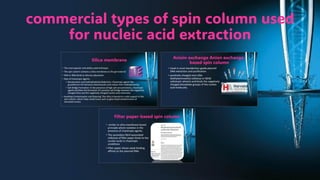
commercial types of spin column used
for nucleic acid extraction
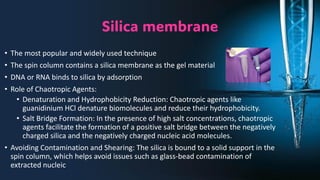
Silica membrane
• The most popular and widely used technique
• The spin column contains a silica membrane as the gel material
• DNA or RNA binds to silica by adsorption
• Role of Chaotropic Agents:
• Denaturation and Hydrophobicity Reduction: Chaotropic agents like
guanidinium HCl denature biomolecules and reduce their hydrophobicity.
• Salt Bridge Formation: In the presence of high salt concentrations, chaotropic
agents facilitate the formation of a positive salt bridge between the negatively
charged silica and the negatively charged nucleic acid molecules.
• Avoiding Contamination and Shearing: The silica is bound to a solid support in the
spin column, which helps avoid issues such as glass-bead contamination of
extracted nucleic
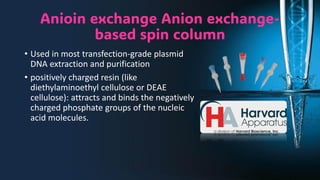
Anioin exchange Anion exchange-
based spin column
• Used in most transfection-grade plasmid
DNA extraction and purification
• positively charged resin (like
diethylaminoethyl cellulose or DEAE
cellulose): attracts and binds the negatively
charged phosphate groups of the nucleic
acid molecules.
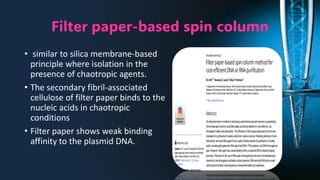
Filter paper-based spin column
• similar to silica membrane-based
principle where isolation in the
presence of chaotropic agents.
• The secondary fibril-associated
cellulose of filter paper binds to the
nucleic acids in chaotropic
conditions
• Filter paper shows weak binding
affinity to the plasmid DNA.
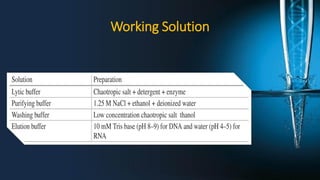
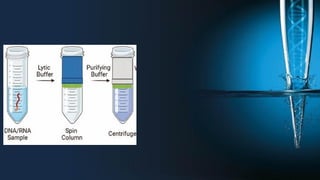
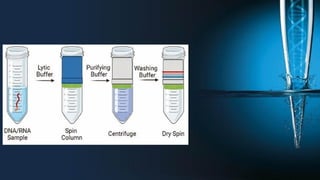
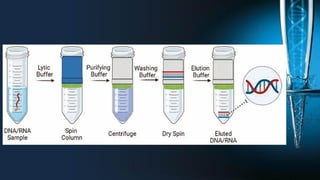
Working Solution
5 – stages process
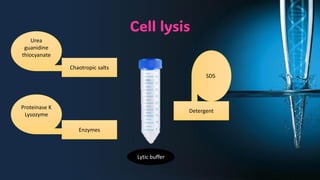
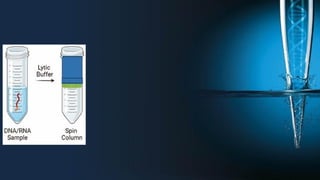
Cell lysis
Lytic buffer
Chaotropic salts
Detergent
Enzymes
Urea
guanidine
thiocyanate
Proteinase K
Lysozyme
SDS
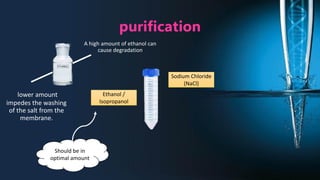
purification
Ethanol /
Isopropanol
Sodium Chloride
(NaCl)
Should be in
optimal amount
lower amount
impedes the washing
of the salt from the
membrane.
A high amount of ethanol can
cause degradation
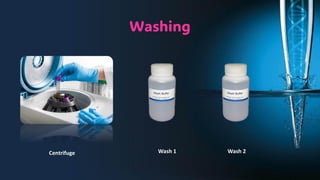
Washing
Centrifuge Wash 1 Wash 2
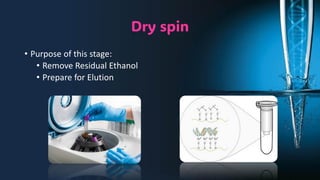
Dry spin
• Purpose of this stage:
• Remove Residual Ethanol
• Prepare for Elution
Elution
For DNA
• DNA is stable in a basic pH
medium and dissolves in it faster
than water.
• A basic buffer of 10 mM Tris at
pH 8–9 is generally used.
For RNA
• water is used as eluent
(RNase-free Water)as water
pH is 4–5. This is because
nucleic acid is more stable
and dissolves easily in
slightly acidic pH.
References
• Gautam, A. (2022). Spin column-based isolation of nucleic acid. In
DNA and RNA Isolation Techniques for Non-Experts (pp. 47-53).
Cham: Springer International Publishing.
• Shin, J. H. (2013). Nucleic acid extraction techniques. Advanced
Techniques in Diagnostic Microbiology, 209-225
• Shin J. H. (2012). Nucleic Acid Extraction Techniques. Advanced
Techniques in Diagnostic Microbiology, 209–225.
https://doi.org/10.1007/978-1-4614-3970-7_11
• Shi, R., Lewis, R. S., & Panthee, D. R. (2018). Filter paper-based spin
column method for cost-efficient DNA or RNA purification. PloS one,
13(12), e0203011. https://doi.org/10.1371/journal.pone.0203011

Spin column extraction method molecular biology course.pdf

  • 1.
  • 2.
  • 3.
    commercial types ofspin column used for nucleic acid extraction
  • 4.
    Silica membrane • Themost popular and widely used technique • The spin column contains a silica membrane as the gel material • DNA or RNA binds to silica by adsorption • Role of Chaotropic Agents: • Denaturation and Hydrophobicity Reduction: Chaotropic agents like guanidinium HCl denature biomolecules and reduce their hydrophobicity. • Salt Bridge Formation: In the presence of high salt concentrations, chaotropic agents facilitate the formation of a positive salt bridge between the negatively charged silica and the negatively charged nucleic acid molecules. • Avoiding Contamination and Shearing: The silica is bound to a solid support in the spin column, which helps avoid issues such as glass-bead contamination of extracted nucleic
  • 5.
    Anioin exchange Anionexchange- based spin column • Used in most transfection-grade plasmid DNA extraction and purification • positively charged resin (like diethylaminoethyl cellulose or DEAE cellulose): attracts and binds the negatively charged phosphate groups of the nucleic acid molecules.
  • 6.
    Filter paper-based spincolumn • similar to silica membrane-based principle where isolation in the presence of chaotropic agents. • The secondary fibril-associated cellulose of filter paper binds to the nucleic acids in chaotropic conditions • Filter paper shows weak binding affinity to the plasmid DNA.
  • 7.
  • 8.
    5 – stagesprocess
  • 9.
    Cell lysis Lytic buffer Chaotropicsalts Detergent Enzymes Urea guanidine thiocyanate Proteinase K Lysozyme SDS
  • 10.
    purification Ethanol / Isopropanol Sodium Chloride (NaCl) Shouldbe in optimal amount lower amount impedes the washing of the salt from the membrane. A high amount of ethanol can cause degradation
  • 11.
  • 12.
    Dry spin • Purposeof this stage: • Remove Residual Ethanol • Prepare for Elution
  • 13.
    Elution For DNA • DNAis stable in a basic pH medium and dissolves in it faster than water. • A basic buffer of 10 mM Tris at pH 8–9 is generally used. For RNA • water is used as eluent (RNase-free Water)as water pH is 4–5. This is because nucleic acid is more stable and dissolves easily in slightly acidic pH.
  • 19.
    References • Gautam, A.(2022). Spin column-based isolation of nucleic acid. In DNA and RNA Isolation Techniques for Non-Experts (pp. 47-53). Cham: Springer International Publishing. • Shin, J. H. (2013). Nucleic acid extraction techniques. Advanced Techniques in Diagnostic Microbiology, 209-225 • Shin J. H. (2012). Nucleic Acid Extraction Techniques. Advanced Techniques in Diagnostic Microbiology, 209–225. https://doi.org/10.1007/978-1-4614-3970-7_11 • Shi, R., Lewis, R. S., & Panthee, D. R. (2018). Filter paper-based spin column method for cost-efficient DNA or RNA purification. PloS one, 13(12), e0203011. https://doi.org/10.1371/journal.pone.0203011