PRESENTATION
ON
DNA METHYLATION
PRESENTED BY
B.R ADITYA
EPIGENETICS
•Study of heritable changes in gene expression that
occur without changes in a DNA sequence.
•Dynamic process that plays a key role in normal cell
growth and differentiation.
•To date the best understood epigenetic mechanism are
1.DNA MEHYLATION.
2.HISTONE MODIFICATION
What is DNA METHYLATION
•DNA Methylation is one is one of the most
commonly occurring epigenetic events taking
place in the mammalian genome.
•DNA Methylation pattern is determined during
embryogenesis and passed over to differentiating
cells and tissue.
•The DNA of most organisms is modified by a
post replicative process which results in three
types of methylated bases in DNA.
•C5 –methylcytosine (5-mc).
•N4- methylcytosine
•N6-methyladenne
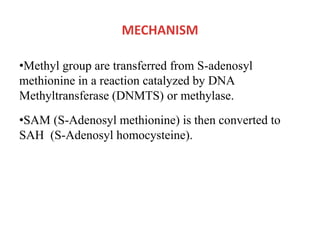
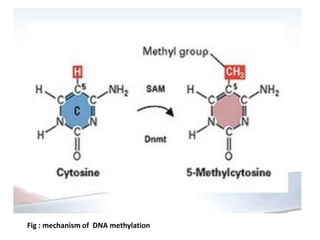
MECHANISM
•Methyl group are transferred from S-adenosyl
methionine in a reaction catalyzed by DNA
Methyltransferase (DNMTS) or methylase.
•SAM (S-Adenosyl methionine) is then converted to
SAH (S-Adenosyl homocysteine).
Fig : mechanism of DNA methylation
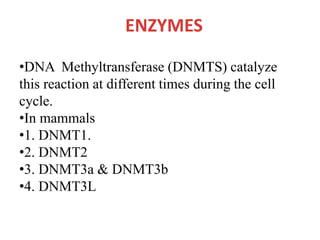
ENZYMES
•DNA Methyltransferase (DNMTS) catalyze
this reaction at different times during the cell
cycle.
•In mammals
•1. DNMT1.
•2. DNMT2
•3. DNMT3a & DNMT3b
•4. DNMT3L
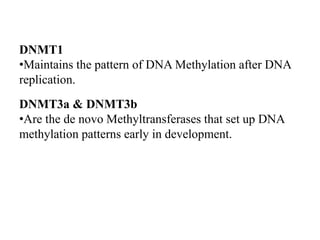
DNMT1
•Maintains the pattern of DNA Methylation after DNA
replication.
DNMT3a & DNMT3b
•Are the de novo Methyltransferases that set up DNA
methylation patterns early in development.
DNMT3L
•Is a protein that is homologous to the other DNMT3Ls
but has no catalytic activity.
•Assists the de novo Methyltransferases by increasing
their ability bind to DNA stimulating their activity.
DNMT2.
•Has been identified as a DNA Methyltrasferase
homolog containing all 10 sequence motifs common to
all DNA Methyltrasferase.
•It does not Methylate DNA but instead Methylates
cytosine -38 in the anti codon loop of aspartic acid
transfer RNA.
MAMMALIAN
GENOME
•The human genome is not methylated uniformly
& contains regions of unmethylated segments
interspersed by methylated regions.
•In contrast to the rest of the genome smaller
regions of DNA called CpG island ranging from
0.5 kb to 5kb & occurring an average 100kb
,have distinctive properties these regions are
unmethylated normally.
CpG Nucleotides
•Occur at low abundance throughout the human
genome.
•Typically methylated in non-promoter regions
and unmethylated in promoter regions.
•Methylation of CpG island is believed to
dysregulate gene transcription through the
inhibition of transcription factor binding either
directly or via altered Histone acetylation.
Role of DNA Methylation
•Suppresses the expression of viral genes &
other deleterious elements that have been in
incorporated into the genome of most of the host
over time.
•In the establishment & Methylation of imprinted
genes.
•Plays a role in long term silencing of gene .
•Plays a role in silencing of repetitive elements
( e.g. transposons).
•Plays a role in x-chromosomes inactivation.
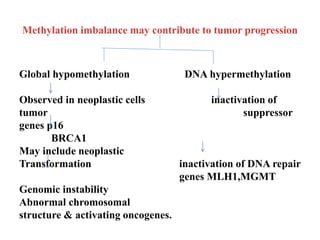
Methylation imbalance may contribute to tumor progression
Global hypomethylation DNA hypermethylation
Observed in neoplastic cells inactivation of
tumor suppressor
genes p16
BRCA1
May include neoplastic
Transformation inactivation of DNA repair
genes MLH1,MGMT
Genomic instability
Abnormal chromosomal
structure & activating oncogenes.
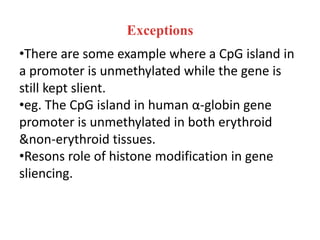
Exceptions
•There are some example where a CpG island in
a promoter is unmethylated while the gene is
still kept slient.
•eg. The CpG island in human α-globin gene
promoter is unmethylated in both erythroid
&non-erythroid tissues.
•Resons role of histone modification in gene
sliencing.
Exceptions
•There are some example where a CpG island in
a promoter is unmethylated while the gene is
still kept slient.
•eg. The CpG island in human α-globin gene
promoter is unmethylated in both erythroid
&non-erythroid tissues.
•Resons role of histone modification in gene
sliencing.
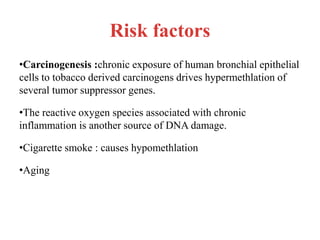
Risk factors
•Carcinogenesis :chronic exposure of human bronchial epithelial
cells to tobacco derived carcinogens drives hypermethlation of
several tumor suppressor genes.
•The reactive oxygen species associated with chronic
inflammation is another source of DNA damage.
•Cigarette smoke : causes hypomethlation
•Aging
Detection of DNA Methylation
•Sodium bisulfite conversion (SBC)
•Mass spectrometry.
•Whole genome bisulfite sequencing
•Methylated DNA immunoprecipitation.
•cDNA microarray.
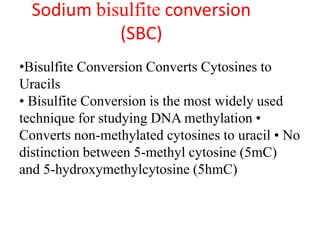
Sodium bisulfite conversion
(SBC)
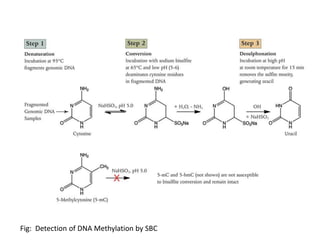
•Bisulfite Conversion Converts Cytosines to
Uracils
• Bisulfite Conversion is the most widely used
technique for studying DNA methylation •
Converts non-methylated cytosines to uracil • No
distinction between 5-methyl cytosine (5mC)
and 5-hydroxymethylcytosine (5hmC)
Fig: Detection of DNA Methylation by SBC
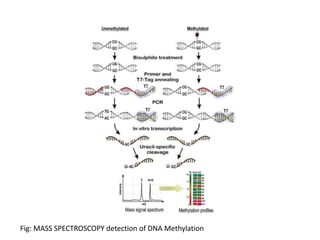
Fig: MASS SPECTROSCOPY detection of DNA Methylation
References
•DNA Methylation and Its Basic Function Lisa D
Moore1, Thuc Le1 and Guoping Fan*,1
1Interdepartmental Program in Neuroscience and
Department of Human Genetics, David Geffen School of
Medicine, University of California, Los Angeles, Los
Angeles, CA, USA
•DNA Methylation Mechanisms and Analysis Methods
to Study this Key Epigenetic Control Karen Reece ,
Ph.D. September 2012 .
•The Role of DNA Methylation in Mammalian
Epigenetics Peter A. Jones* and Daiya Takai
•Wikipedia.
THANK YOU

DNA_methylation

  • 1.
  • 2.
    EPIGENETICS •Study of heritablechanges in gene expression that occur without changes in a DNA sequence. •Dynamic process that plays a key role in normal cell growth and differentiation. •To date the best understood epigenetic mechanism are 1.DNA MEHYLATION. 2.HISTONE MODIFICATION
  • 3.
    What is DNAMETHYLATION •DNA Methylation is one is one of the most commonly occurring epigenetic events taking place in the mammalian genome. •DNA Methylation pattern is determined during embryogenesis and passed over to differentiating cells and tissue.
  • 4.
    •The DNA ofmost organisms is modified by a post replicative process which results in three types of methylated bases in DNA. •C5 –methylcytosine (5-mc). •N4- methylcytosine •N6-methyladenne
  • 5.
    MECHANISM •Methyl group aretransferred from S-adenosyl methionine in a reaction catalyzed by DNA Methyltransferase (DNMTS) or methylase. •SAM (S-Adenosyl methionine) is then converted to SAH (S-Adenosyl homocysteine).
  • 6.
    Fig : mechanismof DNA methylation
  • 7.
    ENZYMES •DNA Methyltransferase (DNMTS)catalyze this reaction at different times during the cell cycle. •In mammals •1. DNMT1. •2. DNMT2 •3. DNMT3a & DNMT3b •4. DNMT3L
  • 8.
    DNMT1 •Maintains the patternof DNA Methylation after DNA replication. DNMT3a & DNMT3b •Are the de novo Methyltransferases that set up DNA methylation patterns early in development.
  • 9.
    DNMT3L •Is a proteinthat is homologous to the other DNMT3Ls but has no catalytic activity. •Assists the de novo Methyltransferases by increasing their ability bind to DNA stimulating their activity. DNMT2. •Has been identified as a DNA Methyltrasferase homolog containing all 10 sequence motifs common to all DNA Methyltrasferase. •It does not Methylate DNA but instead Methylates cytosine -38 in the anti codon loop of aspartic acid transfer RNA.
  • 10.
    MAMMALIAN GENOME •The human genomeis not methylated uniformly & contains regions of unmethylated segments interspersed by methylated regions. •In contrast to the rest of the genome smaller regions of DNA called CpG island ranging from 0.5 kb to 5kb & occurring an average 100kb ,have distinctive properties these regions are unmethylated normally.
  • 11.
    CpG Nucleotides •Occur atlow abundance throughout the human genome. •Typically methylated in non-promoter regions and unmethylated in promoter regions. •Methylation of CpG island is believed to dysregulate gene transcription through the inhibition of transcription factor binding either directly or via altered Histone acetylation.
  • 12.
    Role of DNAMethylation •Suppresses the expression of viral genes & other deleterious elements that have been in incorporated into the genome of most of the host over time. •In the establishment & Methylation of imprinted genes. •Plays a role in long term silencing of gene . •Plays a role in silencing of repetitive elements ( e.g. transposons). •Plays a role in x-chromosomes inactivation.
  • 13.
    Methylation imbalance maycontribute to tumor progression Global hypomethylation DNA hypermethylation Observed in neoplastic cells inactivation of tumor suppressor genes p16 BRCA1 May include neoplastic Transformation inactivation of DNA repair genes MLH1,MGMT Genomic instability Abnormal chromosomal structure & activating oncogenes.
  • 14.
    Exceptions •There are someexample where a CpG island in a promoter is unmethylated while the gene is still kept slient. •eg. The CpG island in human α-globin gene promoter is unmethylated in both erythroid &non-erythroid tissues. •Resons role of histone modification in gene sliencing.
  • 15.
    Exceptions •There are someexample where a CpG island in a promoter is unmethylated while the gene is still kept slient. •eg. The CpG island in human α-globin gene promoter is unmethylated in both erythroid &non-erythroid tissues. •Resons role of histone modification in gene sliencing.
  • 16.
    Risk factors •Carcinogenesis :chronicexposure of human bronchial epithelial cells to tobacco derived carcinogens drives hypermethlation of several tumor suppressor genes. •The reactive oxygen species associated with chronic inflammation is another source of DNA damage. •Cigarette smoke : causes hypomethlation •Aging
  • 17.
    Detection of DNAMethylation •Sodium bisulfite conversion (SBC) •Mass spectrometry. •Whole genome bisulfite sequencing •Methylated DNA immunoprecipitation. •cDNA microarray.
  • 18.
    Sodium bisulfite conversion (SBC) •BisulfiteConversion Converts Cytosines to Uracils • Bisulfite Conversion is the most widely used technique for studying DNA methylation • Converts non-methylated cytosines to uracil • No distinction between 5-methyl cytosine (5mC) and 5-hydroxymethylcytosine (5hmC)
  • 19.
    Fig: Detection ofDNA Methylation by SBC
  • 20.
    Fig: MASS SPECTROSCOPYdetection of DNA Methylation
  • 21.
    References •DNA Methylation andIts Basic Function Lisa D Moore1, Thuc Le1 and Guoping Fan*,1 1Interdepartmental Program in Neuroscience and Department of Human Genetics, David Geffen School of Medicine, University of California, Los Angeles, Los Angeles, CA, USA •DNA Methylation Mechanisms and Analysis Methods to Study this Key Epigenetic Control Karen Reece , Ph.D. September 2012 . •The Role of DNA Methylation in Mammalian Epigenetics Peter A. Jones* and Daiya Takai •Wikipedia.
  • 22.