Presented  by  :  SheetalNarkar
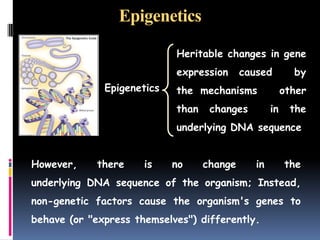
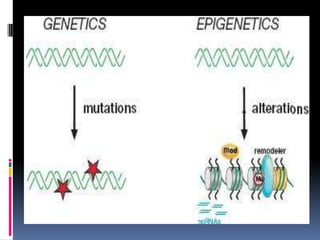
EpigeneticsHeritable changes in gene expression caused  by the mechanisms   other   than changes  in the underlying DNA sequenceEpigenetics	However, there is no change in the underlying DNA sequence of the organism; Instead, non-genetic factors cause the organism's genes to behave (or "express themselves") differently.
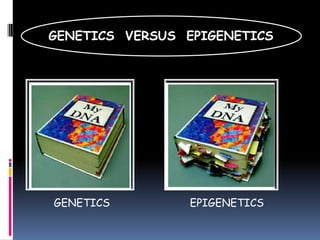
GENETICS  VERSUS  EPIGENETICSGENETICSEPIGENETICS
Molecular  Basis  of  Epigenetics
Molecular  Basis  of  EpigeneticsIt involves modificationsand  activation of certain genes, but not the basic structure of DNA
Additionally, the chromatin proteins associated with DNA may be activated or silenced
This accounts for why the differentiated cells in a multi-cellular organism express only the genes that are necessary for their own activityWhat  are  those  Modifications ?1.	Chromatin Remodeling :It  is the  post translational modification  of the amino acids that make up histoneproteins
As the histones increase the compaction of the DNA , it depresses the genetic activity ; and vice–a-versaWhat  are  those  Modifications ?2. DNA Methylation :It  is the addition of methyl groups to the DNA, mostly at CpG sites, to convert cytosine to 5-methylcytosine
Some areas of genome are methylated heavier than others and highly methylated areas tend to be transcriptionally less activeEpigenetic  Effects  in  HumansGenomic imprinting and related disorders
Cancer and developmental abnormalities
Twin studiesEpigenetic  Effects  in  HumansGenomic imprinting and related disorders
Most mammalian autosomal genes are expressed from both the maternally inherited and paternally inherited copies of the chromosomes
However, some genes are expressed in a parent-of-origin–specific manner. This phenomenon, known as genomic imprintingGenomic imprintingImprinted genes are either expressed only from the allele inherited from the mother (eg. H19 ), or in other instances from the allele inherited from the father (eg. IGF2).
Importance  of  Imprinted  GenesPlay a major role in the embryonic growth and development
Imprinting defects results in various genetic diseases including:
Beckwith-Wiedemann syndrome, 
Silver-Russell Syndrome, 
Angelman Syndrome and 
Prader-Willi SyndromeIGF2Function in embryo       growth & developmentIGF2Monoallelic Expression   Genomic Imprinting… An Epigenetic Event… The differential expression of a gene or chromosomal region according to parental origin of inheritanceInsulin-like Growth Factor 2 (IGF2)
Closer look at IGF2 Locus……Enhancer competition at IGF2-H19 locus
Epigenetics  Research  InstitutesThere are a total of  4,877  institutions  engaged in the research on EpigeneticsAmong the top 20, fourteen of the institutions are US-based, four hail from the UK, and one is from Austria 
Top 10 Research InstitutesJohns Hopkins University tops the list, with 347 papersHarvard University, with 307 papers National Cancer Institute of the US  with 284 papersUniversity of Southern California, with 114 papersUniversity of Virginia, with 45 papers  
Top 10 Research InstitutesUniversity of Cambridge with 155 papers MIT, with 87 papersVienna Biocenter, with 25 papersUniversity of California, San Francisco, with 146 papers UK's Babraham Institute, with 81 papers
To date, approximately 50 imprinted genes have been identified in the human genome (Morison IM, Reeve AE 1998; Morison IM, Ramsay JP, Spencer HG 2005; Glaser RL, Ramsay JP, Morison IM 2006)Worldwide Research Going On

Epigenetics

  • 1.
    Presented by : SheetalNarkar
  • 2.
    EpigeneticsHeritable changes ingene expression caused by the mechanisms other than changes in the underlying DNA sequenceEpigenetics However, there is no change in the underlying DNA sequence of the organism; Instead, non-genetic factors cause the organism's genes to behave (or "express themselves") differently.
  • 4.
    GENETICS VERSUS EPIGENETICSGENETICSEPIGENETICS
  • 5.
    Molecular Basis of Epigenetics
  • 6.
    Molecular Basis of EpigeneticsIt involves modificationsand activation of certain genes, but not the basic structure of DNA
  • 7.
    Additionally, the chromatin proteins associatedwith DNA may be activated or silenced
  • 8.
    This accounts forwhy the differentiated cells in a multi-cellular organism express only the genes that are necessary for their own activityWhat are those Modifications ?1. Chromatin Remodeling :It is the  post translational modification  of the amino acids that make up histoneproteins
  • 9.
    As the histonesincrease the compaction of the DNA , it depresses the genetic activity ; and vice–a-versaWhat are those Modifications ?2. DNA Methylation :It is the addition of methyl groups to the DNA, mostly at CpG sites, to convert cytosine to 5-methylcytosine
  • 10.
    Some areas ofgenome are methylated heavier than others and highly methylated areas tend to be transcriptionally less activeEpigenetic Effects in HumansGenomic imprinting and related disorders
  • 11.
  • 12.
    Twin studiesEpigenetic Effects in HumansGenomic imprinting and related disorders
  • 13.
    Most mammalian autosomalgenes are expressed from both the maternally inherited and paternally inherited copies of the chromosomes
  • 14.
    However, some genesare expressed in a parent-of-origin–specific manner. This phenomenon, known as genomic imprintingGenomic imprintingImprinted genes are either expressed only from the allele inherited from the mother (eg. H19 ), or in other instances from the allele inherited from the father (eg. IGF2).
  • 15.
    Importance of Imprinted GenesPlay a major role in the embryonic growth and development
  • 16.
    Imprinting defects resultsin various genetic diseases including:
  • 17.
  • 18.
  • 19.
  • 20.
    Prader-Willi SyndromeIGF2Function inembryo growth & developmentIGF2Monoallelic Expression Genomic Imprinting… An Epigenetic Event… The differential expression of a gene or chromosomal region according to parental origin of inheritanceInsulin-like Growth Factor 2 (IGF2)
  • 21.
    Closer look atIGF2 Locus……Enhancer competition at IGF2-H19 locus
  • 22.
    Epigenetics Research InstitutesThere are a total of 4,877 institutions engaged in the research on EpigeneticsAmong the top 20, fourteen of the institutions are US-based, four hail from the UK, and one is from Austria 
  • 23.
    Top 10 ResearchInstitutesJohns Hopkins University tops the list, with 347 papersHarvard University, with 307 papers National Cancer Institute of the US with 284 papersUniversity of Southern California, with 114 papersUniversity of Virginia, with 45 papers  
  • 24.
    Top 10 ResearchInstitutesUniversity of Cambridge with 155 papers MIT, with 87 papersVienna Biocenter, with 25 papersUniversity of California, San Francisco, with 146 papers UK's Babraham Institute, with 81 papers
  • 25.
    To date, approximately50 imprinted genes have been identified in the human genome (Morison IM, Reeve AE 1998; Morison IM, Ramsay JP, Spencer HG 2005; Glaser RL, Ramsay JP, Morison IM 2006)Worldwide Research Going On