PRESENTED BY- SOMASHREE DAS
REG NO- 15KUST4023
M.Sc 3rd SEM
DEPARTMENT OF BIOTECHNOLOGY
RAMAIAH COLLEGE OF ARTS, SCIENCE AND COMMERCE 1/12
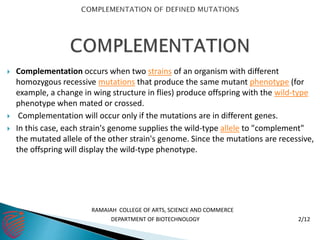
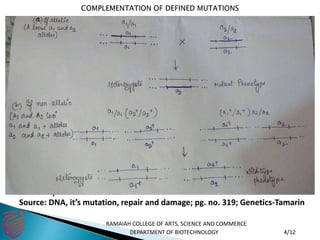
 Complementation occurs when two strains of an organism with different
homozygous recessive mutations that produce the same mutant phenotype (for
example, a change in wing structure in flies) produce offspring with the wild-type
phenotype when mated or crossed.
 Complementation will occur only if the mutations are in different genes.
 In this case, each strain's genome supplies the wild-type allele to "complement"
the mutated allele of the other strain's genome. Since the mutations are recessive,
the offspring will display the wild-type phenotype.
RAMAIAH COLLEGE OF ARTS, SCIENCE AND COMMERCE
DEPARTMENT OF BIOTECHNOLOGY 2/12
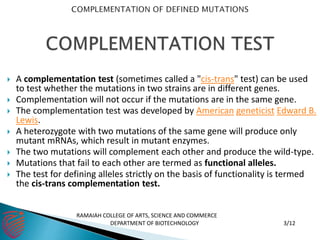
 A complementation test (sometimes called a "cis-trans" test) can be used
to test whether the mutations in two strains are in different genes.
 Complementation will not occur if the mutations are in the same gene.
 The complementation test was developed by American geneticist Edward B.
Lewis.
 A heterozygote with two mutations of the same gene will produce only
mutant mRNAs, which result in mutant enzymes.
 The two mutations will complement each other and produce the wild-type.
 Mutations that fail to each other are termed as functional alleles.
 The test for defining alleles strictly on the basis of functionality is termed
the cis-trans complementation test.
RAMAIAH COLLEGE OF ARTS, SCIENCE AND COMMERCE
DEPARTMENT OF BIOTECHNOLOGY 3/12
 Thus the two mutations will complement each other and produce the wild-type.
 Mutations that fail to complement each other are termed as functional alleles.
 The test for defining alleles strictly on this basis of functionality is termed as cis-
trans complementation test.
Source: DNA, it’s mutation, repair and damage; pg. no. 319; Genetics-Tamarin
RAMAIAH COLLEGE OF ARTS, SCIENCE AND COMMERCE
 DEPARTMENT OF BIOTECHNOLOGY 4/12
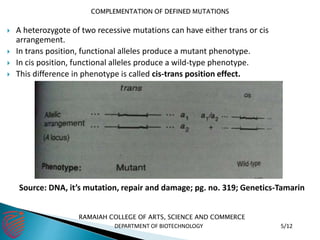
 A heterozygote of two recessive mutations can have either trans or cis
arrangement.
 In trans position, functional alleles produce a mutant phenotype.
 In cis position, functional alleles produce a wild-type phenotype.
 This difference in phenotype is called cis-trans position effect.
Source: DNA, it’s mutation, repair and damage; pg. no. 319; Genetics-Tamarin
RAMAIAH COLLEGE OF ARTS, SCIENCE AND COMMERCE
DEPARTMENT OF BIOTECHNOLOGY 5/12
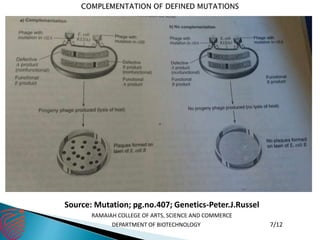
 The complementation test is used to establish how many units of genes are
defined by a given test of mutations that express the same mutant phenotypes.
 In Benzer’s work with rII mutants, the non-permissive strain K12(lamda) was
infected with a pair of rII mutant phages.
 If the phages produce progeny, the two mutants are said to complement each
other, meaning that the two mutations must be in different genes that encode
different products.
 If no progeny phages are produced, the mutants are not complementary indicating
that mutations are in the same functional unit.
RAMAIAH COLLEGE OF ARTS, SCIENCE AND COMMERCE
DEPARTMENT OF BIOTECHNOLOGY 6/12
Source: Mutation; pg.no.407; Genetics-Peter.J.Russel
RAMAIAH COLLEGE OF ARTS, SCIENCE AND COMMERCE
DEPARTMENT OF BIOTECHNOLOGY 7/12
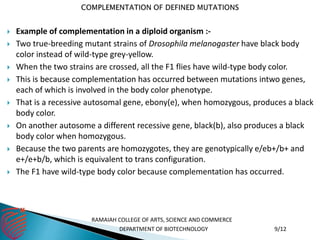
 Each rII mutant phage that co-infects the non-permissive E.coli strain K12(lamda)
carries one rII mutation, a configuration of mutations called the trans
configuration.
 When both the mutations are carried on same chromosome, the configuration is
called cis configuration of mutations.
 Benzer called the genetic unit of function revealed by the cis-trans test as cistron.
A cistron is the smallest segment of DNA that encodes a piece of RNA.
RAMAIAH COLLEGE OF ARTS, SCIENCE AND COMMERCE
DEPARTMENT OF BIOTECHNOLOGY 8/12
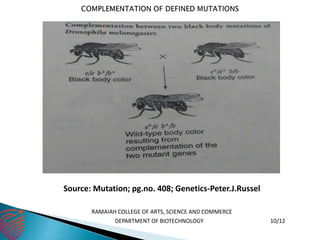
 Example of complementation in a diploid organism :-
 Two true-breeding mutant strains of Drosophila melanogaster have black body
color instead of wild-type grey-yellow.
 When the two strains are crossed, all the F1 flies have wild-type body color.
 This is because complementation has occurred between mutations intwo genes,
each of which is involved in the body color phenotype.
 That is a recessive autosomal gene, ebony(e), when homozygous, produces a black
body color.
 On another autosome a different recessive gene, black(b), also produces a black
body color when homozygous.
 Because the two parents are homozygotes, they are genotypically e/eb+/b+ and
e+/e+b/b, which is equivalent to trans configuration.
 The F1 have wild-type body color because complementation has occurred.
RAMAIAH COLLEGE OF ARTS, SCIENCE AND COMMERCE
DEPARTMENT OF BIOTECHNOLOGY 9/12
Source: Mutation; pg.no. 408; Genetics-Peter.J.Russel
RAMAIAH COLLEGE OF ARTS, SCIENCE AND COMMERCE
DEPARTMENT OF BIOTECHNOLOGY 10/12
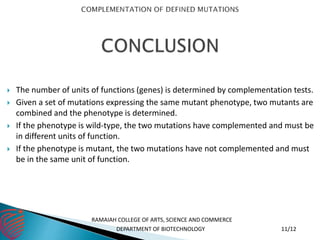
 The number of units of functions (genes) is determined by complementation tests.
 Given a set of mutations expressing the same mutant phenotype, two mutants are
combined and the phenotype is determined.
 If the phenotype is wild-type, the two mutations have complemented and must be
in different units of function.
 If the phenotype is mutant, the two mutations have not complemented and must
be in the same unit of function.
RAMAIAH COLLEGE OF ARTS, SCIENCE AND COMMERCE
DEPARTMENT OF BIOTECHNOLOGY 11/12
 Genetics- Peter. J. Russel
 Genetics- Tamarin
 www.wikipedia.org
 www.britanica.com
 THANK YOU…………..
RAMAIAH COLLEGE OF ARTS, SCIENCE AND COMMERCE
DEPARTMENT OF BIOTECHNOLOGY 12/12

Complementation of defined mutations

  • 1.
    PRESENTED BY- SOMASHREEDAS REG NO- 15KUST4023 M.Sc 3rd SEM DEPARTMENT OF BIOTECHNOLOGY RAMAIAH COLLEGE OF ARTS, SCIENCE AND COMMERCE 1/12
  • 2.
     Complementation occurswhen two strains of an organism with different homozygous recessive mutations that produce the same mutant phenotype (for example, a change in wing structure in flies) produce offspring with the wild-type phenotype when mated or crossed.  Complementation will occur only if the mutations are in different genes.  In this case, each strain's genome supplies the wild-type allele to "complement" the mutated allele of the other strain's genome. Since the mutations are recessive, the offspring will display the wild-type phenotype. RAMAIAH COLLEGE OF ARTS, SCIENCE AND COMMERCE DEPARTMENT OF BIOTECHNOLOGY 2/12
  • 3.
     A complementationtest (sometimes called a "cis-trans" test) can be used to test whether the mutations in two strains are in different genes.  Complementation will not occur if the mutations are in the same gene.  The complementation test was developed by American geneticist Edward B. Lewis.  A heterozygote with two mutations of the same gene will produce only mutant mRNAs, which result in mutant enzymes.  The two mutations will complement each other and produce the wild-type.  Mutations that fail to each other are termed as functional alleles.  The test for defining alleles strictly on the basis of functionality is termed the cis-trans complementation test. RAMAIAH COLLEGE OF ARTS, SCIENCE AND COMMERCE DEPARTMENT OF BIOTECHNOLOGY 3/12
  • 4.
     Thus thetwo mutations will complement each other and produce the wild-type.  Mutations that fail to complement each other are termed as functional alleles.  The test for defining alleles strictly on this basis of functionality is termed as cis- trans complementation test. Source: DNA, it’s mutation, repair and damage; pg. no. 319; Genetics-Tamarin RAMAIAH COLLEGE OF ARTS, SCIENCE AND COMMERCE  DEPARTMENT OF BIOTECHNOLOGY 4/12
  • 5.
     A heterozygoteof two recessive mutations can have either trans or cis arrangement.  In trans position, functional alleles produce a mutant phenotype.  In cis position, functional alleles produce a wild-type phenotype.  This difference in phenotype is called cis-trans position effect. Source: DNA, it’s mutation, repair and damage; pg. no. 319; Genetics-Tamarin RAMAIAH COLLEGE OF ARTS, SCIENCE AND COMMERCE DEPARTMENT OF BIOTECHNOLOGY 5/12
  • 6.
     The complementationtest is used to establish how many units of genes are defined by a given test of mutations that express the same mutant phenotypes.  In Benzer’s work with rII mutants, the non-permissive strain K12(lamda) was infected with a pair of rII mutant phages.  If the phages produce progeny, the two mutants are said to complement each other, meaning that the two mutations must be in different genes that encode different products.  If no progeny phages are produced, the mutants are not complementary indicating that mutations are in the same functional unit. RAMAIAH COLLEGE OF ARTS, SCIENCE AND COMMERCE DEPARTMENT OF BIOTECHNOLOGY 6/12
  • 7.
    Source: Mutation; pg.no.407;Genetics-Peter.J.Russel RAMAIAH COLLEGE OF ARTS, SCIENCE AND COMMERCE DEPARTMENT OF BIOTECHNOLOGY 7/12
  • 8.
     Each rIImutant phage that co-infects the non-permissive E.coli strain K12(lamda) carries one rII mutation, a configuration of mutations called the trans configuration.  When both the mutations are carried on same chromosome, the configuration is called cis configuration of mutations.  Benzer called the genetic unit of function revealed by the cis-trans test as cistron. A cistron is the smallest segment of DNA that encodes a piece of RNA. RAMAIAH COLLEGE OF ARTS, SCIENCE AND COMMERCE DEPARTMENT OF BIOTECHNOLOGY 8/12
  • 9.
     Example ofcomplementation in a diploid organism :-  Two true-breeding mutant strains of Drosophila melanogaster have black body color instead of wild-type grey-yellow.  When the two strains are crossed, all the F1 flies have wild-type body color.  This is because complementation has occurred between mutations intwo genes, each of which is involved in the body color phenotype.  That is a recessive autosomal gene, ebony(e), when homozygous, produces a black body color.  On another autosome a different recessive gene, black(b), also produces a black body color when homozygous.  Because the two parents are homozygotes, they are genotypically e/eb+/b+ and e+/e+b/b, which is equivalent to trans configuration.  The F1 have wild-type body color because complementation has occurred. RAMAIAH COLLEGE OF ARTS, SCIENCE AND COMMERCE DEPARTMENT OF BIOTECHNOLOGY 9/12
  • 10.
    Source: Mutation; pg.no.408; Genetics-Peter.J.Russel RAMAIAH COLLEGE OF ARTS, SCIENCE AND COMMERCE DEPARTMENT OF BIOTECHNOLOGY 10/12
  • 11.
     The numberof units of functions (genes) is determined by complementation tests.  Given a set of mutations expressing the same mutant phenotype, two mutants are combined and the phenotype is determined.  If the phenotype is wild-type, the two mutations have complemented and must be in different units of function.  If the phenotype is mutant, the two mutations have not complemented and must be in the same unit of function. RAMAIAH COLLEGE OF ARTS, SCIENCE AND COMMERCE DEPARTMENT OF BIOTECHNOLOGY 11/12
  • 12.
     Genetics- Peter.J. Russel  Genetics- Tamarin  www.wikipedia.org  www.britanica.com  THANK YOU………….. RAMAIAH COLLEGE OF ARTS, SCIENCE AND COMMERCE DEPARTMENT OF BIOTECHNOLOGY 12/12