NUCLEIC ACID
STRUCTURE
Function:
– store & transmit
genetic information
• Structure:
– monomers = nucleotides
– Polymers = polynucleotides (DNA, RNA)
• Examples:
– RNA (ribonucleic acid) (rRNA, mRNA, tRNA)
– DNA (deoxyribonucleic acid)
– ATP (adenosine triphosphate) which:
• Supplies energy for synthetic reactions and for other
• energy-requiring processes in cells
sugar
Nitrogenous
base
Phosphate
group
Nucleoside
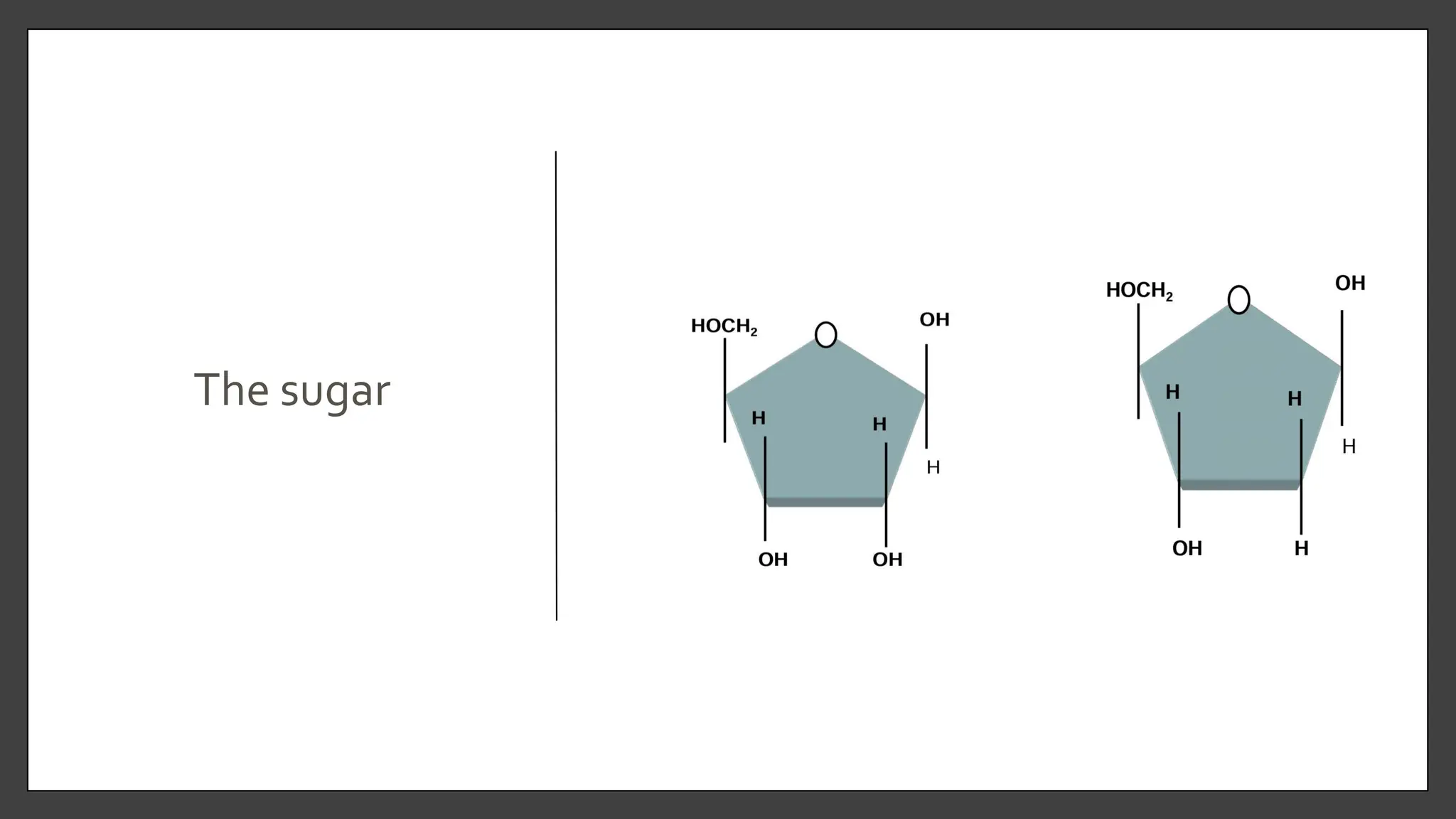
The sugar
Forces that
contribute to
stability of helix
formation
•Hydrogen bonding in
base-pairing
•Hydrophobic
interactions in base
stacking
Forces That Stabilize Nucleic Acid Double
Helix
• There are THREE major forces that contribute to stability of
helix formation
• Hydrogen bonding in base-pairing
• Hydrophobic interactions in base stacking
Chemical forces that stabilize the DNA double
helix:
❖The helical structure of nucleic acids is determine by stacking between
adjacent bases in the same strand.
❖
The double-stranded helical structure of DNA is maintained by hydrogen-
bonding between the bases in the base pairs.
❖
Hydrogen bonding and hydrophobic interaction work cooperatively to form
a very stable structure of ddDNA
❖
If one of the interactions is eliminated , the other is weakened; this
explains why Tm drops so markedly after the addition of a reagant that
destroys either type of interaction
Stacking
• A hydrophobic interaction is an interaction between two molecules (or portions of
molecules) that are somewhat insoluble in water. In response to their repulsion in
water they tend to associate.
•
This is true for nucleic acids the bases of nucleic acids are planar molecules
carrying localized weak charges. The localized charges will maintain solubility but
the large poorly soluble organic rings of the bases tend to cluster. In a nucleic acid
this produces an array known as base-stacking
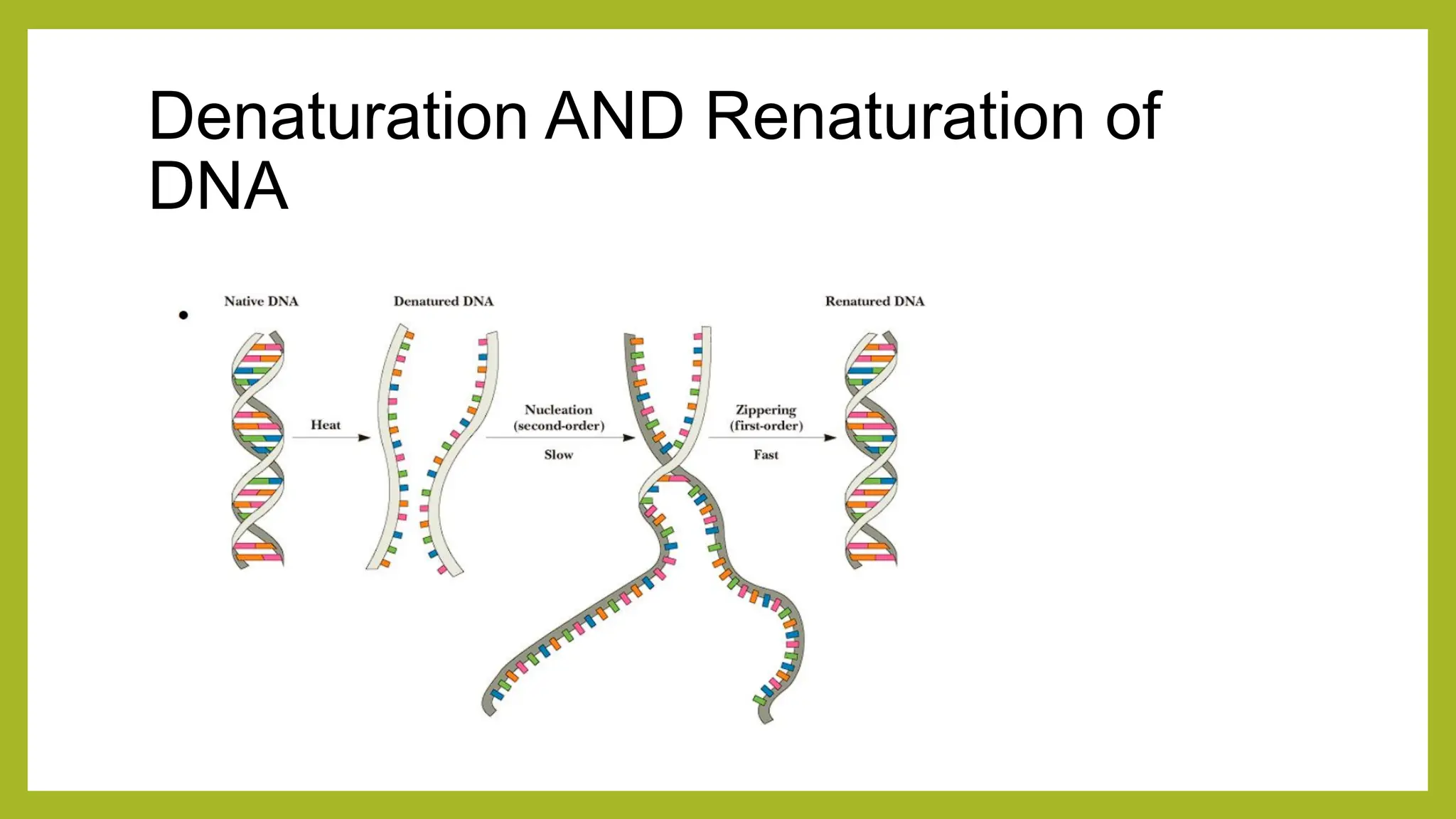
Denaturation AND Renaturation of
DNA
• When duplex DNA molecules are subjected to conditions of pH, temperature or ionic
strength that disrupt hydrogen bonds, the strands are no longer held together. The
double helix is denatured.
• If the temperature is the denaturing agent, the double helix is said to melt;
ENZYMES DRIVE THIS IN THE CELL.
• The phenomenon that the relative absorbance of the DNA solution at 260 nm
increases as the bases unstack is called hyperchromic shift;
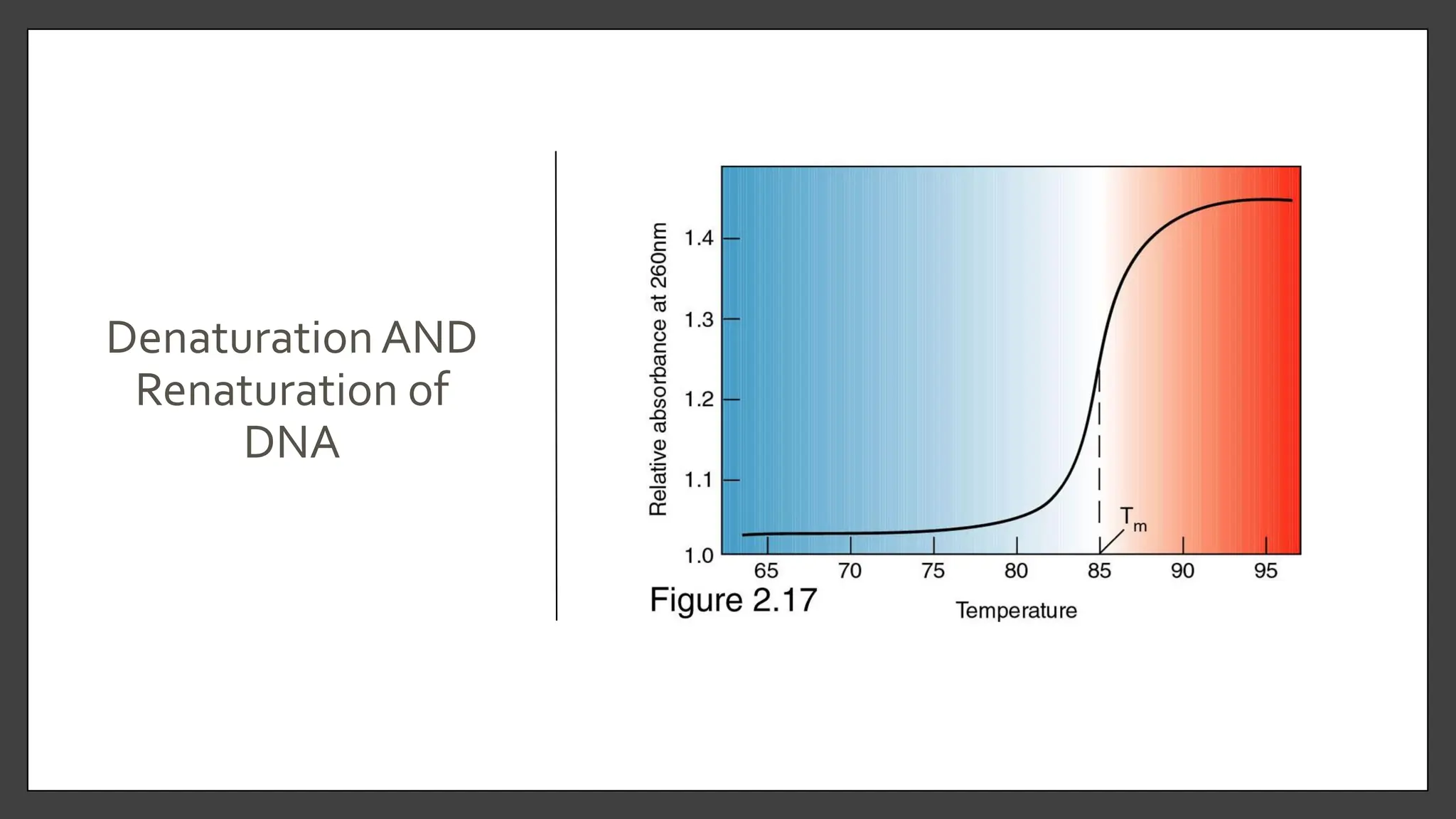
• If one follows the absorbance as a function of temperature, the midpoint
temperature of the absorbance curve is termed melting temperature, Tm.
Denaturation AND Renaturation of
DNA
• Denaturation can be detected by observing the increase in the ability of a DNA
solution to absorb UV light at a wavelength of 260 nm.
•
When bases are highly ordered they absorb less light than when they are in a less
ordered state
•
If the A260 of dsDNA solution is 1.00, the denatured (ssDNA) solution will be A260
1.37.
• If a DNA solution is slowly heated and the A260 is measured at various temperatures
a melting curve is obtained
Denaturation AND Renaturation of
DNA
DenaturationAND
Renaturation of
DNA
Properties affecs
DNA structure
•pH
•Temperature
•Ionic strength
Effects of pH on the structure of DNA
• Hydrogen bonding between the complimentary strands is stable
between pH 4 and 10
• Phosphodiester linkages in the DNA backbone are stable between pH
3 and 12.
• N-glycosidic bonds to purine bases are hydrolysed at pH value of 3
and less.
• Another very effective denaturant is NaOH
• At a pH greater than 11.3 all hydrogen bonds are eliminated and DNA
is completely denatured
Temperature
• There is considerable variation in the temperature stability of the
hydrogen bonds in the double helix, but most DNA begins to unwind
in the range of 80-90 C.
• Phosphodiester linkages and N—glycosidic bonds are stable up to
100C.
• Heat is often used to denature DNA and as result this process is
referred to as melting.
• During melting all covalent bonds including phosphodiester bonds
remain intact. Only hydrogen bonds and stacking interactions are
disrupted.
Ionic strength
• DNA is most stable and soluble in salt solutions. Salt concentrations
of less than 0.05M weaken the hydrogen bonding between
complementary strands.

nucleic acid structure.pdf

  • 1.
  • 2.
    Function: – store &transmit genetic information • Structure: – monomers = nucleotides – Polymers = polynucleotides (DNA, RNA) • Examples: – RNA (ribonucleic acid) (rRNA, mRNA, tRNA) – DNA (deoxyribonucleic acid) – ATP (adenosine triphosphate) which: • Supplies energy for synthetic reactions and for other • energy-requiring processes in cells
  • 3.
  • 4.
  • 9.
    Forces that contribute to stabilityof helix formation •Hydrogen bonding in base-pairing •Hydrophobic interactions in base stacking
  • 10.
    Forces That StabilizeNucleic Acid Double Helix • There are THREE major forces that contribute to stability of helix formation • Hydrogen bonding in base-pairing • Hydrophobic interactions in base stacking
  • 11.
    Chemical forces thatstabilize the DNA double helix: ❖The helical structure of nucleic acids is determine by stacking between adjacent bases in the same strand. ❖ The double-stranded helical structure of DNA is maintained by hydrogen- bonding between the bases in the base pairs. ❖ Hydrogen bonding and hydrophobic interaction work cooperatively to form a very stable structure of ddDNA ❖ If one of the interactions is eliminated , the other is weakened; this explains why Tm drops so markedly after the addition of a reagant that destroys either type of interaction
  • 12.
    Stacking • A hydrophobicinteraction is an interaction between two molecules (or portions of molecules) that are somewhat insoluble in water. In response to their repulsion in water they tend to associate. • This is true for nucleic acids the bases of nucleic acids are planar molecules carrying localized weak charges. The localized charges will maintain solubility but the large poorly soluble organic rings of the bases tend to cluster. In a nucleic acid this produces an array known as base-stacking
  • 13.
    Denaturation AND Renaturationof DNA • When duplex DNA molecules are subjected to conditions of pH, temperature or ionic strength that disrupt hydrogen bonds, the strands are no longer held together. The double helix is denatured. • If the temperature is the denaturing agent, the double helix is said to melt; ENZYMES DRIVE THIS IN THE CELL. • The phenomenon that the relative absorbance of the DNA solution at 260 nm increases as the bases unstack is called hyperchromic shift; • If one follows the absorbance as a function of temperature, the midpoint temperature of the absorbance curve is termed melting temperature, Tm.
  • 14.
    Denaturation AND Renaturationof DNA • Denaturation can be detected by observing the increase in the ability of a DNA solution to absorb UV light at a wavelength of 260 nm. • When bases are highly ordered they absorb less light than when they are in a less ordered state • If the A260 of dsDNA solution is 1.00, the denatured (ssDNA) solution will be A260 1.37. • If a DNA solution is slowly heated and the A260 is measured at various temperatures a melting curve is obtained
  • 15.
  • 16.
  • 17.
  • 19.
    Effects of pHon the structure of DNA • Hydrogen bonding between the complimentary strands is stable between pH 4 and 10 • Phosphodiester linkages in the DNA backbone are stable between pH 3 and 12. • N-glycosidic bonds to purine bases are hydrolysed at pH value of 3 and less. • Another very effective denaturant is NaOH • At a pH greater than 11.3 all hydrogen bonds are eliminated and DNA is completely denatured
  • 20.
    Temperature • There isconsiderable variation in the temperature stability of the hydrogen bonds in the double helix, but most DNA begins to unwind in the range of 80-90 C. • Phosphodiester linkages and N—glycosidic bonds are stable up to 100C. • Heat is often used to denature DNA and as result this process is referred to as melting. • During melting all covalent bonds including phosphodiester bonds remain intact. Only hydrogen bonds and stacking interactions are disrupted.
  • 21.
    Ionic strength • DNAis most stable and soluble in salt solutions. Salt concentrations of less than 0.05M weaken the hydrogen bonding between complementary strands.