DNA sequencing
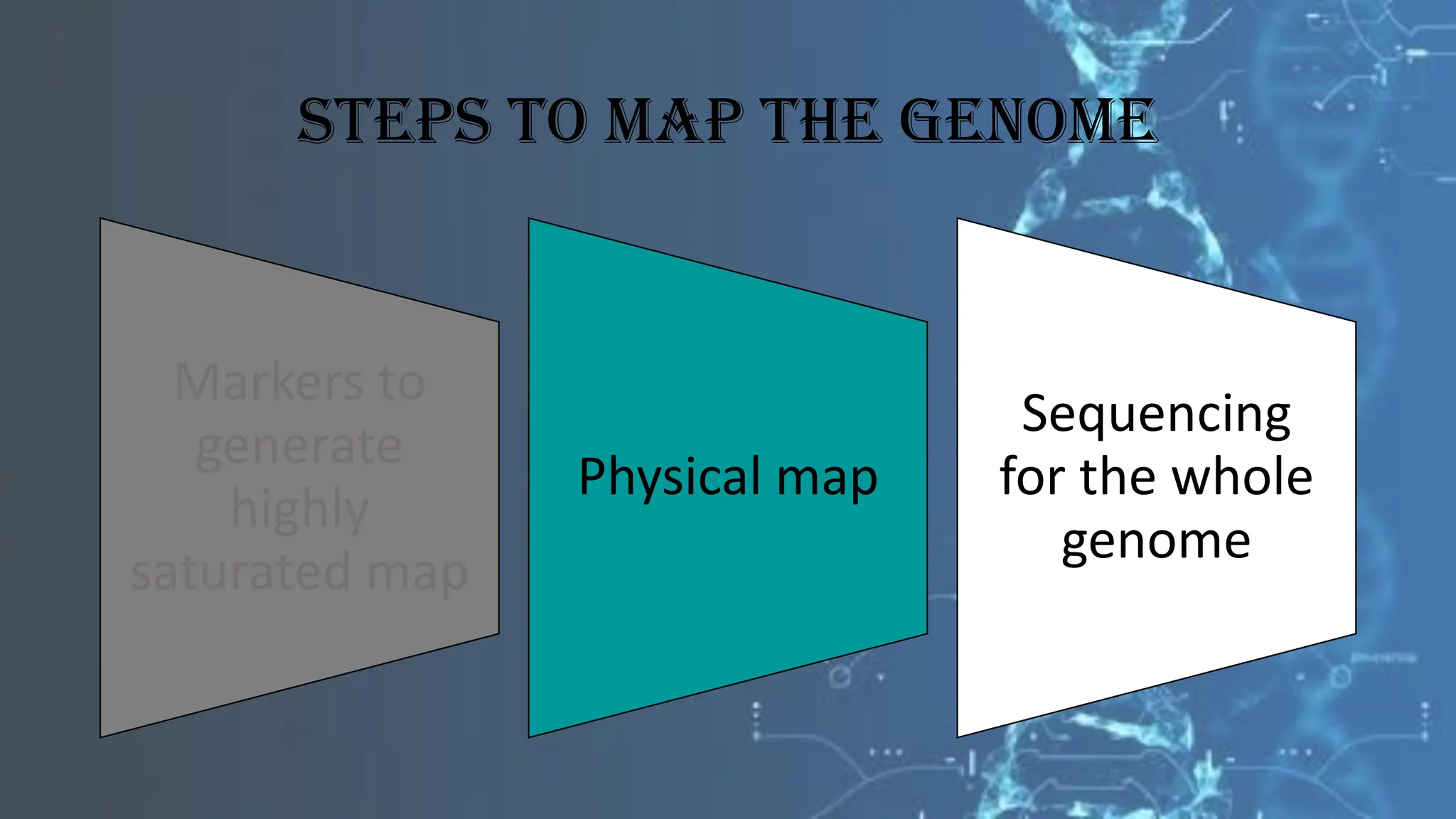
Steps to map the GEnome
Markers to
generate
highly
saturated map
Physical map
Sequencing
for the whole
genome
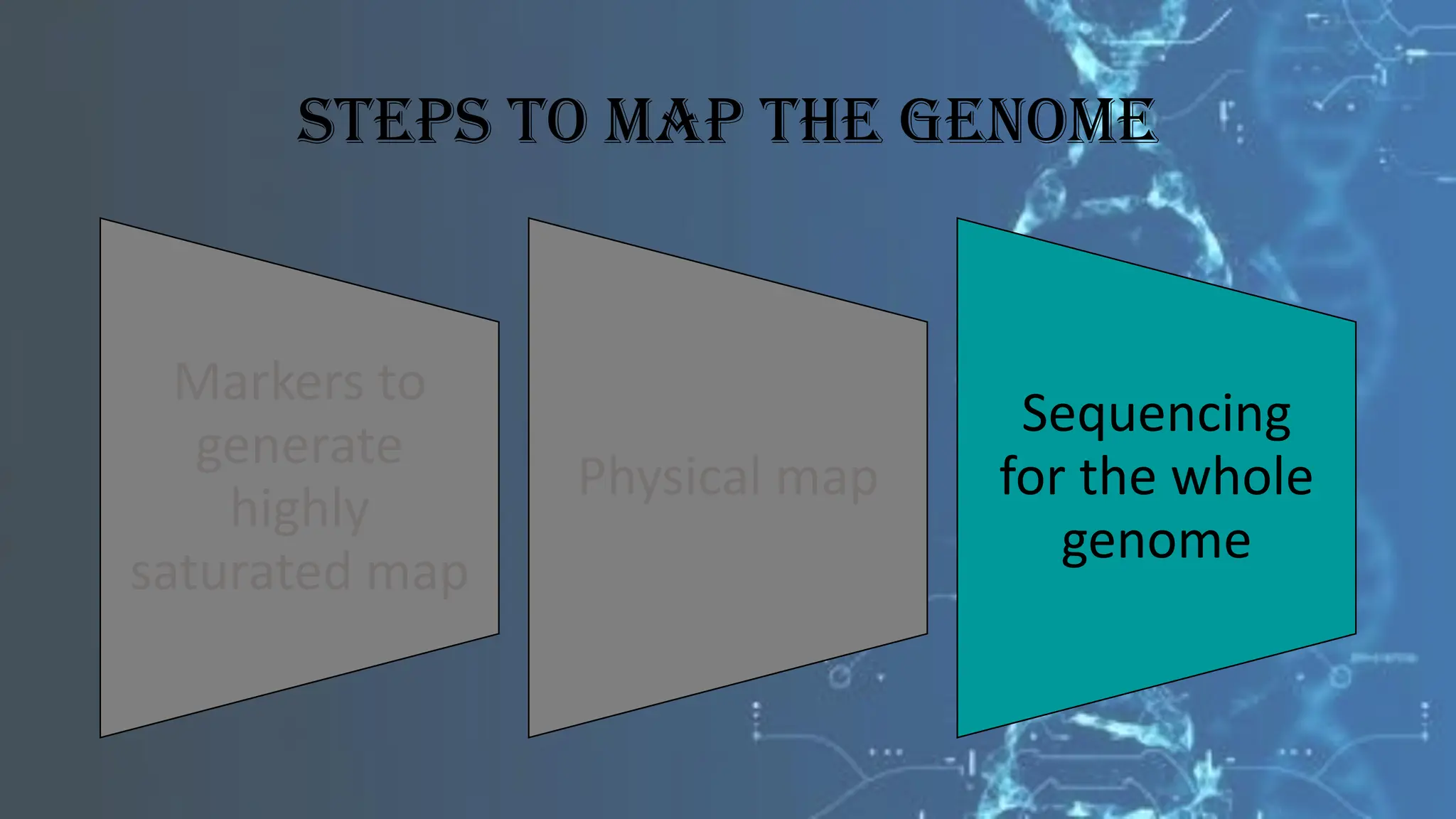
Steps to map the GEnome
Markers to
generate
highly
saturated map
Physical map
Sequencing
for the whole
genome
Why Genome Sequencing?
For many recombinant DNA experiments,
knowledge of a DNA sequence is a prerequisite for
its further manipulation
1. DNA sequencing followed by computer-assisted searching for restriction
endonuclease cleavage sites is often the fastest method for obtaining a
detailed restriction map.
2. Computer-assisted identification of protein-coding regions (ORF) within
the DNA sequence followed by computer-assisted similarity searches of
DNA and protein databases can lead to important insights into the
function and structure of a cloned gene and its product.
3. The DNA sequence is a prerequisite for a detailed analysis of the 5’ and 3’
noncoding regulatory regions of a gene.
4. DNA sequence information is essential for site-directed mutagenesis.
5. Small amounts of DNA sequence information ( “STS” or “EST “) are the
basis of methods for mapping and ordering large DNA segments cloned
into YACs, BACs, or cosmids
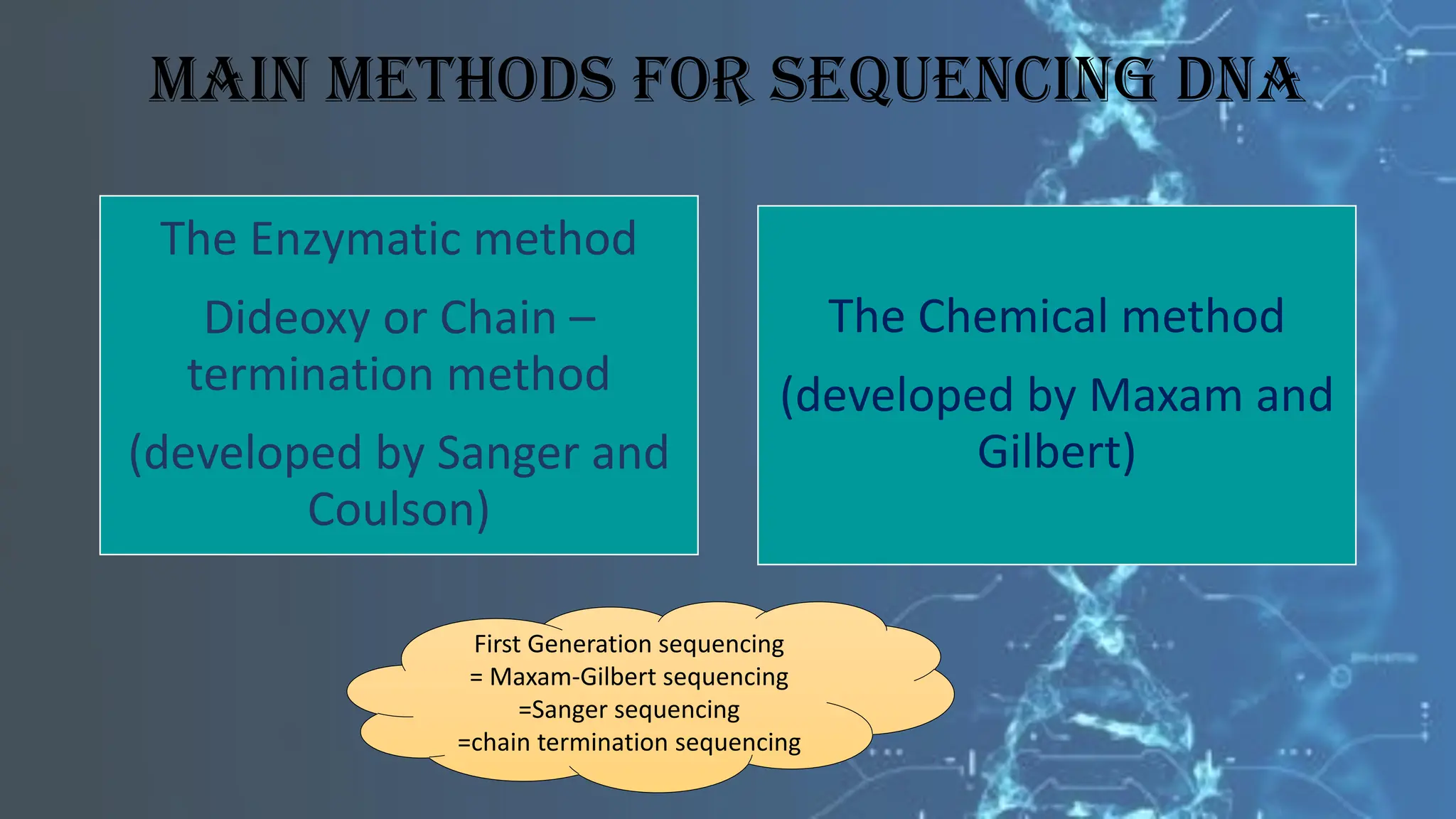
Main methods for sequencing DNA
The Enzymatic method
Dideoxy or Chain –
termination method
(developed by Sanger and
Coulson)
The Chemical method
(developed by Maxam and
Gilbert)
First Generation sequencing
= Maxam-Gilbert sequencing
=Sanger sequencing
=chain termination sequencing
THE DIDEOXY or
ENZYMATIC SEQUENCING METHOD
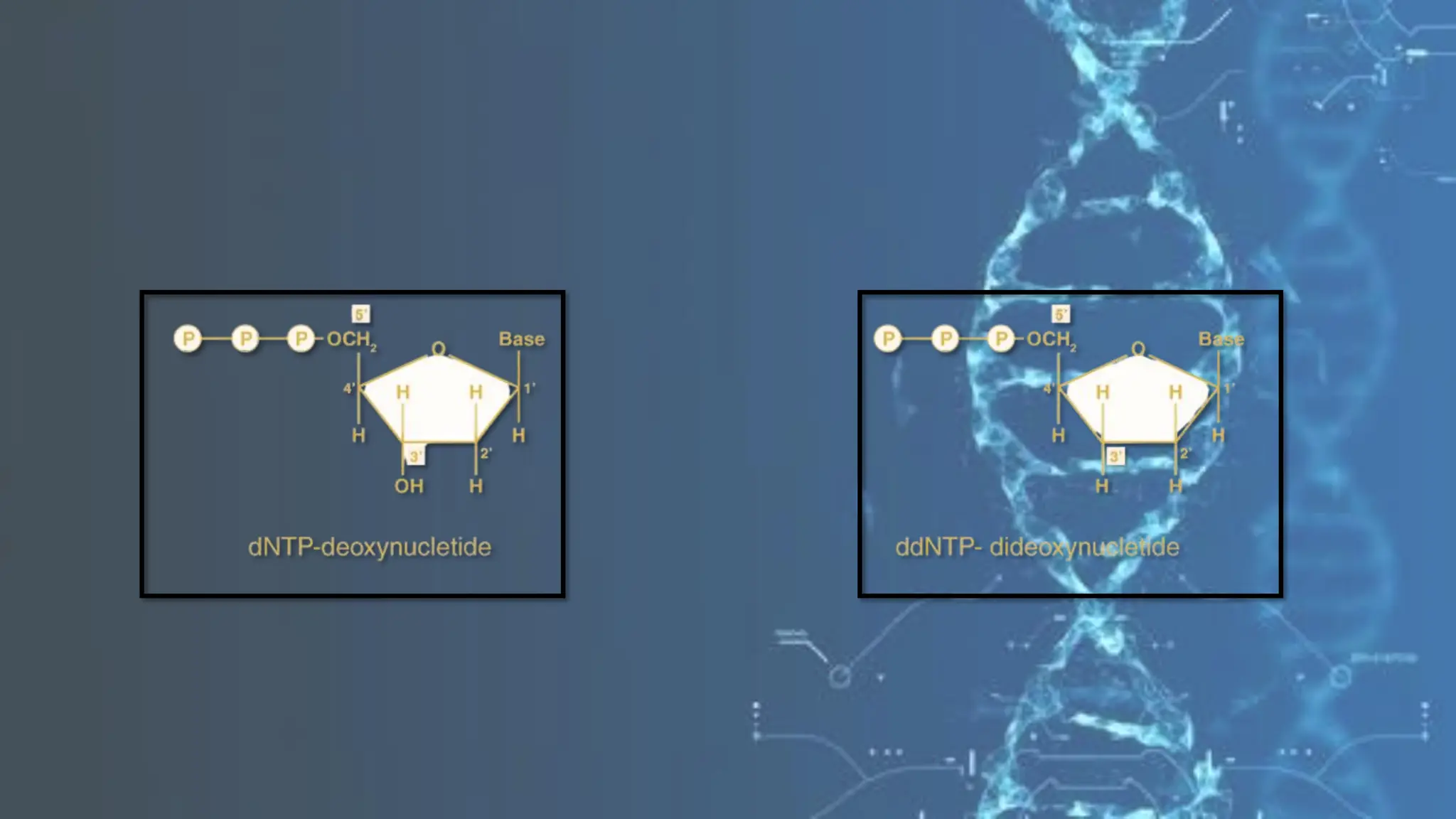
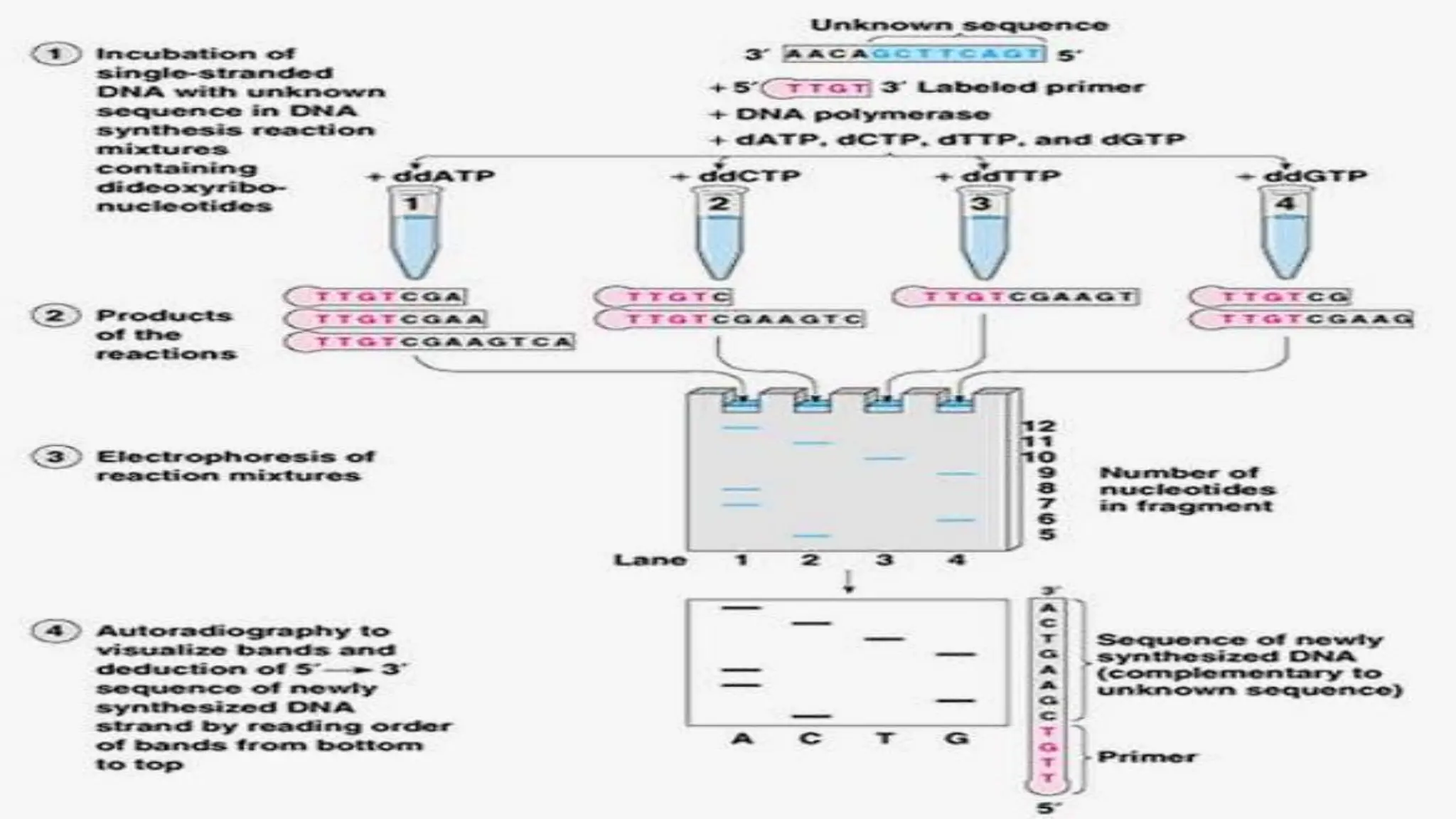
• based on DNA synthesis in the presence of dideoxynucleotides.
• a DNA polymerase is utilized to synthesize
➢a labeled
➢complementary copy of the DNA template
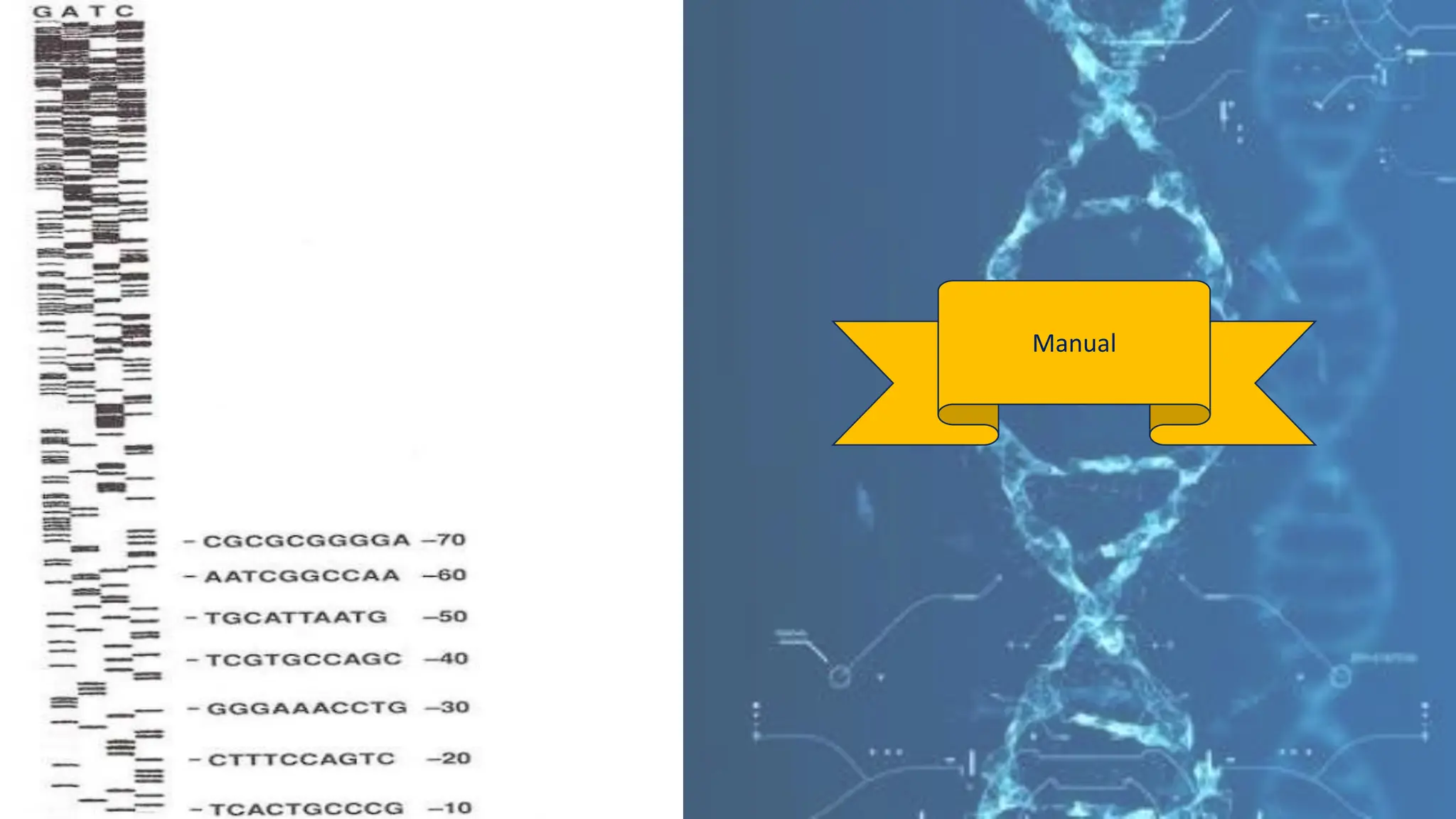
• based on electrophoretic procedures using high – resolution
denaturing polyacrylamide gels (sequencing gels)
• electropherograms
THE DIDEOXY or
ENZYMATIC SEQUENCING METHOD
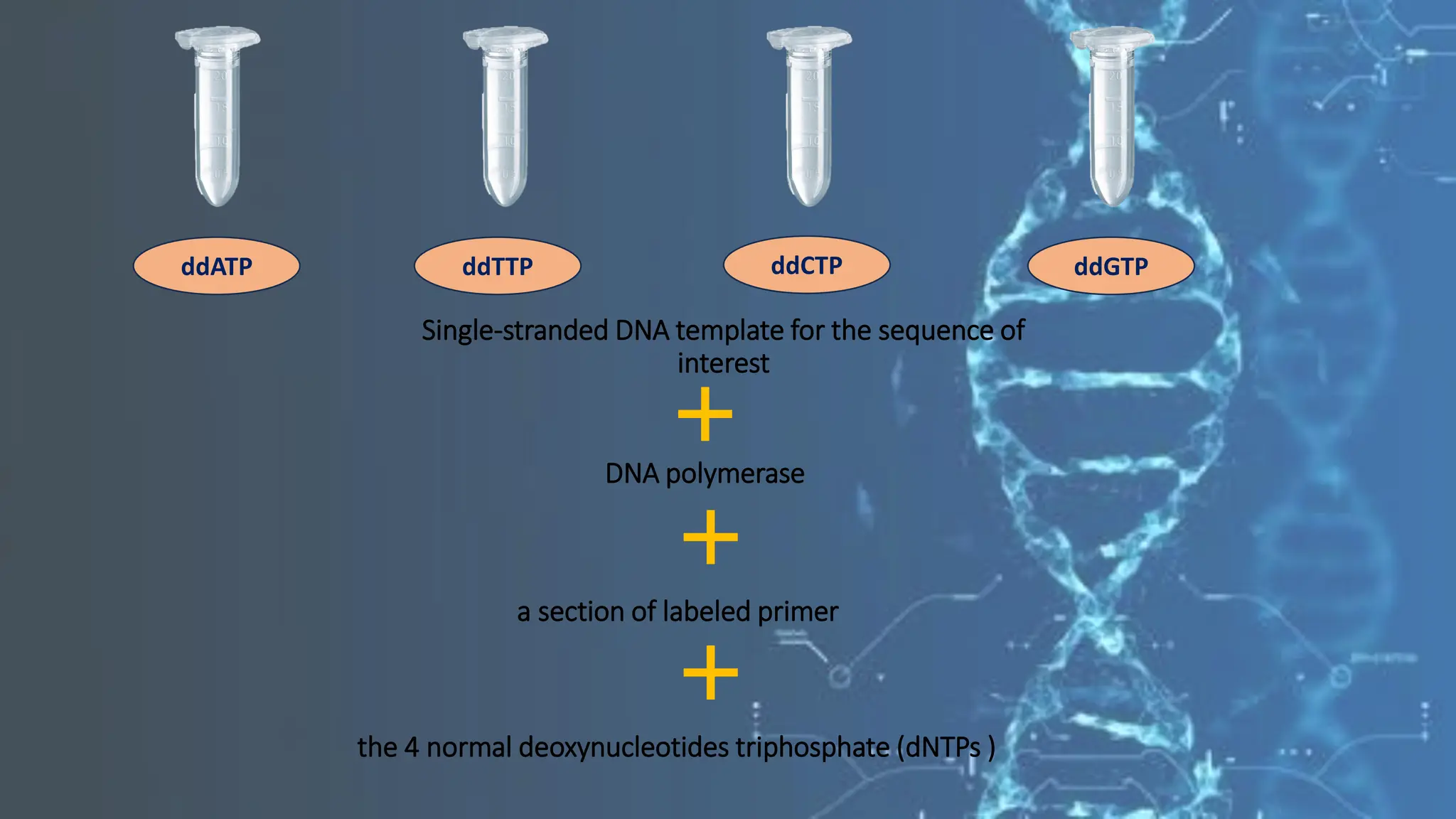
Single-stranded DNA template for the sequence of
interest
DNA polymerase
a section of labeled primer
the 4 normal deoxynucleotides triphosphate (dNTPs )
ddATP ddTTP ddCTP ddGTP
Manual
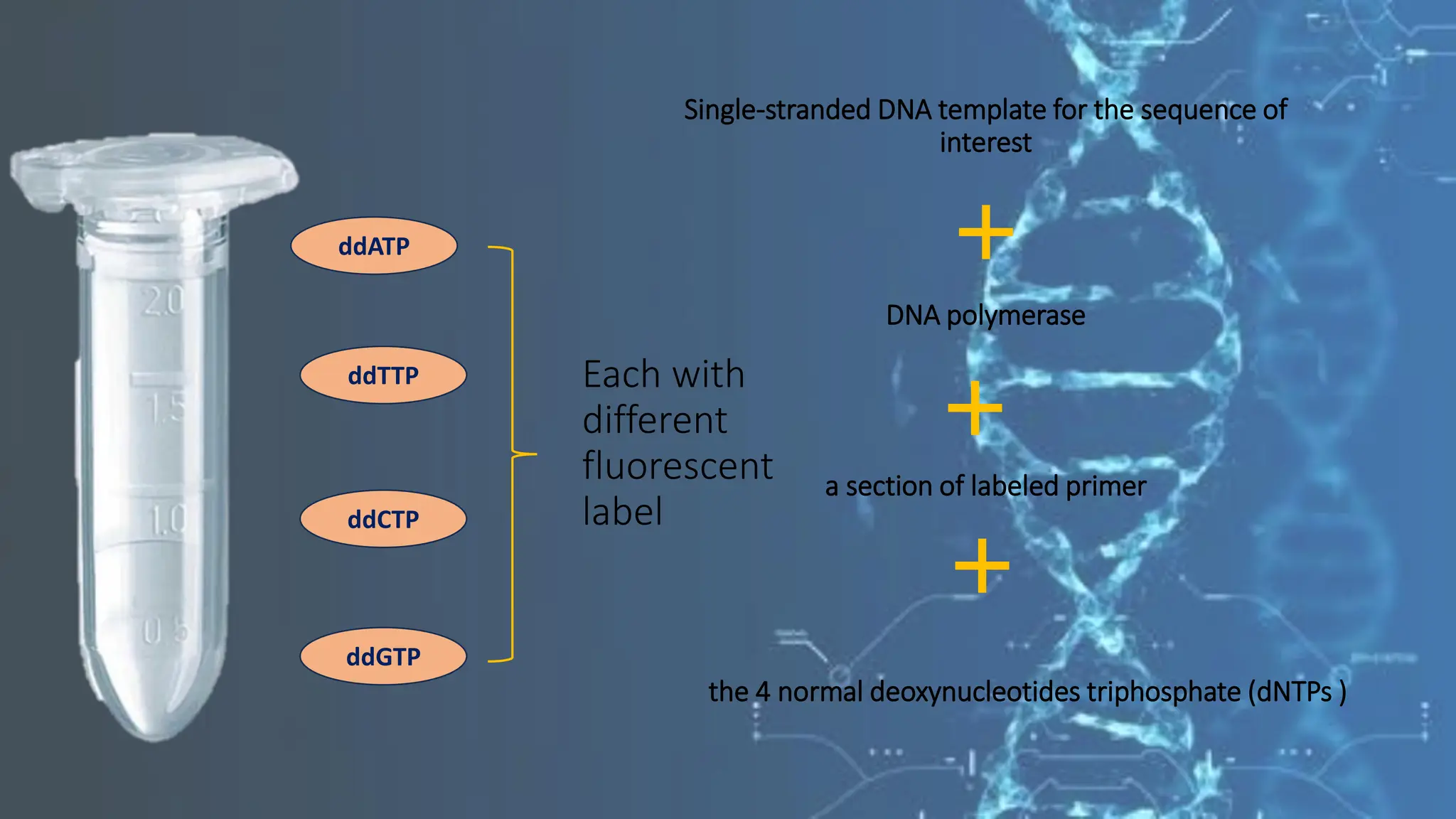
Single-stranded DNA template for the sequence of
interest
DNA polymerase
a section of labeled primer
the 4 normal deoxynucleotides triphosphate (dNTPs )
ddATP
ddTTP
ddCTP
ddGTP
Each with
different
fluorescent
label
chain termination sequencing
methodology
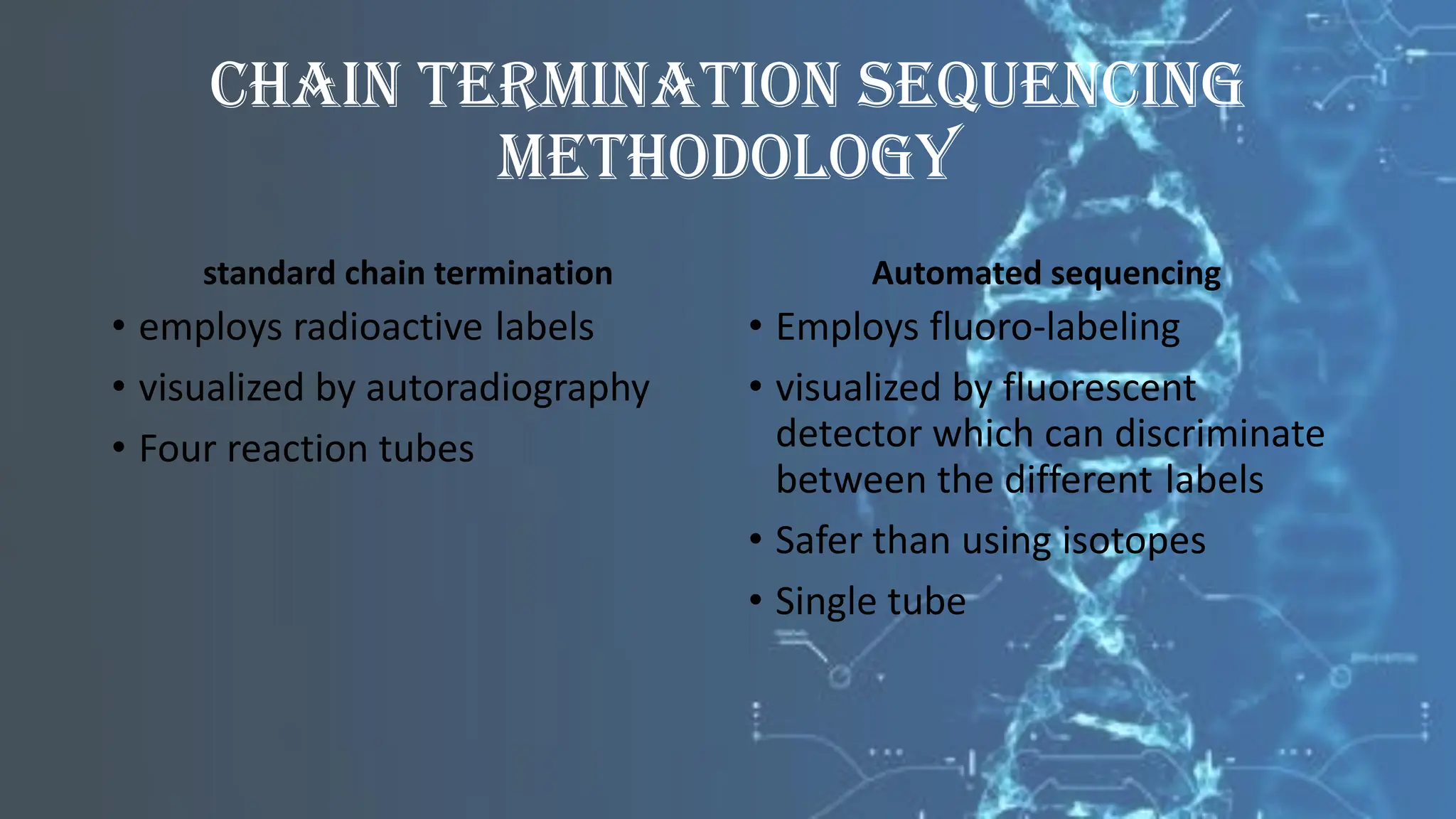
standard chain termination
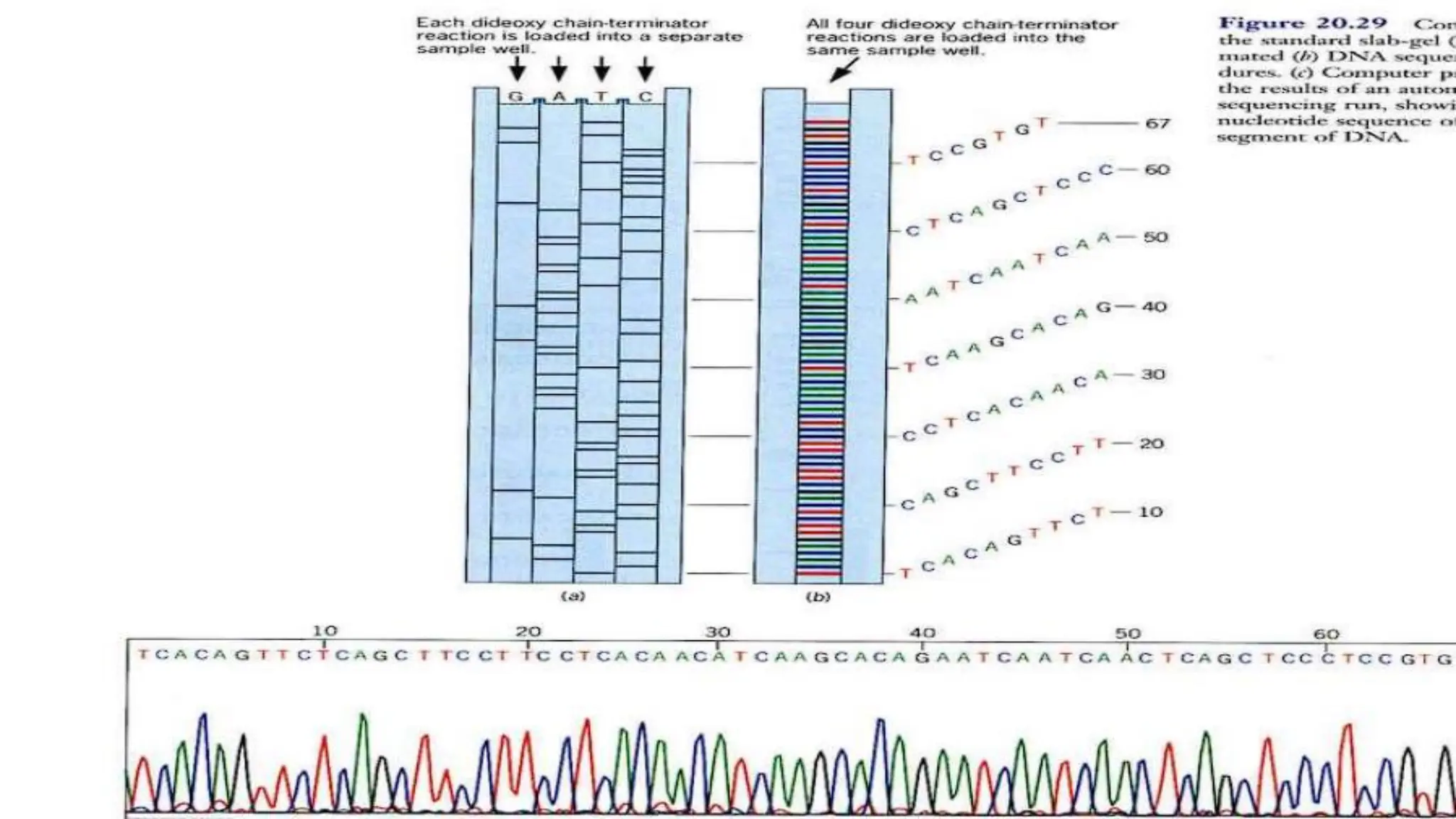
• employs radioactive labels
• visualized by autoradiography
• Four reaction tubes
Automated sequencing
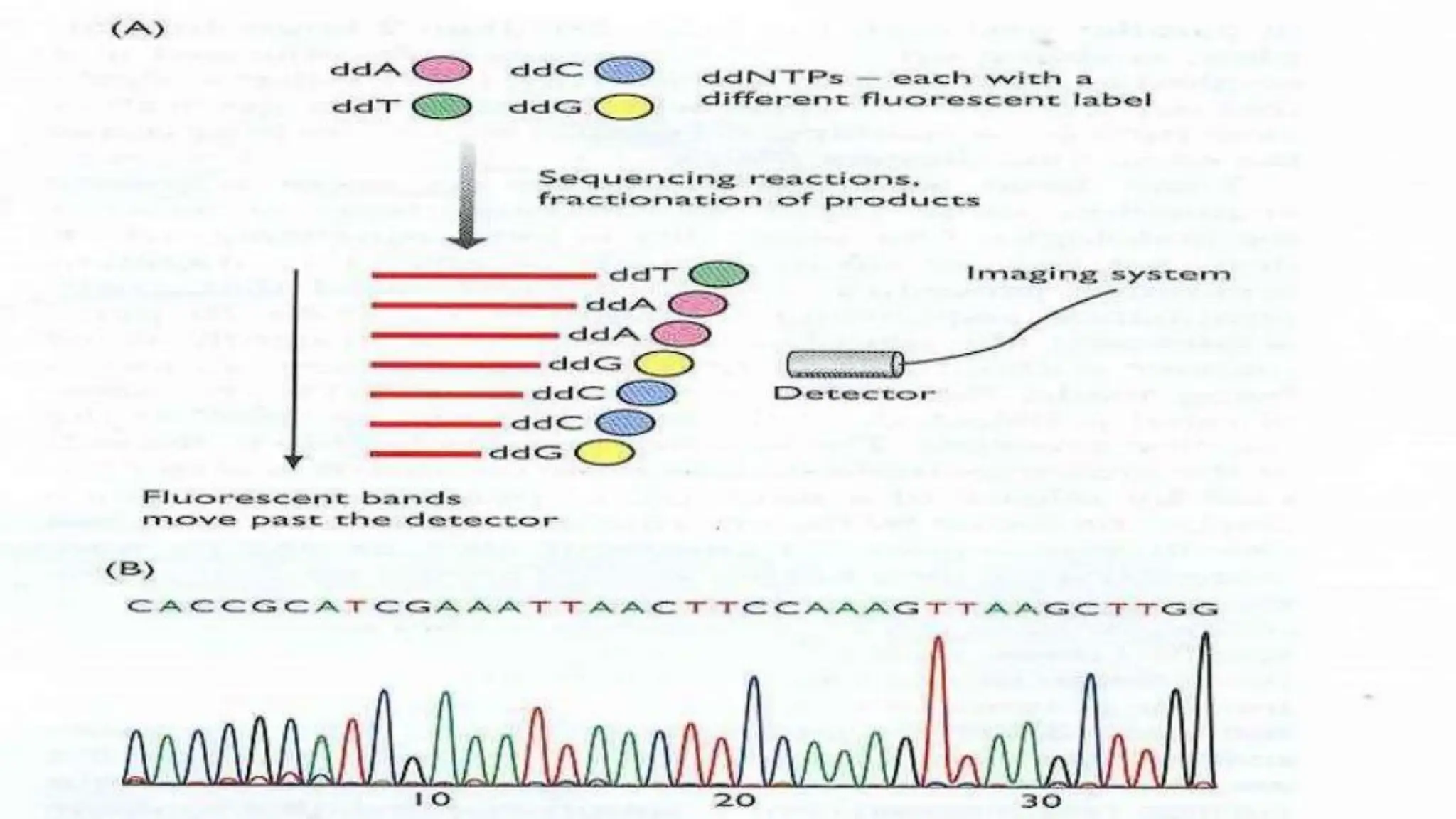
• Employs fluoro-labeling
• visualized by fluorescent
detector which can discriminate
between the different labels
• Safer than using isotopes
• Single tube
THE CHEMICAL SEQUENCING METHOD
• only end-labeled fragments are observed following
autoradiography of the sequencing gel
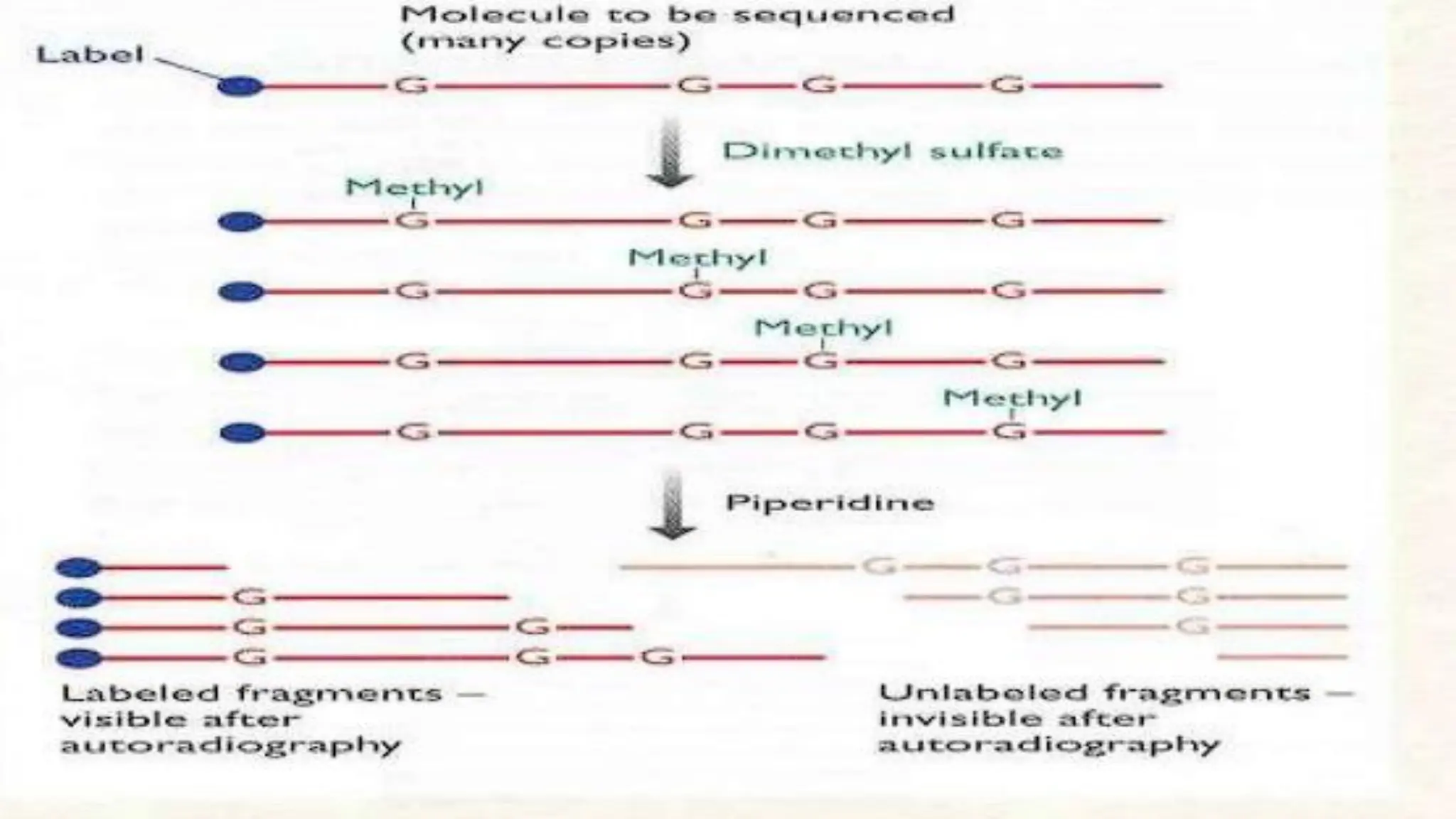
• based on the ability of Hydrazine, Dimethyl sulfate
(DMS) or Formic acid to specifically modify bases
within the DNA molecule
THE CHEMICAL SEQUENCING METHOD
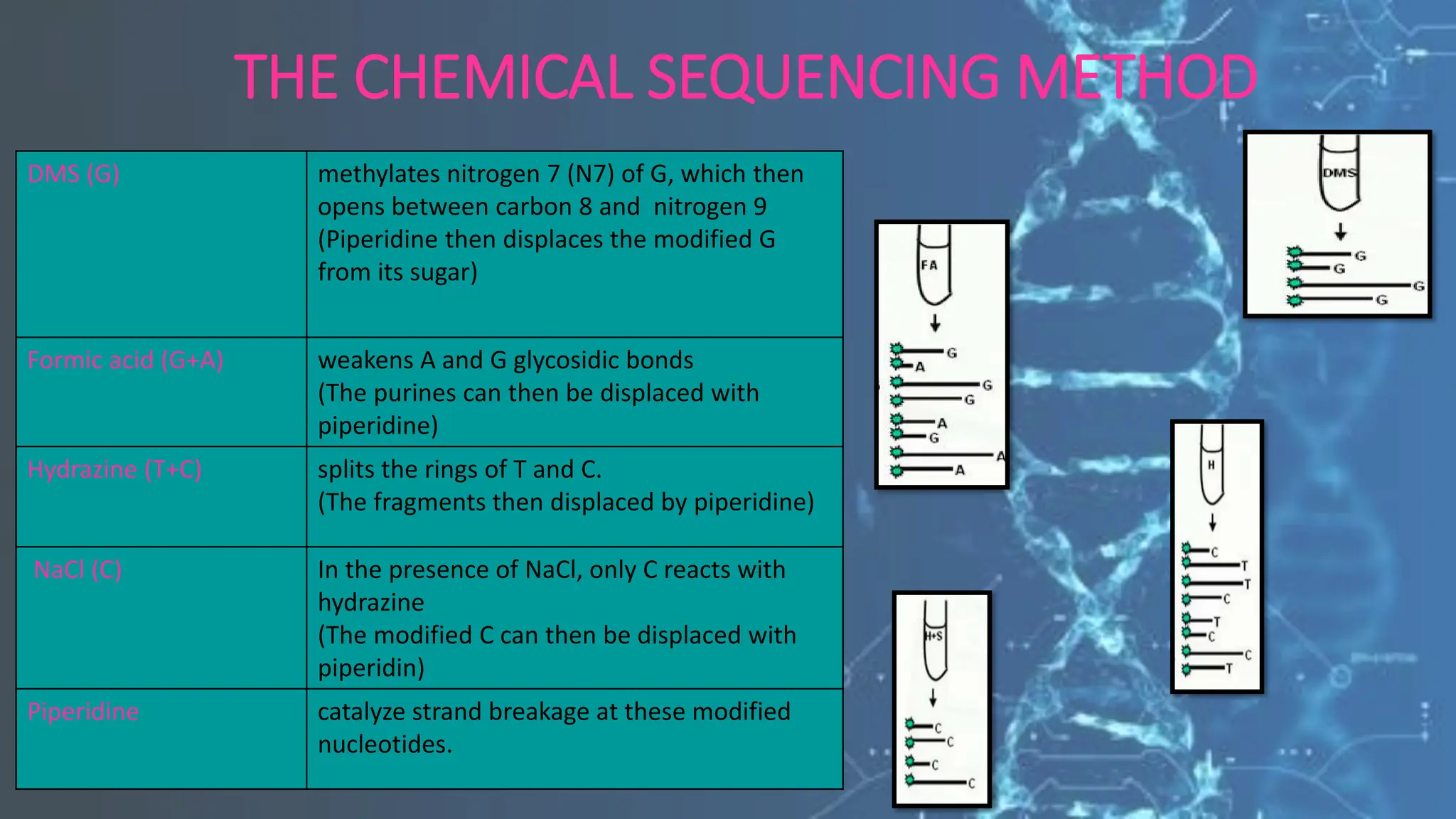
DMS (G) methylates nitrogen 7 (N7) of G, which then
opens between carbon 8 and nitrogen 9
(Piperidine then displaces the modified G
from its sugar)
Formic acid (G+A) weakens A and G glycosidic bonds
(The purines can then be displaced with
piperidine)
Hydrazine (T+C) splits the rings of T and C.
(The fragments then displaced by piperidine)
NaCl (C) In the presence of NaCl, only C reacts with
hydrazine
(The modified C can then be displaced with
piperidin)
Piperidine catalyze strand breakage at these modified
nucleotides.
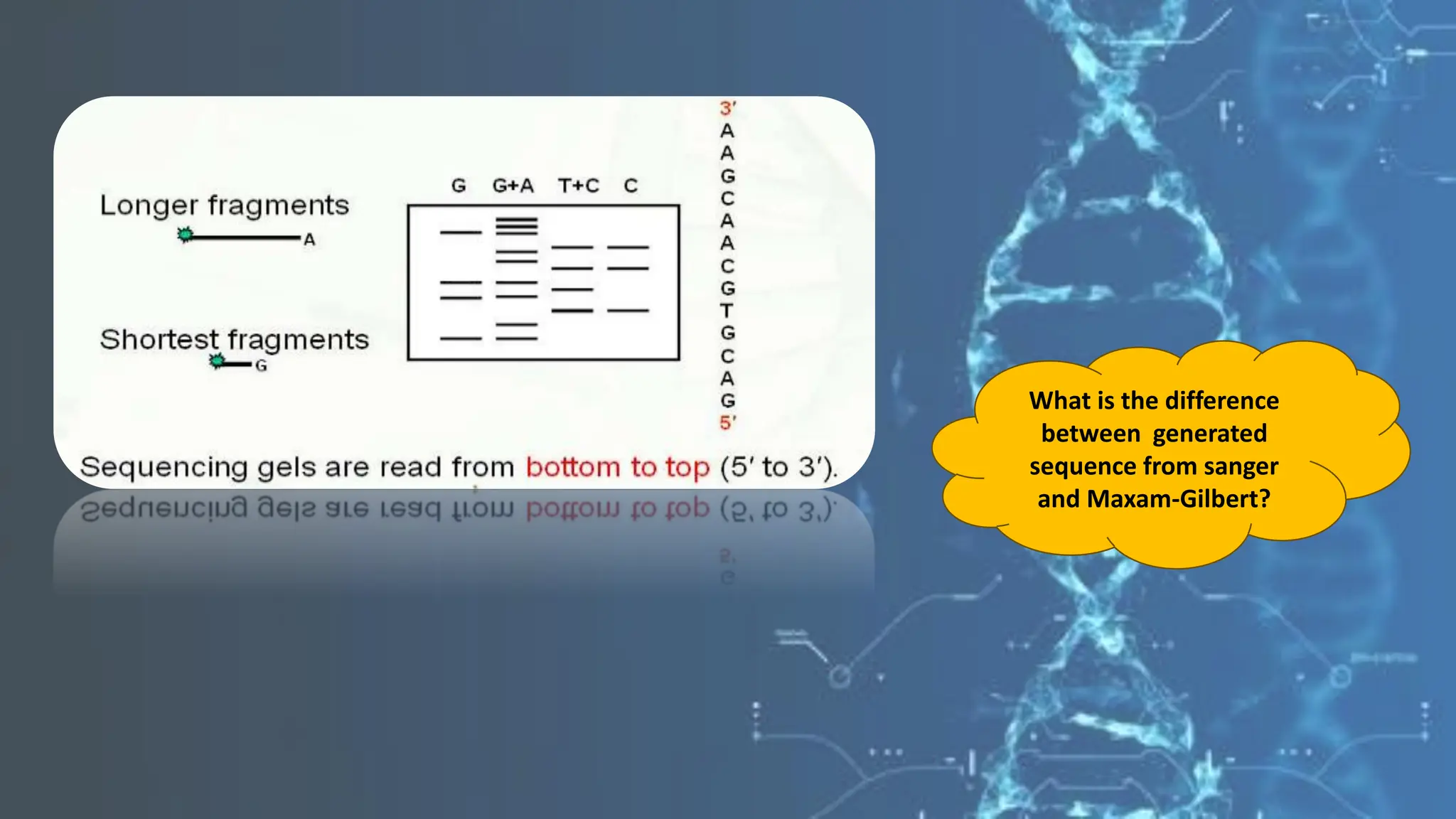
What is the difference
between generated
sequence from sanger
and Maxam-Gilbert?
Next-Generation Sequencing (NGS)
• Despite many technical improvements during this era, the limitations
of automated Sanger sequencing showed a need for new and
improved technologies for sequencing large numbers of human
genomes
• The major advance offered by NGS is the ability to produce an
enormous volume of data cheaply - in some cases over one billion
short reads per instrument run
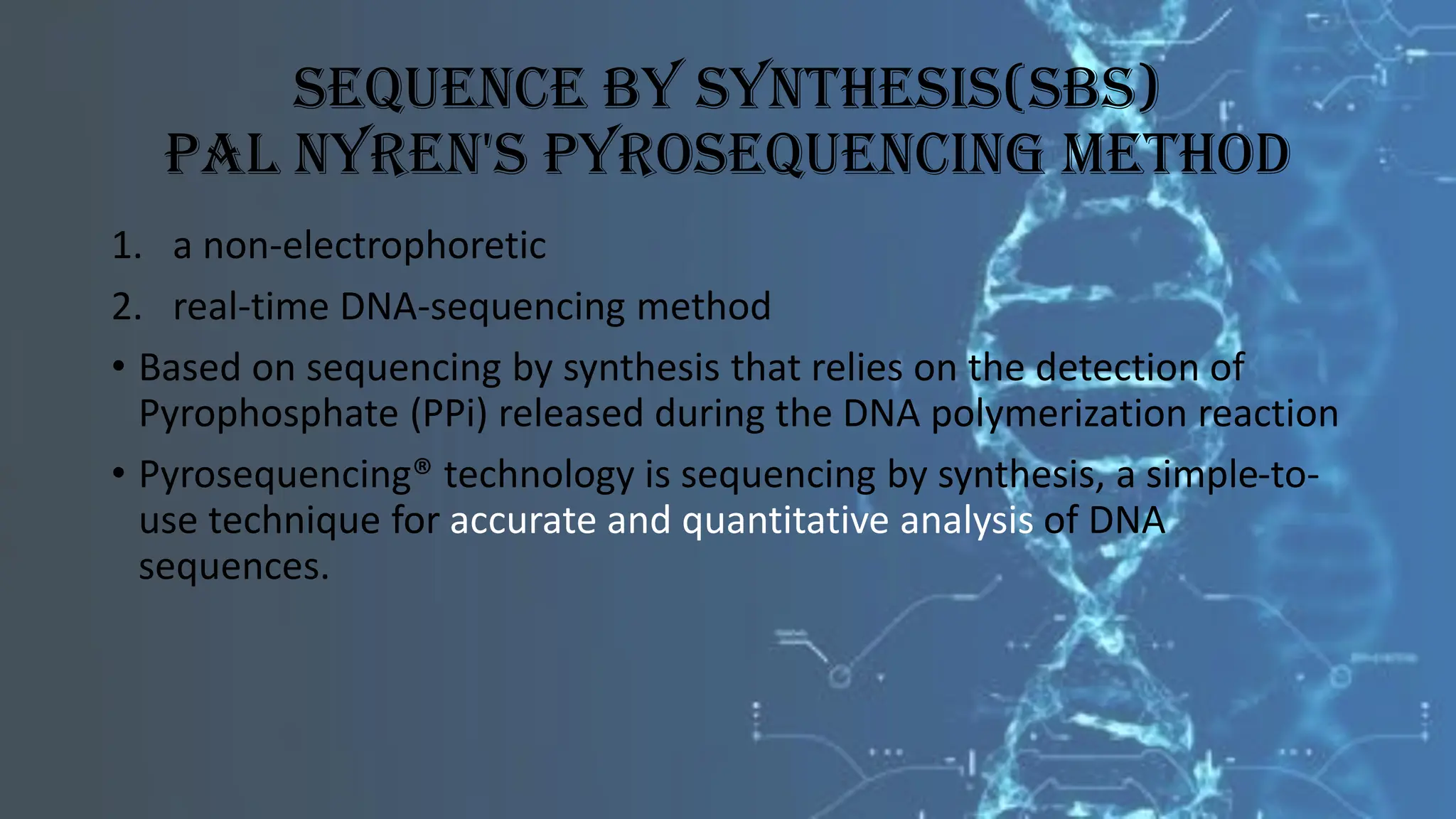
Sequence By Synthesis(SBS)
Pal Nyren's Pyrosequencing Method
1. a non-electrophoretic
2. real-time DNA-sequencing method
• Based on sequencing by synthesis that relies on the detection of
Pyrophosphate (PPi) released during the DNA polymerization reaction
• Pyrosequencing® technology is sequencing by synthesis, a simple-to-
use technique for accurate and quantitative analysis of DNA
sequences.
Sequence By Synthesis(SBS)
Pal Nyren's Pyrosequencing Method
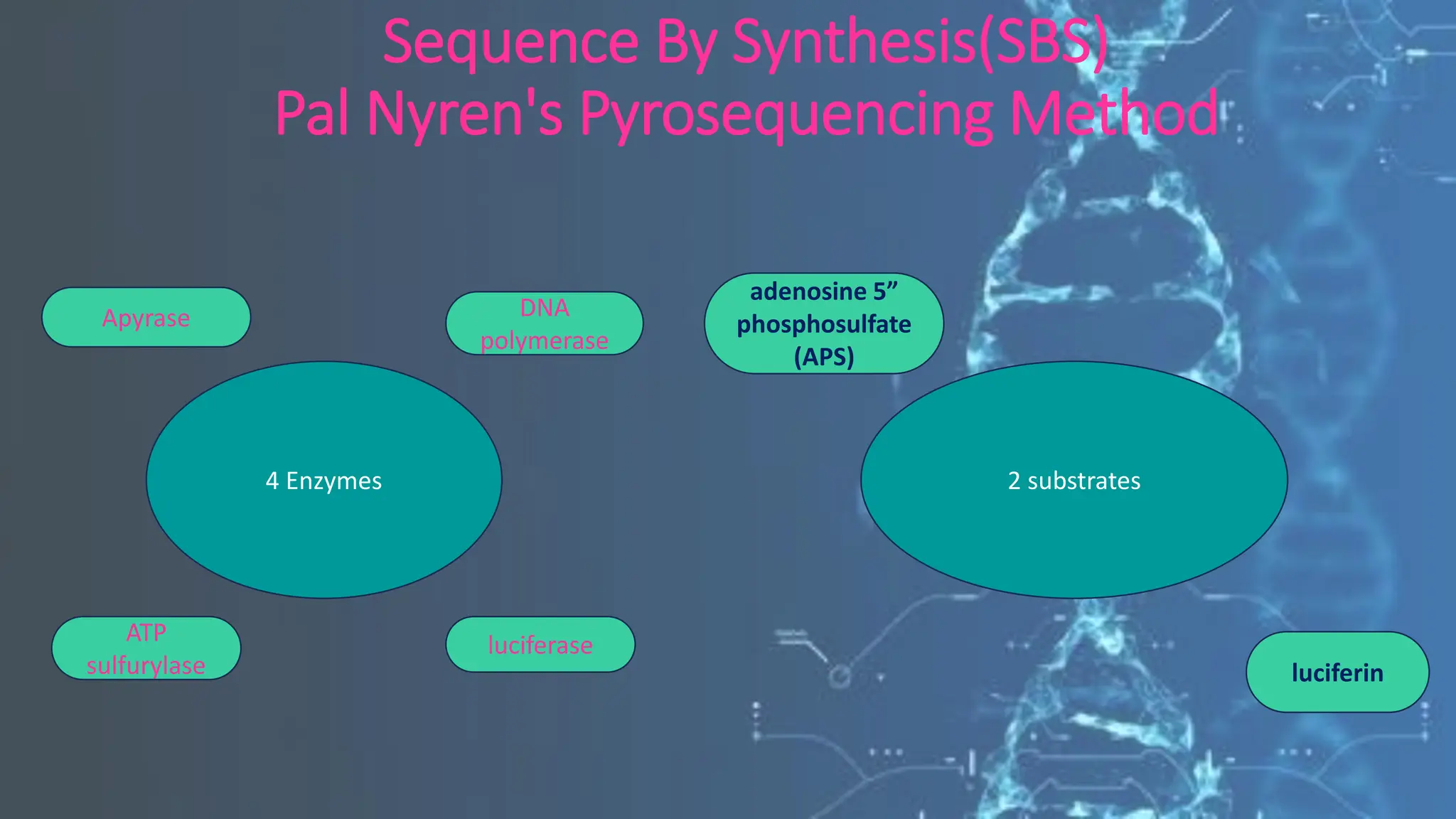
4 Enzymes 2 substrates
Apyrase
luciferase
ATP
sulfurylase
DNA
polymerase
adenosine 5”
phosphosulfate
(APS)
luciferin
Step 1
Step 2
Step 3
Step 4
Step 5
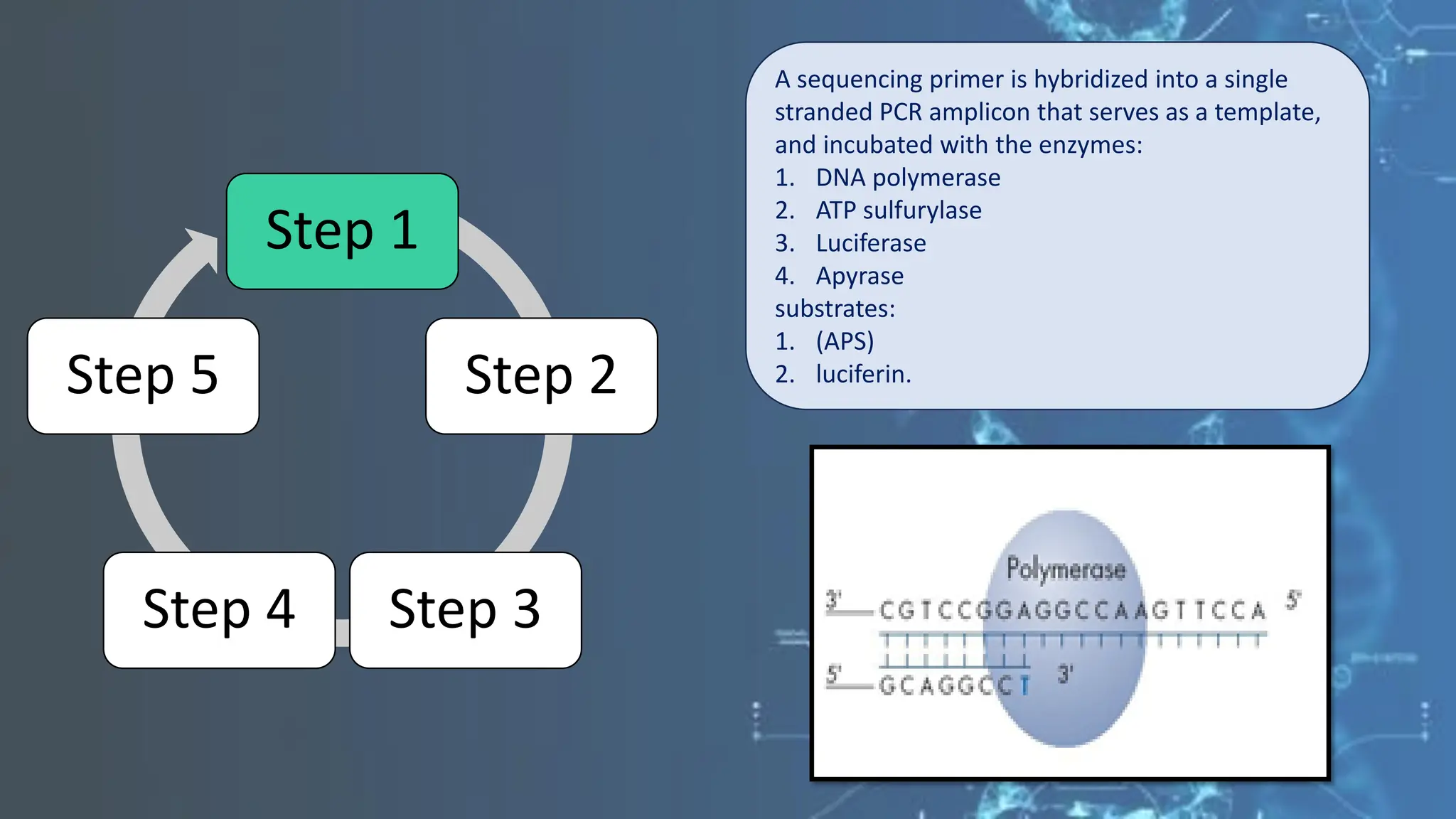
A sequencing primer is hybridized into a single
stranded PCR amplicon that serves as a template,
and incubated with the enzymes:
1. DNA polymerase
2. ATP sulfurylase
3. Luciferase
4. Apyrase
substrates:
1. (APS)
2. luciferin.
Step 1
Step 2
Step 3
Step 4
Step 5
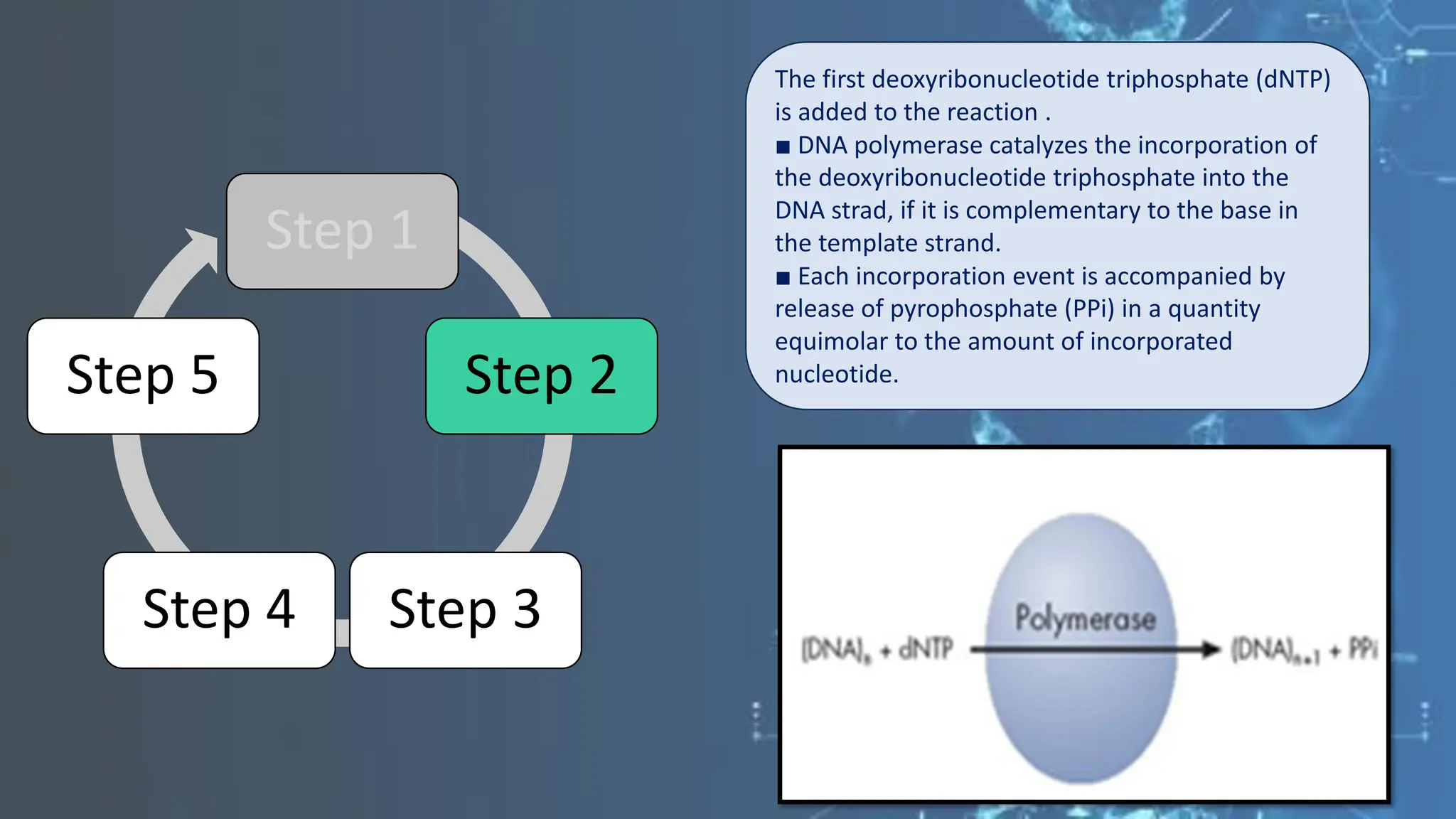
The first deoxyribonucleotide triphosphate (dNTP)
is added to the reaction .
■ DNA polymerase catalyzes the incorporation of
the deoxyribonucleotide triphosphate into the
DNA strad, if it is complementary to the base in
the template strand.
■ Each incorporation event is accompanied by
release of pyrophosphate (PPi) in a quantity
equimolar to the amount of incorporated
nucleotide.
Step 1
Step 2
Step 3
Step 4
Step 5
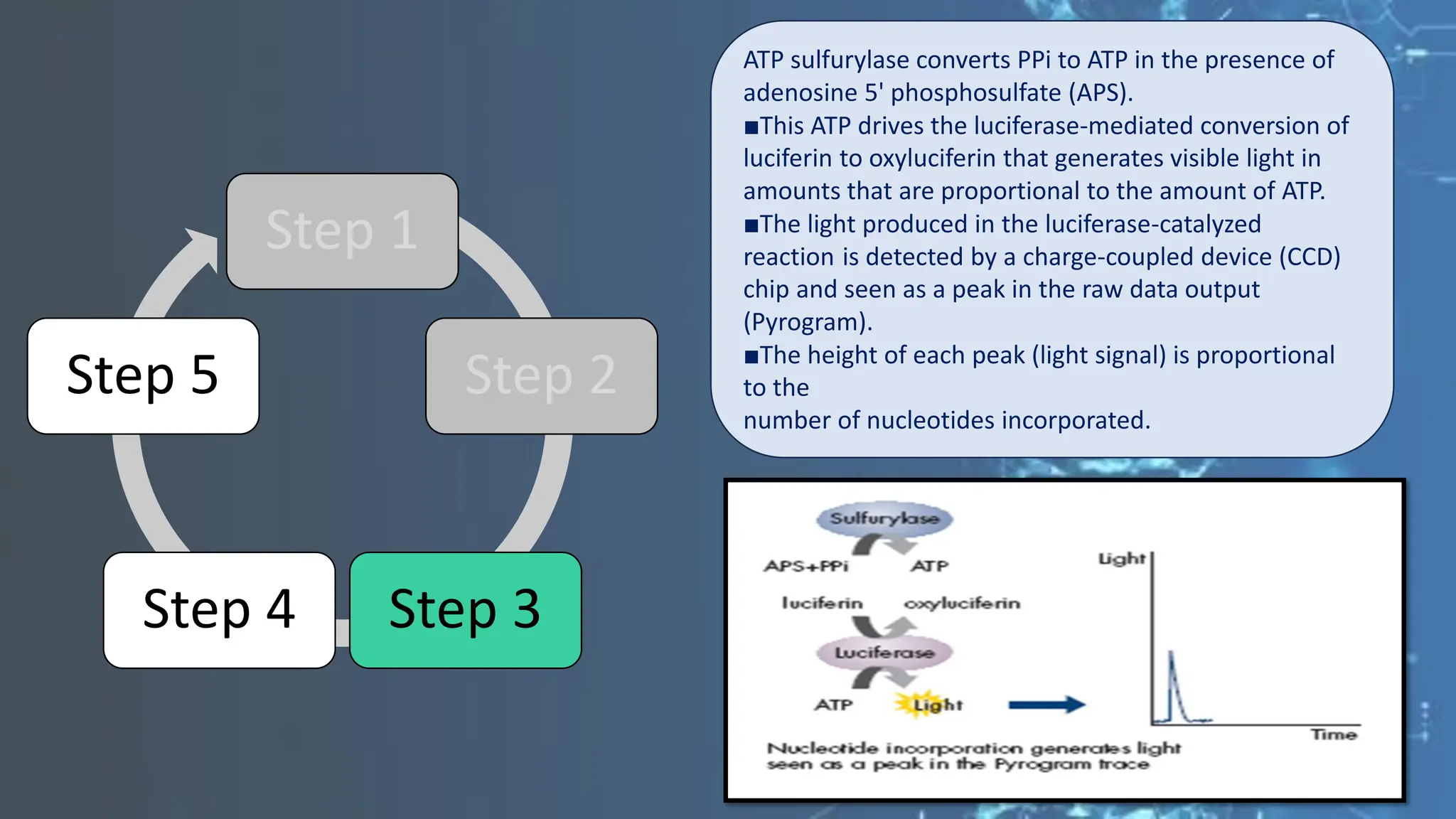
ATP sulfurylase converts PPi to ATP in the presence of
adenosine 5' phosphosulfate (APS).
■This ATP drives the luciferase-mediated conversion of
luciferin to oxyluciferin that generates visible light in
amounts that are proportional to the amount of ATP.
■The light produced in the luciferase-catalyzed
reaction is detected by a charge-coupled device (CCD)
chip and seen as a peak in the raw data output
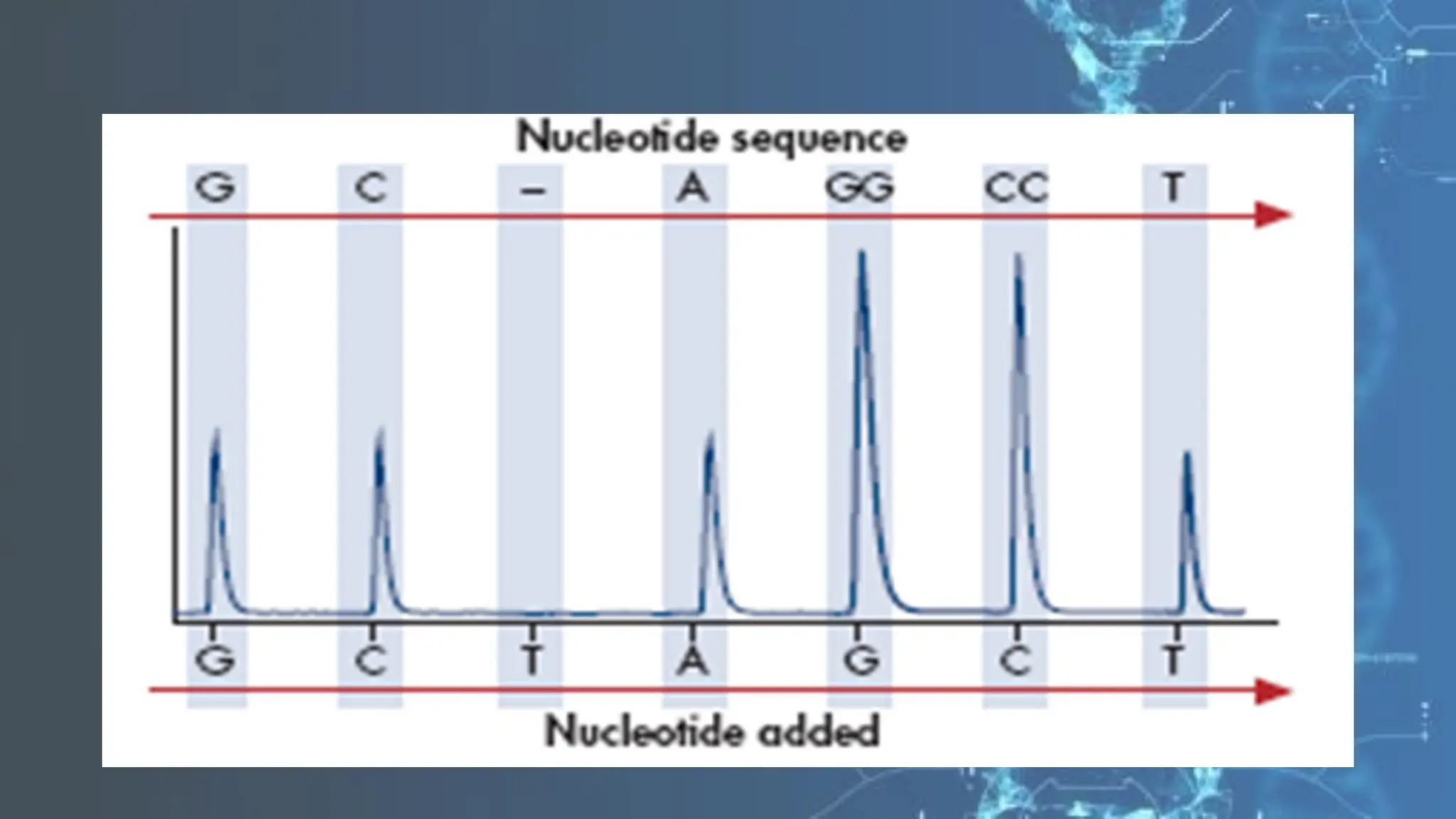
(Pyrogram).
■The height of each peak (light signal) is proportional
to the
number of nucleotides incorporated.
Step 1
Step 2
Step 3
Step 4
Step 5
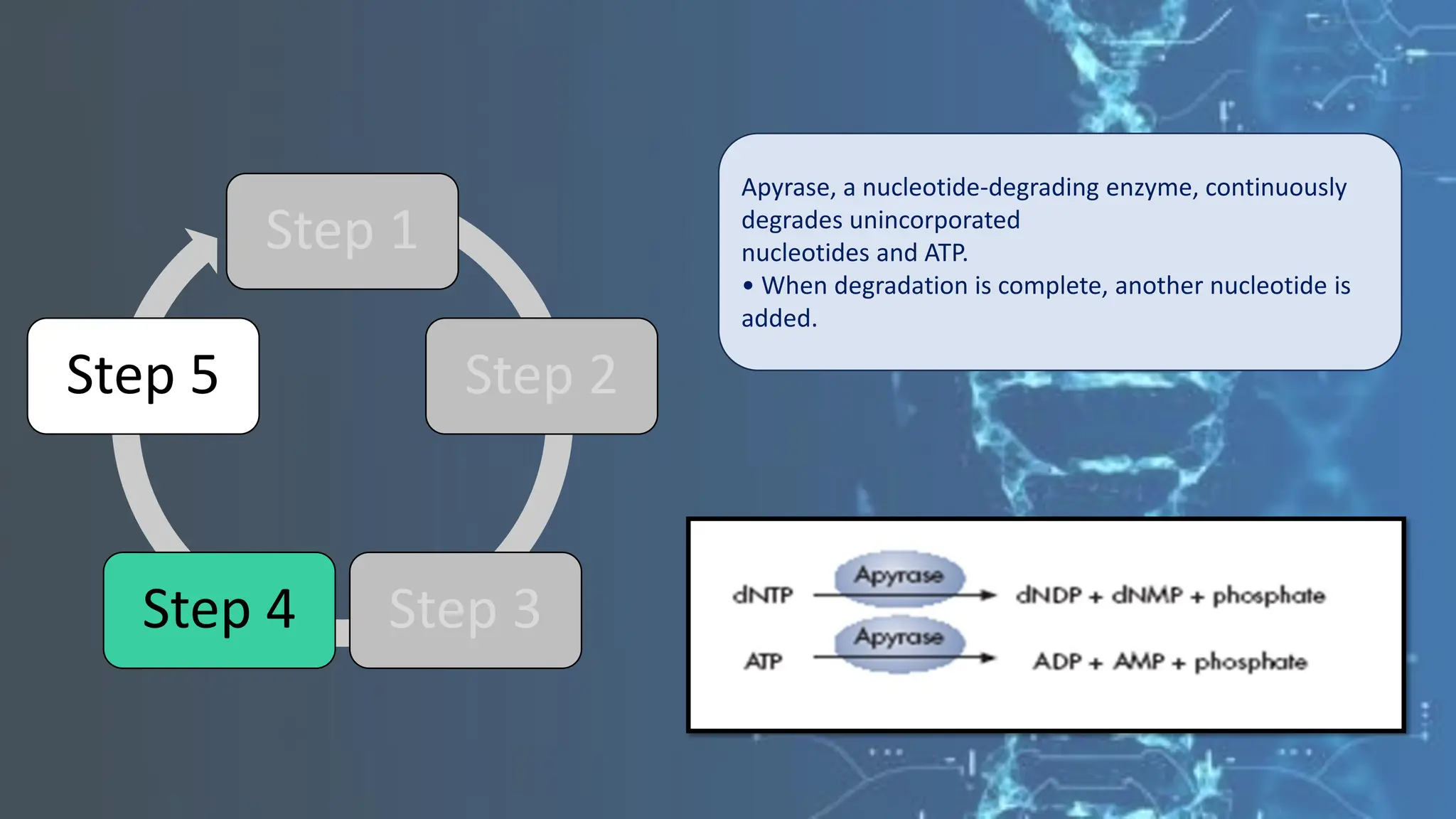
Apyrase, a nucleotide-degrading enzyme, continuously
degrades unincorporated
nucleotides and ATP.
• When degradation is complete, another nucleotide is
added.
Step 1
Step 2
Step 3
Step 4
Step 5
DNA sequencing mapping pdf.pdf

DNA sequencing mapping pdf.pdf

  • 1.
  • 2.
    Steps to mapthe GEnome Markers to generate highly saturated map Physical map Sequencing for the whole genome
  • 3.
    Steps to mapthe GEnome Markers to generate highly saturated map Physical map Sequencing for the whole genome
  • 4.
  • 5.
    For many recombinantDNA experiments, knowledge of a DNA sequence is a prerequisite for its further manipulation 1. DNA sequencing followed by computer-assisted searching for restriction endonuclease cleavage sites is often the fastest method for obtaining a detailed restriction map. 2. Computer-assisted identification of protein-coding regions (ORF) within the DNA sequence followed by computer-assisted similarity searches of DNA and protein databases can lead to important insights into the function and structure of a cloned gene and its product. 3. The DNA sequence is a prerequisite for a detailed analysis of the 5’ and 3’ noncoding regulatory regions of a gene. 4. DNA sequence information is essential for site-directed mutagenesis. 5. Small amounts of DNA sequence information ( “STS” or “EST “) are the basis of methods for mapping and ordering large DNA segments cloned into YACs, BACs, or cosmids
  • 6.
    Main methods forsequencing DNA The Enzymatic method Dideoxy or Chain – termination method (developed by Sanger and Coulson) The Chemical method (developed by Maxam and Gilbert) First Generation sequencing = Maxam-Gilbert sequencing =Sanger sequencing =chain termination sequencing
  • 7.
    THE DIDEOXY or ENZYMATICSEQUENCING METHOD • based on DNA synthesis in the presence of dideoxynucleotides. • a DNA polymerase is utilized to synthesize ➢a labeled ➢complementary copy of the DNA template • based on electrophoretic procedures using high – resolution denaturing polyacrylamide gels (sequencing gels) • electropherograms
  • 8.
    THE DIDEOXY or ENZYMATICSEQUENCING METHOD
  • 10.
    Single-stranded DNA templatefor the sequence of interest DNA polymerase a section of labeled primer the 4 normal deoxynucleotides triphosphate (dNTPs ) ddATP ddTTP ddCTP ddGTP
  • 12.
  • 13.
    Single-stranded DNA templatefor the sequence of interest DNA polymerase a section of labeled primer the 4 normal deoxynucleotides triphosphate (dNTPs ) ddATP ddTTP ddCTP ddGTP Each with different fluorescent label
  • 16.
    chain termination sequencing methodology standardchain termination • employs radioactive labels • visualized by autoradiography • Four reaction tubes Automated sequencing • Employs fluoro-labeling • visualized by fluorescent detector which can discriminate between the different labels • Safer than using isotopes • Single tube
  • 17.
    THE CHEMICAL SEQUENCINGMETHOD • only end-labeled fragments are observed following autoradiography of the sequencing gel • based on the ability of Hydrazine, Dimethyl sulfate (DMS) or Formic acid to specifically modify bases within the DNA molecule
  • 18.
    THE CHEMICAL SEQUENCINGMETHOD DMS (G) methylates nitrogen 7 (N7) of G, which then opens between carbon 8 and nitrogen 9 (Piperidine then displaces the modified G from its sugar) Formic acid (G+A) weakens A and G glycosidic bonds (The purines can then be displaced with piperidine) Hydrazine (T+C) splits the rings of T and C. (The fragments then displaced by piperidine) NaCl (C) In the presence of NaCl, only C reacts with hydrazine (The modified C can then be displaced with piperidin) Piperidine catalyze strand breakage at these modified nucleotides.
  • 20.
    What is thedifference between generated sequence from sanger and Maxam-Gilbert?
  • 21.
    Next-Generation Sequencing (NGS) •Despite many technical improvements during this era, the limitations of automated Sanger sequencing showed a need for new and improved technologies for sequencing large numbers of human genomes • The major advance offered by NGS is the ability to produce an enormous volume of data cheaply - in some cases over one billion short reads per instrument run
  • 22.
    Sequence By Synthesis(SBS) PalNyren's Pyrosequencing Method 1. a non-electrophoretic 2. real-time DNA-sequencing method • Based on sequencing by synthesis that relies on the detection of Pyrophosphate (PPi) released during the DNA polymerization reaction • Pyrosequencing® technology is sequencing by synthesis, a simple-to- use technique for accurate and quantitative analysis of DNA sequences.
  • 23.
    Sequence By Synthesis(SBS) PalNyren's Pyrosequencing Method 4 Enzymes 2 substrates Apyrase luciferase ATP sulfurylase DNA polymerase adenosine 5” phosphosulfate (APS) luciferin
  • 24.
    Step 1 Step 2 Step3 Step 4 Step 5 A sequencing primer is hybridized into a single stranded PCR amplicon that serves as a template, and incubated with the enzymes: 1. DNA polymerase 2. ATP sulfurylase 3. Luciferase 4. Apyrase substrates: 1. (APS) 2. luciferin.
  • 25.
    Step 1 Step 2 Step3 Step 4 Step 5 The first deoxyribonucleotide triphosphate (dNTP) is added to the reaction . ■ DNA polymerase catalyzes the incorporation of the deoxyribonucleotide triphosphate into the DNA strad, if it is complementary to the base in the template strand. ■ Each incorporation event is accompanied by release of pyrophosphate (PPi) in a quantity equimolar to the amount of incorporated nucleotide.
  • 26.
    Step 1 Step 2 Step3 Step 4 Step 5 ATP sulfurylase converts PPi to ATP in the presence of adenosine 5' phosphosulfate (APS). ■This ATP drives the luciferase-mediated conversion of luciferin to oxyluciferin that generates visible light in amounts that are proportional to the amount of ATP. ■The light produced in the luciferase-catalyzed reaction is detected by a charge-coupled device (CCD) chip and seen as a peak in the raw data output (Pyrogram). ■The height of each peak (light signal) is proportional to the number of nucleotides incorporated.
  • 27.
    Step 1 Step 2 Step3 Step 4 Step 5 Apyrase, a nucleotide-degrading enzyme, continuously degrades unincorporated nucleotides and ATP. • When degradation is complete, another nucleotide is added.
  • 28.
    Step 1 Step 2 Step3 Step 4 Step 5