Dr V S Vatkar
Asso Prof
Microbiology Department
D Y Patil Medical College, Kolhapur
INTRODUCTION
 Under picornavirus group
 Small RNA viruses
 Non-enveloped, 20 to 30 nm
 Classification
 Enterovius: infects GIT
 Rhinivirus: infects nasopharynx
 Hepatovirus
 parechovirus
ENTEROVIRUSES
HISTORY
 Paralytic Ds of children
 Landsteiner & Popper: demonstrated experimental
transmission of ds in monkeys
 Ender, Weller & Robbins (1948) Nobel Prize:
demonstrated growth in non neural cell culture like:
human embryo cells , shows cytopathic changes
ENTEROVIRUSES
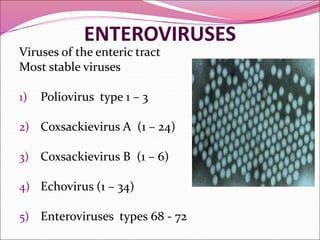
Viruses of the enteric tract
Most stable viruses
1) Poliovirus type 1 – 3
2) Coxsackievirus A (1 – 24)
3) Coxsackievirus B (1 – 6)
4) Echovirus (1 – 34)
5) Enteroviruses types 68 - 72
POLIOVIRUS
 Affinity for nervous tissues
 Morphology :
 Size 27-30 nm
 SS RNA
 60 capsomeres (subunits)
 Viral Proteins(VP1-VP4)
 Icosahedral symmetry
• VP1: major antigenic site for combination with type specific neutralizing Ab
RESISTANCE
 Resistant to ether ,chloroform , bile &
proteolytic enzymes of the intestinal tract,
detergents
 In feces : can survive up to month at 4 0 C
 Stable at pH 3
 years at -20°C
 55°C 30 mins
 MgCL2 protects the virus from heat inactivation.
 Does not survive lyophilisation
 Formaldehyde & oxidising disinfectants: destroy
virus
ANTIGENIC PROPERTIES
 Poliovirus strains classified into 3 types by
neutralization test – 1,2, and 3
 Type 1: the commonest & causes most epidemics
 Type 2: causes endemic infections
 Type 3: causes epidemics, type specific
 2 Antigens are recognized by CFT , ELIZA or PPTn
test -
 Antigen C : heated or H Ag, associated with empty
or non - infectious virus, anti C Ab : not protective,
not neutralizes viral infectivity
 Antigen D: native or N Ag, associated with whole
virion, type specific
 Antigen D is converted to Antigen C by heating the
virus at 56°C, anti D Ab protective
 Potency of injectable polio vaccine : measured in
terms of D Ag units.
PATHOGENESIS
 Transmission: Virus enters by oral route through
ingestion food & water contaminated with human
feces.
 Colonizes the nasopharynx & multiply initially
 Found in throat & feces in initial phases
 Then passes down to Peyer’s patches & epithelial cells
of alimentary canal & lymphatic system
 Inhalation of droplets can also be a mode of entry
 Goes to regional gr of LN
 Enters into blood stream (Primary Viremia)
 Further multiplication in reticuloendothelial system
 Virus again re-enters into blood stream (secondary
Viremia)
 Virus goes to spinal cord & brain (pass along axons of
peripheral nerves to CNS)
 In CNS: virus multiplies selectively in neurons &
destroys them.
 Degeneration of Nissl body (earliest change)
 Degeneration : irreversible, necrotic cell lyses or
phagocytosis by leucocytes or macrophages
 Anterior horn cells of spinal cord : mostly involved,
causes flaccid paralysis, post horn cells may also
involved
 Direct neural transmission to the CNS may occur
in special cases as in poliomyelitis, following
tonsillectomy
 Some cases encephalitis may occur , involves
brainstem extending up to motor & premotor areas
of cerebral cortex
CLINICAL FEATURES
 Inapparent infection: exposed to polio virus, 90-95%
susceptible individuals develop inapparent infection,
causes seroconversion only.
 Only 5-10% cases show clinical illness
 I P : 10 days (range 4 days – 4 weeks)
 Abortive poliomyelitis: (minor illness)- earliest
manifestations like fever, headache, sore throat,
malaise , last for 1-5 days
CLINICAL FEATURES
 Paralytic poliomyelitis: (Major illness)-
If the infection progresses ,the minor illness is followed by
major illness in 3-4 days
 Fever again (biphasic fever) with headache ,stiff neck and
other signs of meningitis- stage of viral invasion of the CNS
 Flaccid paralysis : depending on distribution of paralysis,
classified as SPINAL, BULBAR or SPINOBULBAR
 Mortality is 5-10 % mainly due to respiratory failure
 Recovery of paralised ms : next 4-8 wks, complete after 6
mnths, leaving behind varying degrees of residual paralysis
 Non paralytic poliomyelitis: ds dose not progress beyond
aseptic meningitis.
LAB. DIAGNOSIS
 Specimen: throat swab, feces (rectal swab), blood &
CSF
 Viral Isolation:
 Isolated from blood: primary viremia, little imp, can
be isolated from throat swab at this stage
 Feces: possible 80% cases in 1st wk, 50% till 3rd wk,
25% till 6th wk.
 CSF:
 Primary monkey kidney cell or tissue culture
(human or simian cell culture)
 Growth: detected by CYTOPATHIC effects in 2-3 days
 Identification by neutralization test with pooled or
specific antisera
 SEROLOGY: antibody rise: paired sera or CFT
 MOLECULAR diagnosis: Reverse Transcriptase PCR:
demo of viral RNA in CSF
 Sequencing: 3 types of strains : wild virus, Oral Polio
Vaccine Virus (OPV), Vaccine derived poliovirus
(VDPV)
PROPHYLAXIS
2 types of vaccines :
Active
immunization
a) Killed polio
vaccine (Salk)
b) Live attenuated
OPV (Sabin)
www.polioeradication.org
Polio
Paralysis for life Primarily affects children
Preventable with OPV
SALKS KILLED POLIO VACCINE/INACTIVATED
POLIO VACCINE
 Dev.by Salk in 1953
 Formalin inactivated prep. of 3 t/o polio viruses, grown on
monkey kidney tissue culture, inactivated with formaline
(1:4000) at 37 0 C for 12-15 days
 Deep subcut.or IM injection
 Produces long lasting immunity
 Induces serum antibodies IgM & IgG
 Does not induce IgA in the intestine and hence not able to
prevent alimentary tract infections
Vaccination schedule
 Three doses, given 4-6 weeks apart
 Booster dose six months later
 1st dose: after 6 mnths: maternal Ab does not interfere
 2nd dose: 4 -6 wks after 1st dose, induses better
seroconversion
 3rd dose: 6-12 mnths later,
 immunity lasts for 3-5 yrs, after booster dose
LIVE ATTENUATED OPV/SABIN VACCINE
 Dev.by Koprowsky, Cox & Sabin in 1962
 Contains live attenuated strains of polio viruses 1,2 and 3
 Shelf life 4 M at 4 - 8°C and 2 yrs.at -20°C
 Improper storage conditions and cold chain failure –
problem in dev.countries
 Administered orally
 Stimulates both IgA and humoral antibodies IgG and IgM
 OPV used in INDIA: contains
 Type 1 virus : 10 lakhs
 Type 2 virus : 2 lakhs
 Type 3 virus : 3 lakhs
 TC ID50 per dose ( 0.5 ml)
 Stabilized by MgCl2
 pH: 7.0
Safety
 OPV : tends to acquire neurovirulence on serial
enteric passages, may seen following vaccination.
Incidence ; very low.
 Vaccine associated paralytic polio or Vaccine
Derived Polio Virus (VDPV): rare strain of polio virus,
very rarely OPV strain converts into VDPV strain, polio
myelitis following vaccination
 Contraindication:
immunodeficient/immunocompromised person
Vaccination schedule
 Live attenuated OPV
 3 doses orally
 Zero dose (0 dose): at birth
 First dose along with DPT at
4-6 weeks (1 & 1/2mnth)
 2nd and 3rd – at an interval
of 4-6 weeks
 Booster dose at the age of
16 – 24 months
Issues related to vaccine failure
 Interference by other entero V, may be
Coxsackie B
 Frequent diarrhoea : prevents colonization
of virus in gut
 Breast feeding before & after vaccination
(maternal Ab present in breast milk)
 Inhibitors of polio V : present in saliva
 Proper maintenance of cold chain
PULSE POLIO IMMUNIZATION
 To eradicate polio myelitis globally .
 Mass immunization of OPV on a single day to all
children aged 0-5 years in the community
irrespective of their OPV vaccination status
 whether they are vaccinated or not, through
Universal Immunization Program (UPI)
 Two doses at the interval of 4-6 wks during low
polio transmission period (Nov to Feb) during
Winter season
 Development of Herd Immunity
EPIDEMIOLOGY
 Exclusively a Human
disease
 Feces- imp. source of
spread of virus in the
community
 Warm weather –
conducive to virus spread
 Type 1 – causes epidemics
 Type 2 – paralytic
poliomyelitis
 WHO- 13th May 1988-
Global eradication by
2000
Polio situation in the world
 Status of polio transmission:
 Endemic countries: currently wild polio V is endemic
in only Pakistan, Afghanistan & Nigeria. Nigeria
reported last case in August 2016
 Wild polio virus cases: in 2017, 22 wild polio v cases
were reported globally (17-Afghanistan & 8-Pakistan),
99 vaccine derived polio cases (CVDOV-2) reported
from Democratic Republic of Congo (21) & Syria
Republic (74)
 Currently all natural cases : due to wPV caused by
type 1, no natural cases due to type 2 & type 3 (since
1999 & 2013)
 India: declared polio free since March 2014 (last
natural case was detected in January 2011)
 Global eradication of polio & Endgame
strategic plan:
- interruption of wild polio virus transmission
- strengthening of immunization system: step
wise withdrawal of OPV along with switching over to
IPV
- polio free world by 2018
- infrastructure, man power, funds, knowledge &
experience
COXSACKIEVIRUS
 1949 in Coxsackie village in USA
 Resemble polio viruses in properties & epi.
 Infects suckling mice but not the adult mice
 Classified in 2 groups, based on the patho.changes they
produce
 Group A and Group B
 By neutralization test –
 Group A – divided into 24 types
 Group B - divided into 6 types
GROUP A COXSACKIE VIRUSES
1. Aseptic meningitis:
caused by all types of Gr B v
& A7, A9 Gr A v
2. Herpangina (Vesicular
pharyngitis) – caused by
types 2,4,5,6,8 and 10
Abrupt onset of
fever, pharyngitis ,pain
in abdomen,
headache
3. Hand-foot and
Mouth disease –
caused by types 5
and 16:Presents as a
vesicular lesion
involving hands,
mouth and feet
GROUP B COXSACKIE VIRUSES
1. Epidemic myalgia – Bornholm disease
Fever, stitch like pain in chest & abdo.
2. Myocarditis and Pericarditis (type 1-5) –
3. Aseptic meningitis with paralysis
4. Juvenile diabetes – pancreatitis Gr B-4
5. Neonatal infections – Hepatitis,
meningoencephalitis
6. Respiratory infection: Gr A & Gr B (common
cold), pneumonia: GrB type B4 & B5
 Acute haemorrhagic conjunctivitis: caused by Gr A-
24 & Enterovirus 70
 Self limiting conjunctival ds
 IP: 1 day
 Complete recovery: within 8 days
Lab. diagnosis
Virus isolation from feces or the lesions
a. Inoculation into suckling mice
b. Tissue culture – kidney cells of monkeys
ECHOVIRUSES
 Enteric Cytopathogenic Human Orphan (ECHO) viruses
 34 types – 1 to 34 except 10 and 28 (Rhinoviruses)
 Alimentary tract
 Faeco-oral route
 Some echoviruses agglutinate human RBC’s
 Resistant to 20% ether
CLINICAL FEATURES
 Most infections are asymptomatic
 Rash with fever
 Resp.diseases
 Paralysis
 Infantile diarrhoea
 Pericarditis and
 Aseptic meningitis
Lab. diagnosis
Specimens are :
1. Throat secretions
2. Stool
3. CSF
Isolation of the virus – inoculation into
kidney cells of monkey
ENTEROVIRUSES 68 - 72
68 : Isolated from pharyngeal secretions of children with
pneumonia and bronchitis
69 : Not asso. with any human disease
70 : Acute hemorrhagic conjunctivitis
71 : Isolated from cases of meningitis & encephalitis
72 : Hepatitis virus type A
RHINOVIRUS GR
 Common cold
 Three spp of rhino v (A, B & C) : inf in humans
 C/F: IP: 2-4 days, symptoms : similar to other viruses
causing common cold (corona v, adeno v, entero v,
parainfluenza v & influenza v)
 Sneezing, nasal obstruction, nasal discharge, sore
throat but no fever
 Average 1-2 attacks per year
Enteroviruses

Enteroviruses

  • 1.
    Dr V SVatkar Asso Prof Microbiology Department D Y Patil Medical College, Kolhapur
  • 2.
    INTRODUCTION  Under picornavirusgroup  Small RNA viruses  Non-enveloped, 20 to 30 nm  Classification  Enterovius: infects GIT  Rhinivirus: infects nasopharynx  Hepatovirus  parechovirus
  • 3.
  • 4.
    HISTORY  Paralytic Dsof children  Landsteiner & Popper: demonstrated experimental transmission of ds in monkeys  Ender, Weller & Robbins (1948) Nobel Prize: demonstrated growth in non neural cell culture like: human embryo cells , shows cytopathic changes
  • 5.
    ENTEROVIRUSES Viruses of theenteric tract Most stable viruses 1) Poliovirus type 1 – 3 2) Coxsackievirus A (1 – 24) 3) Coxsackievirus B (1 – 6) 4) Echovirus (1 – 34) 5) Enteroviruses types 68 - 72
  • 6.
    POLIOVIRUS  Affinity fornervous tissues  Morphology :  Size 27-30 nm  SS RNA  60 capsomeres (subunits)  Viral Proteins(VP1-VP4)  Icosahedral symmetry • VP1: major antigenic site for combination with type specific neutralizing Ab
  • 7.
    RESISTANCE  Resistant toether ,chloroform , bile & proteolytic enzymes of the intestinal tract, detergents  In feces : can survive up to month at 4 0 C  Stable at pH 3  years at -20°C  55°C 30 mins  MgCL2 protects the virus from heat inactivation.  Does not survive lyophilisation  Formaldehyde & oxidising disinfectants: destroy virus
  • 8.
    ANTIGENIC PROPERTIES  Poliovirusstrains classified into 3 types by neutralization test – 1,2, and 3  Type 1: the commonest & causes most epidemics  Type 2: causes endemic infections  Type 3: causes epidemics, type specific  2 Antigens are recognized by CFT , ELIZA or PPTn test -
  • 9.
     Antigen C: heated or H Ag, associated with empty or non - infectious virus, anti C Ab : not protective, not neutralizes viral infectivity  Antigen D: native or N Ag, associated with whole virion, type specific  Antigen D is converted to Antigen C by heating the virus at 56°C, anti D Ab protective  Potency of injectable polio vaccine : measured in terms of D Ag units.
  • 10.
    PATHOGENESIS  Transmission: Virusenters by oral route through ingestion food & water contaminated with human feces.  Colonizes the nasopharynx & multiply initially  Found in throat & feces in initial phases  Then passes down to Peyer’s patches & epithelial cells of alimentary canal & lymphatic system  Inhalation of droplets can also be a mode of entry
  • 11.
     Goes toregional gr of LN  Enters into blood stream (Primary Viremia)  Further multiplication in reticuloendothelial system  Virus again re-enters into blood stream (secondary Viremia)  Virus goes to spinal cord & brain (pass along axons of peripheral nerves to CNS)
  • 12.
     In CNS:virus multiplies selectively in neurons & destroys them.  Degeneration of Nissl body (earliest change)  Degeneration : irreversible, necrotic cell lyses or phagocytosis by leucocytes or macrophages  Anterior horn cells of spinal cord : mostly involved, causes flaccid paralysis, post horn cells may also involved
  • 13.
     Direct neuraltransmission to the CNS may occur in special cases as in poliomyelitis, following tonsillectomy  Some cases encephalitis may occur , involves brainstem extending up to motor & premotor areas of cerebral cortex
  • 14.
    CLINICAL FEATURES  Inapparentinfection: exposed to polio virus, 90-95% susceptible individuals develop inapparent infection, causes seroconversion only.  Only 5-10% cases show clinical illness  I P : 10 days (range 4 days – 4 weeks)  Abortive poliomyelitis: (minor illness)- earliest manifestations like fever, headache, sore throat, malaise , last for 1-5 days
  • 15.
    CLINICAL FEATURES  Paralyticpoliomyelitis: (Major illness)- If the infection progresses ,the minor illness is followed by major illness in 3-4 days  Fever again (biphasic fever) with headache ,stiff neck and other signs of meningitis- stage of viral invasion of the CNS  Flaccid paralysis : depending on distribution of paralysis, classified as SPINAL, BULBAR or SPINOBULBAR  Mortality is 5-10 % mainly due to respiratory failure  Recovery of paralised ms : next 4-8 wks, complete after 6 mnths, leaving behind varying degrees of residual paralysis  Non paralytic poliomyelitis: ds dose not progress beyond aseptic meningitis.
  • 19.
    LAB. DIAGNOSIS  Specimen:throat swab, feces (rectal swab), blood & CSF  Viral Isolation:  Isolated from blood: primary viremia, little imp, can be isolated from throat swab at this stage  Feces: possible 80% cases in 1st wk, 50% till 3rd wk, 25% till 6th wk.  CSF:
  • 20.
     Primary monkeykidney cell or tissue culture (human or simian cell culture)  Growth: detected by CYTOPATHIC effects in 2-3 days  Identification by neutralization test with pooled or specific antisera  SEROLOGY: antibody rise: paired sera or CFT  MOLECULAR diagnosis: Reverse Transcriptase PCR: demo of viral RNA in CSF  Sequencing: 3 types of strains : wild virus, Oral Polio Vaccine Virus (OPV), Vaccine derived poliovirus (VDPV)
  • 21.
    PROPHYLAXIS 2 types ofvaccines : Active immunization a) Killed polio vaccine (Salk) b) Live attenuated OPV (Sabin) www.polioeradication.org Polio Paralysis for life Primarily affects children Preventable with OPV
  • 22.
    SALKS KILLED POLIOVACCINE/INACTIVATED POLIO VACCINE  Dev.by Salk in 1953  Formalin inactivated prep. of 3 t/o polio viruses, grown on monkey kidney tissue culture, inactivated with formaline (1:4000) at 37 0 C for 12-15 days  Deep subcut.or IM injection  Produces long lasting immunity  Induces serum antibodies IgM & IgG  Does not induce IgA in the intestine and hence not able to prevent alimentary tract infections
  • 23.
    Vaccination schedule  Threedoses, given 4-6 weeks apart  Booster dose six months later  1st dose: after 6 mnths: maternal Ab does not interfere  2nd dose: 4 -6 wks after 1st dose, induses better seroconversion  3rd dose: 6-12 mnths later,  immunity lasts for 3-5 yrs, after booster dose
  • 24.
    LIVE ATTENUATED OPV/SABINVACCINE  Dev.by Koprowsky, Cox & Sabin in 1962  Contains live attenuated strains of polio viruses 1,2 and 3  Shelf life 4 M at 4 - 8°C and 2 yrs.at -20°C  Improper storage conditions and cold chain failure – problem in dev.countries  Administered orally  Stimulates both IgA and humoral antibodies IgG and IgM
  • 25.
     OPV usedin INDIA: contains  Type 1 virus : 10 lakhs  Type 2 virus : 2 lakhs  Type 3 virus : 3 lakhs  TC ID50 per dose ( 0.5 ml)  Stabilized by MgCl2  pH: 7.0
  • 26.
    Safety  OPV :tends to acquire neurovirulence on serial enteric passages, may seen following vaccination. Incidence ; very low.  Vaccine associated paralytic polio or Vaccine Derived Polio Virus (VDPV): rare strain of polio virus, very rarely OPV strain converts into VDPV strain, polio myelitis following vaccination  Contraindication: immunodeficient/immunocompromised person
  • 27.
    Vaccination schedule  Liveattenuated OPV  3 doses orally  Zero dose (0 dose): at birth  First dose along with DPT at 4-6 weeks (1 & 1/2mnth)  2nd and 3rd – at an interval of 4-6 weeks  Booster dose at the age of 16 – 24 months
  • 28.
    Issues related tovaccine failure  Interference by other entero V, may be Coxsackie B  Frequent diarrhoea : prevents colonization of virus in gut  Breast feeding before & after vaccination (maternal Ab present in breast milk)  Inhibitors of polio V : present in saliva  Proper maintenance of cold chain
  • 29.
    PULSE POLIO IMMUNIZATION To eradicate polio myelitis globally .  Mass immunization of OPV on a single day to all children aged 0-5 years in the community irrespective of their OPV vaccination status  whether they are vaccinated or not, through Universal Immunization Program (UPI)  Two doses at the interval of 4-6 wks during low polio transmission period (Nov to Feb) during Winter season  Development of Herd Immunity
  • 30.
    EPIDEMIOLOGY  Exclusively aHuman disease  Feces- imp. source of spread of virus in the community  Warm weather – conducive to virus spread  Type 1 – causes epidemics  Type 2 – paralytic poliomyelitis  WHO- 13th May 1988- Global eradication by 2000
  • 31.
    Polio situation inthe world  Status of polio transmission:  Endemic countries: currently wild polio V is endemic in only Pakistan, Afghanistan & Nigeria. Nigeria reported last case in August 2016  Wild polio virus cases: in 2017, 22 wild polio v cases were reported globally (17-Afghanistan & 8-Pakistan), 99 vaccine derived polio cases (CVDOV-2) reported from Democratic Republic of Congo (21) & Syria Republic (74)  Currently all natural cases : due to wPV caused by type 1, no natural cases due to type 2 & type 3 (since 1999 & 2013)
  • 32.
     India: declaredpolio free since March 2014 (last natural case was detected in January 2011)  Global eradication of polio & Endgame strategic plan: - interruption of wild polio virus transmission - strengthening of immunization system: step wise withdrawal of OPV along with switching over to IPV - polio free world by 2018 - infrastructure, man power, funds, knowledge & experience
  • 33.
    COXSACKIEVIRUS  1949 inCoxsackie village in USA  Resemble polio viruses in properties & epi.  Infects suckling mice but not the adult mice  Classified in 2 groups, based on the patho.changes they produce  Group A and Group B  By neutralization test –  Group A – divided into 24 types  Group B - divided into 6 types
  • 34.
    GROUP A COXSACKIEVIRUSES 1. Aseptic meningitis: caused by all types of Gr B v & A7, A9 Gr A v 2. Herpangina (Vesicular pharyngitis) – caused by types 2,4,5,6,8 and 10 Abrupt onset of fever, pharyngitis ,pain in abdomen, headache
  • 35.
    3. Hand-foot and Mouthdisease – caused by types 5 and 16:Presents as a vesicular lesion involving hands, mouth and feet
  • 36.
    GROUP B COXSACKIEVIRUSES 1. Epidemic myalgia – Bornholm disease Fever, stitch like pain in chest & abdo. 2. Myocarditis and Pericarditis (type 1-5) – 3. Aseptic meningitis with paralysis 4. Juvenile diabetes – pancreatitis Gr B-4 5. Neonatal infections – Hepatitis, meningoencephalitis 6. Respiratory infection: Gr A & Gr B (common cold), pneumonia: GrB type B4 & B5
  • 37.
     Acute haemorrhagicconjunctivitis: caused by Gr A- 24 & Enterovirus 70  Self limiting conjunctival ds  IP: 1 day  Complete recovery: within 8 days
  • 38.
    Lab. diagnosis Virus isolationfrom feces or the lesions a. Inoculation into suckling mice b. Tissue culture – kidney cells of monkeys
  • 39.
    ECHOVIRUSES  Enteric CytopathogenicHuman Orphan (ECHO) viruses  34 types – 1 to 34 except 10 and 28 (Rhinoviruses)  Alimentary tract  Faeco-oral route  Some echoviruses agglutinate human RBC’s  Resistant to 20% ether
  • 40.
    CLINICAL FEATURES  Mostinfections are asymptomatic  Rash with fever  Resp.diseases  Paralysis  Infantile diarrhoea  Pericarditis and  Aseptic meningitis
  • 42.
    Lab. diagnosis Specimens are: 1. Throat secretions 2. Stool 3. CSF Isolation of the virus – inoculation into kidney cells of monkey
  • 43.
    ENTEROVIRUSES 68 -72 68 : Isolated from pharyngeal secretions of children with pneumonia and bronchitis 69 : Not asso. with any human disease 70 : Acute hemorrhagic conjunctivitis 71 : Isolated from cases of meningitis & encephalitis 72 : Hepatitis virus type A
  • 44.
    RHINOVIRUS GR  Commoncold  Three spp of rhino v (A, B & C) : inf in humans  C/F: IP: 2-4 days, symptoms : similar to other viruses causing common cold (corona v, adeno v, entero v, parainfluenza v & influenza v)  Sneezing, nasal obstruction, nasal discharge, sore throat but no fever  Average 1-2 attacks per year