RHABDO VIRUS
RHABDO VIRUS

Prepared by:              Presentation with:
SAgun PAudel              o Samjhana gurung
Health Assistant
                          o Sabita timilshina
Student of BPH @ LA
  GRANDEE International   o Sarala kumal
  college, Simalchour
                          o Samjhana gurung
  Pokhara, Nepal
INTRODUCTION:
The name is derived from the Greek “rhabdos’’
meaning rod referring to the shape of the viral
particles.
They contain a negative stranded RNA genome
and are very stable to drying.
This group of viruses has a broad host range but
there is only one that affects humans. The viruses
are generally introduced through a bite wound.
CHARACTERISTICS:
 Rhabdoviruses carry their genetic material in the
form of negative-sense single-stranded RNA.
They typically carry genes for five proteins:
 large protein (L)

 glycoprotein (G)

nucleoprotein (N)

phosphoprotein (P) and

matrix protein (M).

 Rhabdoviruses that infect vertebrates are bullet-
shaped.
CHARACTERISTICS :


 Animal rhabdo viruses infect insects, fish, and
mammals, including humans.

   Present in saliva and transmitted by animal bite.

   The most common virus of this family is rabies virus.
CLASSIFICATION:
   Group: Group V (-)ssRNA
   Order: Mononegavirales
   Family: Rhabdoviridae
   Genera:
   Vesiculovirus
   Lyssavirus
   Nucleorhabdovirus
   Novirhabdovirus
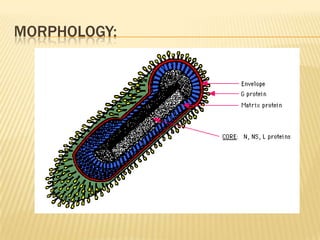
MORPHOLOGY:
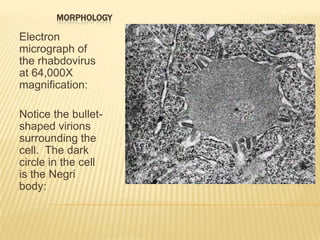
MORPHOLOGY

Electron
micrograph of
the rhabdovirus
at 64,000X
magnification:

Notice the bullet-
shaped virions
surrounding the
cell. The dark
circle in the cell
is the Negri
body:
MORPHOLOGY:
  o The most outstanding characteristic of the
  rhabdovirus is the bullet-shaped virion.
  o Such a shape is caused by a lipid
  envelope, embedded with glycoprotein
  peplomers, surrounding a helically wound
  nucleocapsid.
  o The virions tend to be approximately 70 nm
  wide and 170 nm long.
  oMatrix proteins can also be found
  under the lipoprotein envelope.
REPLICATION:

  Replication of many rhabdoviruses occurs in the
cytoplasm, although several of the plant infecting
viruses replicate in the nucleus.
 In order for replication, both the L and P protein
must be expressed to regulate transcription.
Transcription results in five monocistronic mRNAs
being produced because the intergenic sequences
act as both termination and promoter sequences for
adjacent genes
REPLICATION:
 During their synthesis the mRNAs are processed to
introduce a 5' cap and a 3’ polyadenylated tail to each of the
molecules.
 This structure is homologous to cellular mRNAs and can
thus be translated by cellular ribosomes to produce both
structural and non-structural proteins.
Genomic replication requires a source of newly
synthesized N protein to encapsidate the RNA.
This occurs during its synthesis and results in the
production of a full length anti-genomic copy.

REPLICATION:
    This in turn is used to produce more negative-
    sense genomic RNA.
   Replication characteristically occurs in an
    inclusion body within the cytoplasm, from where
    they bud through various cytoplasmic
    membranes and the outer membrane of the cell.
   This process results in the acquisition of the M +
    G proteins, responsible for the characteristic
    bullet- shaped morphology of the virus.
PATHOGENESIS:
 Rhabdoviruses generally enter via a bite or a
  wound infected with saliva.
 Initially, the virus replicates at the site and then
  infects CNS tissue.
Incubation period:
 6 days up to 1 year
 average 30-70 days.
 virus spreads rapidly via the nerves. CNS damage
  produces the symptoms of disease.
 Neurons accumulate ribonucleoprotein as
  intracytoplasmic inclusions. Infection of the
  thalamus, hypothalamus or pons may occur.
CLINICAL PRESENTATION:

 Most cases go through three stages. [classical
   rabies]:
I.   Prodromal Stage :
 lasts from 2-10 days and presents in the form of
     fever, headache, malaise, fatigue, and also
     localized pain around area of initial
     infection.

I.   Sensory Excitation:
     hyperactivity, hallucinations, disorientation, seizur
     es and bizarre behavior.
CLINICAL PRESENTATION:

 Also about 50% of infected individuals developed
     painful spasms of the pharynx and larynx resulting
     in a fear to eat or drink. Because of this fear they
     drool rather than swallow.
 Increased salivation is another symptom of the
     disease, thus adding to the drooling problem.
 This phase persists for 2-7 days.
III. Coma and Paralysis Phase:
 as the disease persists deterioration of CNS tissue
     leads to
     paralysis and respiratory problems.
CLINICAL PRESENTATION:

About 20% of cases have only two phases [dump
  rabies]:
patient skips the sensory excitation phase and
  progresses right to the coma and paralysis phase.
Dumb rabies is almost 100% fatal with only three
  known cases of survival.
In each of these cases the patients had high titers of
  antibody in the CSF.
LABORATORY DIAGNOSIS:

   Diagnosis is perform best by FA staining or RT-PCR
    of infected cells or tissues.
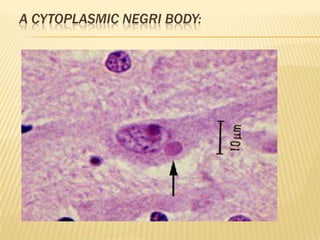
    Animals are diagnosed through histological
    examination of the CNS for Negri bodies.
   The cytoplasmic Negri body is a diagnostic of rabies
    encephalitis. size (7 micrometers) and color as a
    mature RBC.
   brain biopsy.
   Indirect immunofluorescence is most often used to
    detect rabies antigen [impression smear, oronasal
    mucosa scrapings, or hair follicles of the neck].
A CYTOPLASMIC NEGRI BODY:
CONTROL
 Sanitary  : cleansing of a bite wound to reduce the
 number of viral particles can help to prevent disease.
 Use of the vaccine for all dogs (a modified live
 vaccine) and cats (a dead virus suspension) is
 important in preventing spread to humans.
 Immunological : Both active and passive
 vaccination may be used to prevent human disease.
 The active vaccines are inactivated virus grown in
 human diploid cell cultures (HDCV) while the passive
 vaccine uses immunoglobulin.
 There is no any chemotherapeutical control
 available.
TREATMENT:

 Immediate First Aid :
The virus remains localized at the site of the wound for a
  period of time. To help recovery, wash the wound with
  soap and water as soon as possible, and follow with
  application of an antiseptic.
 Vaccine :
 Human Diploid Cell Vaccine :
HDCV should be given intramuscularly on days
  0, 3, 7, 14, and 28, followed by a booster dose on day 90.
 nervous tissue vaccine, or duck embryo vaccine.
 Human Rabies Immune Globulin.
PREVENTION:
  Rabies is the only human disease that can be
  prevented by active immunization after infection. This
  is possible due to the long
  incubation period of the virus.
 Pre-Exposure Immunization:

Anyone at high risk of contact with rabid animals may
  seek pre-exposure prophylaxis.
Rhabdo virus

Rhabdo virus

  • 1.
  • 2.
    RHABDO VIRUS Prepared by: Presentation with: SAgun PAudel o Samjhana gurung Health Assistant o Sabita timilshina Student of BPH @ LA GRANDEE International o Sarala kumal college, Simalchour o Samjhana gurung Pokhara, Nepal
  • 3.
    INTRODUCTION: The name isderived from the Greek “rhabdos’’ meaning rod referring to the shape of the viral particles. They contain a negative stranded RNA genome and are very stable to drying. This group of viruses has a broad host range but there is only one that affects humans. The viruses are generally introduced through a bite wound.
  • 4.
    CHARACTERISTICS:  Rhabdoviruses carrytheir genetic material in the form of negative-sense single-stranded RNA. They typically carry genes for five proteins:  large protein (L)  glycoprotein (G) nucleoprotein (N) phosphoprotein (P) and matrix protein (M).  Rhabdoviruses that infect vertebrates are bullet- shaped.
  • 5.
    CHARACTERISTICS :  Animalrhabdo viruses infect insects, fish, and mammals, including humans.  Present in saliva and transmitted by animal bite.  The most common virus of this family is rabies virus.
  • 6.
    CLASSIFICATION:  Group: Group V (-)ssRNA  Order: Mononegavirales  Family: Rhabdoviridae  Genera:  Vesiculovirus  Lyssavirus  Nucleorhabdovirus  Nucleorhabdovirus  Novirhabdovirus
  • 7.
  • 8.
    MORPHOLOGY Electron micrograph of the rhabdovirus at64,000X magnification: Notice the bullet- shaped virions surrounding the cell. The dark circle in the cell is the Negri body:
  • 9.
    MORPHOLOGY: oThe most outstanding characteristic of the rhabdovirus is the bullet-shaped virion. o Such a shape is caused by a lipid envelope, embedded with glycoprotein peplomers, surrounding a helically wound nucleocapsid. o The virions tend to be approximately 70 nm wide and 170 nm long. oMatrix proteins can also be found under the lipoprotein envelope.
  • 10.
    REPLICATION:  Replicationof many rhabdoviruses occurs in the cytoplasm, although several of the plant infecting viruses replicate in the nucleus.  In order for replication, both the L and P protein must be expressed to regulate transcription. Transcription results in five monocistronic mRNAs being produced because the intergenic sequences act as both termination and promoter sequences for adjacent genes
  • 11.
    REPLICATION:  During theirsynthesis the mRNAs are processed to introduce a 5' cap and a 3’ polyadenylated tail to each of the molecules.  This structure is homologous to cellular mRNAs and can thus be translated by cellular ribosomes to produce both structural and non-structural proteins. Genomic replication requires a source of newly synthesized N protein to encapsidate the RNA. This occurs during its synthesis and results in the production of a full length anti-genomic copy. 
  • 12.
    REPLICATION:  This in turn is used to produce more negative- sense genomic RNA.  Replication characteristically occurs in an inclusion body within the cytoplasm, from where they bud through various cytoplasmic membranes and the outer membrane of the cell.  This process results in the acquisition of the M + G proteins, responsible for the characteristic bullet- shaped morphology of the virus.
  • 13.
    PATHOGENESIS:  Rhabdoviruses generallyenter via a bite or a wound infected with saliva.  Initially, the virus replicates at the site and then infects CNS tissue. Incubation period:  6 days up to 1 year  average 30-70 days.  virus spreads rapidly via the nerves. CNS damage produces the symptoms of disease.  Neurons accumulate ribonucleoprotein as intracytoplasmic inclusions. Infection of the thalamus, hypothalamus or pons may occur.
  • 14.
    CLINICAL PRESENTATION: Mostcases go through three stages. [classical rabies]: I. Prodromal Stage : lasts from 2-10 days and presents in the form of fever, headache, malaise, fatigue, and also localized pain around area of initial infection. I. Sensory Excitation: hyperactivity, hallucinations, disorientation, seizur es and bizarre behavior.
  • 15.
    CLINICAL PRESENTATION: Alsoabout 50% of infected individuals developed painful spasms of the pharynx and larynx resulting in a fear to eat or drink. Because of this fear they drool rather than swallow. Increased salivation is another symptom of the disease, thus adding to the drooling problem. This phase persists for 2-7 days. III. Coma and Paralysis Phase: as the disease persists deterioration of CNS tissue leads to paralysis and respiratory problems.
  • 16.
    CLINICAL PRESENTATION: About 20%of cases have only two phases [dump rabies]: patient skips the sensory excitation phase and progresses right to the coma and paralysis phase. Dumb rabies is almost 100% fatal with only three known cases of survival. In each of these cases the patients had high titers of antibody in the CSF.
  • 17.
    LABORATORY DIAGNOSIS:  Diagnosis is perform best by FA staining or RT-PCR of infected cells or tissues.  Animals are diagnosed through histological examination of the CNS for Negri bodies.  The cytoplasmic Negri body is a diagnostic of rabies encephalitis. size (7 micrometers) and color as a mature RBC.  brain biopsy.  Indirect immunofluorescence is most often used to detect rabies antigen [impression smear, oronasal mucosa scrapings, or hair follicles of the neck].
  • 18.
  • 19.
    CONTROL Sanitary : cleansing of a bite wound to reduce the number of viral particles can help to prevent disease. Use of the vaccine for all dogs (a modified live vaccine) and cats (a dead virus suspension) is important in preventing spread to humans. Immunological : Both active and passive vaccination may be used to prevent human disease. The active vaccines are inactivated virus grown in human diploid cell cultures (HDCV) while the passive vaccine uses immunoglobulin. There is no any chemotherapeutical control available.
  • 20.
    TREATMENT:  Immediate FirstAid : The virus remains localized at the site of the wound for a period of time. To help recovery, wash the wound with soap and water as soon as possible, and follow with application of an antiseptic.  Vaccine :  Human Diploid Cell Vaccine : HDCV should be given intramuscularly on days 0, 3, 7, 14, and 28, followed by a booster dose on day 90.  nervous tissue vaccine, or duck embryo vaccine.  Human Rabies Immune Globulin.
  • 21.
    PREVENTION:  Rabiesis the only human disease that can be prevented by active immunization after infection. This is possible due to the long incubation period of the virus.  Pre-Exposure Immunization: Anyone at high risk of contact with rabid animals may seek pre-exposure prophylaxis.