Module- 4
Topic name
RHINO VIRUS NOTES
Sub code: BMLT5001
Sub Name: Virology and mycology
Department: Department of MLT, SMAS
Faculty: A. Vamsi Kumar
Designation : Assistant professor
Sem- V
SYLLABUS OVERVIEW
Unit-1 Mycology 8 hours
Introduction to medical mycology, basic concepts about superficial and deep mycoses taxonomy , classification &
general characteristics of Various medically important fungi.
Unit-2 Fungal infection 8 hours
Names of fungi & diseases caused by them; superficial mycoses, candida, dermatophytes, opportunistic fungi,
subcutaneous mycoses
Unit-3 Virology 7 hours
Introduction, classification of virus, collection, Transport, & Storage of sample for Viral diagnosis. Staining Techniques
used in virology,
Processing of sample for viral diagnosis (Egg Inoculation & Tissue culture)
Unit-4 RNA Viruses 9 hours
RNA Viruses: Polio myelitis, Rhino virus, Influenza, Rabies, Arbo viruses, Measles Mumps, Rubella, HIV
Unit-5 DNA Viruses 8 hours
DNA viruses: Small Pox, HSV, CMV, EBV, Varicella Zoster, Hepatitis, Adeno virus
Unit - 6 Next generation PCR and it’s modren applications 8 Hours
PCR and Next genration DNA Secquencing techniques to identify viral genome: History of PCR, Priciple of PCR, Stages
of PCR, procedure of PCR, Concept of optimization of PCR, Applications of PCR, Advancements in PCR technology, DNA
sequecing techniques, Methods of DNA Sequencing, Next generation DNA sequencing techniques
Unit-4 RNA Viruses 9 hours
RNA Viruses: Polio myelitis, Rhino virus, Influenza, Rabies, Arbo
viruses, Measles Mumps, Rubella, HIV
Unit 4
NOTES
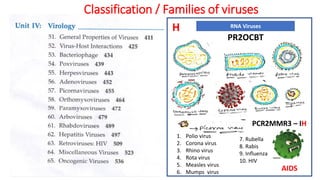
Classification / Families of viruses
DNA Viruses RNA Viruses
HAP3
Herpes viridae
1. Alpha – HS1, HS2, EBV
2. Beta – CMV
3. Gama -VZ
DNA “HAS” the potential
ii. Adenovirus
iii. Small pox
iv. Hepatitis
PR2OCBT
H H
PCR2MMR3 – IH
1. Polio virus
2. Corona virus
3. Rhino virus
4. Rota virus
5. Measles virus
6. Mumps virus
7. Rubella
8. Rabis
9. Influenza
10. HIV
AIDS
General points
1. Introduction
2. Classification
3. Morphology (General properties)
• Size
• Shape
• Symmetry
• Capsomers
• Genome
• Envelop
• Special viral proteins
4. Susceptibility & Resistance
5. Isolation / Cultivation - Animal/tissue/cell
culture
6. Pathogenesis + mode of transmission +
incubation period
7. Signs & Symptoms + Complications
8. Laboratory diagnosis
• Sample collection (antemortem + Post
mortem )
• Transport
• Direct microscopy
• Culture / isolation of virus
• Cytopathic effects
• Inclusion bodies or other tests
• Immunofluorescence tests
• Molecular tests
• Ag detection tests
• Detection of viral specific antibodies
9. Prophylaxis (Vaccination)
• Active immunization
• Passive immunization
10. Treatment
1. I
2. C
3. M
4. S&R
5. Cul
6. Patho
7. Signs
8. LD
9. Px
10.T
1. Introduction
1. I
2. C
3. M
4. S&R
5. Cul
6. Patho
7. Signs
8. LD
9. Px
10.T
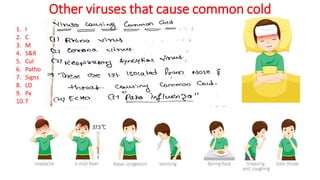
Other viruses that cause common cold
1. I
2. C
3. M
4. S&R
5. Cul
6. Patho
7. Signs
8. LD
9. Px
10.T
2. Classification1. I
2. C
3. M
4. S&R
5. Cul
6. Patho
7. Signs
8. LD
9. Px
10.T
3. Morphology
1. I
2. C
3. M
4. S&R
5. Cul
6. Patho
7. Signs
8. LD
9. Px
10. T
4. Susceptibility & Resistance
1. I
2. C
3. M
4. S&R
5. Cul
6. Patho
7. Signs
8. LD
9. Px
10. T
5. Cultivation
6. Pathogenesis
7. Symptoms of common cold
8. Laboratory Diagnosis
Rhino virus notes

Rhino virus notes

  • 1.
    Module- 4 Topic name RHINOVIRUS NOTES Sub code: BMLT5001 Sub Name: Virology and mycology Department: Department of MLT, SMAS Faculty: A. Vamsi Kumar Designation : Assistant professor Sem- V
  • 2.
    SYLLABUS OVERVIEW Unit-1 Mycology8 hours Introduction to medical mycology, basic concepts about superficial and deep mycoses taxonomy , classification & general characteristics of Various medically important fungi. Unit-2 Fungal infection 8 hours Names of fungi & diseases caused by them; superficial mycoses, candida, dermatophytes, opportunistic fungi, subcutaneous mycoses Unit-3 Virology 7 hours Introduction, classification of virus, collection, Transport, & Storage of sample for Viral diagnosis. Staining Techniques used in virology, Processing of sample for viral diagnosis (Egg Inoculation & Tissue culture) Unit-4 RNA Viruses 9 hours RNA Viruses: Polio myelitis, Rhino virus, Influenza, Rabies, Arbo viruses, Measles Mumps, Rubella, HIV Unit-5 DNA Viruses 8 hours DNA viruses: Small Pox, HSV, CMV, EBV, Varicella Zoster, Hepatitis, Adeno virus Unit - 6 Next generation PCR and it’s modren applications 8 Hours PCR and Next genration DNA Secquencing techniques to identify viral genome: History of PCR, Priciple of PCR, Stages of PCR, procedure of PCR, Concept of optimization of PCR, Applications of PCR, Advancements in PCR technology, DNA sequecing techniques, Methods of DNA Sequencing, Next generation DNA sequencing techniques
  • 3.
    Unit-4 RNA Viruses9 hours RNA Viruses: Polio myelitis, Rhino virus, Influenza, Rabies, Arbo viruses, Measles Mumps, Rubella, HIV Unit 4
  • 4.
  • 5.
    Classification / Familiesof viruses DNA Viruses RNA Viruses HAP3 Herpes viridae 1. Alpha – HS1, HS2, EBV 2. Beta – CMV 3. Gama -VZ DNA “HAS” the potential ii. Adenovirus iii. Small pox iv. Hepatitis PR2OCBT H H PCR2MMR3 – IH 1. Polio virus 2. Corona virus 3. Rhino virus 4. Rota virus 5. Measles virus 6. Mumps virus 7. Rubella 8. Rabis 9. Influenza 10. HIV AIDS
  • 6.
    General points 1. Introduction 2.Classification 3. Morphology (General properties) • Size • Shape • Symmetry • Capsomers • Genome • Envelop • Special viral proteins 4. Susceptibility & Resistance 5. Isolation / Cultivation - Animal/tissue/cell culture 6. Pathogenesis + mode of transmission + incubation period 7. Signs & Symptoms + Complications 8. Laboratory diagnosis • Sample collection (antemortem + Post mortem ) • Transport • Direct microscopy • Culture / isolation of virus • Cytopathic effects • Inclusion bodies or other tests • Immunofluorescence tests • Molecular tests • Ag detection tests • Detection of viral specific antibodies 9. Prophylaxis (Vaccination) • Active immunization • Passive immunization 10. Treatment 1. I 2. C 3. M 4. S&R 5. Cul 6. Patho 7. Signs 8. LD 9. Px 10.T
  • 7.
    1. Introduction 1. I 2.C 3. M 4. S&R 5. Cul 6. Patho 7. Signs 8. LD 9. Px 10.T
  • 8.
    Other viruses thatcause common cold 1. I 2. C 3. M 4. S&R 5. Cul 6. Patho 7. Signs 8. LD 9. Px 10.T
  • 9.
    2. Classification1. I 2.C 3. M 4. S&R 5. Cul 6. Patho 7. Signs 8. LD 9. Px 10.T
  • 10.
    3. Morphology 1. I 2.C 3. M 4. S&R 5. Cul 6. Patho 7. Signs 8. LD 9. Px 10. T
  • 11.
    4. Susceptibility &Resistance 1. I 2. C 3. M 4. S&R 5. Cul 6. Patho 7. Signs 8. LD 9. Px 10. T
  • 12.
  • 13.
  • 14.
    7. Symptoms ofcommon cold
  • 15.