Dr. V. S. Vatkar
Asso Prof,
Microbiology Department
* Causative agent of Leprosy
* Vedic times (Kustha Roga) in
Sushruta Samhita and Biblical
times in Middle East and
Hippocrates,460 BC
* G H Armauer Hansen
(1873)in Norway
* Not possible to cultivate the
bacillus in culture media
* Straight or slightly curved rod
* 1- 8µm 0.2- 0.5µmˣ
* obligate intracellular pathogen
* Gram positive, less acid fast : 5% H2SO4
* Glia: bacilli bounded together by lipid like
substance : ‘Cigar bundle’ appearance
* Globi : masses of glia are known as globi
*Strict aerobe
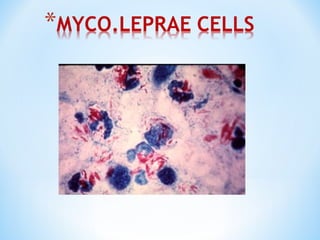
* Virchow’s cells : cigar bundle of
bacilli inside lipid laden macrophages
*Undifferentiated histiocytes / foamy
cells
* Morphological index: % of uniformly
stained bacilli in tissue : method of
assessing pt’s progress who is on
chemotherapy.
* Bacteriological index : no of bacilli in
a tissue
* ICRC (Indian Cancer Research
Centre),Bombay (1962) : AFB isolated
from leprosy pts employing human
foetal spinal ganglion cell culture
* Shephard ( 1960) : Lepra bacilli can
multiply in footpads of mice at 20 C
with development of granuloma in 1-6
mnths
* Thymectomy done to inhibit CMI or
administration of antilymphocyte
serum, generalized inf is produced
stimulating Lepromatous Leprosy
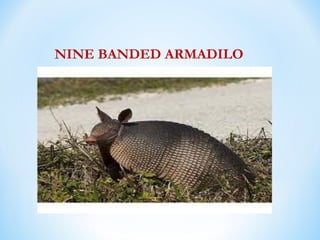
* Nine banded armadilo : highly
susceptible, generalised inf with
lepromatous leprosy
* Natural ds seen in Chimpanzees in
west Africa
* Generation time : 12-13 days
NINE BANDED ARMADILO
* Warm climate : 9-16 days
* Moist soil : 46 days
* Direct sunlight : 2 hours
* UVL : 30 mins.
*Leprosy is a chronic granulomatous
disease of humans, involving the skin,
peripheral nerves, nasal mucosa and
any organ of the body
*Believed to be highly contagious ds
*Due to fear, ignorance, superstitious
beliefs and deformities –
disfigurements causes social stigma
*Pts were considered UNCLEANE &
out casted
*Today early diagnosis & effective
treatment- deformities can be
prevented
*Incubation period:
*3-5yrs (vary between 2 & 40
yrs)
*Due to longer generation time
*Lepromatous leprosy has longer
generation time than
tuberculoid type
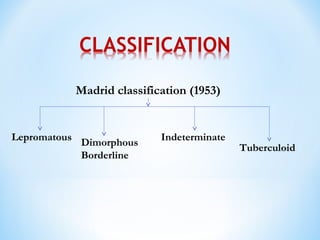
Madrid classification (1953)
Lepromatous
Dimorphous
Borderline
Indeterminate
Tuberculoid
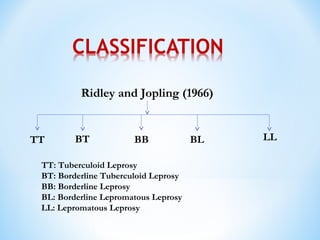
Ridley and Jopling (1966)
TT BT BB BL LL
TT: Tuberculoid Leprosy
BT: Borderline Tuberculoid Leprosy
BB: Borderline Leprosy
BL: Borderline Lepromatous Leprosy
LL: Lepromatous Leprosy
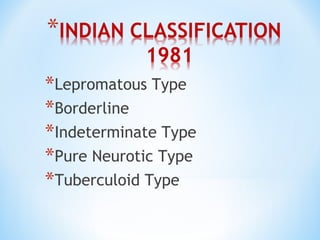
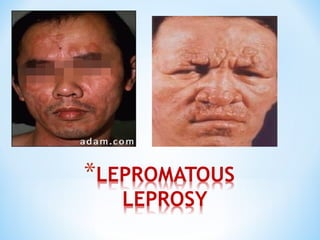
*Lepromatous Type
*Borderline
*Indeterminate Type
*Pure Neurotic Type
*Tuberculoid Type
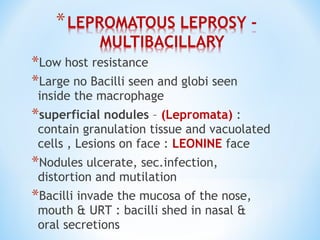
*Low host resistance
*Large no Bacilli seen and globi seen
inside the macrophage
*superficial nodules – (Lepromata) :
contain granulation tissue and vacuolated
cells , Lesions on face : LEONINE face
*Nodules ulcerate, sec.infection,
distortion and mutilation
*Bacilli invade the mucosa of the nose,
mouth & URT : bacilli shed in nasal &
oral secretions
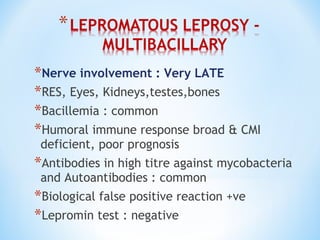
*Nerve involvement : Very LATE
*RES, Eyes, Kidneys,testes,bones
*Bacillemia : common
*Humoral immune response broad & CMI
deficient, poor prognosis
*Antibodies in high titre against mycobacteria
and Autoantibodies : common
*Biological false positive reaction +ve
*Lepromin test : negative
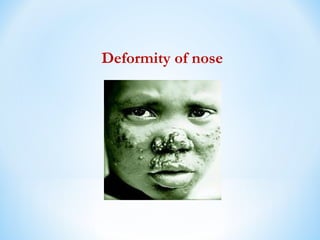
Deformity of nose
* scanty bacilli in the lesions
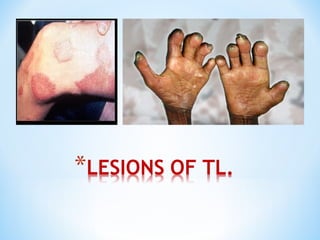
*Few skin lesions : Sharply demarcated,
annular macular hypoigmented
anaesthetic pathes, Deformities in
hands and feet
* Early neural involvement: common
nerve : ULNAR nr & Post-auricular nr
(enlarged & thickened)
* Medial popliteal nr: never involved
* Scanty bacilli in lesions
* Min. infectivity
* CMI adequate
* Lepromin test: positive
* Antimycobacterial antibodies - rare
* Autoantibodies – rare
* Good prognosis
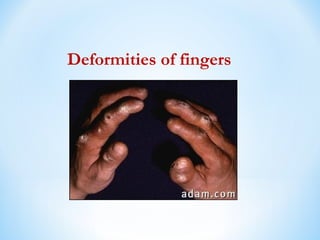
Deformities of fingers
* Possess characteristics of TL and LL
* May shift to any one depending on
chemotherapy or alterations in host
resistance
* Unstable : tissue reaction: no
characteristics of either LL or TT type
*One or two Hypopigmented patches &
definite sensory impairment
*Lesions : bacteriologically negative
* Spontaneous healing
* Some may progress to TT / LL
* Humans : only source of inf (TL or LL)
* Mode of entry : RT or thr’ skin
* Asymptomatic inf quite common in
endemic areas
* bacilli continue to shed from nose &
skin for 2-3 yrs before S/S of ds seen in
pt
* Not highly communicable ds
* I P : 2-5 yrs, as long as 30 yrs
*Direct contact: person to person
*Indirect contact: infected soil,
fomites (cloths & linens)
*Direct dermal inoculation during
tattooing
*Environmental factors: rural areas,
moist soil, humidity, over crowding
*Males affected twice common than
females
* High degree of innate
immunity exists in human
beings
* Humoral & CMI
* Humoral Ab do not have
harmful effects on lepra
bacilli
* Capable of destroying the
bacilli
* Phagocytose the bacilli
* Sp.humoral antibodies absent
* Ig levels same
* Alb: Glob ratio is same
* Deficiency of CMI : deve LL
* No deleterious effect on the bacilli
* Delayed hypersensitivity is absent
* Macrophages phagocytose the bacilli
but do not kill them
* Grow inside the cell
*HLA- DR2 ---- in pts.with
tuberloid
*HLA – MT1 & HLA- DQ1 --- LL
*People with low CMI: LL
*Delayed type of hypersensitivity: to lepra Ag
*Virchow’s Lepra Cell: macrophages unable to kill
intracellular bacilli but bacilli proliferate inside the
cells
*Ag Specific: CMI deficient in LL pts, not susceptible
to any opportunistic infections
*CD4 & CD8 ratio: reverse (1:2) in LL, CD8 cells are
prominent in circulation & in granulomas
*Prominent T2H response: in LL pts: T2H specific
cytokines: IL4,IL5, IL6 & IL10 leads to exaggerated Ab
response so auto Ab common, False +ve VDRL test
*DTH response: lepromine test positive
*CMI intact , prominent T1H response:
release of T1H specific cytokines like
IL2, INF-γ which activates
macrophages
*CD4 & CD8 ratio: Normal, CD4 cells:
seen in circulation & in granulomas
* Normal humoral response
*Deformities: 25% untreated cases develop deformities,
may due to
*Nerve injury: ms weakness, paralysis
*Facial deformities or loss of eyebrows
*Infection or injury (ulcers)
*Common deformities:
*Face Leonine facies, sagging face, saddle nose & corneal
opasity
*Hands: claw hand , wrist drop
*Feet: foot drop, clawing of toes, inversion of foot &
planter ulcers
*Type I : Lepra reaction
- In borderline
- Pts.on chemotherapy
- Influx of lymphocytes in lesion
- Shift to tuberloid morphology
- Erythema & swelling
-Pain & tenderness
- CMI deficient : lesion may shift to Lpromatous pattern
*Type II ( Erythema
Nodosum Leprosum)
*In LL & BL
*With few mnths. chemotherapy
*Tender, inflammed subcut. nodules
appear with fever, lymphadenopathy
*Arthur type response
*Dead cells
*Mitsuda in 1919
*Skin test: delayed type of
hypersensitivity test
*Ag lepromin : boiled,emulsified
lepromatous tissue rich in lepra bacilli
, intradermal injection of lepromin
Biphasic reaction :
1. Fernandez reaction: erythema &
induration
In 24-48 hrs and stays for 3-5 days
analogous to TT
2. Mitsuda reaction
Late reaction in 1-2 wks.
Peak in 1-4 wks. And then subsides,
indurated nodule which may ulcerate
*Modern Ag – standardized
*Lepra bacillus content is 4 10 7ˣ
Lbac./ml
*Std. lepromins from armadillo
*Classify lesions of leprosy pts
*Assess prognosis & treatment
*Assess resistance of individuals
to leprosy
*Tuberculoid leprosy.
*Indicates a good prognosis.
*Indicates resistance to
leprosy.
*Conversion of negative
reaction to positive reaction is
the evidence of improvement.
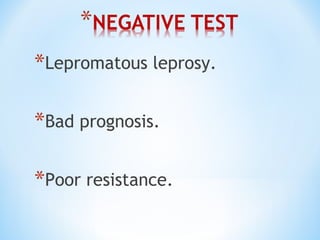
*Lepromatous leprosy.
*Bad prognosis.
*Poor resistance.
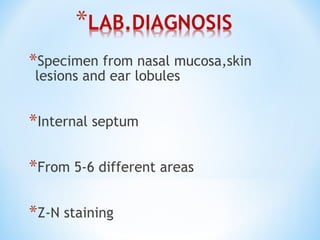
*Specimen from nasal mucosa,skin
lesions and ear lobules
*Internal septum
*From 5-6 different areas
*Z-N staining
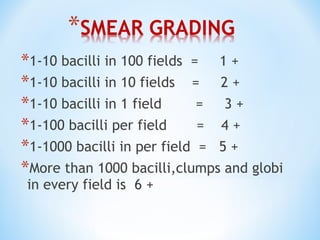
*1-10 bacilli in 100 fields = 1 +
*1-10 bacilli in 10 fields = 2 +
*1-10 bacilli in 1 field = 3 +
*1-100 bacilli per field = 4 +
*1-1000 bacilli in per field = 5 +
*More than 1000 bacilli,clumps and globi
in every field is 6 +
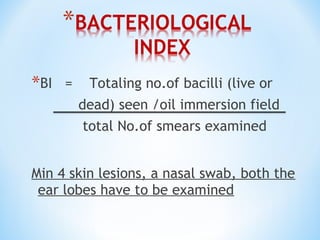
*BI = Totaling no.of bacilli (live or
dead) seen /oil immersion field
total No.of smears examined
Min 4 skin lesions, a nasal swab, both the
ear lobes have to be examined
*Dapsone 100 mg + rifampicin 600
mg for 6 months ( for TT & BT)
Dapsone 100 mg
Rifampicin 600 mg for 2 years
Clofazime 50 mg
*Rat leprosy.
*3-5 μm long, curved bacillus.
*Acid-fast, showing granular staining.
*Gram positive.
*Subcutaneus indurations.
*Lymphadenopathy.
*Ulcerations.
*Loss of hair.
*Chorioallantoic membrane of fertile hen’s egg.
*Tissue culture of rat fibroblast origin.
*Growth appears in 8 – 12 days.
*DNA study show no relation to M.leprae.

Mycobacterium leprae

  • 1.
    Dr. V. S.Vatkar Asso Prof, Microbiology Department
  • 2.
    * Causative agentof Leprosy * Vedic times (Kustha Roga) in Sushruta Samhita and Biblical times in Middle East and Hippocrates,460 BC * G H Armauer Hansen (1873)in Norway * Not possible to cultivate the bacillus in culture media
  • 4.
    * Straight orslightly curved rod * 1- 8µm 0.2- 0.5µmˣ * obligate intracellular pathogen * Gram positive, less acid fast : 5% H2SO4 * Glia: bacilli bounded together by lipid like substance : ‘Cigar bundle’ appearance * Globi : masses of glia are known as globi *Strict aerobe
  • 5.
    * Virchow’s cells: cigar bundle of bacilli inside lipid laden macrophages *Undifferentiated histiocytes / foamy cells * Morphological index: % of uniformly stained bacilli in tissue : method of assessing pt’s progress who is on chemotherapy. * Bacteriological index : no of bacilli in a tissue
  • 6.
    * ICRC (IndianCancer Research Centre),Bombay (1962) : AFB isolated from leprosy pts employing human foetal spinal ganglion cell culture * Shephard ( 1960) : Lepra bacilli can multiply in footpads of mice at 20 C with development of granuloma in 1-6 mnths
  • 7.
    * Thymectomy doneto inhibit CMI or administration of antilymphocyte serum, generalized inf is produced stimulating Lepromatous Leprosy * Nine banded armadilo : highly susceptible, generalised inf with lepromatous leprosy * Natural ds seen in Chimpanzees in west Africa * Generation time : 12-13 days
  • 8.
  • 9.
    * Warm climate: 9-16 days * Moist soil : 46 days * Direct sunlight : 2 hours * UVL : 30 mins.
  • 10.
    *Leprosy is achronic granulomatous disease of humans, involving the skin, peripheral nerves, nasal mucosa and any organ of the body
  • 11.
    *Believed to behighly contagious ds *Due to fear, ignorance, superstitious beliefs and deformities – disfigurements causes social stigma *Pts were considered UNCLEANE & out casted *Today early diagnosis & effective treatment- deformities can be prevented
  • 12.
    *Incubation period: *3-5yrs (varybetween 2 & 40 yrs) *Due to longer generation time *Lepromatous leprosy has longer generation time than tuberculoid type
  • 13.
  • 14.
    Ridley and Jopling(1966) TT BT BB BL LL TT: Tuberculoid Leprosy BT: Borderline Tuberculoid Leprosy BB: Borderline Leprosy BL: Borderline Lepromatous Leprosy LL: Lepromatous Leprosy
  • 15.
  • 16.
    *Low host resistance *Largeno Bacilli seen and globi seen inside the macrophage *superficial nodules – (Lepromata) : contain granulation tissue and vacuolated cells , Lesions on face : LEONINE face *Nodules ulcerate, sec.infection, distortion and mutilation *Bacilli invade the mucosa of the nose, mouth & URT : bacilli shed in nasal & oral secretions
  • 17.
    *Nerve involvement :Very LATE *RES, Eyes, Kidneys,testes,bones *Bacillemia : common *Humoral immune response broad & CMI deficient, poor prognosis *Antibodies in high titre against mycobacteria and Autoantibodies : common *Biological false positive reaction +ve *Lepromin test : negative
  • 18.
  • 20.
    * scanty bacilliin the lesions *Few skin lesions : Sharply demarcated, annular macular hypoigmented anaesthetic pathes, Deformities in hands and feet * Early neural involvement: common nerve : ULNAR nr & Post-auricular nr (enlarged & thickened) * Medial popliteal nr: never involved
  • 21.
    * Scanty bacilliin lesions * Min. infectivity * CMI adequate * Lepromin test: positive * Antimycobacterial antibodies - rare * Autoantibodies – rare * Good prognosis
  • 22.
  • 24.
    * Possess characteristicsof TL and LL * May shift to any one depending on chemotherapy or alterations in host resistance
  • 25.
    * Unstable :tissue reaction: no characteristics of either LL or TT type *One or two Hypopigmented patches & definite sensory impairment *Lesions : bacteriologically negative * Spontaneous healing * Some may progress to TT / LL
  • 26.
    * Humans :only source of inf (TL or LL) * Mode of entry : RT or thr’ skin * Asymptomatic inf quite common in endemic areas * bacilli continue to shed from nose & skin for 2-3 yrs before S/S of ds seen in pt * Not highly communicable ds * I P : 2-5 yrs, as long as 30 yrs
  • 27.
    *Direct contact: personto person *Indirect contact: infected soil, fomites (cloths & linens) *Direct dermal inoculation during tattooing *Environmental factors: rural areas, moist soil, humidity, over crowding *Males affected twice common than females
  • 28.
    * High degreeof innate immunity exists in human beings * Humoral & CMI * Humoral Ab do not have harmful effects on lepra bacilli
  • 29.
    * Capable ofdestroying the bacilli * Phagocytose the bacilli * Sp.humoral antibodies absent * Ig levels same * Alb: Glob ratio is same * Deficiency of CMI : deve LL
  • 30.
    * No deleteriouseffect on the bacilli * Delayed hypersensitivity is absent * Macrophages phagocytose the bacilli but do not kill them * Grow inside the cell
  • 31.
    *HLA- DR2 ----in pts.with tuberloid *HLA – MT1 & HLA- DQ1 --- LL
  • 32.
    *People with lowCMI: LL *Delayed type of hypersensitivity: to lepra Ag *Virchow’s Lepra Cell: macrophages unable to kill intracellular bacilli but bacilli proliferate inside the cells *Ag Specific: CMI deficient in LL pts, not susceptible to any opportunistic infections *CD4 & CD8 ratio: reverse (1:2) in LL, CD8 cells are prominent in circulation & in granulomas *Prominent T2H response: in LL pts: T2H specific cytokines: IL4,IL5, IL6 & IL10 leads to exaggerated Ab response so auto Ab common, False +ve VDRL test
  • 33.
    *DTH response: leprominetest positive *CMI intact , prominent T1H response: release of T1H specific cytokines like IL2, INF-γ which activates macrophages *CD4 & CD8 ratio: Normal, CD4 cells: seen in circulation & in granulomas * Normal humoral response
  • 34.
    *Deformities: 25% untreatedcases develop deformities, may due to *Nerve injury: ms weakness, paralysis *Facial deformities or loss of eyebrows *Infection or injury (ulcers) *Common deformities: *Face Leonine facies, sagging face, saddle nose & corneal opasity *Hands: claw hand , wrist drop *Feet: foot drop, clawing of toes, inversion of foot & planter ulcers
  • 35.
    *Type I :Lepra reaction - In borderline - Pts.on chemotherapy - Influx of lymphocytes in lesion - Shift to tuberloid morphology - Erythema & swelling -Pain & tenderness - CMI deficient : lesion may shift to Lpromatous pattern
  • 36.
    *Type II (Erythema Nodosum Leprosum) *In LL & BL *With few mnths. chemotherapy *Tender, inflammed subcut. nodules appear with fever, lymphadenopathy *Arthur type response *Dead cells
  • 37.
    *Mitsuda in 1919 *Skintest: delayed type of hypersensitivity test *Ag lepromin : boiled,emulsified lepromatous tissue rich in lepra bacilli , intradermal injection of lepromin
  • 38.
    Biphasic reaction : 1.Fernandez reaction: erythema & induration In 24-48 hrs and stays for 3-5 days analogous to TT 2. Mitsuda reaction Late reaction in 1-2 wks. Peak in 1-4 wks. And then subsides, indurated nodule which may ulcerate
  • 39.
    *Modern Ag –standardized *Lepra bacillus content is 4 10 7ˣ Lbac./ml *Std. lepromins from armadillo
  • 40.
    *Classify lesions ofleprosy pts *Assess prognosis & treatment *Assess resistance of individuals to leprosy
  • 41.
    *Tuberculoid leprosy. *Indicates agood prognosis. *Indicates resistance to leprosy. *Conversion of negative reaction to positive reaction is the evidence of improvement.
  • 42.
  • 43.
    *Specimen from nasalmucosa,skin lesions and ear lobules *Internal septum *From 5-6 different areas *Z-N staining
  • 44.
    *1-10 bacilli in100 fields = 1 + *1-10 bacilli in 10 fields = 2 + *1-10 bacilli in 1 field = 3 + *1-100 bacilli per field = 4 + *1-1000 bacilli in per field = 5 + *More than 1000 bacilli,clumps and globi in every field is 6 +
  • 45.
    *BI = Totalingno.of bacilli (live or dead) seen /oil immersion field total No.of smears examined Min 4 skin lesions, a nasal swab, both the ear lobes have to be examined
  • 46.
    *Dapsone 100 mg+ rifampicin 600 mg for 6 months ( for TT & BT) Dapsone 100 mg Rifampicin 600 mg for 2 years Clofazime 50 mg
  • 48.
    *Rat leprosy. *3-5 μmlong, curved bacillus. *Acid-fast, showing granular staining. *Gram positive.
  • 49.
  • 50.
    *Chorioallantoic membrane offertile hen’s egg. *Tissue culture of rat fibroblast origin. *Growth appears in 8 – 12 days. *DNA study show no relation to M.leprae.