POLIO VACCINE
INTRODUCTION
 Poliovirus, the causative agent of poliomyelitis (commonly
known as polio), is a human enterovirus and member of the
family of Picornaviridae.
 Poliovirus was first isolated in 1909 by Karl Landsteiner and
Erwin Popper.
 Poliovirus is one of the most well-characterized viruses, and
has become a useful model system for understanding the
biology of RNA viruses.
STRUCTURE
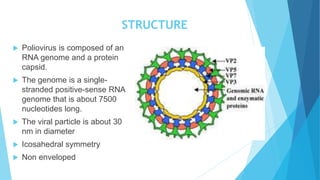
 Poliovirus is composed of an
RNA genome and a protein
capsid.
 The genome is a single-
stranded positive-sense RNA
genome that is about 7500
nucleotides long.
 The viral particle is about 30
nm in diameter
 Icosahedral symmetry
 Non enveloped
TYPES OF POLIO VIRUS
The three serotypes of poliovirus, PV1, PV2, and PV3, each have a slightly
different capsid protein. Capsid proteins define cellular receptor specificity and
virus antigenicity.
 Type 1 (also known as Brunhilde), As of November 2014, wild PV1 is highly
localized to regions in Pakistan and Afghanistan. It is the type most often
isolated from paralytic cases, most often the cause of epidemics
 Type 2(Lansing), Wild PV2 was declared eradicated in September 2014 after
last being detected in October 1999 in Uttar Pradesh, India.
 Type 3 (Leon), As of November 2014, wild PV3 has not been seen since its
2012 detection in parts of Nigeria and Pakistan.
They got their names from the cases in which they were first isolated.
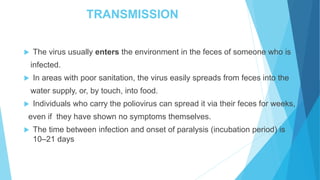
TRANSMISSION
 The virus usually enters the environment in the feces of someone who is
infected.
 In areas with poor sanitation, the virus easily spreads from feces into the
water supply, or, by touch, into food.
 Individuals who carry the poliovirus can spread it via their feces for weeks,
even if they have shown no symptoms themselves.
 The time between infection and onset of paralysis (incubation period) is
10–21 days
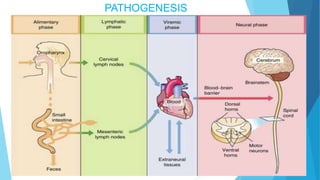
PATHOGENESIS
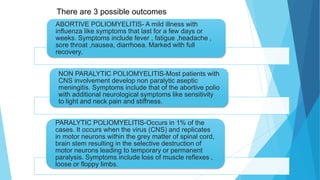
ABORTIVE POLIOMYELITIS- A mild illness with
influenza like symptoms that last for a few days or
weeks. Symptoms include fever , fatigue ,headache ,
sore throat ,nausea, diarrhoea. Marked with full
recovery.
NON PARALYTIC POLIOMYELITIS-Most patients with
CNS involvement develop non paralytic aseptic
meningitis. Symptoms include that of the abortive polio
with additional neurological symptoms like sensitivity
to light and neck pain and stiffness.
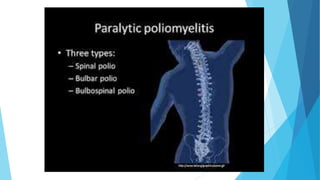
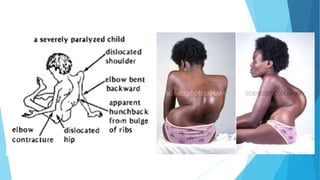
PARALYTIC POLIOMYELITIS-Occurs in 1% of the
cases. It occurs when the virus (CNS) and replicates
in motor neurons within the grey matter of spinal cord,
brain stem resulting in the selective destruction of
motor neurons leading to temporary or permanent
paralysis. Symptoms include loss of muscle reflexes ,
loose or floppy limbs.
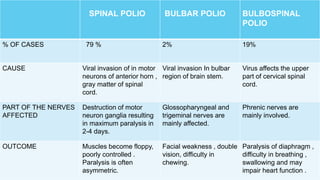
There are 3 possible outcomes
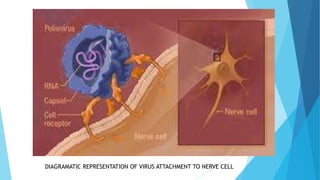
DIAGRAMATIC REPRESENTATION OF VIRUS ATTACHMENT TO NERVE CELL
SPINAL POLIO BULBAR POLIO BULBOSPINAL
POLIO
% OF CASES 79 % 2% 19%
CAUSE Viral invasion of in motor
neurons of anterior horn ,
gray matter of spinal
cord.
Viral invasion In bulbar
region of brain stem.
Virus affects the upper
part of cervical spinal
cord.
PART OF THE NERVES
AFFECTED
Destruction of motor
neuron ganglia resulting
in maximum paralysis in
2-4 days.
Glossopharyngeal and
trigeminal nerves are
mainly affected.
Phrenic nerves are
mainly involved.
OUTCOME Muscles become floppy,
poorly controlled .
Paralysis is often
asymmetric.
Facial weakness , double
vision, difficulty in
chewing.
Paralysis of diaphragm ,
difficulty in breathing ,
swallowing and may
impair heart function .
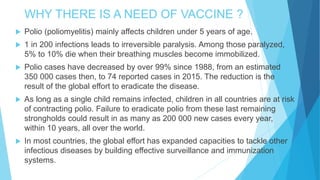
WHY THERE IS A NEED OF VACCINE ?
 Polio (poliomyelitis) mainly affects children under 5 years of age.
 1 in 200 infections leads to irreversible paralysis. Among those paralyzed,
5% to 10% die when their breathing muscles become immobilized.
 Polio cases have decreased by over 99% since 1988, from an estimated
350 000 cases then, to 74 reported cases in 2015. The reduction is the
result of the global effort to eradicate the disease.
 As long as a single child remains infected, children in all countries are at risk
of contracting polio. Failure to eradicate polio from these last remaining
strongholds could result in as many as 200 000 new cases every year,
within 10 years, all over the world.
 In most countries, the global effort has expanded capacities to tackle other
infectious diseases by building effective surveillance and immunization
systems.
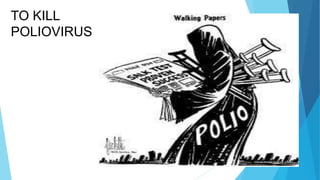
TO KILL
POLIOVIRUS
DEVELOPMENT OF POLIOVIRUS VACCINES
 In 1935, Brodie tried an inactivated vaccine with 10% formalin suspension of PV taken
from infected monkey spinal cord; he tried it first on 20 monkeys, then on 3000
Californian children. The results were poor.
 In the same year, Kollmer tried a live attenuated virus consisting of a 4% suspension
of PV from infected monkey spinal cord, treated with sodium ricinoleate. He used it on
monkeys and then on 10,000 children. The acute paralysis occurred, several died, and
many were paralyzed or suffered allergic reactions shortly after .
 A breakthrough came in 1948 when the virus was successfully cultivated in human
tissue in the laboratory by John Enders. Also reduction of the virulence of the PV
strains was recorded by Theiler, who passaged the Lansing strain in rats and mice
more than 50 times and by Enders, Weller and Robins, who passaged the same
strain in non neuronal cell culture.
 The discovery that the various antigenic strains of PVs could be grouped into three
distinct viral types and the propagation of the PV in vitro led to the development of the
vaccines against poliomyelitis: the formalin-inactivated vaccine (IPV) by Jonas Salk
(1953) and the live-attenuated vaccines (OPV) by Albert Sabin (1956) .
 In 1954, the inactivated vaccine was tested in a placebo-controlled trial,
which enrolled 1.6 million children in Canada, Finland and the United
States.
 In April 1955, Salk’s vaccine was adopted throughout the United States.
The incidence of paralytic poliomyelitis in the United States decreased
from 13.9 cases per 100 000 in 1954 to 0.8 cases per 100 000 in 1961.
 In 1960, Sabin described, in an article published in JAMA, Live, orally
given poliovirus vaccine, the results obtained with his newly developed
trivalent oral vaccine to 26 033 children from a city of 100 000 people in
South America. Because the strains developed by Sabin provided good
antibody levels and were less neurotropic for monkeys, they were
selected and licensed between 1961 and 1963 in the United States for
widespread application.
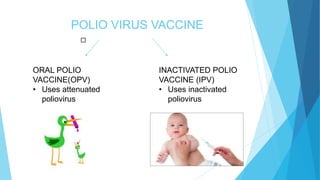
POLIO VIRUS VACCINE
︎
ORAL POLIO
VACCINE(OPV)
• Uses attenuated
poliovirus
INACTIVATED POLIO
VACCINE (IPV)
• Uses inactivated
poliovirus
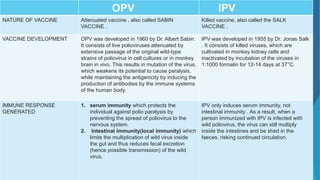
OPV IPV
NATURE OF VACCINE Attenuated vaccine , also called SABIN
VACCINE .
Killed vaccine, also called the SALK
VACCINE .
VACCINE DEVELOPMENT OPV was developed in 1960 by Dr. Albert Sabin.
It consists of live polioviruses attenuated by
extensive passage of the original wild-type
strains of poliovirus in cell cultures or in monkey
brain in vivo. This results in mutation of the virus,
which weakens its potential to cause paralysis,
while maintaining the antigenicity by inducing the
production of antibodies by the immune systems
of the human body.
IPV was developed in 1955 by Dr. Jonas Salk
. It consists of killed viruses, which are
cultivated in monkey kidney cells and
inactivated by incubation of the viruses in
1:1000 formalin for 12-14 days at 37°C.
IMMUNE RESPONSE
GENERATED
1. serum immunity which protects the
individual against polio paralysis by
preventing the spread of poliovirus to the
nervous system.
2. Intestinal immunity(local immunity) which
limits the multiplication of wild virus inside
the gut and thus reduces fecal excretion
(hence possible transmission) of the wild
virus.
IPV only induces serum immunity, not
intestinal immunity . As a result, when a
person immunized with IPV is infected with
wild poliovirus, the virus can still multiply
inside the intestines and be shed in the
faeces, risking continued circulation.
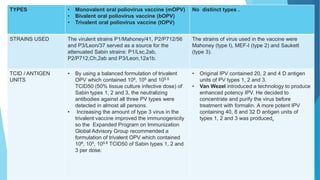
TYPES • Monovalent oral poliovirus vaccine (mOPV)
• Bivalent oral poliovirus vaccine (bOPV)
• Trivalent oral poliovirus vaccine (tOPV)
No distinct types .
STRAINS USED The virulent strains P1/Mahoney/41, P2/P712/56
and P3/Leon/37 served as a source for the
attenuated Sabin strains: P1/Lsc,2ab,
P2/P712,Ch,2ab and P3/Leon,12a1b.
The strains of virus used in the vaccine were
Mahoney (type l), MEF-I (type 2) and Saukett
(type 3).
TCID / ANTIGEN
UNITS
• By using a balanced formulation of trivalent
OPV which contained 106, 105 and 105.5
TCID50 (50% tissue culture infective dose) of
Sabin types 1, 2 and 3, the neutralizing
antibodies against all three PV types were
detected in almost all persons.
• Increasing the amount of type 3 virus in the
trivalent vaccine improved the immunogenicity
so the Expanded Program on Immunization
Global Advisory Group recommended a
formulation of trivalent OPV which contained
106, 105, 105.8 TCID50 of Sabin types 1, 2 and
3 per dose.
• Original IPV contained 20, 2 and 4 D antigen
units of PV types 1, 2 and 3.
• Van Wezel introduced a technology to produce
enhanced potency IPV. He decided to
concentrate and purify the virus before
treatment with formalin. A more potent IPV
containing 40, 8 and 32 D antigen units of
types 1, 2 and 3 was produced.
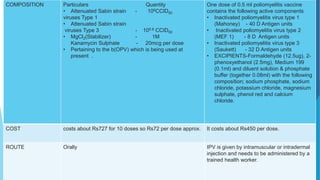
COMPOSITION Particulars Quantity
• Attenuated Sabin strain - 106CCID50
viruses Type 1
• Attenuated Sabin strain
viruses Type 3 - 105.8 CCID50
• MgCl2(Stabilizer) - 1M
Kanamycin Sulphate - 20mcg per dose
• Pertaining to the b(OPV) which is being used at
present .
One dose of 0.5 ml poliomyelitis vaccine
contains the following active components
• Inactivated poliomyelitis virus type 1
(Mahoney) - 40 D Antigen units
• Inactivated poliomyelitis virus type 2
(MEF 1) - 8 D Antigen units
• Inactivated poliomyelitis virus type 3
(Saukett) - 32 D Antigen units
• EXCIPIENTS-Formaldehyde (12.5ug), 2-
phenoxyethanol (2.5mg), Medium 199
(0.1ml) and diluent solution & phosphate
buffer (together 0.08ml) with the following
composition; sodium phosphate, sodium
chloride, potassium chloride, magnesium
sulphate, phenol red and calcium
chloride.
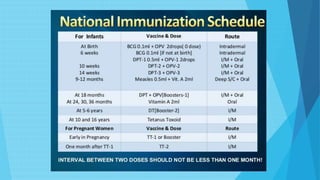
COST costs about Rs727 for 10 doses so Rs72 per dose approx. It costs about Rs450 per dose.
ROUTE Orally IPV is given by intramuscular or intradermal
injection and needs to be administered by a
trained health worker.
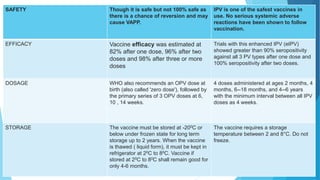
SAFETY Though it is safe but not 100% safe as
there is a chance of reversion and may
cause VAPP.
IPV is one of the safest vaccines in
use. No serious systemic adverse
reactions have been shown to follow
vaccination.
EFFICACY Vaccine efficacy was estimated at
82% after one dose, 96% after two
doses and 98% after three or more
doses
Trials with this enhanced IPV (eIPV)
showed greater than 90% seropositivity
against all 3 PV types after one dose and
100% seropositivity after two doses.
DOSAGE WHO also recommends an OPV dose at
birth (also called 'zero dose'), followed by
the primary series of 3 OPV doses at 6,
10 , 14 weeks.
4 doses administered at ages 2 months, 4
months, 6--18 months, and 4--6 years
with the minimum interval between all IPV
doses as 4 weeks.
STORAGE The vaccine must be stored at -200C or
below under frozen state for long term
storage up to 2 years. When the vaccine
is thawed ( liquid form), it must be kept in
refrigerator at 20C to 80C. Vaccine if
stored at 20C to 80C shall remain good for
only 4-6 months.
The vaccine requires a storage
temperature between 2 and 8°C. Do not
freeze.
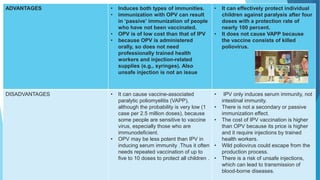
ADVANTAGES • Induces both types of immunities.
• immunization with OPV can result
in ‘passive’ immunization of people
who have not been vaccinated.
• OPV is of low cost than that of IPV
• because OPV is administered
orally, so does not need
professionally trained health
workers and injection-related
supplies (e.g., syringes). Also
unsafe injection is not an issue
• It can effectively protect individual
children against paralysis after four
doses with a protection rate of
nearly 100 percent.
• It does not cause VAPP because
the vaccine consists of killed
poliovirus.
DISADVANTAGES • It can cause vaccine-associated
paralytic poliomyelitis (VAPP),
although the probability is very low (1
case per 2.5 million doses), because
some people are sensitive to vaccine
virus, especially those who are
immunodeficient.
• OPV may be less potent than IPV in
inducing serum immunity .Thus it often
needs repeated vaccination of up to
five to 10 doses to protect all children .
• IPV only induces serum immunity, not
intestinal immunity.
• There is not a secondary or passive
immunization effect.
• The cost of IPV vaccination is higher
than OPV because its price is higher
and it require injections by trained
health workers.
• Wild poliovirus could escape from the
production process.
• There is a risk of unsafe injections,
which can lead to transmission of
blood-borne diseases.
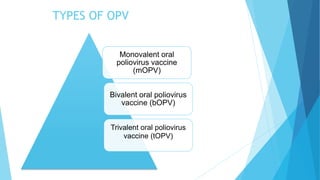
TYPES OF OPV
Monovalent oral
poliovirus vaccine
(mOPV)
Bivalent oral poliovirus
vaccine (bOPV)
Trivalent oral poliovirus
vaccine (tOPV)
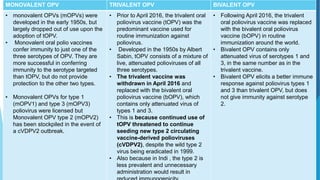
MONOVALENT OPV TRIVALENT OPV BIVALENT OPV
• monovalent OPVs (mOPVs) were
developed in the early 1950s, but
largely dropped out of use upon the
adoption of tOPV.
• Monovalent oral polio vaccines
confer immunity to just one of the
three serotypes of OPV. They are
more successful in conferring
immunity to the serotype targeted
than tOPV, but do not provide
protection to the other two types.
• Monovalent OPVs for type 1
(mOPV1) and type 3 (mOPV3)
poliovirus were licensed but
Monovalent OPV type 2 (mOPV2)
has been stockpiled in the event of
a cVDPV2 outbreak.
• Prior to April 2016, the trivalent oral
poliovirus vaccine (tOPV) was the
predominant vaccine used for
routine immunization against
poliovirus.
• Developed in the 1950s by Albert
Sabin, tOPV consists of a mixture of
live, attenuated polioviruses of all
three serotypes.
• The trivalent vaccine was
withdrawn in April 2016 and
replaced with the bivalent oral
poliovirus vaccine (bOPV), which
contains only attenuated virus of
types 1 and 3.
• This is because continued use of
tOPV threatened to continue
seeding new type 2 circulating
vaccine-derived polioviruses
(cVDPV2), despite the wild type 2
virus being eradicated in 1999.
• Also because in Indi , the type 2 is
less prevalent and unnecessary
administration would result in
• Following April 2016, the trivalent
oral poliovirus vaccine was replaced
with the bivalent oral poliovirus
vaccine (bOPV) in routine
immunization around the world.
• Bivalent OPV contains only
attenuated virus of serotypes 1 and
3, in the same number as in the
trivalent vaccine.
• Bivalent OPV elicits a better immune
response against poliovirus types 1
and 3 than trivalent OPV, but does
not give immunity against serotype
2.
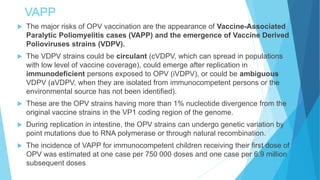
VAPP
 The major risks of OPV vaccination are the appearance of Vaccine-Associated
Paralytic Poliomyelitis cases (VAPP) and the emergence of Vaccine Derived
Polioviruses strains (VDPV).
 The VDPV strains could be circulant (cVDPV, which can spread in populations
with low level of vaccine coverage), could emerge after replication in
immunodeficient persons exposed to OPV (iVDPV), or could be ambiguous
VDPV (aVDPV, when they are isolated from immunocompetent persons or the
environmental source has not been identified).
 These are the OPV strains having more than 1% nucleotide divergence from the
original vaccine strains in the VP1 coding region of the genome.
 During replication in intestine, the OPV strains can undergo genetic variation by
point mutations due to RNA polymerase or through natural recombination.
 The incidence of VAPP for immunocompetent children receiving their first dose of
OPV was estimated at one case per 750 000 doses and one case per 6.9 million
subsequent doses
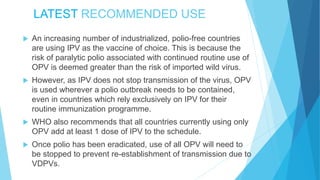
LATEST RECOMMENDED USE
 An increasing number of industrialized, polio-free countries
are using IPV as the vaccine of choice. This is because the
risk of paralytic polio associated with continued routine use of
OPV is deemed greater than the risk of imported wild virus.
 However, as IPV does not stop transmission of the virus, OPV
is used wherever a polio outbreak needs to be contained,
even in countries which rely exclusively on IPV for their
routine immunization programme.
 WHO also recommends that all countries currently using only
OPV add at least 1 dose of IPV to the schedule.
 Once polio has been eradicated, use of all OPV will need to
be stopped to prevent re-establishment of transmission due to
VDPVs.
MASS IMMUNIZATION PROGRAMMES
AGAIST POLIO
PULSE POLIO PROGRAMME
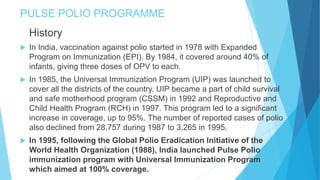
History
 In India, vaccination against polio started in 1978 with Expanded
Program on Immunization (EPI). By 1984, it covered around 40% of
infants, giving three doses of OPV to each.
 In 1985, the Universal Immunization Program (UIP) was launched to
cover all the districts of the country. UIP became a part of child survival
and safe motherhood program (CSSM) in 1992 and Reproductive and
Child Health Program (RCH) in 1997. This program led to a significant
increase in coverage, up to 95%. The number of reported cases of polio
also declined from 28,757 during 1987 to 3,265 in 1995.
 In 1995, following the Global Polio Eradication Initiative of the
World Health Organization (1988), India launched Pulse Polio
immunization program with Universal Immunization Program
which aimed at 100% coverage.
KEY OBJECTIVES
 The Pulse Polio Initiative (PPI) aims at covering every individual in
the country. It aspires to reach even children in remote communities
through an improved social mobilization plan.
 Not a single child should miss the immunization, leaving no chance of
polio occurrence.
 Cases of acute flaccid paralysis (AFP) to be reported in time and
stool specimens of them to be collected within 14 days.
 Outbreak response immunization (ORI) to be conducted as early as
possible.
 Maintaining a high level of surveillance.
 Performance of good mop-up operations where polio has
disappeared.
 STEPS
 Setting up of booths in all parts of the country.
 Initializing walk-in cold rooms, freezer rooms, deep freezers, ice-lined
refrigerators and cold boxes for a steady supply of vaccine to booths.
 Arranging employees, volunteers, and vaccines.
 Ensuring vaccine vial monitor on each vial.
 Immunizing children with OPV on national immunization days.
 Identifying missing children from immunization process.
 Surveillance of efficacy.
 Publicity was extensive and included replacing the national telecoms' authority
ringtone with a vaccination day awareness message, posters, TV and cinema
spots, parades, rallies, and one-to-one communication from volunteers.
 Two million healthcare workers and US$2.3 billion in government funding went
into the campaign.
DIFFICULTIES
 Testing showed that three doses of vaccine was enough to
protect children in developed countries, but it became
obvious that this was not enough in some areas of India.
The Ministry of Health and Family Welfare recommended
eight to ten doses for each child.
 Children in some areas of India are weaker and often had
diarrhoea, which reduced the efficiency of the vaccine. Open
defecation, monsoon flooding, and a lack of water treatment
made it easier for a child to swallow more polio virus. As a
result, children with too few doses of vaccine were not fully
protected and sometimes got polio.
 The eradication program therefore gave drops over and over
again, to boost children's immunity higher and as a
precaution against missed children.
ELIMINATION OF POLIO IN INDIA
 The last reported cases of
wild polio in India were in
West Bengal and Gujarat
on 13 January 2011. On 27
March 2014, the World
Health Organization (WHO)
declared India a polio free
country, since no cases of
wild polio had been
reported in for three years.
 As of mid-2016, only
Afghanistan, Nigeria and
Pakistan have wild polio
cases
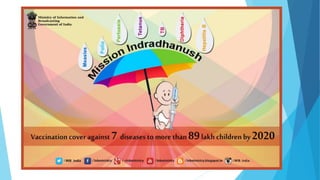
INDRADHANUSH PROGRAMME
LAUNCH DATE
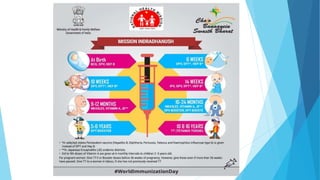
 Mission Indradhanush is a health mission of the government of
India. It was launched by Union Health Minister J. P. Nadda on 25
December 2014.
 Objective
 Aims to cover all those children by 2020 who are either
unvaccinated, or are partially vaccinated against 7 vaccine
preventable diseases
 The diseases are – diphtheria, whooping cough, tetanus, polio,
tuberculosis, measles and hepatitis B
How is the government going about the
implementation?
 Implementation will be done in phases in a “catch up” mode –
the aim is to cover all the children who have been left out or
missed out for immunization
 Technically supported by WHO, UNICEF, rotary international and
other donor partners
 Phase 1 targets 201 districts phase 2 targets 352 districts
 The first round of the first phase started from 7 April 2015-world
health day
 What’s interesting about the phase 1 districts? These 201
high focus districts in the country have nearly 50% of all
unvaccinated or partially vaccinated children!
 Out of the 201 districts, 82 districts are in just four states of up,
Bihar, Madhya Pradesh and Rajasthan.
What are the 4 pillars of strategy for Mission Indradhanush?
#1. Meticulous planning of campaigns/sessions at all levels
 Within the districts, the mission will focus on the 400,000 high risk
settlements identified by the polio eradication
#2. Effective communication and social mobilization efforts
 Generate awareness and demand for immunization services through
need-based communication strategies and social mobilization
activities on programme
#3. Intensive training of the health officials and frontline workers
#4. Establish accountability framework through task forces
 Strengthening the district task forces for immunization in all districts
 Ensuring the use of concurrent session monitoring data to plug the
gaps in implementation on a real time basis
 Collaboration with other ministries, ongoing programmes and
international partners to promote a coordinated and synergistic
approach
RECENT ADVANCES
 New Delhi: The government's ambitious ‘Mission Indradhanush’
programme, which provides immunization against seven life
threatening diseases, is all set to be re-christened as four new
vaccines have been added into it.
 Four new vaccinations - rotavirus, measles rubella, inactivated
polio vaccine bivalent and Japanese Encephalitis are to be
added for adults. In that, very important is rotavirus. 10 lakh
children get hospitalized every year suffering from diarrhoea and
80,000 lose their lives every year..
REFERENCES
 www.cdc.gov
 www.nhp.gov.in
 www.wikipedia.org
 www.ncbi.nih.com
 www.healthline.com
 www.medicalnewstoday.com
Polio vaccine

Polio vaccine

  • 1.
  • 2.
    INTRODUCTION  Poliovirus, thecausative agent of poliomyelitis (commonly known as polio), is a human enterovirus and member of the family of Picornaviridae.  Poliovirus was first isolated in 1909 by Karl Landsteiner and Erwin Popper.  Poliovirus is one of the most well-characterized viruses, and has become a useful model system for understanding the biology of RNA viruses.
  • 3.
    STRUCTURE  Poliovirus iscomposed of an RNA genome and a protein capsid.  The genome is a single- stranded positive-sense RNA genome that is about 7500 nucleotides long.  The viral particle is about 30 nm in diameter  Icosahedral symmetry  Non enveloped
  • 4.
    TYPES OF POLIOVIRUS The three serotypes of poliovirus, PV1, PV2, and PV3, each have a slightly different capsid protein. Capsid proteins define cellular receptor specificity and virus antigenicity.  Type 1 (also known as Brunhilde), As of November 2014, wild PV1 is highly localized to regions in Pakistan and Afghanistan. It is the type most often isolated from paralytic cases, most often the cause of epidemics  Type 2(Lansing), Wild PV2 was declared eradicated in September 2014 after last being detected in October 1999 in Uttar Pradesh, India.  Type 3 (Leon), As of November 2014, wild PV3 has not been seen since its 2012 detection in parts of Nigeria and Pakistan. They got their names from the cases in which they were first isolated.
  • 5.
    TRANSMISSION  The virususually enters the environment in the feces of someone who is infected.  In areas with poor sanitation, the virus easily spreads from feces into the water supply, or, by touch, into food.  Individuals who carry the poliovirus can spread it via their feces for weeks, even if they have shown no symptoms themselves.  The time between infection and onset of paralysis (incubation period) is 10–21 days
  • 6.
  • 7.
    ABORTIVE POLIOMYELITIS- Amild illness with influenza like symptoms that last for a few days or weeks. Symptoms include fever , fatigue ,headache , sore throat ,nausea, diarrhoea. Marked with full recovery. NON PARALYTIC POLIOMYELITIS-Most patients with CNS involvement develop non paralytic aseptic meningitis. Symptoms include that of the abortive polio with additional neurological symptoms like sensitivity to light and neck pain and stiffness. PARALYTIC POLIOMYELITIS-Occurs in 1% of the cases. It occurs when the virus (CNS) and replicates in motor neurons within the grey matter of spinal cord, brain stem resulting in the selective destruction of motor neurons leading to temporary or permanent paralysis. Symptoms include loss of muscle reflexes , loose or floppy limbs. There are 3 possible outcomes
  • 8.
    DIAGRAMATIC REPRESENTATION OFVIRUS ATTACHMENT TO NERVE CELL
  • 10.
    SPINAL POLIO BULBARPOLIO BULBOSPINAL POLIO % OF CASES 79 % 2% 19% CAUSE Viral invasion of in motor neurons of anterior horn , gray matter of spinal cord. Viral invasion In bulbar region of brain stem. Virus affects the upper part of cervical spinal cord. PART OF THE NERVES AFFECTED Destruction of motor neuron ganglia resulting in maximum paralysis in 2-4 days. Glossopharyngeal and trigeminal nerves are mainly affected. Phrenic nerves are mainly involved. OUTCOME Muscles become floppy, poorly controlled . Paralysis is often asymmetric. Facial weakness , double vision, difficulty in chewing. Paralysis of diaphragm , difficulty in breathing , swallowing and may impair heart function .
  • 12.
    WHY THERE ISA NEED OF VACCINE ?  Polio (poliomyelitis) mainly affects children under 5 years of age.  1 in 200 infections leads to irreversible paralysis. Among those paralyzed, 5% to 10% die when their breathing muscles become immobilized.  Polio cases have decreased by over 99% since 1988, from an estimated 350 000 cases then, to 74 reported cases in 2015. The reduction is the result of the global effort to eradicate the disease.  As long as a single child remains infected, children in all countries are at risk of contracting polio. Failure to eradicate polio from these last remaining strongholds could result in as many as 200 000 new cases every year, within 10 years, all over the world.  In most countries, the global effort has expanded capacities to tackle other infectious diseases by building effective surveillance and immunization systems.
  • 13.
  • 14.
    DEVELOPMENT OF POLIOVIRUSVACCINES  In 1935, Brodie tried an inactivated vaccine with 10% formalin suspension of PV taken from infected monkey spinal cord; he tried it first on 20 monkeys, then on 3000 Californian children. The results were poor.  In the same year, Kollmer tried a live attenuated virus consisting of a 4% suspension of PV from infected monkey spinal cord, treated with sodium ricinoleate. He used it on monkeys and then on 10,000 children. The acute paralysis occurred, several died, and many were paralyzed or suffered allergic reactions shortly after .  A breakthrough came in 1948 when the virus was successfully cultivated in human tissue in the laboratory by John Enders. Also reduction of the virulence of the PV strains was recorded by Theiler, who passaged the Lansing strain in rats and mice more than 50 times and by Enders, Weller and Robins, who passaged the same strain in non neuronal cell culture.  The discovery that the various antigenic strains of PVs could be grouped into three distinct viral types and the propagation of the PV in vitro led to the development of the vaccines against poliomyelitis: the formalin-inactivated vaccine (IPV) by Jonas Salk (1953) and the live-attenuated vaccines (OPV) by Albert Sabin (1956) .
  • 15.
     In 1954,the inactivated vaccine was tested in a placebo-controlled trial, which enrolled 1.6 million children in Canada, Finland and the United States.  In April 1955, Salk’s vaccine was adopted throughout the United States. The incidence of paralytic poliomyelitis in the United States decreased from 13.9 cases per 100 000 in 1954 to 0.8 cases per 100 000 in 1961.  In 1960, Sabin described, in an article published in JAMA, Live, orally given poliovirus vaccine, the results obtained with his newly developed trivalent oral vaccine to 26 033 children from a city of 100 000 people in South America. Because the strains developed by Sabin provided good antibody levels and were less neurotropic for monkeys, they were selected and licensed between 1961 and 1963 in the United States for widespread application.
  • 16.
    POLIO VIRUS VACCINE ︎ ORALPOLIO VACCINE(OPV) • Uses attenuated poliovirus INACTIVATED POLIO VACCINE (IPV) • Uses inactivated poliovirus
  • 17.
    OPV IPV NATURE OFVACCINE Attenuated vaccine , also called SABIN VACCINE . Killed vaccine, also called the SALK VACCINE . VACCINE DEVELOPMENT OPV was developed in 1960 by Dr. Albert Sabin. It consists of live polioviruses attenuated by extensive passage of the original wild-type strains of poliovirus in cell cultures or in monkey brain in vivo. This results in mutation of the virus, which weakens its potential to cause paralysis, while maintaining the antigenicity by inducing the production of antibodies by the immune systems of the human body. IPV was developed in 1955 by Dr. Jonas Salk . It consists of killed viruses, which are cultivated in monkey kidney cells and inactivated by incubation of the viruses in 1:1000 formalin for 12-14 days at 37°C. IMMUNE RESPONSE GENERATED 1. serum immunity which protects the individual against polio paralysis by preventing the spread of poliovirus to the nervous system. 2. Intestinal immunity(local immunity) which limits the multiplication of wild virus inside the gut and thus reduces fecal excretion (hence possible transmission) of the wild virus. IPV only induces serum immunity, not intestinal immunity . As a result, when a person immunized with IPV is infected with wild poliovirus, the virus can still multiply inside the intestines and be shed in the faeces, risking continued circulation.
  • 18.
    TYPES • Monovalentoral poliovirus vaccine (mOPV) • Bivalent oral poliovirus vaccine (bOPV) • Trivalent oral poliovirus vaccine (tOPV) No distinct types . STRAINS USED The virulent strains P1/Mahoney/41, P2/P712/56 and P3/Leon/37 served as a source for the attenuated Sabin strains: P1/Lsc,2ab, P2/P712,Ch,2ab and P3/Leon,12a1b. The strains of virus used in the vaccine were Mahoney (type l), MEF-I (type 2) and Saukett (type 3). TCID / ANTIGEN UNITS • By using a balanced formulation of trivalent OPV which contained 106, 105 and 105.5 TCID50 (50% tissue culture infective dose) of Sabin types 1, 2 and 3, the neutralizing antibodies against all three PV types were detected in almost all persons. • Increasing the amount of type 3 virus in the trivalent vaccine improved the immunogenicity so the Expanded Program on Immunization Global Advisory Group recommended a formulation of trivalent OPV which contained 106, 105, 105.8 TCID50 of Sabin types 1, 2 and 3 per dose. • Original IPV contained 20, 2 and 4 D antigen units of PV types 1, 2 and 3. • Van Wezel introduced a technology to produce enhanced potency IPV. He decided to concentrate and purify the virus before treatment with formalin. A more potent IPV containing 40, 8 and 32 D antigen units of types 1, 2 and 3 was produced.
  • 19.
    COMPOSITION Particulars Quantity •Attenuated Sabin strain - 106CCID50 viruses Type 1 • Attenuated Sabin strain viruses Type 3 - 105.8 CCID50 • MgCl2(Stabilizer) - 1M Kanamycin Sulphate - 20mcg per dose • Pertaining to the b(OPV) which is being used at present . One dose of 0.5 ml poliomyelitis vaccine contains the following active components • Inactivated poliomyelitis virus type 1 (Mahoney) - 40 D Antigen units • Inactivated poliomyelitis virus type 2 (MEF 1) - 8 D Antigen units • Inactivated poliomyelitis virus type 3 (Saukett) - 32 D Antigen units • EXCIPIENTS-Formaldehyde (12.5ug), 2- phenoxyethanol (2.5mg), Medium 199 (0.1ml) and diluent solution & phosphate buffer (together 0.08ml) with the following composition; sodium phosphate, sodium chloride, potassium chloride, magnesium sulphate, phenol red and calcium chloride. COST costs about Rs727 for 10 doses so Rs72 per dose approx. It costs about Rs450 per dose. ROUTE Orally IPV is given by intramuscular or intradermal injection and needs to be administered by a trained health worker.
  • 20.
    SAFETY Though itis safe but not 100% safe as there is a chance of reversion and may cause VAPP. IPV is one of the safest vaccines in use. No serious systemic adverse reactions have been shown to follow vaccination. EFFICACY Vaccine efficacy was estimated at 82% after one dose, 96% after two doses and 98% after three or more doses Trials with this enhanced IPV (eIPV) showed greater than 90% seropositivity against all 3 PV types after one dose and 100% seropositivity after two doses. DOSAGE WHO also recommends an OPV dose at birth (also called 'zero dose'), followed by the primary series of 3 OPV doses at 6, 10 , 14 weeks. 4 doses administered at ages 2 months, 4 months, 6--18 months, and 4--6 years with the minimum interval between all IPV doses as 4 weeks. STORAGE The vaccine must be stored at -200C or below under frozen state for long term storage up to 2 years. When the vaccine is thawed ( liquid form), it must be kept in refrigerator at 20C to 80C. Vaccine if stored at 20C to 80C shall remain good for only 4-6 months. The vaccine requires a storage temperature between 2 and 8°C. Do not freeze.
  • 21.
    ADVANTAGES • Inducesboth types of immunities. • immunization with OPV can result in ‘passive’ immunization of people who have not been vaccinated. • OPV is of low cost than that of IPV • because OPV is administered orally, so does not need professionally trained health workers and injection-related supplies (e.g., syringes). Also unsafe injection is not an issue • It can effectively protect individual children against paralysis after four doses with a protection rate of nearly 100 percent. • It does not cause VAPP because the vaccine consists of killed poliovirus. DISADVANTAGES • It can cause vaccine-associated paralytic poliomyelitis (VAPP), although the probability is very low (1 case per 2.5 million doses), because some people are sensitive to vaccine virus, especially those who are immunodeficient. • OPV may be less potent than IPV in inducing serum immunity .Thus it often needs repeated vaccination of up to five to 10 doses to protect all children . • IPV only induces serum immunity, not intestinal immunity. • There is not a secondary or passive immunization effect. • The cost of IPV vaccination is higher than OPV because its price is higher and it require injections by trained health workers. • Wild poliovirus could escape from the production process. • There is a risk of unsafe injections, which can lead to transmission of blood-borne diseases.
  • 22.
    TYPES OF OPV Monovalentoral poliovirus vaccine (mOPV) Bivalent oral poliovirus vaccine (bOPV) Trivalent oral poliovirus vaccine (tOPV)
  • 23.
    MONOVALENT OPV TRIVALENTOPV BIVALENT OPV • monovalent OPVs (mOPVs) were developed in the early 1950s, but largely dropped out of use upon the adoption of tOPV. • Monovalent oral polio vaccines confer immunity to just one of the three serotypes of OPV. They are more successful in conferring immunity to the serotype targeted than tOPV, but do not provide protection to the other two types. • Monovalent OPVs for type 1 (mOPV1) and type 3 (mOPV3) poliovirus were licensed but Monovalent OPV type 2 (mOPV2) has been stockpiled in the event of a cVDPV2 outbreak. • Prior to April 2016, the trivalent oral poliovirus vaccine (tOPV) was the predominant vaccine used for routine immunization against poliovirus. • Developed in the 1950s by Albert Sabin, tOPV consists of a mixture of live, attenuated polioviruses of all three serotypes. • The trivalent vaccine was withdrawn in April 2016 and replaced with the bivalent oral poliovirus vaccine (bOPV), which contains only attenuated virus of types 1 and 3. • This is because continued use of tOPV threatened to continue seeding new type 2 circulating vaccine-derived polioviruses (cVDPV2), despite the wild type 2 virus being eradicated in 1999. • Also because in Indi , the type 2 is less prevalent and unnecessary administration would result in • Following April 2016, the trivalent oral poliovirus vaccine was replaced with the bivalent oral poliovirus vaccine (bOPV) in routine immunization around the world. • Bivalent OPV contains only attenuated virus of serotypes 1 and 3, in the same number as in the trivalent vaccine. • Bivalent OPV elicits a better immune response against poliovirus types 1 and 3 than trivalent OPV, but does not give immunity against serotype 2.
  • 24.
    VAPP  The majorrisks of OPV vaccination are the appearance of Vaccine-Associated Paralytic Poliomyelitis cases (VAPP) and the emergence of Vaccine Derived Polioviruses strains (VDPV).  The VDPV strains could be circulant (cVDPV, which can spread in populations with low level of vaccine coverage), could emerge after replication in immunodeficient persons exposed to OPV (iVDPV), or could be ambiguous VDPV (aVDPV, when they are isolated from immunocompetent persons or the environmental source has not been identified).  These are the OPV strains having more than 1% nucleotide divergence from the original vaccine strains in the VP1 coding region of the genome.  During replication in intestine, the OPV strains can undergo genetic variation by point mutations due to RNA polymerase or through natural recombination.  The incidence of VAPP for immunocompetent children receiving their first dose of OPV was estimated at one case per 750 000 doses and one case per 6.9 million subsequent doses
  • 25.
    LATEST RECOMMENDED USE An increasing number of industrialized, polio-free countries are using IPV as the vaccine of choice. This is because the risk of paralytic polio associated with continued routine use of OPV is deemed greater than the risk of imported wild virus.  However, as IPV does not stop transmission of the virus, OPV is used wherever a polio outbreak needs to be contained, even in countries which rely exclusively on IPV for their routine immunization programme.  WHO also recommends that all countries currently using only OPV add at least 1 dose of IPV to the schedule.  Once polio has been eradicated, use of all OPV will need to be stopped to prevent re-establishment of transmission due to VDPVs.
  • 27.
  • 28.
    PULSE POLIO PROGRAMME History In India, vaccination against polio started in 1978 with Expanded Program on Immunization (EPI). By 1984, it covered around 40% of infants, giving three doses of OPV to each.  In 1985, the Universal Immunization Program (UIP) was launched to cover all the districts of the country. UIP became a part of child survival and safe motherhood program (CSSM) in 1992 and Reproductive and Child Health Program (RCH) in 1997. This program led to a significant increase in coverage, up to 95%. The number of reported cases of polio also declined from 28,757 during 1987 to 3,265 in 1995.  In 1995, following the Global Polio Eradication Initiative of the World Health Organization (1988), India launched Pulse Polio immunization program with Universal Immunization Program which aimed at 100% coverage.
  • 29.
    KEY OBJECTIVES  ThePulse Polio Initiative (PPI) aims at covering every individual in the country. It aspires to reach even children in remote communities through an improved social mobilization plan.  Not a single child should miss the immunization, leaving no chance of polio occurrence.  Cases of acute flaccid paralysis (AFP) to be reported in time and stool specimens of them to be collected within 14 days.  Outbreak response immunization (ORI) to be conducted as early as possible.  Maintaining a high level of surveillance.  Performance of good mop-up operations where polio has disappeared.
  • 30.
     STEPS  Settingup of booths in all parts of the country.  Initializing walk-in cold rooms, freezer rooms, deep freezers, ice-lined refrigerators and cold boxes for a steady supply of vaccine to booths.  Arranging employees, volunteers, and vaccines.  Ensuring vaccine vial monitor on each vial.  Immunizing children with OPV on national immunization days.  Identifying missing children from immunization process.  Surveillance of efficacy.  Publicity was extensive and included replacing the national telecoms' authority ringtone with a vaccination day awareness message, posters, TV and cinema spots, parades, rallies, and one-to-one communication from volunteers.  Two million healthcare workers and US$2.3 billion in government funding went into the campaign.
  • 31.
    DIFFICULTIES  Testing showedthat three doses of vaccine was enough to protect children in developed countries, but it became obvious that this was not enough in some areas of India. The Ministry of Health and Family Welfare recommended eight to ten doses for each child.  Children in some areas of India are weaker and often had diarrhoea, which reduced the efficiency of the vaccine. Open defecation, monsoon flooding, and a lack of water treatment made it easier for a child to swallow more polio virus. As a result, children with too few doses of vaccine were not fully protected and sometimes got polio.  The eradication program therefore gave drops over and over again, to boost children's immunity higher and as a precaution against missed children.
  • 32.
    ELIMINATION OF POLIOIN INDIA  The last reported cases of wild polio in India were in West Bengal and Gujarat on 13 January 2011. On 27 March 2014, the World Health Organization (WHO) declared India a polio free country, since no cases of wild polio had been reported in for three years.  As of mid-2016, only Afghanistan, Nigeria and Pakistan have wild polio cases
  • 34.
    INDRADHANUSH PROGRAMME LAUNCH DATE Mission Indradhanush is a health mission of the government of India. It was launched by Union Health Minister J. P. Nadda on 25 December 2014.  Objective  Aims to cover all those children by 2020 who are either unvaccinated, or are partially vaccinated against 7 vaccine preventable diseases  The diseases are – diphtheria, whooping cough, tetanus, polio, tuberculosis, measles and hepatitis B
  • 35.
    How is thegovernment going about the implementation?  Implementation will be done in phases in a “catch up” mode – the aim is to cover all the children who have been left out or missed out for immunization  Technically supported by WHO, UNICEF, rotary international and other donor partners  Phase 1 targets 201 districts phase 2 targets 352 districts  The first round of the first phase started from 7 April 2015-world health day  What’s interesting about the phase 1 districts? These 201 high focus districts in the country have nearly 50% of all unvaccinated or partially vaccinated children!  Out of the 201 districts, 82 districts are in just four states of up, Bihar, Madhya Pradesh and Rajasthan.
  • 36.
    What are the4 pillars of strategy for Mission Indradhanush? #1. Meticulous planning of campaigns/sessions at all levels  Within the districts, the mission will focus on the 400,000 high risk settlements identified by the polio eradication #2. Effective communication and social mobilization efforts  Generate awareness and demand for immunization services through need-based communication strategies and social mobilization activities on programme #3. Intensive training of the health officials and frontline workers #4. Establish accountability framework through task forces  Strengthening the district task forces for immunization in all districts  Ensuring the use of concurrent session monitoring data to plug the gaps in implementation on a real time basis  Collaboration with other ministries, ongoing programmes and international partners to promote a coordinated and synergistic approach
  • 37.
    RECENT ADVANCES  NewDelhi: The government's ambitious ‘Mission Indradhanush’ programme, which provides immunization against seven life threatening diseases, is all set to be re-christened as four new vaccines have been added into it.  Four new vaccinations - rotavirus, measles rubella, inactivated polio vaccine bivalent and Japanese Encephalitis are to be added for adults. In that, very important is rotavirus. 10 lakh children get hospitalized every year suffering from diarrhoea and 80,000 lose their lives every year..
  • 39.
    REFERENCES  www.cdc.gov  www.nhp.gov.in www.wikipedia.org  www.ncbi.nih.com  www.healthline.com  www.medicalnewstoday.com