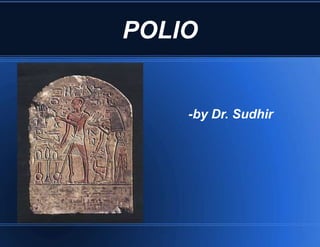
POLIO 
-by Dr. Sudhir
History 
 Sir Walter Scott(1771–1832) may have had the 
earliest recorded case of polio. 
 First described by Michael Underwood in 1789 
 Initially thought to be due to trauma 
 Became known as the Heine-Medin disease due to 
the work of Dr. Jakob Heine and Dr. Karl Oskar 
Medin. 
 Later called infantile paralysis, based on its 
propensity to affect children. 
 3rd human disease targeted for eradication
Poliovirus 
 Enterovirus 
 Spherical virion with a single strand 
RNA 
 Three serotypes: 1, 2, 3 
 Burnhilde & Mahoney strains→ type1 
 Lansing & MEF-1 → type 
2 
 Leon & Saukett →type 3 
 1 & 3 – epidemic 2 – endemic 
Minimal heterotypic immunity between serotypes
ANTIGENS 
D or Native or N antigen 
- whole virion & is type specific 
- Anti-D antibody is protective and its conc in 
IPV denotes the potency of vaccine 
C or Heated or H antigen 
- empty non-infectious virus & is less specific 
- anti-C antibody does not neutralise infectivity 
Heated at 56º C - D →→→ C
Resistance 
 Resistant to ether, chloroform, bile, intestinal 
proteolytic enzymes & detergents 
 Stable at pH of 3 
 Can survive at -20ºC for yrs, 4ºC for months & 
at room temp for 1 day to several weeks 
 Inactivated by heat(55ºC for 30 min), 
formaldehyde, ultraviolet light & chlorination 
 Organic matter in water delays the activation 
by chlorination
Pathogenesis 
 Entry by feco-oral route through ingestion 
 Droplets from Patients with early disease 
can enter through inhalation or through 
conjunctiva 
 Replication in the epithelial cells of GI tract 
& the local lymphatics
Local lymhatics of GIT 
↓ 
Circulatory system (minor or primary viremia) 
↓ 
Reticuloendothelial system 
↓ 
Circulatory system (major or secondary viremia) 
↓ 
Spinal cord & Brain
NERVOUS SYSTEM 
CNS – Multiplies in Neurons & destroys them 
Earliest change – Degeneration of Nissl bodies 
Followed by Nuclear changes & finally neuronal 
death 
Spinal cord – Lesions are mostly in the ant. Horns 
causing flaccid paralysis 
Post. Horn & intermediate column may also be 
involved
Outcomes of Poliovirus Infection 
90 to 95% polio virus infections are 
asymptomatic 
Asymptomatic Minor non-CNS illness 
Aseptic menigitis Paralytic 
0 20 40 60 80 100 
Percent
Poliovirus Epidemiology 
 Reservoir Human 
 Transmission Fecal-oral 
Oral-oral 
possible 
 Communicability 7-10 days before or after 
onset . 
Virus present in stool 3-6 
weeks
Types 
• Asymptomatic Polio 
• Non-paralytic 
• Paralytic 
– Spinal 
– Bulbar 
– Bulbospinal
Asymptomatic Polio 
• Accounts for approximately 95% of cases 
• Virus stays in intestinal tract and does not 
attack the nerves 
• Virus is shed in the stool so infected individual 
is still able to infect others
Non-paralytic Polio 
•Abortive poliomyelitis 
•Does not lead to paralysis 
•Mild symptoms seen such as sore throat, fever, n/v, 
diarrhea, constipation ( Minor illness) 
•Most recover in <1 week 
•Non-paralytic aseptic meningitis ( Major illness) 
– Occurs in 1-2% of polio infections 
– Symptoms are stiffness in the neck, back, and/or legs 
– Increased or abnormal sensations can occur 
– Complete recovery after 2-10 days of symptoms
Paralytic Polio 
Fewer than 1% of those infected develop this 
type 
Acute flaccid paralysis seen. Initially focal but 
spreads over 3 – 4 days 
Headache, neck/back stiffness, unusual 
sensations, increased sensitivity to touch 
Tripod sign + 
Descending paralysis 
Asymmetrical patchy paralysis 
Deep tendon reflex lost before onset of paralysis
Spinal Polio 
–Most common form of paralytic; 79% 
–Attacks motor neurons and causes paralysis of 
muscles of respiration and muscles of 
extremities 
–Children <5 years most likely to become 
paralyzed in one leg 
–Adults are most commonly paralyzed in both 
arms and legs 
–Those affected still retain sensation in 
extremities
Bulbar Polio 
• Accounts for 2% of paralytic polio 
• Virus attacks motor neurons in brainstem 
•Affects cranial nerve function 
•Primarily inhibits ability to breathe, speak, and 
swallow effectively 
Facial asymmetry present
Bulbospinal Polio 
• Accounts for 19% of paralytic cases 
• Affects extremities and cranial nerves 
• Leads to severe respiratory involvement
Paralytic Polio Risk Factors 
• Compromised immune system 
• Pregnancy 
• Mouth or throat surgery 
• Injury or strenuous physical exercise after 
exposure to virus
Encephalitic Polio 
•Very rare 
•Causes inflammation of gray matter of brain 
•Signs/symptoms include agitation, confusion, 
stupor, and coma 
•Autonomic dysfunction is common and it has a 
high mortality
Past Medical Treatment 
•Iron Lung - a sealed 
chamber with an 
electrically driven 
bellows that regulates 
breathing. 
•Rigid Braces 
•Body Casts
Supportive Treatment 
• Antibiotics for infection 
• Analgesics for pain 
• Portable Ventilators for breathing problem 
• Moderate Exercise 
• Nutritional Diet
Post-Polio syndrome (PPS) 
25 % of individuals, decades after recovering 
from the acute infection 
Features include muscle weakness, extreme 
fatigue, or paralysis. 
Due to failure of the over-sized motor units 
created during recovery from paralytic disease 
Factors that increase the risk of PPS include 
time since acute poliovirus 
infection,permanent residual impairment, and 
both overuse and disuse of neurons
PREVENTION
Global Polio Eradication Initiative launched in 
1988 
Polio cases have decreased by over 99% since 
1988, from an estimated 350 000 cases then, to 
1604 reported cases in 2009. 
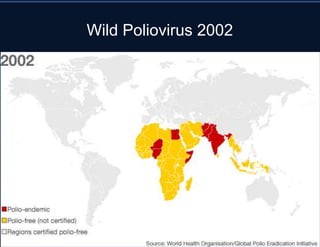
In 2010, only four countries in the world remain 
polio-endemic, down from more than 125 in 1988. 
The remaining countries are Afghanistan, India, 
Nigeria and Pakistan
Wild Poliovirus 1988
Wild Poliovirus 2002
Wild Poliovirus 2012
Wild Poliovirus 2014
Core strategies of GPEI 
1. High infant immunization coverage with four 
doses of oral poliovirus vaccine (OPV) in the 
first year of life 
2. Supplementary doses of OPV to all children 
under five years of age during SIAs(PPI) 
3.AFP surveillance among children under fifteen 
years of age; 
4. Targeted “mop-up” campaigns once wild 
poliovirus transmission is limited to a specific 
focal area.
Poliovirus Vaccine 
 1955 Inactivated vaccine 
 1961 Types 1 and 2 monovalent OPV 
 1962 Type 3 monovalent OPV 
 1963 Trivalent OPV 
 1987 Enhanced-potency IPV (IPV)
Inactivated Polio Vaccine 
 Developed in 1952 by Jonas Salk 
 Contains 3 serotypes of vaccine virus 
 40 units of 1(Mahoney), 8 units of 2(MEF-1) & 
32 units of 3(Saukett) 
 Grown on monkey kidney (Vero) cells 
 Inactivated with formaldehyde 
 Contains trace 2-phenoxyethanol, neomycin, 
streptomycin, polymyxin B 
 Safe in immunocompromised & in pregnancy
Inactivated Polio Vaccine 
 Heat stable at room temp but should be 
refrigerated to preserve potency 
 Highly effective in producing immunity to 
poliovirus 
 >90% immune after 2 doses 
 >99% immune after 3 doses 
 Humoral immunity and to some extend 
pharyngeal immunity 
 Duration of immunity not known with 
certainty
Oral Polio Vaccine 
 Discovered by Albert Sabin 
 Contains 3 serotypes of vaccine virus 
3 lakh TCID 50 of type 1 
1 lakh TCID 50 of type 2 
3 lakh TCID 50 of type 3 
 Grown on monkey kidney (Vero) cells 
 Contains neomycin and streptomycin 
 Shed in stool for up to 6 weeks following 
vaccination
Oral Polio Vaccine 
 Produces both Humoral & local immunity 
 Contributes to herd immunity 
 50% immune after 1 dose 
 >95% immune after 3 doses 
 Immunity probably lifelong 
 Heat labile: -20ºC 
 Can be stabilised by adding MgCl 
 Should not be frozen & thawed repeatedly
Polio Vaccine Adverse Reactions 
 Rare local reactions (IPV) 
 No serious reactions to IPV have been 
documented 
 Paralytic poliomyelitis (OPV)
Polio Vaccine 
Contraindications and Precautions 
 Severe allergic reaction to a vaccine 
component or following a prior dose of 
vaccine 
 Moderate or severe acute illness
Vaccine-Associated Paralytic Polio 
 Mutation of the vaccine inside the body may 
case lose of attenuation(itself brought on by 
reversion) leads to paralytic polio 
 Increased risk in persons >18 years & 
those with immunodeficiency ( B cell) 
 No procedure available for identifying 
persons at risk of paralytic disease 
 5-10 cases per year with exclusive use 
of OPV
2005 in India: Wild case: 66; VAPP 180 
Many countries switched to sequential IPV-OPV 
and then only IPV schedules once the number 
of VAPP cases exceeded wild polio cases.
Vaccine-Derived Paralytic Polio 
virus 
These viruses like those causing VAPP are 
neurovirulent but additionally are transmissible 
and capable of causing outbreaks. 
They have been classified into three groups; 
circulating VDPV (cVDPV), VDPV in the 
immuno-deficient (iVDPV) and VDPV of 
ambiguous origin (aVDPV). 
Risk factors for outbreaks due to cVDPV include 
dropping immunization coverage (both routine 
and SIA's), high population densities, tropical 
conditions and previous eradication of wild virus
POLIO & ITS PREVENTION IN INDIA
India is one of the four countries with wild polio 
virus 
Most cases are reported from Bihar & UP 
Cases seen in various states of north india are 
due to import from there 2 states 
2010 – 42 cases 
Last case of type 2 in 1999 
Last WPV3 Oct 2010 
Last WPV1 Jan 2011 
Polio free country – Jan 2014
Polio Vaccination under UIP 
Vaccine 
OPVº 
OPV1 
OPV2 
OPV3 
OPV4 
Age 
birth 
6 wks 
10 wks 
14 wks 
16-24 Months
Two drops of OPV is used 
Nose should not be pinched 
Instead apply pressure to both side of mouth 
Breast feeding is not contraindicated 
Hot liquids to be avoided for ½ hr after OPV
Pulse Polio Immunization (PPI) 
The supplementary 
immunization activities 
(SIAs) in India launched in 
1995 
Irrespective of the 
immunisation status 
Usually Dec & Jan – Peak 
transmission
Providing additional OPV doses to every child aged <5 
years at intervals of 4-6 weeks during National 
Immunization Days (NIDs) & sub-National 
Immunization Days (SNID's) 
It “Flood” the community with OPV within a very short 
period of time, thereby interrupting transmission of 
virus throughout the community. 
Intensification - house-to-house “search and vaccinate” 
component. 
The number of PPI rounds is determined by the extent 
of poliovirus transmission in the country.
Cold Chain 
The system of transporting, storing and 
distributing vaccine in a potent state at 
recommended temperature till it is 
administered to an individual. 
If cold chain is not maintained from the 
manufacturer to the place of vaccination, the 
vaccine efficacy greatly suffers 
Most vaccines lose their potency by heat and 
sunlight and hence need protection from 
both(2).
The Cold Chain Equipment 
(a) Walk in cold rooms: 3 months and serve districts. 
(b) Deep freezers (300 ltr) and Ice lined Refrigerators: Deep 
freezers are used for making ice packs and to store OPV 
and measles vaccines. 
(c) Small deep freezers and ILR (140 ltr) 
(d) Cold boxes: peripheral centers.mainly for transportation. 
(e) Vaccine carriers:Used to carry small quantities of 
vaccines (16-20 vials) for the out of reach sessions. 
(f) Ice packs
Vaccine Vial Monitoring 
The vaccine vial monitor is a small 
thermochromic sticker on the vaccine vial 
and changes color as the vaccine is 
exposed to heat. 
The color of the sticker tells whether the 
vaccine must be discarded due to excessive 
heat exposure. 
It reduces uncertainty and waste.
AFP Survillance 
Acute flaccid paralysis is defined as: 
Any case of AFP in a child aged <15 years, or any 
case of paralytic illness in a person of any age 
when polio is suspected. 
All health facilities, clinicians and other 
practitioners are required to notify AFP cases 
immediately to the DIO, by the fastest means 
available
Sample Collection 
Two stool specimens are collected as soon as 
possible after the onset of paralysis in the child 
– ideally within 14 days of onset of paralysis 
and at least 24 hours apart. Specimens 
collected within 14 days are much more likely 
to yield the virus. 
Each specimen should be 8 grams – each 
about the size of one adult thumb – collected 
in a clean, dry, screw-capped container. The 
container need not be sterile and no 
preservative/transport media should be used.
Reverse Cold Chain 
The specimens are transported in the “cold chain” – on 
frozen ice packs or ice, in a stool specimen carrier or a 
vaccine carrier specifically designated for this purpose 
– to one of India’s eight WHO-accredited polio 
laboratories. 
Indicator of the quality of the “reverse cold chain” 
↓ 
% of Stool specimens from which a non-polio 
enterovirus is isolated→ ≥10 
(i.e. that the specimen has been continuously 
maintained at temperatures <8° C during 
transportation from the field to the laboratory)
60-day follow-up examination: 
To confirm the presence or absence of residual 
weakness. A 60-day follow-up exam if 
1) inadequate or no stool specimens 
2) isolation of vaccine virus from the stool 
3) isolation of wild poliovirus from the stool 
4) strongly suggestive of poliomyelitis on initial 
examination (“hot case”). 
The child is assessed for weakness, asymmetrical skin 
folds, and difference in left/right mid-arm/mid-thigh 
circumference. The child is considered to have residual 
weakness if any of the above is present, even if 
minimal. The finding of residual weakness taken into 
account during final case classification
Classification
Outbreak response immunization 
(ORI) 
House-to-house immunization following the AFP 
case investigation and stool specimen collection 
Children aged 0-59 months are given one dose of 
oral poliovirus vaccine (OPV) regardless of the 
number of doses received previously. The 
recipients include children of the target age 
group in the village/locality of the AFP case. 
The investigation team searches for additional 
AFP cases in the community, which – if present 
– could signal the possibility of a polio outbreak.
Active case search 
Where an AFP case resides – or where an AFP 
case has visited during the incubation period 
for polio (4-25 days before paralysis onset) 
Carried out immediately along with ORI. 
A search is conducted for any children aged <15 
years who have had the onset of flaccid 
paralysis within the preceding 60 days. All 
cases that are found are investigated 
immediately, with collection of two stool 
specimens before administration of OPV.
“Mopping-up” immunization 
Started when poliovirus transmission has been 
reduced to well-defined and focal geographic 
areas. 
Intensive house-to-house, child-to-child 
immunization campaigns are conducted over a 
period of days to break the final chains of virus 
transmission.
THANK YOU

Polio

  • 1.
  • 2.
    History  SirWalter Scott(1771–1832) may have had the earliest recorded case of polio.  First described by Michael Underwood in 1789  Initially thought to be due to trauma  Became known as the Heine-Medin disease due to the work of Dr. Jakob Heine and Dr. Karl Oskar Medin.  Later called infantile paralysis, based on its propensity to affect children.  3rd human disease targeted for eradication
  • 3.
    Poliovirus  Enterovirus  Spherical virion with a single strand RNA  Three serotypes: 1, 2, 3  Burnhilde & Mahoney strains→ type1  Lansing & MEF-1 → type 2  Leon & Saukett →type 3  1 & 3 – epidemic 2 – endemic Minimal heterotypic immunity between serotypes
  • 4.
    ANTIGENS D orNative or N antigen - whole virion & is type specific - Anti-D antibody is protective and its conc in IPV denotes the potency of vaccine C or Heated or H antigen - empty non-infectious virus & is less specific - anti-C antibody does not neutralise infectivity Heated at 56º C - D →→→ C
  • 5.
    Resistance  Resistantto ether, chloroform, bile, intestinal proteolytic enzymes & detergents  Stable at pH of 3  Can survive at -20ºC for yrs, 4ºC for months & at room temp for 1 day to several weeks  Inactivated by heat(55ºC for 30 min), formaldehyde, ultraviolet light & chlorination  Organic matter in water delays the activation by chlorination
  • 6.
    Pathogenesis  Entryby feco-oral route through ingestion  Droplets from Patients with early disease can enter through inhalation or through conjunctiva  Replication in the epithelial cells of GI tract & the local lymphatics
  • 7.
    Local lymhatics ofGIT ↓ Circulatory system (minor or primary viremia) ↓ Reticuloendothelial system ↓ Circulatory system (major or secondary viremia) ↓ Spinal cord & Brain
  • 8.
    NERVOUS SYSTEM CNS– Multiplies in Neurons & destroys them Earliest change – Degeneration of Nissl bodies Followed by Nuclear changes & finally neuronal death Spinal cord – Lesions are mostly in the ant. Horns causing flaccid paralysis Post. Horn & intermediate column may also be involved
  • 9.
    Outcomes of PoliovirusInfection 90 to 95% polio virus infections are asymptomatic Asymptomatic Minor non-CNS illness Aseptic menigitis Paralytic 0 20 40 60 80 100 Percent
  • 10.
    Poliovirus Epidemiology Reservoir Human  Transmission Fecal-oral Oral-oral possible  Communicability 7-10 days before or after onset . Virus present in stool 3-6 weeks
  • 11.
    Types • AsymptomaticPolio • Non-paralytic • Paralytic – Spinal – Bulbar – Bulbospinal
  • 12.
    Asymptomatic Polio •Accounts for approximately 95% of cases • Virus stays in intestinal tract and does not attack the nerves • Virus is shed in the stool so infected individual is still able to infect others
  • 13.
    Non-paralytic Polio •Abortivepoliomyelitis •Does not lead to paralysis •Mild symptoms seen such as sore throat, fever, n/v, diarrhea, constipation ( Minor illness) •Most recover in <1 week •Non-paralytic aseptic meningitis ( Major illness) – Occurs in 1-2% of polio infections – Symptoms are stiffness in the neck, back, and/or legs – Increased or abnormal sensations can occur – Complete recovery after 2-10 days of symptoms
  • 14.
    Paralytic Polio Fewerthan 1% of those infected develop this type Acute flaccid paralysis seen. Initially focal but spreads over 3 – 4 days Headache, neck/back stiffness, unusual sensations, increased sensitivity to touch Tripod sign + Descending paralysis Asymmetrical patchy paralysis Deep tendon reflex lost before onset of paralysis
  • 15.
    Spinal Polio –Mostcommon form of paralytic; 79% –Attacks motor neurons and causes paralysis of muscles of respiration and muscles of extremities –Children <5 years most likely to become paralyzed in one leg –Adults are most commonly paralyzed in both arms and legs –Those affected still retain sensation in extremities
  • 16.
    Bulbar Polio •Accounts for 2% of paralytic polio • Virus attacks motor neurons in brainstem •Affects cranial nerve function •Primarily inhibits ability to breathe, speak, and swallow effectively Facial asymmetry present
  • 17.
    Bulbospinal Polio •Accounts for 19% of paralytic cases • Affects extremities and cranial nerves • Leads to severe respiratory involvement
  • 18.
    Paralytic Polio RiskFactors • Compromised immune system • Pregnancy • Mouth or throat surgery • Injury or strenuous physical exercise after exposure to virus
  • 19.
    Encephalitic Polio •Veryrare •Causes inflammation of gray matter of brain •Signs/symptoms include agitation, confusion, stupor, and coma •Autonomic dysfunction is common and it has a high mortality
  • 20.
    Past Medical Treatment •Iron Lung - a sealed chamber with an electrically driven bellows that regulates breathing. •Rigid Braces •Body Casts
  • 21.
    Supportive Treatment •Antibiotics for infection • Analgesics for pain • Portable Ventilators for breathing problem • Moderate Exercise • Nutritional Diet
  • 22.
    Post-Polio syndrome (PPS) 25 % of individuals, decades after recovering from the acute infection Features include muscle weakness, extreme fatigue, or paralysis. Due to failure of the over-sized motor units created during recovery from paralytic disease Factors that increase the risk of PPS include time since acute poliovirus infection,permanent residual impairment, and both overuse and disuse of neurons
  • 23.
  • 24.
    Global Polio EradicationInitiative launched in 1988 Polio cases have decreased by over 99% since 1988, from an estimated 350 000 cases then, to 1604 reported cases in 2009. In 2010, only four countries in the world remain polio-endemic, down from more than 125 in 1988. The remaining countries are Afghanistan, India, Nigeria and Pakistan
  • 25.
  • 26.
  • 27.
  • 28.
  • 29.
    Core strategies ofGPEI 1. High infant immunization coverage with four doses of oral poliovirus vaccine (OPV) in the first year of life 2. Supplementary doses of OPV to all children under five years of age during SIAs(PPI) 3.AFP surveillance among children under fifteen years of age; 4. Targeted “mop-up” campaigns once wild poliovirus transmission is limited to a specific focal area.
  • 30.
    Poliovirus Vaccine 1955 Inactivated vaccine  1961 Types 1 and 2 monovalent OPV  1962 Type 3 monovalent OPV  1963 Trivalent OPV  1987 Enhanced-potency IPV (IPV)
  • 31.
    Inactivated Polio Vaccine  Developed in 1952 by Jonas Salk  Contains 3 serotypes of vaccine virus  40 units of 1(Mahoney), 8 units of 2(MEF-1) & 32 units of 3(Saukett)  Grown on monkey kidney (Vero) cells  Inactivated with formaldehyde  Contains trace 2-phenoxyethanol, neomycin, streptomycin, polymyxin B  Safe in immunocompromised & in pregnancy
  • 32.
    Inactivated Polio Vaccine  Heat stable at room temp but should be refrigerated to preserve potency  Highly effective in producing immunity to poliovirus  >90% immune after 2 doses  >99% immune after 3 doses  Humoral immunity and to some extend pharyngeal immunity  Duration of immunity not known with certainty
  • 33.
    Oral Polio Vaccine  Discovered by Albert Sabin  Contains 3 serotypes of vaccine virus 3 lakh TCID 50 of type 1 1 lakh TCID 50 of type 2 3 lakh TCID 50 of type 3  Grown on monkey kidney (Vero) cells  Contains neomycin and streptomycin  Shed in stool for up to 6 weeks following vaccination
  • 34.
    Oral Polio Vaccine  Produces both Humoral & local immunity  Contributes to herd immunity  50% immune after 1 dose  >95% immune after 3 doses  Immunity probably lifelong  Heat labile: -20ºC  Can be stabilised by adding MgCl  Should not be frozen & thawed repeatedly
  • 35.
    Polio Vaccine AdverseReactions  Rare local reactions (IPV)  No serious reactions to IPV have been documented  Paralytic poliomyelitis (OPV)
  • 36.
    Polio Vaccine Contraindicationsand Precautions  Severe allergic reaction to a vaccine component or following a prior dose of vaccine  Moderate or severe acute illness
  • 37.
    Vaccine-Associated Paralytic Polio  Mutation of the vaccine inside the body may case lose of attenuation(itself brought on by reversion) leads to paralytic polio  Increased risk in persons >18 years & those with immunodeficiency ( B cell)  No procedure available for identifying persons at risk of paralytic disease  5-10 cases per year with exclusive use of OPV
  • 38.
    2005 in India:Wild case: 66; VAPP 180 Many countries switched to sequential IPV-OPV and then only IPV schedules once the number of VAPP cases exceeded wild polio cases.
  • 39.
    Vaccine-Derived Paralytic Polio virus These viruses like those causing VAPP are neurovirulent but additionally are transmissible and capable of causing outbreaks. They have been classified into three groups; circulating VDPV (cVDPV), VDPV in the immuno-deficient (iVDPV) and VDPV of ambiguous origin (aVDPV). Risk factors for outbreaks due to cVDPV include dropping immunization coverage (both routine and SIA's), high population densities, tropical conditions and previous eradication of wild virus
  • 40.
    POLIO & ITSPREVENTION IN INDIA
  • 41.
    India is oneof the four countries with wild polio virus Most cases are reported from Bihar & UP Cases seen in various states of north india are due to import from there 2 states 2010 – 42 cases Last case of type 2 in 1999 Last WPV3 Oct 2010 Last WPV1 Jan 2011 Polio free country – Jan 2014
  • 42.
    Polio Vaccination underUIP Vaccine OPVº OPV1 OPV2 OPV3 OPV4 Age birth 6 wks 10 wks 14 wks 16-24 Months
  • 43.
    Two drops ofOPV is used Nose should not be pinched Instead apply pressure to both side of mouth Breast feeding is not contraindicated Hot liquids to be avoided for ½ hr after OPV
  • 44.
    Pulse Polio Immunization(PPI) The supplementary immunization activities (SIAs) in India launched in 1995 Irrespective of the immunisation status Usually Dec & Jan – Peak transmission
  • 45.
    Providing additional OPVdoses to every child aged <5 years at intervals of 4-6 weeks during National Immunization Days (NIDs) & sub-National Immunization Days (SNID's) It “Flood” the community with OPV within a very short period of time, thereby interrupting transmission of virus throughout the community. Intensification - house-to-house “search and vaccinate” component. The number of PPI rounds is determined by the extent of poliovirus transmission in the country.
  • 46.
    Cold Chain Thesystem of transporting, storing and distributing vaccine in a potent state at recommended temperature till it is administered to an individual. If cold chain is not maintained from the manufacturer to the place of vaccination, the vaccine efficacy greatly suffers Most vaccines lose their potency by heat and sunlight and hence need protection from both(2).
  • 47.
    The Cold ChainEquipment (a) Walk in cold rooms: 3 months and serve districts. (b) Deep freezers (300 ltr) and Ice lined Refrigerators: Deep freezers are used for making ice packs and to store OPV and measles vaccines. (c) Small deep freezers and ILR (140 ltr) (d) Cold boxes: peripheral centers.mainly for transportation. (e) Vaccine carriers:Used to carry small quantities of vaccines (16-20 vials) for the out of reach sessions. (f) Ice packs
  • 48.
    Vaccine Vial Monitoring The vaccine vial monitor is a small thermochromic sticker on the vaccine vial and changes color as the vaccine is exposed to heat. The color of the sticker tells whether the vaccine must be discarded due to excessive heat exposure. It reduces uncertainty and waste.
  • 50.
    AFP Survillance Acuteflaccid paralysis is defined as: Any case of AFP in a child aged <15 years, or any case of paralytic illness in a person of any age when polio is suspected. All health facilities, clinicians and other practitioners are required to notify AFP cases immediately to the DIO, by the fastest means available
  • 51.
    Sample Collection Twostool specimens are collected as soon as possible after the onset of paralysis in the child – ideally within 14 days of onset of paralysis and at least 24 hours apart. Specimens collected within 14 days are much more likely to yield the virus. Each specimen should be 8 grams – each about the size of one adult thumb – collected in a clean, dry, screw-capped container. The container need not be sterile and no preservative/transport media should be used.
  • 52.
    Reverse Cold Chain The specimens are transported in the “cold chain” – on frozen ice packs or ice, in a stool specimen carrier or a vaccine carrier specifically designated for this purpose – to one of India’s eight WHO-accredited polio laboratories. Indicator of the quality of the “reverse cold chain” ↓ % of Stool specimens from which a non-polio enterovirus is isolated→ ≥10 (i.e. that the specimen has been continuously maintained at temperatures <8° C during transportation from the field to the laboratory)
  • 53.
    60-day follow-up examination: To confirm the presence or absence of residual weakness. A 60-day follow-up exam if 1) inadequate or no stool specimens 2) isolation of vaccine virus from the stool 3) isolation of wild poliovirus from the stool 4) strongly suggestive of poliomyelitis on initial examination (“hot case”). The child is assessed for weakness, asymmetrical skin folds, and difference in left/right mid-arm/mid-thigh circumference. The child is considered to have residual weakness if any of the above is present, even if minimal. The finding of residual weakness taken into account during final case classification
  • 54.
  • 55.
    Outbreak response immunization (ORI) House-to-house immunization following the AFP case investigation and stool specimen collection Children aged 0-59 months are given one dose of oral poliovirus vaccine (OPV) regardless of the number of doses received previously. The recipients include children of the target age group in the village/locality of the AFP case. The investigation team searches for additional AFP cases in the community, which – if present – could signal the possibility of a polio outbreak.
  • 56.
    Active case search Where an AFP case resides – or where an AFP case has visited during the incubation period for polio (4-25 days before paralysis onset) Carried out immediately along with ORI. A search is conducted for any children aged <15 years who have had the onset of flaccid paralysis within the preceding 60 days. All cases that are found are investigated immediately, with collection of two stool specimens before administration of OPV.
  • 57.
    “Mopping-up” immunization Startedwhen poliovirus transmission has been reduced to well-defined and focal geographic areas. Intensive house-to-house, child-to-child immunization campaigns are conducted over a period of days to break the final chains of virus transmission.
  • 58.