
Hepadnaviridae
      &           Syifa


Hepatitis Virus
                  Syikin
                   Ejat
                  Acap
                  Megat
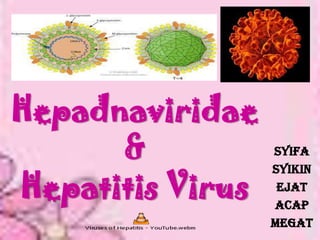
Hepadnaviridae
( Hepa = liver ; dna = deoxyribonucleic
acid )
It is a group of DNA viruses
- The hepadna virus belongs to Class 7 under the
        Baltimore’s system for classification
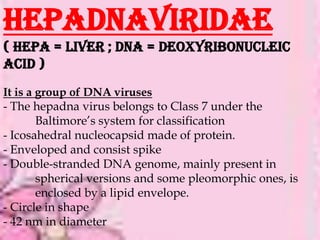
- Icosahedral nucleocapsid made of protein.
- Enveloped and consist spike
- Double-stranded DNA genome, mainly present in
        spherical versions and some pleomorphic ones, is
        enclosed by a lipid envelope.
- Circle in shape
- 42 nm in diameter
Hepatitis
              VirusContent
                Genome
                             -Due to the partial DNA, it is
                             a RNA intermediate. It is
                             also an endogenous DNA
                             which is dependent on DNA
                             polymerase     during    DNA
                             replication.
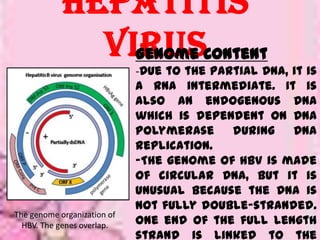
                             -The genome of HBV is made
                             of circular DNA, but it is
                             unusual because the DNA is
                             not fully double-stranded.
The genome organization of
  HBV. The genes overlap.    One end of the full length
                             strand is linked to the
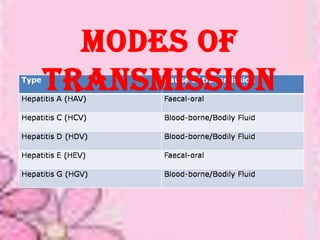
Modes of
Transmission
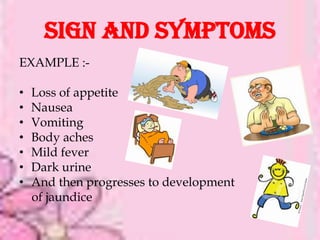
SIGN AND SYMPTOMS
EXAMPLE :-

•   Loss of appetite
•   Nausea
•   Vomiting
•   Body aches
•   Mild fever
•   Dark urine
•   And then progresses to development
    of jaundice
TREATMENT
• Alpha interferon
- Very expensive treatment
- Last round 12-15 weeks
- Makes patient very sick
- Reverse transciptase inhibitor
- Drugs target virus replication strategy by inhibit reverse
   transcriptase
• Recombinant HBsAg vaccine
• Specific antiviral drugs such as lamivudine
- Reverse transcriptase inhibitor
INFECTION TO HUMAN
• Most of the people who come into contact with the virus
  are able to clear the infection alone.
• There are some who cannot, and these patients progress
  to fulminant hepatitis.
• This condition causes severe liver damage and, in very
  rare cases, may also lead to primary hepatocellular
  carcinoma.

Hepadnaviridae

  • 1.
    Hepadnaviridae & Syifa Hepatitis Virus Syikin Ejat Acap Megat
  • 2.
    Hepadnaviridae ( Hepa =liver ; dna = deoxyribonucleic acid ) It is a group of DNA viruses - The hepadna virus belongs to Class 7 under the Baltimore’s system for classification - Icosahedral nucleocapsid made of protein. - Enveloped and consist spike - Double-stranded DNA genome, mainly present in spherical versions and some pleomorphic ones, is enclosed by a lipid envelope. - Circle in shape - 42 nm in diameter
  • 3.
    Hepatitis VirusContent Genome -Due to the partial DNA, it is a RNA intermediate. It is also an endogenous DNA which is dependent on DNA polymerase during DNA replication. -The genome of HBV is made of circular DNA, but it is unusual because the DNA is not fully double-stranded. The genome organization of HBV. The genes overlap. One end of the full length strand is linked to the
  • 4.
  • 6.
    SIGN AND SYMPTOMS EXAMPLE:- • Loss of appetite • Nausea • Vomiting • Body aches • Mild fever • Dark urine • And then progresses to development of jaundice
  • 7.
    TREATMENT • Alpha interferon -Very expensive treatment - Last round 12-15 weeks - Makes patient very sick - Reverse transciptase inhibitor - Drugs target virus replication strategy by inhibit reverse transcriptase • Recombinant HBsAg vaccine • Specific antiviral drugs such as lamivudine - Reverse transcriptase inhibitor
  • 8.
    INFECTION TO HUMAN •Most of the people who come into contact with the virus are able to clear the infection alone. • There are some who cannot, and these patients progress to fulminant hepatitis. • This condition causes severe liver damage and, in very rare cases, may also lead to primary hepatocellular carcinoma.