Presented By
Iqbal Danish
Fakiha javed
Summiya Ikram
Polio is an infectious disease cause by polio virus
which effect spinal cord and brain stem ,it leads to
paralysis and even leads to death
Polio Virus is the causative agent of poliomyelitis
• Children under 5 year of age are more
successeptible to this disease
 Reservoir Human
 Spread through feces
 contaminated food and water
 So.it spread in the communities with
Poor infrastructure
 Poor sanitation
 Crowded living conditions
 Young children are particularly at risk of infection
History and epidemiology:
 Polio virus was first described by Michael
underwood in 1789.first outbreak described
in U.S. in 1843.21000 paralytic cases were
reported in the U.S. in 1952.
 Polioviruses are distributed globally before
the availability of immunization, almost 100%
of the population in developing countries
before the age of 5.the availability of
immunization and the poliovirus eradication
campaign has eradicated poliovirus in most
regions of the world except in the Indian
subcontinent and Africa.
 In 1908 transmission of polio to a monkey by
Landsteiner was confirmed. Virus was grown on tissue
culture in 1949.three types of polio virus were isolated
and identified in 1951.
 Trials of Salk vaccine:
 First large scale trial of Salk was performed in 1954.
 Use of Sabin:
 In 1958 first general use of Sabin was done.
Epidemiology:
 As a result of massive global vaccination campaign
over the past 20 years, polio exists only in a few
countries in Africa and asia.in the Philippines, the last
case was reported in 1993,and in 2000 the Philippines
was certified as polio free country.
Paralytic polio
• loss of reflexes
• severe muscle aches or weakness
• loose and floppy limbs
 Fever
 Sore throat
 Headache
 Vomiting
 Fatigue
 Back pain or stiffness
 Muscle weakness or tenderness
 Meningitis
 Post-polio syndrome is a cluster of disabling signs and
symptoms that affect some people several years — an
average of 35 years — after they had polio. Common
signs and symptoms include:
 Progressive muscle or joint weakness and pain
 General fatigue and exhaustion after minimal activity
 Muscle atrophy
 Breathing or swallowing problems
 Sleep-related breathing disorders, such as sleep apnea
 Decreased tolerance of cold temperatures
 Cognitive problems, such as concentration and memory
difficulties
 Depression or mood swings
Feco-oral
inhalation
infects the pharynx and intestinal mucosa
gains entry by binding to an immunoglobulin –
like receptor known as the poliovirus receptor or
cd155 ,on cell membrane
 Epithelial cells of GIT
 lymphatic tissue-from tonsil to peyer’s patches
 spread to regionl lymph nodes
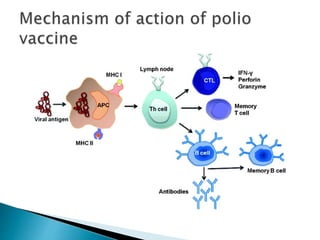
 enter blood stream cause primary viremia
 multiplies in reticulo-endothelial system
 enter blood stream again cause secondary viremia
 carried to spinal cord and brain
 multiply in neurons
 degradation of nissl’s body cause
(chromatolysis )
 nuclear changes follows
 when degeneration irreversible it is
phagocytosed by leucocytes or macrophages
 lesions are in anterior horn of spinal cord cause
flaccid paralysis
 can cause encephalitis involving
 Brainstem
 motor & premotor areas of cerebral cortex
Types of polio vaccine
 There are two general types
1) Inactivated polio vaccine (IPV)
2) Oral polio vaccine (OPV)
 INACTIVATED POLIO VACCINE.
Synonyms for IPV Vaccine
e-IPV
ep-IPV
Salk vaccine
 IPV is a trivalent ( strains 1,2,3) vaccine
SALK POLIO VACCINE.
 Jonas firstly developed the salk vaccine
 1) Formaldehyde-fixed
 2) Non reversion ( this inactivated polio
vaccine can not revert back , no side effects of this
vaccine and safely to use.)
 3 types of polio virus grown in monkey kidney tissue
culture (MKTC)
Procedure for preparation.
 Standard virulent strains used
 3 types of polio vaccines grown separately in MKTC.
 Adequate titre filtered to remove debris and clumps.
 Inactivated with formalin at 37 ºC for 12-15 days.
 Stringent tests to ensure complete
inactivation.
 Issued for used.
HISTORY
 In 1954 whole USA was vaccinated against
polio and 80-90% population was protected.
 In 1955 100 cases of polio myelitis were
reported due to the insufficiently inactivated
vaccine.
 IVP produces antibodies in the blood to all three
types of poliovirus.
 As IPV is not a ‘live’ vaccine, it carries no risk of
VAPP.
 IPV triggers an excellent protective immune
response in most people.
 IPV is one of the safest vaccines in use. No
serious systemic adverse reactions have been
shown to follow vaccination.
 IPV is highly effective in preventing paralytic
disease caused by all three types of poliovirus.
 Shipping and transport is easy.
 IPV induces very low levels of immunity in the
intestine. As a result, when a person immunized
with IPV is infected with wild poliovirus, the virus
can still multiply inside the intestines and be
shed in the faeces, risking continued circulation.
 IPV is over five times more expensive than OPV.
 Administering the vaccine requires trained
health workers, as well as sterile injection
equipment and procedures.
 Booster regime is required.
 Do not stimulate local and mucosal immunity.
 In EPI, dose of IPV is given at
the age of 14 months.
Trivalent oral polio vaccine
synonym is Sabin vaccine.
developed by Albert Sabin in 1961.
it is live attenuated virus vaccine
oral administration of vaccine yields a local gastro
intestinal infection .
A major caution with TOPV is that it is a live
vaccine and must never be injected
 Attenuated by passage in foreign host (monkey kidney
cell) .
 selection to grow in new in host makes virus
 less sited to original host.
 stabilizer such as sucrose or trehalose or arginine
hydrochloride may be add to retain the antigencity .
 Inactivation is carried out by adding formalin at
0.025% concentration.
 Incubation at 37centrigrade upto 48 hours and then at
2- 8 centigrade upto 12 days .
 Test for free formaldehyde content after 12 hours
consistant inactivation of virus is monitored and
verified.
 Oral polio vaccines are easily administered as no need
of highly trained personnel.
 Induce both hummoral and systemic
immunity.Activate all phases of immune system,can
get hummoral igG and local igA.
 Can induce local immunity in gut by stopping viral
replication in GIT.
 Antibodies quickly produced as 1 or 2 doses of oral
vaccine can give 90-100% results.
 Instability at high temperature.
 Very small residual neurovirulence in OPV.
 Frequent vaccine failure even with fully potent vaccine.
 Other adverse events following oral poliovaccines are;
 OPV carries the risk of vaccine associated paralytic
poliomyelitis particularly in infants who receive
vaccine for the first time.
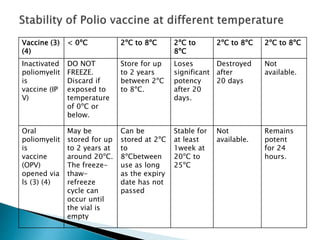
 OPV is a heat sensitive vaccine.
 Should be stored at -20 ºC
 Having shelf life….
o 2 years at -20ºC
o 6 month at 2- 8 ºC
o 1-3 days at room temp.
Vaccine (3)
(4)
< 0ºC 2ºC to 8ºC 2ºC to
8ºC
2ºC to 8ºC 2ºC to 8ºC
Inactivated
poliomyelit
is
vaccine (IP
V)
DO NOT
FREEZE.
Discard if
exposed to
temperature
of 0ºC or
below.
Store for up
to 2 years
between 2ºC
to 8ºC.
Loses
significant
potency
after 20
days.
Destroyed
after
20 days
Not
available.
Oral
poliomyelit
is
vaccine
(OPV)
opened via
ls (3) (4)
May be
stored for up
to 2 years at
around 20ºC.
The freeze-
thaw-
refreeze
cycle can
occur until
the vial is
empty
Can be
stored at 2ºC
to
8ºCbetween
use as long
as the expiry
date has not
passed
Stable for
at least
1week at
20ºC to
25ºC
Not
available.
Remains
potent
for 24
hours.
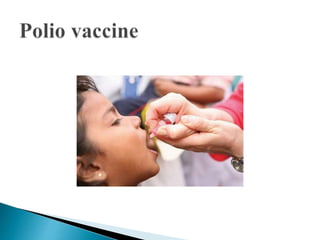
Polio vaccine

Polio vaccine

  • 3.
  • 4.
    Polio is aninfectious disease cause by polio virus which effect spinal cord and brain stem ,it leads to paralysis and even leads to death Polio Virus is the causative agent of poliomyelitis • Children under 5 year of age are more successeptible to this disease
  • 5.
     Reservoir Human Spread through feces  contaminated food and water  So.it spread in the communities with Poor infrastructure  Poor sanitation  Crowded living conditions  Young children are particularly at risk of infection
  • 6.
    History and epidemiology: Polio virus was first described by Michael underwood in 1789.first outbreak described in U.S. in 1843.21000 paralytic cases were reported in the U.S. in 1952.  Polioviruses are distributed globally before the availability of immunization, almost 100% of the population in developing countries before the age of 5.the availability of immunization and the poliovirus eradication campaign has eradicated poliovirus in most regions of the world except in the Indian subcontinent and Africa.
  • 7.
     In 1908transmission of polio to a monkey by Landsteiner was confirmed. Virus was grown on tissue culture in 1949.three types of polio virus were isolated and identified in 1951.  Trials of Salk vaccine:  First large scale trial of Salk was performed in 1954.  Use of Sabin:  In 1958 first general use of Sabin was done.
  • 8.
    Epidemiology:  As aresult of massive global vaccination campaign over the past 20 years, polio exists only in a few countries in Africa and asia.in the Philippines, the last case was reported in 1993,and in 2000 the Philippines was certified as polio free country.
  • 9.
    Paralytic polio • lossof reflexes • severe muscle aches or weakness • loose and floppy limbs
  • 10.
     Fever  Sorethroat  Headache  Vomiting  Fatigue  Back pain or stiffness  Muscle weakness or tenderness  Meningitis
  • 11.
     Post-polio syndromeis a cluster of disabling signs and symptoms that affect some people several years — an average of 35 years — after they had polio. Common signs and symptoms include:  Progressive muscle or joint weakness and pain  General fatigue and exhaustion after minimal activity  Muscle atrophy  Breathing or swallowing problems  Sleep-related breathing disorders, such as sleep apnea  Decreased tolerance of cold temperatures  Cognitive problems, such as concentration and memory difficulties  Depression or mood swings
  • 12.
    Feco-oral inhalation infects the pharynxand intestinal mucosa gains entry by binding to an immunoglobulin – like receptor known as the poliovirus receptor or cd155 ,on cell membrane
  • 13.
     Epithelial cellsof GIT  lymphatic tissue-from tonsil to peyer’s patches  spread to regionl lymph nodes  enter blood stream cause primary viremia  multiplies in reticulo-endothelial system  enter blood stream again cause secondary viremia  carried to spinal cord and brain  multiply in neurons
  • 14.
     degradation ofnissl’s body cause (chromatolysis )  nuclear changes follows  when degeneration irreversible it is phagocytosed by leucocytes or macrophages  lesions are in anterior horn of spinal cord cause flaccid paralysis  can cause encephalitis involving  Brainstem  motor & premotor areas of cerebral cortex
  • 16.
    Types of poliovaccine  There are two general types 1) Inactivated polio vaccine (IPV) 2) Oral polio vaccine (OPV)  INACTIVATED POLIO VACCINE. Synonyms for IPV Vaccine e-IPV ep-IPV Salk vaccine  IPV is a trivalent ( strains 1,2,3) vaccine
  • 17.
    SALK POLIO VACCINE. Jonas firstly developed the salk vaccine  1) Formaldehyde-fixed  2) Non reversion ( this inactivated polio vaccine can not revert back , no side effects of this vaccine and safely to use.)  3 types of polio virus grown in monkey kidney tissue culture (MKTC) Procedure for preparation.  Standard virulent strains used  3 types of polio vaccines grown separately in MKTC.  Adequate titre filtered to remove debris and clumps.  Inactivated with formalin at 37 ºC for 12-15 days.
  • 18.
     Stringent teststo ensure complete inactivation.  Issued for used. HISTORY  In 1954 whole USA was vaccinated against polio and 80-90% population was protected.  In 1955 100 cases of polio myelitis were reported due to the insufficiently inactivated vaccine.
  • 19.
     IVP producesantibodies in the blood to all three types of poliovirus.  As IPV is not a ‘live’ vaccine, it carries no risk of VAPP.  IPV triggers an excellent protective immune response in most people.  IPV is one of the safest vaccines in use. No serious systemic adverse reactions have been shown to follow vaccination.  IPV is highly effective in preventing paralytic disease caused by all three types of poliovirus.  Shipping and transport is easy.
  • 20.
     IPV inducesvery low levels of immunity in the intestine. As a result, when a person immunized with IPV is infected with wild poliovirus, the virus can still multiply inside the intestines and be shed in the faeces, risking continued circulation.  IPV is over five times more expensive than OPV.  Administering the vaccine requires trained health workers, as well as sterile injection equipment and procedures.  Booster regime is required.  Do not stimulate local and mucosal immunity.
  • 21.
     In EPI,dose of IPV is given at the age of 14 months.
  • 22.
    Trivalent oral poliovaccine synonym is Sabin vaccine. developed by Albert Sabin in 1961. it is live attenuated virus vaccine oral administration of vaccine yields a local gastro intestinal infection . A major caution with TOPV is that it is a live vaccine and must never be injected
  • 23.
     Attenuated bypassage in foreign host (monkey kidney cell) .  selection to grow in new in host makes virus  less sited to original host.  stabilizer such as sucrose or trehalose or arginine hydrochloride may be add to retain the antigencity .
  • 24.
     Inactivation iscarried out by adding formalin at 0.025% concentration.  Incubation at 37centrigrade upto 48 hours and then at 2- 8 centigrade upto 12 days .  Test for free formaldehyde content after 12 hours consistant inactivation of virus is monitored and verified.
  • 25.
     Oral poliovaccines are easily administered as no need of highly trained personnel.  Induce both hummoral and systemic immunity.Activate all phases of immune system,can get hummoral igG and local igA.  Can induce local immunity in gut by stopping viral replication in GIT.  Antibodies quickly produced as 1 or 2 doses of oral vaccine can give 90-100% results.
  • 26.
     Instability athigh temperature.  Very small residual neurovirulence in OPV.  Frequent vaccine failure even with fully potent vaccine.  Other adverse events following oral poliovaccines are;  OPV carries the risk of vaccine associated paralytic poliomyelitis particularly in infants who receive vaccine for the first time.
  • 27.
     OPV isa heat sensitive vaccine.  Should be stored at -20 ºC  Having shelf life…. o 2 years at -20ºC o 6 month at 2- 8 ºC o 1-3 days at room temp.
  • 28.
    Vaccine (3) (4) < 0ºC2ºC to 8ºC 2ºC to 8ºC 2ºC to 8ºC 2ºC to 8ºC Inactivated poliomyelit is vaccine (IP V) DO NOT FREEZE. Discard if exposed to temperature of 0ºC or below. Store for up to 2 years between 2ºC to 8ºC. Loses significant potency after 20 days. Destroyed after 20 days Not available. Oral poliomyelit is vaccine (OPV) opened via ls (3) (4) May be stored for up to 2 years at around 20ºC. The freeze- thaw- refreeze cycle can occur until the vial is empty Can be stored at 2ºC to 8ºCbetween use as long as the expiry date has not passed Stable for at least 1week at 20ºC to 25ºC Not available. Remains potent for 24 hours.