SLOW VIRUS DISEASES
Dr Vishal Kulkarni
MBBS MD (Microbiology)
Introduction
 The term “slow virus disease” applied to group of
infections in animals & humans characterized by
a very
- Long incubation period.
- Slow but relentless course
- Terminating fatally
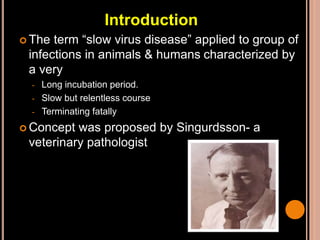
 Concept was proposed by Singurdsson- a
veterinary pathologist
Characteristics-
 Incubation period ranging from months to years
 Course of illness lasting from months to years
with remission & exacerbations
 Predilection for involvment of CNS
 Absence of immune response
 OR immune response that may actually
contribute to pathogenesis
 Genetic predisposition
 Invariable fatal termination
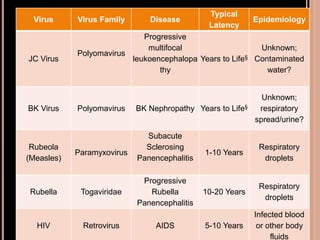
Virus Virus Family Disease
Typical
Latency
Epidemiology
JC Virus
Polyomavirus
Progressive
multifocal
leukoencephalopa
thy
Years to Life§
Unknown;
Contaminated
water?
BK Virus Polyomavirus BK Nephropathy Years to Life§
Unknown;
respiratory
spread/urine?
Rubeola
(Measles)
Paramyxovirus
Subacute
Sclerosing
Panencephalitis
1-10 Years
Respiratory
droplets
Rubella Togaviridae
Progressive
Rubella
Panencephalitis
10-20 Years
Respiratory
droplets
HIV Retrovirus AIDS 5-10 Years
Infected blood
or other body
fluids
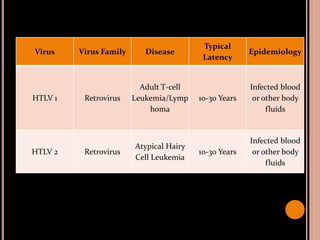
Virus Virus Family Disease
Typical
Latency
Epidemiology
HTLV 1 Retrovirus
Adult T-cell
Leukemia/Lymp
homa
10-30 Years
Infected blood
or other body
fluids
HTLV 2 Retrovirus
Atypical Hairy
Cell Leukemia
10-30 Years
Infected blood
or other body
fluids
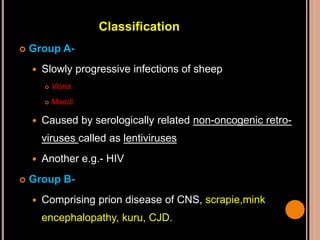
Classification
 Group A-
 Slowly progressive infections of sheep
 Visna
 Maedi
 Caused by serologically related non-oncogenic retro-
viruses called as lentiviruses
 Another e.g.- HIV
 Group B-
 Comprising prion disease of CNS, scrapie,mink
encephalopathy, kuru, CJD.
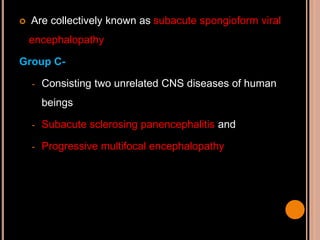
 Are collectively known as subacute spongioform viral
encephalopathy
Group C-
- Consisting two unrelated CNS diseases of human
beings
- Subacute sclerosing panencephalitis and
- Progressive multifocal encephalopathy
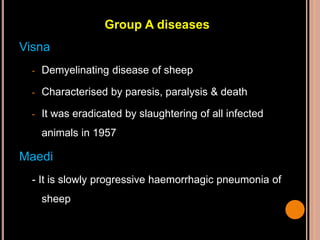
Group A diseases
Visna
- Demyelinating disease of sheep
- Characterised by paresis, paralysis & death
- It was eradicated by slaughtering of all infected
animals in 1957
Maedi
- It is slowly progressive haemorrhagic pneumonia of
sheep
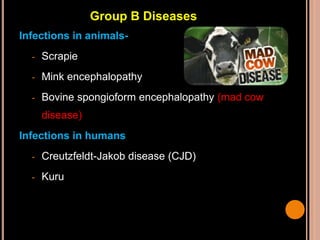
Group B Diseases
Infections in animals-
- Scrapie
- Mink encephalopathy
- Bovine spongioform encephalopathy (mad cow
disease)
Infections in humans
- Creutzfeldt-Jakob disease (CJD)
- Kuru
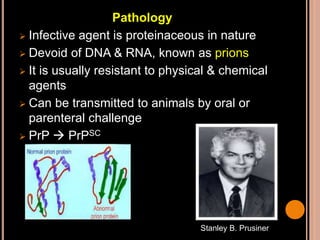
Pathology
 Infective agent is proteinaceous in nature
 Devoid of DNA & RNA, known as prions
 It is usually resistant to physical & chemical
agents
 Can be transmitted to animals by oral or
parenteral challenge
 PrP  PrPSC
Stanley B. Prusiner
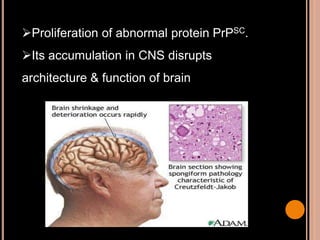
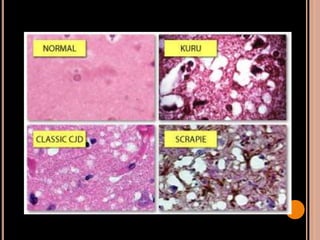
Proliferation of abnormal protein PrPSC.
Its accumulation in CNS disrupts
architecture & function of brain
 Creutzfeldt-Jacob disease
 is a subacute encephalopathy characterized by
 Progressive inco-ordination, dementia & fatal termination.
 Two forms
 Gerstamann-Straussler- Scheinker’s syndrome
 Fatal familial insomnia
 can occur after
 corneal transplant
 contaminated injection of pitutary growth hormone
 Cadaveric human dura grafts used in head injury
 A varient of CJD that affected young people (<45
years) in Britain in 1996
 Raised fear of infection through eating BSE
infected beef
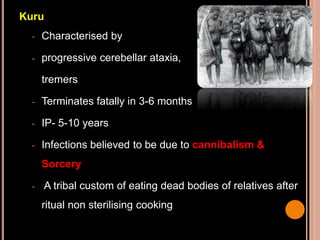
Kuru
- Characterised by
- progressive cerebellar ataxia,
tremers
- Terminates fatally in 3-6 months
- IP- 5-10 years
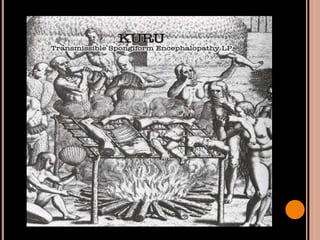
- Infections believed to be due to cannibalism &
Sorcery
- A tribal custom of eating dead bodies of relatives after
ritual non sterilising cooking
Group C Diseases
Subacute sclerosing pan encephalitis ( SSPE)
- Delayed sequel of measles viral infection
- Progressive deterioration of mental & motor function
- Brain cells shows evidence of measles virus infection
- Strains isolated are defective
- May also develop as very late complication live
measles virus vaccination
- Ab in serum & CSF is characteristic
- Rare complication of Rubella virus infection
 Progressive multifocal leucoencephalopathy
 is a rare demyelinating disease in elderly persons
 Whose immune response is impaired by
immunosuppression & malignancy
 Deterioration of motor function, vision & speech
 Polyoma virus has been demonstrated by electron
microscopy in brain biopsy of patients.
THANK YOU…

Slow virus diseases

  • 1.
    SLOW VIRUS DISEASES DrVishal Kulkarni MBBS MD (Microbiology)
  • 2.
    Introduction  The term“slow virus disease” applied to group of infections in animals & humans characterized by a very - Long incubation period. - Slow but relentless course - Terminating fatally  Concept was proposed by Singurdsson- a veterinary pathologist
  • 3.
    Characteristics-  Incubation periodranging from months to years  Course of illness lasting from months to years with remission & exacerbations  Predilection for involvment of CNS  Absence of immune response  OR immune response that may actually contribute to pathogenesis  Genetic predisposition  Invariable fatal termination
  • 4.
    Virus Virus FamilyDisease Typical Latency Epidemiology JC Virus Polyomavirus Progressive multifocal leukoencephalopa thy Years to Life§ Unknown; Contaminated water? BK Virus Polyomavirus BK Nephropathy Years to Life§ Unknown; respiratory spread/urine? Rubeola (Measles) Paramyxovirus Subacute Sclerosing Panencephalitis 1-10 Years Respiratory droplets Rubella Togaviridae Progressive Rubella Panencephalitis 10-20 Years Respiratory droplets HIV Retrovirus AIDS 5-10 Years Infected blood or other body fluids
  • 5.
    Virus Virus FamilyDisease Typical Latency Epidemiology HTLV 1 Retrovirus Adult T-cell Leukemia/Lymp homa 10-30 Years Infected blood or other body fluids HTLV 2 Retrovirus Atypical Hairy Cell Leukemia 10-30 Years Infected blood or other body fluids
  • 6.
    Classification  Group A- Slowly progressive infections of sheep  Visna  Maedi  Caused by serologically related non-oncogenic retro- viruses called as lentiviruses  Another e.g.- HIV  Group B-  Comprising prion disease of CNS, scrapie,mink encephalopathy, kuru, CJD.
  • 7.
     Are collectivelyknown as subacute spongioform viral encephalopathy Group C- - Consisting two unrelated CNS diseases of human beings - Subacute sclerosing panencephalitis and - Progressive multifocal encephalopathy
  • 8.
    Group A diseases Visna -Demyelinating disease of sheep - Characterised by paresis, paralysis & death - It was eradicated by slaughtering of all infected animals in 1957 Maedi - It is slowly progressive haemorrhagic pneumonia of sheep
  • 9.
    Group B Diseases Infectionsin animals- - Scrapie - Mink encephalopathy - Bovine spongioform encephalopathy (mad cow disease) Infections in humans - Creutzfeldt-Jakob disease (CJD) - Kuru
  • 10.
    Pathology  Infective agentis proteinaceous in nature  Devoid of DNA & RNA, known as prions  It is usually resistant to physical & chemical agents  Can be transmitted to animals by oral or parenteral challenge  PrP  PrPSC Stanley B. Prusiner
  • 11.
    Proliferation of abnormalprotein PrPSC. Its accumulation in CNS disrupts architecture & function of brain
  • 13.
     Creutzfeldt-Jacob disease is a subacute encephalopathy characterized by  Progressive inco-ordination, dementia & fatal termination.  Two forms  Gerstamann-Straussler- Scheinker’s syndrome  Fatal familial insomnia  can occur after  corneal transplant  contaminated injection of pitutary growth hormone  Cadaveric human dura grafts used in head injury
  • 14.
     A varientof CJD that affected young people (<45 years) in Britain in 1996  Raised fear of infection through eating BSE infected beef
  • 15.
    Kuru - Characterised by -progressive cerebellar ataxia, tremers - Terminates fatally in 3-6 months - IP- 5-10 years - Infections believed to be due to cannibalism & Sorcery - A tribal custom of eating dead bodies of relatives after ritual non sterilising cooking
  • 17.
    Group C Diseases Subacutesclerosing pan encephalitis ( SSPE) - Delayed sequel of measles viral infection - Progressive deterioration of mental & motor function - Brain cells shows evidence of measles virus infection - Strains isolated are defective
  • 18.
    - May alsodevelop as very late complication live measles virus vaccination - Ab in serum & CSF is characteristic - Rare complication of Rubella virus infection
  • 19.
     Progressive multifocalleucoencephalopathy  is a rare demyelinating disease in elderly persons  Whose immune response is impaired by immunosuppression & malignancy  Deterioration of motor function, vision & speech  Polyoma virus has been demonstrated by electron microscopy in brain biopsy of patients.
  • 21.