Paramyxoviruses Measles, mumps, parainfluenza virus, respiratory syncytial virus, human metapneumovirus www.freelivedoctor.com
Human pathogens in the order  Mononegavirales www.freelivedoctor.com Family Subfamily Genus Human pathogens Rhabdoviridae Lyssavirus Rabies virus Filoviridae Marburghvirus Marburgh virus Ebolavirus Ebola virus Paramyxoviridae Paramyxovirinae Rubulavirus Mumps virus, Parainfluenzavirus 2,4 Respirovirus Parainfluenza virus 1,3 Henipavirus Hendra virus, Nipah virus Morbillivirus Measles virus Pneumovirinae Pneumovirus Respiratory syncytial virus Metaneumovirus Human metapneumovirus
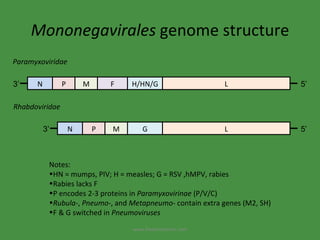
Mononegavirales  genome structure Paramyxoviridae Rhabdoviridae Notes: HN = mumps, PIV; H = measles; G = RSV ,hMPV, rabies Rabies lacks F P encodes 2-3 proteins in  Paramyxovirinae  (P/V/C) Rubula- ,  Pneumo- , and  Metapneumo-  contain extra genes (M2, SH) F & G switched in  Pneumoviruses www.freelivedoctor.com N P M F H/HN/G L 3’ 5’ N P M G L 3’ 5’
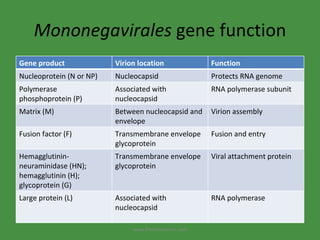
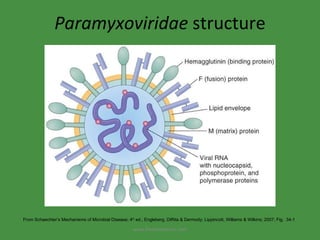
Mononegavirales  gene function www.freelivedoctor.com Gene product Virion location Function Nucleoprotein (N or NP) Nucleocapsid Protects RNA genome Polymerase phosphoprotein (P) Associated with nucleocapsid RNA polymerase subunit Matrix (M) Between nucleocapsid and envelope Virion assembly Fusion factor (F) Transmembrane envelope glycoprotein Fusion and entry Hemagglutinin-neuraminidase (HN); hemagglutinin (H); glycoprotein (G) Transmembrane envelope glycoprotein Viral attachment protein Large protein (L) Associated with nucleocapsid RNA polymerase
Paramyxoviridae  structure From Schaechter’s Mechanisms of Microbial Disease; 4 th  ed.; Engleberg, DiRita & Dermody; Lippincott, Williams & Wilkins; 2007; Fig.  34-1 www.freelivedoctor.com
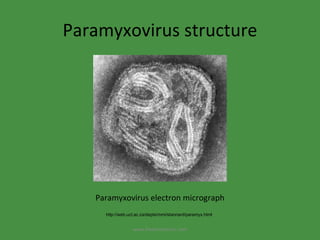
Paramyxovirus structure Paramyxovirus electron micrograph http://web.uct.ac.za/depts/mmi/stannard/paramyx.html www.freelivedoctor.com
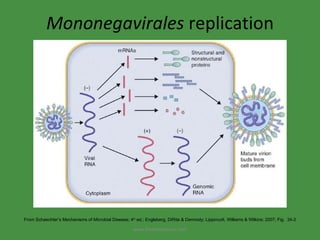
Mononegavirales  replication From Schaechter’s Mechanisms of Microbial Disease; 4 th  ed.; Engleberg, DiRita & Dermody; Lippincott, Williams & Wilkins; 2007; Fig.  34-2 www.freelivedoctor.com
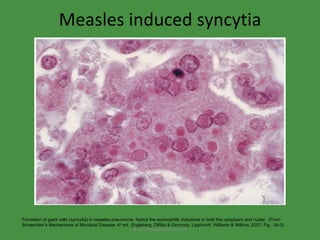
Measles induced syncytia Formation of giant cells (syncytia) in measles pneumonia. Notice the eosinophilic inclusions in both the cytoplasm and nuclei.  (From Schaechter’s Mechanisms of Microbial Disease; 4 th  ed.; Engleberg, DiRita & Dermody; Lippincott, Williams & Wilkins; 2007; Fig.  34-3) www.freelivedoctor.com
Measles: general One of the five classical childhood exanthems (eruptive diseases rubella (togavirus) roseola (HHV 6) fifth disease (parvovirus, B19, erythema infectiosum) chickenpox (herpes zoster) One of the most prominent causes of disease in unvaccinated populations 30-40 million cases per year 1-2 million deaths per year Fewer than 1000 cases in US since 1993; result of live vaccine Host range limited to humans, one serotype www.freelivedoctor.com
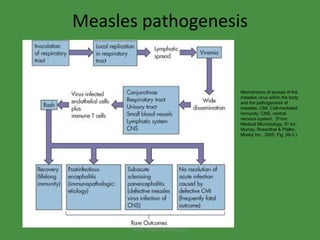
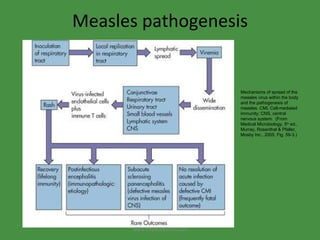
Measles pathogenesis Mechanisms of spread of the measles virus within the body and the pathogenesis of measles. CMI, Cell-mediated immunity; CNS, central nervous system.  (From Medical Microbiology, 5 th  ed., Murray, Rosenthal & Pfaller, Mosby Inc., 2005, Fig. 59-3.) www.freelivedoctor.com
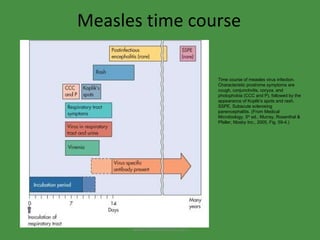
Measles time course Time course of measles virus infection. Characteristic prodrome symptoms are cough, conjunctivitis, coryza, and photophobia (CCC and P), followed by the appearance of Koplik's spots and rash. SSPE, Subacute sclerosing panencephalitis. (From Medical Microbiology, 5 th  ed., Murray, Rosenthal & Pfaller, Mosby Inc., 2005, Fig. 59-4.) www.freelivedoctor.com
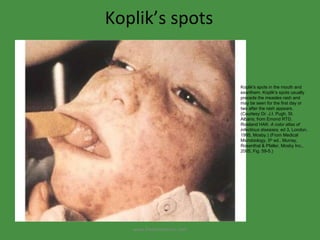
Koplik’s spots Koplik's spots in the mouth and exanthem. Koplik's spots usually precede the measles rash and may be seen for the first day or two after the rash appears. (Courtesy Dr. J.I. Pugh, St. Albans; from Emond RTD, Rowland HAK:  A color atlas of infectious diseases,  ed 3, London, 1995, Mosby.) (From Medical Microbiology, 5 th  ed., Murray, Rosenthal & Pfaller, Mosby Inc., 2005, Fig. 59-5.) www.freelivedoctor.com
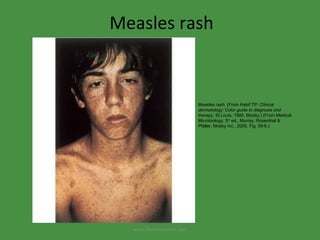
Measles rash Measles rash. (From Habif TP:  Clinical dermatology: Color guide to diagnosis and therapy,  St Louis, 1985, Mosby.) (From Medical Microbiology, 5 th  ed., Murray, Rosenthal & Pfaller, Mosby Inc., 2005, Fig. 59-6.) www.freelivedoctor.com
Measles pathogenesis Mechanisms of spread of the measles virus within the body and the pathogenesis of measles. CMI, Cell-mediated immunity; CNS, central nervous system.  (From Medical Microbiology, 5 th  ed., Murray, Rosenthal & Pfaller, Mosby Inc., 2005, Fig. 59-3.) www.freelivedoctor.com
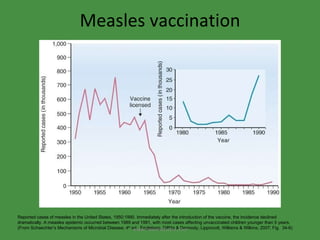
Measles vaccination Reported cases of measles in the United States, 1950:1990. Immediately after the introduction of the vaccine, the incidence declined dramatically. A measles epidemic occurred between 1989 and 1991, with most cases affecting unvaccinated children younger than 5 years.  (From Schaechter’s Mechanisms of Microbial Disease; 4 th  ed.; Engleberg, DiRita & Dermody; Lippincott, Williams & Wilkins; 2007; Fig.  34-6) www.freelivedoctor.com
Mumps www.freelivedoctor.com
Mumps pathogenesis Mechanism of spread of mumps virus within the body.  (From Medical Microbiology, 5 th  ed., Murray, Rosenthal & Pfaller, Mosby Inc., 2005, Fig. 59-7.) www.freelivedoctor.com
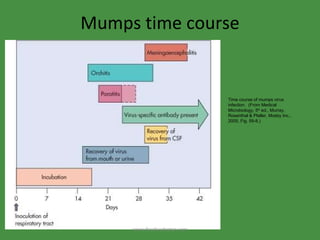
Mumps time course Time course of mumps virus infection.  (From Medical Microbiology, 5 th  ed., Murray, Rosenthal & Pfaller, Mosby Inc., 2005, Fig. 59-8.) www.freelivedoctor.com
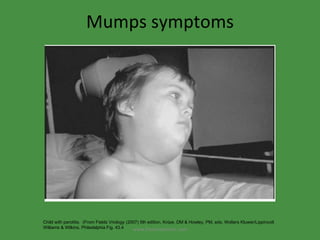
Mumps symptoms Child with parotitis.  (From Fields Vriology (2007) 5th edition, Knipe, DM & Howley, PM, eds, Wolters Kluwer/Lippincott Williams & Wilkins, Philadelphia Fig. 43.4 www.freelivedoctor.com
Respiratory syncytial virus Widespread: 75% of infants seropositive by 1 year of age Yearly in US 50,000-80,000 hospitilizations, 100 infant deaths, 17,000 elderly deaths Host range limited to humans; single serotype Respiratory transmission Highly contageous; contagion period precedes symptoms and may occur in absence of symptoms Localized infections of respiratory tract, no viremia and no systemic infections Disease Children < 1 y.o.: bronchiolitis Pneumonia Common cold in older children and adults Poor immunity Reinfection occurs thoughout life Maternal antibody does not prevent infection Diagnosis rtPCR, immunofluorescence, enzyme immunoassay, serology Treatment Ribavarin reduces severity of symptoms in immunocomprimized patients No vaccine; improper vaccination increases severity of disease Passive vacciniation for high risk infants Palivizumab: anti-F monoclonal antibody www.freelivedoctor.com
Parainfluenza viruses Four serotypes, host range limited to humans,  Respiratory transmission Infections limited to respiratory tract, generally non-systemic and viremia rare Causes cold-like symptoms, bronchitis and croup (serotypes 1 and 2). Infections of children common Diagnosis Virus culture Syncytia formation Hemadsorption Hemagglutination inhibition rtPCR Immunity following infection short-lived.  Individuals subject to re-infection Candidate vaccines are in various stages of clinical trials www.freelivedoctor.com
Human metapneumovirus Respiratory transmission Disease: asymptomatic, common cold, bronchiolotis, pheumonia Accounts for 15% of common colds in children Diagnosis by rtPCR www.freelivedoctor.com
Paramyxovirus summary Structure Negative sense ssRNA genome, helical nucleocapsid, envelope with attachment protein and F protein Pathogenesis Transmission in respiratory droplets and fusion of virus envelope via F protein with plasma membrane of cells in the respiratory tract Replication in cytoplasm, budding Viremia except for RSV and PIV Innate and antibody response important; many symptoms from immune response: rash in measles and swelling in mumps; PIV bronchitis and croup; RSV bronchiolitis and pneumonia in infants Sequelae in CNS for measles and mumps  Diagnosis  Serology or nucleic acid Measles: Koplik spots; mumps: swelling of parotid gland Treatment/prevention MMR live attenuated viral vaccine for measles and mumps, none for RSV or PIV www.freelivedoctor.com

Paramyxovirus

  • 1.
    Paramyxoviruses Measles, mumps,parainfluenza virus, respiratory syncytial virus, human metapneumovirus www.freelivedoctor.com
  • 2.
    Human pathogens inthe order Mononegavirales www.freelivedoctor.com Family Subfamily Genus Human pathogens Rhabdoviridae Lyssavirus Rabies virus Filoviridae Marburghvirus Marburgh virus Ebolavirus Ebola virus Paramyxoviridae Paramyxovirinae Rubulavirus Mumps virus, Parainfluenzavirus 2,4 Respirovirus Parainfluenza virus 1,3 Henipavirus Hendra virus, Nipah virus Morbillivirus Measles virus Pneumovirinae Pneumovirus Respiratory syncytial virus Metaneumovirus Human metapneumovirus
  • 3.
    Mononegavirales genomestructure Paramyxoviridae Rhabdoviridae Notes: HN = mumps, PIV; H = measles; G = RSV ,hMPV, rabies Rabies lacks F P encodes 2-3 proteins in Paramyxovirinae (P/V/C) Rubula- , Pneumo- , and Metapneumo- contain extra genes (M2, SH) F & G switched in Pneumoviruses www.freelivedoctor.com N P M F H/HN/G L 3’ 5’ N P M G L 3’ 5’
  • 4.
    Mononegavirales genefunction www.freelivedoctor.com Gene product Virion location Function Nucleoprotein (N or NP) Nucleocapsid Protects RNA genome Polymerase phosphoprotein (P) Associated with nucleocapsid RNA polymerase subunit Matrix (M) Between nucleocapsid and envelope Virion assembly Fusion factor (F) Transmembrane envelope glycoprotein Fusion and entry Hemagglutinin-neuraminidase (HN); hemagglutinin (H); glycoprotein (G) Transmembrane envelope glycoprotein Viral attachment protein Large protein (L) Associated with nucleocapsid RNA polymerase
  • 5.
    Paramyxoviridae structureFrom Schaechter’s Mechanisms of Microbial Disease; 4 th ed.; Engleberg, DiRita & Dermody; Lippincott, Williams & Wilkins; 2007; Fig. 34-1 www.freelivedoctor.com
  • 6.
    Paramyxovirus structure Paramyxoviruselectron micrograph http://web.uct.ac.za/depts/mmi/stannard/paramyx.html www.freelivedoctor.com
  • 7.
    Mononegavirales replicationFrom Schaechter’s Mechanisms of Microbial Disease; 4 th ed.; Engleberg, DiRita & Dermody; Lippincott, Williams & Wilkins; 2007; Fig. 34-2 www.freelivedoctor.com
  • 8.
    Measles induced syncytiaFormation of giant cells (syncytia) in measles pneumonia. Notice the eosinophilic inclusions in both the cytoplasm and nuclei. (From Schaechter’s Mechanisms of Microbial Disease; 4 th ed.; Engleberg, DiRita & Dermody; Lippincott, Williams & Wilkins; 2007; Fig. 34-3) www.freelivedoctor.com
  • 9.
    Measles: general Oneof the five classical childhood exanthems (eruptive diseases rubella (togavirus) roseola (HHV 6) fifth disease (parvovirus, B19, erythema infectiosum) chickenpox (herpes zoster) One of the most prominent causes of disease in unvaccinated populations 30-40 million cases per year 1-2 million deaths per year Fewer than 1000 cases in US since 1993; result of live vaccine Host range limited to humans, one serotype www.freelivedoctor.com
  • 10.
    Measles pathogenesis Mechanismsof spread of the measles virus within the body and the pathogenesis of measles. CMI, Cell-mediated immunity; CNS, central nervous system. (From Medical Microbiology, 5 th ed., Murray, Rosenthal & Pfaller, Mosby Inc., 2005, Fig. 59-3.) www.freelivedoctor.com
  • 11.
    Measles time courseTime course of measles virus infection. Characteristic prodrome symptoms are cough, conjunctivitis, coryza, and photophobia (CCC and P), followed by the appearance of Koplik's spots and rash. SSPE, Subacute sclerosing panencephalitis. (From Medical Microbiology, 5 th ed., Murray, Rosenthal & Pfaller, Mosby Inc., 2005, Fig. 59-4.) www.freelivedoctor.com
  • 12.
    Koplik’s spots Koplik'sspots in the mouth and exanthem. Koplik's spots usually precede the measles rash and may be seen for the first day or two after the rash appears. (Courtesy Dr. J.I. Pugh, St. Albans; from Emond RTD, Rowland HAK: A color atlas of infectious diseases, ed 3, London, 1995, Mosby.) (From Medical Microbiology, 5 th ed., Murray, Rosenthal & Pfaller, Mosby Inc., 2005, Fig. 59-5.) www.freelivedoctor.com
  • 13.
    Measles rash Measlesrash. (From Habif TP: Clinical dermatology: Color guide to diagnosis and therapy, St Louis, 1985, Mosby.) (From Medical Microbiology, 5 th ed., Murray, Rosenthal & Pfaller, Mosby Inc., 2005, Fig. 59-6.) www.freelivedoctor.com
  • 14.
    Measles pathogenesis Mechanismsof spread of the measles virus within the body and the pathogenesis of measles. CMI, Cell-mediated immunity; CNS, central nervous system. (From Medical Microbiology, 5 th ed., Murray, Rosenthal & Pfaller, Mosby Inc., 2005, Fig. 59-3.) www.freelivedoctor.com
  • 15.
    Measles vaccination Reportedcases of measles in the United States, 1950:1990. Immediately after the introduction of the vaccine, the incidence declined dramatically. A measles epidemic occurred between 1989 and 1991, with most cases affecting unvaccinated children younger than 5 years. (From Schaechter’s Mechanisms of Microbial Disease; 4 th ed.; Engleberg, DiRita & Dermody; Lippincott, Williams & Wilkins; 2007; Fig. 34-6) www.freelivedoctor.com
  • 16.
  • 17.
    Mumps pathogenesis Mechanismof spread of mumps virus within the body. (From Medical Microbiology, 5 th ed., Murray, Rosenthal & Pfaller, Mosby Inc., 2005, Fig. 59-7.) www.freelivedoctor.com
  • 18.
    Mumps time courseTime course of mumps virus infection. (From Medical Microbiology, 5 th ed., Murray, Rosenthal & Pfaller, Mosby Inc., 2005, Fig. 59-8.) www.freelivedoctor.com
  • 19.
    Mumps symptoms Childwith parotitis. (From Fields Vriology (2007) 5th edition, Knipe, DM & Howley, PM, eds, Wolters Kluwer/Lippincott Williams & Wilkins, Philadelphia Fig. 43.4 www.freelivedoctor.com
  • 20.
    Respiratory syncytial virusWidespread: 75% of infants seropositive by 1 year of age Yearly in US 50,000-80,000 hospitilizations, 100 infant deaths, 17,000 elderly deaths Host range limited to humans; single serotype Respiratory transmission Highly contageous; contagion period precedes symptoms and may occur in absence of symptoms Localized infections of respiratory tract, no viremia and no systemic infections Disease Children < 1 y.o.: bronchiolitis Pneumonia Common cold in older children and adults Poor immunity Reinfection occurs thoughout life Maternal antibody does not prevent infection Diagnosis rtPCR, immunofluorescence, enzyme immunoassay, serology Treatment Ribavarin reduces severity of symptoms in immunocomprimized patients No vaccine; improper vaccination increases severity of disease Passive vacciniation for high risk infants Palivizumab: anti-F monoclonal antibody www.freelivedoctor.com
  • 21.
    Parainfluenza viruses Fourserotypes, host range limited to humans, Respiratory transmission Infections limited to respiratory tract, generally non-systemic and viremia rare Causes cold-like symptoms, bronchitis and croup (serotypes 1 and 2). Infections of children common Diagnosis Virus culture Syncytia formation Hemadsorption Hemagglutination inhibition rtPCR Immunity following infection short-lived. Individuals subject to re-infection Candidate vaccines are in various stages of clinical trials www.freelivedoctor.com
  • 22.
    Human metapneumovirus Respiratorytransmission Disease: asymptomatic, common cold, bronchiolotis, pheumonia Accounts for 15% of common colds in children Diagnosis by rtPCR www.freelivedoctor.com
  • 23.
    Paramyxovirus summary StructureNegative sense ssRNA genome, helical nucleocapsid, envelope with attachment protein and F protein Pathogenesis Transmission in respiratory droplets and fusion of virus envelope via F protein with plasma membrane of cells in the respiratory tract Replication in cytoplasm, budding Viremia except for RSV and PIV Innate and antibody response important; many symptoms from immune response: rash in measles and swelling in mumps; PIV bronchitis and croup; RSV bronchiolitis and pneumonia in infants Sequelae in CNS for measles and mumps Diagnosis Serology or nucleic acid Measles: Koplik spots; mumps: swelling of parotid gland Treatment/prevention MMR live attenuated viral vaccine for measles and mumps, none for RSV or PIV www.freelivedoctor.com