EMERGING & RE-
EMERGING INFECTIONS
MI 8.4
Dr V S Vatkar
Associate Professor
Department of Microbiology
D Y Patil Medical College, Kolhapur
DEFINITION
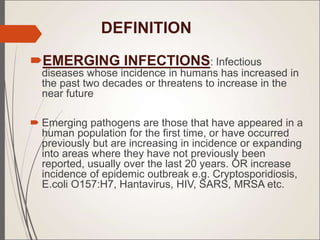
EMERGING INFECTIONS: Infectious
diseases whose incidence in humans has increased in
the past two decades or threatens to increase in the
near future
 Emerging pathogens are those that have appeared in a
human population for the first time, or have occurred
previously but are increasing in incidence or expanding
into areas where they have not previously been
reported, usually over the last 20 years. OR increase
incidence of epidemic outbreak e.g. Cryptosporidiosis,
E.coli O157:H7, Hantavirus, HIV, SARS, MRSA etc.
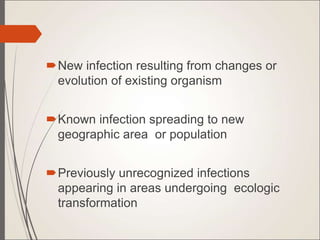
New infection resulting from changes or
evolution of existing organism
Known infection spreading to new
geographic area or population
Previously unrecognized infections
appearing in areas undergoing ecologic
transformation
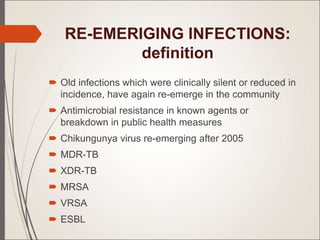
RE-EMERIGING INFECTIONS:
definition
 Old infections which were clinically silent or reduced in
incidence, have again re-emerge in the community
 Antimicrobial resistance in known agents or
breakdown in public health measures
 Chikungunya virus re-emerging after 2005
 MDR-TB
 XDR-TB
 MRSA
 VRSA
 ESBL
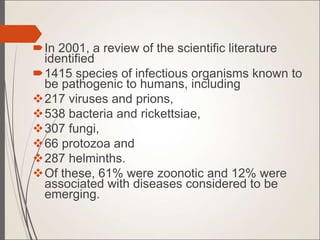
In 2001, a review of the scientific literature
identified
1415 species of infectious organisms known to
be pathogenic to humans, including
217 viruses and prions,
538 bacteria and rickettsiae,
307 fungi,
66 protozoa and
287 helminths.
Of these, 61% were zoonotic and 12% were
associated with diseases considered to be
emerging.
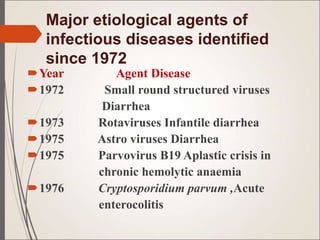
Major etiological agents of
infectious diseases identified
since 1972
Year Agent Disease
1972 Small round structured viruses
Diarrhea
1973 Rotaviruses Infantile diarrhea
1975 Astro viruses Diarrhea
1975 Parvovirus B19 Aplastic crisis in
chronic hemolytic anaemia
1976 Cryptosporidium parvum ,Acute
enterocolitis
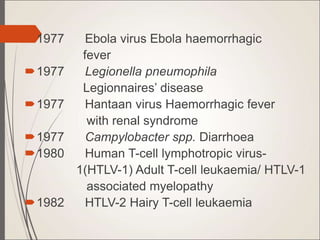
1977 Ebola virus Ebola haemorrhagic
fever
1977 Legionella pneumophila
Legionnaires’ disease
1977 Hantaan virus Haemorrhagic fever
with renal syndrome
1977 Campylobacter spp. Diarrhoea
1980 Human T-cell lymphotropic virus-
1(HTLV-1) Adult T-cell leukaemia/ HTLV-1
associated myelopathy
1982 HTLV-2 Hairy T-cell leukaemia
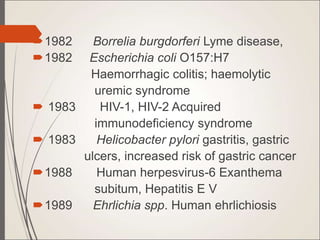
1982 Borrelia burgdorferi Lyme disease,
1982 Escherichia coli O157:H7
Haemorrhagic colitis; haemolytic
uremic syndrome
 1983 HIV-1, HIV-2 Acquired
immunodeficiency syndrome
 1983 Helicobacter pylori gastritis, gastric
ulcers, increased risk of gastric cancer
1988 Human herpesvirus-6 Exanthema
subitum, Hepatitis E V
1989 Ehrlichia spp. Human ehrlichiosis
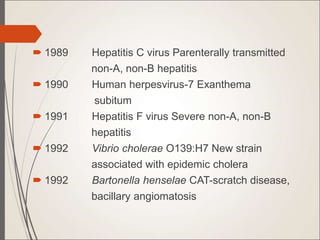
 1989 Hepatitis C virus Parenterally transmitted
non-A, non-B hepatitis
 1990 Human herpesvirus-7 Exanthema
subitum
 1991 Hepatitis F virus Severe non-A, non-B
hepatitis
 1992 Vibrio cholerae O139:H7 New strain
associated with epidemic cholera
 1992 Bartonella henselae CAT-scratch disease,
bacillary angiomatosis
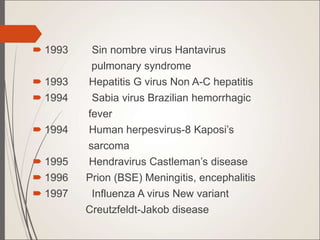
 1993 Sin nombre virus Hantavirus
pulmonary syndrome
 1993 Hepatitis G virus Non A-C hepatitis
 1994 Sabia virus Brazilian hemorrhagic
fever
 1994 Human herpesvirus-8 Kaposi’s
sarcoma
 1995 Hendravirus Castleman’s disease
 1996 Prion (BSE) Meningitis, encephalitis
 1997 Influenza A virus New variant
Creutzfeldt-Jakob disease
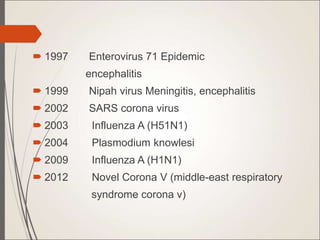
 1997 Enterovirus 71 Epidemic
encephalitis
 1999 Nipah virus Meningitis, encephalitis
 2002 SARS corona virus
 2003 Influenza A (H51N1)
 2004 Plasmodium knowlesi
 2009 Influenza A (H1N1)
 2012 Novel Corona V (middle-east respiratory
syndrome corona v)
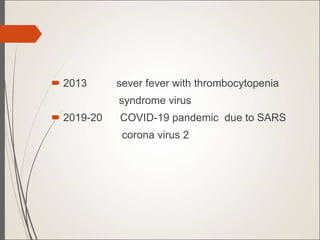
 2013 sever fever with thrombocytopenia
syndrome virus
 2019-20 COVID-19 pandemic due to SARS
corona virus 2
WHY DO PATHOGENS
EMERGE? Reasons.
New environments : new technologies like
dams & irrigation systems, leads to spread of
malaria, schistosomiasis, J E, AC systems:
legionella inf. etc.
Scientific advances: inappropriate & excessive
use of antibiotics & antiparasitic drugs.
 ■ Improved methods of detection and analysis
 ■ Inappropriate use of new generation insecticides.
 Changes in human behavior and
vulnerability: Human circulation and the
accessibility and rapidity of transport
worldwide.
 ■ Deliberate and accidental release of
pathogens to water.
* Individual’s level of nutrition and fitness,
stress, excessive exposure to ultraviolet
irradiation, and pregnancy.
 New techniques:
 Filtration of water, agricultural and wastewater
management practices, may be anticipated and
subsequently controlled by implementing
appropriate resource protection and management
strategies.
Other factors
Demographic : increase size of high risk
population.
Socio-economic factors: may be
anticipated, but the outcomes are
unpredictable and appropriate control
measures difficult to implement.
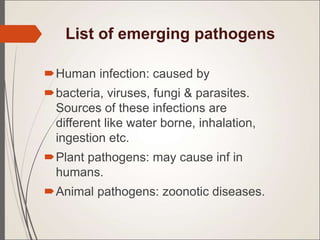
List of emerging pathogens
Human infection: caused by
bacteria, viruses, fungi & parasites.
Sources of these infections are
different like water borne, inhalation,
ingestion etc.
Plant pathogens: may cause inf in
humans.
Animal pathogens: zoonotic diseases.
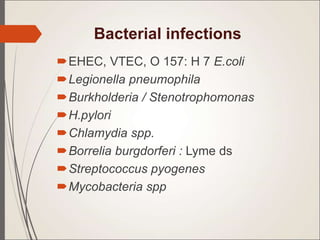
Bacterial infections
EHEC, VTEC, O 157: H 7 E.coli
Legionella pneumophila
Burkholderia / Stenotrophomonas
H.pylori
Chlamydia spp.
Borrelia burgdorferi : Lyme ds
Streptococcus pyogenes
Mycobacteria spp
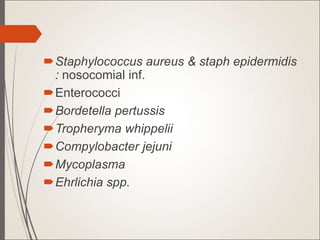
Staphylococcus aureus & staph epidermidis
: nosocomial inf.
Enterococci
Bordetella pertussis
Tropheryma whippelii
Compylobacter jejuni
Mycoplasma
Ehrlichia spp.
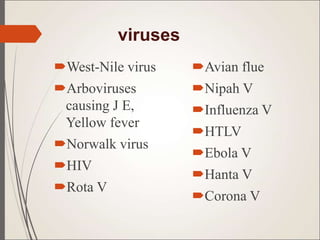
viruses
West-Nile virus
Arboviruses
causing J E,
Yellow fever
Norwalk virus
HIV
Rota V
Avian flue
Nipah V
Influenza V
HTLV
Ebola V
Hanta V
Corona V
Fungi
black moulds found in environment
(immunity of person decreases inf occurs):
a) skin inf (warts & cauliflower like
lesions). Redness, swelling, discharge,
pain at the inf site. b) Pneumonia
most common inf. c) Sinusitis
MOI: inhalation of spores
Treatment: antifungal agents, surgical
excision
No vaccine available.
Zygomycetes (eg, Mucor and Rhizopus ),
Fusarium, Trichosporon,
Pseudallescheria, and Scedosporium.
Parasites:
cryptosporidium parvum
Isospora belli
Giardia
Malarial inf
TRANSMISSION OF
INFECTION (diff modes)
Water borne infections: include
 Cryptosporidium, Giardia
 Legionella, Escherichia coli O157 (E. coli O157),
Cholera O139,
 rotavirus, hepatitis E virus
 norovirus (formerly Norwalk virus).
 Helicobacter pylori (H. pylori)
Coronavirus responsible for
Severe Acute Respiratory Syndrome
(SARS) : transmitted through ‘droplets’.
Mycobacterium Avium Complex (MAC):
leading cause of death in HIV pts. Drinking
water plays an imp role in the spread of inf.
Cyclospora cayetanensis: food borne
outbreaks in Dec 2000, southwest
Germany, oocysts transmit thr’ local
contact & thr’ water.
Schistosomiasis : S.mansoni
Severe illness due to dermal contact with
toxic cyanobacteria has been reported
from tropical marine bathing sites
Zoonotic infections :
Vector borne:
A) Mosquito : J E, dengue, Yellow fever,
chikungunya, West-Nile fever
(Arboviruses).
B) Tick : KFD, Colorado tick fever, Russian
spring summer encephalitis, Rickettsial
diseases: Tick typhus.
C) Rat flea : Y.pestis, Endemic typhus
D) Rat : Borrelia burgdorferi, Leptospira
inf. Lassa fever V.
Nosocomial infection:
 MRSA, Multidrug resistant E.coli,
P.aeruginosa, Clostridium difficile, Serratia
spp., Enterococcus infections.
Inhalation:
Fungal infections: inhalation of spores
(black moulds, opportunistic fungi etc.)
Influenza virus: Avian flu strain: higher
mortality. H5N1 strain outbreak in Hong-
Kong ,2008 (in birds).
COVID-19
Food-related diseases include
hepatitis caused by the hepatitis E virus,
 intestinal spirochetosis caused by
Brachyspira pilosicoli, gnathostomiasis
caused by nematodes and anisakidosis caused
by fish nematodes.
non-gastric Helicobacter spp., Enterobacter
sakazakii, non-jejuni/coli species of
Campylobacter, and non-O157 Shiga toxin-
producing Escherichia coli. , Y.enterocolitica,
M.paratuberculosis (chrohn’s ds),

Emerging reemerging infections

  • 1.
    EMERGING & RE- EMERGINGINFECTIONS MI 8.4 Dr V S Vatkar Associate Professor Department of Microbiology D Y Patil Medical College, Kolhapur
  • 2.
    DEFINITION EMERGING INFECTIONS: Infectious diseaseswhose incidence in humans has increased in the past two decades or threatens to increase in the near future  Emerging pathogens are those that have appeared in a human population for the first time, or have occurred previously but are increasing in incidence or expanding into areas where they have not previously been reported, usually over the last 20 years. OR increase incidence of epidemic outbreak e.g. Cryptosporidiosis, E.coli O157:H7, Hantavirus, HIV, SARS, MRSA etc.
  • 3.
    New infection resultingfrom changes or evolution of existing organism Known infection spreading to new geographic area or population Previously unrecognized infections appearing in areas undergoing ecologic transformation
  • 4.
    RE-EMERIGING INFECTIONS: definition  Oldinfections which were clinically silent or reduced in incidence, have again re-emerge in the community  Antimicrobial resistance in known agents or breakdown in public health measures  Chikungunya virus re-emerging after 2005  MDR-TB  XDR-TB  MRSA  VRSA  ESBL
  • 5.
    In 2001, areview of the scientific literature identified 1415 species of infectious organisms known to be pathogenic to humans, including 217 viruses and prions, 538 bacteria and rickettsiae, 307 fungi, 66 protozoa and 287 helminths. Of these, 61% were zoonotic and 12% were associated with diseases considered to be emerging.
  • 6.
    Major etiological agentsof infectious diseases identified since 1972 Year Agent Disease 1972 Small round structured viruses Diarrhea 1973 Rotaviruses Infantile diarrhea 1975 Astro viruses Diarrhea 1975 Parvovirus B19 Aplastic crisis in chronic hemolytic anaemia 1976 Cryptosporidium parvum ,Acute enterocolitis
  • 7.
    1977 Ebola virusEbola haemorrhagic fever 1977 Legionella pneumophila Legionnaires’ disease 1977 Hantaan virus Haemorrhagic fever with renal syndrome 1977 Campylobacter spp. Diarrhoea 1980 Human T-cell lymphotropic virus- 1(HTLV-1) Adult T-cell leukaemia/ HTLV-1 associated myelopathy 1982 HTLV-2 Hairy T-cell leukaemia
  • 8.
    1982 Borrelia burgdorferiLyme disease, 1982 Escherichia coli O157:H7 Haemorrhagic colitis; haemolytic uremic syndrome  1983 HIV-1, HIV-2 Acquired immunodeficiency syndrome  1983 Helicobacter pylori gastritis, gastric ulcers, increased risk of gastric cancer 1988 Human herpesvirus-6 Exanthema subitum, Hepatitis E V 1989 Ehrlichia spp. Human ehrlichiosis
  • 9.
     1989 HepatitisC virus Parenterally transmitted non-A, non-B hepatitis  1990 Human herpesvirus-7 Exanthema subitum  1991 Hepatitis F virus Severe non-A, non-B hepatitis  1992 Vibrio cholerae O139:H7 New strain associated with epidemic cholera  1992 Bartonella henselae CAT-scratch disease, bacillary angiomatosis
  • 10.
     1993 Sinnombre virus Hantavirus pulmonary syndrome  1993 Hepatitis G virus Non A-C hepatitis  1994 Sabia virus Brazilian hemorrhagic fever  1994 Human herpesvirus-8 Kaposi’s sarcoma  1995 Hendravirus Castleman’s disease  1996 Prion (BSE) Meningitis, encephalitis  1997 Influenza A virus New variant Creutzfeldt-Jakob disease
  • 11.
     1997 Enterovirus71 Epidemic encephalitis  1999 Nipah virus Meningitis, encephalitis  2002 SARS corona virus  2003 Influenza A (H51N1)  2004 Plasmodium knowlesi  2009 Influenza A (H1N1)  2012 Novel Corona V (middle-east respiratory syndrome corona v)
  • 12.
     2013 severfever with thrombocytopenia syndrome virus  2019-20 COVID-19 pandemic due to SARS corona virus 2
  • 13.
    WHY DO PATHOGENS EMERGE?Reasons. New environments : new technologies like dams & irrigation systems, leads to spread of malaria, schistosomiasis, J E, AC systems: legionella inf. etc. Scientific advances: inappropriate & excessive use of antibiotics & antiparasitic drugs.  ■ Improved methods of detection and analysis  ■ Inappropriate use of new generation insecticides.
  • 14.
     Changes inhuman behavior and vulnerability: Human circulation and the accessibility and rapidity of transport worldwide.  ■ Deliberate and accidental release of pathogens to water. * Individual’s level of nutrition and fitness, stress, excessive exposure to ultraviolet irradiation, and pregnancy.
  • 15.
     New techniques: Filtration of water, agricultural and wastewater management practices, may be anticipated and subsequently controlled by implementing appropriate resource protection and management strategies.
  • 16.
    Other factors Demographic :increase size of high risk population. Socio-economic factors: may be anticipated, but the outcomes are unpredictable and appropriate control measures difficult to implement.
  • 17.
    List of emergingpathogens Human infection: caused by bacteria, viruses, fungi & parasites. Sources of these infections are different like water borne, inhalation, ingestion etc. Plant pathogens: may cause inf in humans. Animal pathogens: zoonotic diseases.
  • 18.
    Bacterial infections EHEC, VTEC,O 157: H 7 E.coli Legionella pneumophila Burkholderia / Stenotrophomonas H.pylori Chlamydia spp. Borrelia burgdorferi : Lyme ds Streptococcus pyogenes Mycobacteria spp
  • 19.
    Staphylococcus aureus &staph epidermidis : nosocomial inf. Enterococci Bordetella pertussis Tropheryma whippelii Compylobacter jejuni Mycoplasma Ehrlichia spp.
  • 20.
    viruses West-Nile virus Arboviruses causing JE, Yellow fever Norwalk virus HIV Rota V Avian flue Nipah V Influenza V HTLV Ebola V Hanta V Corona V
  • 21.
    Fungi black moulds foundin environment (immunity of person decreases inf occurs): a) skin inf (warts & cauliflower like lesions). Redness, swelling, discharge, pain at the inf site. b) Pneumonia most common inf. c) Sinusitis MOI: inhalation of spores Treatment: antifungal agents, surgical excision No vaccine available. Zygomycetes (eg, Mucor and Rhizopus ), Fusarium, Trichosporon, Pseudallescheria, and Scedosporium.
  • 22.
  • 23.
    TRANSMISSION OF INFECTION (diffmodes) Water borne infections: include  Cryptosporidium, Giardia  Legionella, Escherichia coli O157 (E. coli O157), Cholera O139,  rotavirus, hepatitis E virus  norovirus (formerly Norwalk virus).  Helicobacter pylori (H. pylori)
  • 24.
    Coronavirus responsible for SevereAcute Respiratory Syndrome (SARS) : transmitted through ‘droplets’. Mycobacterium Avium Complex (MAC): leading cause of death in HIV pts. Drinking water plays an imp role in the spread of inf.
  • 25.
    Cyclospora cayetanensis: foodborne outbreaks in Dec 2000, southwest Germany, oocysts transmit thr’ local contact & thr’ water. Schistosomiasis : S.mansoni Severe illness due to dermal contact with toxic cyanobacteria has been reported from tropical marine bathing sites
  • 26.
    Zoonotic infections : Vectorborne: A) Mosquito : J E, dengue, Yellow fever, chikungunya, West-Nile fever (Arboviruses). B) Tick : KFD, Colorado tick fever, Russian spring summer encephalitis, Rickettsial diseases: Tick typhus.
  • 27.
    C) Rat flea: Y.pestis, Endemic typhus D) Rat : Borrelia burgdorferi, Leptospira inf. Lassa fever V. Nosocomial infection:  MRSA, Multidrug resistant E.coli, P.aeruginosa, Clostridium difficile, Serratia spp., Enterococcus infections.
  • 28.
    Inhalation: Fungal infections: inhalationof spores (black moulds, opportunistic fungi etc.) Influenza virus: Avian flu strain: higher mortality. H5N1 strain outbreak in Hong- Kong ,2008 (in birds). COVID-19
  • 29.
    Food-related diseases include hepatitiscaused by the hepatitis E virus,  intestinal spirochetosis caused by Brachyspira pilosicoli, gnathostomiasis caused by nematodes and anisakidosis caused by fish nematodes. non-gastric Helicobacter spp., Enterobacter sakazakii, non-jejuni/coli species of Campylobacter, and non-O157 Shiga toxin- producing Escherichia coli. , Y.enterocolitica, M.paratuberculosis (chrohn’s ds),