Human ParaInfluenza Virus
(HPIV)
Introduction
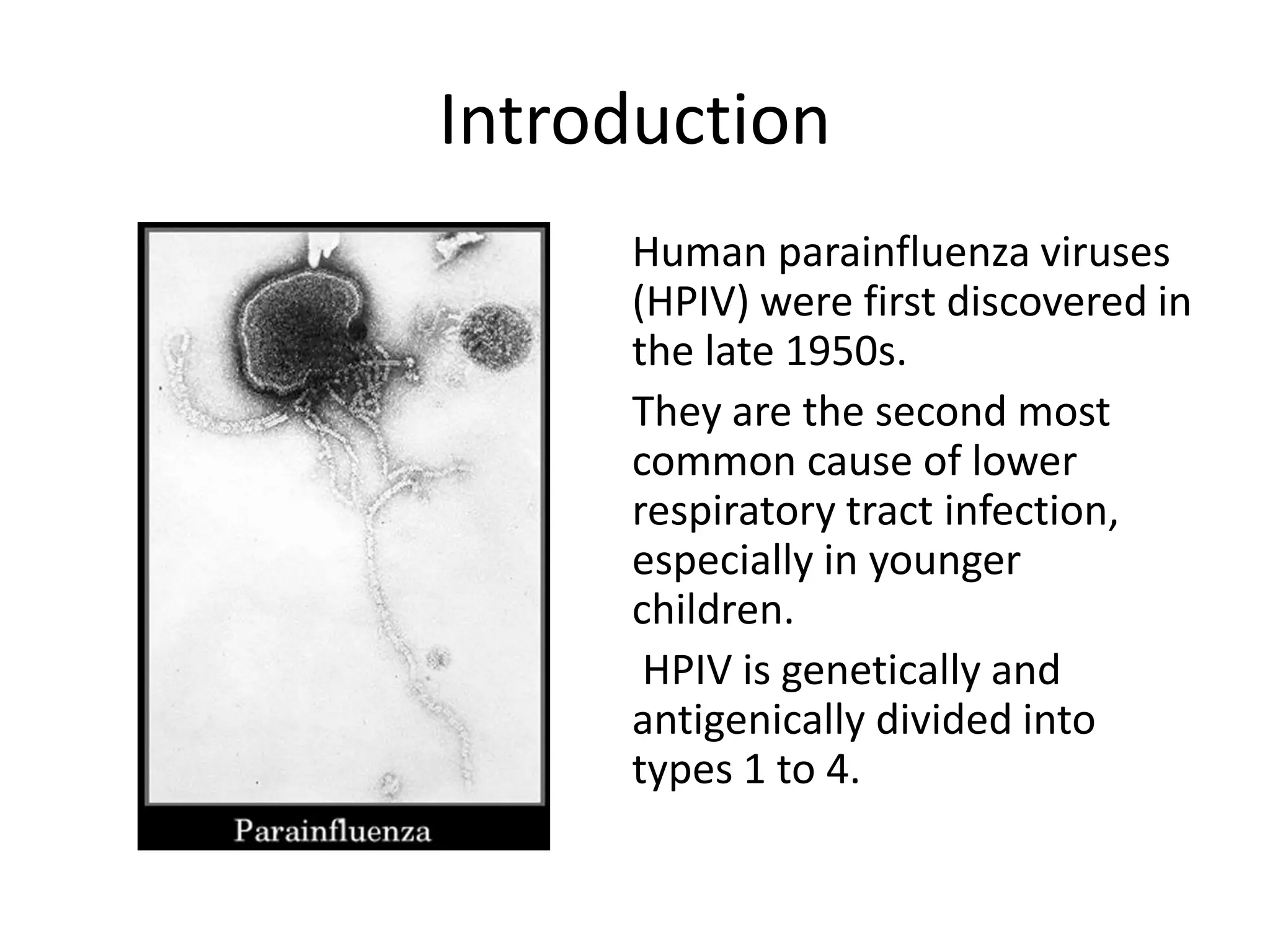
Human parainfluenza viruses
(HPIV) were first discovered in
the late 1950s.
They are the second most
common cause of lower
respiratory tract infection,
especially in younger
children.
HPIV is genetically and
antigenically divided into
types 1 to 4.
o Negative sense, single-
stranded RNA virus
o Varies in size and shape
• d = 150-300 nm
o Major cause of croup
o Enveloped, pleomorphic
morphology
o Divided into 4 types
• Type 1 Sendai Virus
• Type 2 Acute Laryngo
tracheo bronchitis.
• Type 3 Respiratory
infection in children
• Type 4 Respiratory
infection.
Viral Replication
• Virus and host cell lipid membranes fuse together.
• HPIV nucleocapsid is ejected into the cytoplasm of the
cell.
• With the help of the virus-specific RNA-dependent RNA
polymerase (L protein), the transcription takes place.
• Viral mRNAs are translated into the viral proteins.
• Full-length replication of the virus genome.
• Positive strand.
• Negative strand.
• Produced single negative-sense strands of RNA are
then encapsidated with NP.
• Ready for use.
Environmental conditions
• Viral survival decreases at temperature 37°C-
50°C (within 15 min)
• Greatest stability at 4°C or if frozen (e.g.,
−70°C)
• Optimal stability occurs at physiologic pH (7.4
to 8.0)
• Low humidity
• Inactivated by ether
Epidemiology
• HPIV are common community-
acquired respiratory
pathogens without ethnic,
socioeconomic, gender, age, or
geographic boundaries.
• HPIV cause URI in infants,
children, and adults and, to a
lesser extent, LRI in the
immunocompromised, those
with chronic diseases (e.g.,
heart and lung disease and
asthma) and the elderly.
Predisposing factors
• Malnutrition
• Overcrowding
• Vitamin A deficiency
• Lack of breast feeding
• Environmental smoke or
toxins
• Immunosuppression
Mode of transmission
• HPIV-1 could be recovered from only 2 of 40 infected
children at a distance of 60 cm.
• Close-contact transmission and surface contamination.
• HPIV-1, HPIV-2, and HPIV-3 have all been shown to
survive for up to 10 h on nonporous surfaces and 4 h
on porous surfaces.
• Person-to-person spread by direct hand contact
appears to be an unlikely.
• The amount of virus excreted from an acutely infected
child may be more than 10 times.
• Can be efficiently removed from surfaces with most
common detergents, disinfectants, or antiseptic
agents.
Pathogenesis
HPIV infection in the respiratory tract leads to
secretion of high levels of inflammatory cytokines
such as interferon (IFN)–alpha, interleukin (IL)–2,
IL-6, and tumor necrosis factor (TNF)–alpha. The
peak duration of secretion is 7-10 days after
initial exposure. Increasing levels of certain
chemokines such as RANTES (regulated upon
activation, normal T-cell expressed and secreted),
macrophage inflammatory protein (MIP)–K are
detected in the nasal secretion of paediatric
patients.
Symptoms
• Symptoms of a common head cold
nasal congestion
runny nose
sore throat
cough
• Inflammation of nasal cavity mucous membrane
• Inflammation of the larynx and upper airway
Results in narrowing of the airway
• Inspiratory stridor (a sound heard in inspiration through a
spasmodically closed glottis)
• Intercostal retractions (retractions of the chest cavity)
• Diffused inflammation with erythema and edema in the
tracheal walls (because the subglottic region of a child’s
upper airway is narrow, a small amount of edema can
significantly restrict airflow)
Clinical conditions that can be caused
by HPIV
• Causes 10% of the respiratory infections
• CROUP (acute laryngotracheobronchitis)
• Bronchitis
• Bronchiolitis
• Pneumonia
• Minor respiratory tract infections
• Flu-like tracheobronchitis
• Nosocomial infections
Diagnosis
• Pulse Oximetry
• Used to evaluate the severity of the illness.
• Laryngoscopy
• Used in severe cases of parainfluenza virus infection.
• Radiogrpahy
• Posteroanterior (PA) radiography of the neck (only confirms
50% of cases)
• Lab tests:
• Isolation and identification of the virus in cell culture or by direct
detection of the virus in respiratory secretions (usually, collected
within one week of onset of symptoms) using
immunofluorescence, enzyme immunoassay, or polymerase chain
reaction assay
• Demonstration of a significant rise in specific IgG antibodies
between appropriately collected paired serum specimens or
specific IgM antibodies in a single serum specimen
• CBC:
• Complete Blood Count measures:
– Red blood cell (RBC), white blood cell (WBC), total hemoglobin in
blood, hematocrit (fraction of blood composed of RBCs), and mean
corpusular volume (MCV, which measures size of RBCs), ESR
• Hemadsorption
Treatment
• No vaccine to date
• Instead, treatment is focused on managing the
symptoms.
• Based on the severity of symptoms, mainly of croup:
– Croup severity ranges from mild or moderate, to severe
– Severity of the infection is based upon five factors (Level of
consciousness, Cyanosis, Stridor, Air Entry and Retractions)
• Diet
• Analgesics
• Ribavirin
• Cool mist and oral intake of fluids (for soothing the inflamed
mucosa)
• Nebulized epinephrine (for symptom alleviation)
• Corticosteroids (orally, for inflammation and edema)
• Heliox (breathing gas, mixture of helium + oxygen)
• Intubation (in severe cases)
Precaution
• Healthcare workers and caregivers wear masks,
eye protection, gowns, and gloves when
providing care.
• Visitors of the hospitalized patients are at risk of
acquiring disease. They are required to wear the
protective gear-masks, eye protection, gowns and
gloves.
• Hand washing for 15 seconds, using alcohol hand
gels, and environmental cleanliness are
emphasized.

Human para influenza virus

  • 1.
  • 2.
    Introduction Human parainfluenza viruses (HPIV)were first discovered in the late 1950s. They are the second most common cause of lower respiratory tract infection, especially in younger children. HPIV is genetically and antigenically divided into types 1 to 4.
  • 3.
    o Negative sense,single- stranded RNA virus o Varies in size and shape • d = 150-300 nm o Major cause of croup o Enveloped, pleomorphic morphology o Divided into 4 types • Type 1 Sendai Virus • Type 2 Acute Laryngo tracheo bronchitis. • Type 3 Respiratory infection in children • Type 4 Respiratory infection.
  • 4.
    Viral Replication • Virusand host cell lipid membranes fuse together. • HPIV nucleocapsid is ejected into the cytoplasm of the cell. • With the help of the virus-specific RNA-dependent RNA polymerase (L protein), the transcription takes place. • Viral mRNAs are translated into the viral proteins. • Full-length replication of the virus genome. • Positive strand. • Negative strand. • Produced single negative-sense strands of RNA are then encapsidated with NP. • Ready for use.
  • 5.
    Environmental conditions • Viralsurvival decreases at temperature 37°C- 50°C (within 15 min) • Greatest stability at 4°C or if frozen (e.g., −70°C) • Optimal stability occurs at physiologic pH (7.4 to 8.0) • Low humidity • Inactivated by ether
  • 6.
    Epidemiology • HPIV arecommon community- acquired respiratory pathogens without ethnic, socioeconomic, gender, age, or geographic boundaries. • HPIV cause URI in infants, children, and adults and, to a lesser extent, LRI in the immunocompromised, those with chronic diseases (e.g., heart and lung disease and asthma) and the elderly. Predisposing factors • Malnutrition • Overcrowding • Vitamin A deficiency • Lack of breast feeding • Environmental smoke or toxins • Immunosuppression
  • 7.
    Mode of transmission •HPIV-1 could be recovered from only 2 of 40 infected children at a distance of 60 cm. • Close-contact transmission and surface contamination. • HPIV-1, HPIV-2, and HPIV-3 have all been shown to survive for up to 10 h on nonporous surfaces and 4 h on porous surfaces. • Person-to-person spread by direct hand contact appears to be an unlikely. • The amount of virus excreted from an acutely infected child may be more than 10 times. • Can be efficiently removed from surfaces with most common detergents, disinfectants, or antiseptic agents.
  • 8.
    Pathogenesis HPIV infection inthe respiratory tract leads to secretion of high levels of inflammatory cytokines such as interferon (IFN)–alpha, interleukin (IL)–2, IL-6, and tumor necrosis factor (TNF)–alpha. The peak duration of secretion is 7-10 days after initial exposure. Increasing levels of certain chemokines such as RANTES (regulated upon activation, normal T-cell expressed and secreted), macrophage inflammatory protein (MIP)–K are detected in the nasal secretion of paediatric patients.
  • 9.
    Symptoms • Symptoms ofa common head cold nasal congestion runny nose sore throat cough • Inflammation of nasal cavity mucous membrane • Inflammation of the larynx and upper airway Results in narrowing of the airway • Inspiratory stridor (a sound heard in inspiration through a spasmodically closed glottis) • Intercostal retractions (retractions of the chest cavity) • Diffused inflammation with erythema and edema in the tracheal walls (because the subglottic region of a child’s upper airway is narrow, a small amount of edema can significantly restrict airflow)
  • 10.
    Clinical conditions thatcan be caused by HPIV • Causes 10% of the respiratory infections • CROUP (acute laryngotracheobronchitis) • Bronchitis • Bronchiolitis • Pneumonia • Minor respiratory tract infections • Flu-like tracheobronchitis • Nosocomial infections
  • 11.
    Diagnosis • Pulse Oximetry •Used to evaluate the severity of the illness. • Laryngoscopy • Used in severe cases of parainfluenza virus infection. • Radiogrpahy • Posteroanterior (PA) radiography of the neck (only confirms 50% of cases)
  • 12.
    • Lab tests: •Isolation and identification of the virus in cell culture or by direct detection of the virus in respiratory secretions (usually, collected within one week of onset of symptoms) using immunofluorescence, enzyme immunoassay, or polymerase chain reaction assay • Demonstration of a significant rise in specific IgG antibodies between appropriately collected paired serum specimens or specific IgM antibodies in a single serum specimen • CBC: • Complete Blood Count measures: – Red blood cell (RBC), white blood cell (WBC), total hemoglobin in blood, hematocrit (fraction of blood composed of RBCs), and mean corpusular volume (MCV, which measures size of RBCs), ESR • Hemadsorption
  • 13.
    Treatment • No vaccineto date • Instead, treatment is focused on managing the symptoms. • Based on the severity of symptoms, mainly of croup: – Croup severity ranges from mild or moderate, to severe – Severity of the infection is based upon five factors (Level of consciousness, Cyanosis, Stridor, Air Entry and Retractions)
  • 14.
    • Diet • Analgesics •Ribavirin • Cool mist and oral intake of fluids (for soothing the inflamed mucosa) • Nebulized epinephrine (for symptom alleviation) • Corticosteroids (orally, for inflammation and edema) • Heliox (breathing gas, mixture of helium + oxygen) • Intubation (in severe cases)
  • 15.
    Precaution • Healthcare workersand caregivers wear masks, eye protection, gowns, and gloves when providing care. • Visitors of the hospitalized patients are at risk of acquiring disease. They are required to wear the protective gear-masks, eye protection, gowns and gloves. • Hand washing for 15 seconds, using alcohol hand gels, and environmental cleanliness are emphasized.