Dr.V.S.Vatkar
Asso Prof
Microbiology Department
D Y Patil Medical College, Kolhapur
STEARILIZATION –II
CHEMICAL AGENTS
CHEMICAL AGENTS
(DISINFECTANTS)
 Definition: The process of destruction of
vegetative forms of pathogenic organisms is
known as Disinfection.
 Properties of disinfectant: Ideal
antiseptic/disinfectant
 Wide spectrum of activity (effective against all
microbes)
 Fast action & high penetration power
 Stable, non toxic, non irritant, safe & easy to use
 Be effective in acidic or alkaline medium
 Be active in presence of organic mater
 Compatible with other agents , cheap & easily
Factors which determines potency
of disinfectant
 Concentration
 Time of action (contact period)
 Nature of the organism
 pH of the medium
 Temperature
 Presence of extraneous material
Chemical agents
 Alcohols
 Aldehydes
 Dyes: aniline & acridine dyes
 Halogens: iodine, chlorine
 Phenols: carbolic acid
 Gases: ethylene oxide, formaldehyde, BPL,
H2O2 fogging
 Surface active agents
 Metallic salts
Mode of action of disinfectants
 Protein coagulation
 Disruption of cell membrane, causes
damage or loss of cell content
 Removal of free sulphydryl gr essential
for the functioning of the enz & life of cell
 Substrate competition: compound
resembles like a essential substrate of
enz which misleads the metabolism of
the cell
a) ALCOHOLS
 Commonly used: 70% isopropyl alcohol, methyl
alcohol, ethyl alcohol (ethanol)
 Have poor penetrating power : must not be used
in heavily soiled organic matter
 Mechanism of action:
 Destruction of bacterial cell proteins (denaturation
of bacterial proteins)
 No action on spores & viruses
 Action enhances in presence of water (70% alc –
more effective than 90% alc)
Uses:
 Skin antiseptics: ethyl alc & isopropyl alc
(60-90% conc in water)
 Isopropyl alc: preferred - better fat
solvent & has more bactericidal
capacity, disinfection of clinical
thermometers
 Fungal spores: methyl alc is effective
(toxic & inflammable)
 Incubators & cabinets are cleaned with
methyl alc
b) Aldehydes:active against amino gr in
protein mol
 Commonly used: formaldehyde, 2%
gluteraldehyde
 Formaldehyde: bactericidal & sporicidal, lethal
effects on viruses, used to preserve specimens,
formaldehyde gas used for sterilization of
instruments, fumigation of wards, OTs etc.
 gas is irritant & toxic
 Woolen blankets, wool & hide kills spores
including anthrax spores
 Anesthetic machine , baby incubators, lab
cabinets.
 40% formaldehyde is used for sterilization.
 Low penetrating power under dry condition &
increases in moist condition. Achieved by
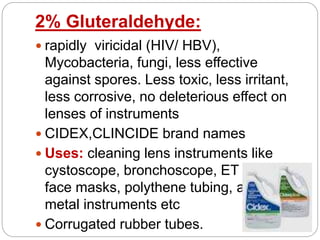
2% Gluteraldehyde:
 rapidly viricidal (HIV/ HBV),
Mycobacteria, fungi, less effective
against spores. Less toxic, less irritant,
less corrosive, no deleterious effect on
lenses of instruments
 CIDEX,CLINCIDE brand names
 Uses: cleaning lens instruments like
cystoscope, bronchoscope, ET tubes,
face masks, polythene tubing, also for
metal instruments etc
 Corrugated rubber tubes.
Orthophthalaldehyde
 Bactericidal activity
 Used to clean endoscopes between patients as it
is quick, effective and safe
 Peracetic acid:
 Good sterilization effect against multidrug
resistant bacteria like MRSA, VRE, & Cl .difficile
 Hypochlorus acid:
 Generated from reverse reaction of Na
hypochlorite & H2O2
 Effective against pathogenic bacteria, especiaaly
biofilm producers
c) Dyes
 Aniline dyes & Acridine dyes
 Mechanism of action: Aniline dyes kills the
bacteria by reaching with acid gr of the cell
 Acridine dyes: impairs DNA complex &
destroy the reproductive capacity of the cell.
 Uses:
 skin/wound antiseptics, selective agents in
media, more active against gram positive
organisms
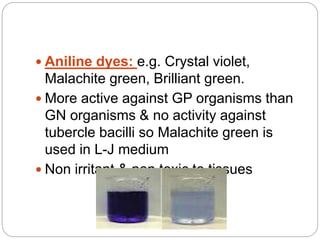
 Aniline dyes: e.g. Crystal violet,
Malachite green, Brilliant green.
 More active against GP organisms than
GN organisms & no activity against
tubercle bacilli so Malachite green is
used in L-J medium
 Non irritant & non toxic to tissues
Acridine dyes:
 e.g. Acraflavine & Proflavin,
euflavin,
 If they impregnated in gauze , they
are slowly released in moist
environment.
 Mode of action: impair the DNA
complex of the organism & prevent
replication
d) Halogens- iodine &
chlorine
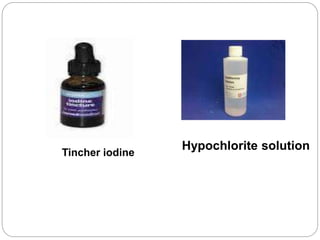
 Iodine : skin disinfectants (tincher iodine),
act against bacteria & viruses, not spores.
2.5% iodine solution : used in ophthalmia
neonaterum
 K iodide (2.5%) & ethanol combination more
effective
 Idophors: PVP (polyvinyl pyrolidone) or
ethoxylate non ionic detergent: free
microbicidal iodine is released from these
compounds
 Povidone iodine: not effective against
Pseudomonas aeruginosa & Bacillus cepecia.
 Chlorine: rapidly bactericidal
 Elemental chlorine (strong oxidizing agent),
hypochlorous acid (HOCl) & hypochlorite ions
(OCl -) are also used
 It is mainly used for purification of water ,
swimming pools, food etc.
 Hypochlorites: active against GP bact & GN
bact also viruses including HIV, HBV, less
effective against mycobacteria
 Non expensive, broad spectrum of activity
 Na Hypochlorite: house hold bleach
 Corrosive to metals, should not be mixed with
acids as it releases large amt of chlorine gas
Tincher iodine
Hypochlorite solution
e) Phenols: phenol, Lysol, cresol,
chorhexidine
 Bactericidal activity: effective against GP bact &
GN bact, less effective on spores & viruses
including HIV, HBV
 Readily absorb through skin & mucus memb, may
cause toxicity
 Lister (1865): father of antiseptic surgery first
used carbolic acid (phenol) for surgery as a
antiseptic solution & showed lower incidence of
post surgical inf
 Mechanism of action: 1) damages cell memb ,
causes cell lysis, 2) pptn of bacterial proteins
causes cell memb damage
 Phenol (carbolic acid): widely used disinfectant
in hospitals. Commonly used compounds are
Lysol & Cresol
 Cresol: used for sterilization of glass wears,
excreta, floor & OT cleaner
 Chloroxylenol: Dettol: used as a antiseptic , not
effective against GN bact
 Chorhexidine (Hibitane): effective against wide
range of bact including Ps.aeruginosa, less toxic,
skin antiseptic & wound dressing
 Uses: burns, wounds, surgical instruments, pre-
op disinfectant.
phenol lysol
Dettol
f) Gases: Ethylene oxide, BPL ,
formaldehyde
 Ethylene oxide gas: colourless liquid with B P
10.7 oC & normal temp & pressure is highly
penetrating gas with sweet ethereal smell. Irritant.
 Highly inflammable & explosive: if it is mixed with
CO2 or N2 its explosive tendencies decreases.
 It removes sulphydryl gr , amino gr, hydroxyl gr,
and carboxyl gr from bact cell (protein mol),
reacts with DNA & RNA causes impairment
 Mutagenic & carcinogenic
 Effective against all type of microorganisms
including viruses & spores.
Uses:
 Sterilization of
 heart-lung machines
 respirators
 Sutures materials
 Dental equipment
 Clothing
 Glass wear, metal, plastics, soil, some
food, tobacco etc
 Unsuitable for fumigation of rooms-
explosive property
Formaldehyde gas
 Widely employed for fumigation of OT & other
rooms
 Gas is generated by adding 150 gm of
KMnO4 to 280 ml of formalin for every 1000
cu.ft. of room volume
 Reaction generates considerable heat &
formaldehyde vapors are generated
 The doors & windows should be closed before
fumigation & remain unopened for next 48 hrs
Betapropiolactone gas
 Condensation product of ketane &
formaldehyde
 Low penetrating power, but efficient
fumigator
 Used for sterilization of biological
products
 Kills all organisms including viruses
 Carcinogenic
Low temperature steam (sterilizer)
formaldehyde
(LTSF)
 Steam at sub atmospheric pressure kills
spores of thermophilic bacilli (Bacillus
stearothermophilus)
 Saturated steam under pressure of 263
mm Hg , temp 73o C
 Hydrogen Peroxide fogging (H2O2):
 Bactericidal
 Oxidizes the cell wall of the organism
Oxidizing agent:
H2O2 (hydrogen peroxide)
 Kills all micro organisms including
spores at higher conc, fugicidal, viricidal,
mycobactericidal
 Uses: plastic implants, contact lenses,
surgical prostheses
 Gas is created in a special chamber/ in
fogging machine
 Process is not effective below 42oC
 Advantages: short cycle time & non toxic
g) Surface active agents
 Reduces surface tension : detergents ,
emulsifiers
 Classified into 4 grs : anionic, cationic, non-ionic
& amphoteric
 Mechanism of action: act on phosphate gr of
cell memb & enter into the cell. Memb looses its
semi-permeability & proteins are denatured
 Cationic compounds : quaternary ammonium
compounds : bactericidal, mostly against GP bact
than GN bact. No action on spores, mycobacteria
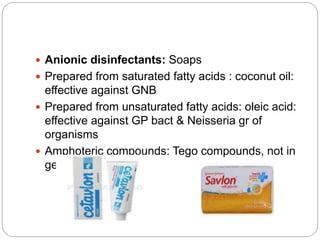
 Cetavlon /Cetrimide: acetyl trimethyl ammonium
bromide
 Anionic disinfectants: Soaps
 Prepared from saturated fatty acids : coconut oil:
effective against GNB
 Prepared from unsaturated fatty acids: oleic acid:
effective against GP bact & Neisseria gr of
organisms
 Amphoteric compounds: Tego compounds, not in
general use
Metallic salts
 Germicidal action depends on their conc, salt of
heavy metals have greater action
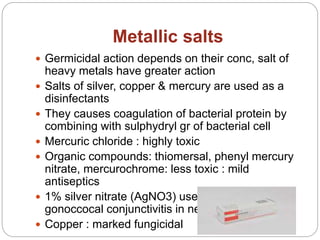
 Salts of silver, copper & mercury are used as a
disinfectants
 They causes coagulation of bacterial protein by
combining with sulphydryl gr of bacterial cell
 Mercuric chloride : highly toxic
 Organic compounds: thiomersal, phenyl mercury
nitrate, mercurochrome: less toxic : mild
antiseptics
 1% silver nitrate (AgNO3) used for burns &
gonoccocal conjunctivitis in newborn
 Copper : marked fungicidal
Plasma sterilizers
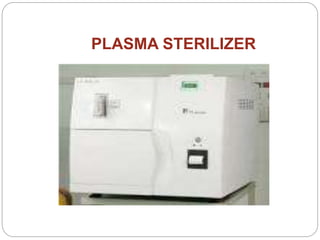
 Plasma : known as fourth state of
matter, consist of ions, electrons &
neutral particals
 Radio friquency energy is applied to
create electromagnetic field, into this
H2O2 fumes are introduced
 Generating free radicals of H2 & O2
 Sterilizes the articles.
PLASMA STERILIZER
Testing of disinfectants
 Rideal Walkar Test: suspension
containing equal no of typhid bacilli are
submitted to varying conc of phenol.
 Chick Martin Test : 3% dried yeast or
human faeces suspension in water is
tested with disinfectant
Stearilization  ii

Stearilization ii

  • 1.
    Dr.V.S.Vatkar Asso Prof Microbiology Department DY Patil Medical College, Kolhapur STEARILIZATION –II CHEMICAL AGENTS
  • 2.
    CHEMICAL AGENTS (DISINFECTANTS)  Definition:The process of destruction of vegetative forms of pathogenic organisms is known as Disinfection.  Properties of disinfectant: Ideal antiseptic/disinfectant  Wide spectrum of activity (effective against all microbes)  Fast action & high penetration power  Stable, non toxic, non irritant, safe & easy to use  Be effective in acidic or alkaline medium  Be active in presence of organic mater  Compatible with other agents , cheap & easily
  • 3.
    Factors which determinespotency of disinfectant  Concentration  Time of action (contact period)  Nature of the organism  pH of the medium  Temperature  Presence of extraneous material
  • 4.
    Chemical agents  Alcohols Aldehydes  Dyes: aniline & acridine dyes  Halogens: iodine, chlorine  Phenols: carbolic acid  Gases: ethylene oxide, formaldehyde, BPL, H2O2 fogging  Surface active agents  Metallic salts
  • 5.
    Mode of actionof disinfectants  Protein coagulation  Disruption of cell membrane, causes damage or loss of cell content  Removal of free sulphydryl gr essential for the functioning of the enz & life of cell  Substrate competition: compound resembles like a essential substrate of enz which misleads the metabolism of the cell
  • 6.
    a) ALCOHOLS  Commonlyused: 70% isopropyl alcohol, methyl alcohol, ethyl alcohol (ethanol)  Have poor penetrating power : must not be used in heavily soiled organic matter  Mechanism of action:  Destruction of bacterial cell proteins (denaturation of bacterial proteins)  No action on spores & viruses  Action enhances in presence of water (70% alc – more effective than 90% alc)
  • 7.
    Uses:  Skin antiseptics:ethyl alc & isopropyl alc (60-90% conc in water)  Isopropyl alc: preferred - better fat solvent & has more bactericidal capacity, disinfection of clinical thermometers  Fungal spores: methyl alc is effective (toxic & inflammable)  Incubators & cabinets are cleaned with methyl alc
  • 8.
    b) Aldehydes:active againstamino gr in protein mol  Commonly used: formaldehyde, 2% gluteraldehyde  Formaldehyde: bactericidal & sporicidal, lethal effects on viruses, used to preserve specimens, formaldehyde gas used for sterilization of instruments, fumigation of wards, OTs etc.  gas is irritant & toxic  Woolen blankets, wool & hide kills spores including anthrax spores  Anesthetic machine , baby incubators, lab cabinets.  40% formaldehyde is used for sterilization.  Low penetrating power under dry condition & increases in moist condition. Achieved by
  • 9.
    2% Gluteraldehyde:  rapidlyviricidal (HIV/ HBV), Mycobacteria, fungi, less effective against spores. Less toxic, less irritant, less corrosive, no deleterious effect on lenses of instruments  CIDEX,CLINCIDE brand names  Uses: cleaning lens instruments like cystoscope, bronchoscope, ET tubes, face masks, polythene tubing, also for metal instruments etc  Corrugated rubber tubes.
  • 10.
    Orthophthalaldehyde  Bactericidal activity Used to clean endoscopes between patients as it is quick, effective and safe  Peracetic acid:  Good sterilization effect against multidrug resistant bacteria like MRSA, VRE, & Cl .difficile  Hypochlorus acid:  Generated from reverse reaction of Na hypochlorite & H2O2  Effective against pathogenic bacteria, especiaaly biofilm producers
  • 11.
    c) Dyes  Anilinedyes & Acridine dyes  Mechanism of action: Aniline dyes kills the bacteria by reaching with acid gr of the cell  Acridine dyes: impairs DNA complex & destroy the reproductive capacity of the cell.  Uses:  skin/wound antiseptics, selective agents in media, more active against gram positive organisms
  • 12.
     Aniline dyes:e.g. Crystal violet, Malachite green, Brilliant green.  More active against GP organisms than GN organisms & no activity against tubercle bacilli so Malachite green is used in L-J medium  Non irritant & non toxic to tissues
  • 13.
    Acridine dyes:  e.g.Acraflavine & Proflavin, euflavin,  If they impregnated in gauze , they are slowly released in moist environment.  Mode of action: impair the DNA complex of the organism & prevent replication
  • 14.
    d) Halogens- iodine& chlorine  Iodine : skin disinfectants (tincher iodine), act against bacteria & viruses, not spores. 2.5% iodine solution : used in ophthalmia neonaterum  K iodide (2.5%) & ethanol combination more effective  Idophors: PVP (polyvinyl pyrolidone) or ethoxylate non ionic detergent: free microbicidal iodine is released from these compounds  Povidone iodine: not effective against Pseudomonas aeruginosa & Bacillus cepecia.
  • 15.
     Chlorine: rapidlybactericidal  Elemental chlorine (strong oxidizing agent), hypochlorous acid (HOCl) & hypochlorite ions (OCl -) are also used  It is mainly used for purification of water , swimming pools, food etc.  Hypochlorites: active against GP bact & GN bact also viruses including HIV, HBV, less effective against mycobacteria  Non expensive, broad spectrum of activity  Na Hypochlorite: house hold bleach  Corrosive to metals, should not be mixed with acids as it releases large amt of chlorine gas
  • 16.
  • 17.
    e) Phenols: phenol,Lysol, cresol, chorhexidine  Bactericidal activity: effective against GP bact & GN bact, less effective on spores & viruses including HIV, HBV  Readily absorb through skin & mucus memb, may cause toxicity  Lister (1865): father of antiseptic surgery first used carbolic acid (phenol) for surgery as a antiseptic solution & showed lower incidence of post surgical inf  Mechanism of action: 1) damages cell memb , causes cell lysis, 2) pptn of bacterial proteins causes cell memb damage
  • 18.
     Phenol (carbolicacid): widely used disinfectant in hospitals. Commonly used compounds are Lysol & Cresol  Cresol: used for sterilization of glass wears, excreta, floor & OT cleaner  Chloroxylenol: Dettol: used as a antiseptic , not effective against GN bact  Chorhexidine (Hibitane): effective against wide range of bact including Ps.aeruginosa, less toxic, skin antiseptic & wound dressing  Uses: burns, wounds, surgical instruments, pre- op disinfectant.
  • 19.
  • 20.
    f) Gases: Ethyleneoxide, BPL , formaldehyde  Ethylene oxide gas: colourless liquid with B P 10.7 oC & normal temp & pressure is highly penetrating gas with sweet ethereal smell. Irritant.  Highly inflammable & explosive: if it is mixed with CO2 or N2 its explosive tendencies decreases.  It removes sulphydryl gr , amino gr, hydroxyl gr, and carboxyl gr from bact cell (protein mol), reacts with DNA & RNA causes impairment  Mutagenic & carcinogenic  Effective against all type of microorganisms including viruses & spores.
  • 21.
    Uses:  Sterilization of heart-lung machines  respirators  Sutures materials  Dental equipment  Clothing  Glass wear, metal, plastics, soil, some food, tobacco etc  Unsuitable for fumigation of rooms- explosive property
  • 22.
    Formaldehyde gas  Widelyemployed for fumigation of OT & other rooms  Gas is generated by adding 150 gm of KMnO4 to 280 ml of formalin for every 1000 cu.ft. of room volume  Reaction generates considerable heat & formaldehyde vapors are generated  The doors & windows should be closed before fumigation & remain unopened for next 48 hrs
  • 23.
    Betapropiolactone gas  Condensationproduct of ketane & formaldehyde  Low penetrating power, but efficient fumigator  Used for sterilization of biological products  Kills all organisms including viruses  Carcinogenic
  • 24.
    Low temperature steam(sterilizer) formaldehyde (LTSF)  Steam at sub atmospheric pressure kills spores of thermophilic bacilli (Bacillus stearothermophilus)  Saturated steam under pressure of 263 mm Hg , temp 73o C  Hydrogen Peroxide fogging (H2O2):  Bactericidal  Oxidizes the cell wall of the organism
  • 25.
    Oxidizing agent: H2O2 (hydrogenperoxide)  Kills all micro organisms including spores at higher conc, fugicidal, viricidal, mycobactericidal  Uses: plastic implants, contact lenses, surgical prostheses  Gas is created in a special chamber/ in fogging machine  Process is not effective below 42oC  Advantages: short cycle time & non toxic
  • 26.
    g) Surface activeagents  Reduces surface tension : detergents , emulsifiers  Classified into 4 grs : anionic, cationic, non-ionic & amphoteric  Mechanism of action: act on phosphate gr of cell memb & enter into the cell. Memb looses its semi-permeability & proteins are denatured  Cationic compounds : quaternary ammonium compounds : bactericidal, mostly against GP bact than GN bact. No action on spores, mycobacteria  Cetavlon /Cetrimide: acetyl trimethyl ammonium bromide
  • 27.
     Anionic disinfectants:Soaps  Prepared from saturated fatty acids : coconut oil: effective against GNB  Prepared from unsaturated fatty acids: oleic acid: effective against GP bact & Neisseria gr of organisms  Amphoteric compounds: Tego compounds, not in general use
  • 28.
    Metallic salts  Germicidalaction depends on their conc, salt of heavy metals have greater action  Salts of silver, copper & mercury are used as a disinfectants  They causes coagulation of bacterial protein by combining with sulphydryl gr of bacterial cell  Mercuric chloride : highly toxic  Organic compounds: thiomersal, phenyl mercury nitrate, mercurochrome: less toxic : mild antiseptics  1% silver nitrate (AgNO3) used for burns & gonoccocal conjunctivitis in newborn  Copper : marked fungicidal
  • 29.
    Plasma sterilizers  Plasma: known as fourth state of matter, consist of ions, electrons & neutral particals  Radio friquency energy is applied to create electromagnetic field, into this H2O2 fumes are introduced  Generating free radicals of H2 & O2  Sterilizes the articles.
  • 30.
  • 31.
    Testing of disinfectants Rideal Walkar Test: suspension containing equal no of typhid bacilli are submitted to varying conc of phenol.  Chick Martin Test : 3% dried yeast or human faeces suspension in water is tested with disinfectant