DR V S VATKAR
Asso Prof
Microbiology Department
D Y Patil Medical College, Kolhapur

Objectives
Classification of fungi
Infections caused by fungi like
superficial mycoses, deep mycoses,
opportunistic mycoses
Mycotoxicoses
Laboratory diagnosis of fungi
Mykos (Greek word): fungus, study of
fungi
Most of the fungi : saprophytes
Human infections : mainly
opportunistic
Widespread use of modern advances in
treatment: antibiotics, steroids &
immunosuppressive agents, leads to
opportunistic fungal infection
Introduction

Eukaryotes
Rigid cell wall: chitin, mannan & other
polysaccharides
Cytoplasmic membrane contains sterols
True nuclei with nuclear membrane & paired
chromosomes
Divide asexually, sexually or by both
May be unicellular/multicellular
Characteristics of fungi

CLASSIFICATION
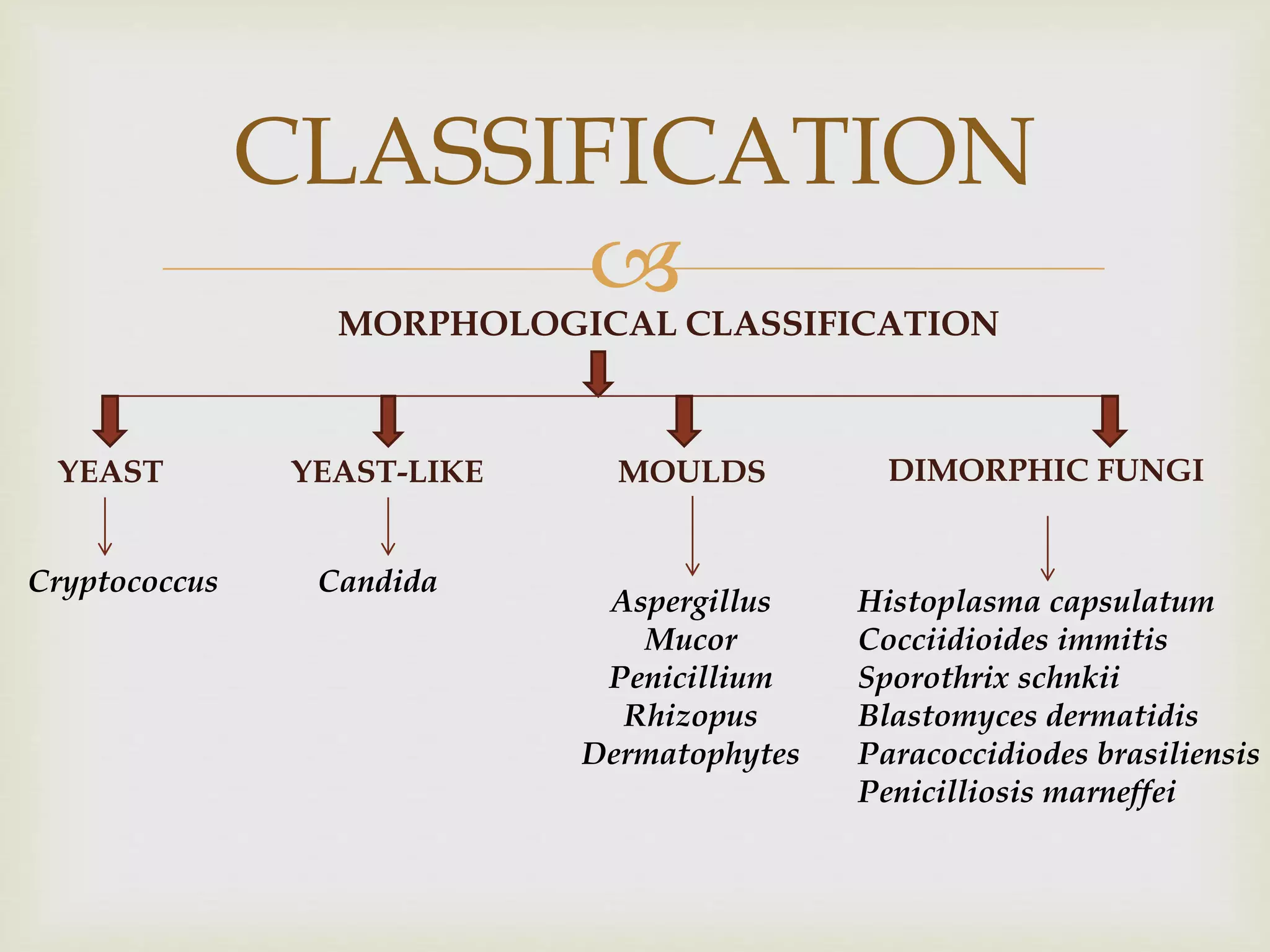
MORPHOLOGICAL CLASSIFICATION
YEAST YEAST-LIKE MOULDS DIMORPHIC FUNGI
Cryptococcus Candida
Aspergillus
Mucor
Penicillium
Rhizopus
Dermatophytes
Histoplasma capsulatum
Cocciidioides immitis
Sporothrix schnkii
Blastomyces dermatidis
Paracoccidiodes brasiliensis
Penicilliosis marneffei

Morphological Classification
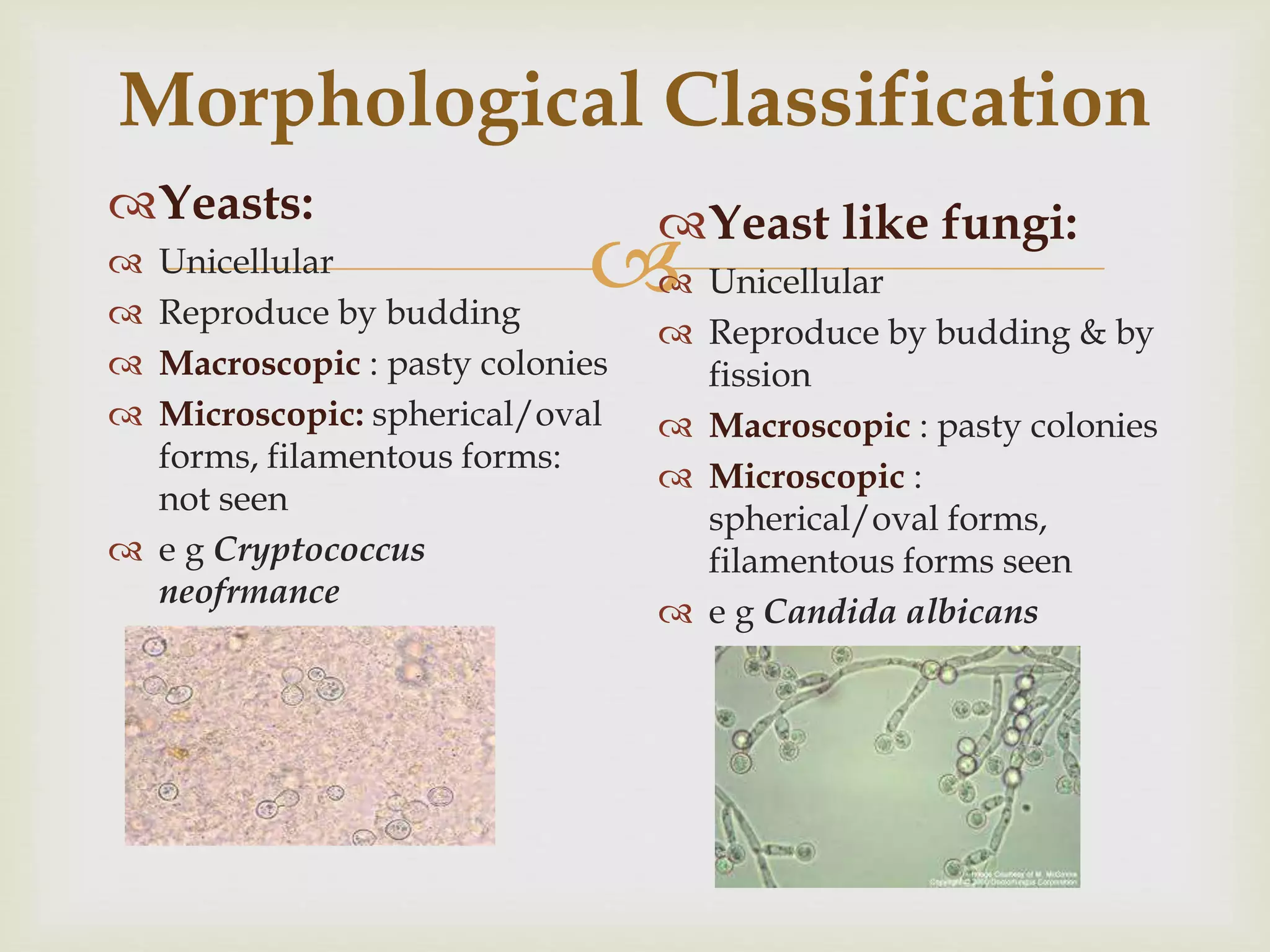
Yeasts:
 Unicellular
 Reproduce by budding
 Macroscopic : pasty colonies
 Microscopic: spherical/oval
forms, filamentous forms:
not seen
 e g Cryptococcus
neofrmance
Yeast like fungi:
 Unicellular
 Reproduce by budding & by
fission
 Macroscopic : pasty colonies
 Microscopic :
spherical/oval forms,
filamentous forms seen
 e g Candida albicans

Morphological Classification
 Filamentous fungi/Moulds:
 Hyphae: septe (cross walls,
multicellular) or aseptate
(coenocytic)
 Reproduction: asexual: spore
formation (some exhibit sexual
reproduction)
 Macroscopic:
cottony/woolly/velvety/granu
lar, pigmentation on the reverse
 Microscopic: thread like
filamentous hyphae aseptate
or septate.
 Mycelium : vegetative/arial
& shapes like racquet,
nodular, pectinate , spiral,
root-like etc
 e g Aspergillus fumigatus,
Penicillium, Mucor etc

Thermally Dimorphic fungi:
 Grow as filaments in culture at 22 0 C & in
environment
 yeast forms at 37 0 C
 e g Histoplasma capsulatum
Morphological Classification

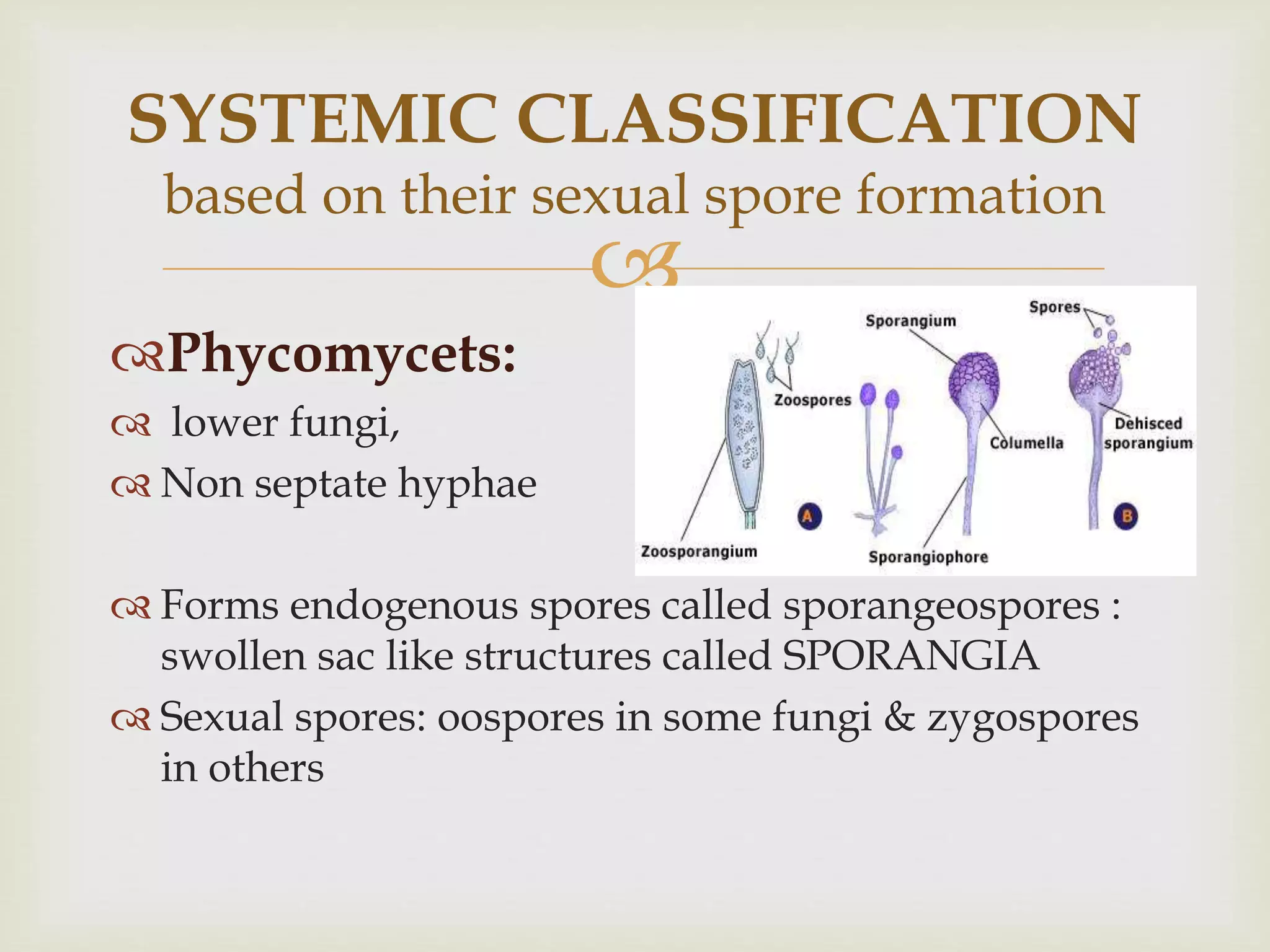
Phycomycets:
 lower fungi,
 Non septate hyphae
 Forms endogenous spores called sporangeospores :
swollen sac like structures called SPORANGIA
 Sexual spores: oospores in some fungi & zygospores
in others
SYSTEMIC CLASSIFICATION
based on their sexual spore formation

Ascomycets:
 Highre fungi
 Sexual spores (ascospores) within a sac
 Includes both filamentous & yeast forms

Basidiomycetes:
 Higher fungi
 Forms sexual spores (basidiospores) on the base/
basidium

Fungi imperfecti:
 Most of the medically important fungi belongs to
this group

Pathogenic classification
Primary pathogenic: causes infection in healthy
person
 e g diamorphic fungi
Opportunistic pathogenic: causes infection in
immunocompromised patients
Superficial mycoses
Cutaneous mycoses
Subcutaneous mycoses
Deep/systemic mycoses
Opportunistic mycoses
Mycotoxicoses: disease produce due to fungal toxins
 Hypersensitivity (allergic reactions): inhalation of fungal
spores
Fungal infections (Mycoses)
Microscopy
Culture
Serology
Skin test
Antifungal susceptibility test
Laboratory Diagnosis

 Collect from affected site : skin scrapings, nail bed
etc
 Disseminated infections: blood
Specimens
Potassium hydroxide (KOH) preparation:
 Tissue specimens like skin scrapings : examined as
wet mount (10% KOH)
 Tissue : kept in KOH for 20 min incubator at 37 0 C,
for affected nail samples 40% KOH is used
 Alkali digest cells & other tissue materials, we can
see fungus clearly
Microscopy

Calcoflour white:
 Sensitive staining technique, good visualization of
fungal morphology
Gram stain: yeast & Yeast like fungus

India ink preparations: Negative staining: to
visualise the capsule of fungus

Methenamine silver stain & Periodic –acid-
schiff (PAS) stain: used to demonstrate fungus in
tissue
Lactophenol cotton blue stain: widely used
method to see morphology
 Most of the fungi grow in media used to grow
bacteria but at low pH
 Grow better at 25-30 0 C except fungi causing
systemic mycoses(37 0 C). Aspergillus fumigatus :
grow even at 50 0C
Media :
Specific medias
Non- Specific medias
Culture

SABOURAUD DEXTROSE agar ,
Sabouraud glucose neopeptone agar
(antibiotics added)
Common culture media
pH 5.4, neutral
Czapek-Dox medium, bird seed agar, Niger
seed agar, corn meal agar
Cyclohexamide : incorporated in it to
prevent contamination by moulds
Cultures : incubated at room temperature (22
0 C) for wk & at 37 0C for days

Growth characteristics
 Rapidity of growth
 Colour & morphology
of the colony on
obverse
 Pigmentation on the
reverse
 Morphology of hypha:
diameter, septa, conidia
etc

Non specific media :
Brain heart infusion agar
Brain heart infusion broth
Blood agar
Teased mount:
 Bit of fungal colony is teased out from culture plate,
 Place a drop of lactophenol cotton blue stain
 Put a cover slip
 View under low power & then focus under high
power
 Proper morphology is difficult to view in teased
mount
Morphological studies can be studied by teased
mount, slide culture & cellophane tape preparation
 Proper morphology of fungus is seen .
 Procedure: sterile glass slide , place it on a bent glass
rod in a petri dish, a 1 cm square block of SDA is
placed on it
 Test strain of fungus is inoculated at four sides of
agar block
 Inoculated block is covered with sterile cover slip
 Incubate it at 25 0 C for 48 hrs
 Take a clean glass slide, put a drop of LCB stain over
it, transfer a cover slip on this slide
 Observe under microscope
Slide Culture

Cellophane tape mount
 Technically easy
Serology:
 Antibody detection: agglutination, Complement
Fixation, Immunodiffusion, CIEP, ELISA
 Antigen detection: Latex agglutination
(Cryptococcus)
Newer rapid diagnostic tests: Nucleic acid
hybridization, PCR

 Infection of dead layer of skin & its appendages
 No inflammatory response
 Cosmetic effects
 Cutaneous Infections
 Dermatophytes mainly causative agents
 Candida
Superficial Mycoses

Pityriasis versicolar (Tinea
versicolar)
 Usually asymptomatic
 Does not beyond stratum
corneum layer of skin
 World wide distribution
 Prevalent in torpics
 Seen in young adults
mainly
 Causitive agent :
Malassezia furfur
 C/F: confluent macular
areas of discolouration or
depigmentation of skin of
chest, abdomen, upper
limbs and back.
 Present on normal skin ,
but opportunistic
pathogen
 Diagnosis: skin scrapings
shows yeast like cells,
short branched filaments,
 Grow on SDA covered
with olive oil
Depigmentation of the skin

Tinea nigra
 Infection of stratum
corneum
 Palms
 Black/brownish
macular lesions
 Seen in tropics
 Causative agent:
Exophila werneckii,
Exophila castellanii
 Diagnosis:
 Skin scraping
 Brownish, branched,
septate hyphae and
budding cells
 SDA colonies: grey or
black colonies
Infection of hair
Firm , irregular nodules along the hair shaft
Nodules : composed of fungal elements,
cemented together on the hair shaft
Black piedra : caused by Piedraia hortae
White piedra: caused by Trichosporon
beigelii
Piedra
BLACK PIEDRA
WHITE PIEDRA

Commonly called ringworm or tinea
infection
Infection of keratinised structures like
hair, nail & skin caused by keratophilic
Dermatophytes
 acute or chronic
Dermatophytes

 Characteristics of
dermatophytes:
 Hyaline filamentous
fungi, digest keratin by
producing enzyme
keratinase
 Resistant to
cyclohexamide
 Classified into 3 genera
 Microsporum
 Trichophyton
 Epidermophyton
 Microsporum: M
gypseum, M cannis
 Trichophyton: T rubrum,
T mentagrophytes , t
verrucosum
 Epidermophyton: E
floccosum
 Twice common in males than females
 Tinea barbae (barber’s itch): involves beared area of
face & neck
 Tinea corporis: smooth or non-hairy skin of the body
 Tinea imbricata: found in tropics, extensive
concentric rings papulosquamous scaly patches
 Tinea capitis: affects scalp
 Tinea cruris: affects groin & perineum
 Tinea pedis: (athlet’s foot)
 Tinea manuum: affects hands
 Tinea unguium: affects nails
Clinical aspects
Tinea barbae
Tinea corporis
Tinea cruris
Tinea capitis
Tinea manuum
Tinea pedis
Tinea imbricata
Tinea unguium

Clinical features
Skin lesions: circular,
dry, erythematous, scaly
& itchy
Hair lesions: kerion,
sacrring & alopecia,
 a) Favus: chronic type of
ringworm, dence crusts
(scutula) develop in the
hair follicles leading to
alopecia & scarring
 b) Kerion: severe boggy
lesions with marked
inflammation sometimes
develop on scalp
 Nail lesions:
 deformed, friable,
discolouration
 Accumulation of debris
under the nails

 Mechanism : unclear
 Fungal products : responsible for local inflammation
 Hypersensitivity to fungal Ags: sterile vesicular
lesions, sometimes seen in sites distant from
ringworm lesions,
 These lesions are called as dermatophytidis
 Diagnosis : by clinical features, use of Wood’s lamp
Pathogenicity
Specimen: skin scrapings (from edges of the
lesions), nail & hair clippings(hair plucked from the
scalp)
Microscopy: wet preparation: scrapings from the
lesion is placed in a drop of 10-20% KOH on a slide,
put a cover slip, keep for 10-20 min to digest keratin.
Then observe the slide under the microscope
Laboratory diagnosis

 Hair: plucked hair examined under UV light (Woods
lamp)
 Ectothrix : arthrospores seen surrounding the hair
shaft
 Endothrix: spores : inside the hair shaft
 Specimen : inoculated on SDA containing
Chloramphenicol or SDA with chloramphenicol &
cycloheximide
 Incubated aerobically at 25-30 0 C upto 21 days
 identification by macroscopic & microscopic appearance
of fungal colonies
 Trichophyton: powdery, velvety or waxy with
pigmentation
 Microsporum: cotton like, velvety or powdery with white
to brown pigmenation
 Epidermophyton: powdery greenish or yellow colonies
Culture

Trichophyton: Microconidia abundant, scanty
Macroconidia: thin, elongated , blunt ends, spiral
hyphae, racquet mycelium, affects hair, nail & skin
Microsporum: scany microconidia,
Macroconidia: spore form, large, arranged singly on
the end of hyphae, affects hair & skin
Epidermophyton: powdery & greenish yellow,
microconidia : absent, Macroconidia: pear shaped,
arranged in clusters, affects skin & nails
Microscopic examination

Species identification: physiological
tests
Hydrolyses urea
Grow on polished rice grains
Special amino acids & vitamins can be
tested
Antigen detection: hypersensitivity test
(trichophytin)
Mild infection : topical imidazole
Severe infections: griseofulvin orally 4-6 wks
Hair : 3-6 mnths treatment
Nails: upto 1 year
Alternative treatment: oral imedazole like
ketoconazole 200 mg b d daily or itraconazole
100 mg od daily, fluconazole 150 mg od daily
Treatment
Human : main host for Anthrophilic
dermatophytes e g Tricophyton rubrum,
Microsporum audouinii, Epidermophyton
floccosum
Zoophilic: affects animals e g T.
verrucosum, M cannis in dogs
Geophilic: naturally in soil, less
pathogenic for human e g M gypseum
Epidemiology & Prevention

Personal cleanliness
 avoid contact with infectious
material
Proper treatment
THANK YOU

Mycology i

  • 1.
    DR V SVATKAR Asso Prof Microbiology Department D Y Patil Medical College, Kolhapur
  • 2.
     Objectives Classification of fungi Infectionscaused by fungi like superficial mycoses, deep mycoses, opportunistic mycoses Mycotoxicoses Laboratory diagnosis of fungi
  • 3.
    Mykos (Greek word):fungus, study of fungi Most of the fungi : saprophytes Human infections : mainly opportunistic Widespread use of modern advances in treatment: antibiotics, steroids & immunosuppressive agents, leads to opportunistic fungal infection Introduction
  • 4.
     Eukaryotes Rigid cell wall:chitin, mannan & other polysaccharides Cytoplasmic membrane contains sterols True nuclei with nuclear membrane & paired chromosomes Divide asexually, sexually or by both May be unicellular/multicellular Characteristics of fungi
  • 5.
     CLASSIFICATION MORPHOLOGICAL CLASSIFICATION YEAST YEAST-LIKEMOULDS DIMORPHIC FUNGI Cryptococcus Candida Aspergillus Mucor Penicillium Rhizopus Dermatophytes Histoplasma capsulatum Cocciidioides immitis Sporothrix schnkii Blastomyces dermatidis Paracoccidiodes brasiliensis Penicilliosis marneffei
  • 6.
     Morphological Classification Yeasts:  Unicellular Reproduce by budding  Macroscopic : pasty colonies  Microscopic: spherical/oval forms, filamentous forms: not seen  e g Cryptococcus neofrmance Yeast like fungi:  Unicellular  Reproduce by budding & by fission  Macroscopic : pasty colonies  Microscopic : spherical/oval forms, filamentous forms seen  e g Candida albicans
  • 7.
     Morphological Classification  Filamentousfungi/Moulds:  Hyphae: septe (cross walls, multicellular) or aseptate (coenocytic)  Reproduction: asexual: spore formation (some exhibit sexual reproduction)  Macroscopic: cottony/woolly/velvety/granu lar, pigmentation on the reverse  Microscopic: thread like filamentous hyphae aseptate or septate.  Mycelium : vegetative/arial & shapes like racquet, nodular, pectinate , spiral, root-like etc  e g Aspergillus fumigatus, Penicillium, Mucor etc
  • 9.
     Thermally Dimorphic fungi: Grow as filaments in culture at 22 0 C & in environment  yeast forms at 37 0 C  e g Histoplasma capsulatum Morphological Classification
  • 11.
     Phycomycets:  lower fungi, Non septate hyphae  Forms endogenous spores called sporangeospores : swollen sac like structures called SPORANGIA  Sexual spores: oospores in some fungi & zygospores in others SYSTEMIC CLASSIFICATION based on their sexual spore formation
  • 12.
     Ascomycets:  Highre fungi Sexual spores (ascospores) within a sac  Includes both filamentous & yeast forms
  • 13.
     Basidiomycetes:  Higher fungi Forms sexual spores (basidiospores) on the base/ basidium
  • 14.
     Fungi imperfecti:  Mostof the medically important fungi belongs to this group
  • 17.
     Pathogenic classification Primary pathogenic:causes infection in healthy person  e g diamorphic fungi Opportunistic pathogenic: causes infection in immunocompromised patients
  • 18.
    Superficial mycoses Cutaneous mycoses Subcutaneousmycoses Deep/systemic mycoses Opportunistic mycoses Mycotoxicoses: disease produce due to fungal toxins  Hypersensitivity (allergic reactions): inhalation of fungal spores Fungal infections (Mycoses)
  • 19.
  • 20.
      Collect fromaffected site : skin scrapings, nail bed etc  Disseminated infections: blood Specimens
  • 21.
    Potassium hydroxide (KOH)preparation:  Tissue specimens like skin scrapings : examined as wet mount (10% KOH)  Tissue : kept in KOH for 20 min incubator at 37 0 C, for affected nail samples 40% KOH is used  Alkali digest cells & other tissue materials, we can see fungus clearly Microscopy
  • 22.
     Calcoflour white:  Sensitivestaining technique, good visualization of fungal morphology Gram stain: yeast & Yeast like fungus
  • 23.
     India ink preparations:Negative staining: to visualise the capsule of fungus
  • 24.
     Methenamine silver stain& Periodic –acid- schiff (PAS) stain: used to demonstrate fungus in tissue Lactophenol cotton blue stain: widely used method to see morphology
  • 25.
     Most ofthe fungi grow in media used to grow bacteria but at low pH  Grow better at 25-30 0 C except fungi causing systemic mycoses(37 0 C). Aspergillus fumigatus : grow even at 50 0C Media : Specific medias Non- Specific medias Culture
  • 26.
     SABOURAUD DEXTROSE agar, Sabouraud glucose neopeptone agar (antibiotics added) Common culture media pH 5.4, neutral Czapek-Dox medium, bird seed agar, Niger seed agar, corn meal agar Cyclohexamide : incorporated in it to prevent contamination by moulds Cultures : incubated at room temperature (22 0 C) for wk & at 37 0C for days
  • 27.
     Growth characteristics  Rapidityof growth  Colour & morphology of the colony on obverse  Pigmentation on the reverse  Morphology of hypha: diameter, septa, conidia etc
  • 28.
     Non specific media: Brain heart infusion agar Brain heart infusion broth Blood agar
  • 29.
    Teased mount:  Bitof fungal colony is teased out from culture plate,  Place a drop of lactophenol cotton blue stain  Put a cover slip  View under low power & then focus under high power  Proper morphology is difficult to view in teased mount Morphological studies can be studied by teased mount, slide culture & cellophane tape preparation
  • 30.
     Proper morphologyof fungus is seen .  Procedure: sterile glass slide , place it on a bent glass rod in a petri dish, a 1 cm square block of SDA is placed on it  Test strain of fungus is inoculated at four sides of agar block  Inoculated block is covered with sterile cover slip  Incubate it at 25 0 C for 48 hrs  Take a clean glass slide, put a drop of LCB stain over it, transfer a cover slip on this slide  Observe under microscope Slide Culture
  • 31.
     Cellophane tape mount Technically easy Serology:  Antibody detection: agglutination, Complement Fixation, Immunodiffusion, CIEP, ELISA  Antigen detection: Latex agglutination (Cryptococcus) Newer rapid diagnostic tests: Nucleic acid hybridization, PCR
  • 32.
      Infection ofdead layer of skin & its appendages  No inflammatory response  Cosmetic effects  Cutaneous Infections  Dermatophytes mainly causative agents  Candida Superficial Mycoses
  • 33.
     Pityriasis versicolar (Tinea versicolar) Usually asymptomatic  Does not beyond stratum corneum layer of skin  World wide distribution  Prevalent in torpics  Seen in young adults mainly  Causitive agent : Malassezia furfur  C/F: confluent macular areas of discolouration or depigmentation of skin of chest, abdomen, upper limbs and back.  Present on normal skin , but opportunistic pathogen  Diagnosis: skin scrapings shows yeast like cells, short branched filaments,  Grow on SDA covered with olive oil
  • 34.
  • 35.
     Tinea nigra  Infectionof stratum corneum  Palms  Black/brownish macular lesions  Seen in tropics  Causative agent: Exophila werneckii, Exophila castellanii  Diagnosis:  Skin scraping  Brownish, branched, septate hyphae and budding cells  SDA colonies: grey or black colonies
  • 36.
    Infection of hair Firm, irregular nodules along the hair shaft Nodules : composed of fungal elements, cemented together on the hair shaft Black piedra : caused by Piedraia hortae White piedra: caused by Trichosporon beigelii Piedra
  • 37.
  • 39.
  • 41.
     Commonly called ringwormor tinea infection Infection of keratinised structures like hair, nail & skin caused by keratophilic Dermatophytes  acute or chronic Dermatophytes
  • 42.
      Characteristics of dermatophytes: Hyaline filamentous fungi, digest keratin by producing enzyme keratinase  Resistant to cyclohexamide  Classified into 3 genera  Microsporum  Trichophyton  Epidermophyton  Microsporum: M gypseum, M cannis  Trichophyton: T rubrum, T mentagrophytes , t verrucosum  Epidermophyton: E floccosum
  • 43.
     Twice commonin males than females  Tinea barbae (barber’s itch): involves beared area of face & neck  Tinea corporis: smooth or non-hairy skin of the body  Tinea imbricata: found in tropics, extensive concentric rings papulosquamous scaly patches  Tinea capitis: affects scalp  Tinea cruris: affects groin & perineum  Tinea pedis: (athlet’s foot)  Tinea manuum: affects hands  Tinea unguium: affects nails Clinical aspects
  • 44.
  • 45.
    Tinea manuum Tinea pedis Tineaimbricata Tinea unguium
  • 46.
     Clinical features Skin lesions:circular, dry, erythematous, scaly & itchy Hair lesions: kerion, sacrring & alopecia,  a) Favus: chronic type of ringworm, dence crusts (scutula) develop in the hair follicles leading to alopecia & scarring  b) Kerion: severe boggy lesions with marked inflammation sometimes develop on scalp  Nail lesions:  deformed, friable, discolouration  Accumulation of debris under the nails
  • 47.
      Mechanism :unclear  Fungal products : responsible for local inflammation  Hypersensitivity to fungal Ags: sterile vesicular lesions, sometimes seen in sites distant from ringworm lesions,  These lesions are called as dermatophytidis  Diagnosis : by clinical features, use of Wood’s lamp Pathogenicity
  • 48.
    Specimen: skin scrapings(from edges of the lesions), nail & hair clippings(hair plucked from the scalp) Microscopy: wet preparation: scrapings from the lesion is placed in a drop of 10-20% KOH on a slide, put a cover slip, keep for 10-20 min to digest keratin. Then observe the slide under the microscope Laboratory diagnosis
  • 49.
      Hair: pluckedhair examined under UV light (Woods lamp)  Ectothrix : arthrospores seen surrounding the hair shaft  Endothrix: spores : inside the hair shaft
  • 50.
     Specimen :inoculated on SDA containing Chloramphenicol or SDA with chloramphenicol & cycloheximide  Incubated aerobically at 25-30 0 C upto 21 days  identification by macroscopic & microscopic appearance of fungal colonies  Trichophyton: powdery, velvety or waxy with pigmentation  Microsporum: cotton like, velvety or powdery with white to brown pigmenation  Epidermophyton: powdery greenish or yellow colonies Culture
  • 52.
     Trichophyton: Microconidia abundant,scanty Macroconidia: thin, elongated , blunt ends, spiral hyphae, racquet mycelium, affects hair, nail & skin Microsporum: scany microconidia, Macroconidia: spore form, large, arranged singly on the end of hyphae, affects hair & skin Epidermophyton: powdery & greenish yellow, microconidia : absent, Macroconidia: pear shaped, arranged in clusters, affects skin & nails Microscopic examination
  • 56.
     Species identification: physiological tests Hydrolysesurea Grow on polished rice grains Special amino acids & vitamins can be tested Antigen detection: hypersensitivity test (trichophytin)
  • 57.
    Mild infection :topical imidazole Severe infections: griseofulvin orally 4-6 wks Hair : 3-6 mnths treatment Nails: upto 1 year Alternative treatment: oral imedazole like ketoconazole 200 mg b d daily or itraconazole 100 mg od daily, fluconazole 150 mg od daily Treatment
  • 58.
    Human : mainhost for Anthrophilic dermatophytes e g Tricophyton rubrum, Microsporum audouinii, Epidermophyton floccosum Zoophilic: affects animals e g T. verrucosum, M cannis in dogs Geophilic: naturally in soil, less pathogenic for human e g M gypseum Epidemiology & Prevention
  • 59.
     Personal cleanliness  avoidcontact with infectious material Proper treatment
  • 60.