SCGH CME ICD / Pacemaker Talk
Darren Bond - Medtronic
29th Jan 2015
Objectives
• Discuss common reasons for ED
checks and outcomes

• Show a device interrogation
• Go through magnet operation for
ICD and PPM’s
• Give overview of CareLink Express
(CLE) status in WA
• What's new
o MRI devices
o Injectable loop recorders
o Leadless pacemakers
Common Reasons for Device Checks in ED
• Syncope – 100% get the device checked
• Palpitation
• Device Beeping
• Shock from their device (include Pseudo shocks)
• Pacing spikes where they shouldn’t be
• Patient feeling unwell
• Pseudo malfuctions
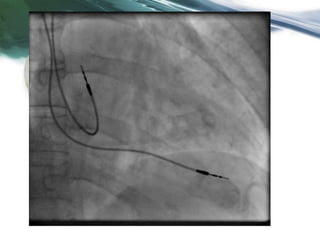
Device interrogation
• Pacemaker
• Loop
• ICD
Pseudomalfunctions
• ECG findings that appear to result from pacemaker
malfunction but that represent normal pacemaker function
• Defined as Unusual, Unexpected, Eccentric
Pseudomalfunctions
Rate
Rate Changes May Occur Due to Normal Device Operation:
• Magnet operation
• Timing variations (A-A versus V-V timing)
• Upper rate behavior (Pseudo-Wenckebach; 2:1 block)
• Electrical reset (may occur due to exposure to electromagnetic interference (EMI) –
e.g., electrocautery, defibrillation, causing reversion to a “back-up” mode)
• Battery depletion
• Device intervention algorithms (PMT, NCAP, PMOP, etc.)
• Rate response
• Therapy (Hysteresis, Rate drop response, Mode switching, MVP, etc.)
Pseudomalfunctions
Rate
Rate Changes May Occur Due to Normal Device Operation:
• Magnet operation
• Timing variations (A-A versus V-V timing)
• Upper rate behavior (Pseudo-Wenckebach; 2:1 block)
• Electrical reset (may occur due to exposure to electromagnetic interference (EMI) –
e.g., electrocautery, defibrillation, causing reversion to a “back-up” mode)
• Battery depletion
• Device intervention algorithms (PMT, NCAP, PMOP, etc.)
• Rate response
• Therapy (Hysteresis, Rate drop response, Mode switching, MVP, etc.)
Pseudomalfunctions
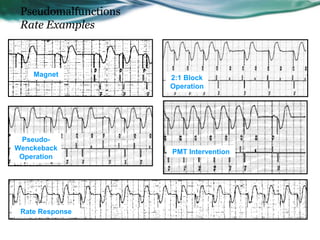
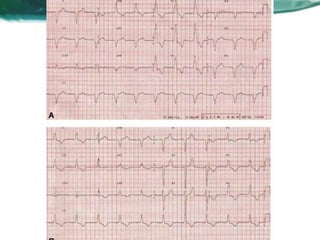
Rate Examples
Magnet
Pseudo-
Wenckeback
Operation
2:1 Block
Operation
PMT Intervention
Rate Response
Pseudomalfunctions:
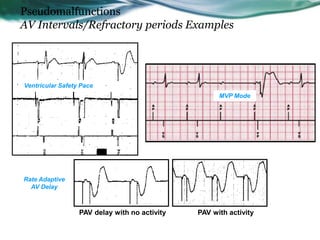
• May appear anomalous due to:
o MVP Mode
o Safety pacing
o Blanking
o Rate-adaptive AV delay
o Sensor-varied PVARP
o PVC response
o Noncompetitive atrial pace (NCAP)
Pseudomalfunctions
AV Intervals/Refractory periods Examples
Ventricular Safety Pace
MVP Mode
PAV delay with no activity PAV with activity
Rate Adaptive
AV Delay
Pseudomalfunctions
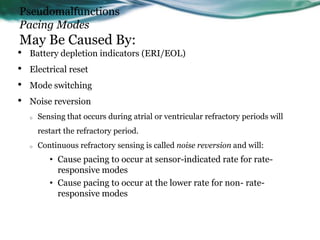
Pacing Modes
May Be Caused By:
• Battery depletion indicators (ERI/EOL)
• Electrical reset
• Mode switching
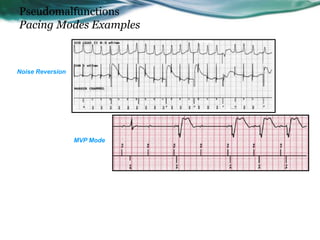
• Noise reversion
o Sensing that occurs during atrial or ventricular refractory periods will
restart the refractory period.
o Continuous refractory sensing is called noise reversion and will:
• Cause pacing to occur at sensor-indicated rate for rate-
responsive modes
• Cause pacing to occur at the lower rate for non- rate-
responsive modes
Pseudomalfunctions
Pacing Modes Examples
Noise Reversion
MVP Mode
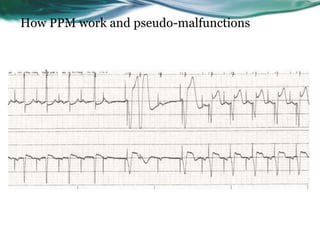
How PPM work and pseudo-malfunctions
Magnet Application on Medtronic Devices
Magnet Effect: Medtronic Pacemaker
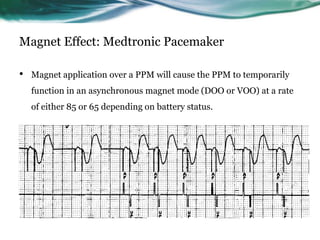
• Magnet application over a PPM will cause the PPM to temporarily
function in an asynchronous magnet mode (DOO or VOO) at a rate
of either 85 or 65 depending on battery status.
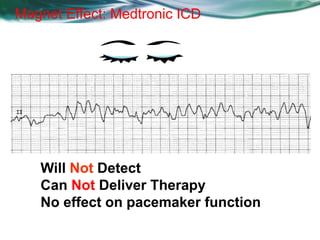
Will Not Detect
Can Not Deliver Therapy
No effect on pacemaker function
Magnet Effect: Medtronic ICD
Magnet Effect on Medtronic ICD
• Results in:
o Temporary suspension of tachycardia detections. ICD will not deliver any
tachycardia or fibrillation therapies.
o NO effect on the pacemaker function of the device.
o Continuous Monitoring of the rhythm is required. If VT or VF develops,
remove the magnet and the device will detect and treat the arrhythmia.
o You may hear a constant tone for 15-30 seconds when the magnet is first
applied. If beeping occurs, the ICD should be checked.
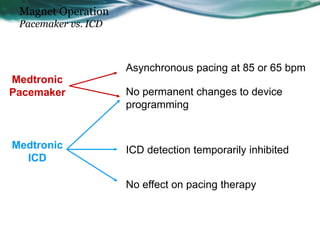
Magnet Operation
Pacemaker vs. ICD
Medtronic
ICD
Medtronic
Pacemaker
Asynchronous pacing at 85 or 65 bpm
ICD detection temporarily inhibited
No permanent changes to device
programming
No effect on pacing therapy
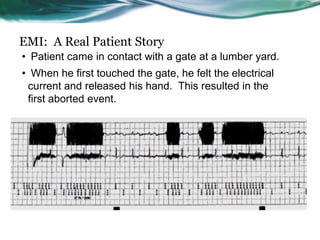
EMI: A Real Patient Story
• Patient came in contact with a gate at a lumber yard.
• When he first touched the gate, he felt the electrical
current and released his hand. This resulted in the
first aborted event.
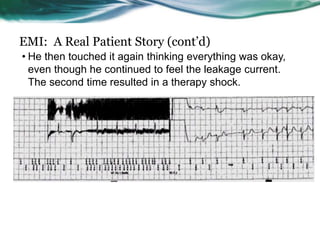
EMI: A Real Patient Story (cont’d)
• He then touched it again thinking everything was okay,
even though he continued to feel the leakage current.
The second time resulted in a therapy shock.
Sources of EMI in Hospitals
• Sources of EMI that may interfere with pacemaker and ICD
operation include surgical/therapeutic equipment such as:
o Electrocautery
o Extracorporeal shock-wave lithotripsy
o MRI
o Therapeutic radiation
o TENS units
o Transthoracic defibrillation
o Tissue Expanders
HRS Consensus: Take Home Messages
• Inactivation of ICD detection is not a universal requirement for all
procedures.
• Rendering PPMs asynchronous in PPM patients is not a universal
requirement of all procedures.
Crossley GH, Poole JE, Rozner MA, et al., “The Heart Rhythm Society (HRS)/American Society of Anesthesiologists (ASA) Expert Consensus
Statement on the Perioperative Management of Patients with Implantable Defibrillators, Pacemakers and Arrhythmia Monitors: Facilities and
Patient Management.” Heart Rhythm, 2011 July; 8(7): 1114-1154
HRS Consensus: Take Home Messages
• Risk of EMI depends on the type of medical procedure as well as
clinical makeup of the patient.
o Bipolar electrosurgery does not cause EMI unless it is applied directly to
the CIED.
o Device reset occurs infrequently with electrosurgery.
o Electrosurgery applied below the umbilicus is much less likely to cause
PPM or ICD interference than when applied above the umbilicus.
o Lead tissue interface damage from external current is considered an
unlikely risk.
Crossley GH, Poole JE, Rozner MA, et al., “The Heart Rhythm Society (HRS)/American Society of Anesthesiologists (ASA) Expert Consensus
Statement on the Perioperative Management of Patients with Implantable Defibrillators, Pacemakers and Arrhythmia Monitors: Facilities and
Patient Management.” Heart Rhythm, 2011 July; 8(7): 1114-1154
“On/Off” Options for ICDs
• If a magnet cannot be used to SUSPEND detections…
–A programmer should be acquired and the detections turned
OFF
–This operation should be confirmed with the Cardiac Health
Provider (written order required)
–The patient should be monitored and connected to an external
defibrillator during the procedure
–Great care must be taken to ensure that the detections are
turned back ON before the patient is unmonitored or leaving
the facility
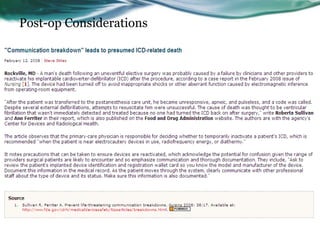
Post-op Considerations
Other Use of Magnet
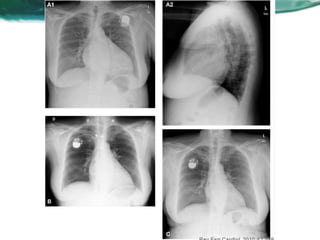
• If a patient is in a pacemaker mediated tachycardia (PMT), placing a
magnet over the dual chamber pacemaker will stop the PMT by
forcing the pacemaker to an asynchronous paced mode.
• The asynchronous pacing mode will eliminate “tracking” of rapid
sensed atrial rhythms into the ventricle (often at the Upper Tracking
Rate) and the pacemaker-generated rhythm will slow
• If an SVT is in progress, the magnet rate will likely have little effect
on the rhythm
Stopping PMT With a Magnet
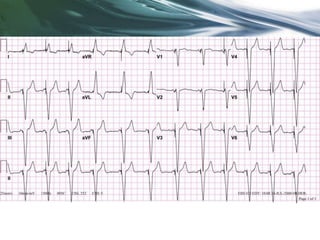
Case Study #1
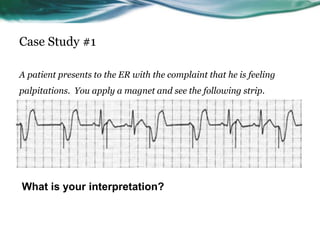
A patient presents to the ER with the complaint that he is feeling
palpitations. You apply a magnet and see the following strip.
What is your interpretation?
Case Study #1
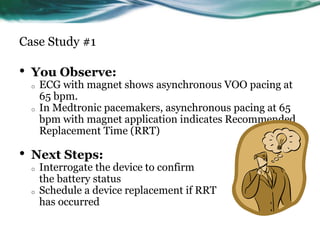
• You Observe:
o ECG with magnet shows asynchronous VOO pacing at
65 bpm.
o In Medtronic pacemakers, asynchronous pacing at 65
bpm with magnet application indicates Recommended
Replacement Time (RRT)
• Next Steps:
o Interrogate the device to confirm
the battery status
o Schedule a device replacement if RRT
has occurred
Case Study #1
• Conclusion:
o Device interrogation reveals a “Device has reached RRT:
Replace Pacer” message confirming the pacemaker battery
status
o Patient is scheduled for a device replacement
o He is also advised to comply with scheduled clinic follow-
ups and CareLink transmissions post-implant
Case Study #2
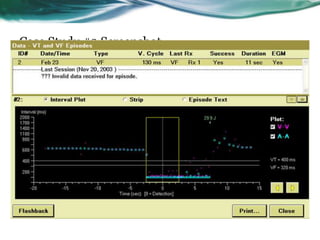
A 64 year old male was implanted with a Marquis DR ICD. You have
been called for a device check after a non-cardiac surgery during
which the patient received a shock via the ICD. During the procedure,
electrocautery was utilized. Patient was in normal sinus rhythm and
hemodynamically stable immediately preceding the ICD therapy.
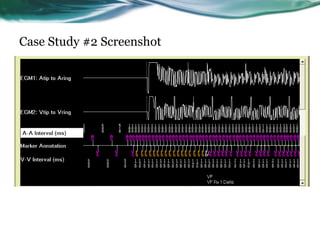
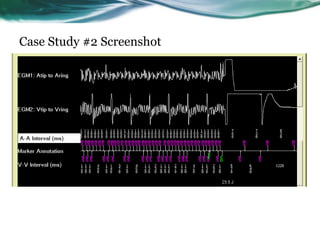
Case Study #2 Screenshot
Case Study #2 Questions
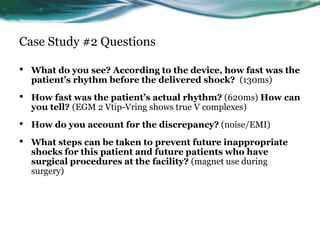
• What do you see? According to the device, how fast was the
patient’s rhythm before the delivered shock? (130ms)
• How fast was the patient’s actual rhythm? (620ms) How can
you tell? (EGM 2 Vtip-Vring shows true V complexes)
• How do you account for the discrepancy? (noise/EMI)
• What steps can be taken to prevent future inappropriate
shocks for this patient and future patients who have
surgical procedures at the facility? (magnet use during
surgery)
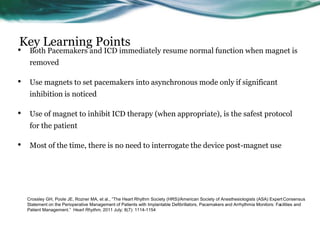
Key Learning Points
• Both Pacemakers and ICD immediately resume normal function when magnet is
removed
• Use magnets to set pacemakers into asynchronous mode only if significant
inhibition is noticed
• Use of magnet to inhibit ICD therapy (when appropriate), is the safest protocol
for the patient
• Most of the time, there is no need to interrogate the device post-magnet use
Crossley GH, Poole JE, Rozner MA, et al., “The Heart Rhythm Society (HRS)/American Society of Anesthesiologists (ASA) Expert Consensus
Statement on the Perioperative Management of Patients with Implantable Defibrillators, Pacemakers and Arrhythmia Monitors: Facilities and
Patient Management.” Heart Rhythm, 2011 July; 8(7): 1114-1154
Carelink Express
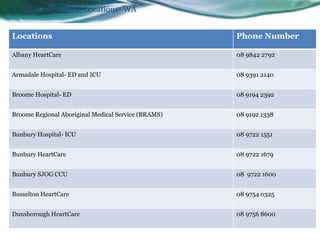
CareLink Express Locations- WA
Locations Phone Number
Albany HeartCare 08 9842 2792
Armadale Hospital- ED and ICU 08 9391 2140
Broome Hospital- ED 08 9194 2392
Broome Regional Aboriginal Medical Service (BRAMS) 08 9192 1338
Bunbury Hospital- ICU 08 9722 1551
Bunbury HeartCare 08 9722 1679
Bunbury SJOG CCU 08 9722 1600
Busselton HeartCare 08 9754 0325
Dunsborough HeartCare 08 9756 8600
Carelink Express
• What it is
• Locations in WA
Locations Phone Number
Albany HeartCare 08 9842 2792
Armadale Hospital- ED and ICU 08 9391 2140
Broome Hospital- ED 08 9194 2392
Broome Regional Aboriginal Medical Service (BRAMS) 08 9192 1338
Bunbury Hospital- ICU 08 9722 1551
Bunbury HeartCare 08 9722 1679
Bunbury SJOG CCU 08 9722 1600
Busselton HeartCare 08 9754 0325
Dunsborough HeartCare 08 9756 8600
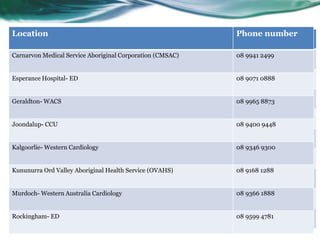
Location Phone number
Carnarvon Medical Service Aboriginal Corporation (CMSAC) 08 9941 2499
Esperance Hospital- ED 08 9071 0888
Geraldton- WACS 08 9965 8873
Joondalup- CCU 08 9400 9448
Kalgoorlie- Western Cardiology 08 9346 9300
Kununurra Ord Valley Aboriginal Health Service (OVAHS) 08 9168 1288
Murdoch- Western Australia Cardiology 08 9366 1888
Rockingham- ED 08 9599 4781
Questions?

Emergency Department ICD and pacemaker issues

  • 1.
    SCGH CME ICD/ Pacemaker Talk Darren Bond - Medtronic 29th Jan 2015
  • 2.
    Objectives • Discuss commonreasons for ED checks and outcomes • Show a device interrogation • Go through magnet operation for ICD and PPM’s • Give overview of CareLink Express (CLE) status in WA • What's new o MRI devices o Injectable loop recorders o Leadless pacemakers
  • 3.
    Common Reasons forDevice Checks in ED • Syncope – 100% get the device checked • Palpitation • Device Beeping • Shock from their device (include Pseudo shocks) • Pacing spikes where they shouldn’t be • Patient feeling unwell • Pseudo malfuctions
  • 4.
  • 5.
    Pseudomalfunctions • ECG findingsthat appear to result from pacemaker malfunction but that represent normal pacemaker function • Defined as Unusual, Unexpected, Eccentric
  • 6.
    Pseudomalfunctions Rate Rate Changes MayOccur Due to Normal Device Operation: • Magnet operation • Timing variations (A-A versus V-V timing) • Upper rate behavior (Pseudo-Wenckebach; 2:1 block) • Electrical reset (may occur due to exposure to electromagnetic interference (EMI) – e.g., electrocautery, defibrillation, causing reversion to a “back-up” mode) • Battery depletion • Device intervention algorithms (PMT, NCAP, PMOP, etc.) • Rate response • Therapy (Hysteresis, Rate drop response, Mode switching, MVP, etc.)
  • 7.
    Pseudomalfunctions Rate Rate Changes MayOccur Due to Normal Device Operation: • Magnet operation • Timing variations (A-A versus V-V timing) • Upper rate behavior (Pseudo-Wenckebach; 2:1 block) • Electrical reset (may occur due to exposure to electromagnetic interference (EMI) – e.g., electrocautery, defibrillation, causing reversion to a “back-up” mode) • Battery depletion • Device intervention algorithms (PMT, NCAP, PMOP, etc.) • Rate response • Therapy (Hysteresis, Rate drop response, Mode switching, MVP, etc.)
  • 8.
  • 9.
    Pseudomalfunctions: • May appearanomalous due to: o MVP Mode o Safety pacing o Blanking o Rate-adaptive AV delay o Sensor-varied PVARP o PVC response o Noncompetitive atrial pace (NCAP)
  • 10.
    Pseudomalfunctions AV Intervals/Refractory periodsExamples Ventricular Safety Pace MVP Mode PAV delay with no activity PAV with activity Rate Adaptive AV Delay
  • 11.
    Pseudomalfunctions Pacing Modes May BeCaused By: • Battery depletion indicators (ERI/EOL) • Electrical reset • Mode switching • Noise reversion o Sensing that occurs during atrial or ventricular refractory periods will restart the refractory period. o Continuous refractory sensing is called noise reversion and will: • Cause pacing to occur at sensor-indicated rate for rate- responsive modes • Cause pacing to occur at the lower rate for non- rate- responsive modes
  • 12.
  • 13.
    How PPM workand pseudo-malfunctions
  • 14.
    Magnet Application onMedtronic Devices
  • 15.
    Magnet Effect: MedtronicPacemaker • Magnet application over a PPM will cause the PPM to temporarily function in an asynchronous magnet mode (DOO or VOO) at a rate of either 85 or 65 depending on battery status.
  • 16.
    Will Not Detect CanNot Deliver Therapy No effect on pacemaker function Magnet Effect: Medtronic ICD
  • 17.
    Magnet Effect onMedtronic ICD • Results in: o Temporary suspension of tachycardia detections. ICD will not deliver any tachycardia or fibrillation therapies. o NO effect on the pacemaker function of the device. o Continuous Monitoring of the rhythm is required. If VT or VF develops, remove the magnet and the device will detect and treat the arrhythmia. o You may hear a constant tone for 15-30 seconds when the magnet is first applied. If beeping occurs, the ICD should be checked.
  • 18.
    Magnet Operation Pacemaker vs.ICD Medtronic ICD Medtronic Pacemaker Asynchronous pacing at 85 or 65 bpm ICD detection temporarily inhibited No permanent changes to device programming No effect on pacing therapy
  • 19.
    EMI: A RealPatient Story • Patient came in contact with a gate at a lumber yard. • When he first touched the gate, he felt the electrical current and released his hand. This resulted in the first aborted event.
  • 20.
    EMI: A RealPatient Story (cont’d) • He then touched it again thinking everything was okay, even though he continued to feel the leakage current. The second time resulted in a therapy shock.
  • 21.
    Sources of EMIin Hospitals • Sources of EMI that may interfere with pacemaker and ICD operation include surgical/therapeutic equipment such as: o Electrocautery o Extracorporeal shock-wave lithotripsy o MRI o Therapeutic radiation o TENS units o Transthoracic defibrillation o Tissue Expanders
  • 22.
    HRS Consensus: TakeHome Messages • Inactivation of ICD detection is not a universal requirement for all procedures. • Rendering PPMs asynchronous in PPM patients is not a universal requirement of all procedures. Crossley GH, Poole JE, Rozner MA, et al., “The Heart Rhythm Society (HRS)/American Society of Anesthesiologists (ASA) Expert Consensus Statement on the Perioperative Management of Patients with Implantable Defibrillators, Pacemakers and Arrhythmia Monitors: Facilities and Patient Management.” Heart Rhythm, 2011 July; 8(7): 1114-1154
  • 23.
    HRS Consensus: TakeHome Messages • Risk of EMI depends on the type of medical procedure as well as clinical makeup of the patient. o Bipolar electrosurgery does not cause EMI unless it is applied directly to the CIED. o Device reset occurs infrequently with electrosurgery. o Electrosurgery applied below the umbilicus is much less likely to cause PPM or ICD interference than when applied above the umbilicus. o Lead tissue interface damage from external current is considered an unlikely risk. Crossley GH, Poole JE, Rozner MA, et al., “The Heart Rhythm Society (HRS)/American Society of Anesthesiologists (ASA) Expert Consensus Statement on the Perioperative Management of Patients with Implantable Defibrillators, Pacemakers and Arrhythmia Monitors: Facilities and Patient Management.” Heart Rhythm, 2011 July; 8(7): 1114-1154
  • 24.
    “On/Off” Options forICDs • If a magnet cannot be used to SUSPEND detections… –A programmer should be acquired and the detections turned OFF –This operation should be confirmed with the Cardiac Health Provider (written order required) –The patient should be monitored and connected to an external defibrillator during the procedure –Great care must be taken to ensure that the detections are turned back ON before the patient is unmonitored or leaving the facility
  • 25.
  • 26.
    Other Use ofMagnet • If a patient is in a pacemaker mediated tachycardia (PMT), placing a magnet over the dual chamber pacemaker will stop the PMT by forcing the pacemaker to an asynchronous paced mode. • The asynchronous pacing mode will eliminate “tracking” of rapid sensed atrial rhythms into the ventricle (often at the Upper Tracking Rate) and the pacemaker-generated rhythm will slow • If an SVT is in progress, the magnet rate will likely have little effect on the rhythm Stopping PMT With a Magnet
  • 27.
    Case Study #1 Apatient presents to the ER with the complaint that he is feeling palpitations. You apply a magnet and see the following strip. What is your interpretation?
  • 28.
    Case Study #1 •You Observe: o ECG with magnet shows asynchronous VOO pacing at 65 bpm. o In Medtronic pacemakers, asynchronous pacing at 65 bpm with magnet application indicates Recommended Replacement Time (RRT) • Next Steps: o Interrogate the device to confirm the battery status o Schedule a device replacement if RRT has occurred
  • 29.
    Case Study #1 •Conclusion: o Device interrogation reveals a “Device has reached RRT: Replace Pacer” message confirming the pacemaker battery status o Patient is scheduled for a device replacement o He is also advised to comply with scheduled clinic follow- ups and CareLink transmissions post-implant
  • 30.
    Case Study #2 A64 year old male was implanted with a Marquis DR ICD. You have been called for a device check after a non-cardiac surgery during which the patient received a shock via the ICD. During the procedure, electrocautery was utilized. Patient was in normal sinus rhythm and hemodynamically stable immediately preceding the ICD therapy.
  • 31.
    Case Study #2Screenshot
  • 32.
    Case Study #2Screenshot
  • 33.
    Case Study #2Screenshot
  • 34.
    Case Study #2Questions • What do you see? According to the device, how fast was the patient’s rhythm before the delivered shock? (130ms) • How fast was the patient’s actual rhythm? (620ms) How can you tell? (EGM 2 Vtip-Vring shows true V complexes) • How do you account for the discrepancy? (noise/EMI) • What steps can be taken to prevent future inappropriate shocks for this patient and future patients who have surgical procedures at the facility? (magnet use during surgery)
  • 35.
    Key Learning Points •Both Pacemakers and ICD immediately resume normal function when magnet is removed • Use magnets to set pacemakers into asynchronous mode only if significant inhibition is noticed • Use of magnet to inhibit ICD therapy (when appropriate), is the safest protocol for the patient • Most of the time, there is no need to interrogate the device post-magnet use Crossley GH, Poole JE, Rozner MA, et al., “The Heart Rhythm Society (HRS)/American Society of Anesthesiologists (ASA) Expert Consensus Statement on the Perioperative Management of Patients with Implantable Defibrillators, Pacemakers and Arrhythmia Monitors: Facilities and Patient Management.” Heart Rhythm, 2011 July; 8(7): 1114-1154
  • 36.
  • 38.
    CareLink Express Locations-WA Locations Phone Number Albany HeartCare 08 9842 2792 Armadale Hospital- ED and ICU 08 9391 2140 Broome Hospital- ED 08 9194 2392 Broome Regional Aboriginal Medical Service (BRAMS) 08 9192 1338 Bunbury Hospital- ICU 08 9722 1551 Bunbury HeartCare 08 9722 1679 Bunbury SJOG CCU 08 9722 1600 Busselton HeartCare 08 9754 0325 Dunsborough HeartCare 08 9756 8600
  • 39.
    Carelink Express • Whatit is • Locations in WA Locations Phone Number Albany HeartCare 08 9842 2792 Armadale Hospital- ED and ICU 08 9391 2140 Broome Hospital- ED 08 9194 2392 Broome Regional Aboriginal Medical Service (BRAMS) 08 9192 1338 Bunbury Hospital- ICU 08 9722 1551 Bunbury HeartCare 08 9722 1679 Bunbury SJOG CCU 08 9722 1600 Busselton HeartCare 08 9754 0325 Dunsborough HeartCare 08 9756 8600 Location Phone number Carnarvon Medical Service Aboriginal Corporation (CMSAC) 08 9941 2499 Esperance Hospital- ED 08 9071 0888 Geraldton- WACS 08 9965 8873 Joondalup- CCU 08 9400 9448 Kalgoorlie- Western Cardiology 08 9346 9300 Kununurra Ord Valley Aboriginal Health Service (OVAHS) 08 9168 1288 Murdoch- Western Australia Cardiology 08 9366 1888 Rockingham- ED 08 9599 4781
  • 44.