Left atrial function -
an overlooked metrics in clinical
routine echocardiography
Dr. Nagula Praveen
Luigi P. Badano*, Sherif F. Nagueh, and Denisa Muraru
European Journal of Heart Failure (2019)
doi:10.1002/ejhf.1475
Left ventricular diastolic dysfunction (LVDD)
• Independent predictor of all-cause mortality even in the pre
clinical stage.
• Required for the diagnosis of HFpEF.
• Cardiac catheterisation - gold standard for evaluation.
• Echocardiography - to rule in or rule out LVDD in patients
with unexplained dyspnoea.
• No single echocardiographic parameter can be used in
isolation to make the diagnosis of LVDD.
Diagnosis of LVDD
• Measurement of LAVs (maximum and minimum)
• LV mass
• E’ velocity
• LV global longitudinal strain can be used to diagnose LVDD
But not
• LV filling pressures ( abnormal values can still be seen in
normal LA pressures)
• Minor elevations in E/e’ <14
• LA strain
Left atrial volume (LAV)
• Provides robust information on the chronicity and the severity of
LVDD.
• Feasible and reproducible marker.
• Superior to other echocardiographic markers.
• Can be normal in early stages of LVDD.
• Can be unreliable in patients with heart failure on therapy.
• In patients with LVDD and normal LV filling pressures,
increased LAV – predicts increased LV filling pressures during
exercise.
Normal LV diastolic function, enlarged LAV
• Bradycardia
• High output states
• Atrial arrhythmias
• Significant mitral valve disease
• Trained athletes
• Three dimensional echocardiography
• Tissue doppler imaging
• Two dimensional speckle tracking measurement of
longitudinal LA strain and strain rate.
Left atrial phasic function assessment
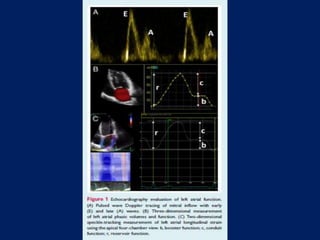
• Assessed by volumetric analysis
• Volumetric LA phasic function can be obtained by measuring
• Maximum (at LV end systole),
• Minimum (at LV end diastole) volumes and
• Pre A (before atrial systole, before electrocardiographic P
wave) volumes
From these volumes,
• total (reservoir phase),
• passive (conduit phase) and
• active (booster phase) emptying LA volumes and fractions can
be derived.
Three dimensional echocardiography
Two dimensional speckle tracking imaging
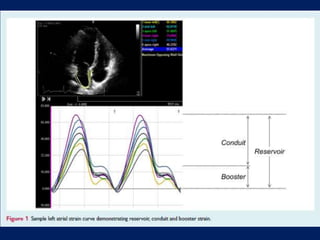
LA strain during
• the reservoir phase (LAS r) = difference of the strain value at
mitral valve opening minus ventricular end – diastole
(positive value)
• the conduit phase (LAScd) = difference of the strain value at
the onset of atrial contraction minus mitral valve opening
(negative value)
• In AF, LAScd = LASr but with a negative sign
• the contraction or booster phase, measured in patients only
in sinus rhythm, difference of the strain value at ventricular
end diastole minus onset of atrial contraction (negative
value).
LA strain
• Left atrial strain globally reflects atrial function, remodelling
and distensbility.
• Represents the cumulative adverse impact of chronically
impaired LV relaxation and end – diastolic viscoelastic
stiffness on the left atrium, which can result in pulmonary
venous hypertension during exercise associated with HFPEF.
Left atrial structure and function in HFPEF
• Accuracy of LA strain in patients with unexplained dyspnoea,
where the diagnosis of HFPEF was definitely confirmed or
refuted using maximal effort invasive exercise assessment.
• LA reservoir strain was highly feasible and demonstrated net
classification improvement when LA reservoir strain was
added to recommended echocardiographic parameters used
to diagnose HFPEF.
• LA stiffness index still added further improvement.
Reddy YN, Obokata M, Egbe A, Yang JH, Pislaru S, Lin G, Carter R, Borlaug BA. Left atrial strain and compliance
in the diagnostic evaluation of heart failure with preserved ejection fraction. Eur J Heart Fail 2019 Mar 28.
doi: 10.1002/ejhf-1464 [Epub ahead of print].
• LA reservoir strain showed a very high specificity (94%) but
a relative low sensitivity (56%) for diagnosis of HFPEF.
Limitations of the study
• Reference used to diagnose HFPEF was exercise wedge pressure (
many patients had normal wedge pressure at rest).
• Echocardiographic markers were obtained only at rest ( change in
exercise cannot be reflected).
• Apart from LV mass, all other measurements are affected by change
in LV preload, afterload and LV relaxation, which change with
exercise.
• Cardiac catheterization and echocardiographic measurements were
not simultaneous (a median delay of 6 days between the two
studies).
• Change in treatment ( blood pressure control or diuretics) can lower
LA wedge pressure – alter echocardiographic indices of LA pressure
(E/e’ ratio and LA strain) – accuracy of these parameters ?
LA reservoir strain finally
• Useful screening tool
• Most logical and reasonably supported recommendation is
to perform the echocardiographic diastolic stress test to
diagnose HFPEF in patients at risk, with unexplained
dyspnoea and predicted normal LV filling pressures at rest
– a similar strategy done in catheterization laboratory.
Conclusion
• LA function metrics provide new insights into the
contribution of the left atrium to overall cardiovascular
performance and to improve our diagnostic capabilities for
conditions like LVDD and HFPEF.
• Predicts prognosis in patients with HFPEF.
• Therapeutic target of the elusive cardiac condition.
Future
• Robust clinical data outcome from large prospective
multicentre trials are needed to confirm the incremental
diagnostic and prognostic power of LA function metrics over
LV function data and conventional echo-doppler function
assessment.
• Age and sex- adjusted normal reference data on a larger scale
is required using the available criteria of LA strain parameters
and LA three dimensional LA volumes.

Left atrial function

  • 1.
    Left atrial function- an overlooked metrics in clinical routine echocardiography Dr. Nagula Praveen Luigi P. Badano*, Sherif F. Nagueh, and Denisa Muraru European Journal of Heart Failure (2019) doi:10.1002/ejhf.1475
  • 2.
    Left ventricular diastolicdysfunction (LVDD) • Independent predictor of all-cause mortality even in the pre clinical stage. • Required for the diagnosis of HFpEF. • Cardiac catheterisation - gold standard for evaluation. • Echocardiography - to rule in or rule out LVDD in patients with unexplained dyspnoea. • No single echocardiographic parameter can be used in isolation to make the diagnosis of LVDD.
  • 3.
    Diagnosis of LVDD •Measurement of LAVs (maximum and minimum) • LV mass • E’ velocity • LV global longitudinal strain can be used to diagnose LVDD But not • LV filling pressures ( abnormal values can still be seen in normal LA pressures) • Minor elevations in E/e’ <14 • LA strain
  • 4.
    Left atrial volume(LAV) • Provides robust information on the chronicity and the severity of LVDD. • Feasible and reproducible marker. • Superior to other echocardiographic markers. • Can be normal in early stages of LVDD. • Can be unreliable in patients with heart failure on therapy. • In patients with LVDD and normal LV filling pressures, increased LAV – predicts increased LV filling pressures during exercise.
  • 5.
    Normal LV diastolicfunction, enlarged LAV • Bradycardia • High output states • Atrial arrhythmias • Significant mitral valve disease • Trained athletes
  • 6.
    • Three dimensionalechocardiography • Tissue doppler imaging • Two dimensional speckle tracking measurement of longitudinal LA strain and strain rate. Left atrial phasic function assessment
  • 7.
    • Assessed byvolumetric analysis • Volumetric LA phasic function can be obtained by measuring • Maximum (at LV end systole), • Minimum (at LV end diastole) volumes and • Pre A (before atrial systole, before electrocardiographic P wave) volumes From these volumes, • total (reservoir phase), • passive (conduit phase) and • active (booster phase) emptying LA volumes and fractions can be derived. Three dimensional echocardiography
  • 9.
    Two dimensional speckletracking imaging LA strain during • the reservoir phase (LAS r) = difference of the strain value at mitral valve opening minus ventricular end – diastole (positive value) • the conduit phase (LAScd) = difference of the strain value at the onset of atrial contraction minus mitral valve opening (negative value) • In AF, LAScd = LASr but with a negative sign • the contraction or booster phase, measured in patients only in sinus rhythm, difference of the strain value at ventricular end diastole minus onset of atrial contraction (negative value).
  • 10.
    LA strain • Leftatrial strain globally reflects atrial function, remodelling and distensbility. • Represents the cumulative adverse impact of chronically impaired LV relaxation and end – diastolic viscoelastic stiffness on the left atrium, which can result in pulmonary venous hypertension during exercise associated with HFPEF.
  • 11.
    Left atrial structureand function in HFPEF • Accuracy of LA strain in patients with unexplained dyspnoea, where the diagnosis of HFPEF was definitely confirmed or refuted using maximal effort invasive exercise assessment. • LA reservoir strain was highly feasible and demonstrated net classification improvement when LA reservoir strain was added to recommended echocardiographic parameters used to diagnose HFPEF. • LA stiffness index still added further improvement. Reddy YN, Obokata M, Egbe A, Yang JH, Pislaru S, Lin G, Carter R, Borlaug BA. Left atrial strain and compliance in the diagnostic evaluation of heart failure with preserved ejection fraction. Eur J Heart Fail 2019 Mar 28. doi: 10.1002/ejhf-1464 [Epub ahead of print].
  • 13.
    • LA reservoirstrain showed a very high specificity (94%) but a relative low sensitivity (56%) for diagnosis of HFPEF.
  • 14.
    Limitations of thestudy • Reference used to diagnose HFPEF was exercise wedge pressure ( many patients had normal wedge pressure at rest). • Echocardiographic markers were obtained only at rest ( change in exercise cannot be reflected). • Apart from LV mass, all other measurements are affected by change in LV preload, afterload and LV relaxation, which change with exercise. • Cardiac catheterization and echocardiographic measurements were not simultaneous (a median delay of 6 days between the two studies). • Change in treatment ( blood pressure control or diuretics) can lower LA wedge pressure – alter echocardiographic indices of LA pressure (E/e’ ratio and LA strain) – accuracy of these parameters ?
  • 15.
    LA reservoir strainfinally • Useful screening tool • Most logical and reasonably supported recommendation is to perform the echocardiographic diastolic stress test to diagnose HFPEF in patients at risk, with unexplained dyspnoea and predicted normal LV filling pressures at rest – a similar strategy done in catheterization laboratory.
  • 16.
    Conclusion • LA functionmetrics provide new insights into the contribution of the left atrium to overall cardiovascular performance and to improve our diagnostic capabilities for conditions like LVDD and HFPEF. • Predicts prognosis in patients with HFPEF. • Therapeutic target of the elusive cardiac condition.
  • 17.
    Future • Robust clinicaldata outcome from large prospective multicentre trials are needed to confirm the incremental diagnostic and prognostic power of LA function metrics over LV function data and conventional echo-doppler function assessment. • Age and sex- adjusted normal reference data on a larger scale is required using the available criteria of LA strain parameters and LA three dimensional LA volumes.