Pacemakers
Pacemakers Pacemakers are the electronic devices that can be used to initiate the heartbeat when the heart’s intrinsic electrical system cannot effectively generate a rate adequate to support cardiac output
Types of Pacemaker Temporary pacemaker Permanent pacemaker
Temporary Pacemaker   Temporary Pacemakers can be used temporarily , either supportively or prophylactically, until the condition responsible for the rate or conduction disturbance resolves .
Indications Bradycardia Sinus bradycardia  and arrest Sick sinus syndrome Heart blocks Tachydysrhythmias Supraventricular Ventricular Permanent pacemaker failure Support cardiac output after cardiac surgery Diagnostic studies Electrophysiological studies Atrial electrogram
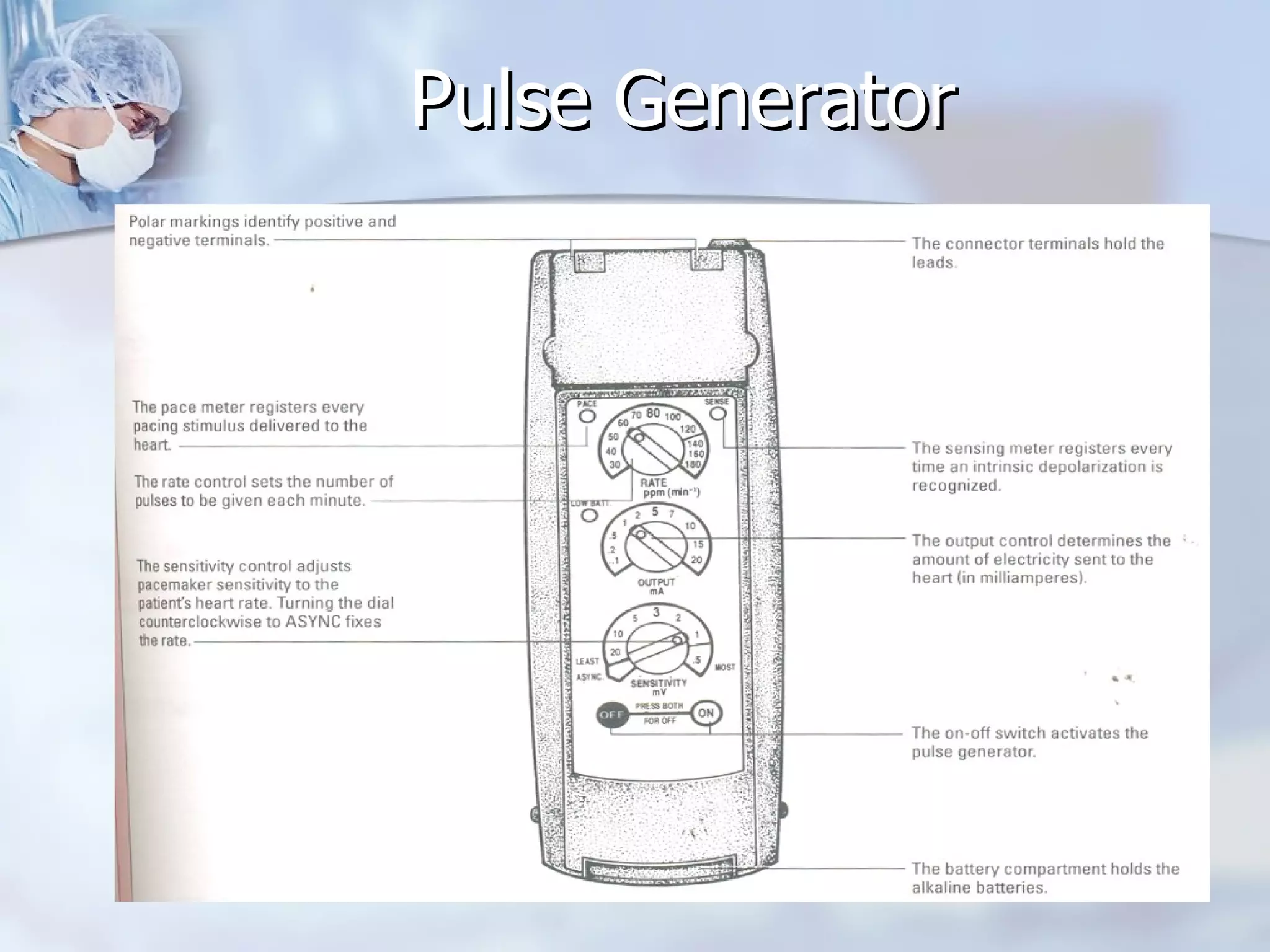
The Pacemaker System A simple electrical circuit consisting of  PULSE GENERATOR PACING LEAD
Pulse Generator
Pacing pulse generator The pulse generator is designed to generate  an electrical current that travels through pacing lead and exits through electrode that is in direct contact with the heart. This electrical current initiates a myocardial depolarization. The power source for a temporary external pulse generator is standard 9-volt alkaline battery inserted into the generator
Pacing Lead System The pacing lead used for temporary pacing may be bipolar or unipolar  Bipolar Pacing System In bipolar pacing system, two electrodes (positive and negative) are located within the heart
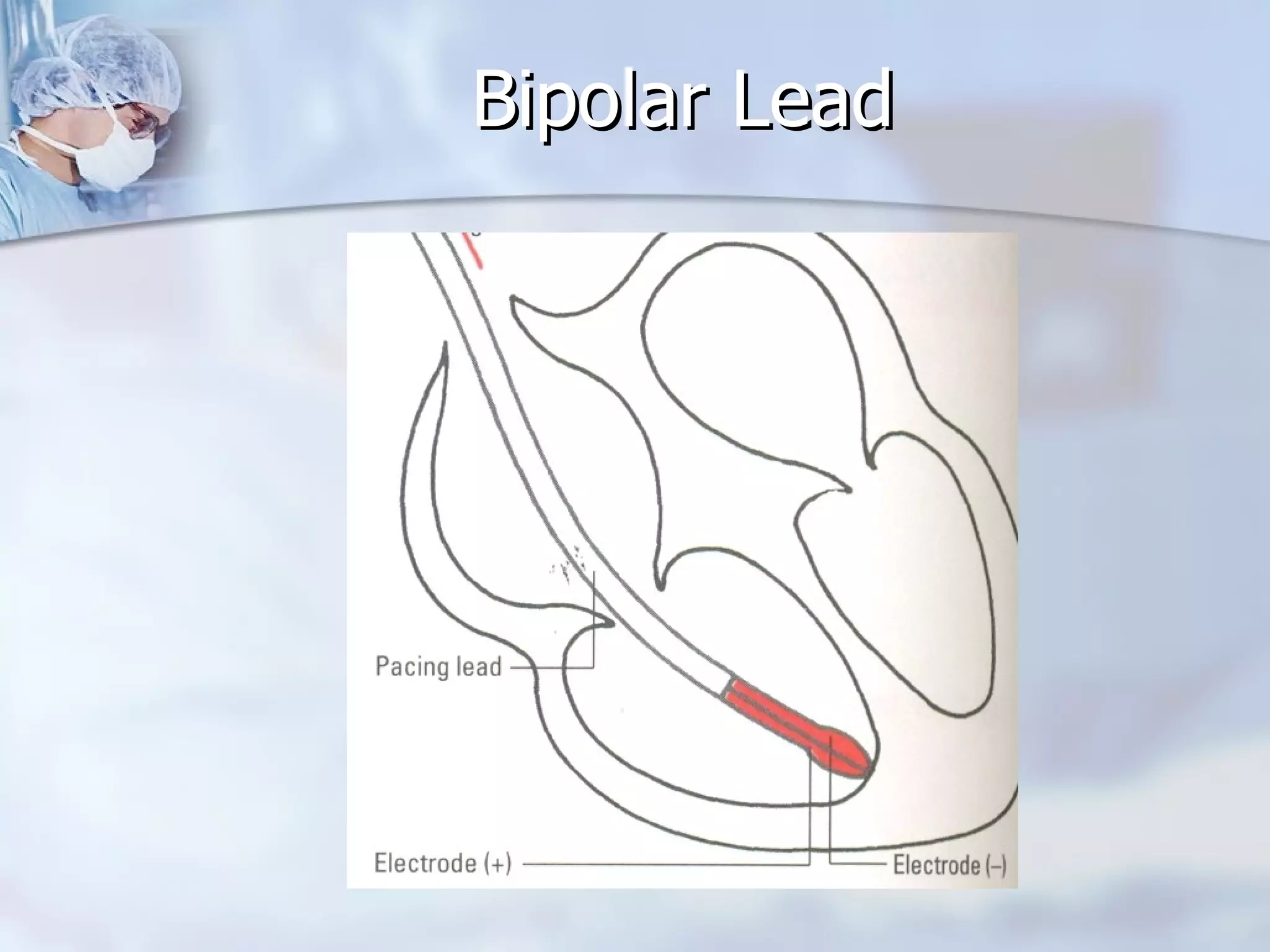
Bipolar Pacing System The bipolar lead used in the transvenous pacing as two electrodes on one catheter. The distal , or negative , electrode is at the tip of the pacing lead and is in the direct contact with the heart, usually inside the right atrium or ventricle.
Bipolar pacing system Approximately 1 cm from the negative electrode is a positive electrode . The negative electrode is attached to the negative terminal, and the positive electrode is attached to the positive terminal of the pulse generator, either directly or via a bridging cable
Bipolar pacing system An epicardial lead system is often used for temporary pacing after cardiac surgery The bipolar epicardial lead system has two separate insulated wires (one negative and one positive) that are loosely secured with sutures to the cardiac chambers to be paced. Both electrodes are in contact with myocardial tissues, so either wire may be use as the negative, or ground electrode
Bipolar Lead
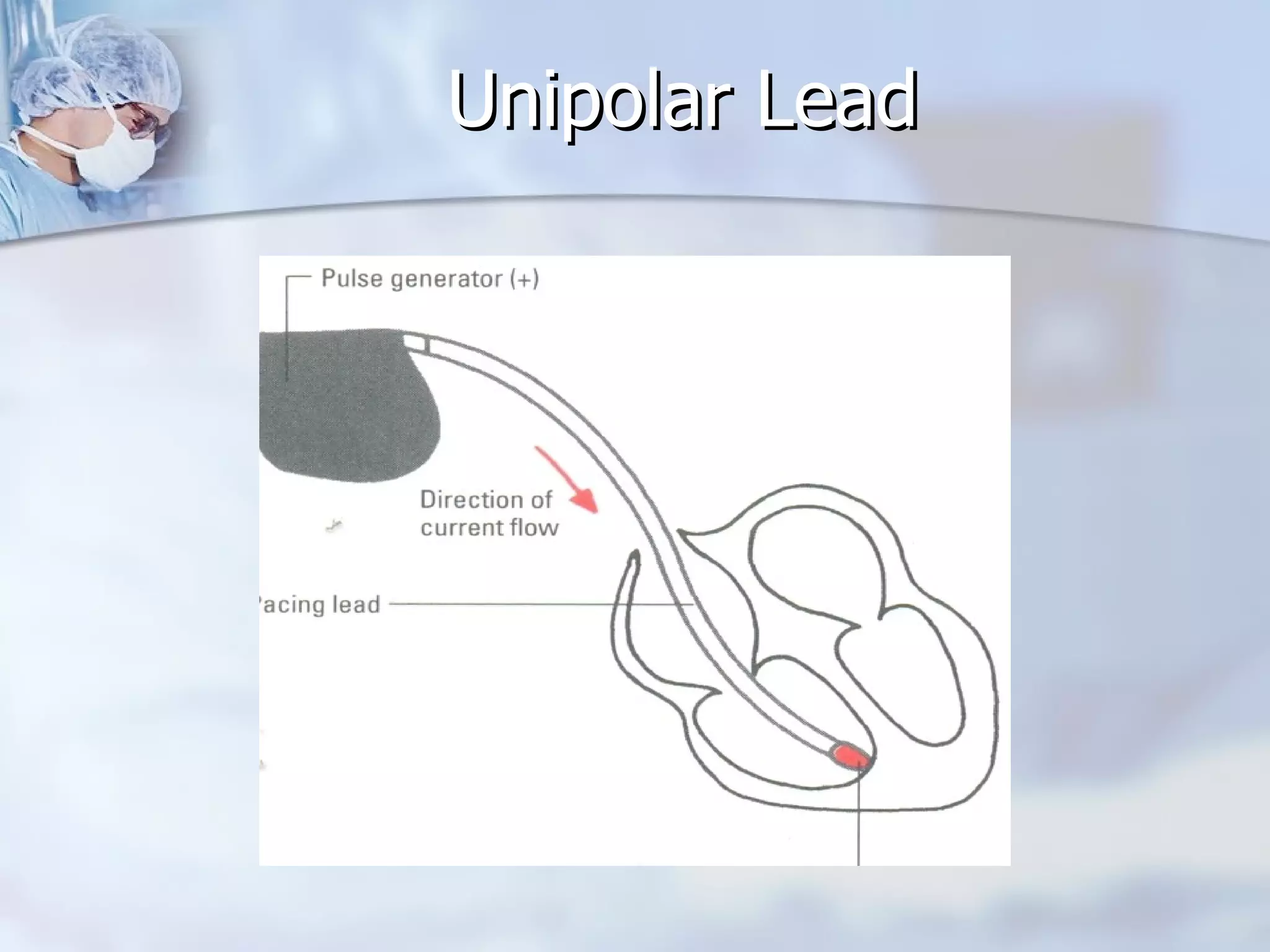
Unipolar Pacing System A unipolar pacing system has only one electrode (the negative electrode) making contact with the heart. In the case of unipolar epicardial lead  system, the positive can be formed  by a piece of surgical steel wire sewn into the sucutaneous tissue of the chest
Unipolar Lead
Pacing Routes Transcutaneous pacing Transthoracic pacing Epicardial pacing Transvenous pacing
Transvenous pacing It involves threading an electrode catheter through a vein into the right atrium or right ventricle. Five different veins can be used. Antecubital approach Femoral approach Subclavian Internal jugular External jugular
Pacemaker terminology Fixed rate (Asynchronous) Delivers a pacing stimulus at a set (fixed) rate regardless of the occurrence of spontaneous myocardial depolarization; occurs in non-sensing modes. It delivers an electrical impulse at a present fixed rate to the heart and functions independently of cardiac activity.
Pacemaker Terminology Demand (synchronous) Delivers  a pacing stimulus only when the heart’s intrinsic pacemaker fails to function at a predetermined rate; the pacing stimulus is either inhibited or triggered by the sensing of intrinsic activity.  The pulse generator delivers artificial stimulus only when needed or on demand and therefore does not compete with patient’s rhythm
Pacemaker Terminology Atrioventricular (AV) Sequential (Dual Chamber) Delivers a pacing stimulus to both the atrium and ventricle in physiologic sequence with  sufficient AV delay to permit adequate ventricular filling
Examples of Temporary Pacing  Modes Asynchronous  Universal AOO  DDD  VOO DOO Synchronous  AAI VVI DVI
Pacemaker Settings RATE OUTPUT SENSITIVITY
RATE It regulates the number of impulse that can be delivered to the heart per minute. The rate setting depend on the physiological needs of the patient, but it is generally maintained between 60-80 beats/min. If the pacemaker is operating in dual-chamber mode, the ventricular control rate also regulate the atrial rate.
OUTPUT It is the amount of electrical current (measured in milliamperes [mA]) that is delivered to the heart to initiate depolarization. The point at which depolarization occurs is termed threshold and is indicated by a myocardial response to the pacing stimulus (capture)
SENSITIVITY The sensitivity control regulates the ability of the pacemaker to the heart’s intrinsic electrical activity. Sensitivity is measured in millivolts (mV) and determines the size of the intracardiac signal that generator will recognize
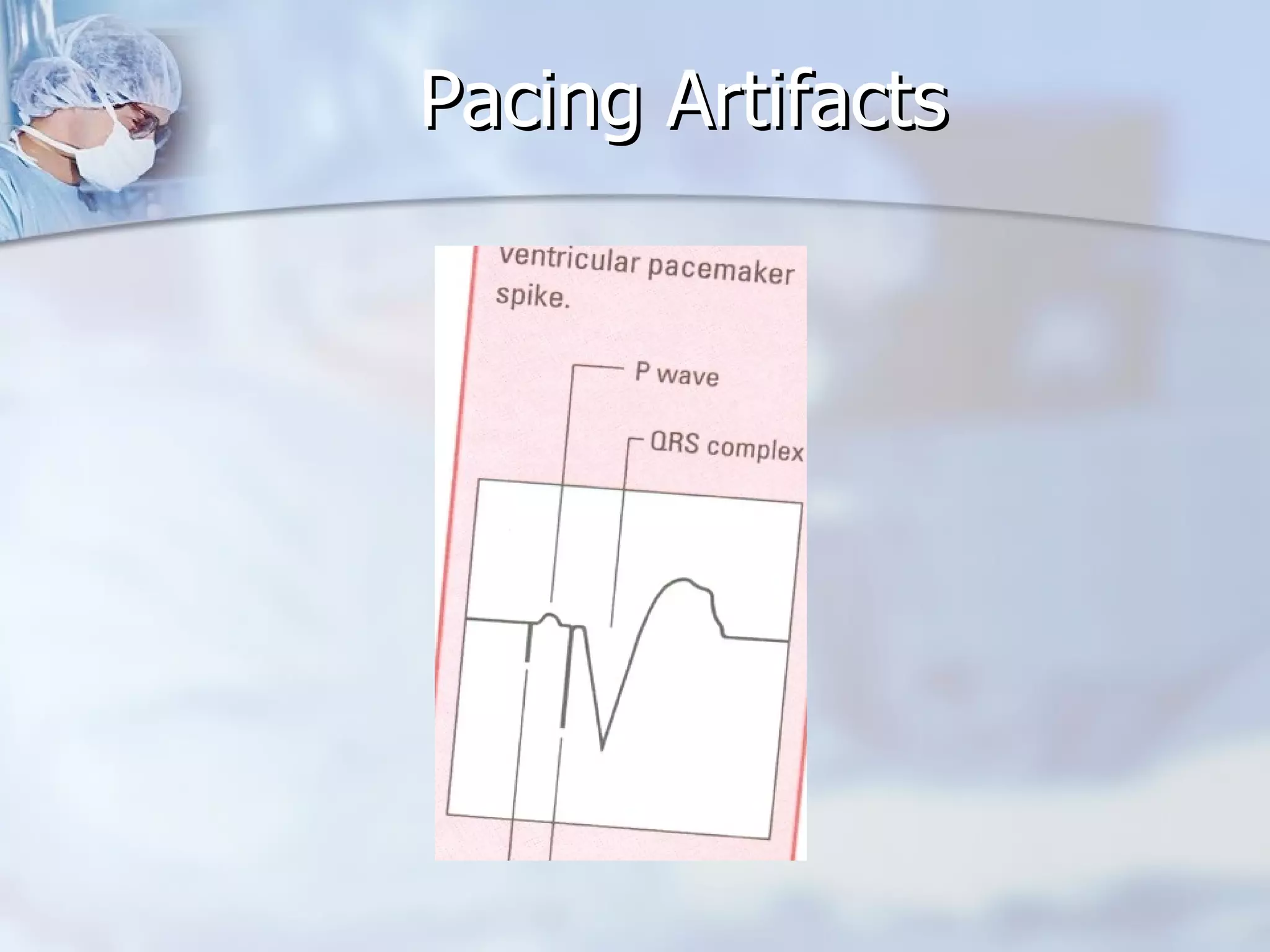
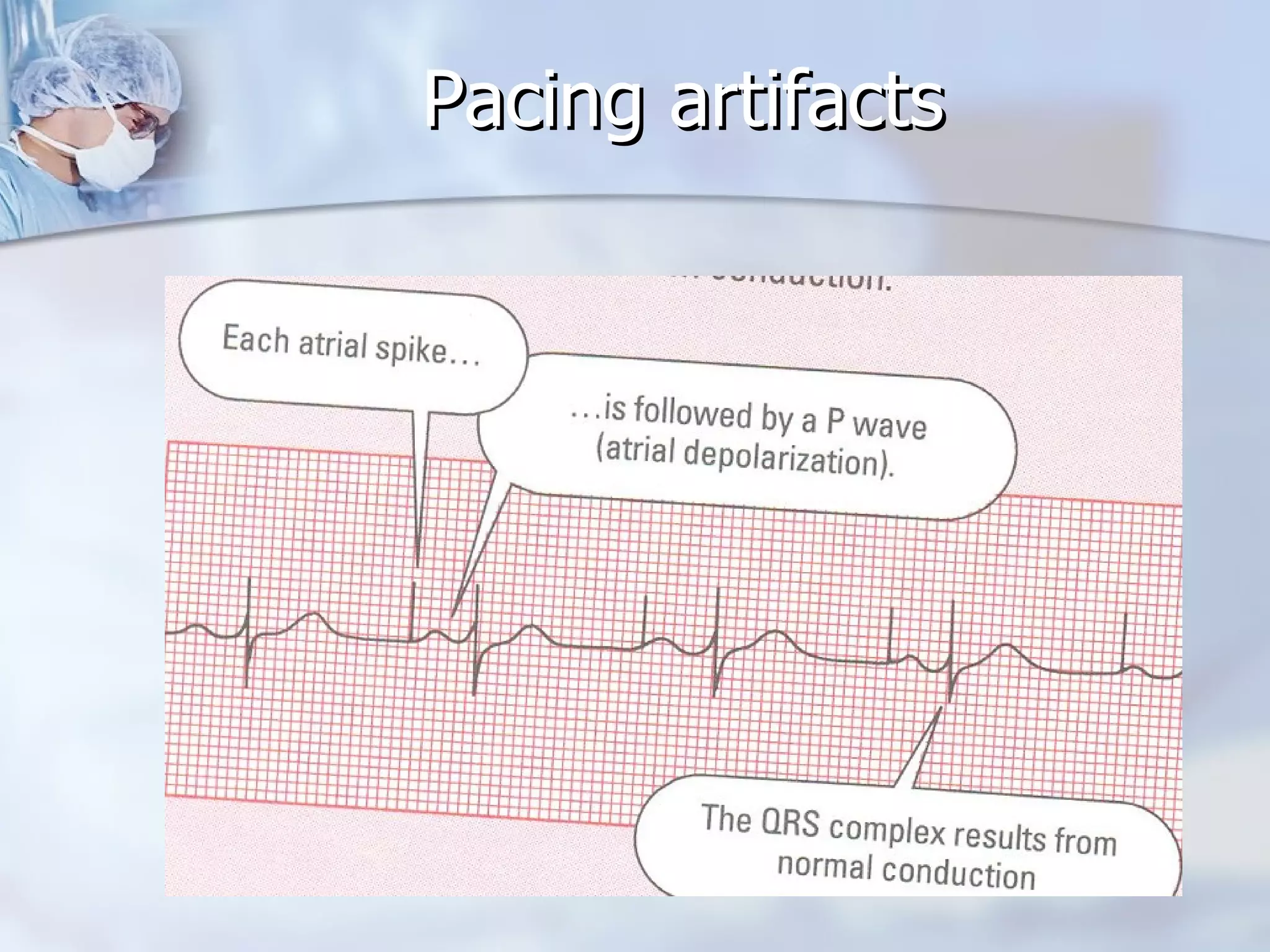
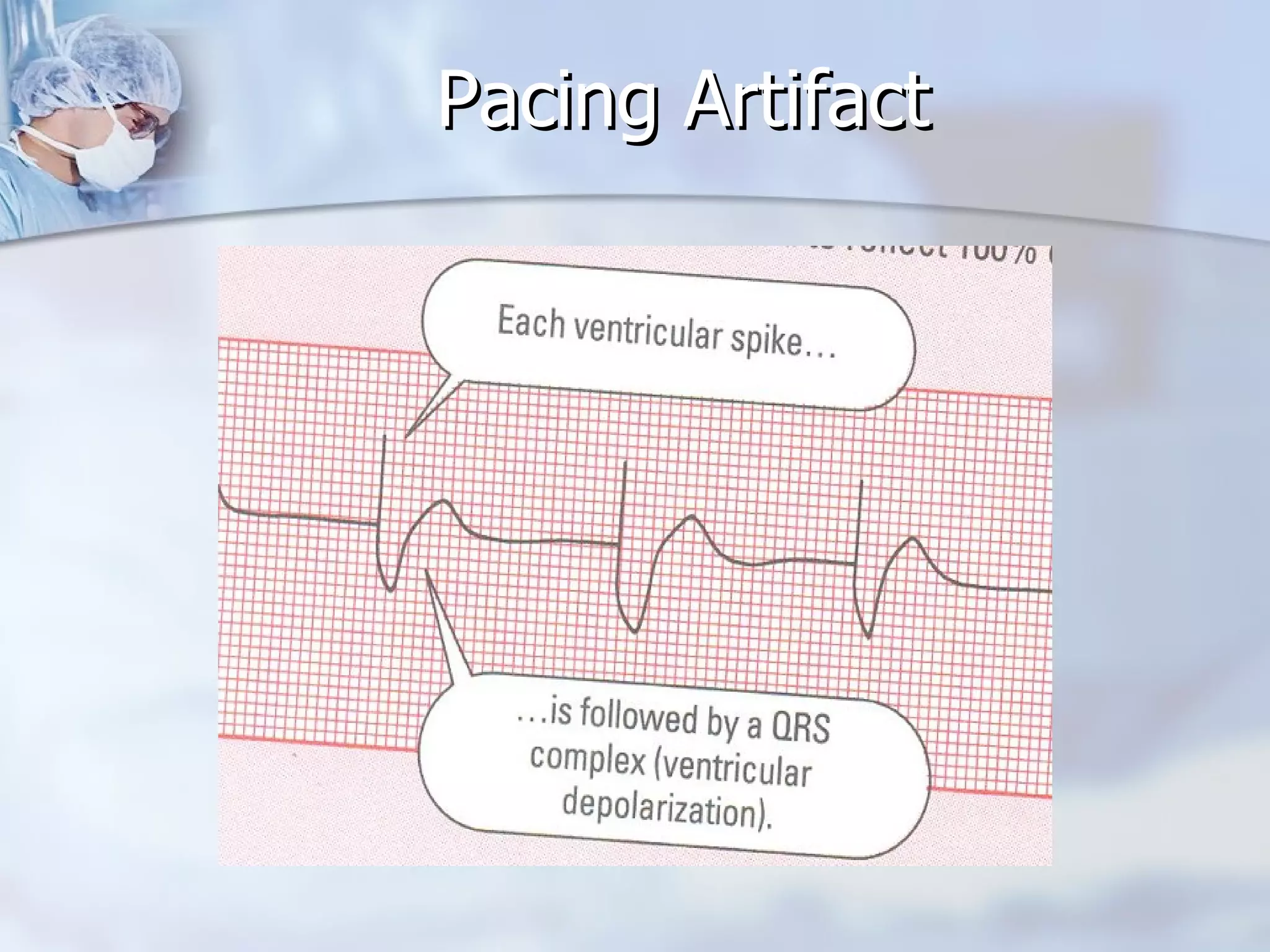
PACINING ARTIFACTS All patients with temporary pacemaker require continuous ECG monitoring. The pacing artifact is the spike that is seen on the ECG tracing as the pacing stimulus is delivered to the heart. A  P wave is visible after the pacing artifact if atrium is being paced.
Pacing Artifacts
Pacing artifacts
Pacing Artifact
ADVERSE EFFECTS Muscle stimulation Pneumothorax Ectopic beats like PVC’s Ventricular perforation Perforation of other organs like  Liver Stomach Diaphragm
- Troubleshooting IN TPI
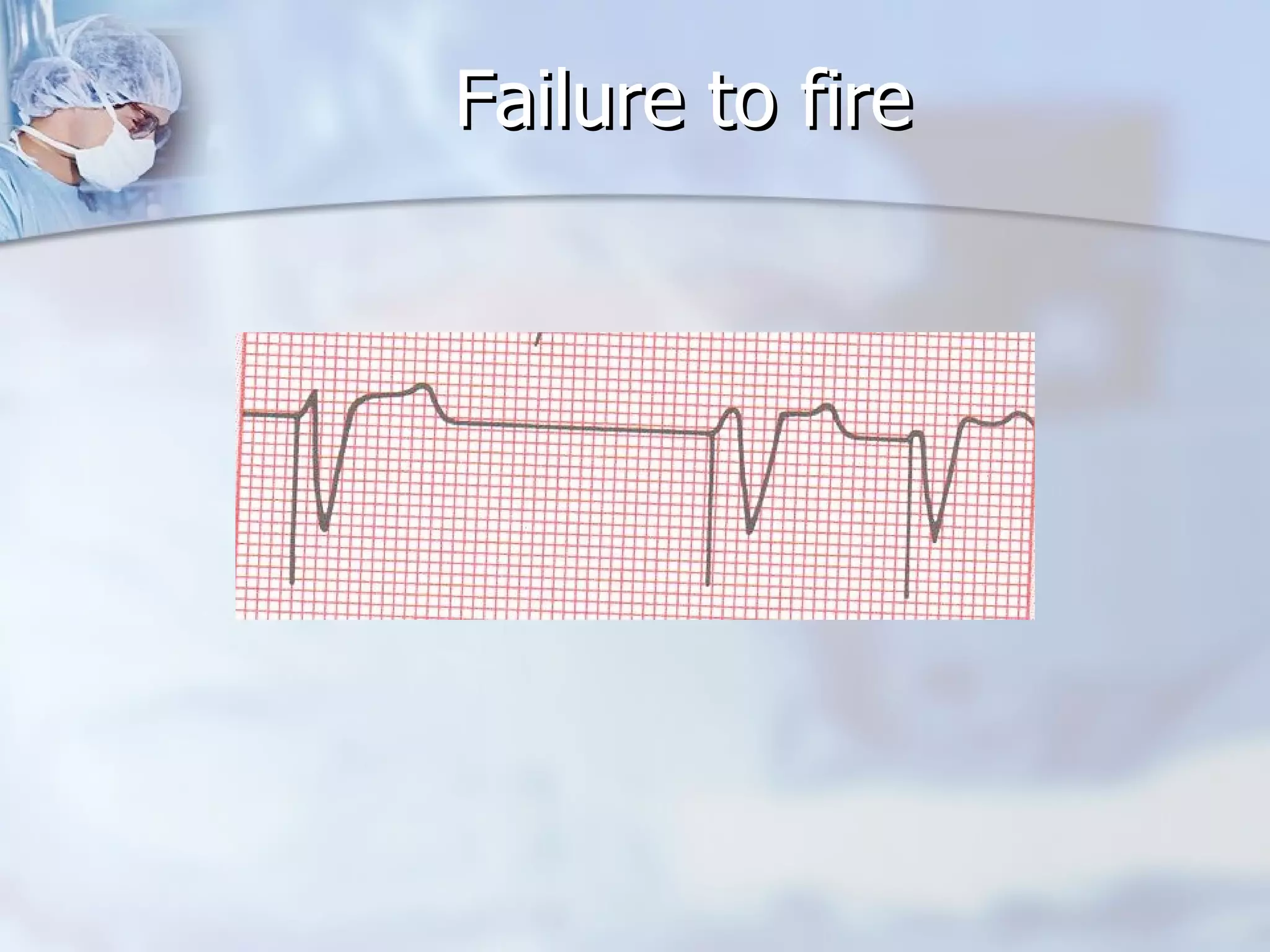
Failure to Fire  Failure of the pacemaker deliver the pacing stimulus results in the disappearance of the pacing artifact, even though the patient’s intrinsic rate is less than the set rate on the pacer. This can occur either intermittently or continuously and can be attributed to failure of the pulse generator or its battery
Failure to fire
Failure to fire CAUSES Loose head hookups Dead battery Malfunctioning pulse generator
Failure to fire INTERVENTIONS Secure lead hookups Replace battery Replace pulse generator
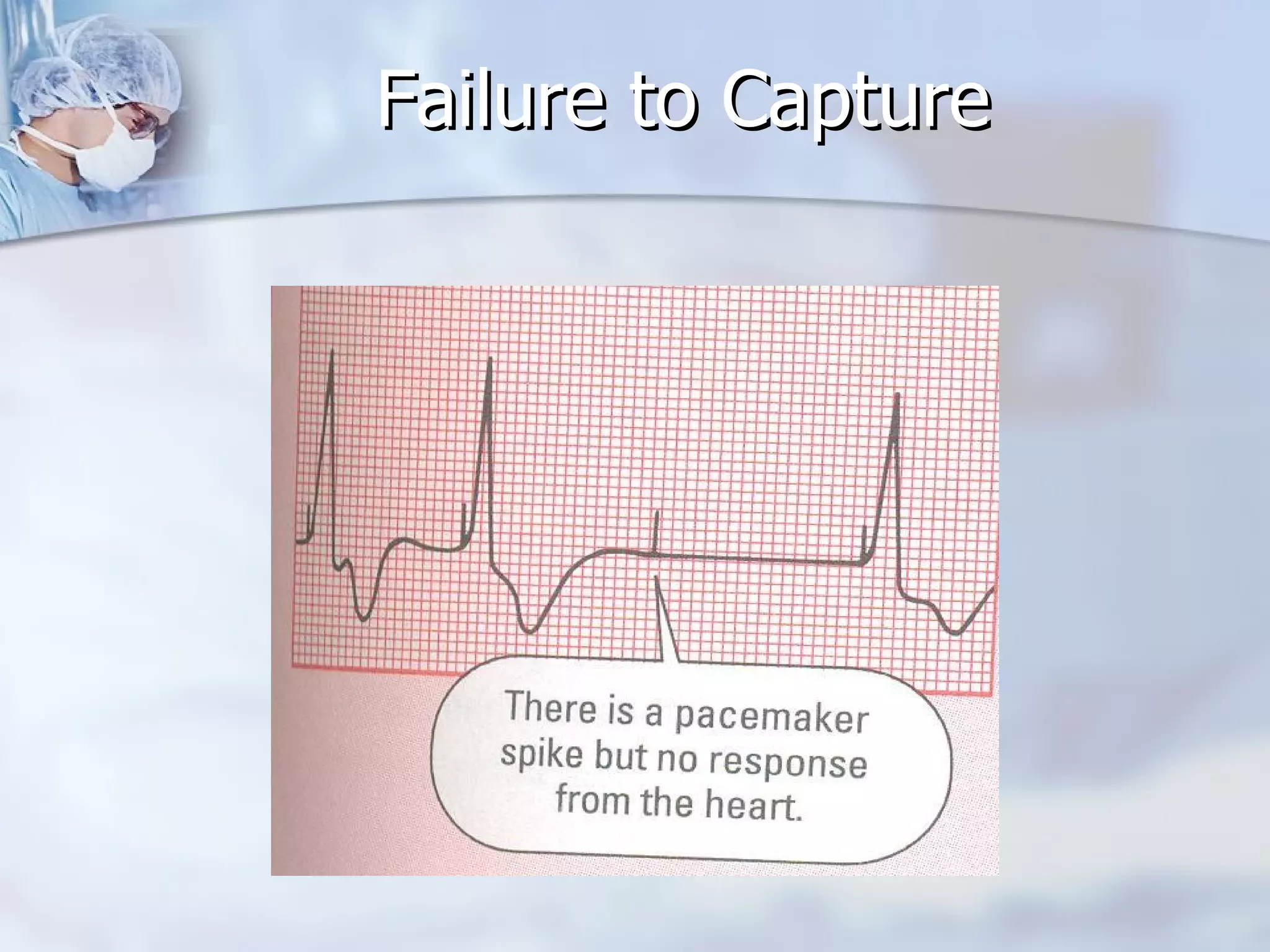
Failure to Capture If the pacing stimulus fires but fails to initiate a myocardial depolarization, a pacing artifact will be present but will not be followed by the expected P wave or QRS complex, depending on the chamber being paced.
Failure to Capture
Failure to Capture CAUSES Pacemaker output too low Catheter dislodged Loose connections
Failure to Capture INTEREVENTIONS Increase pacemaker output Reposition catheter Secure all connections
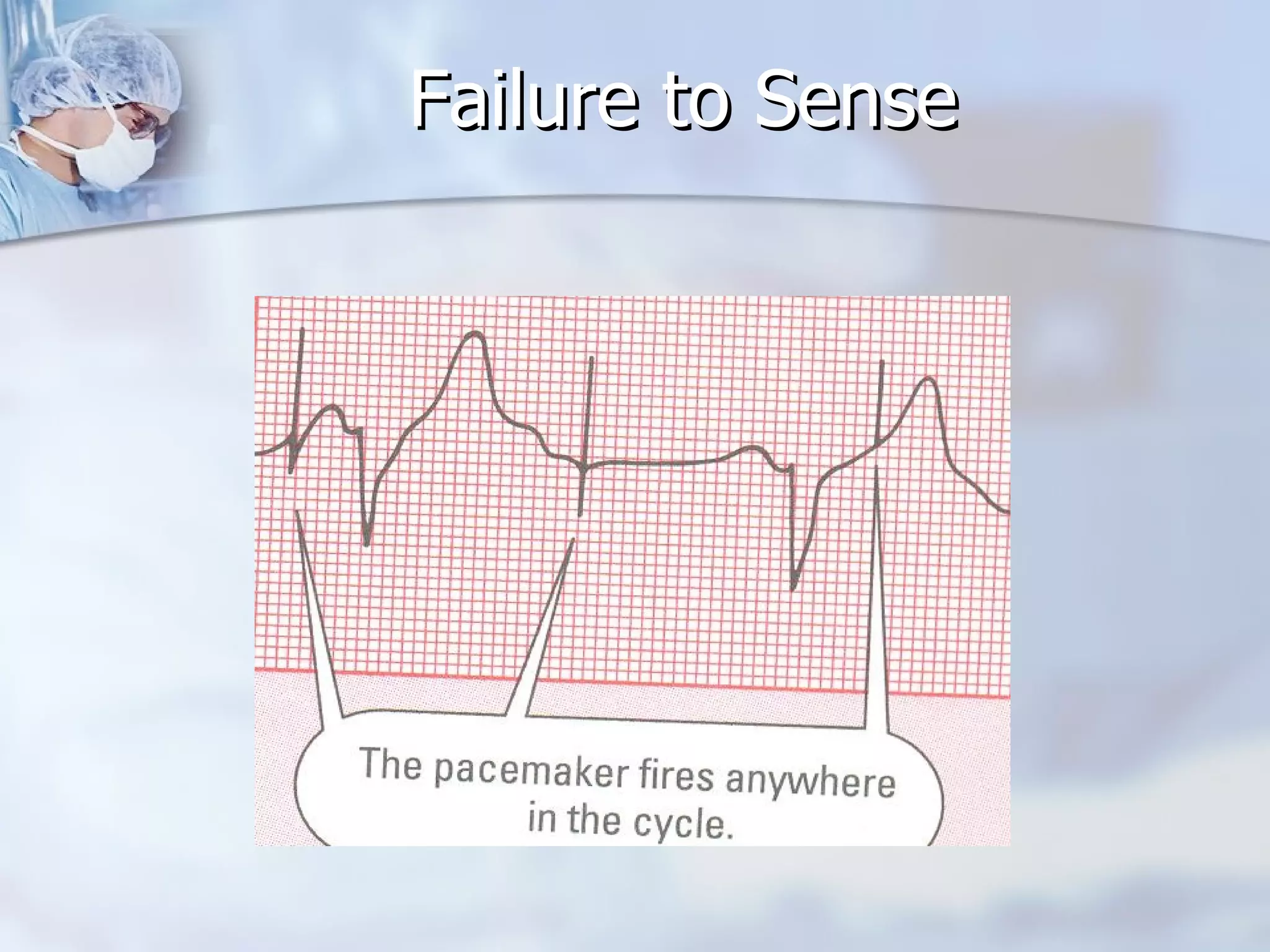
Failure to Sense UNDERSENSING In it pacemaker fires at wrong times or for the wrong reasons (help being given when none is needed) OVERSENSING In it pacemaker fires incorrectly senses depolarization and refuses to fire when it should (won’t pace when the patient actually needs it)
Failure to Sense
Failure to sense CAUSES Electrolyte imbalance Disconnection or dislodgement of lead Edema or fibrosis at the tip of electrode Drug interaction Drug battery
Failure to sense INTERVENTION Correct the sensitivity setting Replace battery Secure all connections Correct the underlying cause
Medical Management The physician determines the pacing route based on the patient’s clinical situation. Generally transcutaneous pacing is used in emergent situations until a transvenous lead can be secured.
Medical Management If the patient is undergoing heart surgery, epicardial leads may be electively placed at the end of the operation. The physician places the transvenous or epicardial pacing lead(s), repositioning as needed to obtain adequate pacing and sensing thresholds.
Nursing Management Four primary areas: Assessment and prevention of pacemaker malfunction,  Protection against micro shock,  Surveillance for complications such as infection  Patient education.
Prevention of Pacemaker Malfunction Continuous ECG monitoring is essential to facilitate prompt recognition  and appropriate intervention for pacemaker malfunction.  The temporary pacing lead and bridging cable must be properly secured to the body with tape to prevent the accidental displacement of the electrode, which can result in failure to pace or sense.  The external pulse generator can be secured to the patient’s waist with a strap
Prevention of Pacemaker Malfunction For the patient on a regimen of bed rest, the pulse generator can be suspended with twill tape from an intravenous (IV) pole mounted overhead on the ceiling. This not only will prevent tension on the lead while the patient is moved (given adequate length of bridging cable) but will also alleviate the possibility of accidental dropping of the pulse generator.
Prevention of Pacemaker Malfunction The nurse inspects for: loose connections between the lead(s) and pulse generator on a regular basis.  Replacement batteries and pulse generator must always be available on the unit.  The battery has an anticipated lifespan of 1 month, it probably is sound practice to change the battery if the pacemaker has been operating continually for several days.
Prevention of Pacemaker Malfunction Pulse generators (new generation) provide a low-battery signal 24 hours before complete loss of battery function to prevent inadvertent interruptions in pacing. The pulse generator must always be labeled with the date that the battery was replaced.
Micro-shock Protection   It is important to be aware of all sources of EMI within the critical care environment that could interfere with the pacemaker’s function. Sources of EMI in the clinical area include electrocautery, defibrillation current, radiation therapy, magnetic resonance imaging devices, and transcutaneous electrical nerve stimulation (TENS) units.
Micro-shock Protection In most cases, if EMI is suspected of precipitating pacemaker malfunction, converting to asynchronous mode (fixed rate) will maintain pacing until the cause of the EMI is removed. The pacing electrode provides a direct, low resistance path to the heart, the nurse takes special care while handling the external components of the pacing system to avoid conducting stray electrical current from other equipment.
Infection Infection at the lead site is a rare but  serious complication associated with temporary pacemakers.  The (sites) is carefully inspected for purulent drainage, erythema, and edema, and the patient is observed for the signs of systemic infection.
Infection Site care is performed according to institution’s protocol. Although most infections remain localized, endocarditis can occur in patients with endocardial pacing leads. A less common complication associated with transvenous pacing is myocardial perforation, which can result in rhythmic hiccoughs or cardiac tamponade.
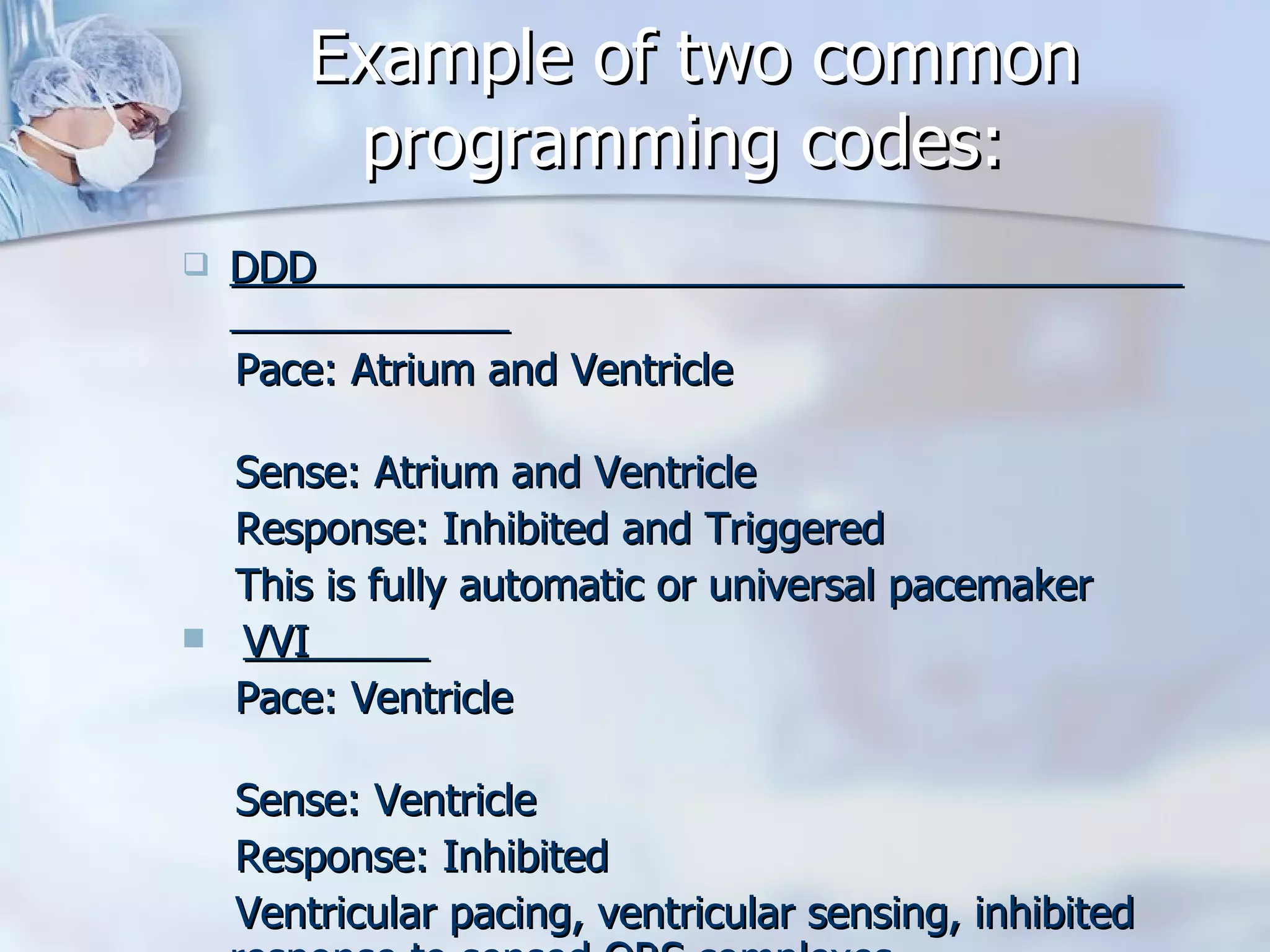
Example of two common programming codes: DDD  Pace: Atrium and Ventricle  Sense: Atrium and Ventricle  Response: Inhibited and Triggered This is fully automatic or universal pacemaker  VVI  Pace: Ventricle  Sense: Ventricle  Response: Inhibited Ventricular pacing, ventricular sensing, inhibited response to sensed QRS complexes
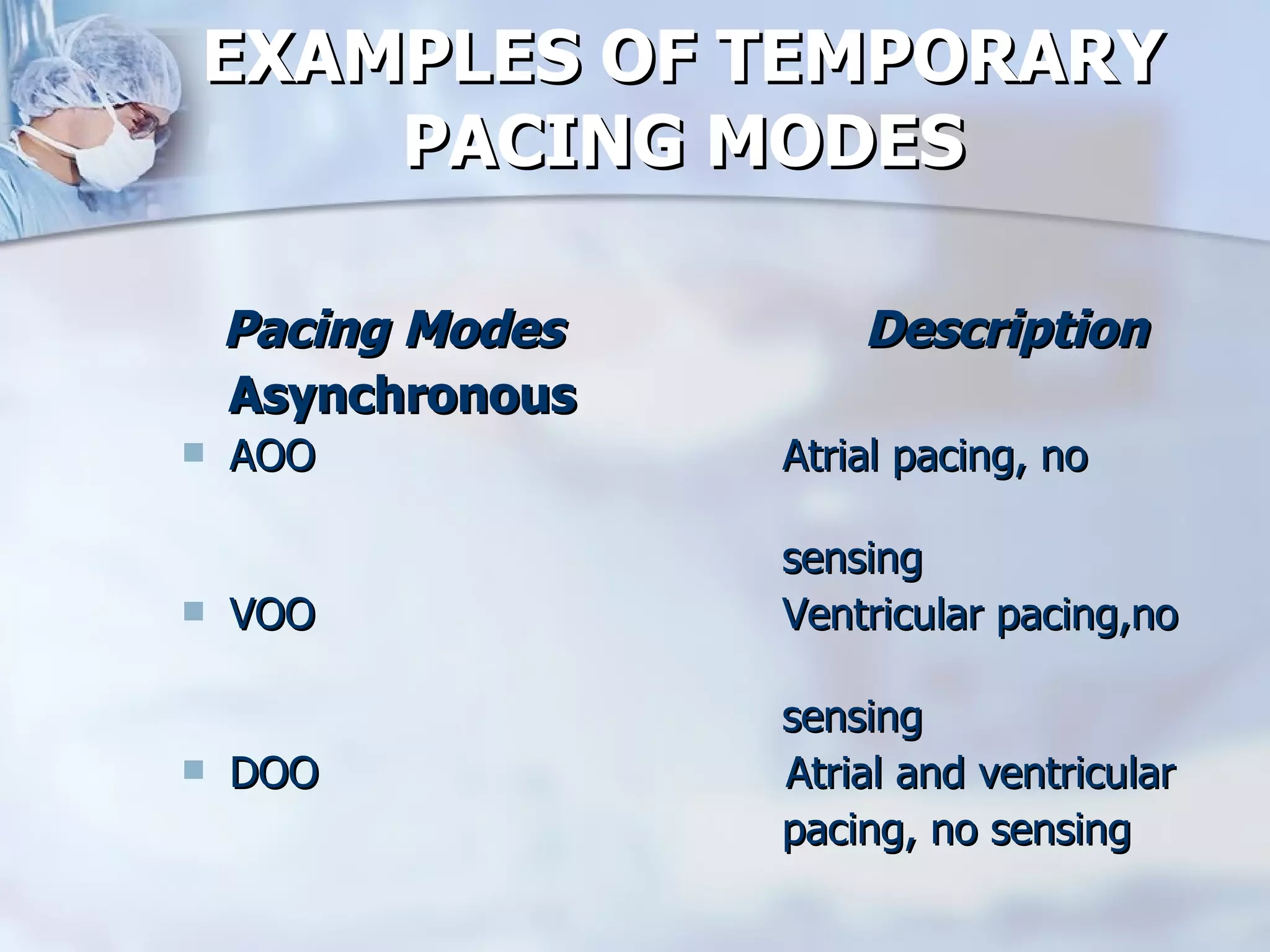
EXAMPLES OF TEMPORARY PACING MODES Pacing Modes  Description Asynchronous AOO  Atrial pacing, no  sensing VOO  Ventricular pacing,no  sensing DOO  Atrial and ventricular pacing, no sensing
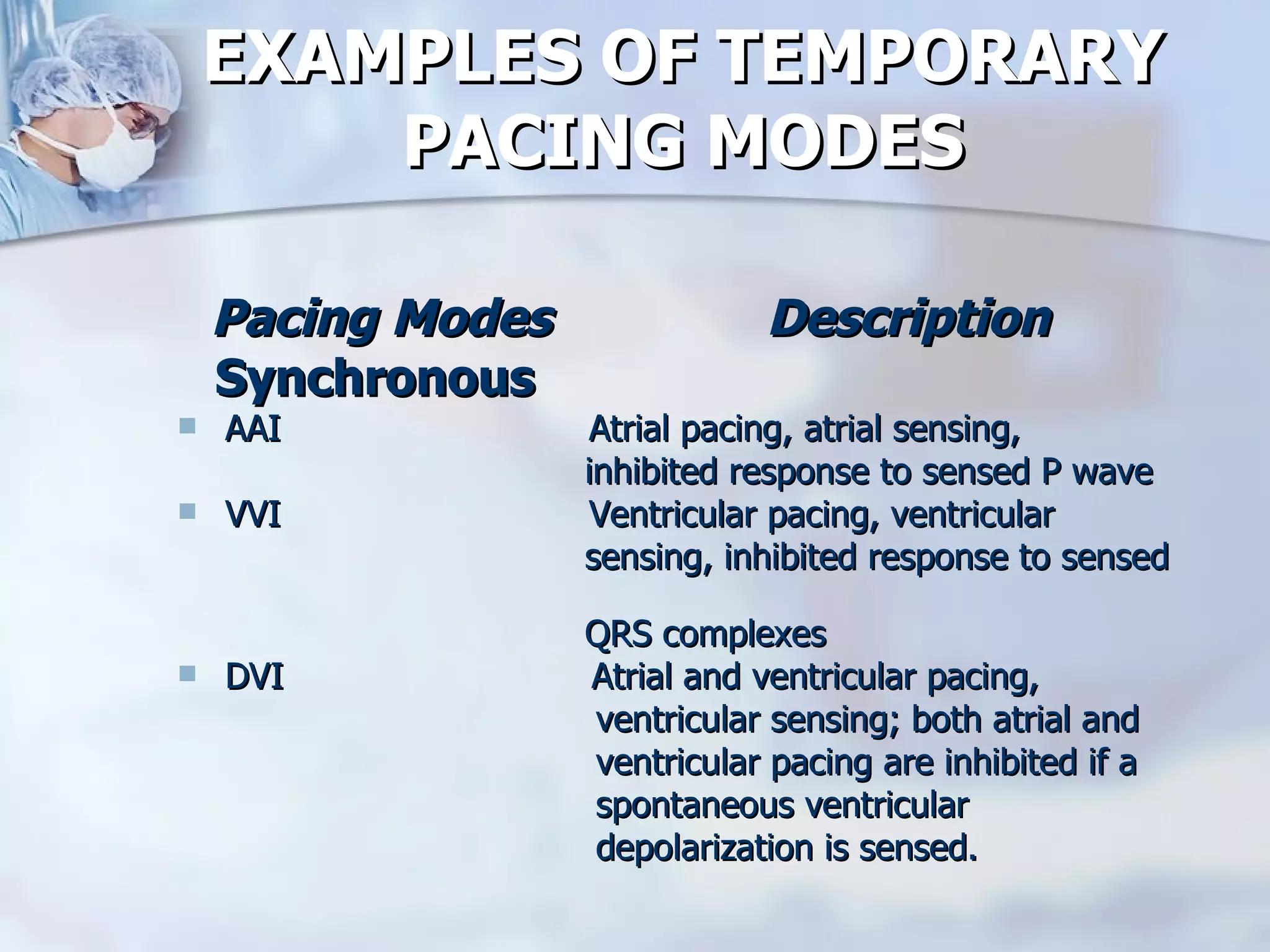
EXAMPLES OF TEMPORARY PACING MODES Pacing Modes  Description Synchronous AAI  Atrial pacing, atrial sensing,  inhibited response to sensed P wave VVI  Ventricular pacing, ventricular  sensing, inhibited response to sensed  QRS complexes DVI  Atrial and ventricular pacing,  ventricular sensing; both atrial and  ventricular pacing are inhibited if a  spontaneous ventricular  depolarization is sensed.
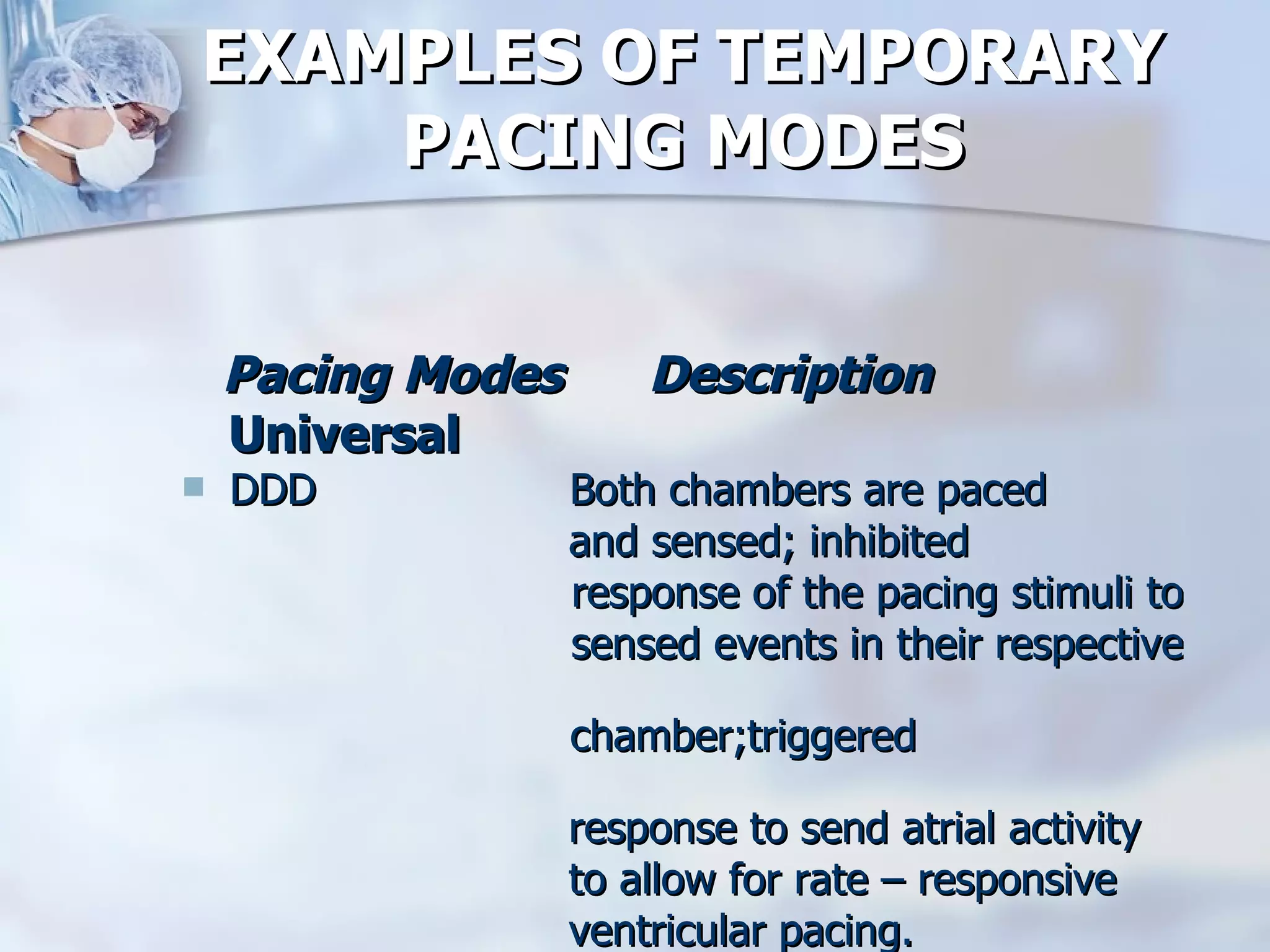
EXAMPLES OF TEMPORARY PACING MODES Pacing Modes  Description Universal DDD  Both chambers are paced  and sensed; inhibited  response of the pacing stimuli to  sensed events in their respective  chamber;triggered  response to send atrial activity  to allow for rate – responsive  ventricular pacing.

Temporary Pacemaker Slides

  • 1.
  • 2.
    Pacemakers Pacemakers arethe electronic devices that can be used to initiate the heartbeat when the heart’s intrinsic electrical system cannot effectively generate a rate adequate to support cardiac output
  • 3.
    Types of PacemakerTemporary pacemaker Permanent pacemaker
  • 4.
    Temporary Pacemaker Temporary Pacemakers can be used temporarily , either supportively or prophylactically, until the condition responsible for the rate or conduction disturbance resolves .
  • 5.
    Indications Bradycardia Sinusbradycardia and arrest Sick sinus syndrome Heart blocks Tachydysrhythmias Supraventricular Ventricular Permanent pacemaker failure Support cardiac output after cardiac surgery Diagnostic studies Electrophysiological studies Atrial electrogram
  • 6.
    The Pacemaker SystemA simple electrical circuit consisting of PULSE GENERATOR PACING LEAD
  • 7.
  • 8.
    Pacing pulse generatorThe pulse generator is designed to generate an electrical current that travels through pacing lead and exits through electrode that is in direct contact with the heart. This electrical current initiates a myocardial depolarization. The power source for a temporary external pulse generator is standard 9-volt alkaline battery inserted into the generator
  • 9.
    Pacing Lead SystemThe pacing lead used for temporary pacing may be bipolar or unipolar Bipolar Pacing System In bipolar pacing system, two electrodes (positive and negative) are located within the heart
  • 10.
    Bipolar Pacing SystemThe bipolar lead used in the transvenous pacing as two electrodes on one catheter. The distal , or negative , electrode is at the tip of the pacing lead and is in the direct contact with the heart, usually inside the right atrium or ventricle.
  • 11.
    Bipolar pacing systemApproximately 1 cm from the negative electrode is a positive electrode . The negative electrode is attached to the negative terminal, and the positive electrode is attached to the positive terminal of the pulse generator, either directly or via a bridging cable
  • 12.
    Bipolar pacing systemAn epicardial lead system is often used for temporary pacing after cardiac surgery The bipolar epicardial lead system has two separate insulated wires (one negative and one positive) that are loosely secured with sutures to the cardiac chambers to be paced. Both electrodes are in contact with myocardial tissues, so either wire may be use as the negative, or ground electrode
  • 13.
  • 14.
    Unipolar Pacing SystemA unipolar pacing system has only one electrode (the negative electrode) making contact with the heart. In the case of unipolar epicardial lead system, the positive can be formed by a piece of surgical steel wire sewn into the sucutaneous tissue of the chest
  • 15.
  • 16.
    Pacing Routes Transcutaneouspacing Transthoracic pacing Epicardial pacing Transvenous pacing
  • 17.
    Transvenous pacing Itinvolves threading an electrode catheter through a vein into the right atrium or right ventricle. Five different veins can be used. Antecubital approach Femoral approach Subclavian Internal jugular External jugular
  • 18.
    Pacemaker terminology Fixedrate (Asynchronous) Delivers a pacing stimulus at a set (fixed) rate regardless of the occurrence of spontaneous myocardial depolarization; occurs in non-sensing modes. It delivers an electrical impulse at a present fixed rate to the heart and functions independently of cardiac activity.
  • 19.
    Pacemaker Terminology Demand(synchronous) Delivers a pacing stimulus only when the heart’s intrinsic pacemaker fails to function at a predetermined rate; the pacing stimulus is either inhibited or triggered by the sensing of intrinsic activity. The pulse generator delivers artificial stimulus only when needed or on demand and therefore does not compete with patient’s rhythm
  • 20.
    Pacemaker Terminology Atrioventricular(AV) Sequential (Dual Chamber) Delivers a pacing stimulus to both the atrium and ventricle in physiologic sequence with sufficient AV delay to permit adequate ventricular filling
  • 21.
    Examples of TemporaryPacing Modes Asynchronous Universal AOO DDD VOO DOO Synchronous AAI VVI DVI
  • 22.
    Pacemaker Settings RATEOUTPUT SENSITIVITY
  • 23.
    RATE It regulatesthe number of impulse that can be delivered to the heart per minute. The rate setting depend on the physiological needs of the patient, but it is generally maintained between 60-80 beats/min. If the pacemaker is operating in dual-chamber mode, the ventricular control rate also regulate the atrial rate.
  • 24.
    OUTPUT It isthe amount of electrical current (measured in milliamperes [mA]) that is delivered to the heart to initiate depolarization. The point at which depolarization occurs is termed threshold and is indicated by a myocardial response to the pacing stimulus (capture)
  • 25.
    SENSITIVITY The sensitivitycontrol regulates the ability of the pacemaker to the heart’s intrinsic electrical activity. Sensitivity is measured in millivolts (mV) and determines the size of the intracardiac signal that generator will recognize
  • 26.
    PACINING ARTIFACTS Allpatients with temporary pacemaker require continuous ECG monitoring. The pacing artifact is the spike that is seen on the ECG tracing as the pacing stimulus is delivered to the heart. A P wave is visible after the pacing artifact if atrium is being paced.
  • 27.
  • 28.
  • 29.
  • 30.
    ADVERSE EFFECTS Musclestimulation Pneumothorax Ectopic beats like PVC’s Ventricular perforation Perforation of other organs like Liver Stomach Diaphragm
  • 31.
  • 32.
    Failure to Fire Failure of the pacemaker deliver the pacing stimulus results in the disappearance of the pacing artifact, even though the patient’s intrinsic rate is less than the set rate on the pacer. This can occur either intermittently or continuously and can be attributed to failure of the pulse generator or its battery
  • 33.
  • 34.
    Failure to fireCAUSES Loose head hookups Dead battery Malfunctioning pulse generator
  • 35.
    Failure to fireINTERVENTIONS Secure lead hookups Replace battery Replace pulse generator
  • 36.
    Failure to CaptureIf the pacing stimulus fires but fails to initiate a myocardial depolarization, a pacing artifact will be present but will not be followed by the expected P wave or QRS complex, depending on the chamber being paced.
  • 37.
  • 38.
    Failure to CaptureCAUSES Pacemaker output too low Catheter dislodged Loose connections
  • 39.
    Failure to CaptureINTEREVENTIONS Increase pacemaker output Reposition catheter Secure all connections
  • 40.
    Failure to SenseUNDERSENSING In it pacemaker fires at wrong times or for the wrong reasons (help being given when none is needed) OVERSENSING In it pacemaker fires incorrectly senses depolarization and refuses to fire when it should (won’t pace when the patient actually needs it)
  • 41.
  • 42.
    Failure to senseCAUSES Electrolyte imbalance Disconnection or dislodgement of lead Edema or fibrosis at the tip of electrode Drug interaction Drug battery
  • 43.
    Failure to senseINTERVENTION Correct the sensitivity setting Replace battery Secure all connections Correct the underlying cause
  • 44.
    Medical Management Thephysician determines the pacing route based on the patient’s clinical situation. Generally transcutaneous pacing is used in emergent situations until a transvenous lead can be secured.
  • 45.
    Medical Management Ifthe patient is undergoing heart surgery, epicardial leads may be electively placed at the end of the operation. The physician places the transvenous or epicardial pacing lead(s), repositioning as needed to obtain adequate pacing and sensing thresholds.
  • 46.
    Nursing Management Fourprimary areas: Assessment and prevention of pacemaker malfunction, Protection against micro shock, Surveillance for complications such as infection Patient education.
  • 47.
    Prevention of PacemakerMalfunction Continuous ECG monitoring is essential to facilitate prompt recognition and appropriate intervention for pacemaker malfunction. The temporary pacing lead and bridging cable must be properly secured to the body with tape to prevent the accidental displacement of the electrode, which can result in failure to pace or sense. The external pulse generator can be secured to the patient’s waist with a strap
  • 48.
    Prevention of PacemakerMalfunction For the patient on a regimen of bed rest, the pulse generator can be suspended with twill tape from an intravenous (IV) pole mounted overhead on the ceiling. This not only will prevent tension on the lead while the patient is moved (given adequate length of bridging cable) but will also alleviate the possibility of accidental dropping of the pulse generator.
  • 49.
    Prevention of PacemakerMalfunction The nurse inspects for: loose connections between the lead(s) and pulse generator on a regular basis. Replacement batteries and pulse generator must always be available on the unit. The battery has an anticipated lifespan of 1 month, it probably is sound practice to change the battery if the pacemaker has been operating continually for several days.
  • 50.
    Prevention of PacemakerMalfunction Pulse generators (new generation) provide a low-battery signal 24 hours before complete loss of battery function to prevent inadvertent interruptions in pacing. The pulse generator must always be labeled with the date that the battery was replaced.
  • 51.
    Micro-shock Protection It is important to be aware of all sources of EMI within the critical care environment that could interfere with the pacemaker’s function. Sources of EMI in the clinical area include electrocautery, defibrillation current, radiation therapy, magnetic resonance imaging devices, and transcutaneous electrical nerve stimulation (TENS) units.
  • 52.
    Micro-shock Protection Inmost cases, if EMI is suspected of precipitating pacemaker malfunction, converting to asynchronous mode (fixed rate) will maintain pacing until the cause of the EMI is removed. The pacing electrode provides a direct, low resistance path to the heart, the nurse takes special care while handling the external components of the pacing system to avoid conducting stray electrical current from other equipment.
  • 53.
    Infection Infection atthe lead site is a rare but serious complication associated with temporary pacemakers. The (sites) is carefully inspected for purulent drainage, erythema, and edema, and the patient is observed for the signs of systemic infection.
  • 54.
    Infection Site careis performed according to institution’s protocol. Although most infections remain localized, endocarditis can occur in patients with endocardial pacing leads. A less common complication associated with transvenous pacing is myocardial perforation, which can result in rhythmic hiccoughs or cardiac tamponade.
  • 55.
    Example of twocommon programming codes: DDD Pace: Atrium and Ventricle Sense: Atrium and Ventricle Response: Inhibited and Triggered This is fully automatic or universal pacemaker VVI Pace: Ventricle Sense: Ventricle Response: Inhibited Ventricular pacing, ventricular sensing, inhibited response to sensed QRS complexes
  • 56.
    EXAMPLES OF TEMPORARYPACING MODES Pacing Modes Description Asynchronous AOO Atrial pacing, no sensing VOO Ventricular pacing,no sensing DOO Atrial and ventricular pacing, no sensing
  • 57.
    EXAMPLES OF TEMPORARYPACING MODES Pacing Modes Description Synchronous AAI Atrial pacing, atrial sensing, inhibited response to sensed P wave VVI Ventricular pacing, ventricular sensing, inhibited response to sensed QRS complexes DVI Atrial and ventricular pacing, ventricular sensing; both atrial and ventricular pacing are inhibited if a spontaneous ventricular depolarization is sensed.
  • 58.
    EXAMPLES OF TEMPORARYPACING MODES Pacing Modes Description Universal DDD Both chambers are paced and sensed; inhibited response of the pacing stimuli to sensed events in their respective chamber;triggered response to send atrial activity to allow for rate – responsive ventricular pacing.