Right Heart Catheterization
Dr. Md.Toufiqur Rahman
MBBS, FCPS, MD, FACC, FESC, FRCPE, FSCAI,
FAPSC, FAPSIC, FAHA, FCCP, FRCPG
Associate Professor of Cardiology
National Institute of Cardiovascular Diseases(NICVD),
Sher-e-Bangla Nagar, Dhaka-1207
Consultant, Medinova, Malibagh branch
Honorary Consultant, Apollo Hospitals, Dhaka and
STS Life Care Centre, Dhanmondi
drtoufiq19711@yahoo.com
CRT 2014
Washington
DC, USA
Q.1
Q.2
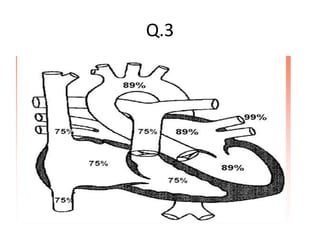
Q.3
Q.4
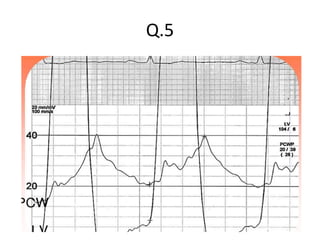
Q.5
Q.6
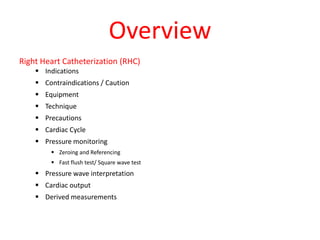
Overview
Right Heart Catheterization (RHC)
 Indications
 Contraindications / Caution
 Equipment
 Technique
 Precautions
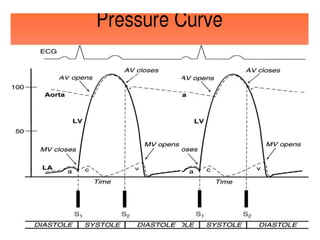
 Cardiac Cycle
 Pressure monitoring
 Zeroing and Referencing
 Fast flush test/ Square wave test
 Pressure wave interpretation
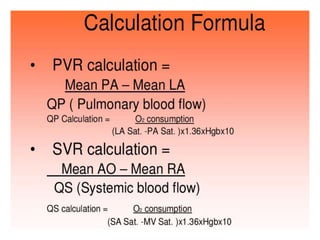
 Cardiac output
 Derived measurements
History
• First Cardiac catheterization –
▫ According to Andre Cournand, it was first performed by Claude
Bernard in 1844, in a horse, both rt and lt ventrilces were
entered by retrograde approach from the jugular vein and
carotid artery
▫ Werner Forssmann is credited with performing the
first cardiac catheterization of a living person
himself, at the age of 25 yrs
• Forssmann for his contribution and foresight shared
the Nobel Prize in Medicine with Andre Cournand and
Dickinson Richards in 1956
History
• 1929- Dr. Warner
Forssman proven that
right heart catheterization
is possible in humans
• 1964- Dr. Bradley
introduced small
diagnostic catheter
• 1970- Balloon Flotation
Catheter by Doctor H.J.C
Swan and William Ganz
Cardiac catheterization implies the insertion
of flexible tube into one or more heart
chambers usually under fluoroscopic guide
for diagnostic or therapeutic purpose
Definition
Indication of cardiac catheterization
1. Diagnostic indication
-Collects data to evaluate PT’s condition
2. Therapeutic indication
3. Prognostic indication
1. Diagnostic catheterization is in the routine preoperative evaluation of
most congenital defects, such as VSDs, ASD, TOF, DORV, CoA and other
complex CHD.
2. Before interventional catheterization
a. Assessment of patient hemodynamics and anatomy
b. to confirm congenital or acquired heart disease in infants and children
3. When the anatomy of a CHD is inadequately defined by noninvasive
means
4. in very complex lesions  specific details about the anatomy or
hemodynamics
5. High-flow or low-flow physiology associated with semilunar valve
stenosis
a.Combined aortic stenosis (AS) and insufficiency
b.Combined Pulmonary stenosis and insufficiency
6. In cavopulmonary anastomosis and after Fontan completion 
Diagnostic catheterization is useful in the evaluation for proceeding
with completion of Fontan, revision of Fontan, or transplantation
Diagnostic indication-
7. EP study
1. His bundle electrocardiography in 1st degree, 2nd
degree & CHB
2. Endocardial mapping in WPW syndrome
8. Endocardial biopsy
1. DCM
2. HCM
3. Amyloidosis
4. sarcoidosis
Diagnostic indication
 Angiocardiography –
1. Rt and lt ventriculography –
a) Chamber size
b) Wall thickness
c) Wall motion
d) Aneurysm
e) Volume
f) Dimension
g) Fractional shortening
and
h) Ejection fraction
2. Aortography –
a) AR
b) AS
c) Co of Aorta
d) PDA
e) Aortic arch
syndrome
3. CAG – determine
coronary artery
anatomy
Diagnostic indication
 Pressure study –
a) it means measurement of pressure and recording of its wave
form.
b) High RV pressure in catheterization found in the following
condition –
a) VSD
b) PS
c) PH in MS, COPD
d) Ruptured sinus of valsalva into RV
c) Trans-valvular pressure difference can grade the severity of –
a) AS
b) PS
c) MS
d) PCW help to find out LVEDP
 Oxymetry –
a) Shunt calculation
b) To determine Cardiac output
Therapeutic indication
1. Closure of the following defects –
1. ASD
2. VSD
3. PDA
4. MAPCA
2. PTMC
3. Thrombolytic therapy – intracoronary, systemic
4. PTCA
5. PTA – for peripheral artery stenosis
6. Valvuloplasty – PS, MS, AS
7. Dilatation of coarctation of aorta
Therapeutic indication
9. Introduction of ‘’UMBRELLA’’ in to IVC for
recurrent pulmonary emboli from DVT
10. Rushkind procedure in TGA, for balloon
rupture of interatrial septum by
brockenbergh needle
11. Cardiac pacing
12. Peripheral arterial balloon dilatation
13. Hemodynamic monitoring and treatment of
pt with cardiogenic shock by swan gauze
catheter
Prognostic indication
1. Post CABG catheter for assessment of –
1. cardiac function and
2. coronary perfusion
2. Post PTCA
3. After thrombolytic therapy
4. After repair of VSD
5. After valve replacement
6. Prior to any cardiac operation to estimate
the prognosis of operation
Contraindication of cardiac catheterization
• Absolute contraindication – In expert
hand none is contraindicated
1. Patient refusal
2. IE
1. Recent AMI usually within 3 week  in case of adult
pt
2. Intercurrent febrile illness
2. CCF
3. Severe or malignant hypertension  predispose to
myocardial ischaemia and/or heart failure during
angiography
4. Life threatening arrhythmia, but it is indicated in-
1. While myocardial mapping and subsequent electrotherapy
2. Surgery is contemplated for treatment of arrhythmia
Relative contraindications
5. Severe renal failure
6. Allergy to dye
7. Severe hypokalaemia
8. Anticoagulant state  PT > 18 s
9. Moribund pt
10. Primary pulmonary hypertension
11. Presence of LBBB
12. Digitalis toxicity
13. Severe anaemia
14. Severe PS
Relative contraindications
MEDICATIONS USED
 Premadication –
 Inj Pethidine
 Inj Phenargoan
 Saline infusion
 Heparin -
 For Pt
 flushing all tubing, catheters, sheaths
 Lidocaine for tissue numbing
 Anaesthetic medication for relaxing the pt
 Water soluble contrast
EQUIPMENT NEEDED
 Procedure tray should include:
1. sterile –
1. gowns and gloves
2. sterile towels and drapes for procedure
3. Sterile gauze
4. scalpel, needles, scissors, hemostats
5. syringes for heparin/saline flush, lidocaine,
and blood oximetry
1. labels with marking pen for any item filled with a solution
2. basin for heparin/saline mixture & waste fluids,
3. skin prep solution
4. connection tubing
EQUIPMENT NEEDED
 Anaesthesia machine
 Oxygen supply
 Suction apparatus
 Defibrillator
 Temporary pacemaker
 Pulse oximeter
 NIBP
 Equipment to perform cardiac output studies
 Activated clotting time (ACT) equipment
30
EQUIPMENT NEEDED
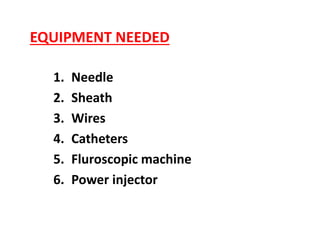
1. Needle
2. Sheath
3. Wires
4. Catheters
5. Fluroscopic machine
6. Power injector
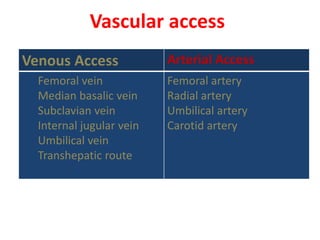
Vascular access
Venous Access Arterial Access
Femoral vein
Median basalic vein
Subclavian vein
Internal jugular vein
Umbilical vein
Transhepatic route
Femoral artery
Radial artery
Umbilical artery
Carotid artery
Needles for percutaneous puncture
• Angiographic needle – designed for single wall puncture
– small in diameter,
– thin walled,
– short beveled
– very sharp.
– Hub  clear
• True Seldinger needle
• Chiba™ needle percutaneous transhepatic access
Angiographic Needle with Protector, Seldinger Hub, Thin Wall
True Seldinger Needle
Chiba Needle
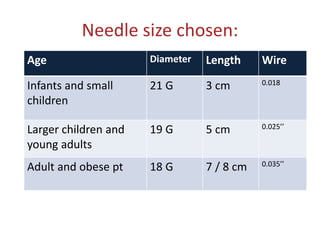
Needle size chosen:
Age Diameter Length Wire
Infants and small
children
21 G 3 cm 0.018
Larger children and
young adults
19 G 5 cm 0.025’’
Adult and obese pt 18 G 7 / 8 cm 0.035’’
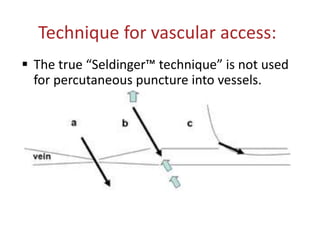
Technique for vascular access:
 The true “Seldinger™ technique” is not used
for percutaneous puncture into vessels.
Technique for vascular access:
• Modified Seldinger technique for vascular
access with single wall puncture into vessels.
Vascular Sheath
 Percutaneous introduction and then the use of an
indwelling vascular sheath in vessels is the standard
technique for catheterization of pediatric and congenital
heart patients.
 Ideal sheath should have:
1. Dilator 
1. long, fine and smoothly tapered tip.
2. inner lumen of the dilator tip should tightly fit over the guide wire
3. tip of the dilator should have a smooth, fine transitional taper onto
the surface of the wire.
2. female Lure™ lock connecting hub at the proximal end
3. back-bleed valve
4. Lateral tube / flush port
Vascular Sheath
When introduced from the inguinal area, the sheath should be long enough to
extend into the common iliac vein.
In small infants a sheath into the femoral vein should extend proximal to the
formation of the inferior vena cava.
Vascular Sheath
 Ideal short sheath (7.5 cm long) for venous site –
 5 Fr for an infant or child (<15– 20 Kg) and
 7 Fr for a larger child or adult
 Extra long sheaths (45 to 90 cm ) are used to –
1. guide catheters directly and repeatedly to an area
within the heart itself (biopsies, blade catheters),
2. for trans septal procedures,
3. to deliver special devices within the heart or great
vessels (stents, occlusion devices), and
4. for the withdrawal of foreign bodies from the vascular
system.
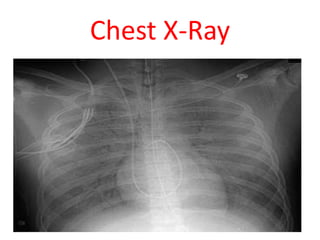
Swan-Ganz Catheter(Pulmonary
Artery Catheterization)
• Swan-Ganz Catheter-
Balloon flotation
Pulmonary Artery catheter
• Use for monitoring
critically ill patients
(mostly in the ICU)
• Catheterization only
possible on the right side
of the heart
• Catheter is hooked up to a
Cardiac Output computer
Chest X-Ray
Usage
• Detection of Heart
Failure and Septic
Shock
• Measures indirect left
ventricular pressure
• Measure Cardiac
Output by
thermodilution for:
Right Atrial and Right
Ventricular pacing and
right-sided pressures
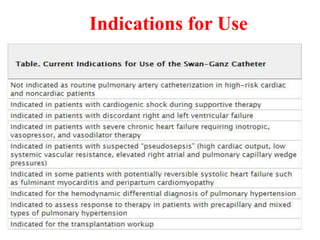
Indications for Use
Indications
• Assess volume status
• Assess RV or LV failure
• Assess Pulmonary Hypertension
• Assess Valvular disease
• Cardiac Surgery
Heart Failure Sensor
• Wireless
Radiofrequency; no
direct connection to
Cardiac Output
Computer
• Reduced
hospitalization among
heart failure patients
• Longer duration of use
• No batteries required
• No wearable parts
Advantages
• Ability to monitor
patient’s blood
flow through the
heart when
critically ill
• Detect of the
effectiveness of
certain
medications,
Heart Failure, and
Shock
Benefits
• Effect on Treatment Decisions: information gathered
from PA catheter data can beneficially change
therapy
• Preoperative Catheterization: information gathered
prior to surgery can lead to cancellation or
modification of surgical procedure, thereby
preventing morbidity and mortality
• Perioperative Monitoring: provides invasive
hemodynamic monitoring in the surgical setting
Disadvantages
• Over usage of the
balloon
• If fluid bag is not under
pressure, patient can
bleed to death
• Ventricular tachycardia
can occur if catheter
slides back into the
Right Ventricle
• Short duration of use
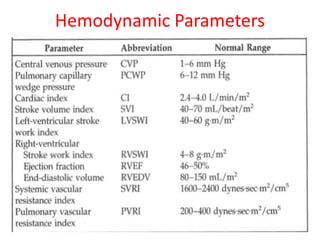
Hemodynamic Parameters
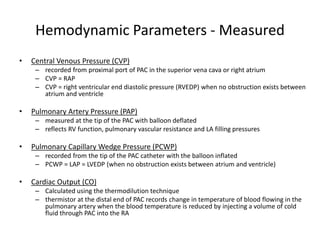
Hemodynamic Parameters - Measured
• Central Venous Pressure (CVP)
– recorded from proximal port of PAC in the superior vena cava or right atrium
– CVP = RAP
– CVP = right ventricular end diastolic pressure (RVEDP) when no obstruction exists between
atrium and ventricle
• Pulmonary Artery Pressure (PAP)
– measured at the tip of the PAC with balloon deflated
– reflects RV function, pulmonary vascular resistance and LA filling pressures
• Pulmonary Capillary Wedge Pressure (PCWP)
– recorded from the tip of the PAC catheter with the balloon inflated
– PCWP = LAP = LVEDP (when no obstruction exists between atrium and ventricle)
• Cardiac Output (CO)
– Calculated using the thermodilution technique
– thermistor at the distal end of PAC records change in temperature of blood flowing in the
pulmonary artery when the blood temperature is reduced by injecting a volume of cold
fluid through PAC into the RA
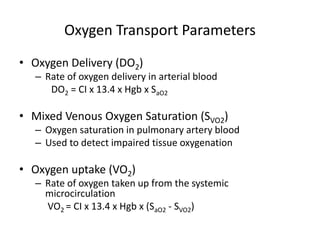
Oxygen Transport Parameters
• Oxygen Delivery (DO2)
– Rate of oxygen delivery in arterial blood
DO2 = CI x 13.4 x Hgb x SaO2
• Mixed Venous Oxygen Saturation (SVO2)
– Oxygen saturation in pulmonary artery blood
– Used to detect impaired tissue oxygenation
• Oxygen uptake (VO2)
– Rate of oxygen taken up from the systemic
microcirculation
VO2 = CI x 13.4 x Hgb x (SaO2 - SVO2)
ASA Practice Guidelines for Pulmonary
Artery Catheterization (2003)
• Appropriateness of PA catheterization depends on the risks
associated with the:
– (a) Patient: Are there presexisting medical conditions that may
increase the risk of hemodynamic instability?
– (b) Surgery: Is the procedure associated with significant hemodynamic
fluctuations which may cause end organ damage?
– (c) Practice setting: Could the complications associated with
hemodynamic disturbance be worsened if the technical or cognitive
skills of the physicians or nurses caring for the patient are poor?
ASA Practice Guidelines for Pulmonary
Artery Catheterization (2003)
• According to the Task Force on Pulmonary Artery
Catheterization, PAC monitoring was deemed appropriate
and/or necessary in the following patient groups:
– 1) surgical patients undergoing procedures associated with
a high risk of complications from hemodynamic changes
– 2) surgical patients with advanced cardiopulmonary disease
who would be at increased risk for adverse Perioperative
events
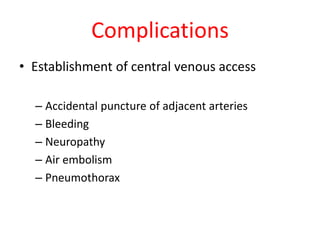
Complications
• Establishment of central venous access
– Accidental puncture of adjacent arteries
– Bleeding
– Neuropathy
– Air embolism
– Pneumothorax
Complications
• Pulmonary artery catheterization
– Dysrhythmias
• Premature ventricular and atrial contractions
• Ventricular tachycardia or fibrillation
– Right Bundle Branch Block (RBBB)
• In patients with preexistinh LBBB, can lead to complete
heart block.
– Minor increase in tricuspid regurgitation
Complications
• Pulmonary catheter residence
– Thromboembolism
– Mechanical, catheter knots
– Pulmonary Infarction
– Infection, Endocarditis
– Endocardial damage, cardiac valve injury
– Pulmonary Artery Rupture
• 0.03-0.2% incidence, 41-70% mortality
Thank Youdrtoufiq19711@yahoo.com
Asia Pacific Congress of
Hypertension, 2014, February
Cebu city, Phillipines
Seminar on Management
of Hypertension,
Gulshan, Dhaka

Right heart catheterization

  • 1.
    Right Heart Catheterization Dr.Md.Toufiqur Rahman MBBS, FCPS, MD, FACC, FESC, FRCPE, FSCAI, FAPSC, FAPSIC, FAHA, FCCP, FRCPG Associate Professor of Cardiology National Institute of Cardiovascular Diseases(NICVD), Sher-e-Bangla Nagar, Dhaka-1207 Consultant, Medinova, Malibagh branch Honorary Consultant, Apollo Hospitals, Dhaka and STS Life Care Centre, Dhanmondi drtoufiq19711@yahoo.com CRT 2014 Washington DC, USA
  • 3.
  • 4.
  • 5.
  • 6.
  • 7.
  • 8.
  • 9.
    Overview Right Heart Catheterization(RHC)  Indications  Contraindications / Caution  Equipment  Technique  Precautions  Cardiac Cycle  Pressure monitoring  Zeroing and Referencing  Fast flush test/ Square wave test  Pressure wave interpretation  Cardiac output  Derived measurements
  • 10.
    History • First Cardiaccatheterization – ▫ According to Andre Cournand, it was first performed by Claude Bernard in 1844, in a horse, both rt and lt ventrilces were entered by retrograde approach from the jugular vein and carotid artery ▫ Werner Forssmann is credited with performing the first cardiac catheterization of a living person himself, at the age of 25 yrs • Forssmann for his contribution and foresight shared the Nobel Prize in Medicine with Andre Cournand and Dickinson Richards in 1956
  • 11.
    History • 1929- Dr.Warner Forssman proven that right heart catheterization is possible in humans • 1964- Dr. Bradley introduced small diagnostic catheter • 1970- Balloon Flotation Catheter by Doctor H.J.C Swan and William Ganz
  • 12.
    Cardiac catheterization impliesthe insertion of flexible tube into one or more heart chambers usually under fluoroscopic guide for diagnostic or therapeutic purpose Definition
  • 15.
    Indication of cardiaccatheterization 1. Diagnostic indication -Collects data to evaluate PT’s condition 2. Therapeutic indication 3. Prognostic indication
  • 16.
    1. Diagnostic catheterizationis in the routine preoperative evaluation of most congenital defects, such as VSDs, ASD, TOF, DORV, CoA and other complex CHD. 2. Before interventional catheterization a. Assessment of patient hemodynamics and anatomy b. to confirm congenital or acquired heart disease in infants and children 3. When the anatomy of a CHD is inadequately defined by noninvasive means 4. in very complex lesions  specific details about the anatomy or hemodynamics 5. High-flow or low-flow physiology associated with semilunar valve stenosis a.Combined aortic stenosis (AS) and insufficiency b.Combined Pulmonary stenosis and insufficiency 6. In cavopulmonary anastomosis and after Fontan completion  Diagnostic catheterization is useful in the evaluation for proceeding with completion of Fontan, revision of Fontan, or transplantation Diagnostic indication-
  • 17.
    Diagnostic indication- 7. EPstudy 1. His bundle electrocardiography in 1st degree, 2nd degree & CHB 2. Endocardial mapping in WPW syndrome 8. Endocardial biopsy 1. DCM 2. HCM 3. Amyloidosis 4. sarcoidosis
  • 18.
    Diagnostic indication  Angiocardiography– 1. Rt and lt ventriculography – a) Chamber size b) Wall thickness c) Wall motion d) Aneurysm e) Volume f) Dimension g) Fractional shortening and h) Ejection fraction 2. Aortography – a) AR b) AS c) Co of Aorta d) PDA e) Aortic arch syndrome 3. CAG – determine coronary artery anatomy
  • 19.
    Diagnostic indication  Pressurestudy – a) it means measurement of pressure and recording of its wave form. b) High RV pressure in catheterization found in the following condition – a) VSD b) PS c) PH in MS, COPD d) Ruptured sinus of valsalva into RV c) Trans-valvular pressure difference can grade the severity of – a) AS b) PS c) MS d) PCW help to find out LVEDP  Oxymetry – a) Shunt calculation b) To determine Cardiac output
  • 20.
    Therapeutic indication 1. Closureof the following defects – 1. ASD 2. VSD 3. PDA 4. MAPCA 2. PTMC 3. Thrombolytic therapy – intracoronary, systemic 4. PTCA 5. PTA – for peripheral artery stenosis 6. Valvuloplasty – PS, MS, AS 7. Dilatation of coarctation of aorta
  • 21.
    Therapeutic indication 9. Introductionof ‘’UMBRELLA’’ in to IVC for recurrent pulmonary emboli from DVT 10. Rushkind procedure in TGA, for balloon rupture of interatrial septum by brockenbergh needle 11. Cardiac pacing 12. Peripheral arterial balloon dilatation 13. Hemodynamic monitoring and treatment of pt with cardiogenic shock by swan gauze catheter
  • 22.
    Prognostic indication 1. PostCABG catheter for assessment of – 1. cardiac function and 2. coronary perfusion 2. Post PTCA 3. After thrombolytic therapy 4. After repair of VSD 5. After valve replacement 6. Prior to any cardiac operation to estimate the prognosis of operation
  • 23.
    Contraindication of cardiaccatheterization • Absolute contraindication – In expert hand none is contraindicated 1. Patient refusal 2. IE
  • 24.
    1. Recent AMIusually within 3 week  in case of adult pt 2. Intercurrent febrile illness 2. CCF 3. Severe or malignant hypertension  predispose to myocardial ischaemia and/or heart failure during angiography 4. Life threatening arrhythmia, but it is indicated in- 1. While myocardial mapping and subsequent electrotherapy 2. Surgery is contemplated for treatment of arrhythmia Relative contraindications
  • 25.
    5. Severe renalfailure 6. Allergy to dye 7. Severe hypokalaemia 8. Anticoagulant state  PT > 18 s 9. Moribund pt 10. Primary pulmonary hypertension 11. Presence of LBBB 12. Digitalis toxicity 13. Severe anaemia 14. Severe PS Relative contraindications
  • 28.
    MEDICATIONS USED  Premadication–  Inj Pethidine  Inj Phenargoan  Saline infusion  Heparin -  For Pt  flushing all tubing, catheters, sheaths  Lidocaine for tissue numbing  Anaesthetic medication for relaxing the pt  Water soluble contrast
  • 29.
    EQUIPMENT NEEDED  Proceduretray should include: 1. sterile – 1. gowns and gloves 2. sterile towels and drapes for procedure 3. Sterile gauze 4. scalpel, needles, scissors, hemostats 5. syringes for heparin/saline flush, lidocaine, and blood oximetry 1. labels with marking pen for any item filled with a solution 2. basin for heparin/saline mixture & waste fluids, 3. skin prep solution 4. connection tubing
  • 30.
    EQUIPMENT NEEDED  Anaesthesiamachine  Oxygen supply  Suction apparatus  Defibrillator  Temporary pacemaker  Pulse oximeter  NIBP  Equipment to perform cardiac output studies  Activated clotting time (ACT) equipment 30
  • 31.
    EQUIPMENT NEEDED 1. Needle 2.Sheath 3. Wires 4. Catheters 5. Fluroscopic machine 6. Power injector
  • 32.
    Vascular access Venous AccessArterial Access Femoral vein Median basalic vein Subclavian vein Internal jugular vein Umbilical vein Transhepatic route Femoral artery Radial artery Umbilical artery Carotid artery
  • 33.
    Needles for percutaneouspuncture • Angiographic needle – designed for single wall puncture – small in diameter, – thin walled, – short beveled – very sharp. – Hub  clear • True Seldinger needle • Chiba™ needle percutaneous transhepatic access
  • 34.
    Angiographic Needle withProtector, Seldinger Hub, Thin Wall True Seldinger Needle Chiba Needle
  • 35.
    Needle size chosen: AgeDiameter Length Wire Infants and small children 21 G 3 cm 0.018 Larger children and young adults 19 G 5 cm 0.025’’ Adult and obese pt 18 G 7 / 8 cm 0.035’’
  • 36.
    Technique for vascularaccess:  The true “Seldinger™ technique” is not used for percutaneous puncture into vessels.
  • 37.
    Technique for vascularaccess: • Modified Seldinger technique for vascular access with single wall puncture into vessels.
  • 38.
    Vascular Sheath  Percutaneousintroduction and then the use of an indwelling vascular sheath in vessels is the standard technique for catheterization of pediatric and congenital heart patients.  Ideal sheath should have: 1. Dilator  1. long, fine and smoothly tapered tip. 2. inner lumen of the dilator tip should tightly fit over the guide wire 3. tip of the dilator should have a smooth, fine transitional taper onto the surface of the wire. 2. female Lure™ lock connecting hub at the proximal end 3. back-bleed valve 4. Lateral tube / flush port
  • 39.
    Vascular Sheath When introducedfrom the inguinal area, the sheath should be long enough to extend into the common iliac vein. In small infants a sheath into the femoral vein should extend proximal to the formation of the inferior vena cava.
  • 40.
    Vascular Sheath  Idealshort sheath (7.5 cm long) for venous site –  5 Fr for an infant or child (<15– 20 Kg) and  7 Fr for a larger child or adult  Extra long sheaths (45 to 90 cm ) are used to – 1. guide catheters directly and repeatedly to an area within the heart itself (biopsies, blade catheters), 2. for trans septal procedures, 3. to deliver special devices within the heart or great vessels (stents, occlusion devices), and 4. for the withdrawal of foreign bodies from the vascular system.
  • 41.
    Swan-Ganz Catheter(Pulmonary Artery Catheterization) •Swan-Ganz Catheter- Balloon flotation Pulmonary Artery catheter • Use for monitoring critically ill patients (mostly in the ICU) • Catheterization only possible on the right side of the heart • Catheter is hooked up to a Cardiac Output computer
  • 42.
  • 43.
    Usage • Detection ofHeart Failure and Septic Shock • Measures indirect left ventricular pressure • Measure Cardiac Output by thermodilution for: Right Atrial and Right Ventricular pacing and right-sided pressures
  • 44.
  • 45.
    Indications • Assess volumestatus • Assess RV or LV failure • Assess Pulmonary Hypertension • Assess Valvular disease • Cardiac Surgery
  • 46.
    Heart Failure Sensor •Wireless Radiofrequency; no direct connection to Cardiac Output Computer • Reduced hospitalization among heart failure patients • Longer duration of use • No batteries required • No wearable parts
  • 47.
    Advantages • Ability tomonitor patient’s blood flow through the heart when critically ill • Detect of the effectiveness of certain medications, Heart Failure, and Shock
  • 48.
    Benefits • Effect onTreatment Decisions: information gathered from PA catheter data can beneficially change therapy • Preoperative Catheterization: information gathered prior to surgery can lead to cancellation or modification of surgical procedure, thereby preventing morbidity and mortality • Perioperative Monitoring: provides invasive hemodynamic monitoring in the surgical setting
  • 49.
    Disadvantages • Over usageof the balloon • If fluid bag is not under pressure, patient can bleed to death • Ventricular tachycardia can occur if catheter slides back into the Right Ventricle • Short duration of use
  • 50.
  • 51.
    Hemodynamic Parameters -Measured • Central Venous Pressure (CVP) – recorded from proximal port of PAC in the superior vena cava or right atrium – CVP = RAP – CVP = right ventricular end diastolic pressure (RVEDP) when no obstruction exists between atrium and ventricle • Pulmonary Artery Pressure (PAP) – measured at the tip of the PAC with balloon deflated – reflects RV function, pulmonary vascular resistance and LA filling pressures • Pulmonary Capillary Wedge Pressure (PCWP) – recorded from the tip of the PAC catheter with the balloon inflated – PCWP = LAP = LVEDP (when no obstruction exists between atrium and ventricle) • Cardiac Output (CO) – Calculated using the thermodilution technique – thermistor at the distal end of PAC records change in temperature of blood flowing in the pulmonary artery when the blood temperature is reduced by injecting a volume of cold fluid through PAC into the RA
  • 52.
    Oxygen Transport Parameters •Oxygen Delivery (DO2) – Rate of oxygen delivery in arterial blood DO2 = CI x 13.4 x Hgb x SaO2 • Mixed Venous Oxygen Saturation (SVO2) – Oxygen saturation in pulmonary artery blood – Used to detect impaired tissue oxygenation • Oxygen uptake (VO2) – Rate of oxygen taken up from the systemic microcirculation VO2 = CI x 13.4 x Hgb x (SaO2 - SVO2)
  • 53.
    ASA Practice Guidelinesfor Pulmonary Artery Catheterization (2003) • Appropriateness of PA catheterization depends on the risks associated with the: – (a) Patient: Are there presexisting medical conditions that may increase the risk of hemodynamic instability? – (b) Surgery: Is the procedure associated with significant hemodynamic fluctuations which may cause end organ damage? – (c) Practice setting: Could the complications associated with hemodynamic disturbance be worsened if the technical or cognitive skills of the physicians or nurses caring for the patient are poor?
  • 54.
    ASA Practice Guidelinesfor Pulmonary Artery Catheterization (2003) • According to the Task Force on Pulmonary Artery Catheterization, PAC monitoring was deemed appropriate and/or necessary in the following patient groups: – 1) surgical patients undergoing procedures associated with a high risk of complications from hemodynamic changes – 2) surgical patients with advanced cardiopulmonary disease who would be at increased risk for adverse Perioperative events
  • 55.
    Complications • Establishment ofcentral venous access – Accidental puncture of adjacent arteries – Bleeding – Neuropathy – Air embolism – Pneumothorax
  • 56.
    Complications • Pulmonary arterycatheterization – Dysrhythmias • Premature ventricular and atrial contractions • Ventricular tachycardia or fibrillation – Right Bundle Branch Block (RBBB) • In patients with preexistinh LBBB, can lead to complete heart block. – Minor increase in tricuspid regurgitation
  • 57.
    Complications • Pulmonary catheterresidence – Thromboembolism – Mechanical, catheter knots – Pulmonary Infarction – Infection, Endocarditis – Endocardial damage, cardiac valve injury – Pulmonary Artery Rupture • 0.03-0.2% incidence, 41-70% mortality
  • 62.
    Thank Youdrtoufiq19711@yahoo.com Asia PacificCongress of Hypertension, 2014, February Cebu city, Phillipines Seminar on Management of Hypertension, Gulshan, Dhaka