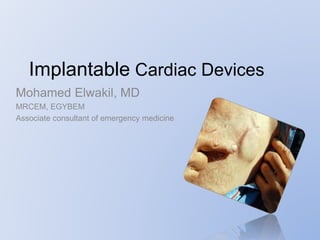
Implantable Cardiac Devices
Mohamed Elwakil, MD
MRCEM, EGYBEM
Associate consultant of emergency medicine
TYPES
• Pacemaker
• ICD
• CRT
• Cardiac Assist Devices
Pacemakers
Introduction
Pace /peɪs/ :move or develop (something) at a particular rate or
speed.
Modern Pacemakers are devices that detect the electrical activity of
the heart (sense) and stimulate it to contract at a faster rate.
First described in 1952,
Permanent transvenous pacing devices were introduced into clinical
practice in the early 1960s.
Indications
• symptomatic heart block
• symptomatic sinus bradycardia
• atrial fibrillation with a symptomatic
bradycardia (low ventricular response rate)
in the absence of medications that affect
atrioventricular (AV) conduction.
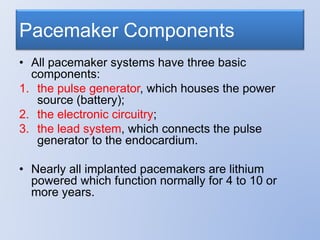
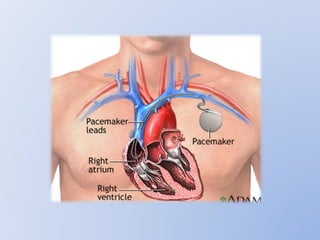
Pacemaker Components
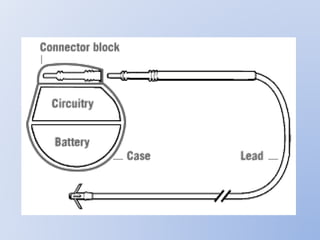
• All pacemaker systems have three basic
components:
1. the pulse generator, which houses the power
source (battery);
2. the electronic circuitry;
3. the lead system, which connects the pulse
generator to the endocardium.
• Nearly all implanted pacemakers are lithium
powered which function normally for 4 to 10 or
more years.
• Permanent pacemakers have endocardial
leads that are positioned in contact with
the endocardium of the right ventricle and,
in the case of a dual-chamber device, the
right atrium, with a subclavian or cephalic
vein approach used for insertion.
Pacemaker Terminology
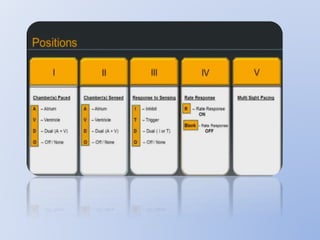
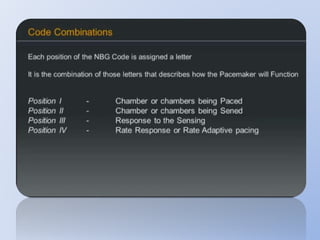
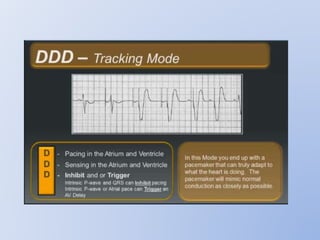
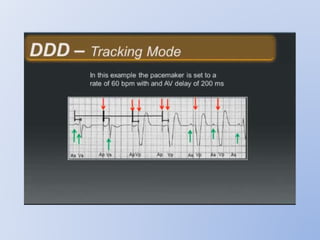
• In 1974, A letter code was established
• Five-letter code scheme
• The 1st 3 codes letters are used most
commonly
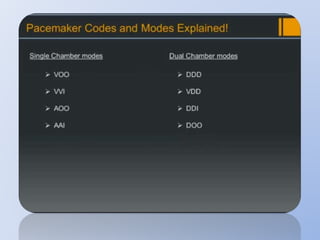
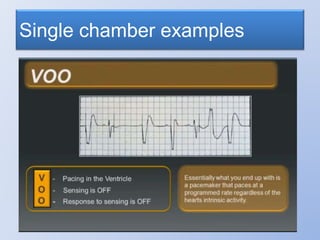
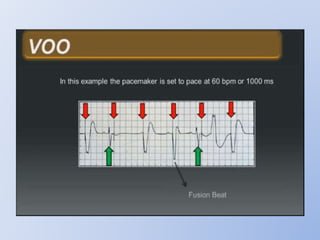
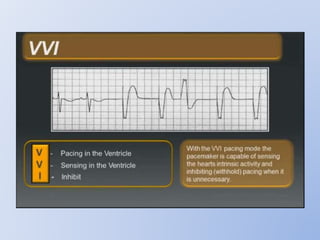
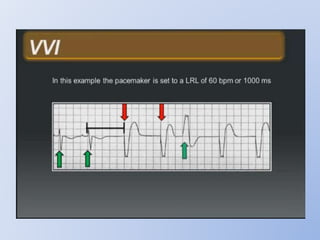
Single chamber examples
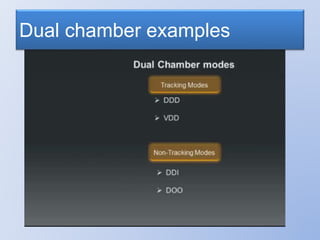
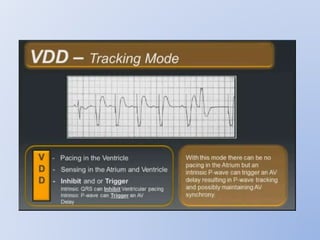
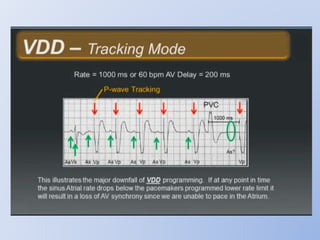
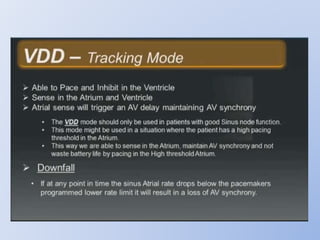
Dual chamber examples
Complications
• If a patient with a pacemaker has a fever of
unclear cause, pacemaker lead infection and
endocarditis should be considered.
• Pain in the arm ipsilateral to the site of
insertion should suggest acute
thrombophlebitis.
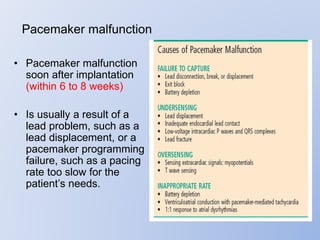
• Pacemaker malfunction
soon after implantation
(within 6 to 8 weeks)
• Is usually a result of a
lead problem, such as a
lead displacement, or a
pacemaker programming
failure, such as a pacing
rate too slow for the
patient’s needs.
Pacemaker malfunction
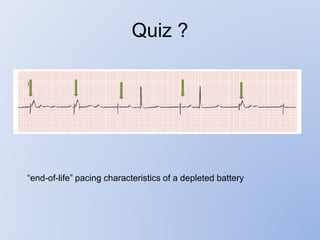
Quiz ?
“end-of-life” pacing characteristics of a depleted battery
ACLS and Pacemaker
• Electrical defibrillation at recommended shock
strengths (200, 300, and 360 J) can be safely
performed in the patient with a pacemaker.
• The safe distance is (>10 cm) from the pulse
generator. Alternatively, defibrillation electrodes can be
placed in an anteroposterior configuration.
• Temporary transcutaneous pacing may be needed if
the pacemaker cannot be reprogrammed or normal
pacing does not resume spontaneously.
Transcutaneous Pacing
• Temporary cardiac pacing using pads or paddles
applied externally to the chest.
• INDICATIONS:
1. bradycardia unresponsive to drug therapy
2. 3rd degree heart block
3. Mobitz type II second-degree heart block when
haemodynamically unstable or operation planned
4. overdrive pacing
5. asystole
Transcutaneous Pacing, cont.
METHOD OF INSERTION AND/OR USE
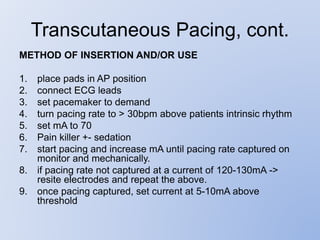
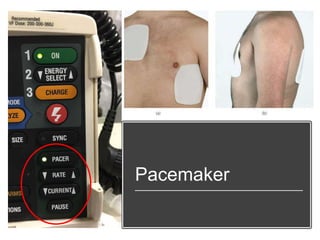
1. place pads in AP position
2. connect ECG leads
3. set pacemaker to demand
4. turn pacing rate to > 30bpm above patients intrinsic rhythm
5. set mA to 70
6. Pain killer +- sedation
7. start pacing and increase mA until pacing rate captured on
monitor and mechanically.
8. if pacing rate not captured at a current of 120-130mA ->
resite electrodes and repeat the above.
9. once pacing captured, set current at 5-10mA above
threshold
Pacemaker
Implantable Cardioverter-
defibrillators
ICD
Implantable Cardioverter-defibrillators
ICD
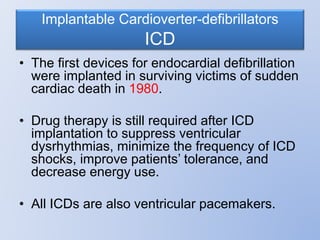
• The first devices for endocardial defibrillation
were implanted in surviving victims of sudden
cardiac death in 1980.
• Drug therapy is still required after ICD
implantation to suppress ventricular
dysrhythmias, minimize the frequency of ICD
shocks, improve patients’ tolerance, and
decrease energy use.
• All ICDs are also ventricular pacemakers.
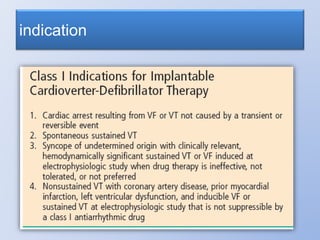
indication
• The most common complaint of ICD patients is the
occurrence of frequent shocks.
• An increase in the frequency of episodes may occur in
the setting of hypokalemia, hypomagnesemia,
ischemia (with or without infarction), or the
proarrhythmic effect of drugs administered to decrease
the frequency of ventricular tachyarrhythmias.
• Many ICD patients, particularly those with newly
implanted devices, report that their device has
discharged, but subsequent device interrogation
reveals that no discharge occurred
Complications
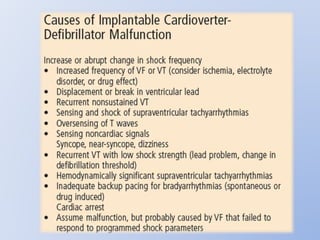
ACLS and ICD
• An ICD does not prevent sudden death in all
patients at risk, and a patient with an ICD may
arrive in cardiac arrest (2% annual incidence in
patients with implanted devices).
• Resuscitation efforts in the patient with an ICD
should be undertaken.
• Deactivation with magnet application is important
in the immediate post-resuscitation period.
Ventricular dysrhythmias are common at this time
due to prolonged global myocardial ischemia.
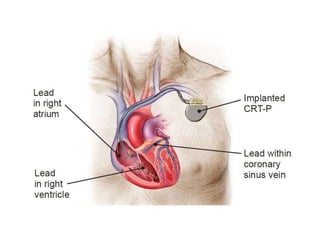
Biventricular Pacing
CRT
cardiac resynchronization
therapy
• Is a therapy for patients with left-sided heart
failure (ejection fracture under 35%) and
ventricular dyssynchrony.
• Indications
1. patients with (NYHA) class II, III or IV heart
failure
2. left ventricular dysfunction
3. left bundle branch block
complication
• coronary sinus dissection occurred in 0.3% to
4.0% of patients and coronary vein or
coronary sinus perforation in 0.8% to 2.0% of
patients
• Cardiac tamponade, less than 1% of patients.
• Dislodgement of the left ventricular electrode
with resultant loss of pacing occurs as an
early complication in approximately 10% of
patients
Cardiac Assist Devices
Overview
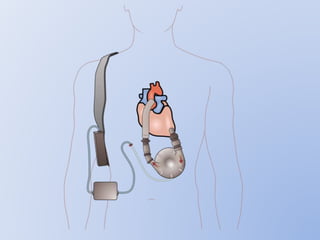
• Mechanical ventricular assistance devices
have been used as a“bridge” to
transplantation since the 1960s.
• Devices: Jarvik 2000 and HeartMate II
• Types
1. The left ventricular assist device (LVAD)
2. The biventricular assist device (BiVAD)
3. Total artificial heart (TAH).
• Most left ventricular assist device (LVADs) do
not produce pulsatile flow; therefore, these
patients will not have a palpable pulse.
• Patients with a total artificial heart (TAH) have
no native heart and no cardiac electrical
activity. Electrocardiogram (ECG) for the TAH
will read asystole. Defibrillation and pacing
will not be effective. Chest compressions will
not be effective and may be harmful.
Take Home
• Pacemaker malfunction arises in a limited number of
ways: failure to pace, oversensing, undersensing, and
pacing at an inappropriate rate (too fast or too slow).
• paced ventricular complexes are conducted with a left
bundle branch block pattern, A right bundle branch
pattern is abnormal and suggests lead displacement.
• Magnet application does not turn off a pacemaker, it
turns off the sensing or inhibition function. Fixed-rate
pacing that is independent of or in competition with the
underlying native rhythm will ensue. Removal of the
magnet restores the inhibitory activity of the
pacemaker and returns it to demand pacing mode.
• Defibrillation is safe in patients with a
pacemaker or implantable cardioverter-
defibrillator (ICD). Paddles should be
placed at least 10 cm from the
subcutaneous implant site of the device.
References
• Rosenen`s 2018, Implantable Cardiac Devices
• Pacemaker Codes and Modes – Explained,
https://www.youtube.com/watch?v=L-
lMhDQTq7w&index=18&list=WL
• https://lifeinthefastlane.com/ccc/transcutane
ous-pacing/
• https://en.wikipedia.org/wiki/Ventricular_assi
st_device

Implantable Cardiac Devices

  • 1.
    Implantable Cardiac Devices MohamedElwakil, MD MRCEM, EGYBEM Associate consultant of emergency medicine
  • 2.
    TYPES • Pacemaker • ICD •CRT • Cardiac Assist Devices
  • 3.
  • 4.
    Introduction Pace /peɪs/ :moveor develop (something) at a particular rate or speed. Modern Pacemakers are devices that detect the electrical activity of the heart (sense) and stimulate it to contract at a faster rate. First described in 1952, Permanent transvenous pacing devices were introduced into clinical practice in the early 1960s.
  • 5.
    Indications • symptomatic heartblock • symptomatic sinus bradycardia • atrial fibrillation with a symptomatic bradycardia (low ventricular response rate) in the absence of medications that affect atrioventricular (AV) conduction.
  • 7.
    Pacemaker Components • Allpacemaker systems have three basic components: 1. the pulse generator, which houses the power source (battery); 2. the electronic circuitry; 3. the lead system, which connects the pulse generator to the endocardium. • Nearly all implanted pacemakers are lithium powered which function normally for 4 to 10 or more years.
  • 9.
    • Permanent pacemakershave endocardial leads that are positioned in contact with the endocardium of the right ventricle and, in the case of a dual-chamber device, the right atrium, with a subclavian or cephalic vein approach used for insertion.
  • 12.
    Pacemaker Terminology • In1974, A letter code was established • Five-letter code scheme • The 1st 3 codes letters are used most commonly
  • 16.
  • 21.
  • 28.
    Complications • If apatient with a pacemaker has a fever of unclear cause, pacemaker lead infection and endocarditis should be considered. • Pain in the arm ipsilateral to the site of insertion should suggest acute thrombophlebitis.
  • 30.
    • Pacemaker malfunction soonafter implantation (within 6 to 8 weeks) • Is usually a result of a lead problem, such as a lead displacement, or a pacemaker programming failure, such as a pacing rate too slow for the patient’s needs. Pacemaker malfunction
  • 31.
    Quiz ? “end-of-life” pacingcharacteristics of a depleted battery
  • 32.
    ACLS and Pacemaker •Electrical defibrillation at recommended shock strengths (200, 300, and 360 J) can be safely performed in the patient with a pacemaker. • The safe distance is (>10 cm) from the pulse generator. Alternatively, defibrillation electrodes can be placed in an anteroposterior configuration. • Temporary transcutaneous pacing may be needed if the pacemaker cannot be reprogrammed or normal pacing does not resume spontaneously.
  • 33.
    Transcutaneous Pacing • Temporarycardiac pacing using pads or paddles applied externally to the chest. • INDICATIONS: 1. bradycardia unresponsive to drug therapy 2. 3rd degree heart block 3. Mobitz type II second-degree heart block when haemodynamically unstable or operation planned 4. overdrive pacing 5. asystole
  • 34.
    Transcutaneous Pacing, cont. METHODOF INSERTION AND/OR USE 1. place pads in AP position 2. connect ECG leads 3. set pacemaker to demand 4. turn pacing rate to > 30bpm above patients intrinsic rhythm 5. set mA to 70 6. Pain killer +- sedation 7. start pacing and increase mA until pacing rate captured on monitor and mechanically. 8. if pacing rate not captured at a current of 120-130mA -> resite electrodes and repeat the above. 9. once pacing captured, set current at 5-10mA above threshold
  • 35.
  • 37.
  • 38.
    Implantable Cardioverter-defibrillators ICD • Thefirst devices for endocardial defibrillation were implanted in surviving victims of sudden cardiac death in 1980. • Drug therapy is still required after ICD implantation to suppress ventricular dysrhythmias, minimize the frequency of ICD shocks, improve patients’ tolerance, and decrease energy use. • All ICDs are also ventricular pacemakers.
  • 39.
  • 40.
    • The mostcommon complaint of ICD patients is the occurrence of frequent shocks. • An increase in the frequency of episodes may occur in the setting of hypokalemia, hypomagnesemia, ischemia (with or without infarction), or the proarrhythmic effect of drugs administered to decrease the frequency of ventricular tachyarrhythmias. • Many ICD patients, particularly those with newly implanted devices, report that their device has discharged, but subsequent device interrogation reveals that no discharge occurred Complications
  • 42.
    ACLS and ICD •An ICD does not prevent sudden death in all patients at risk, and a patient with an ICD may arrive in cardiac arrest (2% annual incidence in patients with implanted devices). • Resuscitation efforts in the patient with an ICD should be undertaken. • Deactivation with magnet application is important in the immediate post-resuscitation period. Ventricular dysrhythmias are common at this time due to prolonged global myocardial ischemia.
  • 44.
  • 46.
    cardiac resynchronization therapy • Isa therapy for patients with left-sided heart failure (ejection fracture under 35%) and ventricular dyssynchrony. • Indications 1. patients with (NYHA) class II, III or IV heart failure 2. left ventricular dysfunction 3. left bundle branch block
  • 47.
    complication • coronary sinusdissection occurred in 0.3% to 4.0% of patients and coronary vein or coronary sinus perforation in 0.8% to 2.0% of patients • Cardiac tamponade, less than 1% of patients. • Dislodgement of the left ventricular electrode with resultant loss of pacing occurs as an early complication in approximately 10% of patients
  • 48.
  • 50.
    Overview • Mechanical ventricularassistance devices have been used as a“bridge” to transplantation since the 1960s. • Devices: Jarvik 2000 and HeartMate II • Types 1. The left ventricular assist device (LVAD) 2. The biventricular assist device (BiVAD) 3. Total artificial heart (TAH).
  • 51.
    • Most leftventricular assist device (LVADs) do not produce pulsatile flow; therefore, these patients will not have a palpable pulse. • Patients with a total artificial heart (TAH) have no native heart and no cardiac electrical activity. Electrocardiogram (ECG) for the TAH will read asystole. Defibrillation and pacing will not be effective. Chest compressions will not be effective and may be harmful.
  • 53.
    Take Home • Pacemakermalfunction arises in a limited number of ways: failure to pace, oversensing, undersensing, and pacing at an inappropriate rate (too fast or too slow). • paced ventricular complexes are conducted with a left bundle branch block pattern, A right bundle branch pattern is abnormal and suggests lead displacement. • Magnet application does not turn off a pacemaker, it turns off the sensing or inhibition function. Fixed-rate pacing that is independent of or in competition with the underlying native rhythm will ensue. Removal of the magnet restores the inhibitory activity of the pacemaker and returns it to demand pacing mode.
  • 54.
    • Defibrillation issafe in patients with a pacemaker or implantable cardioverter- defibrillator (ICD). Paddles should be placed at least 10 cm from the subcutaneous implant site of the device.
  • 56.
    References • Rosenen`s 2018,Implantable Cardiac Devices • Pacemaker Codes and Modes – Explained, https://www.youtube.com/watch?v=L- lMhDQTq7w&index=18&list=WL • https://lifeinthefastlane.com/ccc/transcutane ous-pacing/ • https://en.wikipedia.org/wiki/Ventricular_assi st_device

Editor's Notes

  • #18 Characteristically, a left bundle branch block conduction pattern is seen. A right bundle branch pattern is abnormal and may represent lead displacement through a patent foramen ovale, placement of the lead in the coronary sinus, septal perforation, or may be seen with safe right ventricular apical position.
  • #31 The term pacemaker malfunction refers specifically to problems with the circuitry or power source of the pulse generator, the pacemaker lead (most commonly displacement or fracture), or the interface between the pacing electrode and the myocardium (pacing or sensing threshold). In addition, environmental factors, such as extracardiac or extracorporeal electrical signals, may interfere with normal pacemaker function.18,19 With use of the standard electrocardiogram (ECG), pacemaker malfunction can be separated into three broad categories: (1) failure to capture (no pacemaker spikes or spikes not followed by an atrial or ventricular complex), (2) inappropriate sensing (oversensing or undersensing spikes occur prematurely or do not occur even though the programmed interval is exceeded), or (3) inappropriate pacemaker rate. Symptomatic pacemaker malfunction after implantation occurs in less than 5% of patients and is rarely immediately lifethreatening. Malfunction is most commonly a result of inappropriate sensing, followed by failure to capture. Typical presentations and causes of pacemaker malfunction are listed in
  • #32 Intermittent failure to capture and slow pacing rate (lead I). This lead I rhythm strip demonstrates intermittent failure to capture of a VVI pacemaker. The first and second pacemaker spikes are followed by wide-paced QRS complexes; the third and fourth spikes are not. The pacemaker spikes occur at a rate of approximately 50 beats/min. The device was programmed to pace at a rate of 75 beats/min. This is a typical example of “end-of-life” pacing characteristics of a depleted battery.