Approach to pt with pacemaker and ICDs Badar AlHamrashdi. EM OMSB R3
Outline Pacemaker codes Pacemaker configurations Indications for pacemakers Problems with pacemakers ICDs Summery .
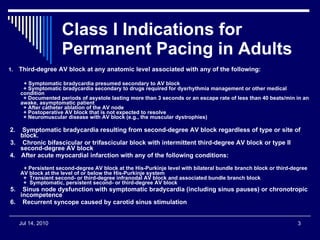
Class I Indications for Permanent Pacing in Adults   1.     Third-degree AV block at any anatomic level associated with any of the following:     + Symptomatic bradycardia presumed secondary to AV block   + Symptomatic bradycardia secondary to drugs required for dysrhythmia management or other medical condition   + Documented periods of asystole lasting more than 3 seconds or an escape rate of less than 40 beats/min in an awake, asymptomatic patient   + After catheter ablation of the AV node   + Postoperative AV block that is not expected to resolve   + Neuromuscular disease with AV block (e.g., the muscular dystrophies)   2.    Symptomatic bradycardia resulting from second-degree AV block regardless of type or site of block.   3.    Chronic bifascicular or trifascicular block with intermittent third-degree AV block or type II second-degree AV block   4.      After acute myocardial infarction with any of the following conditions:     + Persistent second-degree AV block at the His-Purkinje level with bilateral bundle branch block or third-degree AV block at the level of or below the His-Purkinje system   +  Transient second- or third-degree infranodal AV block and associated bundle branch block   +  Symptomatic, persistent second- or third-degree AV block 5.    Sinus node dysfunction with symptomatic bradycardia (including sinus pauses) or chronotropic incompetence   6.    Recurrent syncope caused by carotid sinus stimulation
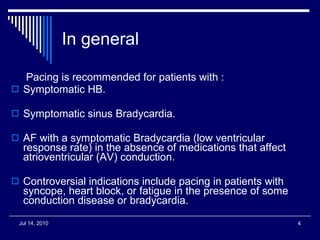
In general Pacing is recommended for patients with : Symptomatic HB. Symptomatic sinus Bradycardia. AF with a symptomatic Bradycardia (low ventricular response rate) in the absence of medications that affect atrioventricular (AV) conduction.  Controversial indications include pacing in patients with syncope, heart block, or fatigue in the presence of some conduction disease or bradycardia.
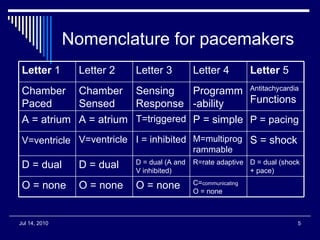
Nomenclature for pacemakers  C= communicating  O = none O = none  O = none  O = none  D = dual (shock + pace) R=rate adaptive D = dual (A and V inhibited) D = dual D = dual S = shock  M=multiprogrammable  I = inhibited  V=ventricle  V=ventricle   P = pacing   P = simple  T=triggered   A = atrium  A = atrium  Antitachycardia  Functions  Programm-ability  Sensing Response  Chamber Sensed  Chamber Paced  Letter  5 Letter 4 Letter 3 Letter 2 Letter  1
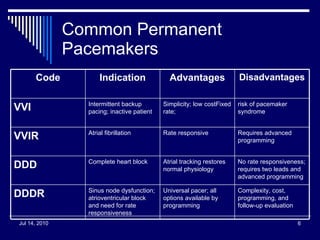
Common Permanent Pacemakers  Complexity, cost, programming, and follow-up evaluation Universal pacer; all options available by programming Sinus node dysfunction; atrioventricular block and need for rate responsiveness DDDR No rate responsiveness; requires two leads and advanced programming Atrial tracking restores normal physiology Complete heart block DDD Requires advanced programming Rate responsive Atrial fibrillation VVIR risk of pacemaker syndrome Simplicity; low costFixed rate;  Intermittent backup pacing; inactive patient VVI Disadvantages Advantages Indication Code
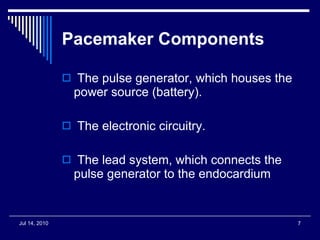
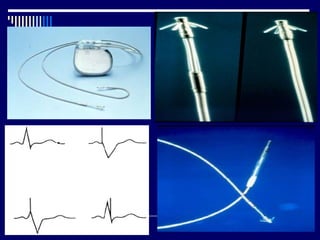
Pacemaker Components The pulse generator, which houses the  power source (battery). The electronic circuitry. The lead system, which connects the pulse generator to the endocardium
 
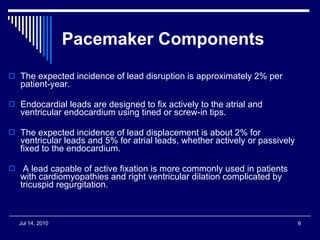
Pacemaker Components The expected incidence of lead disruption is approximately 2% per patient-year. Endocardial leads are designed to fix actively to the atrial and ventricular endocardium using tined or screw-in tips.  The expected incidence of lead displacement is about 2% for ventricular leads and 5% for atrial leads, whether actively or passively fixed to the endocardium. A lead capable of active fixation is more commonly used in patients with cardiomyopathies and right ventricular dilation complicated by tricuspid regurgitation.
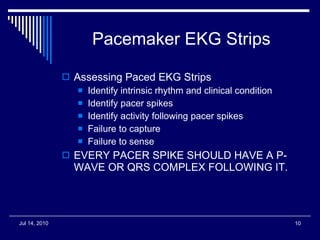
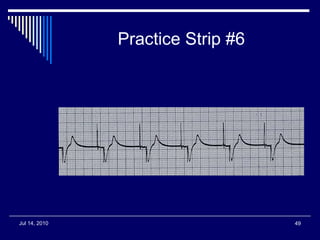
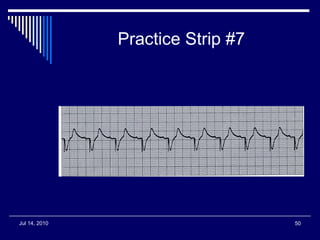
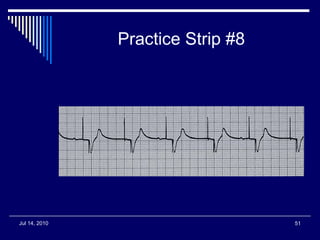
Pacemaker EKG Strips Assessing Paced EKG Strips Identify intrinsic rhythm and clinical condition Identify pacer spikes Identify activity following pacer spikes Failure to capture Failure to sense EVERY PACER SPIKE SHOULD HAVE A P-WAVE OR QRS COMPLEX FOLLOWING IT.
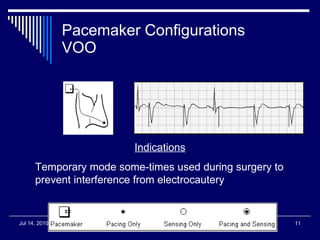
Pacemaker Configurations VOO Indications Temporary mode some-times used during surgery to prevent interference from electrocautery
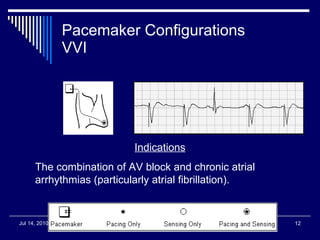
Pacemaker Configurations VVI Indications The combination of AV block and chronic atrial arrhythmias (particularly atrial fibrillation).
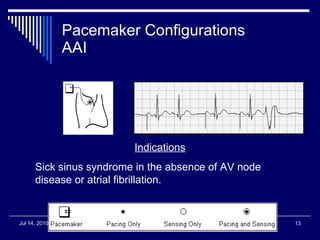
Pacemaker Configurations AAI Indications Sick sinus syndrome in the absence of AV node disease or atrial fibrillation.
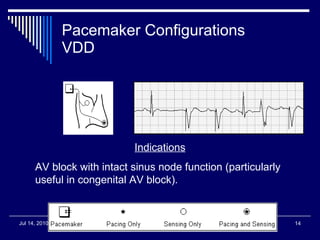
Pacemaker Configurations VDD Indications AV block with intact sinus node function (particularly useful in congenital AV block).
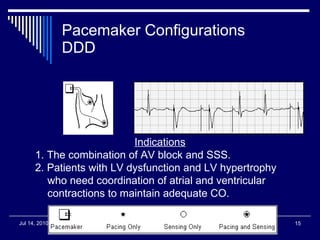
Pacemaker Configurations DDD Indications 1. The combination of AV block and SSS. 2. Patients with LV dysfunction and LV hypertrophy who need coordination of atrial and ventricular contractions to maintain adequate CO.
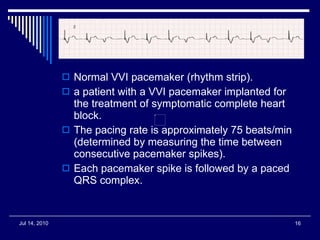
Normal VVI pacemaker (rhythm strip). a patient with a VVI pacemaker implanted for the treatment of symptomatic complete heart block.  The pacing rate is approximately 75 beats/min (determined by measuring the time between consecutive pacemaker spikes).  Each pacemaker spike is followed by a paced QRS complex.
 
Complications of Implantation   Infection . Thrombophlebitis  . The “Pacemaker Syndrome”  . Pacemaker Malfunction .
Complications of Implantation Infection: Surgical procedure + FB. Incidence : 2 %.sepsis :1%. Pain & local inflammation. 20-25% +ve blood c/s. S. aureus  and  S. epidermidis in 60-70%. Emperic Abics: vancomycin The pulse generator & pacemaker lead are usually removed  .
Complications of Implantation Thrombophlebitis: Incidence of venous obstruction ranges from 30% to 50%  . Axillary, subclavian, and innominate veins or (SVC) . Edema, pain, & venous engorgement of the arm ipsilateral to the site of lead insertion only in 0.5-3.5 %. Dx:Duplex u/s of the J.venous system, venography, or contrast-enhanced CT. Rx: I/V heparin therapy followed by long-term warfarin
Complications of Implantation The “Pacemaker Syndrome”: * After implantation, in 20%. * A pt may present with new complaints or a worsening of the Sx that prompted evaluation & eventual pacemaker therapy. * These include syncope or near-syncope, orthostatic dizziness, fatigue, exercise intolerance, weakness, lethargy, chest fullness or pain, cough, uncomfortable pulsations in the neck or abdomen, right upper quadrant pain, and other nonspecific symptoms.
Complications of Implantation The “Pacemaker Syndrome”: * The etiology :is the loss of AV synchrony &  * Is most common with VVI pacing  * Elevated (BNP) & diuresis .  * DDI pacing in a pt with AV block may result in this syndrome if the sinus node discharge rate exceeds the programmed rate of the pacemaker.  * Rx: replacing a VVI pacemaker with a dual-chamber pacemaker or lowering the pacing rate of the VVI unit. * Consultation with a cardiologist is recommended .
Complications of Implantation Pacemaker Malfunction  :
Assessment of pacemaker function Magnet placement externally over the pulse generator . It does not inhibit or turn off a pacemaker . Converts the pacemaker to an asynchronous or fixed-rate pacing mode, It is no longer inhibited by the patient's intrinsic electrical activity.  Used when the pt's intrinsic heart rate exceeds the pacemaker's set rate and pacemaker function is inhibited.  Magnet application then allows pacing to occur, and pacing rate and the presence of capture can be determined.
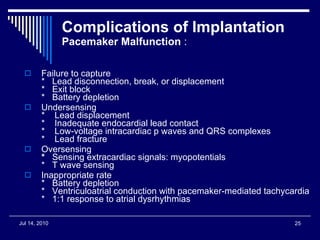
Complications of Implantation  Pacemaker Malfunction  : Failure to capture    *   Lead disconnection, break, or displacement   *   Exit block   *   Battery depletion    Undersensing    *    Lead displacement   *    Inadequate endocardial lead contact   *    Low-voltage intracardiac p waves and QRS complexes   *    Lead fracture    Oversensing     *    Sensing extracardiac signals: myopotentials   *  T wave sensing    Inappropriate rate    *   Battery depletion   *   Ventriculoatrial conduction with pacemaker-mediated tachycardia   *   1:1 response to atrial dysrhythmias
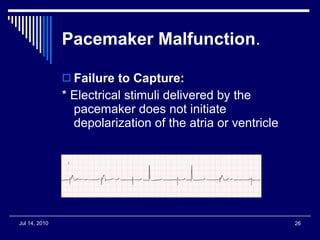
Pacemaker Malfunction . Failure to Capture: * Electrical stimuli delivered by the pacemaker does not initiate depolarization of the atria or ventricle
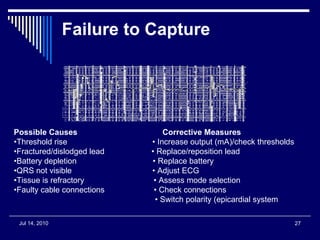
Failure to Capture   Possible Causes  Corrective Measures • Threshold rise  • Increase output (mA)/check thresholds • Fractured/dislodged lead  • Replace/reposition lead • Battery depletion  • Replace battery • QRS not visible  • Adjust ECG • Tissue is refractory  • Assess mode selection • Faulty cable connections  • Check connections •  Switch polarity (epicardial system
Pacemaker Malfunction  : Inappropriate Sensing * Undersensing  . * Oversensing.
Undersensing Failure of the pacemaker to sense intrinsic R-waves or intrinsic P-waves May be complete or intermittent.  May result from a change in the sensing parameters selected at the time of insertion.  This is most commonly  after acute RV infarction or cardiomyopathies, causing intracardiac signals to decrease in amplitude.  It is typically recognized electrocardiographically as the appearance of pacemaker spikes occurring earlier than the programmed rate.  Failure of a stimulus spike to produce a complex when it occurs during the atrial or ventricular refractory period should not be interpreted as failure to pace.
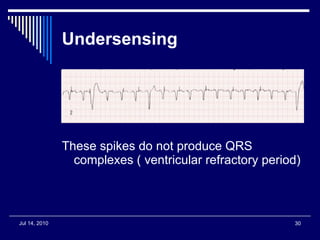
Undersensing These spikes do not produce QRS complexes ( ventricular refractory period)
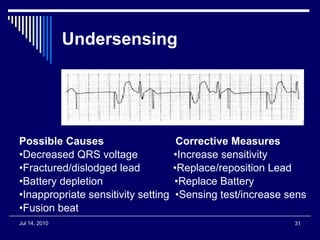
Undersensing Possible Causes  Corrective Measures • Decreased QRS voltage  •Increase sensitivity • Fractured/dislodged lead  •Replace/reposition Lead • Battery depletion  •Replace Battery • Inappropriate sensitivity setting  •Sensing test/increase sens • Fusion beat
Oversensing   Inhibition of the pacemaker by events  that is not of cardiac origin. Pacemaker should ignore, e.g. T-waves, myopotentials and  electrocautery. The result may be intermittent, irregular pacing or an apparent complete absence of pacemaker function.  Close proximity to a microwave oven should not cause pacemaker problems . Interference can be caused by the use of a digital cellular phone. Within 10cm
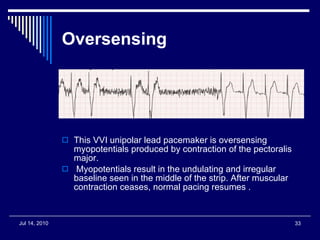
Oversensing This VVI unipolar lead pacemaker is oversensing myopotentials produced by contraction of the pectoralis major. Myopotentials result in the undulating and irregular baseline seen in the middle of the strip. After muscular contraction ceases, normal pacing resumes .
Management   Hx   Physical Examination  , CXR   12-Lead ECG Disposition of the ED Pt with a Pacemaker  . Advanced Cardiac Life Support Interventions
IMPLANTABLE CARDIOVERTER-DEFIBRILLATORS   Class I Indications: 1.     Cardiac arrest resulting from VF or VT not caused by a transient or reversible event.    2.     Spontaneous sustained VT .    3.     Syncope of undetermined origin with clinically relevant, hemodynamically significant sustained VT or VF induced at electrophysiologic study when drug therapy is ineffective, not tolerated, or not preferred .    4.     Nonsustained VT with coronary artery disease, prior myocardial infarction, left ventricular dysfunction, and inducible VF or sustained VT at electrophysiologic study that is not suppressible by a class I antiarrhythmic drug
 
Causes of Implantable Cardioverter-Defibrillator Malfunction  Increase or abrupt change in shock frequency    *    Increased frequency of VF or VT (consider ischemia, electrolyte disorder, or drug effect)   *    Displacement or break in ventricular lead   *    Recurrent nonsustained VT   *    Sensing and shock of SVTs.   *    Oversensing of T waves   *    Sensing noncardiac signals    Syncope, near-syncope, dizziness     *    Recurrent VT with low shock strength (lead problem, change in defibrillation threshold)   *    Hemodynamically significant SVTs    *    Inadequate backup pacing for bradyarrhythmias (spontaneous or drug induced)    Cardiac arrest     *   Assume malfunction, but probably due to VF that failed to respond to programmed shock parameters
Causes of Implantable Cardioverter-Defibrillator Malfunction ICD patients are aware of when the ICD discharges to terminate VT or VF.  The most common complaint of ICD patients is the occurrence of frequent shocks (i.e., occurring at a rate greater than they are accustomed to). Increasing shock rate may be appropriate and not indicative of ICD malfunction if the patient is experiencing an increase in the frequency of VT or VF episodes.  An increase in the frequency of episodes may occur in the setting of hypokalemia, hypomagnesemia, ischemia (with or without infarction) related to underlying coronary artery disease, or the proarrhythmic effect of drugs administered to decrease the frequency of ventricular tachyarrhythmias.
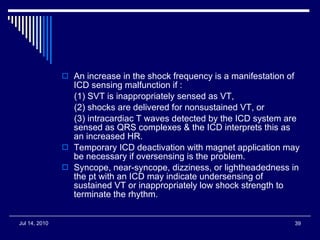
An increase in the shock frequency is a manifestation of ICD sensing malfunction if : (1) SVT is inappropriately sensed as VT,  (2) shocks are delivered for nonsustained VT, or (3) intracardiac T waves detected by the ICD system are sensed as QRS complexes & the ICD interprets this as an increased HR.  Temporary ICD deactivation with magnet application may be necessary if oversensing is the problem.  Syncope, near-syncope, dizziness, or lightheadedness in the pt with an ICD may indicate undersensing of sustained VT or inappropriately low shock strength to terminate the rhythm.
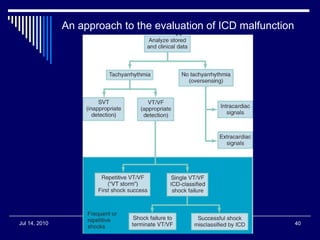
An approach to the evaluation of ICD malfunction
Advanced Cardiac Life Support Interventions   Transthoracic defibrillation can be performed in  the standard fashion  with a stacked sequence of shocks (200, 300, 360 J) if VF is the arrest rhythm.  The sternal electrode or paddle should be placed in a parasternal location about  10 cm  from the ICD subcutaneous pouch if the device has been implanted in the right deltopectoral area. If it has been implanted in the left deltopectoral region, this recommended safety distance is usually exceeded.
No reports of injury to rescuers from ICDs discharges during resuscitation efforts.  The device can be deactivated with magnetic application during resuscitation efforts as well as after.
Disposition of the ED Pt with an ICD should consult the patient's cardiologist regarding evaluation and therapy . Admission to a monitored setting . Reprogramming may be necessary. If a lead problem is detected, reimplantation is required.
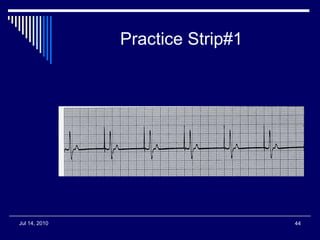
Practice Strip#1
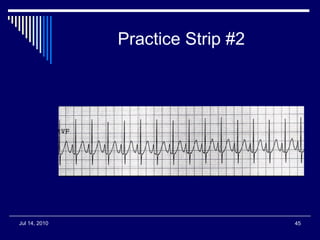
Practice Strip #2
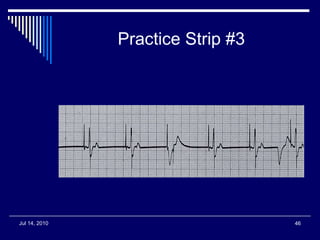
Practice Strip #3
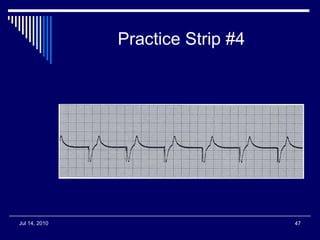
Practice Strip #4
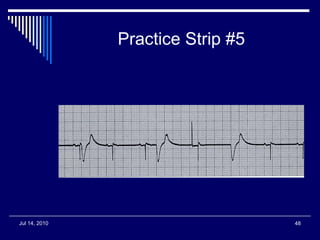
Practice Strip #5
Practice Strip #6
Practice Strip #7
Practice Strip #8
Summery  Pacemaker malfunction soon after implantation (within 6 to 8 wks) is usually due to a lead problem, such as a lead displacement, or to pacemaker programming failure, such as a pacing rate too slow for the patient's needs.    Pacemaker malfunction arises in a limited number of ways: failure to pace, oversensing, undersensing, and pacing at an inappropriate rate (too fast or too slow).    With lithium-iodine batteries, abrupt failure is an unlikely cause of pacemaker malfunction. If a patient with a pacemaker presents with a fever of unclear etiology, pacemaker lead infection and endocarditis should be considered.
Summery Because paced ventricular complexes are conducted with a LBBB pattern, a paced rhythm obscures the ECG Dx of AMI.     Magnet application does not turn off a pacemaker. It does convert an inhibited or noncompetitive pacemaker to one that is not inhibited. Fixed-rate pacing and competition with the pacing underlying rhythm occur.     Defibrillation is safe in patients with a pacemaker or ICD if paddles are placed at least 10 cm from the subcutaneous implant site of the device. Alternatively, anteroposterior defibrillation with adhesive defibrillation electrodes can be performed.  There are no reports of injury to rescuers from ICD discharges during manual chest compressions

Pacer ppt

  • 1.
    Approach to ptwith pacemaker and ICDs Badar AlHamrashdi. EM OMSB R3
  • 2.
    Outline Pacemaker codesPacemaker configurations Indications for pacemakers Problems with pacemakers ICDs Summery .
  • 3.
    Class I Indicationsfor Permanent Pacing in Adults 1.    Third-degree AV block at any anatomic level associated with any of the following:    + Symptomatic bradycardia presumed secondary to AV block   + Symptomatic bradycardia secondary to drugs required for dysrhythmia management or other medical condition   + Documented periods of asystole lasting more than 3 seconds or an escape rate of less than 40 beats/min in an awake, asymptomatic patient   + After catheter ablation of the AV node   + Postoperative AV block that is not expected to resolve   + Neuromuscular disease with AV block (e.g., the muscular dystrophies)   2.    Symptomatic bradycardia resulting from second-degree AV block regardless of type or site of block.   3.    Chronic bifascicular or trifascicular block with intermittent third-degree AV block or type II second-degree AV block   4.     After acute myocardial infarction with any of the following conditions:   + Persistent second-degree AV block at the His-Purkinje level with bilateral bundle branch block or third-degree AV block at the level of or below the His-Purkinje system   +  Transient second- or third-degree infranodal AV block and associated bundle branch block   +  Symptomatic, persistent second- or third-degree AV block 5.    Sinus node dysfunction with symptomatic bradycardia (including sinus pauses) or chronotropic incompetence   6.    Recurrent syncope caused by carotid sinus stimulation
  • 4.
    In general Pacingis recommended for patients with : Symptomatic HB. Symptomatic sinus Bradycardia. AF with a symptomatic Bradycardia (low ventricular response rate) in the absence of medications that affect atrioventricular (AV) conduction. Controversial indications include pacing in patients with syncope, heart block, or fatigue in the presence of some conduction disease or bradycardia.
  • 5.
    Nomenclature for pacemakers C= communicating  O = none O = none O = none O = none D = dual (shock + pace) R=rate adaptive D = dual (A and V inhibited) D = dual D = dual S = shock M=multiprogrammable I = inhibited V=ventricle V=ventricle P = pacing P = simple T=triggered A = atrium A = atrium Antitachycardia Functions Programm-ability Sensing Response Chamber Sensed Chamber Paced Letter 5 Letter 4 Letter 3 Letter 2 Letter 1
  • 6.
    Common Permanent Pacemakers Complexity, cost, programming, and follow-up evaluation Universal pacer; all options available by programming Sinus node dysfunction; atrioventricular block and need for rate responsiveness DDDR No rate responsiveness; requires two leads and advanced programming Atrial tracking restores normal physiology Complete heart block DDD Requires advanced programming Rate responsive Atrial fibrillation VVIR risk of pacemaker syndrome Simplicity; low costFixed rate; Intermittent backup pacing; inactive patient VVI Disadvantages Advantages Indication Code
  • 7.
    Pacemaker Components Thepulse generator, which houses the power source (battery). The electronic circuitry. The lead system, which connects the pulse generator to the endocardium
  • 8.
  • 9.
    Pacemaker Components Theexpected incidence of lead disruption is approximately 2% per patient-year. Endocardial leads are designed to fix actively to the atrial and ventricular endocardium using tined or screw-in tips. The expected incidence of lead displacement is about 2% for ventricular leads and 5% for atrial leads, whether actively or passively fixed to the endocardium. A lead capable of active fixation is more commonly used in patients with cardiomyopathies and right ventricular dilation complicated by tricuspid regurgitation.
  • 10.
    Pacemaker EKG StripsAssessing Paced EKG Strips Identify intrinsic rhythm and clinical condition Identify pacer spikes Identify activity following pacer spikes Failure to capture Failure to sense EVERY PACER SPIKE SHOULD HAVE A P-WAVE OR QRS COMPLEX FOLLOWING IT.
  • 11.
    Pacemaker Configurations VOOIndications Temporary mode some-times used during surgery to prevent interference from electrocautery
  • 12.
    Pacemaker Configurations VVIIndications The combination of AV block and chronic atrial arrhythmias (particularly atrial fibrillation).
  • 13.
    Pacemaker Configurations AAIIndications Sick sinus syndrome in the absence of AV node disease or atrial fibrillation.
  • 14.
    Pacemaker Configurations VDDIndications AV block with intact sinus node function (particularly useful in congenital AV block).
  • 15.
    Pacemaker Configurations DDDIndications 1. The combination of AV block and SSS. 2. Patients with LV dysfunction and LV hypertrophy who need coordination of atrial and ventricular contractions to maintain adequate CO.
  • 16.
    Normal VVI pacemaker(rhythm strip). a patient with a VVI pacemaker implanted for the treatment of symptomatic complete heart block. The pacing rate is approximately 75 beats/min (determined by measuring the time between consecutive pacemaker spikes). Each pacemaker spike is followed by a paced QRS complex.
  • 17.
  • 18.
    Complications of Implantation Infection . Thrombophlebitis . The “Pacemaker Syndrome” . Pacemaker Malfunction .
  • 19.
    Complications of ImplantationInfection: Surgical procedure + FB. Incidence : 2 %.sepsis :1%. Pain & local inflammation. 20-25% +ve blood c/s. S. aureus and S. epidermidis in 60-70%. Emperic Abics: vancomycin The pulse generator & pacemaker lead are usually removed .
  • 20.
    Complications of ImplantationThrombophlebitis: Incidence of venous obstruction ranges from 30% to 50% . Axillary, subclavian, and innominate veins or (SVC) . Edema, pain, & venous engorgement of the arm ipsilateral to the site of lead insertion only in 0.5-3.5 %. Dx:Duplex u/s of the J.venous system, venography, or contrast-enhanced CT. Rx: I/V heparin therapy followed by long-term warfarin
  • 21.
    Complications of ImplantationThe “Pacemaker Syndrome”: * After implantation, in 20%. * A pt may present with new complaints or a worsening of the Sx that prompted evaluation & eventual pacemaker therapy. * These include syncope or near-syncope, orthostatic dizziness, fatigue, exercise intolerance, weakness, lethargy, chest fullness or pain, cough, uncomfortable pulsations in the neck or abdomen, right upper quadrant pain, and other nonspecific symptoms.
  • 22.
    Complications of ImplantationThe “Pacemaker Syndrome”: * The etiology :is the loss of AV synchrony & * Is most common with VVI pacing * Elevated (BNP) & diuresis . * DDI pacing in a pt with AV block may result in this syndrome if the sinus node discharge rate exceeds the programmed rate of the pacemaker. * Rx: replacing a VVI pacemaker with a dual-chamber pacemaker or lowering the pacing rate of the VVI unit. * Consultation with a cardiologist is recommended .
  • 23.
    Complications of ImplantationPacemaker Malfunction :
  • 24.
    Assessment of pacemakerfunction Magnet placement externally over the pulse generator . It does not inhibit or turn off a pacemaker . Converts the pacemaker to an asynchronous or fixed-rate pacing mode, It is no longer inhibited by the patient's intrinsic electrical activity. Used when the pt's intrinsic heart rate exceeds the pacemaker's set rate and pacemaker function is inhibited. Magnet application then allows pacing to occur, and pacing rate and the presence of capture can be determined.
  • 25.
    Complications of Implantation Pacemaker Malfunction : Failure to capture *   Lead disconnection, break, or displacement  *   Exit block   *   Battery depletion    Undersensing   *    Lead displacement   *    Inadequate endocardial lead contact   *    Low-voltage intracardiac p waves and QRS complexes   *    Lead fracture    Oversensing    *    Sensing extracardiac signals: myopotentials * T wave sensing    Inappropriate rate   *  Battery depletion   *  Ventriculoatrial conduction with pacemaker-mediated tachycardia   *   1:1 response to atrial dysrhythmias
  • 26.
    Pacemaker Malfunction .Failure to Capture: * Electrical stimuli delivered by the pacemaker does not initiate depolarization of the atria or ventricle
  • 27.
    Failure to Capture Possible Causes Corrective Measures • Threshold rise • Increase output (mA)/check thresholds • Fractured/dislodged lead • Replace/reposition lead • Battery depletion • Replace battery • QRS not visible • Adjust ECG • Tissue is refractory • Assess mode selection • Faulty cable connections • Check connections • Switch polarity (epicardial system
  • 28.
    Pacemaker Malfunction : Inappropriate Sensing * Undersensing . * Oversensing.
  • 29.
    Undersensing Failure ofthe pacemaker to sense intrinsic R-waves or intrinsic P-waves May be complete or intermittent. May result from a change in the sensing parameters selected at the time of insertion. This is most commonly after acute RV infarction or cardiomyopathies, causing intracardiac signals to decrease in amplitude. It is typically recognized electrocardiographically as the appearance of pacemaker spikes occurring earlier than the programmed rate. Failure of a stimulus spike to produce a complex when it occurs during the atrial or ventricular refractory period should not be interpreted as failure to pace.
  • 30.
    Undersensing These spikesdo not produce QRS complexes ( ventricular refractory period)
  • 31.
    Undersensing Possible Causes Corrective Measures • Decreased QRS voltage •Increase sensitivity • Fractured/dislodged lead •Replace/reposition Lead • Battery depletion •Replace Battery • Inappropriate sensitivity setting •Sensing test/increase sens • Fusion beat
  • 32.
    Oversensing Inhibition of the pacemaker by events that is not of cardiac origin. Pacemaker should ignore, e.g. T-waves, myopotentials and electrocautery. The result may be intermittent, irregular pacing or an apparent complete absence of pacemaker function. Close proximity to a microwave oven should not cause pacemaker problems . Interference can be caused by the use of a digital cellular phone. Within 10cm
  • 33.
    Oversensing This VVIunipolar lead pacemaker is oversensing myopotentials produced by contraction of the pectoralis major. Myopotentials result in the undulating and irregular baseline seen in the middle of the strip. After muscular contraction ceases, normal pacing resumes .
  • 34.
    Management Hx Physical Examination , CXR 12-Lead ECG Disposition of the ED Pt with a Pacemaker . Advanced Cardiac Life Support Interventions
  • 35.
    IMPLANTABLE CARDIOVERTER-DEFIBRILLATORS Class I Indications: 1.     Cardiac arrest resulting from VF or VT not caused by a transient or reversible event.    2.     Spontaneous sustained VT .    3.     Syncope of undetermined origin with clinically relevant, hemodynamically significant sustained VT or VF induced at electrophysiologic study when drug therapy is ineffective, not tolerated, or not preferred .    4.     Nonsustained VT with coronary artery disease, prior myocardial infarction, left ventricular dysfunction, and inducible VF or sustained VT at electrophysiologic study that is not suppressible by a class I antiarrhythmic drug
  • 36.
  • 37.
    Causes of ImplantableCardioverter-Defibrillator Malfunction Increase or abrupt change in shock frequency    *    Increased frequency of VF or VT (consider ischemia, electrolyte disorder, or drug effect)   *    Displacement or break in ventricular lead   *    Recurrent nonsustained VT   *    Sensing and shock of SVTs.   *    Oversensing of T waves   *    Sensing noncardiac signals    Syncope, near-syncope, dizziness    *    Recurrent VT with low shock strength (lead problem, change in defibrillation threshold)   *    Hemodynamically significant SVTs    *    Inadequate backup pacing for bradyarrhythmias (spontaneous or drug induced)    Cardiac arrest    *   Assume malfunction, but probably due to VF that failed to respond to programmed shock parameters
  • 38.
    Causes of ImplantableCardioverter-Defibrillator Malfunction ICD patients are aware of when the ICD discharges to terminate VT or VF. The most common complaint of ICD patients is the occurrence of frequent shocks (i.e., occurring at a rate greater than they are accustomed to). Increasing shock rate may be appropriate and not indicative of ICD malfunction if the patient is experiencing an increase in the frequency of VT or VF episodes. An increase in the frequency of episodes may occur in the setting of hypokalemia, hypomagnesemia, ischemia (with or without infarction) related to underlying coronary artery disease, or the proarrhythmic effect of drugs administered to decrease the frequency of ventricular tachyarrhythmias.
  • 39.
    An increase inthe shock frequency is a manifestation of ICD sensing malfunction if : (1) SVT is inappropriately sensed as VT, (2) shocks are delivered for nonsustained VT, or (3) intracardiac T waves detected by the ICD system are sensed as QRS complexes & the ICD interprets this as an increased HR. Temporary ICD deactivation with magnet application may be necessary if oversensing is the problem. Syncope, near-syncope, dizziness, or lightheadedness in the pt with an ICD may indicate undersensing of sustained VT or inappropriately low shock strength to terminate the rhythm.
  • 40.
    An approach tothe evaluation of ICD malfunction
  • 41.
    Advanced Cardiac LifeSupport Interventions Transthoracic defibrillation can be performed in the standard fashion with a stacked sequence of shocks (200, 300, 360 J) if VF is the arrest rhythm. The sternal electrode or paddle should be placed in a parasternal location about 10 cm from the ICD subcutaneous pouch if the device has been implanted in the right deltopectoral area. If it has been implanted in the left deltopectoral region, this recommended safety distance is usually exceeded.
  • 42.
    No reports ofinjury to rescuers from ICDs discharges during resuscitation efforts. The device can be deactivated with magnetic application during resuscitation efforts as well as after.
  • 43.
    Disposition of theED Pt with an ICD should consult the patient's cardiologist regarding evaluation and therapy . Admission to a monitored setting . Reprogramming may be necessary. If a lead problem is detected, reimplantation is required.
  • 44.
  • 45.
  • 46.
  • 47.
  • 48.
  • 49.
  • 50.
  • 51.
  • 52.
    Summery Pacemakermalfunction soon after implantation (within 6 to 8 wks) is usually due to a lead problem, such as a lead displacement, or to pacemaker programming failure, such as a pacing rate too slow for the patient's needs.    Pacemaker malfunction arises in a limited number of ways: failure to pace, oversensing, undersensing, and pacing at an inappropriate rate (too fast or too slow).    With lithium-iodine batteries, abrupt failure is an unlikely cause of pacemaker malfunction. If a patient with a pacemaker presents with a fever of unclear etiology, pacemaker lead infection and endocarditis should be considered.
  • 53.
    Summery Because pacedventricular complexes are conducted with a LBBB pattern, a paced rhythm obscures the ECG Dx of AMI.    Magnet application does not turn off a pacemaker. It does convert an inhibited or noncompetitive pacemaker to one that is not inhibited. Fixed-rate pacing and competition with the pacing underlying rhythm occur.    Defibrillation is safe in patients with a pacemaker or ICD if paddles are placed at least 10 cm from the subcutaneous implant site of the device. Alternatively, anteroposterior defibrillation with adhesive defibrillation electrodes can be performed. There are no reports of injury to rescuers from ICD discharges during manual chest compressions